
The way customers communicate with businesses has undergone a dramatic, irreversible transformation.
For decades, legacy IVR (“Press 1 for billing…Press 2 for support…”) dominated call center infrastructure.
But today, IVR is collapsing under its own weight.
Customers hate it, but enterprises outgrow it.
And digital-first businesses can no longer afford the operational drag and experience gaps it creates.
In its place rises a new standard, Voice AI Customer Service, powered by conversational voice AI, AI-powered call routing, intelligent voice assistants, and speech recognition support systems that can understand customers in natural language, provide instant solutions, and integrate with enterprise systems without friction.
This shift is not incremental; it’s revolutionary. So, dive more deeply into this blog to know better!
Key Takeaways
- Legacy IVR is fundamentally incompatible with modern customer expectations, especially in an era of instant, personalized support.
- Voice AI customer service is now capable of understanding natural language with >90% accuracy using speech-to-text (STT) and natural language understanding (NLU).
- Enterprises using virtual voice agents achieve significant cost reductions, operational efficiency, and scalable 24/7 support.
- AI voice customer support integrates seamlessly with CRMs, ERPs, ticketing systems, and real-time analytics—something IVR cannot match.
- The shift to AI-powered voice customer experience is becoming a competitive necessity rather than a technological preference.
Why Legacy IVR Is Dead?
Legacy IVR isn’t just outdated, it’s fundamentally obsolete in a world where customers demand speed, personalization, and conversational simplicity.
While IVR was initially a breakthrough in phone-based automation, it has failed to develop with rising consumer expectations.
Today’s customers don’t want to “press 1 or press 2” or navigate robotic menus.
They want real conversations, instant solutions, and intelligent understanding.
Below are three expanded reasons driving the decline of IVR:
1. Technical Rigidity
Legacy IVR systems are built on linear, rule-based decision trees that break the moment a customer deviates from the predefined script.
Updating these trees requires manual configuration, scripting, and costly consultant hours.
This rigidity means IVR cannot adapt to new business processes, seasonal influxes, or evolving customer behavior.
As a result, companies end up with outdated menus that frustrate customers and create bottlenecks at precisely the moments they need to scale.
2. Decision-Tree Fatigue & Customer Frustration
Customers today expect intuitive, conversational experiences, not a maze of slow, repetitive keypress options.
Research consistently shows that consumers abandon IVR due to menu complexity, robotic interactions, and repetitious loops.
Worse, IVR systems often fail to recognize why the customer is calling until deep into the interaction, forcing callers to repeat themselves to human agents.
This increases dissatisfaction, elongates call times, and damages overall brand trust.
3. Inability to Personalize or Understand Context
IVR treats every caller identically. There is no access to customer history, no understanding of intent, and no ability to tailor responses based on previous interactions.
In a world where personalization drives loyalty, generic IVR experiences feel archaic.
Customers expect a system to instantly recognize them, identify their issue, and offer personalized resolutions, something IVR technology is fundamentally incapable of doing.
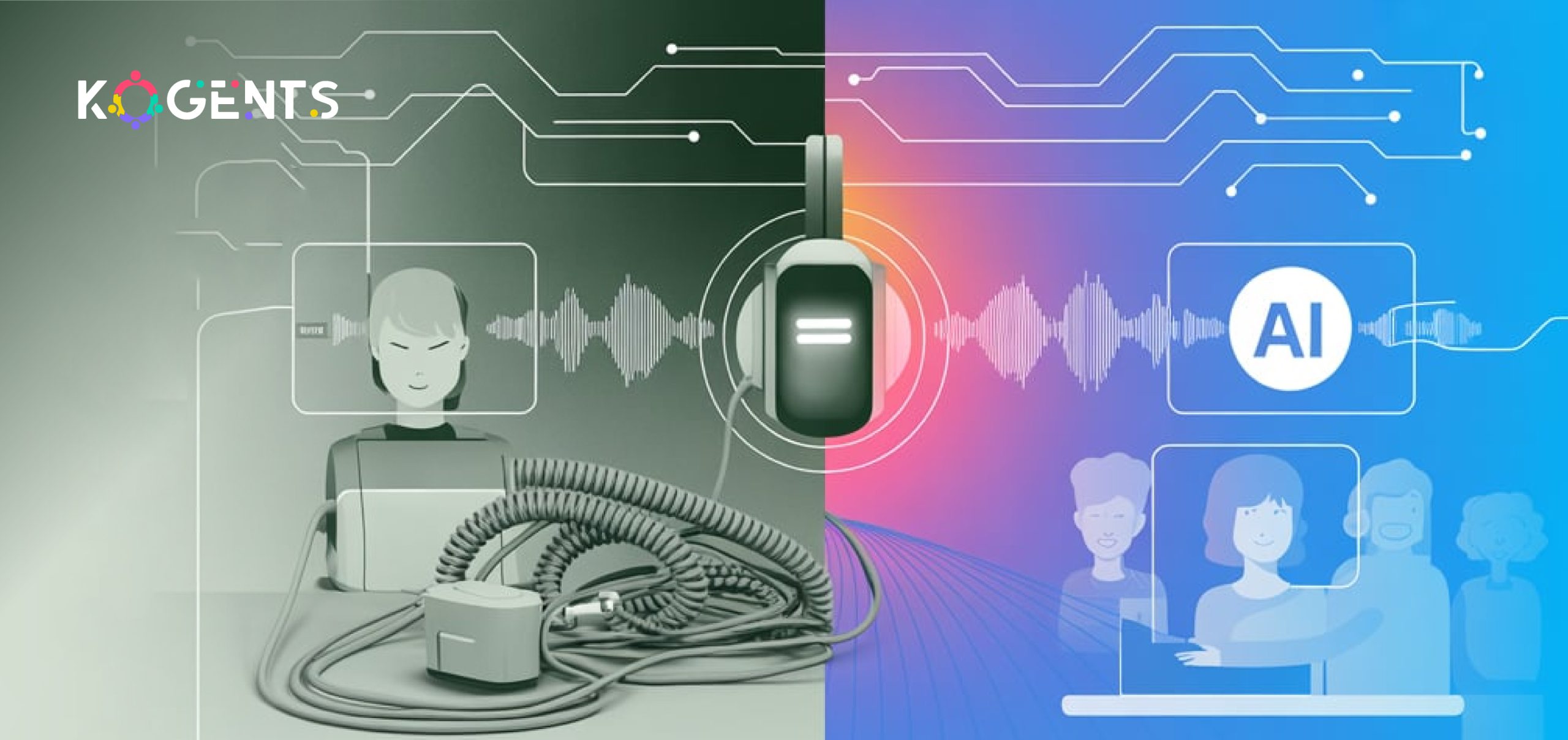
What Replaced IVR: The Rise of Voice AI Customer Service?
Voice AI didn’t just replace IVR; it reinvented what phone-based customer service can be.
Voice AI customer service uses natural language processing (NLP), machine learning, intent recognition, and real-time speech analysis to understand customers conversationally, just like a skilled human agent.
Unlike IVR, Voice AI doesn’t require customers to conform to rigid menu paths. Instead, it listens, interprets, and responds in natural language.
Several transformational shifts drive the rise of conversational voice AI:
1. Consumer expectations for real conversations
- Customers expect frictionless, intuitive experiences that mirror human-to-human dialog.
- Voice AI is designed to understand nuance, emotion, and context, not just keypresses.
2. Breakthroughs in AI technologies
Generative AI and Large Language Models (LLMs) have dramatically improved natural language understanding, enabling AI to interpret customer intent with human-like accuracy.
3. Business need for scalable automation
Contact centers cannot scale purely through human staffing.
How Conversational Voice AI Works?
Conversational Voice AI is powered by several interconnected AI technologies that work in real time to understand, respond, and resolve customer requests.
1. Advanced Speech-to-Text (STT) Engines
Voice AI begins by converting the customer’s speech into text with extremely high accuracy. Modern STT systems, powered by OpenAI, Google, Nuance, AWS, and NVIDIA, are trained on billions of voice samples and can understand diverse accents, dialects, speech speeds, and noisy environments with exceptional precision.
2. Natural Language Understanding (NLU) & Intent Recognition
- Once the speech is transcribed, NLU models analyze it to understand customer intent (“I want to track my order,” “My internet is down,” “I need to reset my PIN”).
- This involves sentiment analysis, entity extraction, context tracking, and emotion recognition.
- Unlike IVR, Voice AI doesn’t require predefined paths; it dynamically adapts to the customer’s phrasing.
3. Dialogue Management & AI Reasoning
- This component manages multi-turn conversations, context, and memory.
- It ensures the AI stays aligned with the customer’s goal, asks clarifying questions when needed, and executes appropriate actions.
- The system can pivot mid-conversation, recall previous details, and redirect seamlessly like a human agent would.
4. Text-to-Speech (TTS) & Generative Voice Output
- Voice AI generates fluid, human-like responses using neural TTS models.
- These voices sound natural, expressive, and contextually aware, far from the robotic monotone of traditional IVR.
- Some platforms also use emotion-infused speech synthesis, adjusting tone based on conversation sentiment.
5. Backend Automation & API Integrations
Voice AI connects to CRMs (Salesforce, HubSpot), ERPs (SAP, Oracle), ticketing systems (Zendesk, Freshdesk), and proprietary databases to complete tasks autonomously, including billing, reservations, troubleshooting, authentication, and more.
Note: This transforms Voice AI into a self-service engine, not just a conversational layer.
10 Reasons Voice AI Customer Service Is the New Standard
1. 24/7 Always-On Availability
- Unlike human teams bound by shifts, Voice AI operates continuously.
- It provides consistent, high-quality support across time zones and peak call volumes.
- This guarantees that customers always have immediate access to help, an expectation in modern digital ecosystems.
2. Reduction in Operational Cost
- Voice AI automates high-volume, low-complexity tasks that consume most of the agent’s time.
- By handling repetitive workflows like account verification, password resets, and order tracking, Voice AI cuts costs while freeing agents to focus on complex, value-driven interactions.
3. Faster Average Handle Time (AHT)
- Voice AI gathers customer context before handing off calls to agents, reducing verification time and improving resolution speed.
- AI also eliminates unnecessary transfers and menu navigation, enabling transactions to be completed in seconds rather than minutes.
4. Accuracy with Real-Time Speech Recognition
- Advanced acoustic modeling and neural networks allow Voice AI to interpret speech, even with background noise, thick accents, or atypical phrasing.
- This results in higher-quality interactions and fewer misunderstandings compared to outdated IVR systems.
5. Personalization at Massive Scale
- Voice AI pulls data from CRMs and past interactions to personalize calls instantly.
- It can greet customers by name, predict their needs, and offer tailored solutions without manual lookup, replicating human-level personalization 10,000 times simultaneously.
6. Real-Time Analytics & Insights
- Voice AI collects granular insights on customer behavior, intent trends, sentiment, drop-off points, and compliance patterns, providing operational intelligence that IVR systems cannot capture.
- Leaders use these insights to improve products, optimize staffing, and predict demand.
7. Multilingual Support & Native-Level Fluency
- Voice AI systems can understand and respond in dozens of languages with natural fluency, making global support easier and more consistent.
- This eliminates the need for multilingual agents during every shift, drastically reducing staffing complexity.
8. Built-In Compliance & Security
- Modern Voice AI adheres to global standards (GDPR, SOC 2, PCI DSS) and offers enhanced fraud prevention through voice biometrics.
- These capabilities are essential for industries like banking, healthcare, and insurance, where compliance is non-negotiable.
9. Workforce Optimization & Dynamic Scaling
- Voice AI absorbs spikes in call volume instantly, allowing human agents to focus only on complex or critical cases.
- This improves workforce morale, reduces burnout, and ensures consistent service quality even during unexpected surges.
10. Consistency That Human Teams Cannot Replicate
- Voice AI delivers the same level of accuracy, tone, speed, and knowledge every time, without fatigue, mood variations, or human limitations.
- This elevates the customer experience and ensures best-in-class service delivery 24/7.
Case Studies
Case Study 1: Major Airline Replaces IVR with Voice AI
A North American airline experienced long wait times, overloaded agents, and customer dissatisfaction due to outdated IVR menus.
After replacing IVR with Voice AI customer service, they deployed conversational agents capable of handling booking changes, flight updates, cancellations, and baggage inquiries.
Expanded Outcomes:
- 35% reduction in total handle time, as AI identified the caller’s intent instantly.
- Automated 50% of flight status calls, reducing agent AI voice workload significantly.
- $8.7M annual savings driven by workforce optimization and faster call flows.
- +22% improvement in CSAT due to instant language support and personalization.
Case Study 2: Telecom Giant Deploys Voicebots
- A European telecom supported millions of monthly calls, with 60% being repetitive troubleshooting queries.
- Their IVR system led to customer drop-offs and poor routing accuracy.
Expanded Outcomes:
- 65% of technical support calls are fully automated using voice AI assistant support.
- 95% intent accuracy, keeping customers in the correct help path.
- Customer wait time reduced from 8 minutes to <30 seconds.
- 40% reduction in manual agent workload, improving efficiency and employee satisfaction.
Case Study 3: Banking Institution Implements Virtual Voice Agents
- A large European bank faced growing fraud attempts and identity verification challenges.
- They deployed virtual voice agents with biometric verification and generative AI reasoning.
Expanded Outcomes:
- 50% reduction in fraud-related calls using voice authentication.
- 60% automation of routine banking tasks, such as balance checks and card activation.
- 25% AHT reduction, as AI completed identity verification instantly.
- NPS increased by 14 points, driven by faster response times and secure interactions.
Legacy IVR vs. Voice AI Customer Service
| Feature | Legacy IVR | Voice AI Customer Service |
| Natural Language Understanding | None | Full NLU/NLP support |
| Customer Satisfaction | Low | High |
| Personalization | None | Strong |
| Scalability | Poor | Unlimited |
| Multilingual Support | Limited | 50+ languages |
| AHT | High | 20–30% lower |
| Operational Costs | High | Up to 60% lower |
| Real-Time Analytics | None | Advanced |
| Integrations | Limited | Full API/CRM/ERP integration |
| Automation Rate | 10–15% | 60–80% |
Conclusion
Legacy IVR had its moment, but that moment has passed. Today’s customers expect personalized, on-demand, conversational experiences.
Voice AI customer service delivers this with unmatched accuracy, scalability, and operational efficiency.
For businesses committed to high-quality customer experience (CX) and long-term digital transformation, embracing AI voice customer support, virtual voice agents, and speech AI for customer service is not just beneficial; it’s essential.
If your organization is ready to move beyond outdated IVR and towards a future-proof, scalable, personalized customer experience powered by Voice AI, now is the moment.
Adopt the technology with the help of kogents.ai that top enterprises, financial institutions, and global operators already rely on.
The future of support is here; bring your brand with it.
FAQs
What is Voice AI customer service?
It is an AI-powered system that uses conversational AI, speech recognition, and intent detection to automate phone-based customer interactions.
How accurate is Voice AI for customer support?
Current systems achieve >90% speech recognition accuracy, thanks to LLMs and neural acoustic modeling.
What is the difference between voicebots and chatbots?
Voicebots process spoken language, while chatbots process written text.
How do AI voice customer service platforms reduce cost?
By automating repetitive queries, reducing AHT, and enabling 24/7 support without increasing headcount.
Are AI-powered voice systems replacing human agents?
Not replacing—augmenting. They handle routine tasks so agents can focus on complex issues.
What industries benefit most from Voice AI?
Telecom, banking, airlines, healthcare, insurance, and retail.
How does Voice AI integrate with existing systems?
Through APIs connecting CRMs, ERPs, billing, ticketing, and internal databases.
Does Voice AI support multilingual capabilities?
Yes—modern systems support 50+ languages, accents, and dialects.
What is the cost of implementing Voice AI customer service?
Depends on scale, but most enterprises see a full ROI within 6–12 months.
Is Voice AI secure and compliant?
Yes. Leading platforms support GDPR, PCI DSS, ISO 9001, and SOC 2 compliance standards.