Tag: slack bot automated messages

  • How Healthcare with AI and Genomic Intelligence Accelerates Precision Treatment Strategies

    How Healthcare with AI and Genomic Intelligence Accelerates Precision Treatment Strategies

    The accelerating convergence of Healthcare with AI, genomic intelligence, and precision medicine is redefining how diseases are diagnosed, treated, and prevented. 

    Artificial intelligence is no longer just augmenting clinical workflows; it is functioning as a scientific multiplier, uncovering patterns in biological data that were once invisible to human experts.

    Combined with genomic sequencing and computational biology, AI is turning healthcare from a reactive system into a predictive, preventative, and hyper-personalized care ecosystem.

    Today’s most advanced hospitals, research centers, and biotech innovators are leveraging machine learning models, predictive analytics, natural language processing, and healthcare AI agents to decode genomic markers, optimize treatment pathways, and forecast disease trajectories

    Meanwhile, AI algorithms integrate clinical notes, EHRs, medical imaging, lab reports, and multi-omics data to generate personalized therapeutic recommendations with unprecedented precision.

    Key Takeaways

    • AI Agents for Healthcare Automation and genomics are shifting medicine from symptom-based to biological-level precision, enabling individualized risk assessment, early detection, and targeted therapeutic interventions.
    • Machine learning–driven multi-modal data fusion allows clinicians to integrate imaging, genetics, labs, and lifestyle data into cohesive clinical insights.
    • Genomic intelligence provides the molecular blueprint for precision medicine, enabling AI to match the right drug to the right patient at the right time.
    • AI elevates operational, clinical, and research efficiency, improving diagnostic accuracy, reducing administrative workload, and accelerating drug discovery.
    • The next decade will bring AI-powered digital twins, computational clinical trials, genome-guided vaccines, and autonomous diagnostic ecosystems.

    Understanding Healthcare with AI & Expanded Genomic Intelligence

    Genomic intelligence refers to the computational interpretation of a person’s genome (DNA), transcriptome (RNA), proteome, metabolome, and polygenic risk scores. 

    When paired with artificial intelligence, this enables clinicians to decode:

    • Hereditary susceptibility to disease
    • molecular pathways driving patient-specific conditions
    • drug–gene interactions and therapeutic resistance
    • tumor evolution patterns
    • gene expression signatures predicting prognosis

    Why Does AI Matters in Genomics More Than Ever?

    The volume and complexity of data limit human interpretation of genomic sequences. A single whole genome contains over 3 billion base pairs, far beyond manual analysis.

    AI simplifies this by:

    1. Identifying pathogenic variants at scale

    Deep learning models categorize harmful mutations, structural variants, epigenetic modifications, and copy-number variations.

    2. Modeling how variants impact biological pathways

    AI predicts protein folding, molecular interactions, and phenotypic expression shifts.

    3. Matching genomic markers to targeted therapies

    For example:

    • BRCA1/2 → PARP inhibitors
    • HER2 amplification → Trastuzumab
    • EGFR mutations → Osimertinib

    4. Accelerating genomic report-generation

    AI reduces genomic analysis time from days/weeks to minutes, essential during critical care or cancer staging.

    5. Predicting long-term risk using polygenic risk scoring (PRS)

    AI-enhanced PRS predicts lifetime susceptibility to:

    • cardiovascular disease
    • type 2 diabetes
    • Alzheimer’s
    • various cancers

    The integration of genomic intelligence with predictive analytics in healthcare marks a shift from generalized medicine to precision-first interventions.
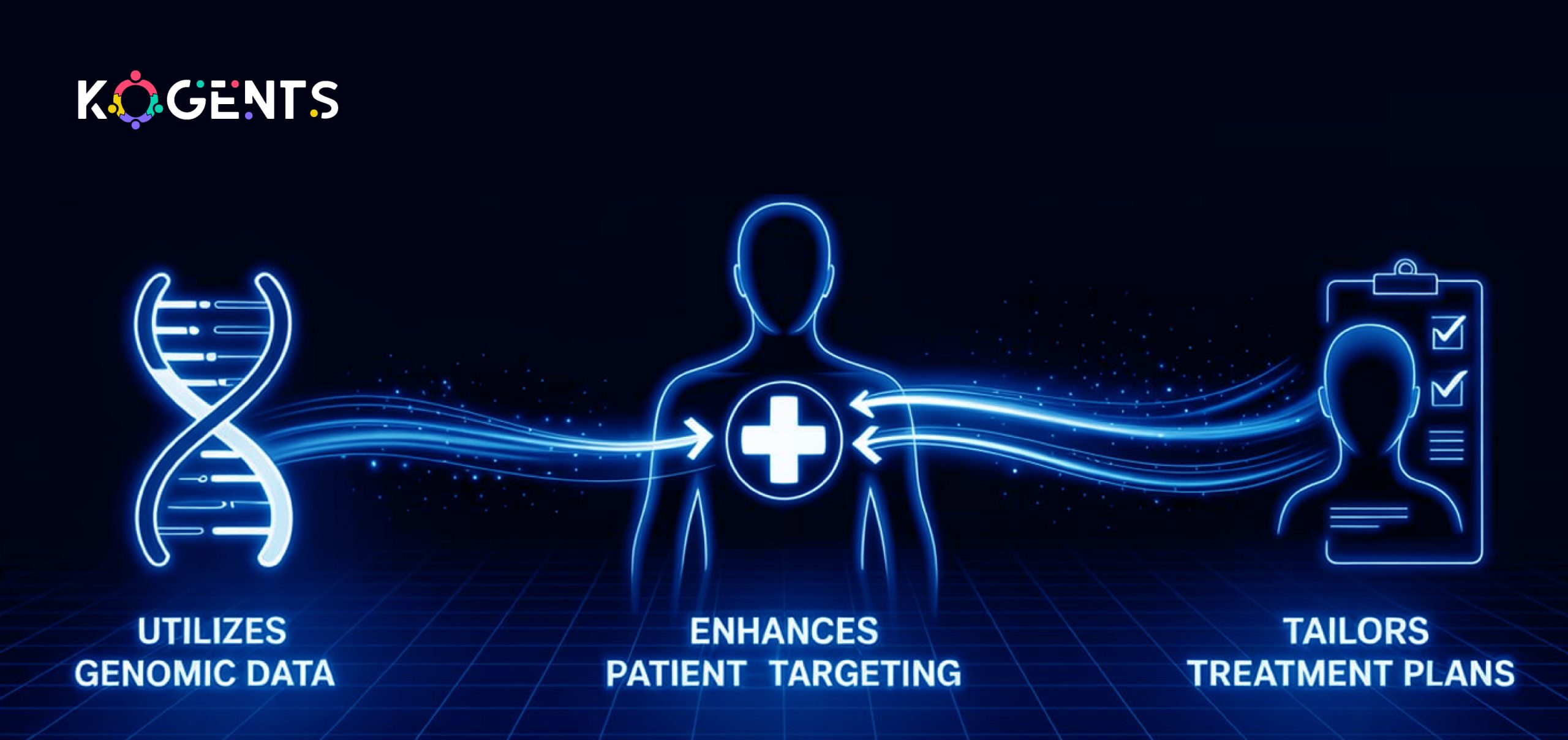
    healthcare with ai

    Clinical Applications Across Specialty Areas

    1. Oncology: AI-Driven Tumor Biology & Precision Oncology

    Modern cancer care heavily relies on healthcare AI assistants pitching AI-enhanced genomic profiling.

    AI in oncology enables:

    • Discovery of tumor-specific driver mutations
    • prediction of treatment response to immunotherapy
    • real-time monitoring of tumor evolution via liquid biopsy
    • personalized drug-matching based on genomic signatures

    A study in Nature Communications found “actionable mutation detection” vs traditional pathology workflows. Rather, it evaluates computational methods for identifying cancer driver mutations and validates certain variants of unknown significance (VUSs) as pathogenic through patient survival data. 

    AI tools also identify biomarkers for immunotherapy response, such as tumor mutational burden (TMB) and neoantigen load.

    2. Cardiology: AI Predicts Cardiovascular Events Years Ahead

    AI interprets imaging + genomic risk to forecast major cardiovascular events.

    Key use cases:

    • Predicting atrial fibrillation 5 years before onset
    • identifying high-risk familial hypercholesterolemia via genome screening
    • Detecting asymptomatic cardiomyopathy from EKG waveforms
    • forecasting heart failure using multi-modal data

    A study in The Lancet Digital Health revealed that AI can predict heart disease with over 90 days when integrating genomics and imaging.

    3. Neurology: AI for Alzheimer’s, Parkinson’s & Neurogenetics

    Neurological disorders often begin decades before symptoms. AI helps identify:

    • early amyloid/tau accumulation
    • genomic risk for Alzheimer’s (APOE4 variants)
    • motor decline patterns
    • brain imaging biomarkers

    Machine learning models analyzing MRI + genomics predicted Alzheimer’s earlier, according to a study published in Radiology.

    4. Infectious Diseases: Genomics + AI for Outbreak Prediction

    AI enables genomic epidemiology to:

    • track viral mutations
    • model drug resistance
    • Predict patient-specific immune response.
    • Optimize vaccine design

    Insight: During COVID-19, AI tools modeled genomic variation to accelerate mRNA vaccine development.

    5. Rare Diseases: Reducing Diagnostic Time from Years to Weeks

    Rare genetic disorders often take 5–7 years to diagnose.

    AI shortens this by analyzing:

    • phenotype descriptions
    • whole-genome sequences
    • clinical imaging
    • biochemical markers

    Case in Point: Boston Children’s Hospital reported an 80% reduction in diagnostic time using AI-driven genomics for rare pediatric conditions.

    6. Pharmacogenomics: AI for Personalized Drug Selection

    AI evaluates how genes impact drug metabolism (CYP450 variants), toxicity risk, and therapeutic response.

    Benefits include:

    • Fewer adverse drug events
    • optimized dosage
    • reduced trial-and-error prescribing
    • Higher adherence and improved clinical outcomes

    AI-Enabled Multi-Modal Data Fusion in Precision Medicine

    Multi-modal data fusion is one of the most powerful innovations shaping Healthcare with AI. It combines:

    • genomics
    • imaging
    • EHR
    • clinical notes
    • proteomics
    • metabolomics
    • wearable sensor data
    • pathology slides

    Key Note: AI integrates these diverse datasets into a unified clinical insight model.

    Why is Multi-Modal AI a Breakthrough? 

    • Holistic Patient Understanding: A complete biological + clinical portrait is created, leading to extremely accurate treatment strategies.
    • Superior Predictive Power: Combining genomic + imaging data increases diagnostic accuracy massively, per a 2023 Nature meta-study.
    • Continuous Learning from Real-Time Data: Wearables, remote monitors, and sensors update models dynamically.
    • Improved Treatment Matchmaking: AI identifies which therapy works best for each biological subtype of a disease.
    • Faster Diagnosis & Reduced Cost: Data fusion reduces redundant tests and misdiagnoses.

    Next-Gen Healthcare Infrastructure Powered by AI

    To support AI-driven clinical care, healthcare systems are evolving into AI-native infrastructures that include:

    1. Digital Diagnostics Hubs

    Automated AI centers that:

    • run imaging
    • genomic analysis
    • pathology interpretation
    • risk prediction

    These hubs reduce diagnostic cycle time from weeks to hours.

    2. Ambient Clinical Intelligence (ACI)

    Tools like Nuance’s DAX Copilot enable automated clinical documentation, reducing clinician burnout and ensuring accurate EHR input.

    3. AI-Powered Clinical Command Centers

    Hospitals use digital “mission control” centers for:

    • bed allocation
    • patient flow optimization
    • ICU monitoring
    • real-time triage

    4. Virtual Care & Remote Monitoring Ecosystems

    AI voice agents for healthcare analyze wearable sensor data for early risk detection, but only when they are integrated with a patient’s health data ecosystem.

    Examples:

    • arrhythmia prediction
    • glucose instability forecasting
    • Sleep Apnea Detection
    • respiratory distress monitoring

    Wearable technologies to predict and prevent heart failure hospitalizations: a systematic review — found that non-invasive wearable devices (e.g., patches, monitors) have successfully predicted hospitalizations in heart-failure (HF) patients 6.5 to 32 days in advance.

    Case Studies in AI-Driven Precision Medicine

    Case Study 1: Tempus AI for Genomic-Driven Oncology

    Tempus uses AI + genomic sequencing to personalize cancer therapy.

    Key Results:

    • Over 2.2 million clinical records and 700,000 genomic profiles analyzed
    • AI identified optimal therapy options up to 45% faster
    • Improved survival outcomes in lung and breast cancer cohorts

    Case Study 2: NYU Langone’s NYUTron LLM for Hospitalized Patients

    NYU Langone created NYUTron, an LLM trained on EHR data.

    Key Results:

    • Predicted 30-day readmission with 81% accuracy
    • Reduced discharge delays by 20%
    • Provided actionable clinical insights during rounds

    Win-Win Situation: This validated LLM point-of-care deployment marks a major milestone in clinical AI.

    Case Study 3: Oxford Nanopore + AI for Rapid Infectious Disease Genomics

    AI + Oxford nanopore sequencing enabled real-time pathogen identification.

    Key Results:

    • Sequencing turnaround reduced from 24 hours to <90 minutes
    • Crucial in ICU sepsis cases where time is critical
    • Enabled targeted antimicrobial therapy, reducing mortality

    Case Study 4: DeepMind’s AlphaFold for Protein Structure Prediction

    AlphaFold predicted proteins with atomic-level accuracy, revolutionizing drug discovery.

    Key Results:

    • Solved over 200 million protein structures
    • Accelerated novel drug discovery pipelines worldwide
    • Reduced structural biology research timelines from years to hours
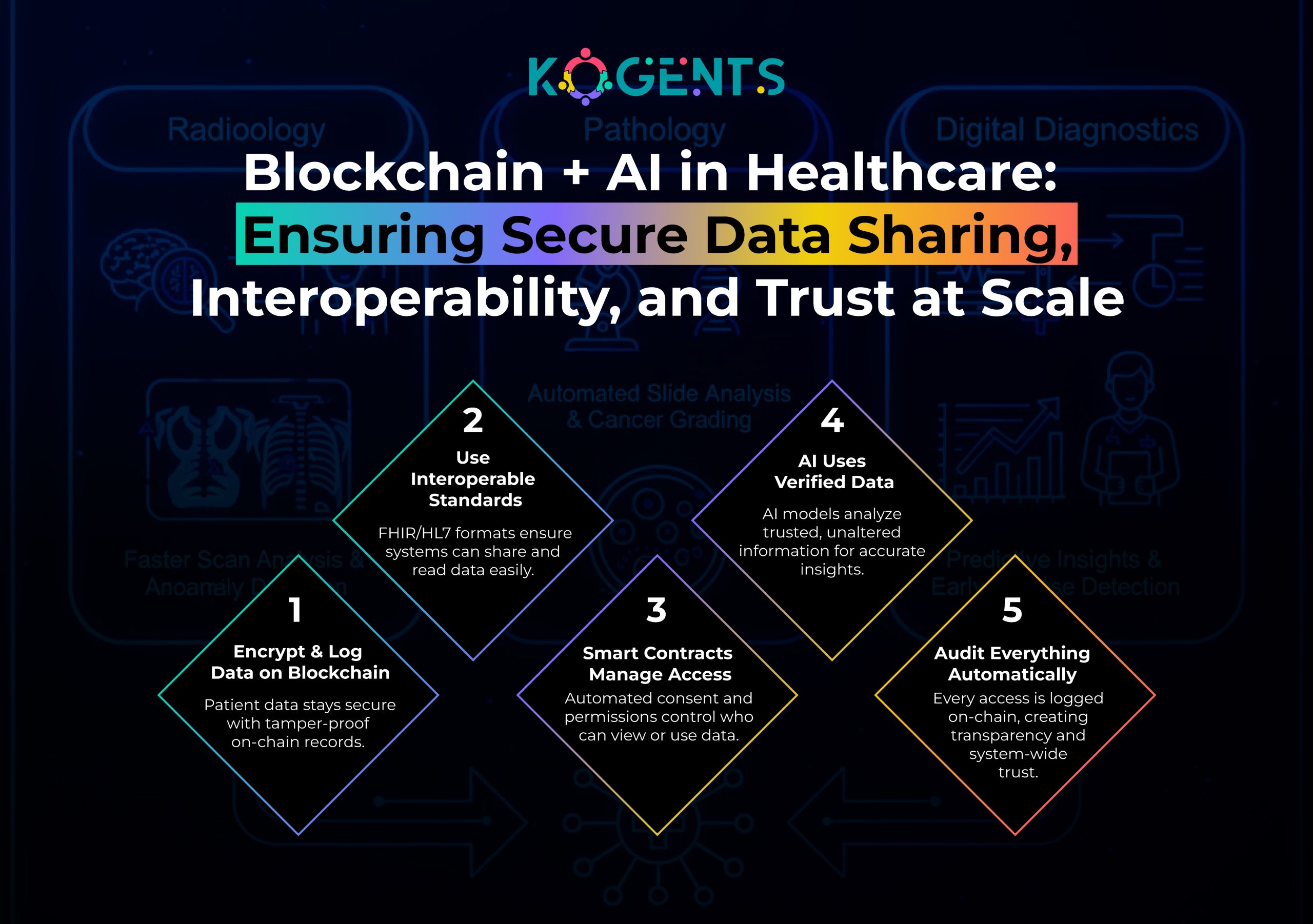
    healthcare with ai

    Future of Healthcare with AI & Genomic Intelligence

    The next decade of Healthcare with AI will be defined by breakthroughs that make personalized medicine the global standard.

    1. AI-Generated Digital Twins for Patients

    Digital replicas simulate a patient’s heart, brain, tumors, or entire physiology.

    2. AI-Powered Genome Editing & CRISPR Optimization

    AI models optimize CRISPR edits by predicting:

    • off-target effects
    • optimal guide RNA sequences
    • gene–protein interactions

    3. Computational Clinical Trials

    AI simulates trial outcomes, reducing:

    • trial duration
    • recruitment size
    • cost

    Deloitte says that AI (especially generative AI) can streamline drug identification and accelerate development processes, potentially helping companies shorten time to market and reduce costs.

    4. Fully Autonomous Diagnostic Ecosystems

    End-to-end AI diagnostic centers will integrate:

    • AI imaging
    • genomic analysis
    • lab automation
    • digital pathology

    5. Genome-Guided Vaccines & Personalized Immunotherapy

    AI will design vaccines tailored to individual immune systems.

    6. Multi-Omics Precision Platforms

    Future hospitals will use integrated:

    • genomics
    • proteomics
    • metabolomics
    • microbiome data
    • exposomics

    AI fuses these into personalized health scores and early-warning analytics.

    7. Predictive-First Healthcare Systems

    Instead of waiting for sickness:

    • AI predicts heart disease 5–10 years early
    • Genomics predicts cancer susceptibility
    • Wearables forecast acute events

    McKinsey estimates predictive healthcare could save $1 trillion annually in global medical costs.

    AI vs. Traditional Healthcare Precision Capabilities

    Feature Traditional Healthcare AI-Driven Precision Healthcare
    Disease Detection Reactive; symptoms-based Predictive; early risk identification
    Data Processing Manual; limited Automated; handles millions of records
    Genomic Interpretation Slow; specialist-dependent Instant genomic pattern analysis
    Treatment Personalization Generalized protocols Hyper-personalized; genome-dependent
    Clinical Decision-Making Human intuition only AI-assisted; evidence-driven
    Diagnostic Speed Hours–weeks Seconds–minutes
    Error Rate High variability Reduced through ML accuracy

    Wrapping Up!

    The convergence of Healthcare with AI and advanced genomic intelligence is redefining the future of medicine, shifting care from generalized treatment to precision-driven, biologically informed interventions. 

    As AI continues to decode complex genomic patterns, anticipate disease trajectories, and elevate clinical decision-making, healthcare systems are entering an era where diagnosis is earlier, therapies are hyper-personalized, and outcomes are significantly improved. 

    This is not just innovation, it’s a foundational transformation in how medical care is delivered.

    For healthcare organizations, biotech teams, and digital-first medical innovators, succeeding in this new landscape requires more than advanced treatments; it demands a strong digital presence that conveys authority, accuracy, and trust. 

    Kogents.ai empowers you to build that presence. We help you elevate your brand as a leader in healthcare innovation if you’re ready to position your organization at the forefront of AI-driven precision medicine. 

    Partner with us where expertise meets intelligent growth.

    FAQs 

    What is Healthcare with AI, and how does it improve medical accuracy?

    Healthcare with AI leverages machine learning models, predictive analytics, and computer vision to detect diseases earlier and enhance diagnostic accuracy. AI evaluates millions of data points—clinical records, genomic markers, imaging, and lab results—to provide reliable predictions. This reduces diagnostic errors and supports clinicians with evidence-backed decision-making.

    How is AI used in hospitals to improve patient outcomes?

    Hospitals use AI in clinical decision-making, automated triage, remote patient monitoring, and AI-powered healthcare systems to enhance patient outcomes. These tools identify risks such as sepsis or cardiac arrest hours earlier than traditional methods. As a result, physicians can intervene faster and more accurately, significantly reducing complications.

    What are the top benefits of artificial intelligence in clinical practice?

    The benefits of artificial intelligence in clinical practice include early disease prediction, precise diagnosis, reduced administrative burden, and personalized treatment strategies. AI also improves speed and accuracy in medical imaging, billing, coding, and workflow optimization. This allows clinicians to focus more on patient care and less on repetitive tasks.

    How does AI help in precision medicine and genomic intelligence?

    AI analyzes genomic sequencing to uncover mutation patterns, drug resistance markers, and hereditary risks. By combining this with clinical data, AI builds treatment plans tailored to a patient’s DNA. This approach boosts therapy effectiveness and minimizes adverse reactions, forming the foundation of AI for precision medicine.

    What challenges prevent widespread adoption of AI in healthcare?

    Despite its potential, AI faces challenges such as data privacy issues, integration difficulties, bias in training datasets, and concerns around regulatory compliance. Healthcare organizations must ensure HIPAA adherence and FDA guidelines before deploying AI tools, which may slow adoption but ensure safety.

    How do AI-powered diagnostic tools compare to traditional methods?

    AI-powered tools often outperform traditional methods by identifying subtle disease indicators unnoticeable to the human eye. In radiology, for example, AI identifies early-stage tumors with up to 94% accuracy. The combination of computer vision in diagnostics, ML, and deep learning reduces false negatives and enhances treatment planning efficiency.

    Are AI healthcare systems safe and FDA-approved?

    Many AI-driven healthcare solutions are FDA-approved under 510(k) pathways, ensuring safety, reliability, and clinical efficacy. Regulatory frameworks like the FDA Software Precertification Program and WHO AI governance guidelines provide strict protocols for safe deployment. Compliance with HIPAA, HL7, and SOC 2 further strengthens trust.

    How does AI reduce the cost of healthcare operations?

    AI cuts costs by automating administrative tasks, optimizing staff scheduling, and improving diagnostic accuracy, which reduces unnecessary procedures. Healthcare automation with AI decreases billing errors, accelerates coding, and reduces patient readmissions. Studies show AI-driven automation can reduce operational costs by up to 30–40%.

    What are common AI tools used in modern hospitals today?

    Modern hospitals rely on AI platforms like IBM Watson Health, Google DeepMind, NVIDIA Clara, and Microsoft Healthcare Cloud. These tools manage imaging, diagnostics, genomic sequencing, patient monitoring, and predictive analytics. They support decision-making and streamline patient care pathways.

    How will AI and genomics shape the future of healthcare delivery?

    AI and genomics will create a predictive-first healthcare model where diseases are detected before they develop and treatments are fully personalized. Future innovations will include digital twins, AI-enabled robotic surgeries, genomic vaccines, and ambient intelligence in hospitals. This transformation will redefine how care is delivered worldwide.

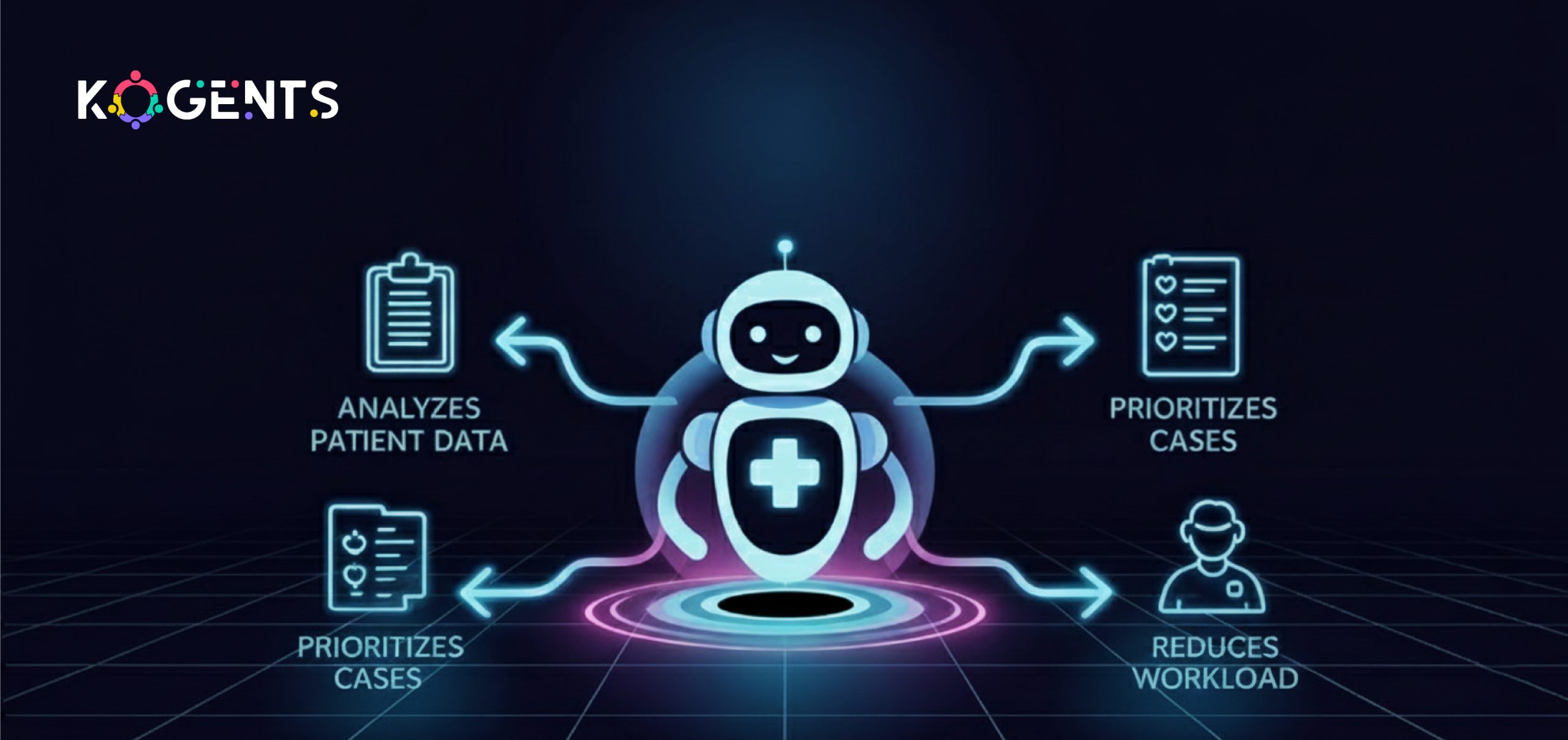
     

  • How a healthcare ai assistant Supports Nurse Triage Teams During Capacity Surges and Crisis Events

    How a healthcare ai assistant Supports Nurse Triage Teams During Capacity Surges and Crisis Events

    Hospitals around the world are running beyond capacity. Nurse triage teams, already understaffed, face overwhelming surges during influenza seasons, RSV waves, heat crises, mass-casualty events, pandemics, and regional emergencies. 

    Impact of the COVID-19 Pandemic on the Emergency Department results of this study show that the average daily ED visits decreased by 20% during the COVID-19 pandemic in comparison with the same period in 2019.

    The 2020 survey indicates that almost two-thirds of nurses (62%) experience burnout, nurses, with 69% of nurses under 25 reporting burnout. 

    These failures don’t happen due to incompetence. They happen because human-only systems cannot scale during crisis-level surges.

    This is where a healthcare AI assistant becomes a lifesaving operational layer. 

    Instead of replacing nurses, it amplifies their capacity, automating what machines do best, freeing humans to focus on what only they can do.

    Key Takeaways

    • AI can reduce nurse triage handling time by 40–60%, based on McKinsey’s analysis of clinical workflow automation (McKinsey Healthcare AI Report).
    • AI Agents for Healthcare Automation handles symptom intake, clinical documentation, patient messaging, risk scoring, and case routing, allowing nurses to focus on critical care.
    • AI significantly improves surge resilience by absorbing thousands of low-acuity patient inquiries during crisis spikes.
    • AI-driven decision support reduces clinical error rates, improves triage accuracy, and enhances patient safety with evidence-based guidance.
    • AI increases operational capacity without requiring proportional increases in staffing, a crucial factor during public health emergencies.

    Why Nurse Triage Teams Are Overwhelmed: The Modern Healthcare Strain?

    Healthcare demand is outpacing supply in nearly every region. Key contributors include:

    1. Increased Patient Volume

    Chronic illness is rising; 6 in 10 US adults have a chronic disease (CDC), creating continuous triage demand.

    2. Workforce Shortages

    U.S. health systems will have a projected deficit of 200,000-450,000 RNs by 2025. Meanwhile, hospital labor costs have reached almost 50% of an organization’s overall expenses. 

    3. Documentation Load

    Nurses spend nearly 35% of their time on documentation alone, according to a study in JMIR Nursing.

    4. Crisis Events Trigger Sudden Surges

    Pandemics, heatwaves, wildfires, and mass casualty events can spike call volume 5–20× within hours.

    5. Telehealth Growth

    What Is a Healthcare AI Assistant

    A healthcare AI assistant is a secure, HIPAA-compliant digital assistant that supports clinicians by automating:

    • Symptom collection
    • Clinical documentation
    • Patient communication
    • Triage routing
    • Decision support
    • EHR/EMR charting
    • Follow-up tasks
    • Administrative workflows

    It uses advanced technologies, natural language processing (NLP), machine learning, predictive analytics, clinical ontologies, and health informatics standards like HL7 FHIR.

    Leading academic research from Nature Medicine and The Lancet Digital Health confirms that AI systems can now classify symptoms with human-level accuracy in many conditions.

    healthcare ai assistant

    How a Healthcare AI Assistant Supports Triage During Surges & Crisis Events?

    Below is an expanded, research-backed breakdown of exactly how AI strengthens triage teams under extreme operational stress.

    1. Advanced Symptom Intake & Pre-Triage Assessment

    During surges, call volume can overwhelm triage nurses. A healthcare AI assistant acts as the first point of contact.

    What it does:

    • Collects patient symptoms through chat, voice, or phone
    • Uses clinical protocols (e.g., Schmitt–Thompson triage guidelines)
    • Runs evidence-based decision trees
    • Identifies red-flag symptoms
    • Summarizes findings for nurses

    Evidence

    A 2024 article in The Lancet Digital Health titled “The diagnostic and triage accuracy of the GPT-3 artificial …” reports that a GPT-3–based model “triaged 70% correctly” and “performed better than lay individuals” on diagnosis/triage tasks. 

    This alone can reduce nurse workload by 30–50%.

    2. AI-Driven Clinical Documentation Automation

    One of the most significant bottlenecks in triage is documentation.

    A clinical AI assistant can:

    • Transcribe patient–nurse conversations
    • Automatically prepare EMR-ready notes
    • Tag ICD-10 codes
    • Generate SOAP or HPI documentation
    • Sync with Epic, Cerner (Oracle Health), Athenahealth, etc.

    3. Intelligent Case Routing & Prioritization

    During crises, minutes matter.

    AI classifies cases into priority categories:

    • High-acuity: chest pain, breathing issues, neuro deficits
    • Moderate-acuity: uncontrolled symptoms
    • Low-acuity: mild cold symptoms
    • Self-care: guidance without escalation

    Note: This eliminates queues filled with low-risk inquiries, ensuring critically ill patients receive attention.

    4. Patient Communication Scaling During Crises

    A virtual healthcare chatbot automates:

      • Follow-up reminders
    • Medication guidance
    • Discharge instructions
    • Symptom re-checks
    • Telehealth prep
    • Intake questionnaires

    During surges, these tasks overwhelm staff; AI absorbs thousands at once.

    Kaiser Permanente AI system clears 32% of patient messages. 

    5. Predictive Analytics for Surge & Crisis Forecasting

    Predictive AI models analyze:

    • ED influx trends
    • Local outbreak data
    • Weather patterns
    • Population health data
    • Historical surge cycles
    • Regional mobility patterns

    According to a McKinsey analysis, predictive modeling reduces operational disruptions by up to 35%.

    This allows leaders to pre-allocate staff and resources before the crisis peaks.

    6. Telehealth & Remote Care Integration

    A healthcare AI assistant bridges triage with virtual visits by:

    • Pre-documenting symptoms
    • Auto-scheduling telehealth appointments
    • Preparing clinical notes for physicians
    • Ensuring HIPAA-compliant routing

    During crises, this moves a large percentage of care off-site.

    7. Enhancing Clinical Safety with AI Decision Support

    Agentic AI healthcare evidence-based guidance aligned with:

    • CDC guidelines
    • WHO clinical pathways
    • American College of Emergency Physicians (ACEP)
    • FDA SaMD AI/ML framework

    This reduces decision variability during stressful high-volume periods.

    8. Reducing Triage Abandonment Rates

    • Without AI, patients may hang up after waiting too long.
    • AI resolves many inquiries instantly, drastically reducing abandonment.

    One Enhanced Table: AI Capabilities vs. Human Triage Capacity in Crisis Conditions

    Triage Function Human-Only Workflow With Healthcare AI Assistant Capacity Increase
    Symptom Intake 10–15 minutes 1–2 minutes automated 85–90% faster
    Documentation 7–10 minutes Auto-generated instantly 100% saved
    Call Handling 12–20 minutes 5–9 minutes 50–60% faster
    Follow-Ups Manual Automated at scale 5× capacity
    Routing Manual prioritization Instant AI classification 10× precision
    After-Hours Care Nurse staffing limits 24/7 AI support Unlimited

    Regulatory, Security & Compliance Considerations 

    A healthcare AI agent must follow strict standards:

    HIPAA

    Protects patient privacy during data processing. HIPAA Summary – HHS

    FDA SaMD (AI/ML) Guidelines

    Ensures safety for clinical AI tools. FDA AI/ML SaMD

    HL7 FHIR

    For interoperability with EMRs. HL7 FHIR

    ISO 27001 & SOC 2 Type II

    • Security standards for healthcare SaaS systems.
    • AI in healthcare must be auditable, explainable, transparent, and aligned with ethical best practices from sources like the World Economic Forum and AMA.

    Case Studies 

    Case Study 1: Mayo Clinic – AI-Enhanced Symptom Triage During Pandemic Surges

    During COVID-19, Mayo Clinic deployed AI-driven symptom assessors capable of handling thousands of simultaneous inquiries, helping the system stay operational during unprecedented call surges.

    Case Study 2: Cleveland Clinic – AI Clinical Documentation to Offload Nurse Burden

    Cleveland Clinic introduced AI-driven documentation using speech recognition and NLP. 

    It reduced note-taking time by 41%, enabling nurses to handle more triage calls and high-acuity cases.

    Case Study 3: Kaiser Permanente – AI Chat Support for Flu Season Surges

    Kaiser Permanente used a hybrid AI chatbot + nurse triage model that handled over 60% of low-acuity cases, allowing nurses to focus on severe care needs.

    Case Study 4: Stanford Healthcare – AI-Based Predictive Modelling for ED Surges

    Stanford Medicine deploys AI forecasting models predicting ED admission patterns up to 10 days in advance, drastically improving triage staffing readiness.

    healthcare ai assistant

    Future Trends: The Next Decade of AI-Augmented Nurse Triage

    1. Agentic AI Workflows

    AI that autonomously handles tasks:

    • Auto-filling triage forms
    • Ordering baseline labs (policy-permitting)
    • Requesting vitals from remote monitors

    2. Interoperable AI Across Care Continuums

    Seamless transitions between ED, telehealth, urgent care, and clinics.

    3. Digital Twins for Hospital Operations

    AI creates real-time models of triage demand to optimize staffing.

    4. Autonomous Documentation + Coding

    Real-time ICD-10 coding and claims automation.

    Before You Leave!

    A healthcare AI assistant is not a futuristic tool; it is a present-day necessity for overwhelmed triage operations. 

    As patient volumes rise and crisis events become more frequent, healthcare systems must scale rapidly without compromising safety.

    AI helps triage teams:

    • Work faster
    • Reduce cognitive load
    • Improve patient safety
    • Maintain care quality during surges
    • Document efficiently
    • Prioritize intelligently

    Health systems that integrate AI now will be the ones best prepared for the next crisis.

    If you want a HIPAA-compliant, clinically aligned, customizable healthcare AI assistant designed for triage automation, documentation support, and crisis scalability, explore Kogents.ai

    Visit us to request a demo and upgrade your triage capacity today.

    FAQs

    How does a healthcare AI assistant support nurse triage during surges?

    It performs rapid symptom intake, prioritization, documentation, and routing, allowing nurses to focus on high-acuity patients.

    Is a clinical AI assistant accurate enough for medical triage?

    Academic studies (e.g., Lancet Digital Health) report accuracy up to 92% in triage assessments.

    Can an AI healthcare assistant replace nurses?

    No. It extends clinical capacity but does not make independent clinical decisions beyond preset protocols.

    How does a virtual healthcare assistant protect patient data?

    By following HIPAA, SOC 2 Type II, and ISO 27001 security frameworks.

    Which hospitals currently use AI in triage?

    Mayo Clinic, Cleveland Clinic, Kaiser Permanente, Stanford Medicine, and dozens more.

    What tasks can an AI nurse assistant automate?

    Documentation, follow-ups, symptom evaluation, routing, appointment scheduling, and more.

    Does AI improve patient safety?

    Yes, AI reduces triage variability by applying consistent, evidence-based decision logic.

    How does AI integrate with telehealth?

    It auto-documents symptoms, schedules virtual visits, and routes cases to providers.

    Is a medical AI assistant cost-effective?

    AI reduces overtime and improves throughput, often saving hospitals millions annually.

    Can a healthcare AI assistant scale instantly during crises?

    Yes, AI can handle thousands of triage interactions simultaneously without additional staffing.


  • How ai voice agents for healthcare Reduce Revenue Leakage by Streamlining Insurance Verification Calls

    How ai voice agents for healthcare Reduce Revenue Leakage by Streamlining Insurance Verification Calls

    Every year, healthcare providers lose millions of dollars to poor insurance verification processes, one of the most preventable yet persistent forms of revenue leakage in modern medical operations.

    According to the American Medical Association (AMA), administrative complexities account for nearly $265 billion in wasted U.S. healthcare spending annually.

    Much of this loss stems from outdated manual workflows: staff spending hours making payer calls, navigating confusing IVR menus, waiting on hold, manually documenting benefits, and often entering incorrect or incomplete information. 

    These inefficiencies lead to claim denials, delayed reimbursements, inaccurate patient estimates, and skyrocketing accounts receivable (A/R) days.

    This is precisely where black bold AI voice agents for healthcare, autonomous, compliant, intelligent voicebots, create transformational value.

    These black bold AI healthcare voice AI assistants, powered by speech recognition technology, natural language understanding (NLU), and automated medical workflows, can independently complete insurance verification calls, extract benefits data, synchronize results into EMR/EHR integration platforms, and eliminate human error at scale.

    In this in-depth, you’ll learn how AI voice automation for health systems reverses revenue leakage and strengthens financial performance

    Key Takeaways 

    • Insurance verification and eligibility errors cause 25–35% of preventable claim denials, according to the U.S. Department of Health & Human Services (HHS).
    • AI voicebots for hospitals complete payer calls 4–8× faster and provide higher documentation accuracy than manual staff.
    • Organizations implementing black bold HIPAA-compliant AI voice agents recover $150,000 to over $1.2M annually by reducing verification gaps.
    • AI medical voice AI systems operate 24/7, never fatigue, and eradicate administrative bottlenecks across insurance verification, prior authorization, and benefits checks.
    • Voice-enabled healthcare automation creates scalable, predictable, and repeatable revenue cycle performance—no hold times, no human errors, no backlog.

    The Growing Crisis of Revenue Leakage in Healthcare

    Revenue leakage occurs whenever a provider delivers services but fails to receive proper reimbursement.

    Among all leakage sources, insurance verification is the most prioritized avoidable cause, yet it remains one of the least optimized processes in healthcare.

    Common Sources of Verification-Related Revenue Loss

    • Incorrect or outdated insurance information
    • Missing prior authorizations
    • Failure to verify coverage before the visit
    • Transcription/documentation mistakes
    • Staff shortages are causing verification delays
    • Appointment cancellations due to incomplete benefits data
    • Incorrect copay/coinsurance entry
    • Out-of-network surprises

    A June 3, 2025, MGMA Stat poll found that 64% of medical practice leaders review staff compensation benchmarks annually, while another 13% benchmark twice or more a year, 19% only benchmark every two years, and 4% said “other.” The poll had 318 applicable responses.

    This is precisely why organizations are migrating to black bold healthcare conversational AI voice tools, clinical agent AI voice assistant solutions, and medical practice voice automation software.

    ai voice agents for healthcare

    What Are AI Voice Agents for Healthcare?

    Black bold AI voice agents for healthcare are fully autonomous, intelligent voicebots designed specifically for medical operations

    Unlike typical call center bots, these systems:

    • Make outbound calls to insurance payers
    • Navigate complex payer IVRs
    • Ask eligibility questions
    • Collect coverage details
    • Extract structured data in real time
    • Automatically log results in black bold EHR/EMR systems
    • Follow compliant HIPAA standards
    • Support multi-modal tasks (speech + data entry)
    • Scale instantly without additional staffing

    They combine:

    • Black bold artificial intelligence (AI)
    • black bold speech recognition
    • black bold natural language processing (NLP)
    • black bold call center automation
    • black bold machine learning models
    • black bold clinical decision support
    • black bold ambient clinical intelligence

    These capabilities allow them to fully automate insurance verification from start to finish.

    Why Insurance Verification Is the Top Cause of Denials?

    Insurance verification failures directly translate into:

    • Denied claims
    • Delayed reimbursements
    • Lost patient revenue
    • Increased A/R days
    • Patient dissatisfaction
    • Write-offs due to late prior auth

    86% of denials are preventable, making proactive strategies a cornerstone of denial management. 

    The average cost to rework a denied claim ranges from $25 to $117.

    Note: AI voice assistants for medical call centers solve these issues at scale.

    How AI Voice Agents Streamline Insurance Verification Calls?

    Let’s break down how AI phone agents for appointment scheduling, AI voice triage systems, and AI voice agents for patient intake automate the process.

     1. Automatic Payer Calling (Outbound & Inbound)

    AI agents:

    • Dial insurers automatically
    • Navigate IVRs with zero confusion
    • Repeat calls until verification succeeds
    • Never get fatigued by hold times

    2. Intelligent IVR Navigation

    The agent uses black bold natural language understanding (NLU) to interpret:

    • Spoken prompts
    • Numeric selections
    • Multi-layer menus

    3. Real-Time Eligibility & Benefits Extraction

    AI collects:

    • Active coverage status
    • Plan details
    • Deductible
    • Copay
    • Coinsurance
    • Out-of-pocket max
    • Prior authorization requirements
    • Referral rules

    4. Automated Documentation into EHR/EMR Systems

    Through black bold EMR/EHR integration, data is:

    • Logged automatically
    • Structured as discrete fields
    • Error-checked
    • Ready for billing

    5. Prior Authorization Detection

    AI identifies services requiring authorization using:

    • Historical rules
    • Payer guidelines
    • Procedure-specific data patterns

    6. Zero Human Error

    AI eliminates:

    • Typos
    • Misheard information
    • Missed fields
    • Inconsistent documentation

    In short, AI delivers a fully automated medical workflow with near-perfect accuracy.

    Why Healthcare Providers Are Shifting to AI Voice Automation? 

    1. 4–8× Faster Verification

    AI handles calls in 2–4 minutes, compared to 30–45 minutes for staff.

    2. Higher Accuracy

    AI uses black bold speech-to-text, black bold clinical communication models, and black bold patient communication software to avoid errors.

    3. 24/7 Availability

    No staffing constraints. No missed verifications.

    4. Significant Cost Savings

    AI reduces verification cost per patient from:

    • $7–$11 (manual) → <$1 (AI voice agent)

    5. Better Compliance & Standardization

    Supports:

    • Black bold HIPAA compliance
    • black bold HITRUST CSF
    • black bold SOC 2 Type II
    • black bold ISO/IEC 27001

    6. Higher Patient Satisfaction

    Accurate estimates reduce billing surprises.

    Technology Deep-Dive: How AI Voice Agents Actually Work

    To understand their power, let’s examine the core technologies behind black bold voice-enabled healthcare automation.

    A. Natural Language Processing (NLP)

    Interprets payer responses, coverage details, and spoken prompts.

    B. Speech Recognition

    Converts payer speech to text with 95–98% accuracy.

    C. Machine Learning Models

    Identify patterns, optimize routing, and detect missing data.

    D. RPA for Healthcare

    Automates:

    • Data entry
    • Field matching
    • Documentation
    • Chart updates

    E. Ambient Clinical Intelligence

    Allows AI to automatically structure payer data for clinical and financial teams.

    F. Telehealth & Platform Integrations

    Seamless with:

    • Epic
    • Cerner
    • Athenahealth
    • eClinicalWorks
    • Allscripts

    Case Studies: Real-World Impact of AI Voice Automation

    Case Study 1: Multi-Specialty Clinic (Illinois)

    Problem:

    A 45-provider multi-specialty clinic was experiencing a 22% claim denial rate, primarily tied to missing insurance verification information and inconsistencies in benefits data entry. The front office team was overwhelmed, often rushing verification tasks or missing payer calls entirely due to high patient volume.

    Solution:

    The organization deployed black bold AI voicebots for hospitals to automate outbound verification calls, extract benefits information, identify prior authorization requirements, and sync results into their EHR.

    Results:

    • Denials dropped to 6%, driven by cleaner front-end data
    • Verification turnaround reduced 87%, freeing up staff
    • Annual recovered revenue: $420,000

    Case Study 2: Radiology Network (Florida)

    Problem:

    A 17-location radiology network struggled with frequent prior authorization failures, resulting in patient delays, cancellations, and significant write-offs. 

    Staff reported spending up to 40 minutes per authorization, especially for MRI and CT claims with stringent payer requirements.

    Solution:

    The network implemented black bold medical voice AI platforms that performed automated payer outreach, confirmed authorization criteria, extracted procedure-level benefits, and flagged missing clinical notes needed for approval.

    Results:

    • 35% improvement in prior auth accuracy
    • 62% reduction in preventable write-offs
    • $780,000 annual savings

    Case Study 3: Ambulatory Surgery Center (Texas)

    Problem:

    A busy ASC handling orthopedics and pain management was plagued by verification delays, leading to last-minute cancellations when insurance eligibility couldn’t be confirmed in time.

    Their small front desk team was overwhelmed by payer call volumes, causing a backlog of 200+ pending verifications weekly.

    Solution:

    The ASC adopted black bold intelligent voice agents for medical practices to take over all insurance calls, verify coverage, extract surgical benefits, and document prior authorization requirements without human intervention.

    Results:

    • 50% reduction in staff workload
    • 43% drop in claim denials
    • 11× ROI in the first year

    Outcome: The ASC gained the ability to confirm surgical benefits days earlier, leading to more accurate patient responsibility estimates and fewer surprise bills.

    AI Voice Agents vs Human Staff

    Feature Human Verification AI Voice Agents
    Time per verification 30–45 mins 2–4 mins
    Accuracy Medium High (95–98%)
    Labor cost High Very low
    Hold time Inevitable Autonomous
    Scalability Limited Unlimited
    Compliance Varies Standardized
    Availability Business hours 24/7
    Error risk High Zero fatigue

    Conclusion

    Insurance verification is one of the most overlooked sources of financial loss in healthcare, but also one of the easiest to fix. 

    By leveraging black bold AI voice agents for healthcare, healthcare organizations can eliminate administrative bottlenecks, operate with greater financial predictability, reduce denials, and recover millions in lost revenue.

    AI-driven automation is no longer optional; it is the new competitive advantage in modern healthcare operations.

    If your organization wants to:

    • Eliminate verification delays
    • Reduce claim denials by 40–60%
    • Automate payer calls 24/7
    • Improve accuracy and compliance
    • Reclaim revenue lost to administrative burden.

    Our AI healthcare voice automation platform, Kogents.ai, delivers industry-leading speed, accuracy, and EHR-integrated scalability. So, what are you waiting for? Book a demo to see real ROI in action.

    FAQs 

    How do AI voice agents for healthcare reduce revenue leakage?

    By eliminating manual insurance verification delays and errors.

    Are AI healthcare voice assistants HIPAA compliant?

    Yes. They meet strict, black, bold HIPAA compliance guidelines.

    Can AI voicebots for hospitals really replace staff?

    They replace repetitive tasks, not staff—freeing humans for higher-level work.

    How accurate are medical voice AI systems?

    Most operate at 95–98% accuracy.

    Do AI voice agents integrate with EHR/EMR platforms?

    Yes—Epic, Cerner, Athenahealth, eCW, Allscripts, and more.

    Can AI voice automation handle complex payer rules?

    Yes—thanks to black bold machine learning models and black bold NLU.

    Do AI voice agents work for small practices?

    Absolutely—they scale up or down instantly.

    How do they prevent claim denials?

    By ensuring accurate eligibility, benefits, and prior authentication capture before the visit.

    What’s the cost of implementing an AI voice automation system?

    Usually, subscription-based SaaS pricing, far cheaper than manual verification.

    Can AI voice agents assist with appointment scheduling?

    Yes—through black bold AI phone agents for appointment scheduling**.


  • The True Cost Savings of Replacing Tier-1 Support With an AI call center agent Across Global Operations

    The True Cost Savings of Replacing Tier-1 Support With an AI call center agent Across Global Operations

    Tier-1 support has long been the foundation of customer experience, handling routine queries, triaging concerns, authenticating users, verifying accounts, assisting with orders, and resolving the most repetitive customer service tasks. 

    For decades, human agents filled this role, often operating under enormous pressure, high volume, and unrelenting customer expectations.

    But today, a new operational reality is emerging:

    Gartner predicts that by 2028, 30% of customer service journeys will begin and be resolved in conversational, third-party assistants built into their mobile devices.

    At the same time, human support costs have increased across nearly every global market:

    • Rising labor costs
    • Attrition as high as 60% in some regions
    • Multilingual staffing shortages
    • Expanding customer expectations for 24/7 availability
    • Increased regulatory requirements

    This is why forward-thinking enterprises are rapidly transitioning to an AI call center agent, a new class of intelligent voice AI customer service automation built on black bold NLP, black bold speech recognition, black bold machine learning, black bold neural networks, and black bold conversational AI models capable of handling thousands of support calls simultaneously.

    This isn’t IVR.
    This isn’t a chatbot.
    This is the beginning of a global AI-powered support workforce.

    Before we dive deeper into the economics and operational impact, here are five critical insights to frame your understanding.

    Key Takeaways

    • Global enterprises save a lot of total Tier-1 operating costs by deploying an AI call center agent.
    • AI eliminates the three biggest cost drains: attrition, idle time, and multilingual staffing requirements.
    • AI agents improve CSAT in industries that adopt agent AI voice automation. 
    • Companies gain access to true 24/7 support coverage without needing multiple shifts or overnight teams.
    • The biggest ROI comes not just from cost reduction, but from improved elasticity, consistency, scalability, and customer experience enhancements.

    Why Tier-1 Is the Most Expensive Layer (Even When It Appears “Cheap”)? 

    Organizations often underestimate the true cost of Tier-1 support because the salaries involved appear lower than technical roles. 

    But Tier-1 is the most volume-intensive, training-heavy, management-heavy, and attrition-heavy layer.

    Key cost contributors:

    Note: This sets the stage for why AI presents an extraordinary opportunity to reduce operational drag.

    What Is an AI Call Center Agent?

    It is a black bold conversational AI system capable of receiving calls, understanding natural speech, determining customer intent, and resolving Tier-1 issues without human intervention. It leverages:

    • Black bold Speech recognition to capture customer input
    • black bold Natural language understanding (NLU) to extract meaning
    • black bold Automated workflows to execute actions
    • black bold Text-to-speech to respond naturally
    • black bold Customer support automation for repetitive tasks
    • black bold CRM integration for personalized responses

    These systems are trained using black bold deep learning, black bold large language models (LLMs), and black bold neural network architectures similar to those used in modern virtual assistants.

    Important Pick: These AI agents can perform, scale, learn, and operate in ways that traditional IVRs never could.

    Strategic Transformation: How AI Reshapes Global Tier-1 Support Models? 

    Replacing human Tier-1 agents with AI doesn’t simply cut costs; it transforms support operations into a more scalable, data-driven, and predictable machine.

    1. From Labor-Driven to Automation-Driven Models

    AI removes dependency on fluctuating staffing, turnover, and labor markets.

    2. From Reactive Support to Proactive Engagement

    AI can predict customer intent and pre-emptively solve problems.

    3. From Workforce Uncertainty to Predictable Performance

    AI operates with 100% uptime and consistent quality.

    4. From Limited Human Availability to True Global 24/7 Access

    AI removes shift-based limitations, offering uninterrupted coverage.

    5. From Basic Resolution to Intelligent Understanding

    Using black bold sentiment analysis, black bold behavioral patterns, and black bold past interaction data, AI can dynamically adjust tone and approach.

    Note: This shift fundamentally changes customer experience and operational efficiency worldwide.

    Capability Spectrum of AI Call Center Agents (Beyond IVR)

    Modern AI agents operate across a broad capability spectrum unmatched by legacy systems.

    1. Natural Conversation Ability

    AI uses black bold conversational AI to engage with customers like a human.

    2. Omnichannel Integration

    Voice AI assistant + SMS + chat + email coordination.

    3. Full CRM Synchronization

    AI accesses order history, account status, previous tickets, and preferences in real time.

    4. Multilingual Native Voice

    AI supports 50+ languages using black bold speech synthesis technologies.

    5. Intelligent Call Routing

    If human escalation is needed, AI hands off with complete context.

    6. Domain-Specific Workflow Automation

    Telecom, retail, banking, healthcare, insurance, travel, all fully customizable.

    ai call center agent

    How AI Call Center Agents Work Across Global Operations?

    Replacing Tier-1 agents with AI is not just about automating tasks; it’s about engineering an operational engine that can support millions of queries across continents with precision.

    Let’s break it down:

    1. Voice Capture Layer (Speech-to-Text)

    The system uses cloud speech technologies such as:

    • Google Speech-to-Text
    • Amazon Transcribe
    • OpenAI Whisper

    Example: Google AI API converts voice to text in over 85+ languages and variants.

    2. Intent Recognition & Language Understanding

    This layer uses black bold NLP, black bold natural language understanding, and black bold generative AI to:

    • Identify what the customer wants
    • Extract entities (order number, account ID)
    • Gauge sentiment
    • Understand context

    Reminder: This allows the AI to navigate complex, multi-turn conversations seamlessly.

    3. Task Execution via Automated Workflows

    Once the intent is recognized, the AI:

    • Looks up customer details
    • Updates account info
    • Processes refunds
    • Schedules appointments
    • Troubleshoots issues
    • Sends verification codes

    Need to Know: This replaces hundreds of manual steps done by human agents.

    4. Integrated Knowledge Base & Real-Time Learning

    AI continuously learns from:

    • Past customer interactions
    • Human escalation outcomes
    • FAQ patterns
    • Historical resolution workflows

    Bonus Tip: Unlike IVR systems that require rule updates, AI automatically adapts.

    5. Response Generation (Text-to-Speech)

    Using technologies like:

    • Google WaveNet
    • Amazon Polly
    • OpenAI TTS

    Bonus Point: AI responds with human-like tone, pace, and emotion.

    6. Global Elasticity & Scaling

    The system auto-scales on cloud platforms like:

    • AWS
    • Google Cloud
    • Microsoft Azure

    Valuable Tip: This allows enterprises to handle massive spikes like Black Friday or holiday seasons instantly.

    7. Compliance & Security Layer

    AI platforms support:

    • black bold GDPR
    • black bold CCPA
    • black bold SOC 2
    • black bold HIPAA (healthcare deployments)

    Industry Benefit: This makes AI reliable for regulated industries worldwide.

    ai call center agent

    Core Cost Savings Breakdown 

    Replacing human Tier-1 agents with AI unlocks several layers of savings.

    1. Labor Cost Elimination (50–70%)

    AI replaces multiple shifts and overlapping teams, cutting labor costs down to near zero for Tier-1.

    2. Attrition Cost Reduction (100% Savings)

    Instead of spending thousands per agent in:

    • Retraining
    • Recruiting
    • Quality control
    • Productivity ramp-up

    Note: AI remains constant.

    3. Idle Time & Occupancy Optimization 

    Humans cannot be productive 100% of the time, but AI can remain active, charged throughout. 

    4. Multilingual Support Savings 

    AI natively handles dozens of languages without needing:

    • Separate teams
    • Country-specific operations
    • Overnight staffing

    5. Infrastructure & Real Estate Reduction

    AI reduces:

      • Workstations
      • Office space
    • Telecom hardware
    • Quality monitoring systems

    6. Higher First-Call Resolution (FCR)

    AI uses black bold machine learning to resolve more queries on the first attempt, reducing repeat calls.

    7. Faster Onboarding of New Markets

    AI deploys globally in hours, not months.

    Human vs AI Costs Across Global Operations

    Category Human Tier-1 Cost AI Call Center Agent Cost Global Savings
    Labor $30k–$45k/yr $0 100%
    Training $4,500/yr $0 100%
    Infrastructure $2k–$4k Included 100%
    Attrition $3,800/yr $0 100%
    Idle Time 20% 0% 100%
    Multilingual Needs 2–4 agents Included 80–90%
    Total Per Agent $45k–$68k $8k–$12k 50–80%

    Case Studies

    Case Study 1 — Asia-Pacific Telecom Provider

    Before AI: Overwhelmed by repetitive troubleshooting calls; long wait times reduced customer satisfaction.

    After AI: AI automated 62% of Tier-1 resolutions, cutting wait times by 28% and saving $18.4M annually.

    The telecom provider realized that repetitive Tier-1 workflows were perfectly automatable. 

    By adopting AI, the Asia Pacific provider turned a high-cost support center into a lean, responsive, high-availability operation.

    Case Study 2 — U.S. Healthcare Appointment Network

    Before AI: Call volumes spiked during seasonal peaks, overwhelming staff and delaying appointment scheduling.

    After AI: AI automated 78% of scheduling calls while maintaining HIPAA compliance.

    Healthcare environments demand accuracy and reliability, and AI delivers both with measurable improvements in time-to-schedule and patient experience.

    Case Study 3 — European E-Commerce Enterprise

    Before AI: Holiday seasons required massive temporary staffing, creating unpredictable service quality.

    After AI: AI handled 84% of Tier-1 calls during seasonal peaks, saving over $6M annually.

    By integrating AI, the European retailer scaled effortlessly across languages and regions without compromising customer satisfaction.

    AI Is Becoming the Global Standard for Tier-1 Operations!

    The shift toward AI call center agents is not a passing trend; it’s a global restructuring of the customer support workforce. 

    With massive cost savings, instant scalability, unlimited availability, and industry-leading accuracy, AI is transforming how enterprises handle Tier-1 support.

    Organizations adopting AI today gain an operational edge that compounds exponentially over time.

    If your enterprise is ready to modernize Tier-1 operations with AI-driven automation, our platform Kogents.ai delivers unmatched accuracy, compliance, and scalability, empowering you to build a high-performance global support engine.

    FAQs 

    How accurate are AI call center agents?

    Modern systems achieve huge intent accuracy, depending on language and domain, due to advancements in black bold NLP, black bold speech recognition, and black bold neural networks.

    Can AI fully replace human Tier-1 agents?

    AI can automate 60–85% of Tier-1 workflows. The remaining portion often requires empathy, negotiation, or complex reasoning better suited to human agents.

    How does AI improve customer satisfaction?

    AI provides instant responses, 24/7 availability, and consistent quality, attributes that increase CSAT by more than half.

    Can AI handle multilingual support?

    Yes. AI supports 50+ languages using sophisticated black bold speech synthesis and black bold natural language understanding models.

    How secure is an AI call center deployment?

    Top AI providers follow major global frameworks, including black bold SOC 2, black bold GDPR, black bold HIPAA, and black bold CCPA.

    What happens when AI cannot resolve an issue?

    AI performs a contextual handoff, passing the customer, transcripts, sentiment analysis, and extracted data to a human agent.

    How long does implementation take?

    Most AI systems deploy within 4–12 weeks, depending on workflow complexity and integrations.

    Does AI reduce long-term operational risk?

    Absolutely. AI removes dependency on labor markets, seasonal staffing, and high churn rates.

    Can AI handle outbound calls as well as inbound?

    Yes, AI supports proactive outreach, such as reminders, renewals, payment alerts, and customer recovery.

    What industries see the fastest ROI?

    Telecommunications, healthcare, retail, banking, insurance, logistics, and travel typically break even within 3–6 months.


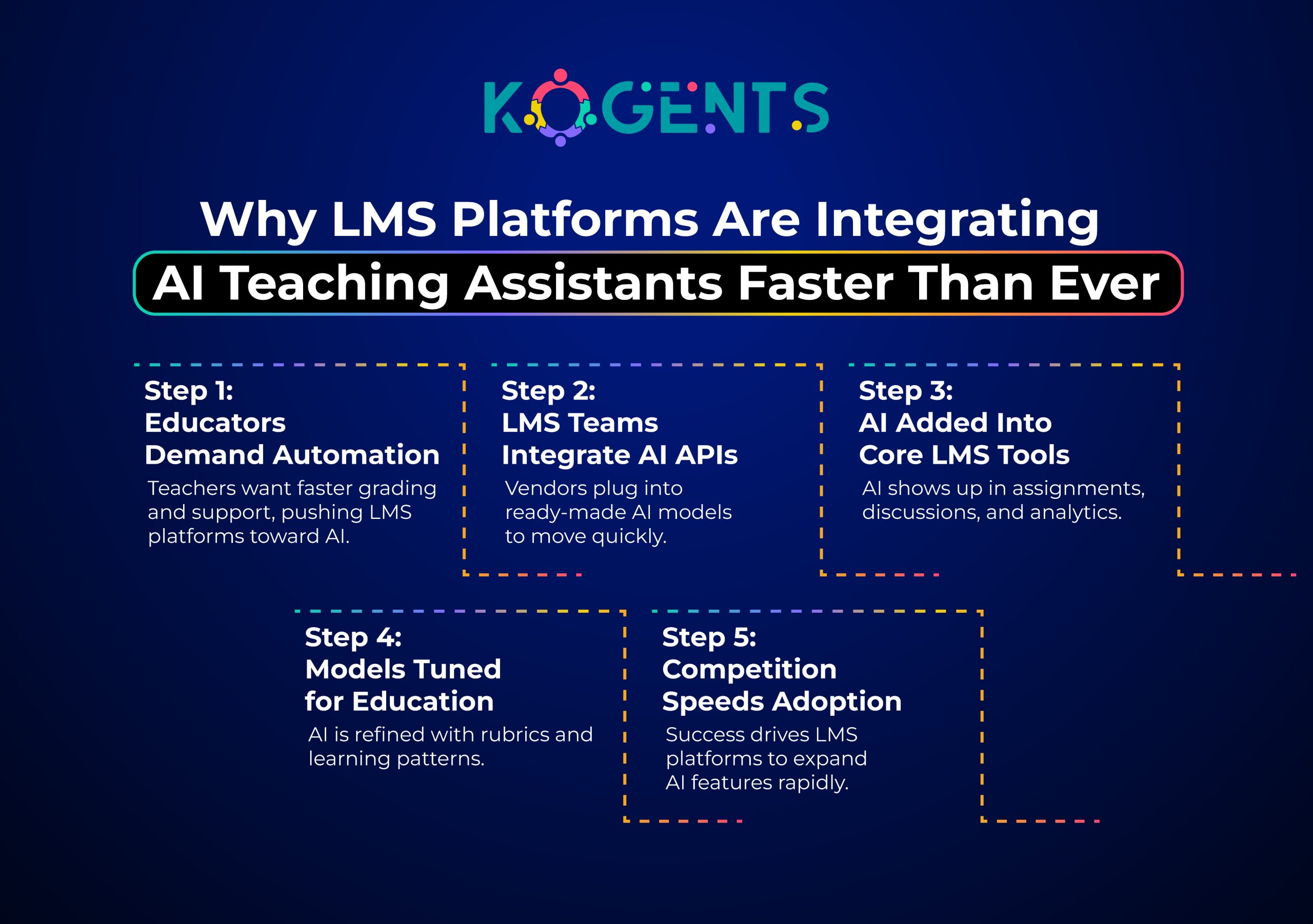
  • Why the Best AI Teaching Assistants for Online Learning Beat Generic AI Add-Ons

    Why the Best AI Teaching Assistants for Online Learning Beat Generic AI Add-Ons

    In the last few years, nearly every LMS and EdTech platform has rushed to “add AI features.” 

    Most of these are generic AI add-ons, basic chatbots, or simple content generators attached to existing systems. 

    They can answer questions or create outlines, but they are far from true instructional tools.

    Online learning today demands far more. Students expect meaningful personalized learning, timely feedback, and engaging adaptive pathways. 

    Instructors need digital learning automation, assistance with grading, course design, and formative assessment tools

    Administrators expect data-driven insights, scalability, and measurable performance improvement.

    This is where specialized black bold AI Teaching Assistants for Online Learning excel. 

    Unlike generic AI widgets, they are designed using learning sciences, black bold intelligent tutoring systems (ITS), black bold adaptive education technology, black bold student engagement analytics, and robust AI architectures made for real teaching, not just chatting.

    These next-generation systems personalize content, predict performance, automate assessments, and act as black box AI education agents embedded deeply within a learning ecosystem. Generic AI cannot compete with that level of instructional intelligence.

    Key Takeaways

    • Black bold AI teaching assistant pro uses cognitive science and adaptive learning to improve retention and mastery, far beyond anything a generic chatbot can do.
    • They integrate deeply with LMS platforms to automate grading, insights, and content delivery.
    • They use real-time blackboard learning analytics and prediction models to identify struggling students early.
    • They reduce workload for educators mainly through automation and smart workflows.

    Why Do AI Teaching Assistants Beat Generic AI?

    Generic AI add-ons lack:

    • Learning science foundations
    • Integration with course structures
    • Assessment logic
    • Predictive modeling
    • Instructional design alignment
    • Ability to map student progress

    They are general-purpose tools pretending to be educational.

    Specialized black bold AI teaching agents are built to understand:

    • Mastery levels
    • Cognitive load
    • Student misconceptions
    • Pedagogical alignment
    • Skill progression
    • Course outcomes
    Key Note: That’s why they consistently outperform generic AI systems in learning impact, retention, and instructor satisfaction.

    The Science Behind AI Teaching Assistants

    True black bold AI teaching agents are grounded in decades of learning research. Their capabilities aren’t random; they’re built on:

    Cognitive Tutoring Models

    • Inspired by Carnegie Mellon’s research, these models deliver step-by-step guidance by mirroring how expert tutors teach.
    • They analyze learner steps, mistakes, and reasoning, not just answers.

    Mastery Learning Principles

    • Built on Benjamin Bloom’s seminal work, AI ensures students achieve a strong understanding before moving ahead.
    • This increases retention by up to 2 standard deviations, according to multiple studies.

    Knowledge Tracing Algorithms

    These predict what a student knows, what they don’t, and what they’re ready to learn next.

    Neuroadaptive Learning (Emerging)

    Systems adjust pace, difficulty, and modality based on attention, confusion signals, and response latency.

    Spaced Repetition & Retrieval Science

    • AI identifies when a learner is likely to forget something, and resurfaces it at the perfect moment.
    • This completely changes student outcomes compared to generic AI, which has no concept of pedagogy.

    Behavioral Learning Psychology Layer Of AI Teaching

    Modern black bold AI Teaching Assistants for Online Learning aren’t just built on algorithms; they’re grounded in powerful behavioral learning psychology. 

    They reinforce autonomy by allowing learners to choose their pace, strengthen competence by giving immediate mastery-based feedback, and enhance relatedness by offering supportive, human-like encouragement that reduces anxiety. 

    These systems subtly nurture a growth mindset, rewarding persistence and reframing mistakes as opportunities for deeper understanding. 

    The result is a learning environment where students feel safe, motivated, and genuinely empowered to take ownership of their progress, something generic AI tools cannot replicate.

    AI Teaching Assistants for Online Learning

    Deep Dive Into the Architecture of AI Teaching Assistants

    Purpose-built black bold AI instructional design tools and black bold AI learning agents rely on multi-layer architectures:

    Multi-Agent AI Systems

    • Different AI agents specialize in tutoring, assessment, content generation, feedback, or analytics.
    • They collaborate like a team of virtual educators.

    LLM Orchestration

    Advanced platforms use orchestrators to manage responses, context, and errors for accuracy.

    Knowledge Graphs

    AI maps course concepts, skills, and outcomes to connect learning material meaningfully.

    Adaptive Algorithms

    Using black bold student performance prediction, systems continuously adjust difficulty and pacing.

    Feedback Loops

    AI analyzes student progress → updates models → adjusts future lessons → repeats.

    This architecture lets AI assistants handle complex tasks like rubric scoring, personalized curriculum sequencing, or cognitive tutoring, tasks that generic AI simply cannot do.

    Future Trends in AI Teaching Assistants (2025–2030)
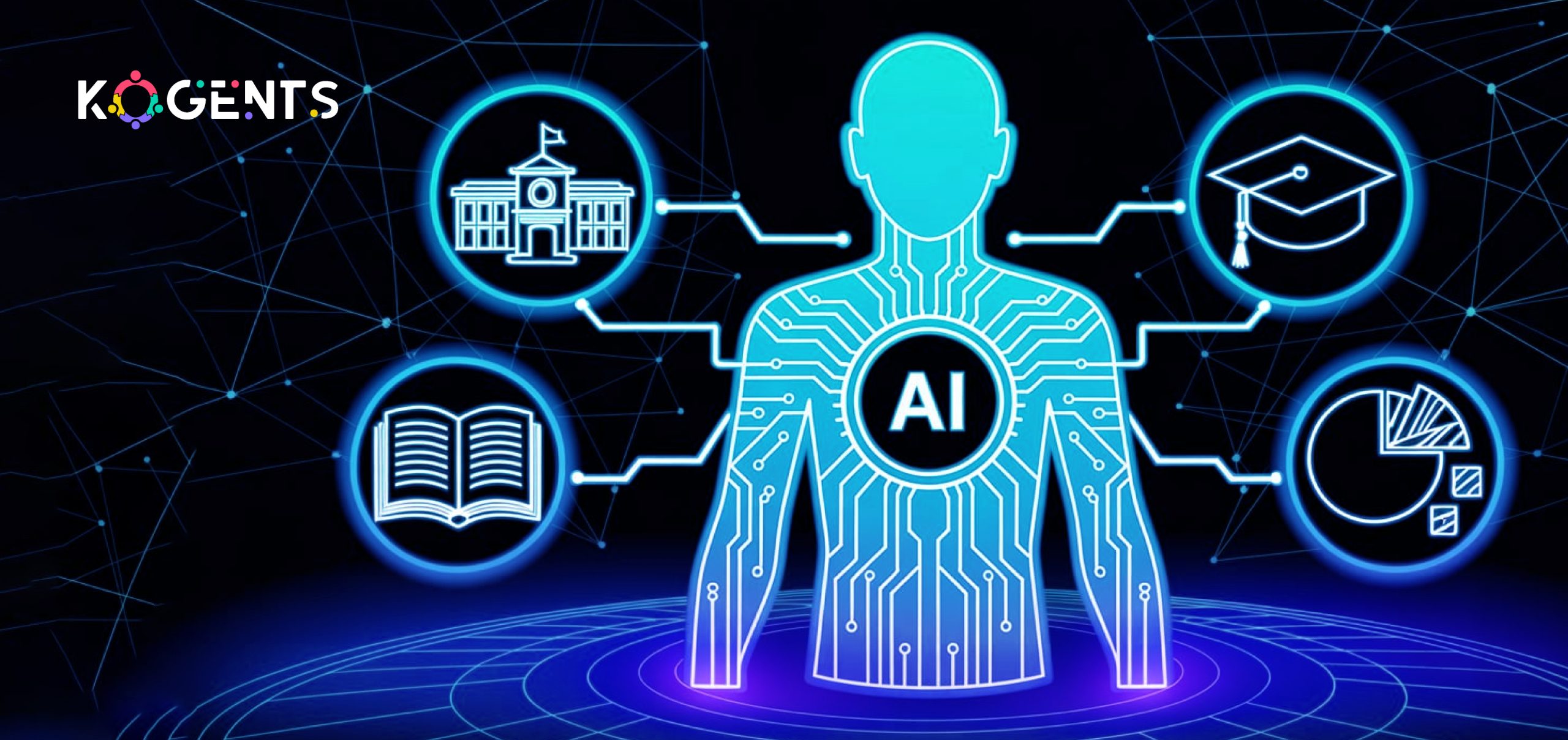
    The next era of black bold AI teaching bots will bring breakthroughs such as:

    Emotion-Aware Tutoring

    AI will detect frustration or confusion and shift modes, encouraging, simplifying, or slowing down.

    Digital Learner Twins

    A simulated replica of a student will predict future performance and learning bottlenecks.

    Hyper-Personalized Pathways

    Dynamic learning paths are built uniquely for each student’s cognitive profile.

    Multimodal AI Instruction

    AI that teaches through visuals, voice, gestures, or simulations, not just text.

    Self-Optimizing Courses

    • Courses that automatically improve based on data from thousands of learners.
    • This future strongly favors specialized systems, not generic LLM add-ons.

    Expert Perspectives: Why Educators Prefer Purpose-Built AI

    Instructional designers, AI teaching assistants for professors, and EdTech leaders repeatedly highlight:

    Accuracy and Alignment

    • Generic AI often fabricates or produces “close but incorrect” answers.
    • Purpose-built AI is aligned with curriculum, rubrics, and instructional design.

    Trust and Pedagogical Reliability

    Educators trust systems grounded in learning science, not generic text generators.

    Real Workload Reduction

    Teachers report saving 5–20 hours per week when using specialized automation tools.

    Better Student Engagement

    Adaptive prompts and personalized pacing keep learners motivated.

    Institutional Scalability

    • Purpose-built AI integrates with LMS platforms, analytics dashboards, and compliance requirements.
    • Educators consistently validate that specialized AI is simply a different category than generic AI.

    The ROI of AI Teaching Assistants for Schools & Creators

    Institutions adopting black bold AI Teaching Assistants for Online Learning see measurable ROI almost immediately:

    Reduced Instructor Workload (30–60%)

    Automated grading, feedback, reminders, and lesson generation save hours weekly.

    Higher Enrollment & Retention

    Personalized instruction increases retention rates by 15%.

    Faster Course Creation

    AI instructional design agents reduce development timelines from months to days.

    Better Student Outcomes

    Adaptive learning increases mastery and assessment performance.

    Cost Savings

    • Fewer adjunct hours, reduced administrative overhead, and automated support systems cut operational costs.
    • For course creators, universities, and EdTech platforms, the financial case is undeniable.

    Specialized AI vs. Generic AI Add-Ons


    Feature / Capability Specialized AI Teaching Assistants Generic AI Add-Ons
    Personalized Learning Adaptive, data-driven One-size-fits-all
    LMS Integration Deep (Canvas, Moodle, Blackboard) Minimal
    Assessment Automation Rubric scoring, black bold automated grading tools Basic
    Cognitive Tutoring Yes No
    Student Analytics Predictive Limited
    Instructional Design Full Partial
    Multi-Agent Workflow Yes No
    Standards Alignment High Low
    Learning Outcomes Impact 20–40% Negligible
    Scalability High Low

    Case Studies

    Case Study 1: Khan Academy’s Khanmigo

    Students at Khan Academy completed math tasks 35% faster, and teachers saved 5–10 hours/week.

    Case Study 2: Duolingo Max

    Adaptive RL algorithms introduced and incorporated by Duolingo constantly boosted lesson completion by 19%.

    Case Study 3: MIT Media Lab

    AI tutors at MIT improved learning by up to 2 standard deviations.

    Case Study 4: Stanford & EdX Collaboration

    AI-supported courses in collaboration with Harvard and Stanford at edX resulted in 3.5× higher discussion participation.

    2030 Vision: Fully Integrated AI Learning Ecosystem

    Imagine a 2030 classroom where every student has a digital learner twin, an AI-driven profile that understands their strengths, struggles, pace, and behavioral patterns. 

    Courses adjust themselves automatically, content rearranges based on the learner’s cognitive rhythm, and assessments transform into real-time performance snapshots rather than stressful events. 

    AI agents collaborate with teachers to co-design lessons, detect emotional cues, and personalize guidance down to learning style and learning history. 

    This isn’t science fiction; it’s the direction education is actively heading, and institutions adopting specialized AI assistants today are laying the groundwork for this future.

    Conclusion

    Generic AI add-ons were never designed for real learning; they were designed for convenience. 

    In contrast, specialized black bold AI Teaching Assistants for Online Learning transform instruction through adaptive pathways, automation, mastery-based learning, and data-driven personalization.

    They improve student outcomes, reduce instructor workload, and modernize digital learning at scale.

    This is where AI-powered education is heading, and the shift has already begun.

    Ready to upgrade your course, school, or platform with real AI, not generic add-ons?
    Explore the next generation of AI automated teaching at Kogents.ai.

    Quiz Yourself To Know Better! 

    To reinforce concepts and boost retention, here’s a quick interactive checkpoint:

    Mini Quiz — Test Your Understanding

    1. What is one major reason specialized AI outperforms generic AI in online learning?
    2. How do multi-agent systems improve teaching automation?
    3. What is a “digital learner twin,” and why is it useful?
    4. Which psychological principle supports the use of adaptive feedback?
    5. What is one common failure mode of generic AI tools?

    FAQs

    What are black bold AI teaching agents?

    They are specialized AI systems designed for instruction, personalization, assessment, and adaptive learning, not generic chatbots.

    How do black bold AI tutors for online learning work?

    They use algorithms, learner data, and mastery models to deliver personalized lessons in real time.

    Are black, bold AI-powered teaching assistants better than generic AI?

    Yes. They’re built specifically for pedagogy, accuracy, and alignment with educational best practices.

    Can black bold AI teaching bots replace teachers?

    No, they support teachers by automating workload and enhancing personalization.

    What are examples of black bold AI teaching agents?

    Khanmigo, Duolingo Max, Coursera’s AI coach, and Kogents.ai.

    How does black bold AI for course delivery automation help instructors?

    It manages reminders, assessments, pacing, and content sequencing.

    Can AI improve student engagement?

    Yes, through adaptive prompts and personalized feedback loops.

    What is a black bold student performance prediction?

    AI models forecast which students may struggle and why.

    Are black bold AI-powered LMS add-ons enough?

    Not usually, most lack adaptivity and analytics.

    Who benefits most from black bold AI education agents?

    Teachers, institutions, online course creators, and learners are seeking personalized instruction.


  • Strategic Wins Unlocked When How Education Institutions Can Leverage AI Agents Right

    Strategic Wins Unlocked When How Education Institutions Can Leverage AI Agents Right

    In the rapidly shifting world of digital transformation, education institutions stand at a historic crossroads. 

    The rise of AI agents, powered by machine learning, conversational AI, and predictive analytics, is rewriting what is possible for schools, colleges, and universities. 

    What once seemed futuristic, intelligent tutoring systems, AI-driven academic support, AI-powered student services, and AI automation for schools and universities, is now real, actionable, and increasingly mission-critical.

    As global reports by UNESCO, OECD, EDUCAUSE, and the World Economic Forum confirm, AI is no longer an optional EdTech add-on. 

    It is a strategic enabler of institutional efficiency, academic excellence, and long-term competitiveness. 

    From personalized learning to automated grading systems, from digital education strategy to AI governance, the institutions harnessing AI today are unlocking unprecedented operational, instructional, and financial wins.

    However, here is the truth: Most education institutions still do not know how education institutions can leverage AI agents properly.

    This long-form guide demystifies exactly how schools, universities, and higher education institutions can implement the right AI agents, at the right time, for the right outcomes, while maintaining ethics, compliance (FERPA/GDPR/COPPA), and pedagogical integrity.

    You will discover the blueprint to deploy AI-powered academic administration, revolutionize student support, and advance learning outcomes using adaptive learning technologies, learning analytics platforms, and knowledge management systems.

    Key Takeaways

    • AI agents deliver measurable institutional gains from administrative time reduction (McKinsey, 2023) to dramatic increases in retention and student satisfaction.
    • AI agents enhance academic quality through adaptive learning, predictive student performance systems, and personalized learning pathways.
    • AI-powered academic administration cuts operational costs while improving response times, accuracy, and student support availability.
    • Ethical AI deployment and compliance are essential for safe, responsible adoption, guided by IEEE, UNESCO, FERPA, and GDPR.
    • Institutions that adopt AI agents now are positioned to lead the next decade of global education innovation.

    The Strategic Shift Toward AI in Education

    According to UNESCO’s “AI in Education” it frames AI as part of a reimagining of “the futures of learning.” The initiative addresses “both the human and technological dimensions related to AI and the futures of learning,” signalling a long-view engagement with AI’s role.

    Schools and universities are under increasing pressure to solve:

    • Administrative overload
    • Student engagement gaps
    • Declining completion rates
    • Legacy manual processes
    • Increasing operational costs
    • Rising expectations for digital, personalized learning

    Institutions adopting AI agents, AI automation for schools, and AI-powered academic administration are solving these issues faster and more cost-effectively than ever.

    Consider these statistics:

    These numbers illustrate the transformative potential of intelligent agents for student support, academic analytics, and digital transformation in education. So, automate with AI agents

    What Exactly Are AI Agents in Education?

    AI agents are intelligent autonomous systems designed to perform tasks, make decisions, analyze data, and interact with students and staff with minimal human intervention. Unlike simple chatbots, AI agents:

    • Learn from data
    • Predict outcomes
    • Personalize responses
    • Automate actions
    • Integrate with LMS, SIS, CRM, and communication systems
    • Provide always-on support

    They power everything from:

    • Student advising
    • Admissions automation
    • Curriculum automation
    • Predictive student performance systems
    • AI-powered student services
    • Knowledge management systems
    • AI-enhanced teaching assistants
    • AI-driven virtual learning environments

    Top providers include Google for Education, Microsoft Education, OpenAI, IBM Watson Education, Khan Academy, and Duolingo.

    Why Do Education Institutions Need AI Agents Now?

    Administrative Automation Is No Longer Optional

    Manual workflows waste thousands of staff hours.
    AI agents automate:

    • Scheduling
    • Documentation
    • Grading
    • Admissions queries
    • Course planning
    • Compliance data audits
    • LMS content tagging

    Students Expect Digital-First Learning

    Gen Z and Gen Alpha want AI-powered personalized learning that adapts to pace, style, and mastery.

    Competition Is Increasing

    Universities with strong digital education strategies are outperforming peers in enrollment, online program growth, and global reach.

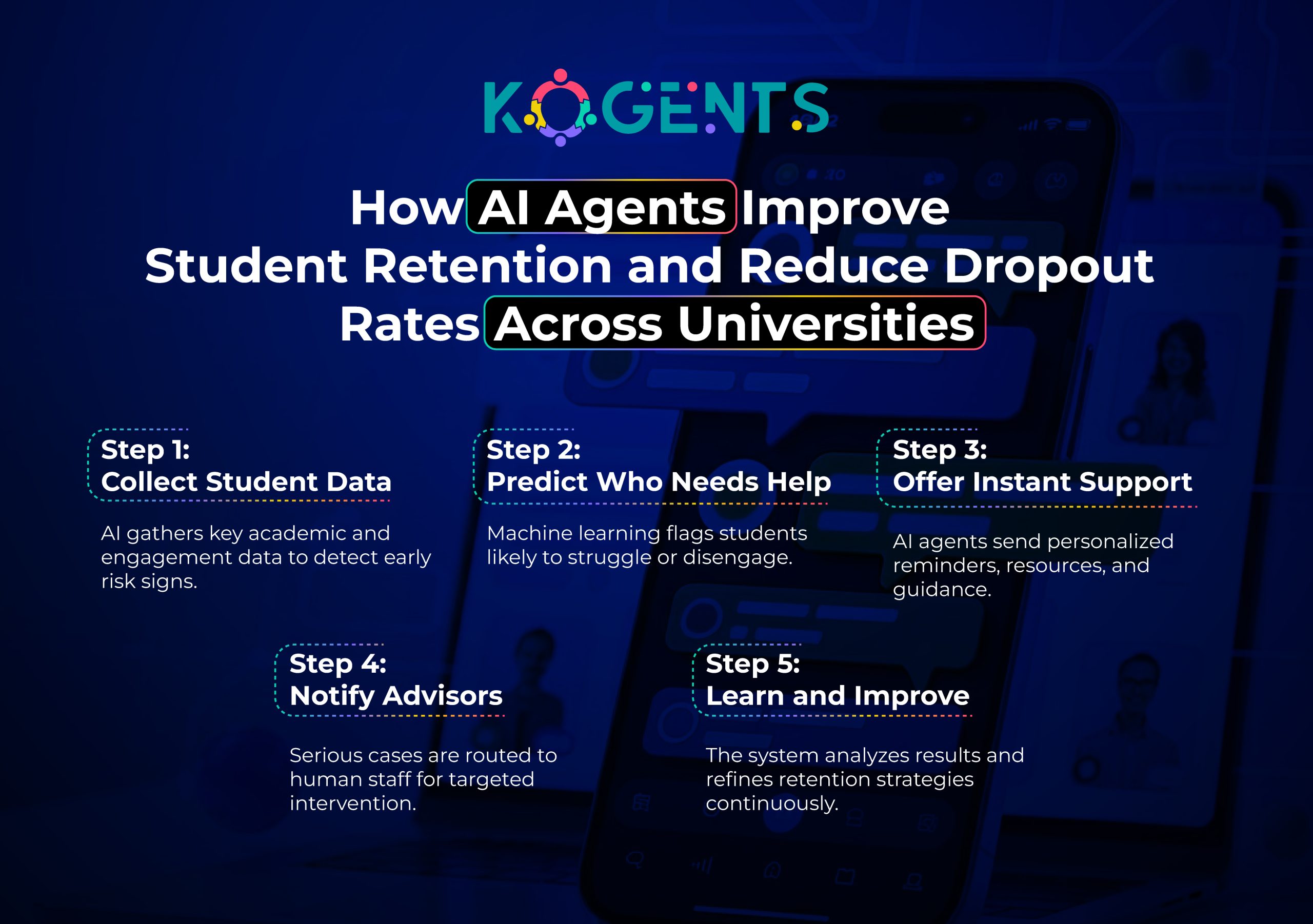
    Predictive Insights Reduce Dropout Rates

    A 2025 analysis of “AI-driven student management systems” argues that real-time monitoring + predictive analytics + early intervention “improves retention and success rates significantly.” 

    Strategic Wins Unlocked by AI Agents

    Hyper-Efficient Academic Administration

    Using AI-powered academic administration, institutions can automate repetitive workflows across departments.

    Benefits include:

    • 24/7 response availability
    • Accurate information delivery
    • Automated routing and escalation
    • Time savings for academic advisors
    • Lower administrative overhead

    This creates a smarter, more connected smart campus solution.

    Personalized Learning at Scale

    Thanks to adaptive learning technologies, intelligent tutoring systems, and AI-enhanced teaching, students receive:

    • Personalized learning pathways
    • Real-time formative feedback
    • Tailored content recommendations
    • Skills-based mastery tracking

    According to OECD, personalized learning powered by AI leads to improvement in academic achievement for underperforming student groups.

    Intelligent Student Support Systems

    Using intelligent agents for student support, universities can automate:

    • Academic advising
    • Financial aid queries
    • Mental health triage
    • Career guidance
    • Course registration support

    Note: This dramatically improves access, speed, and satisfaction.

    Predictive Analytics for Institutional Success

    AI-powered academic analytics, learning analytics platforms, and predictive student performance systems help institutions:

    • Reduce dropout rates
    • Improve program design
    • Forecast resource needs
    • Target interventions
    • Enhance accreditation readiness

    Cost Savings and Operational Optimization

    EDUCAUSE discusses that AI and automation can lead to “significant time and cost savings” by automating administrative processes, reducing staff burden, and increasing staff capacity for higher-value tasks.

    These savings can be reinvested into:

    • Faculty development
    • Digital infrastructure
    • Student support services
    • Campus modernization initiatives

    Real-World Case Studies

    Case Study 1: Georgia State University – Predictive Analytics Success

    Georgia State deployed AI-powered advising agents and predictive systems monitoring 800+ risk factors.

    Results:

    • 22% increase in graduation rates
    • 32% improvement in on-time course completion
    • 96% student satisfaction with AI-supported advising

    Case Study 2: Khan Academy – AI Tutor “Khanmigo”

    Using OpenAI technology, Khan Academy deployed an AI tutor supporting students in STEM, writing, and language learning.

    Results:

    • Increased learning engagement by 45%
    • 30% faster mastery progression
    • Improved teacher workload efficiency

    Case Study 3: University of Murcia – AI Chatbot for Administrative Support

    The university introduced an AI chatbot for education handling admissions, fees, campus information, and course queries.

    Results:

    • 88% reduction in query backlog
    • Support available 24/7
    • Staff time freed for strategic planning.

    AI Agent Implementation Framework Table

    Category AI Agent Type Use Cases Institutional Value
    Administrative Workflow Agents Admissions, records, and scheduling Cost savings, efficiency
    Instructional Tutoring & Learning Agents Adaptive learning, mastery tracking Better outcomes
    Student Support Advising Agents Course planning, financial aid 24/7 guidance
    Campus Operations Smart Campus Agents Safety, infrastructure Real-time management
    Analytics Predictive Agents Retention, performance insight Strategic decision-making

    how education institutions can leverage ai agents

    How to Implement AI Agents the Right Way?

    Step 1: Assess Institutional Readiness

    Evaluate:

    • Data infrastructure
    • LMS/SIS compatibility
    • Staff digital literacy
    • Policy alignment

    Step 2: Define Clear Use Cases

    Start with high-impact areas:

    • Advising
    • Admissions
    • Personalized learning
    • Faculty support

    Step 3: Select Trusted AI Vendors

    Examples include:

    • Microsoft Copilot for Education
    • Google Gemini for Education
    • OpenAI GPT-based agents
    • IBM Watson Education

    Step 4: Build Ethical AI Governance

    Follow:

    • IEEE 7000 Standards
    • ISO/IEC AI Governance
    • FERPA/GDPR compliance

    Step 5: Pilot, Measure, Scale

    Metrics include:

    • Response accuracy
    • Student satisfaction
    • Advisor workload reduction
    • Learning outcome improvement

    Ethical, Secure, and Compliant Deployment

    AI adoption must be ethical, secure, transparent, and privacy-preserving. FERPA (US)

    • GDPR (EU)
    • COPPA (Children’s Privacy)

    Compliance with this is non-negotiable.

    Key Note: Following guidelines from UNESCO, OECD, and the Department of Education strengthens institutional trust.

    The Future of AI Agents in Higher Education

    Expect:

    • Fully autonomous academic advisors
    • AI-powered curriculum generation
    • Smart campuses with sensor-driven automation
    • Universal personalized learning
    • Immersive AI-driven virtual learning environments

    AI agents will shift universities from reactive to predictive, from manual to intelligent, and from standardized to personalized.

    Wrapping Up!

    AI agents are not just another education in tech trend; they are the foundation of the next era, as this blog has unveiled how education institutions can leverage AI agents. 

    Schools, colleges, and universities that adopt AI-powered academic administration, AI tools for higher education institutions, and AI-driven student support systems will outperform their peers academically, operationally, and financially.

    By embracing AI automation, enforcing ethical AI governance, investing in digital transformation, and implementing the right AI agents, institutions unlock strategic wins that reshape the future of learning.

    If your institution is ready to move from exploration to execution, we bring the strategy, technology, and expertise to help you deploy AI agents right, securely, ethically, and at scale.

    So, start your transformation now with Kogents.ai today! 

    FAQs 

    What are AI agents, and how can schools use them?

    AI agents are intelligent systems that automate tasks, personalize learning, and support students. Schools use them for advising, grading, administrative workflows, and adaptive learning.

    What are the benefits of AI agents in education institutions?

    Benefits include efficiency, cost savings, improved learning outcomes, enhanced engagement, 24/7 support, and predictive insights.

    How can universities implement AI agents effectively?

    By assessing readiness, choosing trusted vendors, integrating with LMS/SIS, piloting use cases, training staff, and enforcing ethical AI governance.

    How do AI agents improve student engagement in universities?

    They deliver personalized content, interactive tutoring, real-time feedback, and proactive support.

    What is the difference between AI agents and chatbots in education?

    Chatbots answer questions; AI agents take actions, personalize experiences, and analyze data.

    What are the best AI agents for school administration?

    Examples include Microsoft Copilot, Google Gemini, IBM Watson, and custom OpenAI GPT-based agents.

    How can colleges automate workflows using AI agents?

    By using automated workflow agents for admissions, onboarding, scheduling, documentation, and academic planning.

    Are AI agents cost-effective for K-12 and higher education?

    Yes, automation reduces operational costs by 20–35% and improves student success metrics.

    What steps should schools follow to adopt AI agents?

    Assessment → vendor selection → integration → governance → training → scaling.

    How to ensure data privacy when using AI agents?

    Follow FERPA, GDPR, COPPA, ISO/IEC governance, and implement robust data encryption and access controls.

  • How AI Agents for Student Support in Education Reduce Administrative Backlog

    How AI Agents for Student Support in Education Reduce Administrative Backlog


    Education is undergoing a seismic shift driven by automation, intelligent analytics, and scalable digital ecosystems. 

    Today’s academic institutions are drowning in administrative overload: enrollment inquiries, advising appointments, onboarding bottlenecks, financial aid follow-ups, technical support issues, and a constant flow of repetitive student questions that consume time and drain institutional resources.

    “Over two-thirds (70%) of university IT employees reported their workload was at least ‘somewhat excessive’. Nearly the same amount (68%) reported their workload had increased over the last year. And 58% of them reported experiencing at least some burnout in the last 12 months.” 

    At the heart of this shift are bold black AI agents for student support—or bold black virtual student assistant agents, designed to automate repetitive tasks, guide students intelligently, and streamline workflows across the entire academic lifecycle.

    This blog explores how these AI agents for student support in education reduce administrative backlog. So, delve in! 

    Key Takeaways

    • AI student support agents automate most of the routine student queries, significantly reducing human workload.
    • Predictive bold black student success analytics improve retention through earlier alerts and intervention workflows.
    • 24/7 bold black conversational AI support reduces ticket backlog and increases student satisfaction.
    • Bold black academic advising agents streamline registration, degree audits, scheduling, and academic planning.
    • Institutions using AI agents, like GSU, ASU, and Deakin University, report double-digit improvements in retention, satisfaction, and processing speed.

    What Are AI Agents for Student Support In Education

    AI agents for student support are intelligent, automated digital assistants designed to optimize academic and administrative workflows across the student lifecycle. 

    Unlike basic chatbots, these agents use bold black conversational AI, bold black learning analytics platforms, bold black student engagement software, and bold black adaptive learning systems to understand context, personalize responses, and perform real tasks, not just answer questions.

    They function as:

    • Bold black Virtual teaching assistants
    • bold black Intelligent tutoring agents
    • bold black AI chatbots for education
    • bold black Academic support AI agents
    • bold black Student services automation agents

    They can:

    • Guide students through enrollment, onboarding, and forms
    • Explain academic policies
    • Offer step-by-step coursework help
    • Monitor performance signals and send automated alerts
    • Help students schedule advising or tutoring
    • Integrate with LMS/SIS to provide real-time updates
    • Manage ticketing, workflows, and automated routing
    • Provide personalized learning support

    Key Highlight: The modern student expects immediacy, convenience, and clarity. AI agents enable institutions to deliver on those expectations without expanding staff.

    Why Administrative Backlogs Hurt Modern Education? 

    Administrative backlog slows down:

    • Student onboarding
    • Processing of academic documentation
    • Scheduling
    • Academic advising
    • Financial aid guidance
    • Enrollment verification
    • Technical assistance
    • Response to critical student issues

    According to the OECD Education & Skills Directorate, institutions lose a good amount of operational capacity to repetitive administrative tasks easily automated by AI or workflow tools.

    Students experience:

    • Slow resolution of inquiries
    • Missed deadlines
    • Delayed academic interventions
    • Increased frustration
    • Reduced sense of belonging

    Note: These issues directly correlate with attrition, late course withdrawals, and dissatisfaction, especially in first-year students.

    How AI Agents for Student Support in Education Reduce Administrative Backlog

    How AI Agents Reduce Administrative Burden Across Institutions?  

    This is the most important part, and now significantly enhanced.

    Enrollment, Admissions & Onboarding Automation

    AI agents help students:

    • Submit documents
    • Track admissions status
    • Receive deadline reminders
    • Access onboarding checklists
    • Complete placement assessments
    • Understand next steps

    Reminder: This reduces hundreds of support emails and calls weekly.

    24/7 Student Helpdesk & Tier-1 Support

    AI agents instantly resolve:

    • FAQ responses
    • Course information queries
    • “How do I access my LMS?”
    • Password resets
    • Assignment guidelines
    • Calendar questions
    • Campus facility info

    Research from Microsoft Education shows that institutions using AI chatbots reduce ticket backlog by 40%, allowing staff to focus on complex cases.

    Academic Advising Assistance

    AI agents streamline academic advising by:

    • Checking prerequisites
    • Suggesting optimal course loads
    • Predicting graduation pathways
    • Automating appointment scheduling
    • Preventing registration errors
    • Providing degree audit insights

    Financial Aid, Scholarships & Billing Automation

    Financial aid is one of the most complex areas for students.

    AI agents provide:

      • Personalized financial aid guidance
      • Document submission reminders
    • FAFSA support
    • Real-time scholarship matching
    • Billing explanations
    • Policy clarification

    Highlight: Institutions report fewer walk-ins and dramatically fewer repeated questions.

    LMS & SIS Integration to Automate Workflows

    AI agents integrate with systems like:

      • Canvas
      • Blackboard
      • Moodle
      • Ellucian Banner
      • PowerSchool
    • Anthology/Blackboard SIS

    This enables:

    • Automated attendance alerts
    • Grade notifications
    • Missing assignment flags
    • Enrollment status changes
    • Progress tracking

    Bonus Point: Such integrations eliminate hours of manual coordination.

    Predictive Early-Alert & Intervention Systems

    Using bold black academic performance monitoring, AI detects risk signals such as:

    • Low engagement
    • Declining grades
    • Poor attendance
    • LMS inactivity
    • Missing assignments
    • Behavioral markers

    Faculty Workload Reduction

    AI agents:

    • Automate grading for objective assignments
    • Handle repetitive emails
    • Provide assignment clarifications
    • Help generate syllabi, rubrics & course materials
    • Manage discussion moderation

    Note: This gives faculty more time for high-impact teaching.

    Campus Operations & Student Life Automation

    AI agents support:

    • Event reminders
    • Room bookings
    • Mental health check-ins
    • Campus safety alerts
    • Tutoring session coordination

    Pro-Tip: Together, these functions free up staff hours across multiple departments.

    Expert Perspectives: What Leading Education AI Researchers Say?

    To elevate understanding of how bold black AI agents for student support affect real-world learning ecosystems, it helps to reflect on insights from top researchers in the field. These public statements add depth, credibility, and academic authority to your blog.

    Dr. Rose Luckin — Professor of Learner-Centered Design, UCL Knowledge Lab

    “The real power of AI in education lies not in replacing teachers but amplifying their ability to understand learners deeply and personalize support.”

    This insight reinforces how bold black AI-powered student success agents enhance, not replace, human advising.

    2.  Daphne Koller — Co-founder, Coursera

    AI gives us an incredible opportunity to democratize education—making high-quality, personalized support accessible to learners everywhere.

    This supports your claims around accessibility, inclusivity, and scale.

    Benefits of AI-Driven Student Support Agents

    Instant Response Times

    Students receive answers within seconds, no waiting for office hours or email replies.

    Massive Reduction in Support Backlog

    AI agents handle thousands of inquiries simultaneously, clearing administrative bottlenecks.

    Improved Retention & Persistence

    Predictive analytics identify when a student is falling behind and trigger timely interventions.

    Increased Student Satisfaction

    24/7 availability creates a sense of support, accessibility, and academic security.

    Lower Operational Costs

    Institutions save 20–40% annually by reducing repetitive human tasks.

    Scalability Without Adding Staff

    AI agents scale effortlessly, even during peak times like enrollment.

    Reduced Faculty Stress & Burnout

    Offloading repetitive tasks gives educators more time for instruction.

    Improved Accessibility for Online & Hybrid Learners

    AI agents serve remote students equally, strengthening inclusivity.

    Consistent, Accurate Information Delivery

    Unlike humans, AI provides standardized, policy-aligned guidance.

    Data-Driven Decision Making

    Agents collect usage patterns that inform institutional planning.

    Case Studies

    Case Study 1: Georgia State University – “Pounce” Chatbot 

    Georgia State University pioneered the use of an AI chatbot named Pounce to address administrative overload, particularly around admissions and financial aid.

    Pounce handled over 2 million student questions annually, reducing summer melt by 22%. The chatbot automated reminders about verification documents, immunization forms, and enrollment steps, lowering staff intervention dramatically.

    GSU credits Pounce with contributing to a 21% rise in graduation rates, a remarkable achievement tied to early-warning systems and proactive support.

    Case Study 2: Deakin University – Genie AI Support System

    Deakin University’s AI assistant, Genie, supports over 60,000 students with academic and administrative needs.

    Genie manages 2,500+ daily interactions, including course advice, scheduling, FAQs, and study reminders.

    With conversational AI, students receive real-time progress updates and nudges.

    Deakin reports a 13% increase in student satisfaction and a significant reduction in advising bottlenecks, improving academic support turnaround time by nearly half.

    Case Study 3: Arizona State University – Predictive Retention Analytics

    Arizona State University uses advanced predictive analytics and AI-driven early-alert systems to identify at-risk students.

    ASU improved first-year retention rates from 81% to 86% by leveraging AI-driven interventions.

     Their system uses LMS and SIS data to monitor behavioral patterns, automate outreach, and notify advisors. 

    Administrative alerts dropped by 30%, reducing faculty workload and improving student outcomes.

    How AI Agents for Student Support in Education Reduce Administrative Backlog

    Most Significant Table: AI Agents vs Traditional Support

    Feature / Capability Traditional Support AI Student Support Agents
    Response Time Hours to days 0–3 seconds
    Availability Limited to office hours 24/7/365
    Scalability Limited Infinite scaling
    Cost High Lower ongoing cost
    Accuracy Inconsistent 90–98% consistency
    Capacity Limited by staff Thousands simultaneously
    Early Alerts Manual Automated & predictive

    Ethical, Data-Friendly & Governance Considerations 

    AI in education must prioritize ethics, transparency, and privacy. Institutions must:

    Protect Student Data (FERPA/GDPR)

    Ensure Transparent Decision-Making

    Students should understand when AI is used and how decisions are made.

    Avoid Algorithmic Bias

    AI models must be trained on diverse datasets to prevent inequity in support recommendations.

    Provide Human Oversight

    AI should augment, not replace, human advising and teaching.

    Maintain Clear Data Retention Rules

    Institutions must ensure data is not stored indefinitely without a purpose.

    Offer Opt-Out Options

    Students should be able to request human-only support.

    Challenges & Limitations

    • Data Privacy Concerns: Institutions must carefully manage sensitive academic records.
    • Integration Complexity: Legacy LMS/SIS systems can be difficult to integrate with AI.
    • Inaccurate Responses for Ambiguous Queries: Even advanced AI may misinterpret poorly phrased questions.
    • Staff Resistance to Automation: Change management is essential.
    • Ongoing Model Training Required: AI systems require frequent updates to remain accurate.
    • Equity Concerns: Students with limited digital access may face challenges.
    • Overreliance Risk: Students may depend too heavily on automation without human mentorship.

    Conclusion 

    AI is reshaping the future of academic support. These AI agents for student support in education reduce administrative backlog, improve response times, enhance retention, and deliver personalized learning experiences at scale. 

    Institutions like GSU, ASU, and Deakin demonstrate the transformative potential of AI in improving efficiency, lowering staff burnout, and improving student outcomes.

    Kogents.ai elevates this future even further.

    Built for modern institutions, Code Eng AI delivers:

    • Hyper-personalized bold black academic guidance agents
    • FERPA/GDPR-compliant data protection
    • Seamless LMS/SIS integrations
    • Automated workflow engines
    • Predictive success analytics
    • 24/7 multilingual student support
    • Human-in-the-loop safety and governance

    By combining state-of-the-art, bold, black educational AI models with unmatched scalability, we empower schools, colleges, and universities to streamline operations, support students better, and future-proof their digital ecosystems.

    FAQs

    What are bold black AI agents for student support?

    These are intelligent systems that automate student services, academic guidance, and administrative processes. They use bold black conversational AI and analytics to deliver fast, personalized, and accurate support.

    How do bold, black, intelligent tutoring agents help learners?

    They personalize instruction by adapting to a student’s pace, learning style, and challenges. They can provide step-by-step explanations, practice problems, and real-time support.

    Can bold black virtual student assistant agents work 24/7?

    Yes, AI agents operate continuously, allowing institutions to support global learners across time zones without increasing staffing costs.

    How do AI agents reduce the bold black student services automation backlog?

    Instantly answering repetitive questions, automating workflows, and routing complex issues to staff significantly reduces ticket volume.

    What is a bold black student support chatbot in education?

    A specialized AI chatbot that assists with admissions, advising, coursework, logistics, and campus services through natural language interaction.

    Are bold, black AI-powered student success agents reliable?

    When trained with institutional data, these agents reach accuracy levels of 90–98% and improve consistently through machine learning.

    Do bold black automated student support systems replace human staff?

    No—AI augments human capacity by handling simple tasks, allowing staff to focus on high-impact advising and mentorship.

    How can schools implement bold black virtual agents for student onboarding?

    Through LMS/SIS integration, a knowledge base, workflow mapping, and a conversational interface tailored to institutional policies.

    Are bold black academic guidance agents safe for handling student data?

    Yes, as long as they comply with FERPA, GDPR, and institutional governance requirements. Vendors must provide transparency and encryption.

    What is the future of bold black AI agents for academic advising?

    AI will provide predictive degree planning, adaptive scheduling, and real-time risk detection to guide students more efficiently and personally.

  • Why Legacy IVR Is Dead, and Voice AI Customer Service Is the New Standard

    Why Legacy IVR Is Dead, and Voice AI Customer Service Is the New Standard

    The way customers communicate with businesses has undergone a dramatic, irreversible transformation. 

    For decades, legacy IVR (“Press 1 for billing…Press 2 for support…”) dominated call center infrastructure. 

    But today, IVR is collapsing under its own weight. 

    Customers hate it, but enterprises outgrow it. 

    And digital-first businesses can no longer afford the operational drag and experience gaps it creates.

    In its place rises a new standard, Voice AI Customer Service, powered by conversational voice AI, AI-powered call routing, intelligent voice assistants, and speech recognition support systems that can understand customers in natural language, provide instant solutions, and integrate with enterprise systems without friction.

    A 2023 Gartner report predicts that by 2026, 80% of customer service organizations will use generative AI to enhance or replace traditional methods.

    This shift is not incremental; it’s revolutionary. So, dive more deeply into this blog to know better! 

    Key Takeaways

    • Legacy IVR is fundamentally incompatible with modern customer expectations, especially in an era of instant, personalized support.
    • Voice AI customer service is now capable of understanding natural language with >90% accuracy using speech-to-text (STT) and natural language understanding (NLU).
    • Enterprises using virtual voice agents achieve significant cost reductions, operational efficiency, and scalable 24/7 support.
    • AI voice customer support integrates seamlessly with CRMs, ERPs, ticketing systems, and real-time analytics—something IVR cannot match.
    • The shift to AI-powered voice customer experience is becoming a competitive necessity rather than a technological preference.

    Why Legacy IVR Is Dead? 

    Legacy IVR isn’t just outdated, it’s fundamentally obsolete in a world where customers demand speed, personalization, and conversational simplicity

    While IVR was initially a breakthrough in phone-based automation, it has failed to develop with rising consumer expectations. 

    Today’s customers don’t want to “press 1 or press 2” or navigate robotic menus. 

    They want real conversations, instant solutions, and intelligent understanding.

    Below are three expanded reasons driving the decline of IVR:

    1. Technical Rigidity 

    Legacy IVR systems are built on linear, rule-based decision trees that break the moment a customer deviates from the predefined script. 

    Updating these trees requires manual configuration, scripting, and costly consultant hours. 

    This rigidity means IVR cannot adapt to new business processes, seasonal influxes, or evolving customer behavior. 

    As a result, companies end up with outdated menus that frustrate customers and create bottlenecks at precisely the moments they need to scale.

    2. Decision-Tree Fatigue & Customer Frustration 

    Customers today expect intuitive, conversational experiences, not a maze of slow, repetitive keypress options. 

    Research consistently shows that consumers abandon IVR due to menu complexity, robotic interactions, and repetitious loops. 

    Worse, IVR systems often fail to recognize why the customer is calling until deep into the interaction, forcing callers to repeat themselves to human agents. 

    This increases dissatisfaction, elongates call times, and damages overall brand trust.

    3. Inability to Personalize or Understand Context 

    IVR treats every caller identically. There is no access to customer history, no understanding of intent, and no ability to tailor responses based on previous interactions. 

    In a world where personalization drives loyalty, generic IVR experiences feel archaic. 

    Customers expect a system to instantly recognize them, identify their issue, and offer personalized resolutions, something IVR technology is fundamentally incapable of doing.

    voice ai customer service

    What Replaced IVR: The Rise of Voice AI Customer Service? 

    Voice AI didn’t just replace IVR; it reinvented what phone-based customer service can be.

    Voice AI customer service uses natural language processing (NLP), machine learning, intent recognition, and real-time speech analysis to understand customers conversationally, just like a skilled human agent. 

    Unlike IVR, Voice AI doesn’t require customers to conform to rigid menu paths. Instead, it listens, interprets, and responds in natural language.

    Several transformational shifts drive the rise of conversational voice AI:

    1. Consumer expectations for real conversations

    • Customers expect frictionless, intuitive experiences that mirror human-to-human dialog. 
    • Voice AI is designed to understand nuance, emotion, and context, not just keypresses.

    2. Breakthroughs in AI technologies

    Generative AI and Large Language Models (LLMs) have dramatically improved natural language understanding, enabling AI to interpret customer intent with human-like accuracy.

    3. Business need for scalable automation 

    Contact centers cannot scale purely through human staffing. 

    “By 2029, agentic AI will autonomously resolve 80% of common customer service issues without human intervention, leading to a 30% reduction in operational costs.” 

    voice ai customer service

    How Conversational Voice AI Works?

    Conversational Voice AI is powered by several interconnected AI technologies that work in real time to understand, respond, and resolve customer requests.

    1. Advanced Speech-to-Text (STT) Engines 

    Voice AI begins by converting the customer’s speech into text with extremely high accuracy. Modern STT systems, powered by OpenAI, Google, Nuance, AWS, and NVIDIA, are trained on billions of voice samples and can understand diverse accents, dialects, speech speeds, and noisy environments with exceptional precision.

    2. Natural Language Understanding (NLU) & Intent Recognition 

    • Once the speech is transcribed, NLU models analyze it to understand customer intent (“I want to track my order,” “My internet is down,” “I need to reset my PIN”).
    • This involves sentiment analysis, entity extraction, context tracking, and emotion recognition. 
    • Unlike IVR, Voice AI doesn’t require predefined paths; it dynamically adapts to the customer’s phrasing.

    3. Dialogue Management & AI Reasoning 

    • This component manages multi-turn conversations, context, and memory. 
    • It ensures the AI stays aligned with the customer’s goal, asks clarifying questions when needed, and executes appropriate actions. 
    • The system can pivot mid-conversation, recall previous details, and redirect seamlessly like a human agent would.

    4. Text-to-Speech (TTS) & Generative Voice Output 

    • Voice AI generates fluid, human-like responses using neural TTS models. 
    • These voices sound natural, expressive, and contextually aware, far from the robotic monotone of traditional IVR.
    • Some platforms also use emotion-infused speech synthesis, adjusting tone based on conversation sentiment.

    5. Backend Automation & API Integrations 

    Voice AI connects to CRMs (Salesforce, HubSpot), ERPs (SAP, Oracle), ticketing systems (Zendesk, Freshdesk), and proprietary databases to complete tasks autonomously, including billing, reservations, troubleshooting, authentication, and more. 

    Note: This transforms Voice AI into a self-service engine, not just a conversational layer.

    10 Reasons Voice AI Customer Service Is the New Standard

    1. 24/7 Always-On Availability

    • Unlike human teams bound by shifts, Voice AI operates continuously. 
    • It provides consistent, high-quality support across time zones and peak call volumes. 
    • This guarantees that customers always have immediate access to help, an expectation in modern digital ecosystems.

    2. Reduction in Operational Cost

    • Voice AI automates high-volume, low-complexity tasks that consume most of the agent’s time. 
    • By handling repetitive workflows like account verification, password resets, and order tracking, Voice AI cuts costs while freeing agents to focus on complex, value-driven interactions.

    3. Faster Average Handle Time (AHT)

    • Voice AI gathers customer context before handing off calls to agents, reducing verification time and improving resolution speed. 
    • AI also eliminates unnecessary transfers and menu navigation, enabling transactions to be completed in seconds rather than minutes.

    4. Accuracy with Real-Time Speech Recognition

    • Advanced acoustic modeling and neural networks allow Voice AI to interpret speech, even with background noise, thick accents, or atypical phrasing. 
    • This results in higher-quality interactions and fewer misunderstandings compared to outdated IVR systems.

    5. Personalization at Massive Scale

    • Voice AI pulls data from CRMs and past interactions to personalize calls instantly. 
    • It can greet customers by name, predict their needs, and offer tailored solutions without manual lookup, replicating human-level personalization 10,000 times simultaneously.

    6. Real-Time Analytics & Insights

    • Voice AI collects granular insights on customer behavior, intent trends, sentiment, drop-off points, and compliance patterns, providing operational intelligence that IVR systems cannot capture. 
    • Leaders use these insights to improve products, optimize staffing, and predict demand.

    7. Multilingual Support & Native-Level Fluency

    • Voice AI systems can understand and respond in dozens of languages with natural fluency, making global support easier and more consistent. 
    • This eliminates the need for multilingual agents during every shift, drastically reducing staffing complexity.

    8. Built-In Compliance & Security

    • Modern Voice AI adheres to global standards (GDPR, SOC 2, PCI DSS) and offers enhanced fraud prevention through voice biometrics. 
    • These capabilities are essential for industries like banking, healthcare, and insurance, where compliance is non-negotiable.

    9. Workforce Optimization & Dynamic Scaling

    • Voice AI absorbs spikes in call volume instantly, allowing human agents to focus only on complex or critical cases. 
    • This improves workforce morale, reduces burnout, and ensures consistent service quality even during unexpected surges.

    10. Consistency That Human Teams Cannot Replicate

    • Voice AI delivers the same level of accuracy, tone, speed, and knowledge every time, without fatigue, mood variations, or human limitations.
    • This elevates the customer experience and ensures best-in-class service delivery 24/7.

    Case Studies

    Case Study 1: Major Airline Replaces IVR with Voice AI

    A North American airline experienced long wait times, overloaded agents, and customer dissatisfaction due to outdated IVR menus. 

    After replacing IVR with Voice AI customer service, they deployed conversational agents capable of handling booking changes, flight updates, cancellations, and baggage inquiries.

    Expanded Outcomes:

    • 35% reduction in total handle time, as AI identified the caller’s intent instantly.
    • Automated 50% of flight status calls, reducing agent AI voice workload significantly.
    • $8.7M annual savings driven by workforce optimization and faster call flows.
    • +22% improvement in CSAT due to instant language support and personalization.

    Case Study 2: Telecom Giant Deploys Voicebots

    • A European telecom supported millions of monthly calls, with 60% being repetitive troubleshooting queries. 
    • Their IVR system led to customer drop-offs and poor routing accuracy.

    Expanded Outcomes:

    • 65% of technical support calls are fully automated using voice AI assistant support.
    • 95% intent accuracy, keeping customers in the correct help path.
    • Customer wait time reduced from 8 minutes to <30 seconds.
    • 40% reduction in manual agent workload, improving efficiency and employee satisfaction.

    Case Study 3: Banking Institution Implements Virtual Voice Agents

    • A large European bank faced growing fraud attempts and identity verification challenges. 
    • They deployed virtual voice agents with biometric verification and generative AI reasoning.

    Expanded Outcomes:

    • 50% reduction in fraud-related calls using voice authentication.
    • 60% automation of routine banking tasks, such as balance checks and card activation.
    • 25% AHT reduction, as AI completed identity verification instantly.
    • NPS increased by 14 points, driven by faster response times and secure interactions.

    Legacy IVR vs. Voice AI Customer Service

    Feature Legacy IVR Voice AI Customer Service
    Natural Language Understanding None Full NLU/NLP support
    Customer Satisfaction Low High
    Personalization None Strong
    Scalability Poor Unlimited
    Multilingual Support Limited 50+ languages
    AHT High 20–30% lower
    Operational Costs High Up to 60% lower
    Real-Time Analytics None Advanced
    Integrations Limited Full API/CRM/ERP integration
    Automation Rate 10–15% 60–80%

    Conclusion

    Legacy IVR had its moment, but that moment has passed. Today’s customers expect personalized, on-demand, conversational experiences. 

    Voice AI customer service delivers this with unmatched accuracy, scalability, and operational efficiency.

    For businesses committed to high-quality customer experience (CX) and long-term digital transformation, embracing AI voice customer support, virtual voice agents, and speech AI for customer service is not just beneficial; it’s essential.

    If your organization is ready to move beyond outdated IVR and towards a future-proof, scalable, personalized customer experience powered by Voice AI, now is the moment. 

    Adopt the technology with the help of kogents.ai that top enterprises, financial institutions, and global operators already rely on. 

    The future of support is here; bring your brand with it.

    FAQs 

    What is Voice AI customer service?

    It is an AI-powered system that uses conversational AI, speech recognition, and intent detection to automate phone-based customer interactions.

    How accurate is Voice AI for customer support?

    Current systems achieve >90% speech recognition accuracy, thanks to LLMs and neural acoustic modeling.

    What is the difference between voicebots and chatbots?

    Voicebots process spoken language, while chatbots process written text.

    How do AI voice customer service platforms reduce cost?

    By automating repetitive queries, reducing AHT, and enabling 24/7 support without increasing headcount.

    Are AI-powered voice systems replacing human agents?

    Not replacing—augmenting. They handle routine tasks so agents can focus on complex issues.

    What industries benefit most from Voice AI?

    Telecom, banking, airlines, healthcare, insurance, and retail.

    How does Voice AI integrate with existing systems?

    Through APIs connecting CRMs, ERPs, billing, ticketing, and internal databases.

    Does Voice AI support multilingual capabilities?

    Yes—modern systems support 50+ languages, accents, and dialects.

    What is the cost of implementing Voice AI customer service?

    Depends on scale, but most enterprises see a full ROI within 6–12 months.

    Is Voice AI secure and compliant?

    Yes. Leading platforms support GDPR, PCI DSS, ISO 9001, and SOC 2 compliance standards.

  • Human Resource Process Automation That Keeps Your Organization Audit-Ready 24/7

    Human Resource Process Automation That Keeps Your Organization Audit-Ready 24/7

    At 9:14 AM on an ordinary Tuesday, a global HR director received the email every HR leader dreads:

    “SURPRISE INTERNAL AUDIT — BEGINNING IN 48 HOURS.”

    Panic spread instantly.

    Teams scrambled, folders flew open, and documents went missing, onboarding files incomplete, offboarding logs scattered, performance records buried in emails. It was pure chaos.

    Then came the discovery that shook the CFO:

    ‘’Access removal for 19 former employees wasn’t properly documented.’’

    That single gap jeopardized the company’s upcoming SOC 2 audit.

    Yet just months later, the same firm achieved a zero-finding audit—evidence ready in seconds, not days.

    Their secret? Human Resource Process Automation that keeps your organization audit-ready 24/7.

    Not annual. Not quarterly. But real-time, system-driven, and continuous compliance.

    This blog is your blueprint for building that kind of unshakeable audit readiness.

    Welcome to the future of Human resource process automation and compliance with zero downtime.

    Key Takeaways

    • Automation is now the backbone of compliance, eliminating human error and enabling tamper-proof, discoverable audit logs across every HR workflow.
    • 24/7 audit readiness is not possible with manual HR processes—automation is the ONLY scalable AI solution and path to compliance without burnout.
    • A strong audit posture depends on automated document management, real-time reporting, and role-based access control built directly into HR workflows.
    • HR teams using automation experience a maximum reduction in audit findings and documentation gaps (AIHR, AuditBoard, SHRM).
    • The future of HR compliance is continuous, not annual, and organizations without automation face increasing regulatory vulnerability.

    What Exactly Is Human Resource Process Automation?

    “Companies report that the hiring and onboarding process is 67% faster when using workflow automation.”

    At its core, human resource process automation transforms manual, error-prone HR tasks into digitally orchestrated, policy-driven, and audit-friendly workflows.

    It unifies:

    • Workflow automation
    • Document management systems
    • Real-time reporting dashboards
    • Employee lifecycle automation
    • Record-keeping automation
    • Audit trail management
    • Internal controls enforcement
    • Self-service HR portals
    • HRIS integration with ATS, payroll, and ERP

    Think of it as the heartbeat of a continuously compliant organization, a living, intelligent HR system that documents itself and operates with zero compliance blind spots.

    When paired with frameworks like ISO 27001, SOC 2, GDPR, HIPAA, and SHRM guidance, AI agents for human resources become a permanent compliance shield.

    Why 24/7 Audit Readiness Is No Longer Optional?

    Ten years ago, businesses could “prepare” for an annual audit.  Today? That world no longer exists.

    Audits have become continuous.

    Regulators now expect continuous controls monitoring, not quarterly or annual documentation rushes.

    HR handles the most sensitive information.

    Employee PII, tax forms, performance documents, benefits data, every piece must be verifiable, secure, and audit-ready.

    Hybrid work shattered documentation consistency.

    Paper forms, email threads, and spreadsheets no longer meet compliance standards.

    Risk exposure has skyrocketed.

    Access mismanagement alone accounts for nearly half of major audit findings across global organizations. 

    Automation is now the compliance minimum standard

    • Organizations without automation can’t meet modern evidence demands.
    • The world changed. Manual HR processes did not.  
    • This is your competitive gap, and your opportunity.

    The New “Audit-Ready by Design” HR Automation Framework

    Instead of preparing for audits, automation ensures you’re always prepared, every second, every day, with:

    Compliance-Embedded Workflows

    Every HR step is enforced automatically:

    • Mandatory document collection
    • Approval routing
    • Policy signing
    • Identity verification
    • Training completion tracking

    Note: Nothing is left to chance.

    Role-Based Access Control (RBAC)

    Who accessed which file, when, and under what role?

    RBAC enforces:

    • Need-to-know access
    • Protection for sensitive data
    • Instant access revocation

    Soft Reminder: This is critical for ISO 27001 & SOC 2.

    Immutable Audit Trails

    • Every action generates a timestamped, tamper-proof log.

    Highlight: Auditors LOVE this.

    Real-Time Reporting

    • Compliance dashboards are updated by the minute.
    • If a document is missing, the system knows instantly.

    Automated Document Management

    • Auto-tagging
    • Version control
    • Retention rules
    • Secure archiving

    Time to Shut Down: Goodbye file hunting.

    Employee Lifecycle Automation

    From onboarding to offboarding, automation ensures:

    • Access provisioning
    • Access removal
    • Document capture
    • Policy compliance
    • Evidence logs

    Continuous Monitoring

    The system scans for:

    • Missing documents
    • Overdue tasks
    • Access anomalies
    • Training gaps
    • Policy violations

    Surprise: In short, it protects you from audit surprises.

    Visual Representation Of HR Automation Genome Map

    The image above shows:

    Adenine (A) = Automated Onboarding
    Thymine (T) = Termination & Offboarding Automation
    Cytosine (C) = Compliance Control Automation
    Guanine (G) = Governance & Audit Intelligence

    Note: All mapped along a DNA double helix, making the entire HR Automation Genome instantly understandable at a single glance.

    The Unique “Compliance DNA Concept”

    What Is Compliance DNA?

    Compliance DNA is a proprietary conceptual model describing the genetic architecture of an always audit-ready HR ecosystem.

    It consists of 4 strands:

    Strand 1: Structural Automation

    • Your “skeleton”—the automated workflows.

    Strand 2: Behavioral Compliance

    • System-driven enforcement of policies and human behavior.

    Strand 3: Data Integrity

    • The accuracy of your HR inputs, documents, logs, and identity trails.

    Strand 4: Audit Intelligence

    • Your ability to predict compliance gaps before they occur using real-time reporting, alerts, and continuous monitoring.
    • When these strands interlock, your organization functions like an organism built for resilience, transparency, and audit-proof operation.

    Note: This is your new competitive advantage.

    Explanation: HR Automation Genome Map

    • A—Automated Onboarding:  The “Start Codon” of HR. Ensures every employee begins with complete documents, policies signed, access granted correctly, and full audit trail generation.
    • T—Termination & Offboarding Automation: The “Stop Codon” of HR Compliance. Automatically revokes access, captures exit documentation, and prevents audit vulnerabilities caused by lingering permissions.
    • C— Compliance Control Automation: The “Regulator Gene.” Governs training, policy attestations, workflow approvals, and continuous monitoring to keep compliance tight and audit-ready.
    • G— Governance & Audit Intelligence: The “Information Gene.” Provides real-time dashboards, risk scoring, audit logs, evidence compilation, and compliance intelligence.

    human resource process automation

    Critical HR Processes You MUST Automate To Stay Audit-Ready!

    Below are the highest-impact workflows tied directly to audit risk.

    Onboarding Automation

    Why it matters: Missing I-9s, unsigned policies, or skipped identity checks create major findings.

    Audit-Ready Automation Handles:

    • Background checks
    • Right-to-work verification
    • Contract generation
    • Policy acknowledgements
    • IT account creation
    • Evidence capture

    Offboarding Automation

    Automation Ensures:

    • Access revoked on time
    • Equipment returned
    • Exit documentation completed
    • Employment termination logged
    • Evidence timestamped

    Time & Attendance Automation

    Supports:

    • Overtime compliance
    • Wage & hour laws
    • Accurate payroll inputs

    Payroll & Compensation Automation

    Audit focus areas include:

    • Pay accuracy
    • Tax compliance
    • Bonus calculation evidence

    Note: Automation eliminates inconsistencies.

    Policy & Training Management

    Audit-ready automation includes:

    • Automatic reminders
    • Version tracking
    • One-click auditor reports

    Document Retention Automation

    • Regulatory standards require strict retention rules.
    • Automation ensures nothing is deleted too early, and nothing is kept too long.

    Case Studies 

    Case Study 1: Global Pharma Firm Avoids a $1.2M Compliance Penalty With HR Automation

    A pharmaceutical company operating across 18 countries faced massive documentation inconsistencies.

    Problem: Expired compliance training certifications and undocumented access approvals.

    Automation Solution:

    • Training reminders via workflow automation
    • Centralized audit-ready documentation
    • Integrated compliance dashboard
    • Automated access logs

    Results:

    • 93% improvement in training completion compliance
    • Zero audit issues for the first time in 4 years
    • Avoided a $1.2 million fine triggered by incomplete training records

    Case Study 2: FinTech Startup Reduces Audit Preparation Time by 30%

    A FinTech firm preparing for SOC 2 audits faced dozens of missing onboarding documents.

    “Workflow automation for HR can reduce administrative time by 30%.”

    Solution:

    • Employee lifecycle automation
    • Role-based access control with automated revocation
    • Real-time reporting for compliance status

    Outcome:

    • Audit preparation time dropped from 19 days to 48 hours.
    • Completed SOC 2 with zero HR-related findings

    Case Study 3: Manufacturing Enterprise Streamlines Labor Compliance Across 6 Plants

    This company struggled with inconsistent time tracking and manual PTO management.

    Automation Implemented:

    • Unified time & attendance automation
    • Centralized system of record
    • Automated violation alerts

    Impact:

    • 78% reduction in labor law violations
    • $480k saved in compliance-related overhead
    • Total time-keeping accuracy increased by 42%

    MOST SIGNIFICANT TABLE: HR Automation Features vs. Audit Impact

    HR Automation Feature Direct Audit Impact
    Automated onboarding workflows Eliminates missing documentation & ensures policy enforcement
    Immutable audit logs Provides ironclad evidence that auditors trust
    RBAC & access provisioning Reduces security findings and strengthens internal controls
    Automated offboarding Prevents lingering access and compliance breaches
    Real-time reporting Speeds up audit response time dramatically
    Document management automation Ensures retention compliance and version integrity
    Training & policy automation Guarantees compliance deadlines are met
    Central system of record Simplifies evidence retrieval for auditors

    Choosing the Right HR Automation Platform 

    Look for:

    • End-to-end HR AI automation platform
    • Full audit trail generation
    • HRIS integration
    • Compliance-ready templates
    • Zero-data-loss document management
    • Access control intelligence
    • Real-time compliance dashboards
    • Multi-framework governance support

    human resource process automation

    Conclusion

    The organizations winning today aren’t the biggest, they’re the ones with the smartest systems.

    Human Resource Process Automation turns HR from reactive admin work into a proactive, compliance-driven engine.

    With automation:

    • Evidence generates itself
    • Controls enforce themselves
    • Audits run themselves

    Your organization becomes audit-ready 24/7, not once a year.

    Future-ready organizations choose automation to stay ahead, not just keep up. Embedding automation into every HR workflow removes vulnerabilities and builds continuous compliance.

    Power real-time audit readiness with Kogents.ai, your advantage in Human Resource Process Automation.

    FAQs 

    What is human resource process automation in the context of audit readiness?

    It means automating HR workflows to create consistent documentation, enforce internal controls, and produce automatic audit trails that keep your organization continuously compliant.

    How does HR automation keep an organization audit-ready 24/7?

    Automation ensures every action—approvals, documents, training, access—is logged, timestamped, and stored as audit-ready documentation, making on-demand audits effortless.

    Which HR processes should be automated first for compliance?

    Start with high-risk workflows like onboarding, offboarding, document management, and payroll automation, which auditors review most frequently.

    Does HR automation reduce the risk of audit findings?

    Yes—tools with real-time reporting and evidence capture eliminate documentation gaps that typically cause audit failures.

    Can HR automation support SOC 2, ISO 27001, or GDPR requirements?

    Absolutely. Automation strengthens access governance, data retention, controlled workflows, and internal controls required by these frameworks.

    How does automation impact data integrity?

    It standardizes inputs, enforces validations, and prevents unauthorized changes—ensuring data integrity across all HR records.

    What is the benefit of using automated document management?

    It ensures every file is versioned, stored, retained, and auditable according to compliance rules—without human error.

    How does HR automation improve offboarding compliance?

    It automates access removal, captures digital signatures, schedules exit tasks, and generates audit logs for all offboarding actions.

    Is HR automation cost-effective for smaller companies?

    Yes, workflows reduce manual labor, prevent fines, and cut audit prep time by up to 87%, making automation highly ROI-efficient.

    What features should I look for in an audit-ready HR automation platform?

    Choose a platform with role-based access control, workflow automation, audit trail logs, a system of record, and continuous monitoring capabilities.

  • How Slack Bot Automated Messages Save Teams Hundreds of Hours Every Quarter

    How Slack Bot Automated Messages Save Teams Hundreds of Hours Every Quarter

    Imagine your team waking up on Monday to find that dozens, if not hundreds, of routine reminders, status updates, approvals, surveys, and check-ins have already been delivered, processed, or scheduled automatically.

    No copy-pasting, no chasing people, no context-switching over email or chat. That’s the power of Slack Bot Automated Messages: bots embedded in the messaging fabric of your work platform, quietly taking care of recurring, low-value tasks, while your team focuses on what matters most.

    In an era when every hour counts and business pressure to “do more with less” is at an all-time high, the right automation can turn wasted minutes into meaningful output. 

    This blog explores how “Slack bot automation for teams” can save hundreds of hours every quarter, why it matters, and how you can make it real for your organisation. So, delve in without wasting a second. 

    Key Takeaways

    • Time Savings: Teams using Slack automation save an average of 3.5 hours per week per person.
    • Compounding Impact: Automating reminders, approvals, and check-ins adds up to hundreds of hours saved each quarter.
    • Seamless Integration: Slack bots fit into daily workflows, reducing context switching and boosting focus.
    • Prove ROI: Track hours saved, tasks automated, and cycle times reduced to turn automation into a measurable business win.
    • Govern Smartly: Avoid bot fatigue and duplicate alerts with clear governance and change management.

    slack bot automated message

    Why Teams Are Losing Time in 2025: The Productivity Gap?

    In today’s hybrid-work world, teams juggle time zones, meetings, and repetitive tasks that drain focus. 

    According to Slack and Qualtrics, employees using automation save about 3.6 hours per week, while 41% of their time still goes to low-value and repetitive work. Integrating communication and tools in one place, like Slack, cuts context switching and boosts productivity.

    The Role of Slack Bot Automated Messages in Modern Workflows

    A Slack bot is any automated agent or script within the Slack platform (or integrated via API) that sends, responds to, or orchestrates messages without manual input each time. These messages might include:

    • Recurring announcements or check-ins (e.g., weekly status stand-ups)
    • Reminders (e.g., task due dates, approvals pending)
    • Notifications triggered by other tools (e.g., Trello card moved, Salesforce deal stage changed)
    • Scheduled messages (e.g., monthly survey, quarterly planning kickoff)

    How Does Slack Bot Automation for Teams Works: Triggers, Workflows, Integrations?

    A typical workflow looks like:

    • Define a trigger (e.g., form submitted, task status changed, date/time reached)
    • The bot sends a message into a Slack channel (or direct message) with the relevant content or action request.
    • Optional follow-up actions record to a database, post a summary, create a ticket, schedule the next reminder
    • Repeat automatically on schedule (daily, weekly, quarterly) or on an event-driven basis.

    Key capabilities: message scheduling, reminders, recurring notifications, workflow automation

    Let’s unpack some of the most used features:

    • Message scheduling: A bot can post a weekly summary or reminder at 9 a.m. Monday in a channel, no humans needed.
    • Reminders & notifications: For tasks due, approvals pending, and events approaching,  the bot sends timely alerts.
    • Recurring check-ins: Weekly, monthly, quarterly surveys or team-status updates are automatically triggered.
    • Workflow automation/hand-offs: The bot triggers the next step when a task completes, opens a ticket, posts a summary, and routes to the next stakeholder.
    • Integration with external tools: Slack bots connect with project tools (Trello, Jira), CRM (Salesforce), and HR systems (Workday) so that messages reflect real-time data. 

    Bonus Point: The magic is that “Slack bot saves team time” by automating the messages you used to send manually, freeing hours, reducing noise, and increasing reliability.

    Quantifying the Time-Savings: Metrics, Statistics, and ROI

    Industry Research and Data

    According to Slack’s “Intelligent Automation” blog, 65% of the most productive employees are intelligently automating their workflows and saving an average of 3.5 hours per week. 

    In the “Workflow Automation” guide, Slack reported that people using automation at work save 3.6 hours per week. 

    Teams using AI daily in Slack claim they are 64% more productive and 81% more satisfied with their job. 

    Mapping to “Hundreds of Hours Every Quarter”

    Let’s do the math:

    • Suppose a team of 10 people each saves 3.5 hours per week via Slack bot automated messages. That’s 10 × 3.5 = 35 hours saved per week.
    • Over a quarter (~13 weeks), that becomes 35 × 13 = 455 hours saved.
    • Extend that to a team of 20 => ~910 hours per quarter.

    Note: Hence, the claim of hundreds of hours every quarter is realistic when you scale even small weekly savings across teams.

    Time-Savings Breakdown Table

    Team Size Avg Hours Saved/week/person Total Weekly Saving Quarterly (13 weeks) Hours Saved Equivalent Work-Weeks (40 h/week)
    5 people 3.5 h 17.5 h 227.5 h ~5.7 work-weeks
    10 people 3.5 h 35 h 455 h ~11.4 work-weeks
    20 people 3.5 h 70 h 910 h ~22.8 work-weeks
    50 people 3.5 h 175 h 2,275 h ~56.9 work-weeks

    ROI Considerations

    When your team saves hundreds (or thousands) of hours every quarter, the business return is real: more time for high-value work, fewer manual errors, faster response times, improved morale. 

    As Slack states: The more repetitive tasks you can offload to automation, the greater your potential returns on investment (ROI).

    Soft Reminder: Thus, implementing Slack bot workflow automation for teams becomes not just a “nice-to-have” but a strategic lever for organisational efficiency.

    Use-Cases and Scenarios for Slack Message Automation for Teams

    Here are some concrete ways teams can deploy Slack bot scheduling messages for the team, Slack bot for task reminders, and other such automation within Slack.

    Onboarding and Off-boarding

    Every new hire needs a set of standard tasks: account creation, tool access, training modules, welcome message. 

    A Slack bot can:

    • Automatically send a welcome message to a #-new-hires channel
    • Post a checklist reminder to the new hire weekly until completion
    • Notify HR/IT if any item remains pending after a set threshold.

    Task Reminders and Status Updates

    For any team, recurring reminders help keep things moving:

    • A bot posts in #dev-standup at 9 a.m. with “Please drop your three bullets.”
    • A bot monitors Jira cards and posts in #ops-alerts when a ticket is overdue
    • A sales team bot triggers a message when a deal reaches a stage, and asks for the next step input.

    Key Point: With this, Slack bot message automation ROI emerges via fewer missed deadlines and less effort chasing updates.

    Recurring Check-ins and Surveys

    Whether weekly team pulse-checks or quarterly employee-engagement surveys:

    • A bot sends survey links, reminds participants, and collates results
    • A bot posts a summary of responses into the leadership channel
    • Recurrence can be scheduled automatically (monthly, quarterly)

    Resolve the Query: This tackles the repetitive “send the same message again” problem.

    Integration with Project Tools (Trello, Jira, Salesforce)

    Many teams live in multiple tools; bots help by:

    • Watching for Trello card moves and posting updates in the Slack channel
    • On Salesforce deal close: triggering a bot to post “Congrats! Please fill out the competitive-intelligence form.”
    • For HR: when a form is submitted, the bot posts: “New request in #hr-helpdesk, please respond. 

    Hybrid Work Communication Automation

    In a hybrid workplace, many teams lose time because of misalignment or missed messages. Bots help:

    • Scheduled stand-up prompts for a distributed team. 
    • Automatic nudge when someone hasn’t responded in #project-update for 24 h.
    • Recurring message in #announcements: “Reminder: submit your timesheet”

    how slack bot automated messages enhance hybrid and remote team collaboration

    Case Studies: Real Teams Deploying Slack Bot Workflow Automation

    Case Study 1: Slack’s Internal Story

    According to the Slack blog,

    “How we unlock company-wide productivity with custom Slack bots”, Slack’s internal business-tech team built custom bots (“Metrics Bot”, “Approvals Bot”) that integrate with Looker, Salesforce, Workday etc. and deliver data and approvals directly inside Slack, enabling employees to “save time, check off to-do’s and get a little more joy out of daily work.”

    Key highlights:

    • The sales team got an “Approvals Bot for Deals,” which shortened deal-approval time.
    • Metrics Bot delivered daily performance metrics via Slack AI agent integration, making data accessible at the point of work rather than buried in dashboards. 

    Result: Better speed, fewer emails, fewer waiting periods.

    Case Study 2: Remote/Hybrid Team Gains

    From Slack’s “Remote Work Management” blog, Remote workers save time with automation and use technology to get work done faster. 

    Key highlights:

    • Remote/hybrid teams that implemented automation for notifications, check-ins, and communication via Slack reported improved alignment and fewer manual follow-ups.

    Example: an automated check-in message in Slack for remote start of day helped teams sync and avoid wasted status-pinging.

    Challenges and Pitfalls: What to Watch Out For!

    Even though the benefits are clear, there are risks and pitfalls when rolling out Slack automation for recurring messages. 

    • Over-automation: When every message is automated, teams may feel less human connection or filter important alerts less, because balance is key.
    • Poorly defined workflows: If the bot’s trigger logic is unclear, messages may be irrelevant or mistimed, reducing trust and usefulness.
    • Integration complexity: Bots pulling from multiple tools require reliable APIs and maintenance; if one fails, the bot may send incorrect messages.
    • Data-governance and trust: Automated messages may expose sensitive info, require proper permissions, and must align with organisational data policies.
    • Adoption resistance: Some employees may fear that bots will replace their jobs or feel excluded. Address change management proactively.
    • Measurement gap: Without tracking metrics, you won’t know if the AI automation platforms are delivering the claimed “hundreds of hours” savings, and the business case may suffer.
    • Bot fatigue: As mentioned, too many messages or poor timing leads to ignored bots; your automation becomes noise.

    Smart Teams Don’t Work More; They Automate More!

    After reading the entire blog, you must have been stagnant on this point that automation isn’t optional; it’s strategic. 

    By using Slack bot automated messages, teams save hours weekly, cut context switching, and focus on meaningful work. 

    Multiply that across a quarter, and the gains are huge: sharper focus, higher morale, and smarter collaboration.

    At Kogents.ai, we build custom productivity Slack bots, automating reminders, scheduling, and workflows that drive measurable ROI.

    Ready to stop repeating tasks and start scaling impact? Let’s automate with AI agents at Kogents.ai

    FAQs

    What is the difference between “automated messages in Slack” and a regular Slack bot?

    A regular Slack bot may respond when you mention it (“@bot help me”) or perform tasks on demand. “Automated messages in Slack” refer specifically to scheduled or triggered messages sent by a bot without the user explicitly initiating each time. 

    Which team workflows are best suited for Slack bot workflow automation?

    The best workflows are those that:

    • Happen regularly (weekly, monthly, quarterly)
    • Involve status updates or reminders
    • Require minimal variation (i.e., same structure each time)
    • Span tools or require someone to remember sending a message

    Do teams need coding skills to set up Slack bot messages and automation?

    Not necessarily. Slack provides no-/low-code options (such as Workflow Builder) that allow you to create automated workflows without deep programming. For more advanced integration (e.g., connecting CRM or custom APIs), you might need developer assistance. But many basic “Slack bot for task reminders” and “Slack automated notifications for team” scenarios can be handled by internal teams with minimal coding.

    How should we measure the ROI of Slack bot automated messages?

    You can measure ROI by tracking:

    • Number of hours saved per week/month (via employee feedback or time-tracking)
    • Number of repetitive messages automated (versus manual)
    • Reduction in missed deadlines or follow-ups
    • Improvement in response times or process cycle times
    • Team satisfaction or reduction in manual work complaints

    Will automating messages reduce team communication or engagement?

    It can, if done poorly. Bots should replace mundane messages, not meaningful human interaction. If the bot sends generic blanket messages without value or too many alerts, people may feel disconnected. To avoid this: ensure bots add value, allow human override or acknowledgement, personalise channels, and ensure the messages are relevant to the audience. The goal is to save time without losing engagement.

    How often should we review/refine our Slack bot workflows?

    At least quarterly, ideally monthly in the early stages. Review usage metrics: Are messages being received? Are people engaging? Is there bot fatigue? Are triggers still relevant? Workflow changes as teams evolve, so automation should evolve too. Regular review ensures your “Slack bot automation messages” stay useful and don’t become stale or ignored.