Tag: enterprise ai development

  • Deploying a healthcare chatbot with PHI-safe data handling and clinician escalation

    Deploying a healthcare chatbot with PHI-safe data handling and clinician escalation

    Well, we all know that in the past decade, healthcare has shifted from reactive treatment to proactive, data-driven engagement. 

    Patients now expect real-time access to health information and immediate support, something traditional systems often can’t deliver.

    Having said that, the emergence of healthcare chatbots, a conversational AI capable of providing 24/7 AI patient scheduling, support, symptom triage, medication reminders, and administrative assistance.

    Powered by natural language processing (NLP) and machine learning (ML), these systems are helping clinics and startups scale patient engagement at a fraction of the cost.

    Whether it’s a virtual health assistant in telemedicine or a symptom checker chatbot for primary care, conversational AI is no longer an experiment; it’s a clinical necessity.

    Key Takeaways

    • PHI protection and encryption are the cornerstones of patient trust.
    • Clinician escalation safeguards care quality and prevents harm.
    • Ethical and explainable AI builds credibility and regulatory confidence.
    • Integration with EHR and FHIR standards unlocks scalability.
    • The best healthcare chatbots enhance clinicians — they never replace them.

    What Is A Healthcare Chatbot?

    A healthcare chatbot (also known as a medical chatbot or AI chatbot for healthcare) is an intelligent conversational system designed to simulate human dialogue in healthcare contexts. 

    It assists with everything from answering health-related queries to connecting patients with clinicians.

    These bots can:

    • Conduct symptom assessments using structured triage flows.
    • Schedule and confirm appointments.
    • Deliver personalized wellness advice and medication reminders.
    • Help clinicians document visits and prepare patient notes.
    • Integrate securely with EHR systems to update patient records automatically.
    Key Highlight: Chatbots like Ada Health, Babylon Health, and K Health have already proven that when paired with proper oversight and PHI-safe infrastructure, these systems can improve accessibility, reduce clinician burnout, and extend healthcare delivery to underserved regions.

    healthcare chatbot

    The Non-Negotiable Role of PHI-Safe Data Handling

    Every healthcare interaction involves Protected Health Information (PHI), and protecting it isn’t optional. 

    PHI includes any information that can identify a patient, such as names, birthdates, lab results, and chat transcripts.

    HIPAA, GDPR, and similar global regulations make it clear: mishandling PHI can destroy patient trust and expose organizations to massive penalties. 

    The average healthcare data breach now costs over $10 million, according to IBM’s 2024 Data Breach Report.

    To safeguard PHI, follow these best practices:

    • Encrypt everything. Use AES-256 for data at rest and TLS 1.3 for transmission.
    • Limit access. Only authorized roles should handle PHI, enforced via RBAC and MFA.
    • Log every event. Maintain immutable audit trails of access and data use.
    • Minimize collection. Gather only essential data and anonymize when possible.
    • Establish BAAs. Ensure all vendors (e.g., hosting or NLP providers) sign Business Associate Agreements for shared liability.

    Soft Advice: Building a PHI-safe chatbot isn’t just about compliance; it’s about long-term credibility. In digital health, trust is your ultimate brand equity.

    The findings, highlighted in the Medscape & HIMSS AI Adoption by Health Systems Report 2024, reveal that 86% of respondents already leverage AI in their medical organizations, with 60% recognizing its ability to uncover health patterns and diagnoses beyond human detection. However, concerns persist, with 72% citing data privacy as a significant risk.

    Best Practice Description / Implementation Example Tools or Methods
    Encrypt Everything Use AES-256 for data at rest, TLS 1.3 for transmission AWS KMS, Azure Key Vault
    Limit Access Apply role-based access control (RBAC) and MFA Okta, Auth0
    Log Every Event Maintain immutable audit trails Splunk, CloudTrail
    Minimize Collection Store only essential data, anonymize when possible De-identification pipelines
    Establish BAAs Ensure shared vendor liability AWS, Microsoft, or Google Healthcare Cloud

    Architecting a Secure and Compliant Healthcare Chatbot

    Think of your healthcare chatbot architecture as a fortress: every layer must defend patient privacy and clinical integrity.

    The system typically includes:

    1. User Interface (UI): Web or mobile front-end with HTTPS encryption and consent prompts.
    2. NLP/AI Engine: Interprets user queries through intent recognition and entity extraction.
    3. Clinical Logic Module: Encodes triage protocols, guidelines, and escalation triggers.
    4. Integration Layer: Connects securely with EHR, FHIR, or HL7 systems.
    5. Security Layer: Encrypts data, authenticates users, and logs every transaction.
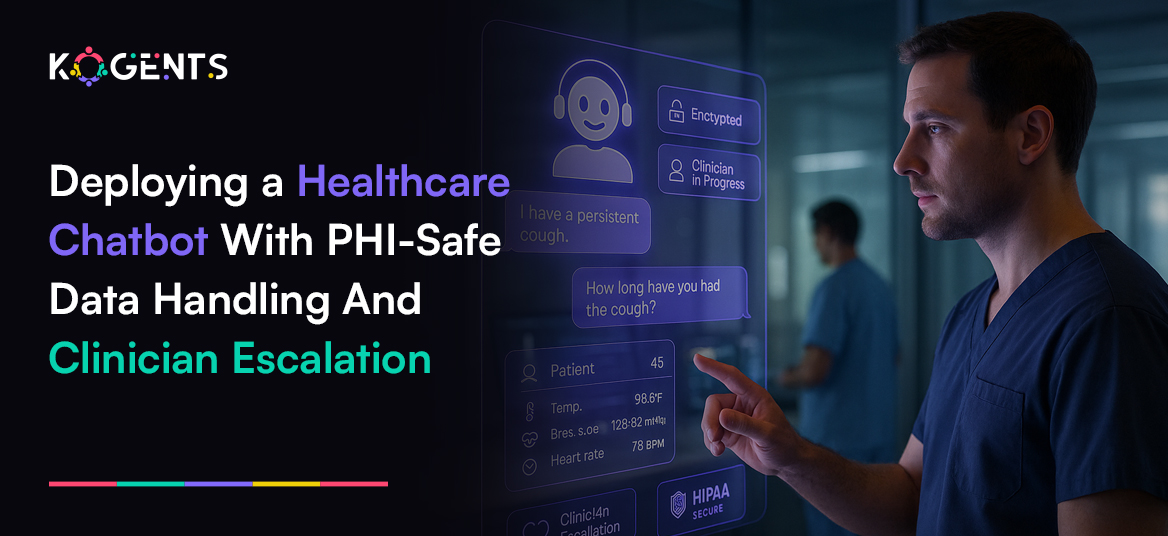
    6. Clinician Escalation Layer: Detects uncertainty or risk and transfers the conversation to human professionals.

    Clinician Escalation: The Human-in-the-Loop Safety Net

    A chatbot, no matter how advanced, must know its limits and when to escalate to a clinician.

    Case In Scenario: When a patient types “I’m dizzy and my heart hurts,” the chatbot should not attempt self-diagnosis. Instead, it should automatically route the case to a licensed clinician through a secure communication channel.

    The escalation workflow looks like this:

    1. Risk Detection: NLP identifies high-risk keywords or emotional distress cues.
    2. Confidence Threshold: If confidence falls below a set level (e.g., 70%), escalation triggers.
    3. Routing: The chatbot securely forwards the case to an on-call clinician.
    4. Human Oversight: A provider takes over, ensuring patient safety.
    5. Audit Trail: Every action is recorded for compliance review.

    This hybrid model, combining AI triage with clinician escalation, reflects the philosophy behind AI ethics in healthcare: automation should support, not replace, human judgment.

    Case in point: The PEACH Chatbot used this model for post-surgical care and reduced emergency readmissions, which depicts the power of AI done responsibly.

    Designing Ethical and Trustworthy Conversations

    Ethical design is the foundation of trustworthy healthcare AI. The World Health Organization (WHO) and European Commission AI Ethics Framework both emphasize transparency, fairness, and accountability as guiding principles for all medical chatbots.

    Here’s how to apply them:

    • Transparency: Make it clear that users are talking to a chatbot, not a clinician.
    • Consent: Always ask permission before storing or processing PHI.
    • Empathy: Train the chatbot’s tone for compassion, especially for mental health contexts.
    • Accessibility: Ensure the chatbot supports multiple languages and adheres to WCAG accessibility standards.
    • Explainability: Use Explainable AI (XAI) techniques so clinicians understand why a chatbot recommended an action.
    Example:

    “I’m your virtual health assistant. I can help you track symptoms, but I’m not a doctor. If your condition seems serious, I’ll connect you with a licensed professional.”

    Integrating Chatbots into Clinical and Business Workflows

    For healthcare entrepreneurs, integration is where AI becomes ROI.

    • In clinical settings, chatbots can automate patient intake, schedule follow-ups, verify insurance, and update records in real time
    • In business operations, AI agents for healthcare automation can manage customer support, streamline workflows, and handle repetitive queries that previously required staff.
    • Imagine a small clinic that deploys a virtual medical assistant capable of answering basic patient questions, collecting vitals, and updating the EHR. 
    • For solopreneurs, this scalability is even more impactful. A mental health coach, for instance, can use a digital health assistant to monitor client progress, send reminders, and even check in automatically after sessions, all within a compliant, secure ecosystem.
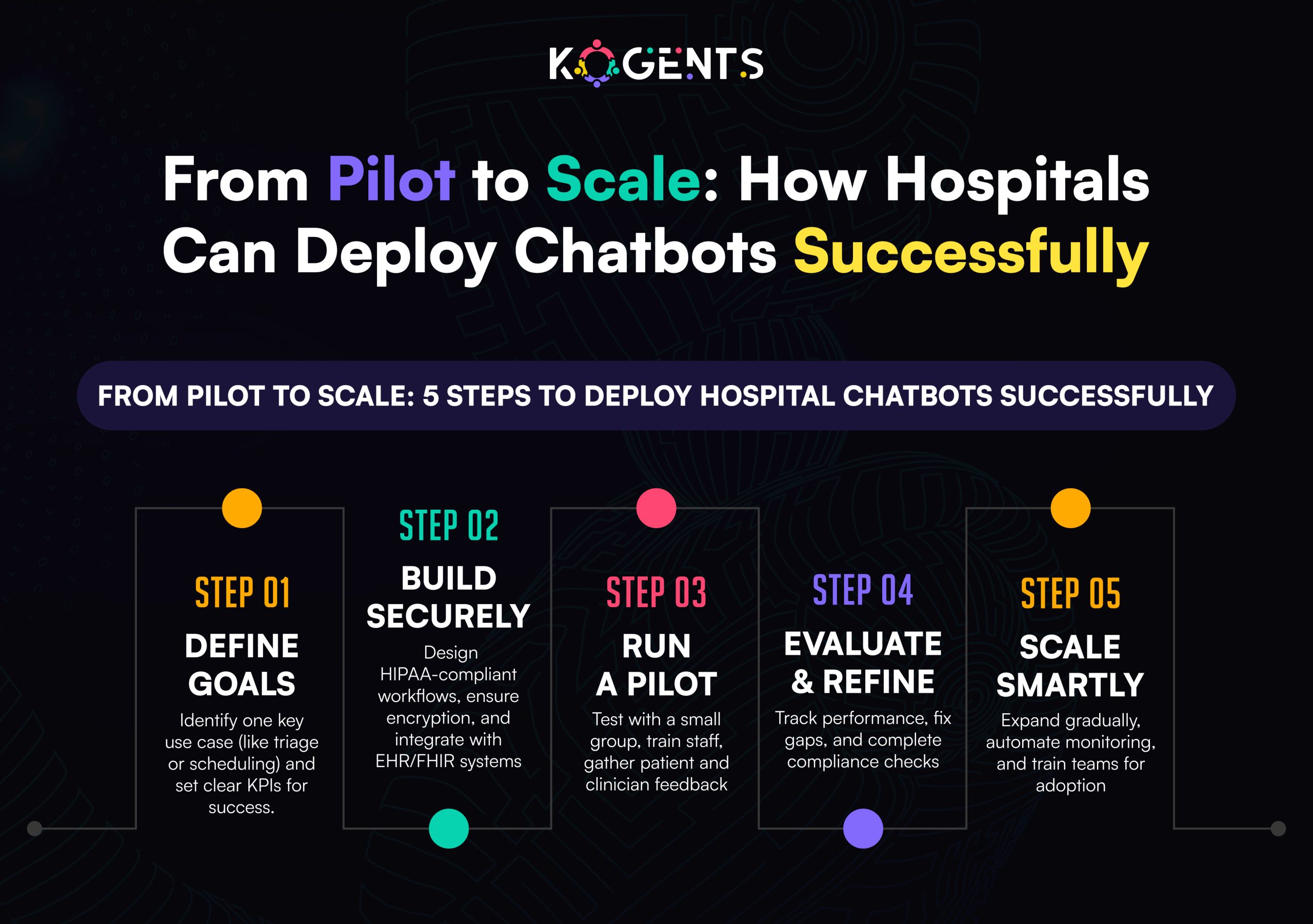
    healthcare chatbot

    From Prototype to Production: The Deployment Roadmap

    A great idea means little without a disciplined deployment process. Here’s a roadmap to move from concept to compliant launch.

    1. Define the Purpose. Choose a clear focus, triage, mental health support, or chronic disease management.
    2. Secure Infrastructure. Host on a HIPAA-compliant cloud such as AWS HealthLake or Microsoft Azure for Healthcare.
    3. Compliance Audit. Conduct internal HIPAA/GDPR assessments and draft BAAs with all vendors.
    4. Model Training. Fine-tune NLP models on de-identified medical data for accuracy and fairness.
    5. Testing. Simulate diverse user scenarios with clinician feedback loops.
    6. Pilot Launch. Start with a small user base; measure engagement, safety, and escalation success.
    7. Monitor Continuously. Establish a DevSecOps pipeline for ongoing updates, penetration testing, and PHI audits.

    Remember: in healthcare AI, deployment isn’t the finish line; it’s the start of an ongoing safety commitment.

    Real-World Use Cases

    • Telehealth Providers use chatbots for patient screening before virtual appointments.
    • Clinics deploy chatbots to manage scheduling, intake, and feedback collection.
    • Mental Health Platforms rely on conversational agents for journaling and emotion tracking.
    • Pharmacies integrate chatbots to help patients with refill reminders and side-effect reporting.
    • Insurance Companies use bots to guide users through claims and benefits questions.

    Challenges & Limitations

    Building a PHI-safe healthcare chatbot comes with challenges that extend beyond coding:

    • Data Breaches: Even small configuration errors can leak PHI. Continuous security audits are essential.
    • Bias & Fairness: AI must be trained on diverse datasets to avoid discrimination in triage results.
    • Regulatory Complexity: Laws evolve quickly — e.g., upcoming FDA AI/ML Action Plan updates.
    • Clinician Resistance: Staff adoption depends on transparency and clinical value.
    • Ethical Grey Zones: Mental health AI must tread carefully around AI doctor diagnosis and crisis intervention.

    The Future: Hybrid Intelligence in Digital Health

    Tomorrow’s healthcare chatbots will do far more than text-based conversations.
    They’ll interpret voice, biometrics, and sensor data; interact across languages; and collaborate in real time with care teams.

    Emerging trends shaping this future include:

    • Multimodal AI combining text, speech, and imagery for richer diagnostics.
    • Federated learning that improves model performance across hospitals without sharing PHI.
    • Voice-enabled virtual assistants for aging populations.
    • Proactive health management powered by wearable data integration.
    • AI governance dashboards to monitor fairness and safety metrics continuously.

    Case Study: MedConnect AI

    MedConnect AI, a 2024 startup, launched a HIPAA-compliant healthcare chatbot for rural clinics.

    The platform integrated FHIR APIs for EHR access, used AES-256 encryption, and featured built-in clinician escalation for symptom triage.

    Within six months, results were dramatic:

    • Average triage time dropped from 7 minutes to 2.
    • Clinician workload decreased by 35%.
    • PHI breach rate = 0.
    • Patient satisfaction rose to 93%.

    MedConnect’s founders, both solopreneurs,  proved that responsible design and clinician collaboration can make AI both ethical and profitable.

    Responsible AI is the Future of Healthcare! 

    Deploying a PHI-safe healthcare chatbot is not merely a technological achievement; it’s a statement of ethical commitment and trust.

    When an entrepreneur designs with privacy in mind, clinicians engage confidently, and patients share openly.

    When human oversight is embedded into automation, care becomes not only faster but safer. And when startups align with regulations from HIPAA to GDPR, they don’t just comply — they lead.

    Ultimately, a successful healthcare chatbot isn’t measured by its sophistication, but by its compassion, security, and reliability

    These three pillars — privacy, empathy, and clinical escalation- define the difference between a tool that chats and one that truly cares.

    If you’re ready to deploy AI that patients and providers can trust, now is the time to act. So, get in touch with the team at Kogents.ai to build secure, compliant, and human-centered AI systems. Call us at +1 (267) 248-9454 or drop an email at info@kogents.ai

    FAQs

    What is a healthcare chatbot, and how is it used in clinics?

    A healthcare chatbot is an AI-powered conversational system that assists patients and clinicians through natural dialogue. It’s used for appointment booking, symptom triage, medication reminders, and health education — improving accessibility and efficiency.

    How can I ensure my healthcare chatbot is HIPAA-compliant?

    To be HIPAA-compliant, encrypt all PHI using AES-256 and TLS 1.3, use access controls with multi-factor authentication, maintain audit trails, and ensure vendors sign BAAs. Regular third-party security audits are also essential.

    What is PHI-safe data handling, and why does it matter?

    PHI-safe handling ensures patient data is protected from unauthorized access or misuse. It’s vital because breaches can lead to regulatory fines and loss of patient trust. Proper encryption, data minimization, and anonymization safeguard privacy.

    How does clinician escalation work in healthcare chatbots?

    Clinician escalation activates when the AI detects risk or uncertainty — for example, when a user reports severe symptoms. The chatbot transfers the case to a licensed clinician through secure systems, ensuring timely and safe intervention.

    Are AI chatbots replacing doctors or nurses?

    No. AI chatbots are designed to support healthcare professionals, not replace them. They handle repetitive or low-risk tasks, allowing clinicians to focus on high-value care that requires human judgment and empathy.

    What technologies power a modern healthcare chatbot?

    These bots use natural language processing (NLP), machine learning, LLMs, FHIR API integration, and encryption frameworks. Tools like Microsoft Azure for Healthcare or AWS HealthLake provide HIPAA-ready infrastructure.

    What are the most common healthcare chatbot use cases?

    Top use cases include symptom triage, appointment scheduling, chronic disease management, mental health support, and patient education. Startups also use chatbots for intake automation and remote monitoring.

    How can startups deploy a chatbot safely without a large team?

    Entrepreneurs can leverage pre-certified cloud services (AWS, Azure) with HIPAA compliance built in, use no-code bot builders that support FHIR integration, and outsource compliance audits to third-party firms specializing in healthcare AI.

    What are the biggest risks in deploying a healthcare chatbot?

    Risks include PHI breaches, algorithmic bias, hallucinated medical advice, and poor clinician integration. These can be mitigated through human-in-the-loop escalation, regular model retraining, and strict data governance.

    What’s the future of AI chatbots in healthcare?

    The next generation of healthcare chatbots will be multimodal, combining voice, vision, and predictive analytics. They’ll proactively alert clinicians to health risks and work as co-pilots in clinical care — blending automation with empathy.
     

  • Developing AI software as a medical device with compliant MLOps and monitoring

    Developing AI software as a medical device with compliant MLOps and monitoring

    The number of AI-enabled medical devices approved by the FDA has grown exponentially in recent years, and half of all devices (467 devices [51.7%]) were submitted by North American–based applicants, with most being registered in the US. 

    This statistical fact clearly depicts that the future of medicine is digital, and at its core lies Software as a Medical Device (SaMD), an emerging category of regulated software that performs medical functions without being part of a physical device. 

    From AI-powered imaging diagnostics to digital stethoscopes and mental health monitoring apps, SaMD is transforming how clinicians diagnose, predict, and personalize treatment.

    For entrepreneurs and solopreneurs in health tech, the opportunity is massive, but so is the regulatory responsibility. 

    Developing AI SaMD requires mastering compliance, building trust with regulators like the FDA and European Commission, and maintaining consistent performance post-deployment. 

    The foundation for achieving this is compliant MLOps, a framework that unites machine learning development, regulatory governance, and post-market monitoring into a single, auditable lifecycle.

    This guide breaks down everything you need to know about developing AI Software as a Medical Device, how to implement compliant MLOps pipelines, and how to ensure your solution meets global regulatory standards while remaining agile and innovative.

    Key Takeaways

    • Software as a Medical Device (SaMD) is revolutionizing healthcare through AI and digital innovation.
    • Compliance and quality management aren’t optional; they’re the backbone of trust.
    • MLOps for AI SaMD ensures traceability, validation, and continuous monitoring.
    • Post-market vigilance guarantees patient safety and regulatory confidence.
    • For entrepreneurs, early adoption of compliance frameworks translates into faster approvals and sustainable growth.

    Decode The Term: Software as a Medical Device (SaMD)?

    The International Medical Device Regulators Forum (IMDRF) defines Software as a Medical Device (SaMD) as “software intended to be used for one or more medical purposes that perform these purposes without being part of a hardware medical device.”

    SaMD vs. SiMD

    It’s important to distinguish between:

    • SaMD (Software as a Medical Device): Standalone software like an AI radiology model, remote health monitoring tool, or mental health app.
    • SiMD (Software in a Medical Device): Embedded software inside a device, such as firmware in an insulin pump.

    Regulatory Frameworks

    Different regions define and regulate SaMD differently:

    • United States (FDA): Overseen by the Center for Devices and Radiological Health (CDRH). Submissions fall under 510(k), De Novo, or PMA pathways.
    • European Union (EU MDR): Defines “Medical Device Software (MDSW)” under MDR Article 2. Classification is risk-based (Class I–III) depending on intended use.
    • IMDRF: Provides global harmonization through risk-based frameworks and clinical evaluation guidance.

    Examples of SaMD

    • Aidoc – AI imaging triage tool cleared by FDA.
    • Eko Health – Digital stethoscope with AI for cardiac analysis.
    • Caption Health – AI for ultrasound guidance.

    Note: These examples prove that software alone, when properly validated and regulated, can truly become a clinical-grade medical device.

    software as a medical device

    The Rise of AI in SaMD Development

    Artificial Intelligence (AI) has accelerated the SaMD landscape, enabling predictive AI doctor diagnosis and real-time patient insights. 

    AI and Machine Learning (ML) models can detect subtle patterns invisible to human eyes, powering clinical decision support (CDS) tools and automated diagnostics.

    However, AI also introduces complexity. Unlike static rule-based software, AI models learn and evolve.

    A model that performs well today might degrade tomorrow if data distributions change, a phenomenon known as data drift.

    That’s why regulators require strong governance over every step of the AI lifecycle.

    To manage this, the FDA, IMDRF, and WHO are promoting Good Machine Learning Practice (GMLP) principles for data quality, transparency, reproducibility, and monitoring.

    GMLP bridges AI innovation and regulatory reliability.

    In essence, AI SaMD = Software + AI Model + Medical Purpose + Regulation.
    The secret to sustaining this equilibrium lies in compliant MLOps, the operational discipline that ensures ML systems are built, deployed, and maintained under quality management and regulatory control.

    Regulatory Foundations for SaMD

    • Developing SaMD is not just about writing code; it’s about engineering trust. 
    • Regulators demand that every software component be traceable, validated, and risk-managed. 

    Let’s explore the foundational standards that guide this process.

    Core SaMD Standards

    Standard Purpose
    IEC 62304 Defines the software life-cycle processes for medical device software. Covers design, implementation, verification, and maintenance.
    ISO 14971 Focuses on risk management for medical devices — identifying, evaluating, and mitigating hazards.
    ISO 13485 Defines quality management systems (QMS) specific to medical device organizations.
    IEC 82304-1 Addresses health software product safety and security.
    ISO/IEC 27001 Manages data security and integrity, critical for clinical datasets.

    Key Regulatory Elements

    1. Intended Use – Clearly define the medical purpose.
    2. Risk Classification – Based on AI patient scheduling impact.
    3. Design Controls – Traceability from requirements → implementation → verification.
    4. Validation & Verification (V&V) – Ensures that the software meets its intended use.
    5. Clinical Evaluation – Demonstrate safety and performance through evidence.
    6. Post-Market Surveillance (PMS) – Monitor and report performance post-deployment.

    Pro Tip: Start with IEC 62304 mapping early, as even small startups can embed traceability and risk management into their Git workflows with tools like Greenlight Guru or Orcanos QMS.

    Building Compliant MLOps Pipelines for AI SaMD

    MLOps (Machine Learning Operations) applies DevOps principles to ML development, but in regulated environments, it also embeds compliance, validation, and quality management.

    A compliant MLOps pipeline ensures every dataset, model version, and metric powering AI agents for healthcare automation is traceable, validated, and reproducible.

    Key Components of Compliant MLOps

    1. Data Governance & Lineage
      • Maintain detailed records of dataset sources, preprocessing steps, and labeling methods.
      • Use data versioning tools (like DVC or MLflow) integrated with QMS for audit readiness.
    2. Model Version Control & Traceability
      • Every model iteration must link back to specific training data, hyperparameters, and validation results.
      • Maintain a Model Card summarizing performance, limitations, and clinical use conditions.
    3. Validation & Verification Automation
      • Automate unit, integration, and regression testing.
      • Integrate automated pipelines with Design Review and Risk Management checkpoints.
    4. Change Management
      • Document every change affecting safety or performance.
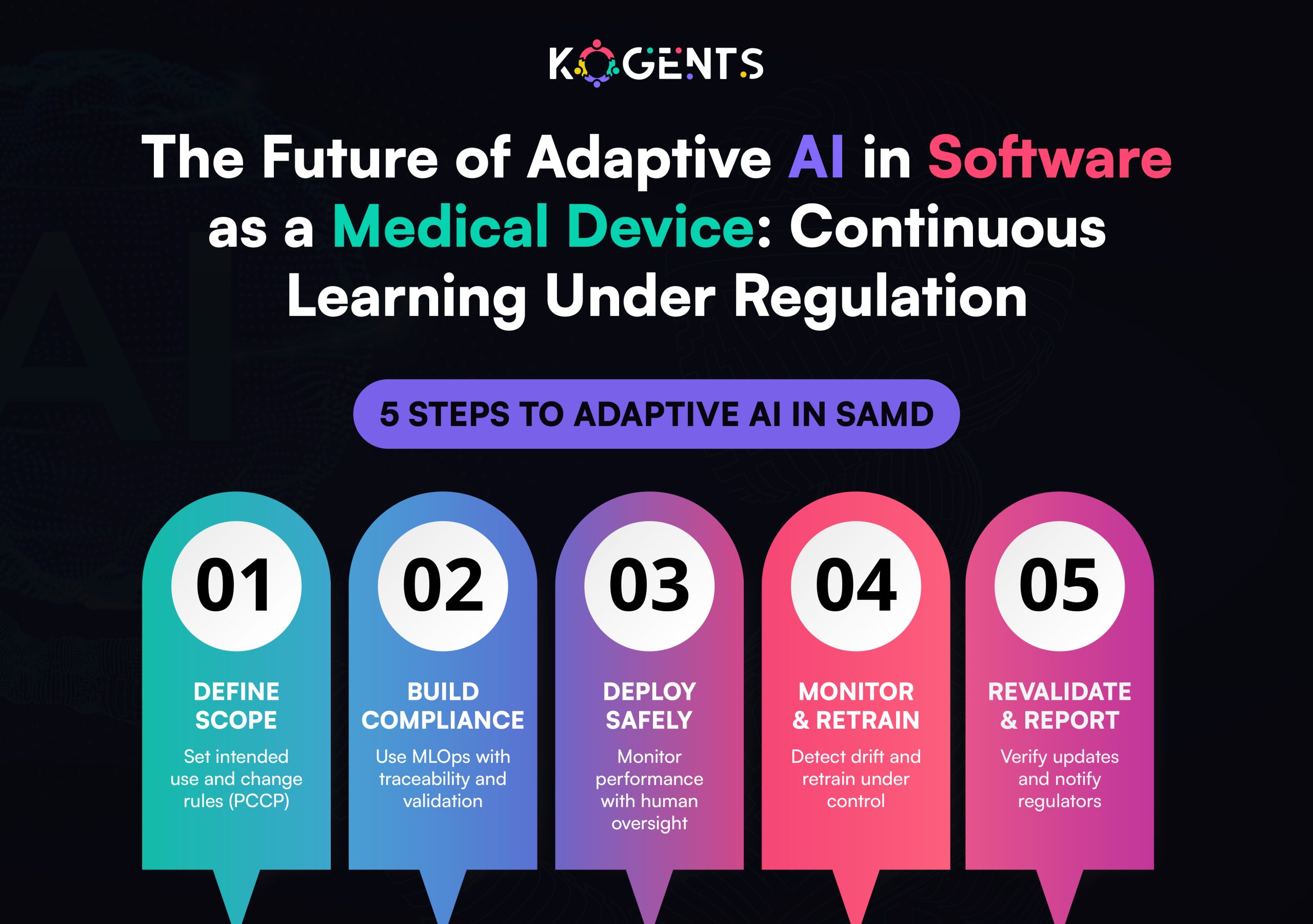
      • Follow the FDA’s Predetermined Change Control Plan (PCCP) for AI models that evolve post-approval.
    5. Auditability & Reproducibility
      • Store logs, metrics, and artifacts to enable end-to-end audit trails for regulators.

    Compliant MLOps Tools

    • MLflow / Kubeflow for experiment tracking.
    • Greenlight Guru for medical QMS integration.
    • Azure ML, AWS SageMaker, or GCP Vertex AI with compliance configurations.

    Continuous Monitoring and Post-Market Surveillance

    Once your AI SaMD is deployed, your compliance journey doesn’t end; it begins. Regulators expect post-market surveillance (PMS) to ensure continued safety, performance, and real-world accuracy.

    Post-Market Monitoring in Practice

    • Performance Drift Monitoring: Track accuracy, precision, sensitivity/specificity over time.
    • Data Drift Detection: Monitor input data for shifts in distribution or quality.
    • Bias Detection: Evaluate demographic fairness continuously.
    • Adverse Event Reporting: Log and report incidents as per regulatory timelines.
    • Explainability Tracking: Ensure clinicians understand AI outputs.

    Automation Opportunities

    Integrate monitoring into MLOps dashboards:

    • Trigger alerts when metrics drop below thresholds.
    • Automate retraining workflows under a controlled, validated process.
    • Generate Regulatory PMS Reports periodically.

    Global Best Practices

    Both the FDA and EU MDR emphasize continuous oversight, not one-time approval. The FDA’s Total Product Lifecycle (TPLC) framework aligns perfectly with this model, blending pre-market validation with post-market vigilance.

    Challenges and Pitfalls in AI SaMD Development

    Even the best teams face challenges in balancing innovation with compliance.

    Common Challenges

    1. Data Scarcity and Privacy Constraints
      • Medical datasets are limited and often fragmented.
      • Compliance with HIPAA (US) and GDPR (EU) is mandatory.
    2. Algorithmic Bias and Explainability
      • Black-box models risk clinical mistrust. Regulators demand transparency.
    3. Validation Across Environments
      • Models must generalize across clinical settings, devices, and populations.
    4. Interoperability Barriers
      • Integration with hospital EHRs (Epic, Cerner, FHIR APIs) can be complex.
    5. High Regulatory Costs
      • Verification, documentation, and QMS setup require upfront investment.

    Avoid These Compliance Mistakes

    • Skipping early risk classification.
    • Missing traceability between requirements and tests.
    • Ignoring usability engineering (human factors).
    • Deploying unvalidated updates to production models.

    Soft Reminder: Adopt a “compliance-by-design” approach, embed validation gates within your CI/CD pipelines rather than adding them later.

    AI SaMD vs. Traditional Medical Software

    Aspect Traditional Medical Software AI-Enabled SaMD
    Decision Logic Rule-based, deterministic Data-driven, adaptive
    Regulation Model Fixed function validation Continuous oversight required
    Validation Process One-time premarket validation Continuous validation & monitoring
    Risk Management Stable Dynamic (requires active reclassification for updates)
    Maintenance Periodic updates Continuous learning and retraining
    Oversight Manual Automated through MLOps & audit trails
    Transparency Clear logic flow Requires model explainability tools

    Case Study Spotlight: From Startup to FDA Clearance

    Case: Aidoc — AI Imaging Diagnostics

    Aidoc, founded in Israel, built an AI-based diagnostic platform that helps radiologists detect critical findings in CT scans. Its journey offers a masterclass in AI SaMD lifecycle excellence.

    1. Intended Use: Assist radiologists by prioritizing scans with potential abnormalities.
    2. Risk Classification: Moderate risk (FDA Class II).
    3. Clinical Data Pipeline: Trained on millions of de-identified medical images under HIPAA compliance.
    4. Model Validation: Conducted multi-site clinical trials to prove sensitivity/specificity.
    5. Regulatory Submission: Submitted through the FDA’s 510(k) pathway.
    6. Post-Market Surveillance: Continuous model performance tracking with real-time dashboards.

    Result: Aidoc became one of the first AI radiology SaMDs cleared by the FDA, setting a precedent for AI-enabled diagnostics worldwide.

    Takeaway for Entrepreneurs: Invest early in compliance infrastructure. Aidoc didn’t treat validation as an afterthought; it built compliance into its product DNA.

    Best Practices & ROI for Entrepreneurs and Solopreneurs

    For founders entering the medical AI space, compliance can seem overwhelming. But early adherence to SaMD best practices can save time, money, and regulatory pain later.

    Top Best Practices

    • Start with intended use clarity:  Your regulatory pathway depends on it.
    • Build a minimal QMS early: Even small startups can use templates aligned to ISO 13485.
    • Implement traceability from day one: Link code commits to design controls and risk items.
    • Use validated tools: Only deploy AI models in qualified cloud environments.
    • Engage regulatory consultants: They can shorten approval cycles dramatically.

    Mini Case Example: A digital pathology startup using compliant MLOps reduced its FDA submission cycle from 18 months to 12 months, saving over $500,000 in development delays.

    The Future of AI Software as a Medical Device

    The next generation of SaMD will be adaptive, interoperable, and context-aware. Regulators are already preparing for this evolution.

    Emerging Trends

    1. Adaptive AI Regulation: FDA’s forthcoming framework for continuously learning models.
    2. Federated Learning: Privacy-preserving model training across hospitals.
    3. Real-World Evidence (RWE): Using real-world performance data for post-market validation.
    4. FHIR & HL7 Integration: Seamless exchange between SaMD and EHR systems.
    5. Global Harmonization: IMDRF, WHO, and regional bodies aligning AI medical device standards.

    Pro Tip: Compliance is not bureaucracy; it’s a competitive advantage in winning trust, funding, and regulatory approval.

    software as a medical device

     Before You Leave! 

    The line between software and medical device has blurred, and for good reason. As AI Software as a Medical Device becomes central to modern medicine, entrepreneurs who embrace compliant MLOps and continuous monitoring will define the future of digital health.

    Building SaMD isn’t just about compliance; it’s about saving lives with software that’s safe, effective, and transparent. 

    Whether you’re a solopreneur developing a diagnostic app or a startup founder scaling AI in healthcare, regulatory alignment will amplify your innovation, not hinder it.

    Look how Kogents.ai empowers entrepreneurs, solopreneurs, and healthcare providers to build compliant AI medical devices. 

    FAQs

    How do you ensure continuous monitoring after SaMD deployment?

    Post-market surveillance (PMS) includes monitoring data and performance drift, detecting bias, logging adverse events, and generating periodic regulatory reports. Automation in MLOps pipelines enables real-time alerts and retraining workflows.

    What are the common challenges in developing AI-based SaMD?

    Challenges include limited clinical datasets, data privacy (HIPAA, GDPR), algorithmic bias, validation across multiple environments, interoperability with EHRs, and high regulatory costs.

    What is the difference between traditional medical software and AI-enabled SaMD?

    Traditional software uses fixed, rule-based logic and requires one-time validation.
    AI-enabled SaMD is adaptive, requiring continuous validation, risk reassessment, and ongoing monitoring for fairness and reliability.

    What is Software as a Medical Device (SaMD)?

    SaMD refers to software that performs medical functions — such as diagnosis, monitoring, or treatment — without being part of a physical medical device. Examples include AI imaging tools, digital stethoscopes, and mental health monitoring apps.

    How is SaMD different from Software in a Medical Device (SiMD)?

    SaMD operates independently of hardware, like an AI-based radiology model. SiMD, on the other hand, is embedded in a physical device, such as firmware in an insulin pump.

  • Enterprise AI Development that Reduces Integration Risk for Global Teams

    Enterprise AI Development that Reduces Integration Risk for Global Teams

    Do you know that the new era of enterprise AI development is not defined by who can build the smartest model, but by who can integrate AI securely, seamlessly, and globally?

    For entrepreneurs, solopreneurs, and enterprise leaders managing distributed teams, the challenge is no longer whether AI works; it’s whether it works everywhere, across multiple systems, time zones, and compliance frameworks.

    AI pilots often thrive in isolation but stumble when integrated across ERP systems, CRMs, or regional data infrastructures.

    This is where the true craft of AI development for enterprises begins: reducing integration risk without slowing innovation.

    In this comprehensive guide, we’ll explore how custom enterprise AI development empowers organizations to scale across borders safely, ethically, and efficiently. So, let’s delve into this guide.

    Key Takeaways

    • Understand the true nature of integration risk in enterprise AI projects.
    • Learn the complete enterprise AI development lifecycle, from discovery to global deployment.
    • Explore actionable methods to mitigate integration risk across regions and tech stacks.
      Compare in-house vs vendor-led approaches in one concise table. 
    • Study credible enterprise AI solutions development case studies with measurable ROI.
    • End with strategic imperatives to future-proof your AI roadmap.

    The Hidden Bottleneck: Integration Risk in Enterprise AI 

    Integration risk is the silent killer of enterprise AI success. While teams often celebrate model accuracy or training speed, the true battlefield lies in how well AI integrates with existing systems, finance, HR, supply chain, customer service, or compliance databases.

    For enterprise-level AI development, even a minor schema mismatch or version conflict between APIs can lead to cascading failures. 

    This is a challenge the best agentic AI company models anticipate and mitigate through modular orchestration and adaptive governance.

    Consider global rollouts where teams use different data standards, privacy laws, or latency thresholds; these variations multiply integration risk exponentially.

    Large enterprise AI development projects often fail not because models are poor, but because integration pipelines break under real-world complexity. 

    As systems evolve, dependencies drift, and governance frameworks tighten, AI must adapt continuously. 

    This is why modern AI integration for legacy systems demands modular architecture, strict governance, and resilient orchestration layers, the backbone of reliable global AI deployment.

    Generative AI has moved beyond buzz to become an essential tool across content creation, software development, and product design. In 2025, 65% of organizations report active use of generative AI, up from around 32% the previous year.

    custom enterprise ai development

    The Enterprise AI Development Lifecycle

    A well-structured enterprise AI development lifecycle ensures AI systems progress from concept to global scalability with minimal friction. 

    Below is a narrative walkthrough of each stage and how integration risk can be mitigated throughout the process.

    Stage 1: Discovery and Strategy

    • This phase involves defining business objectives, identifying AI opportunities, and evaluating system readiness. 
    • Entrepreneurs should perform a data and systems audit to assess integration touchpoints. 
    • Understanding where APIs, databases, and workflows intersect reveals early risk zones.

    Stage 2: Data Architecture and Preparation

    • Once objectives are clear, teams build the data pipelines and architectures to fuel AI. 
    • Integration risk emerges when data originates from multiple global systems. 
    • To mitigate this, adopt standardized data schemas, establish ETL consistency (e.g., Apache Airflow, Kafka), and create metadata catalogs for traceability.

    Stage 3: Model Development and Experimentation

    • Here, machine learning (ML) and deep learning models are built, tested, and refined.
    • While technical accuracy is key, integration foresight matters equally. 
    • Define consistent model input-output schemas, set up feature stores, and ensure models remain modular, capable of integrating with multiple business functions.

    Stage 4: Testing and Validation

    • AI must be validated both technically and operationally. 
    • Conduct integration sandbox tests simulating real-world environments: regional data rules, latency, and system load. 
    • This stage also validates AI governance and compliance, security, and explainability (XAI) requirements to ensure compliance across jurisdictions.

    Stage 5: Enterprise AI Deployment

    • The deployment phase is where many teams encounter friction. 
    • Using a microservices architecture and containerization (Docker, Kubernetes) reduces dependency conflicts. 
    • Each AI service can be updated independently, supporting scalable enterprise AI development across global teams. 
    • Incorporate CI/CD pipelines and blue-green or canary deployments for safe rollouts.

    Stage 6: Integration and Scaling Across Regions

    • After successful deployment, scaling AI globally introduces new integration risks: latency, localization, and cross-region compliance. 
    • Adopt federated learning for sensitive data, regional caching for latency reduction, and cloud-agnostic orchestration to ensure resilience in hybrid or multi-cloud setups.

    Stage 7: Monitoring, Governance, and Continuous Improvement

    • AI never “ends.” Models drift, data evolves, and systems change. 
    • Set up monitoring pipelines, AIOps dashboards, and feedback loops. 
    • Monitor data drift, bias, and performance. 
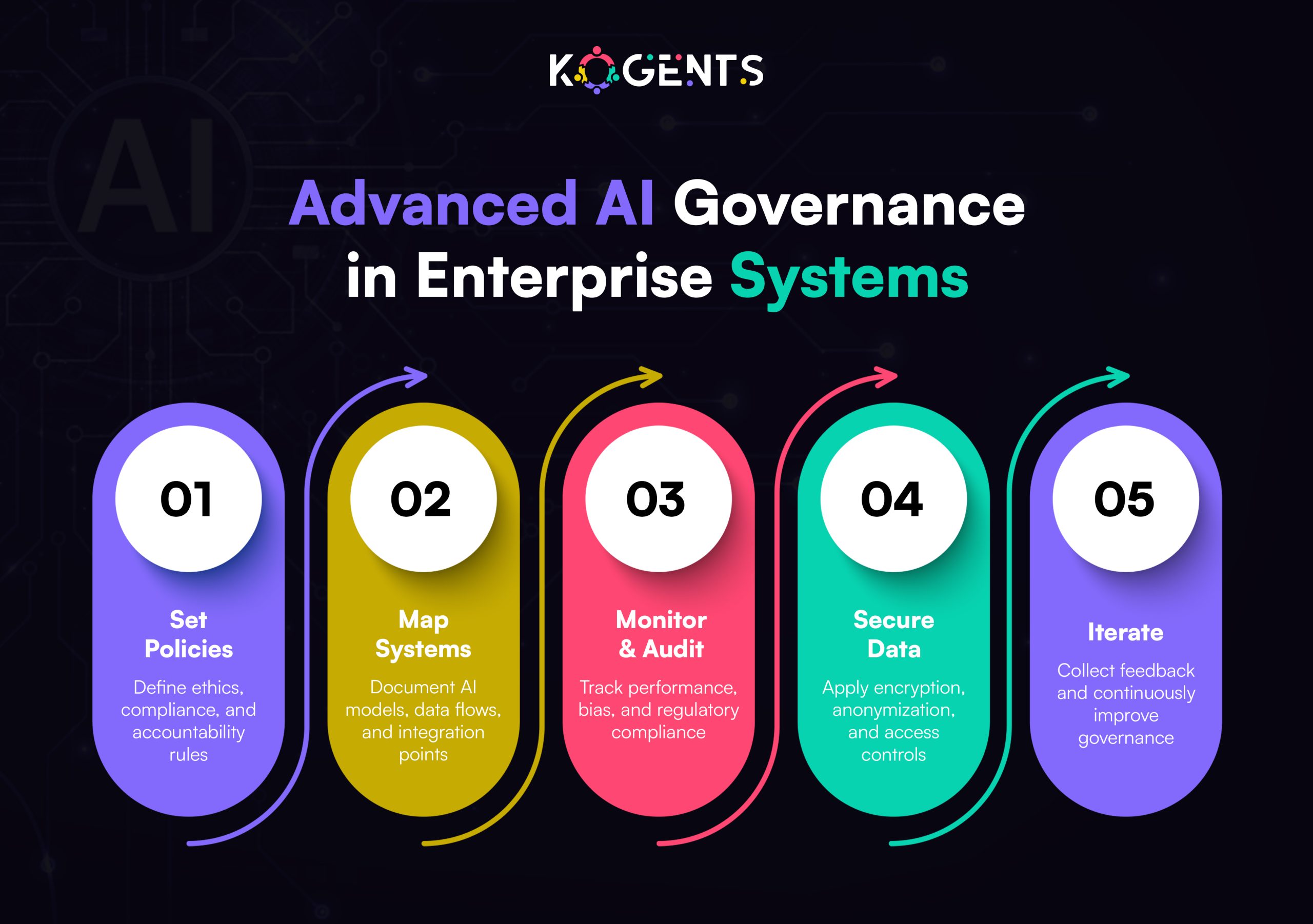
    • Integration risk decreases when governance becomes continuous, not reactive.
    • Each stage feeds into the next, reinforcing an iterative ecosystem, one where integration readiness is designed, tested, and matured before global scaling begins.

    Integration Risk Mitigation Strategies Explained

    Integration risk mitigation is not a checklist; it’s a mindset. 

    To design resilient enterprise AI, entrepreneurs and solopreneurs must embed mitigation practices across people, process, and technology layers.

    1. Design for Modularity

    • Adopt API-first design principles. 
    • Every AI module, whether NLP, computer vision, or predictive analytics, should communicate through well-documented APIs. 
    • This allows teams in different regions to build independently while maintaining interoperability.

    2. Implement Version Control Across Systems

    • Version drift can cripple integration.
    • Use schema versioning, feature store registries, and backward-compatible APIs. 
    • This ensures older systems continue functioning even as new models roll out.

    3. Build with Compliance in Mind

    • Global teams face varying data privacy laws (GDPR, HIPAA, CCPA).
    • Integrate data masking, encryption, and access control at the architecture level. 
    • Secure enterprise AI development is not optional; it’s a compliance mandate.

    4. Use Federated or Hybrid Learning

    For highly regulated industries, federated learning enables AI model training across distributed datasets without moving data across borders, a crucial practice for enterprise AI platform development in healthcare and finance.

    5. Embrace Continuous Monitoring

    • Integration success depends on ongoing observability. 
    • Tools like Prometheus, Grafana, and MLflow allow teams to detect anomalies, drift, or bottlenecks in real-time.

    6. Design for Failure

    • Global AI systems should fail gracefully. 
    • Use fallback mechanisms, circuit breakers, and redundancy protocols. 
    • When a regional system fails, others must continue operating.

    Key Note: By embedding these strategies throughout the lifecycle, teams reduce integration incidents, maintain consistent performance, and ensure system longevity,  transforming AI from an experimental tool into a global operational advantage.

    advanced enterprise ai development

    Vendor vs In-House: The Strategic Decision 

    Choosing between in-house custom enterprise AI development and enterprise AI consulting & development vendors determines not just cost, but control, scalability, and long-term risk.

    Decision Factor In-House / Custom Enterprise AI Development Vendor / Third-Party Enterprise AI Consulting & Development
    Control & Customization Full control over architecture, data, and IP. Ideal for proprietary systems. Prebuilt modules reduce setup time but limit deep customization.
    Integration Risk Higher initially; managed internally via CI/CD, testing, and documentation. Lower short-term risk but potential long-term vendor dependency.
    Cost Profile High upfront investment (CapEx) but lower recurring cost. Lower startup cost (OpEx) but possible recurring licensing fees.
    Time to Market Slower initially; faster for future iterations. Rapid deployment with existing frameworks and tools.
    Compliance & Security Complete ownership of compliance implementation. Vendor must align with your governance frameworks.
    Scalability Scales deeply if infrastructure is modular. Scales faster but depends on the vendor’s tech stack.
    Maintenance Internal teams manage updates and bug fixes. Vendor-driven; governed by SLAs and support terms.

    For entrepreneurs and solopreneurs, a hybrid approach often works best, using vendors for foundational infrastructure (like MLOps platforms) while building proprietary models in-house to retain control and innovation.

    Real-World Case Studies

    Case Study 1: Guardian Life Insurance — Reducing Integration Friction

    Guardian Life modernized its analytics stack using enterprise AI software development practices. 

    By containerizing all models and enforcing strict API contracts, the company reduced integration failures by 35% across global branches and cut deployment time from weeks to days.

    Case Study 2: Italgas — AI-Powered Predictive Maintenance

    Italgas adopted a scalable enterprise AI development approach with edge inference for real-time monitoring of pipelines. 

    Using federated learning, the company minimized cross-border data transfer while complying with EU privacy mandates, saving €4.5M annually through predictive maintenance.

    Strategic Imperatives for Global AI Success

    As AI adoption matures, entrepreneurs must evolve from experimentation to strategic execution. Here are the strategic imperatives shaping the next wave of enterprise AI automation development:

    • Adopt Compound AI Architectures: Blend LLMs, predictive analytics, and agentic AI frameworks like LangChain to create flexible, compound systems that integrate easily across functions.
    • Prioritize Governance and Transparency: Build governance APIs that monitor bias, explainability, and compliance at runtime, not after deployment.
    • Invest in Interoperability: Use open standards (ONNX, MLflow, Apache Kafka) to ensure future compatibility.
    • Foster AI Maturity Culture: Encourage teams to document lessons, share integration templates, and track adoption metrics.
    • Think Globally, Act Modularly: Every new region should plug into a predefined architecture template, minimizing reinvention and ensuring uniform quality.

    Wrapping Up!

    In the interconnected global landscape, enterprise AI development is both a technological and organizational discipline. 

    Reducing integration risk isn’t just about protecting systems; it’s about empowering innovation, ensuring reliability, and uniting global teams under a shared digital framework.

    Whether you’re a solopreneur exploring AI-driven automation or an enterprise leader scaling across continents, the path to sustainable AI success begins with intelligent integration.

    Know that Kogents.ai is here to make your experience risk-free and an enterprise-grade AI deployment. Give us a call at +1 (267) 248-9454 or drop an email at info@kogents.ai.

    FAQs

    What is enterprise AI development?

    It’s the process of creating scalable, secure AI systems designed to integrate into complex enterprise ecosystems.

    How does enterprise AI differ from consumer AI?

    Enterprise AI development emphasizes governance, integration, and compliance across distributed systems — unlike consumer AI, which focuses on individual user experience.

    What are the main phases of enterprise AI development?

    Discovery, data architecture, model development, testing, deployment, scaling, and continuous governance.

    Why is integration risk so critical?

    Integration failures lead to downtime, compliance breaches, and lost trust — even if the AI model itself performs well.

    What tools help manage enterprise AI integration?

    Apache Airflow, MLflow, Kubernetes, TensorFlow Serving, and MLOps tools like Kubeflow.

    How can solopreneurs apply enterprise AI strategies?

    By adopting modular design, cloud-based AI services, and using prebuilt APIs for faster scaling.

    What is federated learning, and why is it useful?

    It’s a privacy-preserving method that trains models on distributed data sources without moving the data, ideal for regulated industries.

    What role does AI governance play?

    Governance ensures accountability, fairness, and compliance, critical for secure enterprise AI development.

    What is the ROI of enterprise AI deployment?

    Returns include reduced manual workload, lower integration costs, improved compliance, and faster innovation cycles.

    What’s the future of enterprise AI?

    The future lies in enterprise generative AI development, where intelligent agents autonomously coordinate workflows, guided by strong governance frameworks.