
Customer expectations have changed. Today’s users want answers now, not in ten minutes, and definitely not “within 24–48 hours.”
Whether they’re browsing a SaaS product, filing a claim with an insurance provider, or troubleshooting a fintech app, the demand is universal: fast, accurate, and human-like responses without friction.
The moment real-time AI chat arrived, a breakthrough occurred where AI-powered live chat automation, streaming AI responses, and instant conversational intelligence merged to replace slow, scripted chatbots with dynamic and context-aware experiences.
Unlike traditional bots that respond after processing full queries, real-time conversational AI communicates token-by-token, enabling a continuous AI conversation engine that feels human, intuitive, and immediate.
Across industries, this shift is redefining everything from customer support automation to sales engagement, healthcare triage, travel assistance, and banking experiences.
This blog breaks down how real-time AI chat works, why it matters, the industries using it, the technology powering it, and real-world case studies from credible organizations, plus a one-of-a-kind structural approach designed to make this article truly exceptional.
Key Takeaways
- Real-time chat automation delivers immediate, streaming responses that drastically improve customer satisfaction and reduce operational costs.
- Industries like healthcare, banking, ecommerce, SaaS, travel, and telecom are deploying real-time conversational AI to replace traditional chat systems.
- Technologies such as natural language processing, token streaming, accelerated inference, and generative AI architectures enable low-latency, human-quality interactions.
- Companies using AI-powered live chat automation report up to 40–60% reductions in support costs and 2–3x increases in customer engagement.
- Kogents.ai provides future-ready, enterprise-grade AI chat automation to transform real-time customer conversations at scale.
What Exactly Is Real-Time AI Chat?
Beyond Conventional Chatbots: A Paradigm Shift
Traditional chatbots were built on decision trees, predefined flows, and pattern matching. While useful for FAQs, they lacked:
- Conversational depth
- Dynamic reasoning
- Real-time contextual awareness
By contrast, bold real-time AI chat leverages large language models (LLMs) such as GPT-4/5, Claude, Llama, and Gemini, alongside token streaming, enabling:
- Adaptive conversations
- Continuous reinforcement of context
- Predictive intent modeling
- Personalized responses based on historical user behavior
This evolution turns chat systems into digital conversational agents, capable of guiding customers across entire journeys, not just answering questions.
Deep-Dive: Components of Real-Time Conversational Intelligence
✔ Natural Language Understanding (NLU)
Extracts user intent, entities, sentiment, and context in milliseconds.
✔ Natural Language Generation (NLG)
Generates human-like, grammatically accurate responses.
✔ Streaming Tokenization
LLMs generate text token-by-token, enabling responses to appear instantly rather than after full computation.
✔ Context Window Optimization
Modern models process extended context, sometimes exceeding 200k+ tokens, allowing long conversations without memory loss.
✔ Inference Acceleration Techniques
Technologies such as:
- Speculative decoding
- Quantization-aware training
- Low-rank adaptation (LoRA)
- GPU batching & parallel inference
Note: drastically reduce latency for enterprise loads.

Why Are Industries Adopting Real-Time AI Chat?
The Experience Economy & Instant Gratification Trend
Harvard Business Review states:
Real-time conversational AI removes waiting from the equation, empowering businesses to deliver:
- Zero-wait customer service
- Proactive support using predictive analytics
- Conversational UX that feels intuitive and human
Deep Business Impacts Beyond Support
Revenue Growth
Real-time AI increases conversions by:
- Reducing drop-offs
- Optimizing product recommendations
- Automating sales qualification
- Offering contextual upsells
McKinsey reports that AI-driven personalization can increase revenue by 10–30%.
Operational Efficiency
AI reduces support load by handling:
- High-volume repetitive queries
- Tier-1 and Tier-2 troubleshooting
- Knowledge-based requests
- Transaction and account-related tasks
Zendesk chatbot integration found that companies using AI automation saw up to 80% fewer tickets per agent.
Risk Reduction & Compliance
Real-time systems help maintain:
- GDPR, HIPAA, SOC 2, ISO/IEC 23053 adherence
- Real-time redaction of sensitive PII
- Intent detection for fraud or abnormal patterns
Banks and fintech companies now use AI to flag suspicious messages in real-time before transactions occur.
Real-Time Conversational AI Capabilities
True Personalization at Scale
Real-time AI uses:
- User behavior analytics
- Purchase history
- Demographics
- Interaction context
to tailor interactions dynamically.
This leads to a hyper-personalized journey, where the best AI chatbot for WhatsApp remembers the customer’s preferences and anticipates needs organically.
Multi-Channel Real-Time AI Chat
Today’s customers move across channels rapidly:
-
- Website
- Mobile app
- Instagram bot automation
- Viber AI chatbot
- In-product widgets
AI provides unified communication across all surfaces with a consistent personality and knowledge.
Autonomous Conversational Agents (ACA)
Next-generation real-time AI agents can:
-
- Perform actions
- Execute backend tasks
- Troubleshoot technical issues
- Modify user settings
- Trigger workflows
- Update account information
This shifts AI from being a support tool to becoming a self-sufficient operations engine.
Industry Use Cases with Additional Context
Healthcare — AI as the First Point of Clinical Contact
Beyond triage, real-time AI supports:
- Medication reminders
- Symptom progression tracking
- Post-discharge care automation
- Insurance pre-authorization queries
- Pre-surgery preparation guidance
Case in Point: According to McKinsey, AI can save healthcare organizations $200–360 billion a year globally.
Finance & Banking — Precision, Compliance & Fraud Prevention
Real-time AI is now used to:
- Explain transactions
- Automate KYC verification
- Detect abnormal spending in real-time
- Provide investment insights
- Assist with loan applications
Case in Point: JPMorgan reported that AI saved them 360,000 hours of manual labor annually.
Ecommerce — Real-Time Shopping Assistance
AI enhances:
- Product discovery
- Delivery support
- Returns management
- Cross-sell & upsell in-cart
- Dynamic discounting
Case in Point: Amazon reported that real-time AI recommendation engines drive 35% of overall sales.
Travel — AI as a Live Concierge
Beyond itineraries, AI offers:
- Visa & immigration guidance
- Real-time delay notifications
- Personalized destination insights
- Emergency travel support
It acts as a 24/7 global travel agent.
Myths vs. Reality
| Myth | Reality |
| “AI chatbots replace humans entirely.” | Real-time AI augments humans by handling repetitive tasks; humans still manage emotional, high-stakes conversations. |
| “Real-time AI is only for big companies.” | SMBs gain the fastest ROI due to lean teams and high ticket volume. |
| “AI responses are generic.” | With RAG, grounding, and personalization, AI becomes business-specific and domain-aware. |
| “AI can’t understand complex queries.” | Modern LLMs + vector search + contextual chaining = deep technical accuracy. |
| “AI introduces compliance risks.” | When implemented correctly, real-time AI reduces compliance risk with automated redaction and routing. |
SaaS — AI for Product Adoption & Lifecycle Enhancement
Real-time AI improves:
- User onboarding
- Product tutorials
- In-app troubleshooting
- Feature adoption campaigns
- Developer documentation guidance
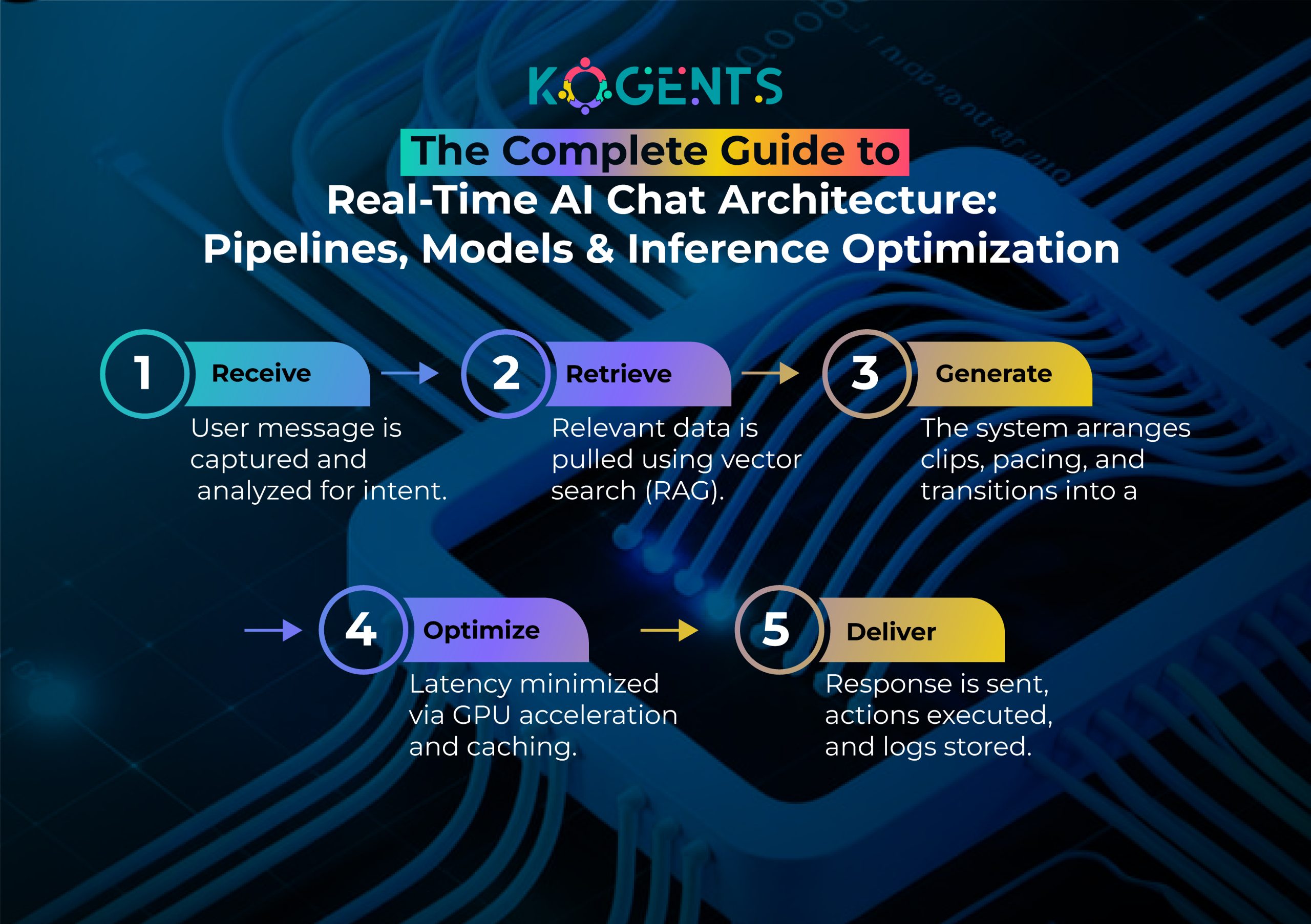
Deep Technical View — Architecture of Real-Time AI Chat Systems
Data Layer Enhancements
Real-time AI relies on:
- Vector databases (Pinecone, Milvus, Weaviate)
- Retrieval-augmented generation (RAG)
- Intent routing engines
- Interaction analytics
RAG drastically reduces hallucinations by grounding AI responses in company knowledge.
Infrastructure-Level Innovations
To ensure low latency, companies deploy:
- GPU clusters (NVIDIA H100/L40S)
- Serverless inference endpoints
- Dynamic request batching
- Asynchronous pipeline execution
- Edge inference (Cloudflare Workers, AWS Lambda@Edge)
Key Point: These optimizations push real-time AI toward sub-100ms response windows, matching human conversation pacing.
Security & Governance Layer
Modern systems include:
- Dynamic PII masking
- Message encryption
- Role-based access control
- Model audit trails
- Ethical guardrail frameworks
This supports safe, compliant AI operations at scale.
Why Real-Time AI Outperforms Humans in Live Chat?
Predictive Intelligence
AI identifies user frustration through:
- Punctuation
- Sentiment markers
- Behavioral signals
- Dwell time patterns
Key Highlight: AI can automatically escalate issues before dissatisfaction grows.
Scalability & Reliability
AI can handle:
- Millions of concurrent conversations
- Zero downtime
- Multilingual interactions
- Dynamic spikes
Example: (Black Friday, tax season, travel disruptions)
Note: Human teams simply cannot scale to this capacity without enormous operational costs.
The Future of Real-Time AI Chat: Know Here!
The next 3–5 years will bring:
✔ Multimodal Real-Time Agents
Text + voice + image + action-based reasoning.
✔ Emotionally Intelligent AI
Detects tone changes and adapts personality dynamically.
✔ Autonomous Business Process AI Agents
Systems that complete workflows, not just guide them.
✔ Predictive Engagement Models
AI anticipates customer needs based on behavioral patterns.
Conclusion
Real-time AI chat isn’t just an upgrade from traditional chatbots; it is a foundational transformation in how businesses and customers interact.
With live AI chat systems, companies can deliver instant support, create personalized experiences, reduce costs, and scale across global customer bases effortlessly.
As industries race toward automation, personalization, and real-time responsiveness, the organizations that embrace real-time conversational AI now will be the ones that dominate customer experience in the years ahead.
Ready to deploy enterprise-grade, real-time AI chat built for speed, accuracy, and scalability?
Experience the future of conversational automation with Kogents.ai, your partner in intelligent customer engagement.
Visit us today to book your personalized demo.
FAQs
What is real-time AI chat, and how exactly does it work?
Real-time AI chat uses generative AI, natural language processing, and streaming inference to produce instant tokenized responses as the user types. Instead of waiting for the full answer to be generated, AI streams words in real-time—similar to a human typing. This creates seamless interaction, reduces cognitive friction, and enhances overall conversational UX.
What response speed qualifies as “real-time” in conversational AI?
An AI chat system must respond in under 1 second to be considered real-time. For premium interactions (e.g., fintech, healthcare triage), a latency of <300 milliseconds is ideal. Anything slower causes cognitive delays and reduces perceived intelligence.
How does real-time conversational AI impact customer experience?
It enhances the experience by delivering:
- No wait times
- Instant problem resolution
- Personalized responses
- Reduced frustration
- Increased engagement
Can real-time AI chat handle complex technical or domain-specific queries?
Yes, when integrated with RAG, vector databases, and domain-trained LLMs. This enables AI to fetch verified answers from documentation, knowledge bases, or CRM, ensuring accuracy even in regulated fields such as healthcare or finance.
What are the biggest challenges businesses face when implementing real-time AI chat?
Common challenges include:
- Maintaining low latency under high load
- Ensuring data privacy & compliance
- Preventing misinformation/hallucinations
- Integrating AI with legacy systems
- Balancing automation with human escalation
How does real-time AI chat integrate with websites, apps, or SaaS platforms?
Integration is typically achieved via:
- JavaScript widgets
- Webhooks
- AI chat SDK
- Custom API pipelines
- WordPress/Shopify plug-ins
These methods allow embedding AI into any digital touchpoint within minutes.
Is real-time AI chat secure and compliant with global standards?
Yes, when implemented correctly. Modern AI infrastructures support:
- Encryption at rest & in motion
- Dynamic PII redaction
- SOC 2 Type II compliance
- HIPAA-aligned medical data policies
- GDPR data rights management
Can real-time AI reduce support team workload? If so, by how much?
Absolutely. Companies typically see:
- 40–70% reduction in support ticket volume
- 80–90% automation of repetitive queries
- 3x agent efficiency, as AI handles Tier-1 tasks
This allows human agents to focus on escalations and complex cases.
How can businesses measure the success of real-time AI chat?
Effective KPIs include:
- First Response Time (FRT)
- Resolution Time (RT)
- Ticket deflection rate
- Cost per conversation
- Lead conversion rate
- AI containment rate
- Customer satisfaction (CSAT)
What’s the best way for businesses to get started with real-time AI chat?
The ideal approach includes:
- Identify high-volume conversation areas
- Choose an enterprise-grade AI platform
- Integrate your knowledge base for grounding
- Build workflows for common customer tasks
- Launch a pilot → measure → optimize → scale