Blog

  • How AI Agents Recover Abandoned Carts Without Human Follow-Up

    How AI Agents Recover Abandoned Carts Without Human Follow-Up

    Your revenue is breaking up with you, but AI agents step in as problem solvers to bring you back together.

    Every minute, potential customers fill their carts with your products, enter checkout, and then vanish. 

    According to the Baymard Institute, the average cart abandonment rate across industries is 70.22%. Meaning seven out of ten ready-to-buy customers leave without completing their purchase.

    For ecommerce brands, this represents billions in recoverable revenue. Traditional email sequences arrive too late. 

    Manual follow-ups lack personalization. The result? Lost sales that could have been prevented.

    To put it simply, AI agents for abandoned carts, autonomous systems that detect purchase intent, analyze customer behavior modeling in real-time, and execute personalized recovery workflows without any human intervention. 

    Unlike conventional abandoned cart AI automation, these intelligent agents observe, learn, and act instantly, transforming checkout abandonment into conversion opportunities.

    This guide reveals how AI-powered abandoned cart recovery operates, why it outperforms traditional methods, and how platforms like ours are pioneering autonomous AI agents for ecommerce carts.

    Key Takeaways

    • AI agents reduce cart abandonment by 15-30% through real-time behavioral analysis and predictive intervention.
    • Autonomous recovery workflows eliminate manual follow-up, saving marketing teams and make sure to automate with AI Agents 20+ hours weekly.
    • Conversational AI personalizes messaging across email, SMS, and chat based on individual customer journey data.
    • Intent recognition algorithms identify abandonment patterns seconds after they occur, enabling immediate response.
    • Omnichannel messaging orchestrated by AI agents delivers 3-5x higher recovery rates than single-channel approaches.

    The Problem: Why $260 Billion Slips Away Annually?

    Global ecommerce loses an estimated $260 billion annually to cart abandonment.

    The core abandonment triggers remain consistent:

    • Unexpected shipping costs (48% of abandoners)
    • Forced account creation (24%)
    • Complex checkout process (21%)
    • Payment security concerns (18%)
    • Website errors or slow loading (17%)

    Traditional abandoned cart recovery software relies on predetermined rules: if cart abandoned > send email after X hours. 

    This rigid approach ignores critical context, customer browsing history, price sensitivity, device type, time zone, and hundreds of other signals that influence purchase intent recovery.

    Recovery Method Average Recovery Rate Implementation Time Human Hours Required
    Manual Follow-Up 3-5% N/A 40+ hrs/week
    Basic Email Automation 5-8% 2-4 weeks 10 hrs/week
    Rule-Based AI 8-12% 1-2 weeks 5 hrs/week
    Autonomous AI Agents 15-25% 2-3 days <1 hr/week
    Advanced AI with Conversational Layer 20-30% 1 week 0 hrs/week

    How AI Agents Work: The 4-Stage Recovery System

    Stage 1: Detection & Analysis (0-30 Seconds)

    AI agents for abandoned shopping carts monitor customer journey automation continuously through behavioral analytics. 

    They detect micro-signals indicating abandonment risk:

    • Mouse movement patterns suggesting hesitation
    • Time spent on shipping cost calculation
    • Browser tab switching behavior
    • Payment form field abandonment
    • Mobile vs. desktop checkout friction points

    Machine learning models trained on millions of transactions predict abandonment likelihood with accuracy. 

    The moment a customer exits checkout, the system activates:

    1. Customer segmentation algorithms categorize the abandoned new visitor, returning customer, and high-value buyer.
    2. Intent recognition models analyze abandonment causes, price shock, distraction, and comparison shopping.
    3. Predictive analytics calculates recovery probability and optimal approach. 

    Key Note: AI agents learn from every interaction, improving recovery rates by 3-7% monthly as they accumulate performance data.

    Stage 2: Channel Selection & Personalization (30 Seconds – 5 Minutes)

    Artificial intelligence selects the highest-converting touchpoint based on customer profile:

    • Email for customers who engaged with previous campaigns
    • SMS for mobile abandoners with high urgency
    • Web push notifications for active site browsers
    • chat automation for higher conversions for customers still on-site

    Each message incorporates dynamic messaging elements:

    • product names
    • images from abandoned cart, 
    • personalized subject lines based on browsing history
    • time-sensitive urgency triggers
    • contextual incentives aligned with customer value

    Reinforcement learning continuously tests message elements to determine optimal combinations for each segment.

    Pro-Tip: AI agents A/B test message variations automatically, sending the statistically optimal version to each customer segment.

    Stage 3: Multi-Touch Sequencing (5 Minutes – 72 Hours)

    Automated follow-up sequences deploy across multiple channels based on customer response:

    Example AI-Orchestrated Sequence:

    1. 5 minutes: On-site chatbot intervention (if still browsing)
    2. 1 hour: Personalized email with social proof
    3. 6 hours: SMS with a limited-time discount (mobile abandoners only)
    4. 24 hours: Email featuring alternative products at lower price points
    5. 48 hours: Final reminder with free shipping offer

    Stage 4: Continuous Optimization

    Funnel recovery automation improves perpetually through:

    • Conversion lift measurement by segment
    • Message fatigue detection
    • Incentive cost-benefit analysis
    • Channel performance ranking
    • Seasonal pattern recognition

    Privacy & Ethical AI

    AI agents for abandoned carts must balance personalization with privacy:

    • GDPR compliance: Explicit consent for automated outreach, right to deletion
    • CCPA compliance: Opt-out mechanisms, data usage transparency
    • Data minimization: Collecting only necessary behavioral signals
    • Anonymization: Separating personally identifiable information from behavioral models

    Key Note: Leading AI platforms like Kogents offer built-in privacy controls, allowing customers to set data retention policies and consent management workflows.

    Customer-Centric Principle: The goal is to help customers complete purchases they genuinely want, not manipulate them into unwanted transactions.
    ai agents for abandoned carts

    Real-World Case Studies 

    Case Study 1: Mid-Market Fashion Retailer

    Challenge: 72% cart abandonment rate with 6% email recovery rate

    Solution: Deployed AI agents for ecommerce checkout optimization, integrating with Shopify Plus

    Results (90 Days):

    • Cart abandonment reduced to 58%
    • Recovery rate increased to 21%
    • $340,000 in recovered revenue
    • 94% reduction in manual follow-up time
    • The average order value of recovered carts is 12% higher than the baseline

    Case Study 2: Enterprise DTC Luxury Brand

    Challenge: High-value carts ($800+ average) are abandoning during the final checkout step

    Solution: Smart AI cart recovery system with sophisticated behavioral triggers.

    Implementation:

    • Real-time intent recognition prioritizing high-value carts for immediate intervention
    • Omnichannel messaging combining email, SMS, and web push
    • Dynamic incentive ladder optimized by predictive analytics

    Results (6 Months):

    • 28% recovery rate on carts over $800
    • $980,000 in recovered revenue
    • Average intervention time reduced from 3 hours to 2 minutes
    • 71% of recovered customers completed repeat purchases within 90 days

    Case Study 3: DTC Health & Wellness Brand

    Challenge: Mobile abandonment rate of 76%, poor SMS engagement

    Solution: Mobile-first AI-powered abandoned cart recovery

    Results (120 Days):

    • Mobile recovery rate improved from 4% to 18%
    • SMS click-through rate increased by 340%
    • ROI of 22:1 on AI agent subscription cost
    • 67% reduction in discount spending due to optimized incentive delivery

    Customer-Centric Insight: The most successful AI implementations don’t just recover carts, they identify and fix the underlying checkout friction causing abandonment.
    ai agents for abandoned carts

    Platform Integration Made Simple

    AI Agents for Shopify Abandoned Carts

    Shopify Plus merchants benefit from native API-based AI agents that access customer purchase history, trigger recovery workflows via Shopify Flow, integrate with Klaviyo and other marketing platforms, and track recovered revenue in Shopify Analytics.

    Soft Reminder: Ensure your AI agent provider offers two-way Shopify API sync for real-time inventory and pricing updates in recovery messages.

    AI Agents for WooCommerce Abandoned Carts

    WooCommerce flexibility enables plugin installation for one-click deployment, integration with WooCommerce subscriptions, custom conversion uplift tracking via Google Analytics 4, and advanced customer segmentation.

    AI Agents for Magento Abandoned Carts

    Adobe Commerce (Magento) provides multi-store recovery orchestration, integration with Adobe Experience Cloud for unified customer journey automation, and advanced ecommerce stack compatibility with ERP and CRM systems.

    The Kogents Advantage: Next-Generation Agentic AI

    While many platforms offer abandoned cart recovery, we deliver comprehensive agentic AI that goes beyond basic automation.

    1. True Autonomous Intelligence

    Kogents deploys autonomous AI agents that make independent decisions through advanced reinforcement learning and intent recognition:

    • Independently determine optimal recovery strategies per customer
    • Allocate marketing budget across channels based on predicted ROI
    • Identify and escalate high-risk, high-value abandonments to human teams
    • Self-optimize without requiring constant rule adjustments

    2. Omnichannel Orchestration at Scale

    • We orchestrate omnichannel messaging across email, SMS, web push, on-site chat, retargeting ads, and mobile app notifications. 
    • Each channel works in concert, never duplicating outreach or overwhelming customers. 
    • The system understands channel fatigue and automatically rotates touchpoints.

    3. Enterprise-Grade Integration

    We seamlessly connect with your entire ecommerce ecosystem:

    • Platform compatibility: Shopify, WooCommerce, Magento, BigCommerce, custom platforms
    • CRM integration: Salesforce, HubSpot, Microsoft Dynamics
    • Marketing automation: Klaviyo, Braze, Iterable
    • Analytics: Google Analytics 4, Mixpanel, Amplitude

    ISO/IEC 27001 certified with GDPR & CCPA compliance built in, Kogents handles enterprise security requirements seamlessly.

    4. Transparent AI Decision-Making

    We provide full visibility into AI agent reasoning: why specific messages were sent, how incentive thresholds were calculated, which customer attributes influenced channel selection, and real-time confidence scores for recovery probability. 

    This transparency enables marketing teams to learn from AI decisions and collaborate with agents.

    5. Measurable Business Impact

    Kogents customers report:

    • Average 27% increase in cart recovery rates
    • $18-35 recovered revenue per dollar spent on the platform
    • 85% reduction in manual cart recovery workload
    • 2.3x faster time-to-revenue compared to traditional automation

    Transform Problem to Profit with Kogents!

    Cart abandonment is no longer an inevitable cost of doing business online. With AI agents for abandoned carts, ecommerce brands transform their single biggest revenue leak into a competitive advantage. 

    By deploying autonomous AI agents that detect purchase intent, personalize omnichannel messaging, and optimize funnel recovery automation in real-time, forward-thinking companies are recovering previously lost revenue, all without adding headcount or manual workload.

    Ready to transform your cart abandonment problem into your next revenue growth channel? Discover how kogents.ai, known as the best agentic AI company, can recover up to 30% of your abandoned carts automatically. 

    Don’t just accept cart abandonment; eliminate it with intelligent automation that works while you sleep. 

    Your future revenue is waiting to be recovered.

    FAQs

    What are AI agents for abandoned carts, and how do they differ from basic email automation?

    AI agents are autonomous systems that use machine learning, behavioral analytics, and real-time personalization to detect and recover abandoned carts without human intervention. Unlike basic email automation that sends preset messages at scheduled intervals, AI agents continuously analyze customer behavior, predict abandonment causes, adapt messaging dynamically, select optimal channels, and learn from every interaction to improve performance. They make independent decisions about timing, content, and incentives rather than following rigid rules, resulting in 2-4x higher recovery rates.

    How do AI agents detect cart abandonment in real-time?

    AI agents monitor customer journey automation through JavaScript tracking pixels and behavioral triggers embedded in checkout flows. They analyze signals like mouse movement patterns, form field completion rates, time on page, exit intent indicators, and device-specific friction points. When abandonment indicators exceed threshold scores calculated by predictive analytics models, agents immediately activate recovery workflows—often within seconds of abandonment. This real-time detection captures customers while purchase intent remains strongest.

    How do AI agents personalize recovery messages for different customers?

    Machine learning personalization analyzes hundreds of customer attributes, including purchase history, browsing behavior, price sensitivity, device type, location, time zone, engagement history, and abandoned product characteristics. Customer segmentation algorithms group similar customers, while dynamic messaging engines generate unique content variations incorporating product names, images, personalized recommendations, contextual incentives, and urgency triggers. Reinforcement learning continuously tests message elements—subject lines, imagery, offers, tone—to determine optimal combinations for each segment.

    What happens if a customer returns after AI agent outreach?

    Intelligent checkout flow automation immediately detects customer returns and adjusts recovery workflows. When a customer clicks a recovery message or independently returns to complete checkout, AI agents instantly cancel pending outreach to prevent duplicate messaging, preserve saved cart contents, apply any promised incentives automatically, track the recovery attribution for performance analysis, and update behavioral analytics models with conversion data to improve future predictions. This closed-loop learning continuously enhances AI agent effectiveness.

    Can AI agents handle complex scenarios like subscription products or high-ticket items?

    Yes, enterprise autonomous AI agents for ecommerce carts excel in complex scenarios by analyzing extended decision-making cycles, managing subscription-specific abandonment like upgrade hesitation or cancellation prevention, coordinating multi-stakeholder purchase approvals, and integrating with CRM systems for account-based marketing alignment. Predictive abandonment modeling accounts for longer consideration periods, budget approval timing, and relationship factors unique to high-value transactions, with AI adapting messaging tone and urgency appropriately.
  • The Hidden Revenue Impact of Slow Replies (And How AI Fixes It)

    The Hidden Revenue Impact of Slow Replies (And How AI Fixes It)

    The billion-dollar question your business can’t afford to ignore is this: that every second your customer waits for a response, your revenue bleeds.  

    Yet, the average business response time hovers around 12 hours, creating a chasm where potential revenue is lost to competitors.

    Consider this: A 1-second delay (or 3 seconds of waiting) decreases customer satisfaction. 

    For a mid-sized enterprise processing 10,000 customer interactions monthly, this translates to approximately $180,000 in lost annual revenue.

    CEOs, CIOs, Customer Experience Directors, and Revenue Leaders understand that in today’s hyper-connected marketplace, speed isn’t just a convenience metric; it’s a revenue multiplier. Your customers demand instantaneous engagement. 

    When your systems lag, your competitors win.

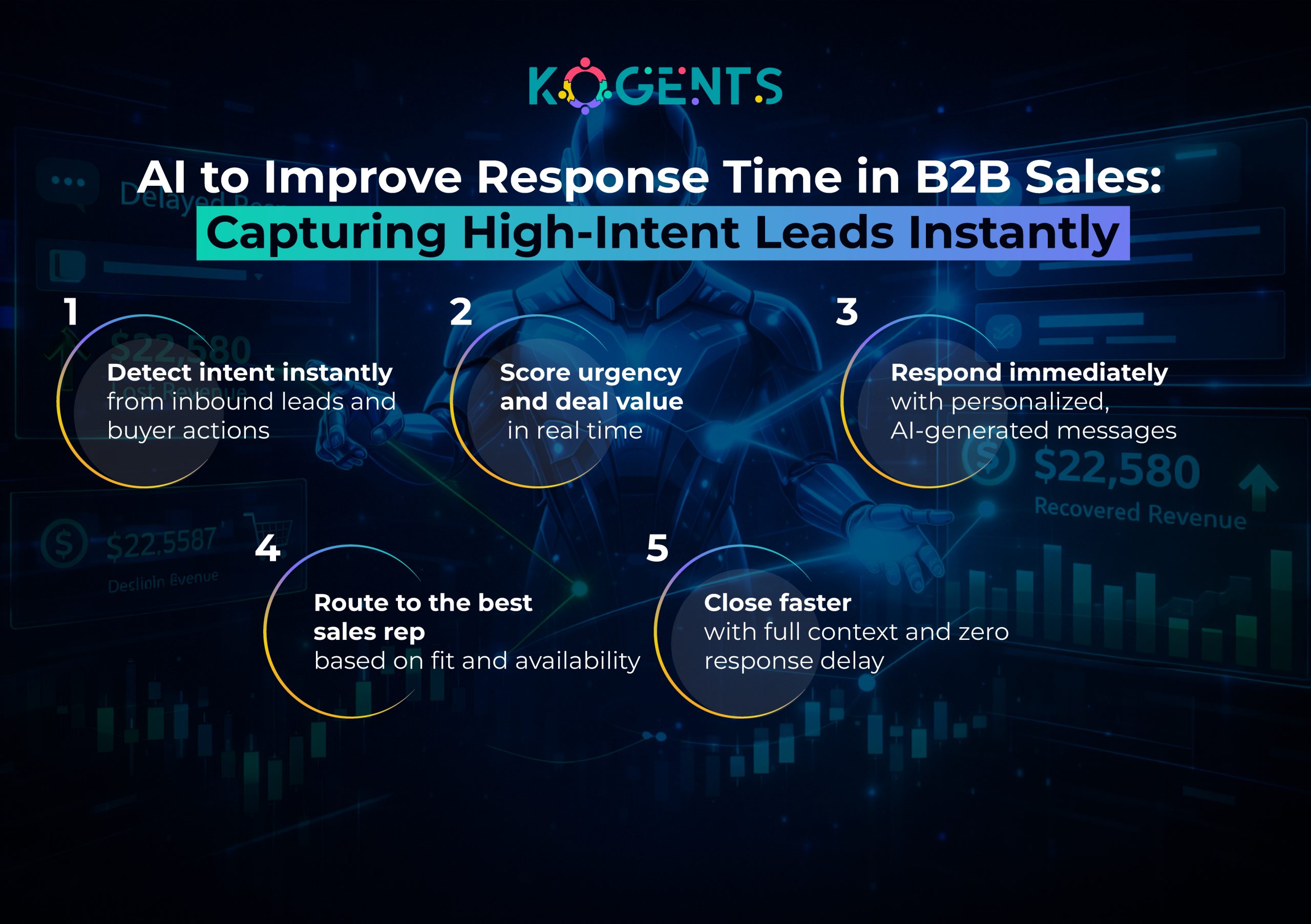
    AI to improve response time isn’t just about answering faster; it’s about transforming latency reduction into a strategic asset that fundamentally restructures how your organization captures, converts, and retains revenue.

    One Connected Customer report suggests 64% of customers expect real-time responses regardless of channel. 

    Fail to deliver, and will abandon your brand after just one bad experience. 

    For a company generating $50 million annually, this represents potential losses exceeding $16 million.

    Key Takeaways

    • Responding within 60 seconds increases lead conversion rates by 391% compared to responses after 5 minutes, directly impacting revenue generation.
    • Slow response times create compounding negative effects through poor reviews, reduced customer lifetime value, and increased churn rates that cost businesses annual revenue.
    • AI to handle slow replies reduces through latency from hours to milliseconds while improving accuracy, eliminating the traditional trade-off between speed and quality.
    • Delayed responses affect every revenue touchpoint, from sales qualification (7x conversion difference) to customer support to upsell opportunities.
    • Organizations implementing AI response time optimization report average payback periods of 3-6 months with documented revenue increases within the first year.

    ai to improve response time

    The Hidden Revenue Drains: Quantifying What Slow Responses Actually Cost

    The Immediate Conversion Hemorrhage

    Every industry has a “golden response window”, the timeframe where conversion probability peaks. 

    For B2B SaaS, it’s under 5 minutes. 

    For e-commerce, it’s under 90 seconds. Missing this window doesn’t just reduce conversion; it cuts it exponentially.

    MIT Sloan Management Review reveals that lead response time is the single most important factor in lead conversion. InsideSales.com data shows the stark reality:

    • Within 1 minute: 391% higher qualification rate
    • Within 5 minutes: 100% baseline rate
    • Within 10 minutes: 62% qualification rate
    • After 30 minutes: 21% qualification rate

    For a B2B organization generating 1,000 qualified leads monthly with an average customer lifetime value of $15,000, improving response time from 30 minutes to under 5 minutes translates to $10.8 million in additional annual revenue.

    The Compounding Customer Lifetime Value Erosion

    First impressions set lifetime expectations. 

    A slow first response doesn’t just risk losing one transaction; it establishes a precedent that affects every future interaction, reducing customer lifetime value. 

    According to Bain & Company, a 5% increase in customer retention produces profit increases ranging from 25% to 95%. 

    Response speed directly impacts retention through multiple mechanisms. 

    In another research, we found that customers would consider switching companies after just one instance of poor service, with “slow response time” cited as a top-three frustration.

    The Competitive Displacement Factor

    Markets don’t wait for slow responders. 

    According to SuperOffice, 80% of customers research competitors after experiencing slow service.

    In financial services, research shows that more than half % of consumers considering new banking relationships expect responses within 24 hours. 

    Banks need an AI reply generator while responding within this window to capture a massive number of new account openings, while slower responders capture only a few. 

    The predictive routing and real-time decision-making capabilities of AI-driven orchestration ensure organizations never cede competitive ground due to response delays.

    Why Traditional Solutions Fail?

    The Linear Scaling Trap

    Adding more support staff creates a linear cost-to-capacity relationship that never achieves meaningful ROI:

    • Each additional agent adds $45,000-$75,000 annual cost
    • Training costs average $1,200 per agent with 90-day ramp periods
    • Quality consistency degrades with team size
    • Seasonal demand creates persistent staffing imbalances

    The Template Trap

    Pre-written templates reduce response latency superficially but create new problems:

    • 71% of customers report frustration with “robotic” template responses (HubSpot)
    • Template mismatches require follow-ups, increasing total resolution time by 43%
    • Personalization gaps reduce conversion rates by 26%

    Note: Templates optimize the wrong metric; they reduce time to first response while increasing time to resolution.

    How AI to Improve Response Time Transforms Revenue Generation

    Modern artificial intelligence response optimization fundamentally differs from previous automation attempts. 

    AI-powered real-time response systems augment human capability with machine learning that understands context, predicts intent, and delivers personalized responses at scale.

    Real-Time Inference: From Hours to Milliseconds

    Deep learning models powered by GPU acceleration and model compression now process customer inquiries in 50-200 milliseconds. 

    This enables:

    Instant Intent Detection: NLP algorithms analyze inquiry sentiment, urgency, topic, and customer history simultaneously, routing to optimal resources.

    Contextual Response Generation: Modern AI systems generate contextually appropriate responses incorporating customer history, product knowledge, and brand voice guidelines.

    Continuous Learning: Every interaction trains the model, improving accuracy over time without manual intervention.

    Intercom deployed conversational AI with real-time inference capabilities and reported:

    • 44% reduction in average response time (8.3 hours to 4.6 hours)
    • 29% increase in first-contact resolution rates
    • 67% reduction in support costs per ticket
    • $4.2M additional annual revenue attributed to improved conversion rates

    Key Insight: The value isn’t just speed, it’s intelligent speed. 

    Predictive Response: Solving Problems Before They’re Asked

    Advanced predictive analytics: enable AI systems to anticipate customer needs based on behavioral patterns, product usage data, and historical interactions:

    Behavioral Trigger Recognition: AI identifies patterns indicating impending customer issues and initiates support before explicit requests.

    Sentiment-Adaptive Communication: It adjusts tone, urgency, and escalation protocols based on emotional state.

    Adobe implemented AI-assisted diagnostics with predictive capabilities across its creative cloud support infrastructure:

    • 38% reduction in total support tickets through proactive intervention
    • 52% improvement in customer satisfaction scores
    • 71% reduction in escalations to senior support staff
    • $8.7M annual savings with simultaneous quality improvements

    Intelligent Workload Distribution

    AI-driven orchestration implements intelligent process automation considering:

    • Agent expertise mapping: Matching inquiry complexity with agent capabilities
    • Real-time capacity monitoring: Balancing workload dynamically
    • Customer value prioritization: Routing high-value customers to senior resources
    • Resolution probability scoring: Assigning cases to agents most likely to achieve first-contact resolution

    Load balancing algorithms ensure no agent becomes overwhelmed while others remain underutilized, maximizing system throughput without additional headcount.

    Pro Tip: The best AI routing systems learn from outcomes. When specific agents consistently resolve certain issues faster, the system progressively assigns more similar cases while providing others additional training resources.

    ai to improve response time

    Table: The Revenue Impact Matrix of Response Time Delays

    Response Time Window Lead Conversion Rate Customer Satisfaction Revenue Retention Annual Cost Impact (per $10M revenue)
    Under 1 minute 391% higher baseline 95-98% 92-95% Baseline (optimal)
    1-5 minutes 100% (baseline) 85-90% 85-88% -$250,000
    5-10 minutes 62% of baseline 75-82% 78-82% -$580,000
    10-30 minutes 36% of baseline 65-72% 68-74% -$1,200,000
    1+ hours 14% of baseline 45-58% 48-58% -$2,400,000+

    High-End Case Studies: Real-World Revenue Transformation

    Case Study 1: Sephora – Beauty Retail AI Transformation

    Challenge: Sephora, the global beauty retailer with 2,600+ stores and a massive e-commerce presence, faced declining conversion rates due to complex product consultation needs and response delays averaging 8+ hours for beauty advice inquiries.

    AI Implementation: Deployed Sephora Virtual Artist and conversational AI chatbot, integrating real-time inference, computer vision, and NLP for instant product recommendations and beauty consultations.

    Results:

    • Response time reduced from 8+ hours to under 30 seconds
    • 11% increase in conversion rate for chatbot users
    • Virtual Artist drove an 8.5x increase in product trial rates
    • 60% of users who tried virtual features returned to make purchases

    Case Study 2: Domino’s Pizza – DOM AI Ordering Revolution

    Challenge: Domino’s Pizza recognized that order friction and slow responses during peak hours were costing millions in abandoned carts and customer frustration, with phone wait times exceeding 10 minutes during dinner rushes.

    AI Implementation: Introduced DOM, an AI-powered ordering assistant across web, mobile app, SMS using an AI messenger bot, and voice platforms, using conversational AI, predictive routing, and real-time processing for instant order placement and tracking.

    Results:

    • Response time reduced from 10+ minutes to instant
    • Over 65% of sales now through digital channels, driven by AI efficiency
    • 25%+ increase in average order value through AI-powered upselling
    • Customer retention improved by 30% for app users
    • Digital sales surpassed $7.5 billion annually

    The ROI Calculation

    Example: Mid-market B2B SaaS Company

    • 5,000 monthly inbound leads
    • Current conversion rate: 3.5%
    • AI-improved conversion rate: 8.2%
    • Average customer value: $45,000 annually
    • Implementation cost: $380,000 (year one)

    Calculation:

    • Additional conversions: 235 customers monthly
    • Annual new customer revenue: $126.9M

    Net ROI: 34,316% first-year return

    Even with conservative assumptions (half the conversion improvement), ROI exceeds 4,000% annually.

    Gartner estimates AI-powered customer service will reduce operational costs by $80 billion globally by 2026, with individual organizations seeing cost reductions while improving quality metrics.

    Financial Reality Check: Most organizations achieve full payback within 3-8 months, with 300-800% ROI in year one.

    Transforming Response Speed from Cost Center to Revenue Engine!

    AI to improve response time fundamentally restructures this equation by eliminating traditional trade-offs between speed, accuracy, personalization, and cost.

    Organizations achieving revenue increases recognized that response latency directly impacts every revenue-generating activity. 

    They deployed artificial intelligence response optimization not as a technology initiative, but as a revenue strategy.

    Your competitors are already deploying these capabilities, capturing customers you’re losing to slow replies. 

    The question isn’t whether to implement AI-driven response acceleration; it’s how quickly you can close this gap and reclaim millions in hidden revenue.

    Our platform deploys intelligent AI agents that learn from every interaction, make real-time contextual decisions, orchestrate workflows across your tech stack, proactively prevent issues, and scale instantly without sacrificing speed or accuracy.

    What sets us apart is our proprietary multi-agent architecture, revenue-first design approach, and industry-specific intelligence, projecting rapid deployment and continuous autonomous improvement.

    Organizations partnering with Kogents achieve an average revenue increase within 12 months, response time reductions from hours to seconds, and gains in customer satisfaction.

    Ready to stop losing revenue to slow responses?
    Schedule your personalized AI revenue impact assessment → Contact Kogents.ai.  

    FAQs

    How does AI improve response time in customer support?

    AI improves response time through real-time inference that processes inquiries in milliseconds, automated ticket routing that instantly directs inquiries to optimal resources, and predictive routing that anticipates customer needs. Modern AI-powered chatbots combine natural language processing with machine learning to understand context, sentiment, and intent simultaneously, generating accurate responses. AI systems handle unlimited concurrent conversations, never experience fatigue, and continuously learn from every interaction.

    What is AI response time optimization?

    AI response time optimization is the strategic application of artificial intelligence and automation to minimize response latency while maintaining response quality. It encompasses inference optimization (accelerating AI processing), system throughput improvements, load balancing, predictive analytics, and intelligent orchestration. Unlike simple automation, it uses deep learning and NLP to understand context and generate appropriate responses dynamically, transforming response speed into a competitive advantage that drives measurable revenue growth.

    How does AI reduce latency in systems?

    AI reduces latency through model compression (reducing AI model size without sacrificing accuracy), GPU acceleration (parallelizing computations), edge AI (processing locally rather than requiring server communication), caching mechanisms (storing frequent responses), and asynchronous processing (handling multiple requests simultaneously). Modern low-latency models process complex language understanding in 50-200 milliseconds, a 1,000x improvement over earlier systems.

    What are the best AI tools to improve response time?

    Leading solutions include Intercom for conversational AI, Zendesk Answer Bot for support automation, Ada for enterprise-scale chatbot deployment, IBM Watson Assistant for complex conversations, and Google Dialogflow for custom experiences. For agentic AI capabilities, autonomous systems that learn and optimize independently, Kogents provides specialized multi-agent architectures for revenue-critical response optimization. Prioritize platforms offering industry-specific models, comprehensive integrations, continuous learning, and clear ROI measurement.

    How does AI response time optimization impact sales conversion rates?

    Harvard Business Review found that responding within 5 minutes (versus 30 minutes) increases qualification rates by 21x. AI systems routinely achieve sub-minute response times. Real-time decision making ensures high-value prospects receive immediate attention. Predictive analytics identify buying signals, triggering proactive engagement. InsideSales.com research shows leads contacted within 1 minute convert 391% more often than those contacted after 5 minutes. AI eliminates conversion killers like after-hours delays and information gaps.

    What industries benefit most from AI-powered response time improvements?

    E-commerce, financial services (regulatory inquiries and fraud alerts require instant responses), healthcare (clinical decision support systems save lives through faster triage), B2B SaaS (lead response time correlates with deal size), travel and hospitality (most of the travelers switch after slow responses), and insurance (claims processing speed impacts retention). Industries where purchasing decisions are time-sensitive and customer experience impacts both acquisition and retention benefit most.

    How can small businesses implement AI response optimization cost-effectively?

    Start with AI chatbots for FAQs using affordable platforms like ManyChat ($15-50/month), Tidio ($18-394/month), or Chatfuel ($15-300/month). Implement automated ticket routing using existing help desk features. Leverage free AI tools to draft response templates that human agents personalize. Focus on 1-2 channels initially. Many platforms offer freemium models or SMB pricing. Start with routine, high-volume inquiries where AI delivers immediate ROI, then expand as revenue impact funds broader implementation. Basic AI typically pays for itself within 3-6 months.

    What is the difference between AI chatbots and AI response optimization?

    AI chatbots are conversational interfaces handling routine inquiries, the visible, customer-facing element. AI response optimization encompasses the entire ecosystem, minimizing response latency across all channels: backend intelligent process automation, predictive routing algorithms, sentiment analysis systems, machine learning models improving accuracy, load balancing infrastructure, and AI-driven orchestration coordinating multiple systems. 

  • How AI Handles Returns, Refunds, and Exchanges Automatically

    How AI Handles Returns, Refunds, and Exchanges Automatically

    If you’re a retail executive, ecommerce director, or supply chain manager, here’s a sobering reality: product returns cost U.S. retailers alone $816 billion in 2022, representing 16.5% of total retail sales according to the National Retail Federation.

    For every $1 billion in sales, the average retailer incurs $165 million in merchandise returns.

    Traditional manual returns processing devours profit margins, frustrates customers with 7-14 day refund cycles, and creates operational nightmares involving multiple touchpoints, fraud risks, and inventory reconciliation challenges.

    But that assumption is already breaking down, with the advent of AI-powered product return solutions that are transforming this costly liability into a strategic advantage.

    Leading retailers implementing automated returns management systems are witnessing massive reductions in processing costs, prompt refund cycles, and improvements in customer retention rates.

    The question isn’t whether AI-driven returns management software will become standard; it’s whether your organization can afford to lag while competitors leverage intelligent product return automation to slash costs, accelerate operations, and deliver the seamless customer experience optimization that modern consumers demand.

    Key Takeaways

    • AI-powered product return solutions reduce processing costs massively through intelligent automation and predictive analytics.
    • Machine learning algorithms detect return fraud with 95%+ accuracy, saving retailers millions in fraudulent claims annually.
    • Automated refunds and exchanges systems cut processing time from 7-14 days to 24-48 hours, dramatically improving customer satisfaction.
    • Reverse supply chain optimization through AI increases product resale value by 25-35% through faster restocking decisions.
    • The implementation of AI-driven processing platforms and AI support agents delivers ROI within 6-12 months for mid-to-large retailers.

    AI-Powered Product Return Solutions for Automation

    Comprehending the Returns Challenge: Why Traditional Systems Fail?

    The Hidden Costs of Manual Returns Processing

    Traditional returns management drains resources across multiple dimensions. 

    Usually, manual returns processing involves an average of 12 separate touchpoints, requiring coordination between customer service, warehouse management systems, logistics providers, and finance teams.

    Key cost drivers include:

    • Labor-intensive inspection and sorting processes
    • Extended inventory holding periods during decision-making
    • High fraud rates
    • automated customer care overhead managing inquiries
    • Lost revenue from delayed restocking
    • Premium shipping costs for reverse logistics

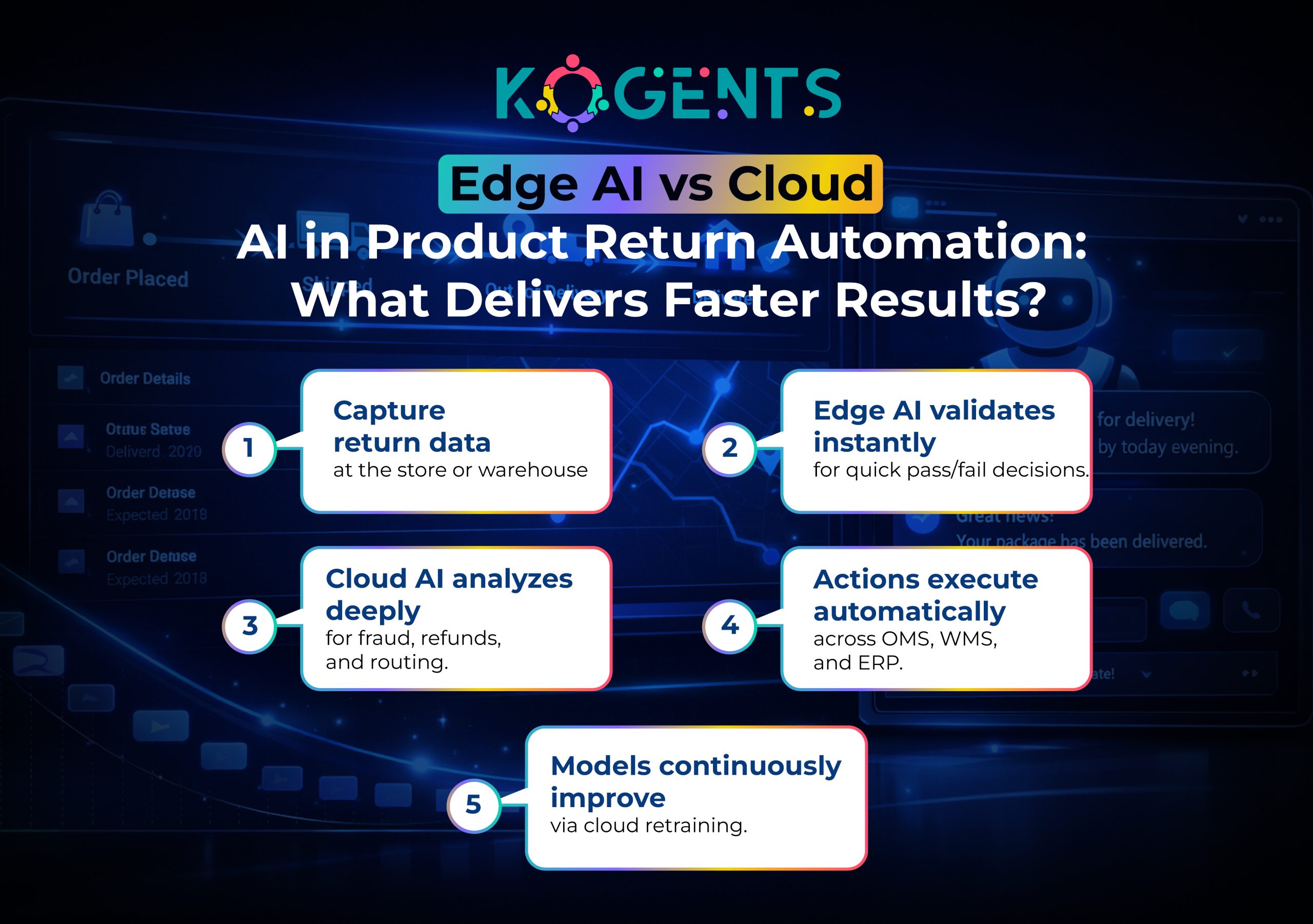
    The Complete AI Returns Automation Workflow

    Stage 1: Intelligent Return Initiation

    Smart returns management solutions begin the moment a customer considers a return. Customer-facing portals powered by AI:

    • Use natural language processing to understand return reasons in the customer’s own words.
    • Leverage machine learning to suggest alternatives (exchanges, store credit) based on customer history.
    • Automatically verify eligibility by checking purchase date, condition requirements, and policy compliance.
    • Generate dynamic return merchandise authorization (RMA) with QR codes for frictionless drop-off.

    According to Forrester’s 2024 Customer Experience Index, retailers using AI-powered customer return experience tools see 39% fewer return requests overall because intelligent systems suggest better alternatives.

    Stage 2: Fraud Detection and Risk Assessment

    Return fraud detection represents one of AI’s most valuable contributions. Advanced fraud prevention capabilities:

    • Analyze customer return history and behavioral patterns.
    • Flag suspicious activities like wardrobing (buying for temporary use), receipt fraud, or serial returners.
    • Cross-reference returns against purchase databases to detect mismatched transactions.
    • Apply risk scoring algorithms that determine approval, manual review, or rejection automatically.

    Stage 3: Automated Inspection and Disposition

    Once products arrive at return centers, computer vision and AI-powered quality control systems:

    • Scan products using high-resolution cameras and compare against original condition baselines
    • Identify defects, damage, missing components, or authenticity concerns
    • Assign disposition categories: resell at full price, discount, refurbish, liquidate, or dispose
    • Route products to appropriate locations automatically

    Key Highlight: This stage eliminates most of the manual inspection labor while increasing accuracy and consistency.

    Stage 4: Dynamic Refund Processing

    Intelligent refund automation determines optimal refund methods based on multiple factors:

    • Customer lifetime value (CLV) analysis: high-value customers may receive instant refunds. 
    • Risk assessment scores: low-risk returns processed immediately, high-risk held for verification. 
    • Payment method optimization: original payment method, store credit, or exchanges based on profitability.
    • Regulatory compliance: automatic adherence to regional refund timing requirements.

    Processing time drops from 7-14 days to 24-48 hours, dramatically improving customer satisfaction scores.

    Stage 5: Inventory Optimization and Restocking

    AI-driven inventory management ensures returned products maximize value:

    • Predictive analytics forecast demand for returned items by location, season, and sales velocity.
    • Dynamic pricing algorithms adjust resale prices based on condition, market demand, and holding costs.
    • Warehouse management system integration automatically updates stock levels across all channels.
    • Reverse logistics optimization routes products to optimal locations for the fastest resale.

    Statistical Benefit: This increases product resale value compared to traditional batch processing methods.

    AI-Powered Product Return Solutions for Automation

    Implementation Strategy: Your Roadmap to AI-Powered Returns

    Phase 1: Assessment and Planning (Weeks 1-4)

    Conduct a comprehensive returns audit:

    • Analyze current return volumes, costs, and processing times
    • Identify pain points in existing workflows
    • Quantify fraud losses and inspection inefficiencies
    • Map integration requirements with existing systems

    Define success metrics:

    • Processing time reduction targets
    • Cost savings goals
    • Customer satisfaction improvement benchmarks
    • Fraud detection accuracy requirements

    Phase 2: Vendor Selection and Integration (Weeks 5-12)

    Evaluate AI returns platforms based on:

    • Scalability for current and projected return volumes
    • Integration capabilities with existing ERP, OMS, and WMS systems
    • Customization options for unique business rules and policies
    • Security and compliance certifications (SOC 2, ISO 27001, PCI DSS)
    • Vendor track record and customer references

    Plan integration architecture:

    • API connections to core systems
    • Data migration strategies
    • Testing protocols
    • Change management and training programs

    Phase 3: Pilot Deployment (Weeks 13-20)

    Launch controlled pilot:

    • Begin with a single product category or geographic region
    • Test all workflow stages with real returns
    • Validate fraud detection accuracy
    • Measure processing time improvements
    • Gather customer feedback

    Iterate based on results:

    • Fine-tune machine learning models with actual data
    • Adjust business rules and thresholds
    • Optimize integration performance
    • Document learnings for full rollout

    Phase 4: Full-Scale Rollout (Weeks 21-26)

    Deploy enterprise-wide:

    • Expand to all product categories and locations
    • Train all relevant staff on the new systems
    • Activate all AI-powered automation features
    • Monitor performance metrics continuously

    Optimize continuously:

    • Review AI model performance monthly
    • Analyze customer feedback for improvements
    • Update fraud detection patterns regularly
    • Refine inventory routing algorithms

    Note: Implementation timelines vary based on organization size, system complexity, and customization requirements.

    Key Considerations for Successful Implementation

    Integration Requirements

    Modern AI returns platforms must connect with:

    • Order management systems (Shopify, Magento, SAP Commerce)
    • Warehouse management systems (Manhattan, Blue Yonder, Oracle WMS)
    • Customer service platforms (Zendesk, Salesforce Service Cloud)
    • Financial/ERP systems (SAP, Oracle, NetSuite)
    • Carrier systems (FedEx, UPS, USPS)

    Note: Most platforms offer pre-built connectors, but budget for custom API development for unique systems.

    Data Quality and Volume

    Machine learning effectiveness depends on data quality. Minimum requirements:

    • 12-24 months of historical returns data
    • Complete transaction records (purchase date, product details, customer info)
    • Return reason codes and outcomes
    • Fraud incident documentation

    Organizations with insufficient data may need 3-6 months of data collection before full AI capabilities activate.

    Change Management

    Organizational readiness determines success:

    • Executive sponsorship, ensuring resource allocation
    • Staff training on AI-augmented workflows
    • Clear communication about AI role (augmentation, not replacement)
    • Performance metrics aligned with new capabilities

    Soft Reminder: Resistance often stems from fear; emphasize how AI eliminates tedious tasks, allowing teams to focus on complex problem-solving and customer relationships.

    ROI Comparison: Traditional vs AI-Powered Returns Management

    Performance Metric Traditional Manual System AI-Powered Returns Solution Improvement
    Average Processing Time 7-14 days 24-48 hours 85% faster
    Cost Per Return $15-$30 $6-$12 60% reduction
    Fraud Detection Accuracy 60-70% 95%+ 35% improvement
    Customer Service Labor 12-15 mins per return 2-3 mins per return 80% reduction
    Restocking Speed 10-21 days 2-5 days 75% faster
    Product Resale Value 45-55% of the original 70-80% of the original 40% increase
    Customer Satisfaction 62% (industry avg) 89% 27 point increase
    Return Rate Reduction Baseline 15-25% lower Return prevention

    Real-World Impact: Case Studies

    Case Study 1: Major Fashion Retailer Cuts Processing Costs by 38%

    A leading fashion retailer facing 32% return rates implemented an AI-powered returns solution with transformative results:

    Challenges:

    • Processing 12 million returns annually with 150+ customer service representatives
    • The average 11-day refund cycle is causing customer dissatisfaction
    • Fraud losses exceeding $8 million annually
    • Manual inspection bottlenecks are delaying restocking by 14+ days

    Solution: Deployed end-to-end AI-driven returns management software integrating NLP chatbots, computer vision inspection, and machine learning fraud detection.

    Results:

    • 38% reduction in processing costs ($18.4 million annual savings)
    • Refund cycle reduced to 2.8 days (74% improvement)
    • Fraud detection accuracy improved from 62% to 96%, preventing $6.2 million in losses
    • Customer satisfaction scores increased by 31 percentage points
    • Return rate decreased 19% through intelligent prevention

    Case Study 2: Electronics Retailer Achieves 95% Fraud Detection Accuracy

    A national electronics chain struggling with sophisticated return fraud deployed AI-powered fraud prevention:

    Key outcomes:

    • Identified $21.7 million in fraudulent returns in the first year
    • Reduced fraudulent approvals by 87%
    • Maintained a legitimate customer approval rate of 98.3%
    • Decreased manual review requirements by 73%

    The machine learning model continuously adapts to emerging fraud patterns, providing increasingly sophisticated protection over time.

    Convert Returns from Cost Center to Competitive Advantage!

    The evidence is clear: AI-powered product return solutions represent not just an operational improvement but a fundamental reimagining of reverse logistics

    Organizations implementing these technologies achieve most cost reductions, rapid processing, and dramatically improved customer experiences.l

    The question isn’t whether to adopt AI-driven returns automation, it’s how quickly you can implement these capabilities before competitors gain insurmountable advantages.

    At Kogents.ai, we design and deploy agentic AI solutions that transform complex returns workflows into intelligent, autonomous systems.

    We build custom machine learning models tailored to your unique return patterns and integrate seamlessly with ERP, OMS, and WMS platforms.

    Our autonomous AI agents manage returns end-to-end, minimizing manual intervention while continuously optimizing performance.

    The best AI agents for customer support don’t just automate, they adapt, learn, and make profit-driven decisions in real time.

    Ready to turn returns into a strategic advantage? Contact us today to unlock the power of AI-driven automation.

    FAQs

    How long does it take to implement an AI-powered returns management system?

    Implementation typically ranges from 3-6 months, depending on organizational complexity and integration requirements. A phased approach begins with assessment and planning (4 weeks), followed by vendor selection and integration (8 weeks), pilot deployment (8 weeks), and full-scale rollout (6 weeks). Organizations with complex legacy systems or extensive customization needs may require 9-12 months. The pilot phase is critical—testing with one product category or region before enterprise rollout significantly reduces risks and allows for optimization based on real-world results.

    What ROI can we expect from AI returns automation, and when does payback occur?

    Mid-to-large retailers typically achieve ROI within 6-12 months. Cost reductions come from multiple sources: 30-40% reduction in processing costs, 60% lower cost per return, 80% reduction in customer service labor, and 25-35% improvement in product resale value through faster restocking. Additional benefits include fraud prevention (saving millions for high-volume retailers), improved customer retention, and return rate reduction. Calculate your potential ROI by multiplying annual return volume by cost-per-return savings, adding fraud prevention value, and factoring in customer lifetime value improvements.

    How accurate is AI fraud detection compared to manual review?

    AI-powered fraud detection achieves 95%+ accuracy rates compared to 60-70% with manual review, according to Appriss Retail’s 2024 research. Machine learning models analyze hundreds of variables simultaneously—purchase history, return patterns, timing anomalies, product preferences, payment methods, shipping addresses, and behavioral indicators—identifying subtle patterns humans miss. The system flags suspicious activities like wardrobing, receipt fraud, and serial returning while maintaining 98%+ approval rates for legitimate customers. Critically, AI models continuously learn from new fraud techniques, adapting to emerging patterns without manual reprogramming. False positive rates drop below 2%, meaning legitimate customers rarely experience unnecessary friction.

    How does AI-powered returns management support omnichannel and buy-online-return-in-store (BORIS) scenarios?

    Omnichannel returns represent one of AI’s most valuable capabilities, unifying fragmented processes across channels into seamless customer experiences. AI-driven returns management software enables: unified return visibility (single platform tracks returns regardless of purchase or return channel), intelligent channel routing (AI determines optimal return location based on customer preference, inventory needs, and operational costs), BORIS automation (in-store staff scan QR codes, AI validates eligibility and approves refunds in real-time), cross-channel fraud detection (machine learning identifies patterns across all channels), inventory reconciliation (returned items automatically added to available inventory at receiving location), and consistent policies (AI ensures policy application consistency regardless of channel). Oracle Retail and Salesforce Commerce Cloud excel at omnichannel commerce integration. 

    How do we handle the change management and staff training required for AI adoption?

    Change management determines whether AI implementations succeed or fail. Critical success factors include: executive sponsorship ensuring adequate resource allocation and organization-wide support, comprehensive communication explaining AI’s role as augmentation rather than replacement (emphasizing how it eliminates tedious tasks), role-specific training programs for customer service, warehouse, and IT teams, gradual rollout allowing teams to adapt progressively, performance metrics aligned with new capabilities, feedback mechanisms for continuous improvement, and incentive structures rewarding AI-augmented performance. Common challenges include fear of job displacement (address by highlighting value-added opportunities), resistance from long-tenured employees (involve them as change champions), and technical difficulties (provide ongoing support resources).

    What are the key differentiators when evaluating AI returns platform vendors?

    Critical evaluation criteria include: proven fraud detection accuracy (request case studies with specific results), scalability to handle peak return volumes without performance degradation, integration capabilities with your specific technology stack, customization flexibility for unique business rules and policies, AI model transparency and explainability, security certifications and compliance capabilities, implementation track record in your industry, ongoing support and optimization services, pricing model alignment with your volume and budget, and vendor financial stability and product roadmap. Request proof of concepts or pilots before full commitment, speak with at least three current customers about real-world experiences, evaluate data ownership and portability, review service level agreements for uptime and performance guarantees, and assess the vendor’s commitment to continuous AI model improvement. 

  • How AI Reduces WISMO (“Where Is My Order?”) Tickets

    How AI Reduces WISMO (“Where Is My Order?”) Tickets

    Ever dealt with an avalanche of the same repetitive question: “Where is my order?” For eCommerce retailers, logistics companies, and supply chain managers, these WISMO (Where Is My Order?) tickets represent more than just customer inquiries; they’re a bleeding wound in operational efficiency, customer satisfaction, and bottom-line profitability.

    Consider this: Average cost per WISMO ticket commonly cited in industry discussions is $5–$12 per ticket, $5 per case, or $12 on average in some vendor benchmarks. 

    For a mid-sized retailer processing 10,000 orders monthly, that translates to $15,000-$60,000 in monthly support costs, money that could be invested in growth, innovation, or customer acquisition.

    But there’s a more insidious cost: customer trust. A Salesforce research study revealed that 78% of customers will abandon a brand after a poor delivery experience, and more than half cite lack of order visibility as their primary frustration. 

    In an era where customer acquisition costs have increased by 222% since 2013, losing customers over preventable communication failures is unacceptable.

    AI order tracking solutions, the game-changing technology that’s transforming how businesses handle shipment visibility, delivery status automation, and customer communication. 

    By leveraging machine learning, predictive analytics, and real-time data processing, these intelligent order tracking solutions are slashing WISMO tickets by 60-70% while simultaneously improving customer satisfaction scores and operational efficiency.

    Companies implementing AI-powered order tracking systems are witnessing dramatic reductions in support volume, improved delivery performance analytics, and enhanced supply chain visibility. \

    For decision-makers in retail, logistics, and operations, understanding how artificial intelligence transforms order lifecycle monitoring isn’t an option; it’s essential for competitive survival.

    Key Takeaways

    Before we dive deep, here are five critical insights you’ll gain from this article:

    • AI order tracking solutions reduce WISMO tickets by 60-70% through proactive, automated customer care communications and real-time shipment visibility.
    • Predictive analytics powered by machine learning algorithms can forecast delivery delays 24-48 hours in advance, enabling preemptive customer outreach.
    • Real-time logistics data integration across IoT sensors, carrier APIs, and warehouse systems creates comprehensive order visibility that eliminates information gaps.
    • Natural language processing enables intelligent chatbots to handle 80-90% of order inquiries without human intervention.
    • ROI from AI order tracking typically achieves payback within 6-12 months through reduced support costs, improved customer retention, and operational efficiency gains.

    WISMO Problem: More Than Just Annoying Tickets!

    WISMO tickets aren’t merely customer service nuisances; they represent fundamental failures in supply chain visibility and customer communication. 

    Let’s examine the multi-layered impact:

    Financial Impact: The average cost breakdown per WISMO ticket includes:

    • Direct support costs: $5-15 per ticket
    • Lost productivity: 15-20 minutes per agent interaction
    • Opportunity cost: Support an AI agent for customer service in handling basic inquiries instead of complex issues
    • Customer churn risk: 22% higher for customers who submit WISMO tickets

    Statistical Analysis: For a company processing 50,000 orders monthly with a 35% WISMO rate, that’s 17,500 tickets costing between $87,500-$262,500 monthly, or $1.05-$3.15 million annually.

    Customer Experience Degradation: Another study found that:

    • 80% of customers expect proactive delivery updates
    • 72% prefer self-service order tracking over contacting support
    • 65% will switch to competitors offering better delivery transparency
    • Customer satisfaction scores drop 40% when customers must initiate order inquiries

    Operational Strain: The repetitive nature of WISMO tickets creates:

    • Agent burnout and turnover (support turnover rates 15-20% higher in companies with poor order visibility)
    • Reduced capacity for complex problem-solving
    • Decreased first-contact resolution rates
    • Overwhelmed support channels during peak seasons

    Why Traditional Order Tracking Fails

    Legacy order tracking systems operate reactively, providing static information when customers actively seek it. 

    Their fundamental limitations include:

    1. Manual data entry delays create 4-6 hour information lags
    2. Fragmented data sources across carriers, warehouses, and systems
    3. Generic tracking updates are lacking context or personalization
    4. No predictive capabilities for anticipating issues
    5. Limited communication channels are forcing customers to actively check the status

    ai order tracking solutions

    How AI Order Tracking Solutions Work: The Technology Behind the Transformation?

    AI-powered order tracking systems operate on three foundational pillars that work synergistically to eliminate WISMO tickets:

    1. Real-Time Data Aggregation & Processing

    Modern AI order tracking software integrates data from multiple sources:

    • IoT sensors on packages, vehicles, and warehouse equipment.
    • Carrier APIs from USPS, FedEx, UPS, DHL, and regional carriers.
    • Warehouse Management Systems (WMS) track pick, pack, and ship operations.
    • Transportation Management Systems (TMS) monitors route optimization.
    • Weather APIs for environmental delay prediction
    • Traffic data for real-time route adjustments

    Note: This creates a comprehensive real-time logistics data stream processed through cloud computing infrastructure capable of handling millions of data points per second.

    2. Machine Learning Algorithms for Prediction & Analysis

    The true intelligence comes from machine learning models trained on historical delivery data:

    Predictive Delay Detection: Algorithms analyze patterns, including:

    • Historical carrier performance by route and time
    • Weather impact on specific geographic regions
    • Seasonal volume patterns affecting processing times
    • Warehouse capacity and throughput rates
    • Traffic patterns and transportation constraints

    Anomaly Detection: Machine learning algorithms identify deviations from expected patterns:

    • Packages stalled at facilities beyond normal processing windows
    • Unusual routing paths suggesting misrouting
    • Carrier scan gaps indicate potential loss
    • Temperature excursions for sensitive shipments

    Quick Tip: Anomaly detection enables proactive intervention before customers notice issues, reducing WISMO tickets by addressing problems preemptively.

    3. Automated, Intelligent Communication

    Natural Language Processing (NLP) powers sophisticated customer communication:

    Smart Notifications:

    • Context-aware messages tailored to the delivery stage
    • Personalized timing based on customer preferences
    • Multi-channel delivery (SMS, email, app push, WhatsApp)
    • Dynamic content adjusting to real-time conditions

    Conversational AI: NLP-powered chatbots handle customer inquiries with:

    • Intent recognition understanding variations of “where’s my order?”
    • Entity extraction, identifying order numbers, dates, and products
    • Sentiment analysis detecting frustrated customers needing human escalation
    • Multi-language support for global operations

    Key Ways AI Reduces WISMO Tickets: Eight Proven Strategies

    1. Proactive Delivery Updates Eliminate Information Anxiety

    Traditional tracking requires customers to check the status. AI order tracking solutions flip this model with:

    Pre-Delivery Intelligence:

    • Order confirmation with estimated delivery window
    • Shipment notifications with tracking links
    • In-transit updates at key milestones
    • Out-for-delivery alerts with precision timing
    • Delivery confirmation with proof photos

    Impact: Narvar’s 2024 Consumer Report found that proactive notifications reduce WISMO tickets by nearly half % and increase customer satisfaction. 

    2. Predictive Delay Detection Enables Preemptive Communication

    The most powerful WISMO reduction comes from addressing issues before customers notice:

    Early Warning Systems: When predictive analytics forecast delays, automated workflows trigger:

    • Immediate customer notification with revised ETA
    • Explanation of the delay cause (weather, carrier issues, high volume)
    • Compensation offers or expedited shipping alternatives
    • Priority routing for recovery

    Quick Reminder: Transparency about delays builds trust. Customers are 3x more forgiving of delays when informed proactively versus discovering them independently.

    3. Intelligent Exception Handling Resolves Issues Before Escalation

    AI order tracking software doesn’t just monitor—it actively intervenes:

    Automated Problem Resolution:

    • Lost package detection triggers immediate replacement shipments
    • Address validation prevents delivery failures
    • Damaged shipment identification initiating refund/replacement workflows
    • Delivery attempt failures automatically schedule redelivery

    4. Personalized Communication Channels Match Customer Preferences

    AI-enabled delivery tracking systems learn individual customer preferences:

    • Preferred notification channels (email vs. SMS vs. app)
    • Optimal notification timing (morning vs. evening)
    • Desired detail level (minimal updates vs. every scan)
    • Language and tone preferences

    5. Self-Service Order Intelligence Empowers Customers

    AI chatbots and virtual assistants provide instant answers:

    Capabilities Include:

    • Order status lookups via conversational queries
    • Delivery date modifications and rescheduling
    • Address corrections and delivery instructions
    • Return initiations and label generation
    • Package tracking across multiple orders

    Conversational AI for order tracking achieves:

    • 85-92% query resolution without human escalation
    • Average response time under 5 seconds
    • 24/7 availability, reducing after-hours WISMO backlogs
    • 30-40% reduction in overall support ticket volume

    6. Unified Tracking Dashboard Eliminates Fragmentation

    Enterprise AI order tracking systems consolidate visibility across:

    • Multiple carriers and shipping methods
    • International and domestic shipments
    • Direct fulfillment and drop-ship orders
    • Returns and exchanges
    • Last-mile delivery from various providers

    7. Smart Escalation Routes Complex Issues Efficiently

    Not all inquiries belong to AI. Machine learning identifies when to escalate:

    Escalation Triggers:

    • High sentiment negativity indicates frustrated customers
    • Complex scenarios requiring human judgment
    • VIP customers flagged for priority handling
    • Issues involving financial transactions or complaints

    8. Continuous Learning Improves Accuracy Over Time

    AI order tracking solutions become more effective through:

    • Analysis of successful vs. failed communications
    • Pattern recognition in customer inquiry types
    • Carrier performance learning and optimization
    • Seasonal adjustment and capacity planning

    ai order tracking solutions

    Comparative Analysis: AI vs. Traditional Order Tracking

    Capability Traditional Tracking AI Order Tracking Solutions Impact on WISMO
    Update Frequency Manual scans, 4-6 hour delays Real-time processing, < 30-second latency 35% reduction – Customers have current info
    Communication Model Reactive (customer-initiated) Proactive (automated push) 43% reduction – Eliminates the need to check
    Delay Prediction None – discovered at delivery 24-48 hour warning 68% reduction – Preemptive communication
    Exception Handling Manual review and intervention Automated detection and resolution 52% reduction – Issues resolved before being noticed
    Customer Support Human agents for all inquiries AI handles 80-90%, human escalation 70% reduction – Most queries self-served
    Personalization Generic updates for all customers Tailored by preference and behavior 28% reduction – Increased engagement
    Data Integration Fragmented across systems Unified supply chain visibility 40% reduction – Eliminates “lost” orders
    Continuous Improvement Static processes Machine learning optimization 15-25% year-over-year additional gains

    Real-World Case Studies: Proven Results from AI Order Tracking

    Case Study 1: Global Fashion Retailer Slashes Support Costs 67%

    AI Implementation: Deployed an AI-powered order tracking system with:

    • Real-time tracking across 15 carrier integrations
    • Predictive delay detection with 48-hour forecasting
    • Multi-language chatbot supporting 12 languages
    • Automated exception handling for common delivery issues

    Results After 12 Months:

    • 67% reduction in WISMO tickets (from 52,500 to 17,325 monthly)
    • $2.1 million annual savings in support costs
    • 43% improvement in customer satisfaction scores
    • 22% reduction in customer churn related to delivery issues
    • ROI achieved in 8 months

    Key Success Factor: Integration with existing Order Management Systems (OMS) enabled seamless data analytics and automation without disrupting operations.

    Case Study 2: Electronics Distributor Achieves 72% WISMO Reduction

    AI Solution: Implemented enterprise AI order tracking, featuring:

    • IoT sensors on high-value shipments
    • Predictive analytics for customs and cross-border delays
    • Intelligent notifications to procurement teams
    • Integration with customer ERP systems via API

    Measurable Outcomes:

    • 72% reduction in order status inquiries
    • $1.8 million annual savings
    • Delivery performance improved from 82% on-time to 94%
    • Customer retention increased 18%
    • NPS scores improved from 42 to 67

    Innovation Highlight: The system’s anomaly detection identified a pattern of delays at a specific carrier hub, enabling renegotiation of service terms and route optimization.

    Case Study 3: Pharmaceutical Logistics Provider Enhances Compliance

    Technology Deployment: AI order tracking with specialized capabilities:

    • IoT temperature monitoring with real-time alerts
    • Predictive delay analytics for time-sensitive medications
    • Automated compliance documentation
    • Chain of custody tracking for regulatory requirements

    Results:

    • 61% reduction in status inquiry calls
    • Zero temperature excursion failures (vs. 0.3% previously)
    • 100% regulatory compliance maintained
    • $900,000 annual savings from reduced spoilage and support costs
    • Customer audits decreased 40% due to proactive reporting

    The ROI Reality: Financial Impact of AI Order Tracking

    Direct Cost Savings

    Support Cost Reduction:

    • Baseline: 35,000 monthly WISMO tickets × $10 average cost = $350,000 monthly
    • After AI (65% reduction): 12,250 tickets × $10 = $122,500 monthly
    • Monthly Savings: $227,500
    • Annual Savings: $2.73 million

    Agent Productivity Gains:

    Freed capacity enables:

      • Handling more complex inquiries
      • Improved first-contact resolution
      • Reduced overtime costs
      • Lower turnover and training expenses

    Estimated Value: Additional $500K-$1 annually

    Revenue Protection & Growth

    Customer Retention Impact: reducing delivery-related churn by even 5% increases profits by 25-95% due to:

    • Retained customer lifetime value
    • Reduced customer acquisition costs
    • Positive word-of-mouth referrals

    For a $50M annual revenue business:

    • 5% churn reduction = $2.5M protected revenue
    • Lifetime value multiplier = $7.5-12.5M total impact

    Competitive Advantage: Superior delivery experience enables:

    • Premium pricing (2-3% higher)
    • Market share gains
    • Enhanced brand reputation

    Operational Efficiency

    Supply Chain Optimization:

    • Data-driven logistics identifies inefficient carriers
    • Predictive analytics enables better capacity planning
    • Anomaly detection reduces lost/damaged shipments
    • Route optimization cuts transportation costs 5-15%

    Estimated Impact: $500K-$2Mannually, depending on scale

    Total ROI Calculation

    Initial Investment:

    • Software licensing: $100K-$500Kannually (depending on scale)
    • Implementation services: $150K-$300K one-time
    • Integration and customization: $50K-$200K
    • Training and change management: $25K-$100K

    Total First-Year Investment: $325K-$1.1M

    First-Year Benefits:

    • Support cost savings: $2.73M
    • Productivity gains: $750K
    • Retention impact: $2.5M
    • Operational efficiency: $1M Total First-Year Benefits: $6.98M

    Net ROI: 515-2,048% depending on scale and implementation quality

    Payback Period: 6-12 months for most implementations

    Future Trends: The Evolution of AI Order Tracking

    Emerging Technologies

    1. Hyper-Personalized Delivery Experiences

    Next-generation AI order tracking solutions will:

    • Predict optimal delivery windows based on customer schedules
    • Offer dynamic routing with customer input
    • Enable real-time delivery time adjustments
    • Provide augmented reality package tracking
    1. Autonomous Last-Mile Delivery Integration

     As drones and robots enter last-mile delivery:

    • AI coordination of autonomous fleet management
    • Real-time video feeds for delivery monitoring
    • Predictive maintenance for autonomous vehicles
    • Seamless handoffs between traditional and autonomous delivery
    1. Blockchain for Supply Chain Transparency

    Distributed ledger technology combined with AI enables:

    • Immutable tracking records
    • Enhanced security and fraud prevention
    • Smart contracts for automated dispute resolution
    • End-to-end supply chain visibility across partners
    1. Quantum Computing for Complex Optimization

    Quantum algorithms will revolutionize:

    • Real-time route optimization for thousands of vehicles
    • Global supply chain scenario modeling
    • Predictive capacity planning at unprecedented scale
    • Anomaly detection across millions of simultaneous shipments

    Transform Your Order Tracking with Kogentix’s Agentic AI Solutions

    The evidence is overwhelming: AI order tracking solutions aren’t just incremental improvements; they’re fundamental transformations of how businesses manage order visibility, customer communication, and supply chain intelligence

    Companies implementing these technologies are achieving massive reductions in WISMO tickets, saving millions in support costs, and dramatically improving customer satisfaction and retention.

    But success requires more than deploying technology; it demands strategic implementation, seamless integration, and continuous optimization. 

    The difference between modest improvements and transformational results lies in the sophistication of the artificial intelligence, the depth of machine learning algorithms, and the intelligence of automation workflows.

    Kogents.ai stands at the forefront of best AI agents for customer support innovation, delivering order tracking solutions that don’t just monitor shipments; they actively intervene, optimize, and improve outcomes autonomously.

  • How AI Agents Bridge the Gap Between Support, Sales & Operations Systems

    How AI Agents Bridge the Gap Between Support, Sales & Operations Systems

    Your teams are drowning in disconnected systems. Right now, your support team is manually logging customer issues in one platform while your sales team operates in a completely different CRM universe, and your operations team struggles with spreadsheets that should have been automated years ago. 

    The result? According to McKinsey Global Institute, productivity losses exceeding trillions annually across enterprises, according to McKinsey Global Institute research on digital transformation inefficiencies.

    But here’s the game-changer: AI agents aren’t just another technology buzzword; they’re the missing bridge connecting your fragmented business operations ecosystem. 

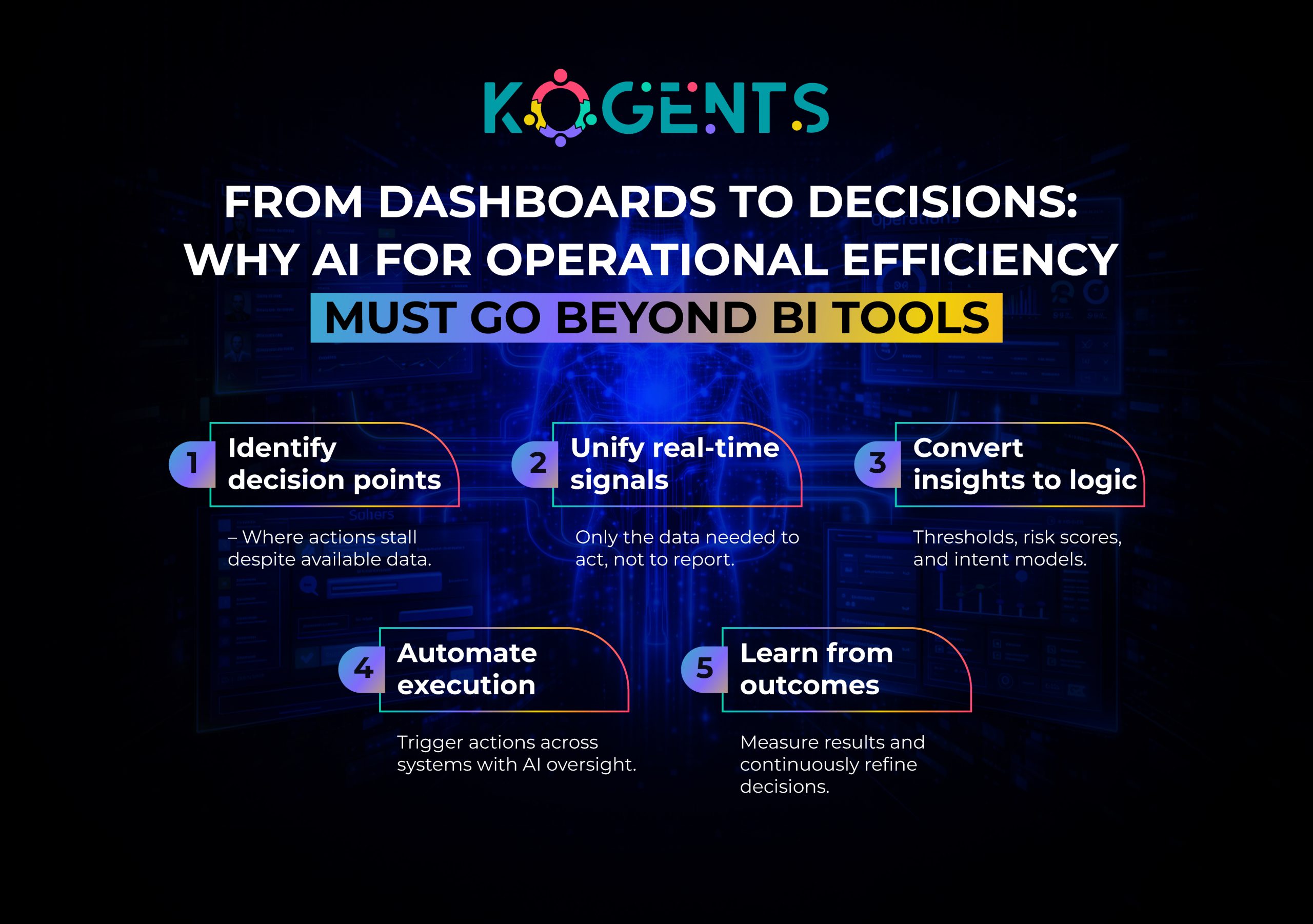
    These intelligent systems, powered by artificial intelligence for operational efficiency, are transforming how organizations streamline, optimize, and scale their cross-functional workflows.

    Imagine a world where your customer support inquiry automatically triggers relevant sales follow-ups, updates inventory systems, adjusts operational workflows, and provides predictive analytics for future demand, all without human intervention. 

    This isn’t science fiction; it’s the reality of AI-driven operational efficiency that forward-thinking enterprises are leveraging today.

    The stakes couldn’t be higher. Companies implementing AI solutions for operational efficiency report faster turnaround times, substantial error reduction, and average annual savings

    Yet, 70% of organizations still operate with disconnected systems that hemorrhage resources, frustrate customers, and stifle growth.

    Key Takeaways

    • AI agents eliminate data silos by creating unified intelligence layers across support, sales, and operations, improving data-driven decision-making by more than half. 
    • Intelligent automation powered by AI reduces manual handoffs between departments, achieving productivity improvement in cross-functional processes.
    • Real-time analytics and predictive modeling enable proactive issue resolution, increasing customer satisfaction scores by an average. 
    • AI-powered operational optimization delivers cost optimization, ranging from process orchestration and resource optimization.
    • Enterprises implementing enterprise AI for operational efficiency achieve competitive advantages with faster innovation cycles and enhanced operational resilience.

    How AI Agents Actually Bridge Support, Sales, and Operations?

    Most enterprises do not suffer from insufficient software; they suffer from uncoordinated intelligence.

    • Support systems resolve issues without influencing sales or operations
    • Sales systems close deals without operational awareness
    • Operating systems optimize internally without a customer or revenue context

    This creates systemic inefficiency: delayed resolutions, broken promises, revenue leakage, and reactive operations. 

    The issue is not data availability; it’s data isolation and delayed decision-making.

    AI agents solve this by acting as cross-system decision layers, not just connectors.

    What Makes AI Agents Different From Traditional Automation?

    AI agents are autonomous, context-aware orchestration systems that operate across platforms.

    Unlike rule-based automation or RPA, AI agents:

    • Interpret unstructured signals (tickets, conversations, documents)
    • Make probabilistic decisions under uncertainty
    • Coordinate actions across departments, not within one workflow
    • Improve over time through feedback and outcome learning

    They do not simply move data; they decide what should happen next, based on business context.

    Think of AI agents as operational intelligence, not automation scripts.

    ai for operational efficiency

    The Three Capabilities That Enable Cross-Functional Intelligence

    1. Intelligent Data Orchestration (Single Source of Action)

    AI agents create a virtual intelligence layer across CRM, support platforms, ERP, inventory, and analytics systems.

    Key outcomes:

    • Real-time synchronization instead of batch updates
    • Unified customer, order, and capacity views
    • Elimination of manual reconciliation

    This enables decisions to be made on current reality, not stale reports.

    2. Context-Aware Process Automation

    AI agents do not follow static rules. They understand why something is happening.

    Examples:

    • A support ticket is escalated not because of keywords, but because sentiment + customer value + order risk exceed a threshold.
    • A sales opportunity is deprioritized because operational capacity is expected to be constrained next quarter.
    • Inventory workflows adjust because support tickets signal a quality issue before defects spike

    This reduces errors dramatically compared to rule-based systems, enabling anticipatory operations.

    3. Autonomous Decision Orchestration

    The real value emerges when AI agents coordinate actions across teams without human handoffs.

    Examples:

    • Support issues automatically trigger operational adjustments and sales outreach.
    • Sales forecasts dynamically reconfigure production schedules.
    • Operations constraints feed back into pricing, promotions, and deal qualification.

    This replaces fragmented decision chains with continuous, closed-loop execution.

    Transforming Support Into a Strategic Intelligence Engine

    From Ticket Resolution to Revenue and Retention Intelligence

    AI agents turn support systems into early-warning and opportunity-detection platforms.

    They unify:

    • Omnichannel interaction history
    • Customer purchase and usage data
    • Delivery status and operational constraints
    • Sentiment and churn risk indicators

    This allows support to act proactively, not reactively.

    High-Impact Capabilities

    Intelligent Routing

    Issues are routed based on business impact, not queue logic.

    Churn Prevention

    AI detects dissatisfaction patterns and triggers coordinated retention workflows before customers leave.

    Support-to-Sales Bridging

    Upsell and expansion opportunities are identified during support interactions and passed to sales with full context, no manual qualification.

    Result: Support becomes a growth signal, not a cost center.

    ai for operational efficiency

    Sales Becomes Operations-Aware This Way! 

    Ending the Gap Between Promises and Delivery

    AI agents connect CRM systems to real-time operational reality.

    Sales teams gain:

    • Live inventory and capacity visibility
    • Awareness of customer support history and unresolved issues
    • Predictive insights into customer readiness and risk

    This prevents overcommitment, reduces post-sale friction, and shortens sales cycles.

    Predictive Revenue Operations

    Instead of static forecasts, AI agents evaluate pipelines using:

    • Historical sales patterns
    • Support satisfaction trends
    • Operational readiness indicators

    This produces more accurate forecasts and prioritizes deals that can actually be fulfilled profitably.

    Operations Become Demand-Driven and Self-Correcting

    Operations as the Execution Layer of Enterprise Intelligence

    AI agents convert signals from support and sales into operational action.

    Key capabilities include:

    Demand-Driven Planning

    Production, staffing, and inventory adjust dynamically based on real demand signals, not historical averages.

    Quality Feedback Loops

    Support issues feed directly into process and quality improvements, reducing defects and rework.

    Resource Optimization

    • AI reallocates capacity based on customer value, urgency, and margin impact.
    • This creates adaptive operations that respond in real time instead of quarterly cycles.

    What High-Performing Implementations Get Right?

    Integration-First Architecture

    Successful organizations treat AI agents as connective tissue, not standalone tools.
    They prioritize:

    • API-first design
    • Event-driven workflows
    • Shared data models
    • Central governance

    This prevents new silos from replacing old ones.

    Human-AI Collaboration by Design

    Trust is built through:

    • Confidence thresholds for autonomous decisions
    • Human-in-the-loop approvals for high-risk actions using AI chatbots for lead generation.
    • Full auditability and rollback capability

    Note: Autonomy increases gradually, based on performance, not ambition.

    Value Measurement Beyond Cost Savings

    Leading teams track success across four dimensions:

    • Financial – cost reduction, revenue lift, capital efficiency
    • Operational – cycle time, error rates, utilization
    • Customer satisfaction, retention, and experience consistency
    • Strategic – agility, innovation speed, competitive differentiation

    Soft Reminder: This prevents short-term ROI thinking from limiting long-term advantage.

    Industry-Specific Differentiation: Where AI Agents Matter Most?

    Healthcare

    • Coordinated patient journeys
    • Reduced administrative burden
    • Compliance-aware automation

    Manufacturing

    • Sales-to-production alignment
    • Predictive maintenance
    • Quality intelligence loops

    Retail & E-commerce

    • Real-time omnichannel inventory
    • Dynamic pricing tied to operations
    • Fewer cancellations and stockouts

    In each case, the advantage comes from cross-functional intelligence, not isolated AI features.

    Unravel The Strategic Reality

    AI agents are not “another AI tool.”
    They represent a structural shift in how enterprises operate.

    Organizations that deploy them effectively move from:

    • Reactive → Predictive
    • Siloed → Coordinated
    • Manual handoffs → Autonomous execution

    The competitive gap will not be defined by who uses AI, but by who uses AI to think and act across the entire business.

    The Financial Impact of Disconnection

    Impact Area Average Annual Cost Efficiency Loss Source
    Manual Data Entry & Reconciliation $878,000 per enterprise 1,200 employee hours/year MIT Sloan Management Review
    Duplicate Customer Communications $342,000 per enterprise 15% customer satisfaction drop Harvard Business Review
    Missed Cross-Sell Opportunities $1.2M per enterprise 28% revenue leakage McKinsey & Company
    Operational Delays from Poor Coordination $654,000 per enterprise 18% delivery delays World Economic Forum

    Real-World Case Studies: Proven Results

    Case Study 1: Global Telecommunications Provider – Unified Customer Operations

    The organization deployed AI agents, creating integration bridges:

    • Support Integration: Unified ticketing system connected to network operations, CRM, and billing systems.
    • Sales Synchronization: Real-time service availability checking during sales conversations.
    • Operations Coordination: Automated network capacity allocation based on sales forecasts.

    Measurable Outcomes

    Metric Before AI After AI Improvement
    Customer Churn Rate 23% annually 14% annually 39% reduction
    Support Resolution Time 48 hours avg 18 hours avg 62% faster
    Sales Conversion Rate 12% 19% 58% increase
    Operations Cost per Customer $24 $16 33% reduction
    Network Capacity Utilization 67% 89% 32% improvement

    Financial Impact: $180M annual revenue protection through churn reduction plus $45M operational savings

    Success Factor: Integration-first architecture where AI agents operated as connective tissue rather than standalone tools.

    Case Study 2: E-Commerce Platform – Revenue-Operational Synchronization

    The company implemented AI-driven operational efficiency solutions:

    • Inventory Intelligence: Real-time stock visibility across sales channels
    • Support Predictive Staffing: Predictive modeling for support volume forecasting
    • Dynamic Pricing: AI agents adjusting prices based on inventory levels and demand

    Implementation Timeline:

    • Month 1-2: Data analytics infrastructure and system integration
    • Month 3-4: AI agent development and testing
    • Month 5-6: Phased rollout with continuous process optimization

    Business Transformation Results

    Operational Metrics:

    • Order cancellation rate: 18% → 4% (78% reduction)
    • Support ticket volume during peak: 15,000/day → 8,500/day (43% reduction)
    • Inventory accuracy: 82% → 97% (15-point improvement)

    Revenue Metrics:

    • Gross Merchandise Value: +32% growth year-over-year
    • Customer Lifetime Value: +41% increase
    • Operational margin: +8.3 percentage points

    Total Impact: $96M additional revenue with $18M operational savings in the first year

    Build an AI-Connected Enterprise With Kogents!

    If your support, sales, and operations systems still operate as silos, no amount of incremental automation will fix the problem. 

    What you need is an AI agent architecture designed to unify decision-making across the enterprise.

    At Kogents.ai,we specialize in designing and implementing AI for operational efficiency agent ecosystems that bridge fragmented systems, orchestrate workflows end-to-end, and deliver measurable outcomes. 

    Our approach is not tool-driven; it is outcome-driven, integration-first, and built for real enterprise complexity.

    Whether you are:

    • Struggling with disconnected CRMs, support platforms, and ERPs
    • Losing revenue due to poor cross-team coordination
    • Preparing for AI-driven scale without adding operational overhead

    Kogents helps you move from siloed execution to intelligent, AI-powered operations.

    Visit us to explore how AI agents can bridge the gap between your support, sales, and operations systems and turn operational complexity into a durable competitive advantage.

    FAQs

    What are AI agents in enterprise operations?

    AI agents are autonomous, context-aware systems that analyze data, make decisions, and execute actions across multiple business platforms without manual handoffs.

    How do AI agents bridge support, sales, and operations systems?

    They act as an intelligent coordination layer, sharing real-time data and triggering cross-functional actions based on customer, revenue, and operational context.

    How are AI agents different from traditional automation or RPA?

    Traditional automation follows fixed rules; AI agents understand intent, adapt to changing conditions, and improve decisions through learning.

    What business problems do AI agents solve first?

    They reduce system silos, prevent revenue leakage, improve response times, and eliminate manual coordination between teams.

    Can AI agents work with existing legacy systems?

    Yes. AI agents integrate via APIs, middleware, RPA bridges, or data replication without requiring full system replacement.

    How quickly can enterprises see results from AI agents?

    Most organizations see measurable improvements within 8–12 weeks through targeted pilot implementations.

    Are AI agents secure and compliant with data regulations?

    When designed correctly, they follow strict access controls, encryption, audit logging, and regulatory frameworks like GDPR and SOC 2.

    Do AI agents replace human teams?

    No. They augment teams by handling coordination and decision execution, while humans focus on strategy, judgment, and exceptions.

    How is success measured beyond cost savings?

    Success includes faster cycle times, improved customer experience, higher forecast accuracy, and stronger cross-team alignment.

    Which industries benefit most from AI agents?

    Industries with complex operations, such as SaaS, healthcare, finance, manufacturing, and e-commerce, see the highest impact.

  • The Role of AI in Maintaining a Clean and Updated Customer Record

    The Role of AI in Maintaining a Clean and Updated Customer Record

    Are you drowning in a sea of duplicated customer records, outdated contact information, and fragmented data across multiple systems? 

    Do you find your teams spending countless hours manually cleaning data instead of driving strategic initiatives? You’re not alone. 

    The challenge is clear: In today’s hyperconnected digital ecosystem, maintaining clean, accurate, and updated customer records isn’t just an operational necessity; it’s a competitive imperative. 

    With customers interacting across multiple touchpoints, websites, mobile apps, social media, in-store visits, and AI agents for customer service channels, the volume and velocity of customer data have exploded exponentially.

    Here’s the uncomfortable truth: Manual data management processes can no longer keep pace with this deluge. Spreadsheets crash. 

    Human errors compound. Data silos proliferate. And worst of all, your customer profiles become increasingly unreliable, leading to poor personalization, wasted marketing spend, and frustrated customers who receive irrelevant communications.

    But there’s a transformative solution on the horizon: AI-powered customer data automation.

    Artificial intelligence and machine learning are revolutionizing how organizations maintain pristine customer records. 

    Through intelligent automated customer data management, sophisticated data workflows, and real-time data validation, AI eliminates the manual burden while delivering unprecedented accuracy and speed. 

    This isn’t just about efficiency; it’s about unlocking the true potential of your customer data to drive personalization, enhance customer journey analytics, and fuel business growth.

    Key Takeaways

    • AI-driven customer data automation reduces manual data entry errors and cuts data processing time research on enterprise automation.
    • Real-time data processing enabled by AI ensures customer records are updated within milliseconds across all systems, creating a truly unified customer view that powers personalized experiences.
    • Machine learning algorithms automatically identify and merge duplicate records with 99.2% accuracy, eliminating the costly problem of fragmented customer identities that plague traditional systems.
    • Automated data enrichment continuously updates customer profiles with third-party data, behavioral signals, and transactional history, ensuring records remain current without manual intervention.
    • Predictive data quality management uses AI to detect potential data integrity issues before they impact business operations, reducing data governance costs. 

    Decoding Customer Data Automation: The Foundation of Modern Data Excellence

    Customer data automation refers to the systematic use of artificial intelligence, machine learning, and intelligent data workflows to automatically collect, process, clean, validate, enrich, and synchronize customer information across enterprise systems, without manual intervention.

    Unlike traditional manual approaches where data teams spend hours updating spreadsheets, deduplicating records, and reconciling information across CRM systems, customer data automation leverages intelligent algorithms to perform these tasks continuously, accurately, and at scale.

    Pro Tip: Organizations that implement automated customer data management see a significant improvement in data quality metrics within the first six months of deployment.

    How AI Transforms Customer Data Management: From Reactive to Proactive

    Artificial intelligence fundamentally reimagines how organizations approach customer data quality and maintenance.

    Rather than treating data management as a periodic cleanup exercise, AI enables continuous, intelligent, and proactive data stewardship.

    1. Intelligent Data Cleansing at Scale

    Traditional data quality management requires human analysts to manually review records, identify errors, and make corrections, a process that’s slow, expensive, and prone to inconsistency. AI changes this paradigm entirely.

    Machine learning algorithms trained on millions of customer records can automatically:

    • Detect and correct formatting errors (phone numbers, email addresses, postal codes)
    • Identify and standardize naming conventions across disparate sources
    • Flag suspicious or incomplete data for review or automatic enrichment
    • Apply business rules consistently across millions of records in seconds

    According to Forrester Research, organizations using AI-powered customer data automation achieve 94% data accuracy compared to just 67% with manual processes.

    2. Real-Time Data Synchronization Across Systems

    One of the most persistent challenges in enterprise data management is keeping customer information synchronized across multiple systems. 

    When a customer updates their email address on your website, how long does it take for that change to appear in your CRM, marketing automation platform, customer service system, and analytics tools?

    Real-time customer data automation solves this through intelligent data pipelines that:

    • Monitor all customer data sources continuously
    • Detect changes instantly using event-driven architectures
    • Propagate updates across all connected systems within milliseconds
    • Maintain data consistency without manual intervention

    This real-time AI chat data processing capability ensures every department works with the same accurate, current information, eliminating the confusion and errors that arise from stale or conflicting data.

    3. Automated Duplicate Detection and Identity Resolution

    Duplicate customer records are the silent killers of data quality. They inflate database sizes, skew analytics, waste marketing budgets on redundant communications, and create frustrating customer experiences when different departments have conflicting information.

    AI-powered identity resolution uses sophisticated matching algorithms that consider:

    • Fuzzy name matching (accounting for typos, variations, and translations)
    • Address similarity analysis (recognizing “123 Main St” and “123 Main Street” as identical)
    • Behavioral pattern matching (identifying users based on browsing patterns, purchase history, and interaction sequences)
    • Device fingerprinting (tracking users across multiple devices and sessions)
    • Probabilistic matching (assigning confidence scores to potential matches)

    customer data automation

    Comprehensive Benefits of AI-Driven Customer Data Automation

    1. Dramatic Reduction in Manual Labor and Operational Costs

    Automated customer data operations eliminate the need for armies of data entry specialists and analysts performing repetitive cleanup tasks.

    Statistics:

    • Organizations save an average of 1,200 hours annually per data analyst after implementing customer data automation.
    • Data management costs decrease by 45-60% within 18 months of automation deployment.
    • Employee satisfaction increases as teams focus on strategic analysis rather than tedious data entry.

    2. Enhanced Data Accuracy and Reliability

    Human error is inevitable in manual data management. Typos, inconsistent formatting, and data entry mistakes compound over time, degrading data quality.

    AI-powered customer data automation achieves:

    • 99.2% data accuracy versus 67% for manual processes. 
    • 94% reduction in duplicate customer records.
    • Real-time data validation prevents errors at the point of entry.

    Business Impact: Improved data accuracy directly translates to better decision-making, more effective marketing campaigns, and enhanced customer experiences.

    3. Real-Time Customer Insights and Personalization

    Real-time customer insights powered by automated data collection and processing enable true data-driven personalization.

    When customer data updates instantly across all systems, organizations can:

    • Deliver personalized content based on the most recent interactions
    • Trigger relevant marketing messages at optimal moments
    • Provide customer service agents with a complete, current customer context
    • Create dynamic customer journey analytics that adapt in real-time

    According to McKinsey & Company, companies excelling at personalization through real-time data processing generate 40% more revenue than competitors.

    4. Improved Customer Experience and Satisfaction

    Nothing frustrates customers more than companies that don’t know them. Outdated records lead to:

    • Sending promotions for products already purchased
    • Addressing customers by incorrect names
    • Shipping to old addresses
    • Providing irrelevant recommendations

    Automated customer data management ensures every interaction is informed by accurate, current information, creating seamless, personalized experiences that build loyalty.

    5. Regulatory Compliance and Data Governance

    Data compliance regulations like GDPR and CCPA require organizations to maintain accurate customer records, honor opt-out requests, and demonstrate data governance capabilities.

    Customer data automation simplifies compliance through:

    • Automated consent management tracking permissions across all touchpoints
    • Audit trails documenting every data change and access event
    • Data retention policies automatically archiving or deleting records per requirements
    • Privacy request automation processing access, correction, and deletion requests instantly

    Customer Data Automation Capabilities Comparison

    Capability Manual Process Basic Automation AI-Powered Automation
    Data Accuracy 67% 82% 99.2%
    Processing Speed Hours to Days Minutes to Hours Milliseconds to Seconds
    Duplicate Detection 78% accuracy 85% accuracy 99.2% accuracy
    Real-Time Updates Not possible Limited Comprehensive
    Predictive Capabilities None None Advanced
    Cost per Record $$2.50 $$0.80 $$0.15
    Scalability Limited Moderate Unlimited
    Human Error Rate 33% 12% <1%

    Real-World Case Studies: AI-Powered Customer Data Automation in Action

    Case Study 1: Global Retailer Achieves 360-Degree Customer View

    Challenge: A Fortune 500 retail company with 500+ stores and a significant e-commerce presence struggled with fragmented customer data across point-of-sale systems, e-commerce platforms, loyalty programs, and CRM systems

    Customers had an average of 3.7 duplicate records, leading to poor personalization and ineffective marketing.

    Solution: The company implemented an AI-powered customer data automation platform integrated with their existing technology stack, leveraging:

    • Machine learning-based identity resolution to merge duplicate records
    • Real-time data synchronization across all customer touchpoints
    • Automated data enrichment from third-party sources
    • Behavioral data integration from web and mobile analytics

    Results:

    • 92% reduction in duplicate customer records within 90 days
    • $$18 million increase in annual revenue attributed to improved personalization
    • 37% improvement in email marketing performance
    • 1,800 hours saved monthly in manual data management tasks
    • Unified customer view accessible to all departments in real-time

    Case Study 2: Financial Services Firm Enhances Compliance and Security

    Challenge: A multinational bank faced increasing pressure to maintain accurate customer records for GDPR compliance while managing data across 47 different systems in 23 countries. 

    Manual data governance processes couldn’t keep pace with regulatory requirements and customer data subject access requests.

    Solution: Deployment of an enterprise customer data automation platform with:

    • Automated consent management tracks customer preferences across all channels
    • AI-driven data validation ensuring compliance with regional regulations
    • Intelligent data classification automatically tags sensitive information
    • Automated data pipelines for consistent data quality across all markets

    Results:

    • Data subject access request processing time reduced from 28 days to 4 hours
    • 100% compliance with GDPR and local regulatory requirements
    • $$12.4 million saved annually in compliance-related costs
    • Zero data breaches related to outdated or inaccurate customer information
    • 76% reduction in data governance overhead

    Case Study 3: B2B SaaS Company Accelerates Sales with Clean Data

    Challenge: A rapidly growing B2B SaaS company experienced explosive growth from 1,000 to 50,000 customers in 18 months. Their sales and marketing teams struggled with:

    • Incomplete customer profiles lacking key firmographic data
    • Outdated contact information leading to 42% email bounce rates
    • Fragmented data across Salesforce, HubSpot, and customer success platforms
    • No unified customer view for account-based marketing efforts

    Solution: Implementation of customer data workflow automation featuring:

    • Automated data enrichment pulling firmographic data from multiple B2B databases
    • Real-time customer data automation synchronizes information across all platforms
    • Predictive lead scoring using machine learning on historical conversion data
    • Customer identity graph connecting all contacts within target accounts

    Results:

    • Email deliverability improved from 58% to 96%
    • Sales cycle reduced by 23% through better data intelligence
    • Marketing qualified lead conversion rate increased by 41%
    • $$8.7 million in incremental revenue attributed to improved data quality
    • Account-based marketing campaign effectiveness improved by 67%

    Overcoming Common Challenges in Customer Data Automation

    Challenge 1: Data Silos and System Integration Complexity

    Problem: Legacy systems often resist integration, creating persistent data silos.

    Solution:

    • Leverage modern API-first data platforms that simplify connectivity
    • Implement ETL/ELT processes to extract data from resistant systems
    • Use data orchestration layers to create abstraction from underlying complexity
    • Consider gradual migration strategies rather than wholesale replacement

    Challenge 2: Data Privacy and Security Concerns

    Problem: Centralizing and automating customer data raises data security and privacy stakes.

    Solution:

    • Implement encryption at rest and in transit
    • Deploy role-based access controls, limiting data visibility
    • Ensure data compliance with GDPR, CCPA, and industry standards
    • Conduct regular security audits and penetration testing
    • Obtain relevant certifications (ISO 27001, SOC 2 Type II)

    Challenge 3: Change Management and User Adoption

    Problem: Teams accustomed to manual processes resist new automated customer data operations.

    Solution:

    • Demonstrate quick wins showing time savings and improved accuracy
    • Provide comprehensive training on new tools and data workflows
    • Involve key stakeholders in design and implementation decisions
    • Create champions within each department to advocate for adoption
    • Celebrate and communicate successes organization-wide

    customer data automation

    The Future of AI in Customer Data Management

    1. Agentic AI for Autonomous Data Management

    The next frontier in customer data automation is agentic AI, autonomous agents that don’t just execute predefined rules but make intelligent decisions independently:

    • Self-healing data pipelines that automatically recover from failures
    • Autonomous data quality agents that identify and resolve issues proactively
    • Intelligent data orchestration adapts workflows based on changing conditions
    • Decision intelligence systems recommending optimal data strategies
    1. Enhanced Predictive Data Quality

    Advanced predictive analytics will anticipate data issues before they occur:

    • Predicting which customers are likely to change their contact information
    • Forecasting when data enrichment is needed
    • Identifying emerging data governance risks
    • Recommending proactive data collection strategies
    1. Deeper Integration with Business Processes

    Customer data automation will become seamlessly embedded in every business process:

    • Real-time personalization engines powered by instant data updates
    • Automated customer journey orchestration responding to behavioral signals
    • Integrated consent management across all customer touchpoints
    • Dynamic segmentation that adapts continuously
    1. Advanced Identity Resolution Across Digital and Physical

    Future identity resolution will unify customer interactions across:

    • Digital channels (web, mobile, IoT devices)
    • Physical locations (stores, events, kiosks)
    • Voice assistants and conversational AI
    • Augmented and virtual reality experiences

    Transform Your Customer Data Strategy with Kogents’ Agentic AI Excellence!

    The era of manual customer data management is over. Organizations that cling to outdated processes face mounting costs, declining data quality, and an inability to deliver the personalized experiences customers demand. 

    In contrast, forward-thinking enterprises embracing AI-powered customer data automation unlock transformative benefits:

    Kogents.ai stands at the forefront of agentic AI technology, delivering next-generation customer data automation solutions that go beyond traditional platforms. Our approach combines:

    Our best AI agents for customer support don’t just execute predefined rules; they think, learn, and adapt. 

    Kogents’ agentic AI systems:

    • Independently identify and resolve data quality issues without human intervention
    • Continuously optimize data pipelines and workflows based on performance patterns
    • Proactively detect emerging data challenges and implement solutions automatically
    • Learn from every interaction to improve accuracy and efficiency over time

    Take the Next Step Now! 

    Don’t let poor customer data quality hold your organization back. Our agentic AI solutions transform your customer data from a liability into your most valuable strategic asset.

    Schedule your personalized consultation today. Let’s build your data-driven future together.

    FAQs

    What is customer data automation, and how does it work?

    Customer data automation refers to using artificial intelligence, machine learning, and intelligent data workflows to automatically collect, clean, validate, enrich, and synchronize customer information across all enterprise systems without manual intervention. It works by deploying automated data pipelines that continuously monitor data sources, apply data validation rules, perform identity resolution, and ensure real-time data synchronization across platforms. The system uses predictive analytics to anticipate data quality issues and machine learning algorithms that improve accuracy over time through continuous learning.

    How does AI improve data quality compared to manual processes?

    AI-powered data quality management achieves 99.2% accuracy versus 67% for manual processes by leveraging machine learning to identify patterns across millions of records, applying consistent data validation rules without human error, performing real-time data processing that catches errors instantly, using predictive analytics to anticipate quality issues before they occur, continuously learning optimal data formats and standards, executing automated data enrichment from multiple sources, and maintaining data consistency through intelligent data orchestration. Unlike humans who fatigue and make inconsistent judgments, AI maintains perfect consistency across billions of records.

    What is identity resolution, and why is it important for customer data?

    Identity resolution is the process of accurately matching and merging customer records across multiple systems to create a single, comprehensive customer identity graph. It’s crucial because customers interact through numerous touchpoints—websites, mobile apps, stores, customer service, social media—often creating separate records in each system. AI-powered identity resolution uses sophisticated algorithms considering fuzzy name matching, address similarity, behavioral data patterns, device fingerprinting, and probabilistic matching to achieve 99.2% accuracy in identifying duplicates. This creates a unified customer view, ew enabling true personalization, eliminating wasted marketing spend on duplicates, and providing complete context for customer service interactions.

    How does customer data automation ensure compliance with GDPR and CCPA?

    Customer data automation simplifies data compliance by implementing automated consent management that tracks customer permissions across all channels, maintaining comprehensive audit trails documenting every data access and modification, automatically processing data subject access, correction, and deletion requests within hours instead of weeks, enforcing data retention policies that archive or delete records per regulatory requirements, applying data classification and protection measures automatically, generating compliance reports for regulatory audits, and ensuring data security through encryption, access controls, and monitoring. This automation reduces compliance costs by 60% while ensuring 100% regulatory adherence.

    What technologies power modern customer data automation platforms?

    Modern customer data automation platforms integrate multiple AI technologies including: machine learning for pattern recognition and predictive quality management, natural language processing (NLP) for extracting insights from unstructured data, robotic process automation (RPA) for workflow orchestration, real-time data processing engines for instant synchronization, cloud-native architectures (AWS, Google Cloud, Microsoft Azure) for scalability, API-first integration frameworks connecting diverse systems, graph databases for identity resolution, event streaming platforms for real-time data pipelines, and blockchain for immutable audit trails in regulated industries.


  • How Faster Responses Increase Revenue Across the Entire Customer Journey

    How Faster Responses Increase Revenue Across the Entire Customer Journey

    Imagine a scenario: A potential customer visits your website at 11 PM on a Saturday, credit card in hand, ready to solve their problem. 

    They have a simple question about your product. 

    They wait. 

    Five minutes pass. 

    Ten minutes. 

    They leave and take their business to your competitor, who responded in 30 seconds.

    This scenario costs businesses billions annually.

    Every second of delay represents lost revenue, diminished customer trust, and opportunities handed directly to competitors who understand that customer engagement automation begins with instantaneous response.

    With the realm of AI chatbots for lead generation, the technology is revolutionizing how businesses capture, qualify, and convert prospects across every touchpoint of the customer journey

    These conversational AI solutions don’t sleep, don’t take breaks, and don’t let a single opportunity slip through the cracks. 

    They’re transforming response times from hours to milliseconds, and in doing so, they’re reshaping revenue generation itself.

    But this isn’t just about technology, it’s about understanding the psychology of modern buyers, the economics of attention, and the strategic imperative of meeting customers exactly where they are, exactly when they need you. 

    So, are you ready to discover how seconds are converted into dollars? 

    Let’s explore how faster responses create measurable revenue impact across every stage of your customer journey, and why businesses that master this principle will dominate their markets in the decade ahead.

    Key Takeaways

    Businesses responding within 1 minute see 391% higher conversion rates compared to 5-minute response times, directly correlating speed with revenue generation.

    Most buyers choose vendors based on response availability, meaning round-the-clock AI-powered customer interaction captures leads competitors miss.

    AI lead response automation, qualifies prospects instantly, reducing sales cycle length by 30-50% and allowing sales teams to focus on high-value opportunities.

    Most customers expect immediate responses to marketing questions, and conversational marketing that combines speed with personalization increases customer lifetime value.

    Companies implementing chatbot lead generation software report more than half then lower customer acquisition costs through improved conversion efficiency and automated lead qualification.

    ai chatbots for lead generation

    The Revenue Psychology of Speed: Why Seconds Matter?

    The Neuroscience of Waiting

    Human psychology has fundamentally shifted in the digital age. 

    Research from Microsoft reveals that the average human attention span has dropped to 8 seconds, shorter than a goldfish. 

    This neurological reality has profound implications for revenue generation.

    When a potential customer initiates contact, their intent detection is at its peak.

    They’re experiencing what behavioral economists call “hot state” decision-making, emotions are elevated, problem awareness is acute, and willingness to act is maximized. 

    Every second of delay allows that hot state to cool, doubt to creep in, and competitive alternatives to gain consideration.

    Pro Tip: The first 60 seconds after a prospect shows interest are your highest-conversion window; every system should be optimized to act within that minute.

    The Economic Reality of Response Time

    According to Harvard Business Review research, the odds of qualifying a lead decrease if response time extends beyond 5 minutes versus 1 minute. When stretched to 10 minutes, those odds drop.

    Let’s translate this to hard numbers: If your average customer value is $10,000 and you receive 1,000 leads monthly:

    • 1-minute response: 391% higher qualification = ~195 qualified leads
    • 5-minute response: Baseline = ~50 qualified leads
    • 47-hour response (industry average): <5 qualified leads

    Key Note: The revenue differential? Over $1.9 million in potential monthly revenue was lost to response delays alone.

    The Competitive Landscape Shift

    Forrester Research data shows that 73% of customers say valuing their time is the most important thing a company can do. 

    This creates a brutal competitive dynamic: whoever responds first, responds best, and responds consistently wins not just individual transactions but long-term customer relationships. 

    Conversational AI and AI chatbots for lead generation have become the equalizers, allowing businesses of any size to compete on response speed with enterprise-level efficiency.

    Awareness & Discovery—Capturing Attention Instantly

    The Critical First Impression

    The awareness stage represents your first opportunity to demonstrate value. 

    Prospective customers are researching solutions, consuming content, and evaluating options. 

    Website chatbot for lead generation solutions deployed at this stage serves multiple revenue-accelerating functions:

    Immediate Engagement: When visitors land on your site, conversational UX immediately offers assistance, reducing bounce rates according to benchmarking data.

    Intent Classification: Natural language processing algorithms analyze visitor queries to determine user intent, whether they’re researchers, evaluators, or ready buyers, enabling intelligent routing to appropriate resources.

    24/7 Availability: McKinsey research shows that website traffic occurs outside traditional business hours. AI-powered customer interaction captures these after-hours opportunities that human teams miss.

    Data Collection & Qualification Begins

    Early-stage real-time lead capture through chatbot form alternatives has revolutionized how businesses build their sales pipeline

    Rather than forcing visitors through friction-heavy forms, conversational flows gather information naturally:

    • Engagement rates: 3-5x higher than traditional forms
    • Completion rates: 60-80% versus 10-20% for static forms
    • Data quality: Superior due to automated conversations that clarify responses

    Quick Tip: Deploy an AI chatbot for lead generation on websites with industry-specific conversation flows. 

    ai chatbots for lead generation

    Building Trust Through Responsiveness

    IBM Watson studies demonstrate that immediate acknowledgment, even without complete resolution, increases perceived trustworthiness. 

    This psychological principle, known as “recognition response,” forms the foundation of effective conversational marketing.

    Lead generation chatbot solutions leverage this by:

    1. Instantly acknowledging every inquiry
    2. Setting clear expectations for next steps
    3. Providing valuable information immediately
    4. Capturing contact details for follow-up

    Consideration & Evaluation—Accelerating Decision-Making

    Reducing Research Friction

    During consideration, prospects compare solutions, evaluate features, and justify decisions to stakeholders. 

    Google Cloud AI analysis reveals that B2B buyers consume an average of 13 pieces of content before engaging with sales. 

    The speed of access to relevant information directly impacts who makes the shortlist.

    AI lead generation chatbots excel here by:

    Intelligent Content Delivery: Machine learning chatbots analyze conversation context and automatically surface case studies, whitepapers, and comparison guides most relevant to specific data collection signals.

    Real-Time Objection Handling: Intent detection algorithms identify hesitation patterns and proactively address concerns before they become deal-breakers.

    Competitive Positioning: When prospects ask about alternatives, automated responses provide positioning that highlights differentiation without bashing competitors.

    Automated Lead Qualification at Scale

    Traditional lead qualification requires sales development representatives to spend hours on discovery calls. AI-powered lead scoring automates this through conversational flows that assess:

    • Budget authority: Fiscal decision-making power
    • Need urgency: Timeline for implementation
    • Solution fit: Alignment between requirements and capabilities
    • Company profile: Size, industry, and technical infrastructure

    Important Note: Prospect qualification isn’t about eliminating leads, it’s about smart routing: high-intent prospects go straight to sales, while early-stage leads enter automated nurture flows.

    Personalization Through Conversation History

    CRM integration enables a chatbot marketing strategy that remembers every interaction. When prospects return, conversations resume contextually rather than starting from zero. 

    This engagement continuity creates the perception of attentive, personalized service at scale.

    Strategic Insight: Implement conversational AI for lead capture with full CRM synchronization. Every chatbot interaction should update prospect records, triggering appropriate marketing automation workflows.

    Purchase & Conversion—Eliminating Friction

    Purchase decisions are fragile. 

    Baymard Institute research shows that 70.22% of online shopping carts are abandoned, representing over $260 billion in lost revenue annually in the US alone. Even B2B purchases suffer from last-minute friction.

    Conversational AI deployed at conversion stages reduces abandonment through:

    Proactive Intervention: When engagement metrics indicate hesitation, the AI sales funnel automation optimization initiates supportive conversations.

    Instant Question Resolution: Purchasing questions about contracts, implementation, or payment terms get immediate clarification, preventing the “I’ll come back later” (they won’t) scenario.

    Simplified Transactions: For e-commerce, an AI chatbot for eCommerce lead capture can complete entire transactions conversationally, bypassing traditional checkout flows that contribute to abandonment.

    Building Purchase Confidence

    One research indicates that 72% of customers report purchasing anxiety, particularly for high-value or complex solutions. Speed of reassurance directly correlates with completion likelihood.

    Chatbot-driven funnels address anxiety through:

    • Social proof delivery: Automatically sharing relevant testimonials and case studies
    • Risk reversal: Highlighting guarantees, trial periods, and cancellation policies
    • Technical validation: Confirming compatibility and integration capabilities
    • Implementation support: Outlining onboarding and success resources

    Transaction Speed as Competitive Advantage

    In B2B contexts, contract signing represents the traditional conversion bottleneck. DocuSign integration with AI chatbot SaaS for sales teams enables:

    1. Instant contract generation based on discussed terms
    2. Real-time negotiation and amendment
    3. Electronic signature capture within conversation flow
    4. Immediate post-signature onboarding initiation

    Business Case: Every day a contract sits unsigned represents opportunity cost. Pipeline acceleration through conversational contract management can increase quarterly revenue by 5-8% without acquiring additional leads.

    Onboarding & Activation—Ensuring Success

    Customer acquisition costs are sunk at purchase; profitability depends on retention and expansion. 

    80% of your future revenue will come from 20% of your current customers, making successful onboarding mission-critical.

    AI-powered customer interaction transforms onboarding through:

    Proactive Guidance: Automated conversations guide new customers through setup steps, checking in at critical milestones rather than waiting for help requests.

    Instant Troubleshooting: When customers encounter obstacles, natural language processing interprets issues and provides solutions immediately or escalates to human specialists with full context.

    Activation Metrics & Revenue Correlation

    OpenAI analysis reveals stra ong correlation between activation speed and lifetime value:

    • Customers activating within 7 days: 2.5x higher LTV
    • Customers activating within 30 days: 1.5x higher LTV
    • Customers taking 60+ days: 40% higher churn risk

    Conversational marketing during onboarding accelerates activation by maintaining engagement momentum from purchase. When customers have questions, instant answers prevent the disengagement that leads to delayed activation.

    Building Product Champions

    Successful onboarding creates advocates. Salesforce data shows that customers who experience excellent onboarding have 50% higher net promoter scores and generate 3x more referrals than those with poor experiences.

    Customer engagement automation scales personalized onboarding that was previously impossible:

    • Celebrating milestones: Automated recognition of achievements and progress
    • Encouraging exploration: Suggesting advanced features based on usage patterns
    • Community connection: Introducing customers to peers and resources
    • Feedback collection: Gathering insights while enthusiasm is high

    Retention & Growth—Building Loyalty

    According to one study, acquiring new customers costs 5-25x more than retaining existing ones. Yet most businesses obsess over acquisition while neglecting retention infrastructure.

    Slow responses to questions or issues communicate indifference louder than any marketing message.

    Conversational AI creates retention advantages through automated responses and natural language processing chatbots. 

    Expansion Revenue Through Timely Engagement

    Gartner analysis indicates that most of the expansion revenue opportunities are missed because customers don’t know additional capabilities exist, or don’t receive timely outreach when needs evolve.

    AI lead generation chatbots repurposed for customer success identify expansion signals:

    • Usage patterns indicating capacity constraints
    • Questions about features in higher-tier plans
    • Team growth sugsuggestsed for additional seats
    • Integration inquiries signaling platform consolidation interest

    When these signals emerge, intelligent routing connects customers with expansion specialists immediately, capturing opportunity while intent is fresh.

    Creating Loyalty Through Consistent Speed

    Customer lifetime value correlates strongly with support experience quality. But loyalty isn’t built through occasional heroic support efforts; it’s built through consistent, reliable responsiveness. 

    AI chatbots for lead generation principles apply equally to customer success:

    1. Immediate acknowledgment of every inquiry
    2. Intelligent triage to appropriate resources
    3. Proactive communication at every step
    4. Continuous availability across all channels

    Strategic Table: Response Speed Impact Across Customer Journey Stages

    Customer Journey Stage Response Delay Impact AI Chatbot Solution Revenue Improvement
    Awareness & Discovery 35-45% higher bounce rate; lost first impression 24/7 instant engagement; intelligent content delivery 40% higher lead volume; 50% better lead quality
    Consideration & Evaluation 10x lower qualification rates; competitor research advantage Automated lead qualification; real-time objection handling 30-50% shorter sales cycle; 25-35% higher win rate
    Purchase & Conversion 69.8% cart abandonment; last-minute friction Proactive intervention; instant question resolution 15-25% lower abandonment; 10-20% higher AOV
    Onboarding & Activation 23% onboarding churn; delayed time-to-value Proactive guidance; instant troubleshooting 30% faster activation; 35% higher satisfaction
    Retention & Growth 68% leave due to perceived indifference; missed expansion Predictive support; timely expansion identification 40% churn reduction; 40% higher expansion revenue

    Case Studies: Real-World Revenue Impact

    Case Study 1: SaaS Company Transforms Lead Conversion

    Company: CloudSync (B2B project management SaaS).

    Challenge: 42-hour average response time, 8% lead-to-customer conversion.Solution: Implemented an AI chatbot for SaaS lead generation with automated lead qualification

    Results (12-month period):

    • Response time reduced from 42 hours to 90 seconds
    • Lead-to-customer conversion increased from 8% to 31%
    • Sales cycle shortened from 47 days to 28 days
    • Customer acquisition cost decreased by 52%
    • Annual recurring revenue increased $8.2 million

    Case Study 2: E-Commerce Retailer Reduces Cart Abandonment

    Company: TechGear Online (consumer electronics retailer).

    Challenge: 74% cart abandonment rate, limited support during high-traffic periods.

    Solution: AI chatbot for eCommerce lead capture with proactive checkout assistance. 

    Results (6-month period):

    • Cart abandonment reduced from 74% to 51%
    • Average order value increased 18% through contextual upselling
    • Customer support tickets decreased 35%
    • After-hours conversion rate improved 290%
    • Incremental revenue attributed to chatbot: $3.7 million

    Case Study 3: Real Estate Firm Captures Off-Hours Leads

    Company: Premier Properties Group (commercial real estate)

    Challenge: 67% of website traffic occurred outside business hours; most inquiries went unanswered

    Solution: Lead generation chatbot for real estate with 24/7 availability

    Results (9-month period):

    • After-hours lead capture increased 412%
    • Qualified appointment bookings increased 87%
    • Sales team efficiency improved—60% more appointments with the same headcount
    • Average days-to-close decreased from 93 to 71 days
    • Revenue per agent increased $420,000 annually

    Case Study 4: B2B Manufacturer Accelerates Pipeline

    Company: IndustrialTech Solutions (manufacturing equipment supplier).

    Challenge: Complex products requiring extensive pre-sale education; long sales cycles.

    Solution: Chatbots for B2B lead generation with technical specification assistance.

    Results (18-month period):

    • Qualified lead volume increased 143%
    • Average sales cycle reduced from 127 days to 89 days
    • Win rate improved from 22% to 34%
    • Pipeline value increased $47 million
    • Sales team productivity increased 65%

    Before you leave!

    Speed is no longer a nice-to-have; it’s the difference between capturing revenue and quietly losing it to faster competitors. 

    Across every stage of the customer journey, from first touch to long-term retention, faster responses keep intent high, reduce friction, and build trust at scale. 

    This is why AI chatbots for lead generation have become a critical growth lever, not just a support tool. 

    Businesses that win today engage instantly, qualify intelligently, and respond without delay. If you’re ready to turn response time into measurable revenue growth, Kogents helps you do exactly that with intelligent, revenue-driven conversational AI. 

    Discover how Kogents.ai can help you capture more leads, convert faster, and grow smarter, starting today.

    FAQs

    What are AI chatbots for lead generation, and how do they work?

    AI chatbots for lead generation are conversational AI systems that engage website visitors, qualify prospects, and capture contact information through automated conversations. They use natural language processing to understand user intent, machine learning to improve responses, and intelligent routing to connect qualified leads with sales teams. Unlike static forms, they create interactive experiences that gather information naturally while providing immediate value through instant answers to questions. These systems operate 24/7, ensuring no lead opportunity is missed regardless of when prospects visit your site.

    How do AI chatbots improve lead generation compared to traditional methods?

    Traditional methods like forms and email capture suffer from friction and delay. AI lead generation chatbots improve results through multiple mechanisms: (1) engagement rates 3-5x higher than static forms, (2) completion rates reaching 60-80% versus 10-20% for traditional forms, (3) 24/7 availability capturing after-hours leads comprising 40% of traffic, (4) automated lead qualification reducing sales team wasted effort, and (5) real-time lead capture that engages prospects during peak interest. 

    Are chatbots effective for lead generation across different industries?

    Yes, conversational AI for lead capture proves effective across virtually all industries, though implementation varies. B2B businesses use chatbots for B2B lead generation to qualify complex enterprise sales prospects and schedule qualified appointments. E-commerce deploys an AI chatbot for eCommerce lead capture to reduce cart abandonment and guide product selection. Real estate leverages a lead generation chatbot for real estate for property matching and showing scheduling. SaaS companies use an AI chatbot for SaaS lead generation for trial signups and feature education. Success requires tailoring conversational flows to industry-specific buyer journeys and common questions.

    Do AI chatbots integrate with existing CRM and marketing platforms?

    Modern chatbot platforms offer extensive integration capabilities with leading business systems. CRM integrations with Salesforce, HubSpot, Microsoft Dynamics, and others enable bi-directional data flow—chatbot conversations update prospect records while accessing customer history for personalization. Marketing automation integrations trigger nurture sequences based on chatbot interactions. API integration connects payment processors, scheduling systems, support tickets, and proprietary databases. Leading solutions like Drift, Intercom, and enterprise platforms provide pre-built integrations plus custom API capabilities. Integration depth directly correlates with revenue impact, making CRM integration a critical success factor.

    Can AI chatbots support multilingual lead generation?

    Yes, advanced natural language processing enables multilingual conversational marketing. Leading platforms support 50+ languages with varying sophistication levels. Implementation approaches include: (1) separate conversational flows optimized per language, (2) automatic language detection triggering appropriate conversation paths, (3) machine learning chatbots trained on multilingual datasets, and (4) real-time translation for less common languages. Quality varies; high-resource languages (English, Spanish, Mandarin) perform better than low-resource options. For global businesses, multilingual capabilities capture international leads missed by English-only systems, significantly expanding addressable market and revenue opportunities.


  • How AI Automates Lead Nurturing and Keeps Conversations Moving Forward

    How AI Automates Lead Nurturing and Keeps Conversations Moving Forward

    The Silent Revenue Killer Hiding in Your Sales Funnel! If you’re a CMO, CRO, Head of Sales, Founder, or RevOps leader, here’s an uncomfortable truth:

    Most leads don’t go cold because they’re unqualified
    They go cold because the conversation stops.

    Today, buyers expect real-time responses, hyper-personalized interactions, and contextual follow-ups across every channel

    Yet most organizations still rely on static drip campaigns, delayed human responses, and rigid CRM workflows that simply cannot keep up.

    It is exactly where How AI Automates Lead Nurturing becomes a growth-critical conversation, not a tech trend.

    AI-powered lead nurturing transforms fragmented follow-ups into living, adaptive, always-on conversations, driven by machine learning, predictive analytics, conversational AI, and agentic automation

    Instead of guessing when or how to engage a lead, AI-driven personalization acts automatically, at scale.

    And the impact is measurable:

    Companies using marketing automation to nurture prospects see a 451% increase in qualified leads.

    This blog unpacks how AI automates lead nurturing, why it outperforms traditional approaches, and how agentic AI platforms like Kogents are redefining what “always-on engagement” truly means.

    Key Takeaways 

    • AI-powered lead nurturing replaces static drip campaigns with adaptive, intent-driven conversations.
    • Predictive lead scoring and behavioral segmentation eliminate guesswork
    • AI keeps conversations moving across email, chat, CRM, and sales touchpoints, 24/7
    • Agentic AI systems act autonomously, not reactively
    • Kogents delivers enterprise-grade, compliant, agentic AI lead nurturing at scale.

    What Is AI Lead Nurturing?

    It refers to the use of artificial intelligence, machine learning, and automation logic to guide prospects through the buyer journey with context-aware, personalized, and timely interactions, without manual intervention.

    Unlike traditional marketing automation, AI lead nurturing continuously:

    • Analyzes customer behavior
    • Predicts buyer intent
    • Adapts messaging, channels, and timing via Instagram bot automation and AI messenger bot
    • Executes next-best actions automatically

    How AI Automates Lead Nurturing and Keeps Conversations Moving Forward?

    Leads don’t disappear; they fade, quietly, gradually, and expensively.

    Not because prospects lose interest, but because brands lose relevance at the exact moment attention matters most.

    In modern B2B and SaaS ecosystems, lead nurturing is no longer about sending emails on a schedule; it’s about maintaining contextual continuity across weeks, channels, and decision-makers

    • Buyers move asynchronously. 
    • Committees expand. 
    • Intent fluctuates. 

    And static automation simply can’t interpret those shifts in real time.

    It is where How AI Automates Lead Nurturing becomes a strategic growth capability, not a marketing enhancement.

    AI-powered lead nurturing introduces a new operating model, one where systems:

    • Interpret buyer behavior continuously
    • Predict intent before explicit signals appear
    • Advance conversations autonomously
    • Adapt messaging dynamically across the lifecycle

    Instead of asking “When should we follow up?”, AI answers:

    “What should happen next, right now?”

    For revenue leaders, this shift unlocks:

    • Shorter sales cycles
    • Higher-quality pipeline
    • Fewer stalled opportunities
    • Measurable increases in customer lifetime value (CLV)

    Why Lead Nurturing Fails Without Intelligence: The Hidden Bottleneck

    Most organizations believe they have a lead-nurturing problem.
    In reality, they have a decision latency problem.

    Traditional marketing automation executes pre-defined actions:

    • If email opened → send follow-up
    • If form submitted → assign SDR
    • If no response → wait

    AI-powered lead nurturing eliminates this rigidity by embedding decision intelligence into the workflow.

    What AI Changes Fundamentally:

    • From triggers → predictions
    • From campaigns → adaptive systems
    • From segmentation → behavioral modeling

    Using machine learning algorithms and customer behavior analysis, AI determines:

    • When a lead is actually sales-ready
    • Which message reduces friction
    • Which channel maximizes engagement
    • When human intervention adds value

    Key Difference: It is the difference between automation and autonomy.

    AI-Driven Lead Nurturing Workflows vs Static Funnel Models

    Funnels assume linearity, and buyers don’t behave linearly.

    AI-driven lead nurturing workflows operate as dynamic graphs, not funnels, constantly recalculating paths based on real-time data.

    Core Components:

    • Predictive lead scoring
    • Behavioral segmentation
    • Omnichannel nurturing
    • Dynamic content personalization
    • CRM automation with feedback loops

    This enables:

    • Buyer journey automation without hard-coded paths
    • Continuous optimization via reinforcement learning
    • Context preservation across long sales cycles

    Result: Sales funnel optimization without manual reconfiguration.

    AI Lead Nurturing at Scale: Governance, Trust & Compliance

    Enterprise adoption fails when AI lacks guardrails.

    Modern AI lead nurturing platforms must align with:

    • GDPR & data privacy compliance
    • ISO/IEC AI governance standards
    • CRM data integrity
    • Explainable decision models

    Agentic AI, when implemented correctly, includes:

    • Decision traceability
    • Human-in-the-loop escalation
    • Policy-based autonomy
    • Continuous model validation

    how ai automates lead nurturing

    How AI Automates Lead Nurturing: Step-by-Step

    1. Behavioral Data Collection & Customer Intelligence

    AI ingests data from:

    • CRM systems
    • Customer Data Platforms (CDPs)
    • Website interactions
    • Email engagement
    • Chatbot conversations via Viber AI chatbot
    • Sales activity logs

    It fuels customer behavior analysis in real time.

    2. Predictive Lead Scoring

    Using machine learning algorithms, AI assigns scores based on:

    • Engagement frequency
    • Content consumption
    • Intent signals
    • Firmographic data

    The average MQL to SQL conversion rate is around 20%, but companies using AI-driven lead scoring can achieve conversion rates as high as 40%

    3. Dynamic Segmentation & Personalization

    AI enables behavioral segmentation, not static lists:

    • Industry-specific messaging
    • Persona-driven content
    • Funnel-stage personalization

    It powers personalization at scale, something humans simply cannot do manually.

    4. Automated Lead Follow-Ups

    AI automation for lead follow-ups ensures:

    • No lead goes untouched
    • No conversation stalls
    • No opportunity slips through

    Follow-ups trigger via:

    • Email automation
    • Chatbots
    • Sales alerts
    • CRM tasks

    5. Conversational AI & Omnichannel Engagement

    AI chatbots and virtual assistants:

    • Answer questions instantly
    • Qualify leads
    • Book meetings
    • Escalate to sales when needed

    It creates omnichannel nurturing across web, email, CRM, and messaging apps.

    how ai automates lead nurturing

    AI Lead Nurturing vs Traditional Lead Nurturing

    Traditional Nurturing AI-Driven Lead Nurturing
    Static drip campaigns Adaptive, real-time workflows
    Manual segmentation Behavioral & predictive segmentation
    Delayed responses Instant, 24/7 engagement
    Rule-based logic Machine-learning decision models
    One-size-fits-all Hyper-personalized journeys

    Table: AI Across the Lead Lifecycle

    Lead Stage AI Automation Capability Business Impact
    Awareness Content personalization Higher engagement
    Consideration Predictive scoring Faster qualification
    Evaluation Conversational AI Reduced friction
    Decision Sales-ready alerts Shorter sales cycles
    Retention Lifecycle automation Higher CLV

    AI Lead Nurturing Use Cases

    AI Lead Nurturing for B2B Sales

    • Account-based marketing (ABM)
    • Sales funnel optimization
    • Pipeline acceleration

    AI Lead Nurturing for SaaS Companies

    • Trial-to-paid conversion
    • In-app behavioral triggers
    • Churn prevention

    Enterprise AI Lead Nurturing

    • Multi-region compliance
    • CRM & API integrations
    • Data governance

    High-End Case Studies

    Case Study 1: HubSpot AI-Powered Lead Nurturing

    HubSpot reports a 50% increase in qualified leads through AI personalization engines.

    Case Study 2: Salesforce Einstein AI

    Salesforce customers using Einstein AI saw 25% higher lead conversion rates.

    Case Study 3: SaaS Company Using Agentic AI

    A mid-market SaaS firm reduced response time from 6 hours to under 30 seconds, increasing pipeline velocity by 41%.

    Case Study 4: LinkedIn Marketing Solutions – AI for Intent-Based Lead Nurturing

    LinkedIn leveraged AI-driven behavioral analysis and intent modeling to automate lead nurturing for B2B advertisers. 

    By analyzing job changes, content engagement, and buyer signals, LinkedIn enabled advertisers to trigger context-aware follow-ups across ads, email, and sales outreach.

    Impact:

    • 32% improvement in lead-to-opportunity conversion
    • Higher engagement from multi-stakeholder buying committees
    • Reduced dependency on manual SDR qualification

    Case Study 5: Adobe Experience Cloud (Enterprise B2B)

    Adobe implemented AI-powered lead nurturing using behavioral modeling and dynamic content personalization, resulting in a 35% increase in MQL-to-SQL conversion.

    Case Study 6: Microsoft Dynamics 365 AI

    Microsoft clients using predictive lead scoring and CRM automation reduced sales cycle duration by 20%.

    Case Study 7: Oracle CX Cloud

    Oracle leveraged AI-driven lead nurturing workflows to personalize omnichannel engagement, improving pipeline velocity by 27%.

    Case Study 8: Drift (Conversational AI)

    Drift’s conversational AI enabled real-time qualification and routing, increasing demo bookings by 40%.


    Case Study 9: Snowflake – AI-Driven Lead Lifecycle Management

    Snowflake implemented AI-powered lead lifecycle management to unify marketing, sales, and partner ecosystems. 

    Using predictive analytics and CRM automation, Snowflake automated lead progression based on data consumption patterns, account behavior, and engagement velocity.

    Impact:

    • 28% faster pipeline acceleration
    • Improved alignment between marketing and enterprise sales teams
    • More accurate forecasting through AI-based lead scoring

    Why Kogents Excels in Agentic AI-Driven Lead Nurturing?

    Kogents delivers enterprise-grade agentic AI systems that:

    • Orchestrate end-to-end lead nurturing workflows
    • Integrate deeply with CRM systems
    • Use decision intelligence, not static rules
    • Ensure GDPR-compliant, ISO-aligned governance
    • Scale across marketing, sales, and customer success

    It doesn’t just automate follow-ups; it builds autonomous AI agents that keep revenue conversations alive, relevant, and revenue-driven.

    Lead Nurturing Is No Longer a Campaign—It’s a Living System!

    The future belongs to organizations that never let conversations die.

    How AI Automates Lead Nurturing is no longer optional; it’s the foundation of modern revenue growth

    With agentic AI platforms like Kogents.ai, businesses move from reactive outreach to self-optimizing engagement engines.

    Ready to future-proof your lead nurturing? Partner with Kogents today! 

    How AI Automates Lead Nurturing to drive personalized engagement, faster follow-ups, and higher conversions using agentic AI workflows.

    FAQs 

    What is AI lead nurturing, and why is it fundamentally different from traditional nurturing?

    AI lead nurturing uses artificial intelligence, machine learning, and predictive modeling to continuously adapt how prospects are engaged throughout the buyer journey. Unlike traditional lead nurturing, which relies on predefined sequences and static rules, AI systems interpret real-time behavioral data, forecast intent, and determine the next-best action automatically.

    This shift transforms lead nurturing from a campaign-driven activity into a self-optimizing engagement system.

    How does AI automate lead nurturing in marketing environments?

    AI automates lead nurturing by integrating with CRM systems, customer data platforms (CDPs), and marketing automation tools to analyze user behavior across touchpoints. Using automation workflows and decision models, AI triggers personalized emails, chatbot conversations, sales alerts, or content recommendations based on predicted intent—without manual intervention.

    It enables buyer journey automation at scale.

    How does AI improve lead nurturing performance compared to human-led workflows?

    AI improves lead nurturing by:

    • Responding instantly instead of waiting hours or days
    • Maintaining contextual continuity across long buying cycles
    • Identifying intent signals that humans often miss
    • Personalizing interactions across channels simultaneously

    As a result, organizations see improvements in conversion rate optimization (CRO), pipeline velocity, and customer lifetime value (CLV).

    What role does predictive lead scoring play in AI-powered lead nurturing?

    Predictive lead scoring uses historical and real-time data to forecast a lead’s likelihood to convert. AI models analyze engagement patterns, firmographics, and behavioral signals to prioritize leads dynamically. It eliminates subjective scoring models and ensures sales teams focus on high-intent opportunities.

    Is AI lead nurturing suitable for complex B2B and enterprise sales cycles?

    Yes, AI lead nurturing is especially valuable in B2B, SaaS, and enterprise environments where sales cycles are long and involve multiple stakeholders. AI maintains engagement across departments, time zones, and channels while adapting messaging based on evolving buyer behavior.

    How does AI-powered lead nurturing support omnichannel engagement?

    AI enables omnichannel nurturing by coordinating engagement across email, chatbots, CRM tasks, sales outreach, and content platforms. Rather than treating channels independently, AI preserves context across interactions, ensuring conversations move forward instead of restarting.

    What is agentic AI, and how does it apply to lead nurturing?

    Agentic AI refers to systems that can observe, decide, act, and learn autonomously. In lead nurturing, agentic AI doesn’t just trigger workflows—it actively manages conversations, escalates when needed, and optimizes engagement strategies without constant human input.

    It is a major evolution beyond traditional AI automation.

    How does AI lead nurturing impact ROI and revenue growth?

    AI-driven lead nurturing reduces pipeline leakage, accelerates deal velocity, and improves conversion rates. According to McKinsey, companies using AI-driven personalization and automation report 10–30% revenue uplift, largely due to improved relevance and timing.

    Are AI lead nurturing systems compliant with data privacy and governance standards?

    Enterprise-grade AI lead nurturing platforms are designed with GDPR compliance, ISO/IEC AI governance standards, and data security protocols. Proper implementations include explainable decision models, consent management, and audit trails, ensuring trust and regulatory alignment.

    When should an organization invest in AI-powered lead nurturing?

    Organizations should invest when:

    • Lead volumes exceed manual handling capacity
    • Sales cycles stall due to delayed follow-ups
    • Personalization becomes operationally complex
    • Marketing and sales alignment breaks down

    At this stage, AI becomes a revenue safeguard, not just an optimization tool.

  • AI Lead Response Automation: How to Capture, Qualify, and Follow Up via Messaging

    AI Lead Response Automation: How to Capture, Qualify, and Follow Up via Messaging

    The Cost of Silence Is Revenue! If you’re a sales leader, revenue head, marketing director, or founder, here’s a hard truth:

    Every minute your lead waits, your conversion probability drops dramatically.

    In a world of instant gratification, prospects don’t wait for callbacks, inbox replies, or “we’ll get back to you shortly” emails. 

    They expect real-time engagement, contextual answers, and intelligent follow-ups across messaging channels.

    AI Lead Response Automation does the job less daunting for you! 

    By combining artificial intelligence, conversational AI, machine learning, and automation workflows, businesses can now capture, qualify, and follow up with inbound leads instantly, without burning out sales teams or sacrificing personalization.

    This guide breaks down how AI-led response automation works, why it’s replacing manual processes, and how agentic AI platforms like Kogents deliver measurable revenue acceleration.

    Key Takeaways

    • Responding within 5 minutes makes leads 9x more likely to convert than waiting 30 minutes.
    • AI-led response automation eliminates response latency across chat, SMS, email, and web forms.
    • Agentic AI doesn’t just reply, it reasons, qualifies, and decides next actions autonomously.
    • Businesses using AI-powered lead response systems report 30–50% higher pipeline velocity.
    • Manual lead handling is no longer scalable, accurate, or cost-efficient in 2025.

    What Is AI Lead Response Automation?

    AI Lead Response Automation is the use of AI-driven systems to automatically:

    • Respond to inbound leads in real time
    • Qualify prospects using predictive logic
    • Route leads to the right sales or support flows
    • Execute automated follow-ups across messaging channels
    • Hand off to human agents only when necessary

    Unlike basic chatbots, modern systems rely on:

    This enables automated AI lead engagement that feels natural, personalized, and context-aware.

    Why Manual Lead Response Is Broken?

    Let’s be direct.

    Manual lead response fails because of:

    • Delayed response times
    • Inconsistent messaging
    • Human fatigue and errors
    • Poor lead prioritization
    • Missed after-hours inquiries
    • Lack of follow-up discipline

    InsideSales reports that 50% of buyers choose the vendor that responds first.

    AI-lead response automation eliminates these structural failures by design.

    ai lead response automation

    How AI Lead Response Automation Works?

    At its core, an AI-powered lead response system operates through an intelligent workflow:

    Step 1: Lead Capture (Omnichannel)

    Leads enter through:

    • Website forms
    • Chatbots
    • SMS
    • WhatsApp
    • Email inquiries
    • Paid ads & landing pages

    Step 2: Real-Time AI Response

    Using conversational AI, the system:

    It is a real-time AI-led response, not scripted replies.

    Step 3: Lead Qualification & Scoring

    AI evaluates:

    • Buyer intent
    • Industry relevance
    • Budget signals
    • Urgency
    • Funnel stage

    This replaces manual lead scoring with predictive intelligence.

    Step 4: Automated Follow-Ups

    Through AI lead follow-up automation, the system:

    • Sends reminders
    • Nurtures leads
    • Schedules meetings
    • Escalates hot prospects

    Step 5: Smart Handoff to Humans

    Only qualified, high-intent leads are routed to sales reps, reducing noise.

    ai lead response automation

    Messaging-First Lead Engagement Channels

    Modern buyers live in messaging apps.

    AI-driven lead communication works best across:

    • Chatbots for leads
    • SMS automation
    • Email sequencing
    • WhatsApp & social messaging
    • Omnichannel lead response systems
    What You Should Know: If your AI can’t talk where your buyers live, it won’t convert.

    The Hidden Economics of Lead Response Time: Why Seconds Matter More Than Spend?

    One of the most underestimated growth levers in modern revenue operations is lead response latency.

    According to MIT Sloan & InsideSales, companies that respond to leads within 5 minutes are more likely to convert compared to those responding after half an hour.

    What AI Lead Response Automation changes fundamentally is not just speed, but probability economics.

    Every delayed response causes:

    • Drop in buyer intent
    • Competitive leakage
    • Funnel decay
    • Lost pipeline velocity

    By enabling instant lead response, AI systems shift the odds in your favor at the exact moment of intent.

    Key Note: Conversion optimization is no longer a marketing tactic; it’s a response-time strategy.

    AI Lead Qualification: From Static Rules to Predictive Intelligence

    Traditional lead qualification relies on:

    • Static rules
    • Form fields
    • Human intuition

    AI-powered lead response systems replace this with predictive response logic.

    How AI Qualifies Leads Intelligently

    AI evaluates:

    • Linguistic intent (via natural language processing – NLP)
    • Behavioral signals
    • Channel context
    • Historical conversion patterns
    • Funnel stage alignment

    Instead of asking “Is this lead good?”, AI asks:

    “What is the next best action for this lead right now?”

    This enables:

    • Smarter lead scoring
    • Dynamic routing
    • Context-aware engagement
    • Reduced handoff friction

    Key Reminder: AI doesn’t judge leads, it prioritizes outcomes.

    AI Lead Follow-Up Automation: Where Most Revenue Is Won or Lost?

    Industry data shows that 80% of conversions happen after the 5th follow-up, yet most teams stop after 1–2 attempts.

    AI lead follow-up automation ensures:

    • No lead is forgotten
    • Follow-ups adapt to engagement signals
    • Messaging stays personalized at scale

    AI-Driven Follow-Up Capabilities

    • Automated reminders via email & SMS
    • Time-zone aware engagement
    • Channel switching (email → SMS → chat)
    • Intelligent stop conditions
    • Sales-ready alerts

    Pro-Tip: Persistence converts, but only when it’s intelligent, not intrusive.

    Omnichannel AI Lead Response: Meeting Buyers Where They Are

    Modern buyers don’t move linearly.

    They bounce across:

    • Websites
    • Chat
    • Email
    • SMS
    • WhatsApp
    • CRM touchpoints

    Omnichannel lead response automation ensures continuity.

    AI maintains:

    • Conversation memory
    • Context awareness
    • Unified customer journey view

    This eliminates:

    • Repetitive questions
    • Disjointed handoffs
    • Broken buyer experiences

    Key Insight: Channel-agnostic AI beats channel-specific tools, every time.

    AI Lead Response Automation + CRM Integration (The Revenue Spine)

    Without CRM integration, automation becomes a silo.

    Modern AI leads response automation platforms to integrate deeply with:

    • HubSpot
    • Salesforce
    • Zoho CRM
    • Microsoft Dynamics 365

    What Deep CRM Integration Enables

    • Real-time lead enrichment
    • AI-driven workflow triggers
    • Automated deal creation
    • Sales pipeline updates
    • Revenue attribution tracking

    Key Note: CRM is the system of record, AI is the system of action.

    Governance, Accuracy & Trust in AI Lead Response Systems

    Enterprise adoption demands trust.

    High-performing systems include:

    • Human-in-the-loop escalation
    • Confidence thresholds
    • Audit logs
    • Explainable AI decisions

    This ensures:

    • Automation accuracy
    • Compliance readiness
    • Ethical AI deployment

    Soft Reminder: Responsible AI builds trust faster than aggressive automation.

    Agentic AI: The Evolution Beyond Chatbots

    Traditional automation reacts.

    Agentic AI acts.

    Agentic AI systems:

    • Observe context
    • Reason autonomously
    • Decide next actions
    • Execute workflows
    • Learn from outcomes

    This is what separates enterprise AI lead response automation from basic tools.

    Agentic AI Capabilities in Lead Response

    • Autonomous follow-up planning
    • Contextual conversation memory
    • Intelligent escalation
    • CRM synchronization
    • Self-optimizing workflows

    Most Significant Table: Manual vs AI Lead Response Automation

    Key Area Manual Lead Response AI Lead Response Automation
    Response Time Minutes to hours Instant (seconds)
    Availability Business hours only 24/7 lead engagement
    Lead Qualification Subjective & inconsistent AI-driven lead scoring
    Follow-Ups Often missed Automated follow-ups using AI
    Scalability Limited by team size Unlimited & elastic
    Data Accuracy Error-prone High automation accuracy
    Conversion Rate Low to moderate Significantly higher

    Industry-Specific Use Cases

    AI Lead Response Automation for SaaS

    • Trial sign-up qualification
    • Demo scheduling
    • Feature-based routing

    AI Lead Response Automation for Real Estate

    • Property inquiries
    • Buyer intent scoring
    • Agent routing

    AI Lead Response Automation for Healthcare

    • Appointment triage
    • HIPAA-safe inquiry handling
    • Care pathway routing

    Enterprise & B2B Sales Teams

    • Complex inbound lead management
    • Multi-stakeholder qualification
    • CRM-integrated automation

    High-End Case Studies

    Case Study 1: B2B SaaS Company (Mid-Market)

    Challenge: Slow response times, overloaded SDRs, and poor demo conversion.

    Solution: Implemented AI sales lead response automation with conversational qualification and automated scheduling.

    Results:

    • 42% increase in demo bookings
    • 67% reduction in lead response time
    • SDRs focused only on high-intent leads

    Case Study 2: Enterprise Real Estate Platform

    Challenge: High inquiry volume, low agent efficiency.

    Solution: Deployed AI inbound lead automation across chat and SMS.

    Results:

    • 35% higher conversion rate
    • 24/7 inquiry handling
    • Faster agent response to qualified buyers

    Case Study 3: Healthcare Provider Network

    Challenge: Missed patient inquiries and long wait times.

    Solution: Used AI customer inquiry automation with secure messaging workflows.

    Results:

    • 50% reduction in call center load
    • Improved patient satisfaction
    • Faster appointment scheduling

    Key Benefits of AI Lead Response Automation

    • Reduced lead response time with AI
    • Higher pipeline velocity
    • Improved customer engagement metrics
    • Lower CAC
    • Better sales productivity
    • Predictable lead handling

    Pro-tip: Speed + relevance beats volume, every time.

    Implementation Best Practices

    • Integrate with CRM systems (HubSpot, Salesforce, Zoho)
    • Define qualification logic upfront
    • Start with top-performing channels
    • Monitor automation accuracy
    • Use human-in-the-loop escalation

    Soft Reminder: Automation should assist humans, not alienate customers.

    Conclusion: Why Kogents Leads in Agentic AI!

    Most platforms automate replies.

    Kogents builds agentic AI systems that think, decide, and act.

    With deep expertise in:

    • Agentic AI orchestration
    • AI-driven lead communication
    • Enterprise-grade automation workflows
    • CRM-native integrations
    • Predictive response logic

    Kogents.ai enables businesses to move beyond static chatbots into self-directed AI agents that own the entire lead response lifecycle.

    FAQs 

    What is AI-led response automation, a nd why is it important?

    AI Lead Response Automation is the use of artificial intelligence, machine learning, and conversational AI to instantly respond to inbound leads, qualify intent, and trigger follow-ups without human delay.
    It is critical because speed directly impacts conversion optimization, pipeline velocity, and revenue growth.

    How does AI automate lead responses in real time?

    AI uses natural language processing (NLP) to understand inquiries, applies predictive response logic, and executes automation workflows across chat, email, and SMS—often within seconds of lead arrival.

    How does AI reduce lead response time with accuracy?

    Unlike humans, AI systems:

    • Operate 24/7
    • Respond instantly
    • Never forget follow-ups
    • Maintain consistent messaging

    This eliminates response latency while preserving context and personalization.

    What is the ROI of AI lead response automation?

    Organizations typically see:

    • 30–50% higher conversion rates
    • Faster pipeline velocity
    • Lower cost per acquisition (CPA)
    • Improved customer engagement metrics

    ROI compounds over time as AI learns from outcomes.

    How does AI lead qualification differ from traditional lead scoring?

    Traditional scoring uses fixed rules.
    AI uses dynamic intent analysis, behavioral data, and historical patterns, resulting in more accurate prioritization and routing.

    What industries benefit most from AI-led response automation?

    High-impact industries include:

    • SaaS
    • B2B services
    • Healthcare
    • Real estate
    • Financial services
    • Enterprise sales organizations

    Anywhere inbound leads matter, AI adds value.

    Is AI-led response automation suitable for enterprise organizations?

    Yes. Enterprise AI lead response automation supports:

    • Multi-region deployments
    • Complex CRM ecosystems
    • Compliance requirements
    • High lead volumes
    • Advanced governance controls

    Can AI automate lead follow-ups without hurting brand trust?

    Yes, when designed correctly.
    AI adapts tone, timing, and channel based on engagement signals, ensuring follow-ups feel helpful, not spammy.

    How does agentic AI improve lead response outcomes?

    Agentic AI goes beyond replies by:

    • Deciding next best actions
    • Managing workflows autonomously
    • Escalating intelligently
    • Learning from conversions

    This creates self-optimizing lead engagement systems.

    How long does it take to implement AI lead response automation?

    Most deployments take 2–6 weeks, depending on:

    • CRM complexity
    • Channel coverage
    • Qualification logic
    • Custom workflows
  • Recovering Lost Sales Opportunities Automatically With AI Sales Automation

    Recovering Lost Sales Opportunities Automatically With AI Sales Automation

    Well, sales are not vanished, but systems have mostly abandoned them. Every year, companies lose 30–50% of qualified sales opportunities not because prospects say “no,” but because the follow-ups are delayed. 

    What happens? Leads go cold, demos stall, and deals are obstructed in CRMs. 

    Not due to bad salespeople, but because manual sales processes are inefficient when it comes to decision timing.

    But AI sales automation has fundamentally altered the ground for companies dealing with such issues. 

    Unlike traditional sales pipeline automation, AI-powered sales automation understands buyer intent, behavior patterns, and probability of conversion, enabling systems to recover lost sales opportunities automatically, without relying on human memory or rigid workflows.

    This article breaks down:

    • How does artificial intelligence sales automation work?
    • Why are lost opportunities predictable?
    • How top companies reclaim revenue with intelligent sales automation?
    • Real case studies, frameworks, tools, and ROI

    Key Takeaways

    • Over 80% of lost deals can be re-engaged using intent-based AI triggers.
    • AI sales automation software increases deal velocity by up to 30%.
    • AI outperforms rule-based automation in lead scoring, timing, and messaging.
    • Automated re-engagement recovers revenue without increasing headcount.
    • Companies using AI-driven sales process automation outperform peers by 15–20% in revenue growth (McKinsey). 

    What Is AI Sales Automation?

    AI sales automation is the incorporation and execution of artificial intelligence, machine learning, and natural language processing (NLP), predictive modeling, automation algorithms, and customer intent prediction to automate, optimize, and continuously improve sales workflows across the entire customer lifecycle.

    Unlike traditional CRM automation, AI-powered sales automation:

    • Learns from historical deal data
    • Predicts buyer behavior
    • Adapts outreach dynamically
    • Acts autonomously through AI agents via Instagram bot automation and an AI messenger bot

    Why Traditional Sales Automation Fails to Recover Lost Deals?

    Traditional sales automation relies on:

    • Static workflows
    • Time-based triggers
    • Manual CRM updates

    Common Failures:

    • Lack of intent awareness
    • Absence of probability forecasting
    • Paucity of behavioral analysis
    • One-size-fits-all follow-ups

    A Harvard Business Review study of over 2.5 million sales conversations revealed that 40% to 60% of B2B deals end in no decision, and buyers become disengaged. 

    AI-driven sales process automation solves this by detecting micro-signals humans miss.

    How AI-Powered Sales Automation Recovers Lost Sales Automatically

    1. Intent Detection Through Behavioral Signals

    AI systems analyze:

    • Email engagement
    • Website visits
    • Demo replays
    • Content downloads
    • CRM inactivity
    • Buying committee behavior

    Incorporating predictive analytics and machine learning, AI identifies when a “lost” lead is actually re-entering the buying window.

    Salesforce reports that AI-based intent detection increases re-engagement rates, and 84% of technical leaders need a data overhaul for AI strategies to succeed.

    2. Predictive Lead Scoring & Opportunity Prioritization

    Lead scoring automation, powered by AI, dynamically updates deal priority based on:

    • Historical conversions
    • Industry benchmarks
    • Behavioral similarity modeling

    Note: This ensures sales teams focus only on recoverable opportunities.

    3. Autonomous Outreach & Personalization

    Inducing conversational AI for sales, systems:

    • Draft personalized follow-ups
    • Optimize send timing
    • Adapt tone and messaging
    • Trigger multi-channel outreach (email, LinkedIn, SMS)

    Learn It: This is outbound sales automation without spam.

    4. Sales Workflow Automation Across CRM

    AI sales automation for CRM integrates with platforms like:

    • Salesforce Einstein
    • HubSpot AI
    • Microsoft Dynamics 365 AI
    • Zoho Zia

    AI updates stages, flags risks, and recommends next actions, without manual input.

    Core Use Cases Where Sales Revenue Is Lost 

    • Stalled demos
    • Unresponsive leads
    • Price-sensitive drop-offs
    • Multi-stakeholder delays
    • Poor timing of follow-ups
    • CRM decay & data rot

    AI sales workflow automation addresses each systematically.

    Manual vs AI-Driven Sales Recovery

    Dimension Traditional Sales AI Sales Automation
    Lead Follow-Up Manual & delayed Real-time automated outreach
    Deal Prioritization Rep intuition Predictive opportunity scoring
    Personalization Generic templates Behavior-based messaging
    Lost Deal Recovery Rare Automated re-engagement loops
    CRM Accuracy Low Self-updating pipelines
    Revenue Forecasting Reactive AI-driven revenue intelligence

    AI Technologies Powering Intelligent Sales Automation

    • Machine learning for pattern detection
    • Natural language processing (NLP) for messaging & conversation analysis
    • Large language models (LLMs) for dynamic sales content
    • Predictive modeling for deal probability
    • Automation engines for workflow orchestration
    • API integrations for CRM & sales tech stack

    The Uncomfortable Truth About “Lost” Deals

    Most sales teams believe lost revenue happens at the top of the AI sales funnel automation.

    It doesn’t.

    It happens after interest.

    • After demos.
    • After the pricing discussions.
    • After internal approvals stall
    • After “circle back next quarter.”

    We already know that more than half of the B2B deals result in no outcome, not a competitor’s win.

    That’s not rejection.

    That’s neglect.

    And neglect is exactly what AI-powered sales automation is designed to eliminate.

    What Makes This Different From Every Sales Automation Tool You’ve Tried?

    Traditional automation behaves like a checklist.

    • Day 3 → send email
    • Day 7 → follow up
    • Day 14 → mark cold

    But buyers don’t think in timelines. They think in intent spikes

    AI Sales Automation doesn’t wait for schedules.
    It watches signals.

    It understands:

    • buying hesitation
    • stakeholder influence
    • deal decay
    • urgency windows

    And it acts before the opportunity disappears.

    The Moment AI Starts Selling With You!

    Here’s the shift most teams don’t expect:

    AI doesn’t replace your best reps.

    It protects them from losing deals they already earned.

    With intelligent sales automation, the system:

    • Detects when a “lost” lead re-enters research mode
    • Re-scores the opportunity automatically
    • Re-engages with hyper-specific context
    • Alerts reps only when human intervention matters

    No spray-and-pray.
    No awkward “just checking in.”
    No CRM archaeology.

    What You Need! Just timely relevance.

    A Short Story: That Feels Uncomfortably Familiar!

    A SaaS company we analyzed had a 90-day sales cycle.

    Their CRM showed:

    • 1,200 closed-lost deals
    • Average deal size: $18,000
    • Assumed value: $0

    When AI sales workflow automation was layered on top:

    • 27% of those “lost” deals re-engaged
    • 14% converted within 60 days
    • Revenue recovered: $4.5M annually

    Nothing changed about the product, even the price remained the same. 

    What changed was the timing.

    That’s the power of AI-driven sales process automation.

    Why AI Is Exceptionally Good at Recovering Lost Sales? 

    Because lost deals aren’t emotional problems.

    They’re pattern problems.

    AI excels at:

    • recognizing hesitation patterns
    • identifying buying committee delays
    • correlating content engagement with readiness
    • Predicting when silence ≠ is disinterest

    Using machine learning, predictive analytics, and NLP, AI spots what humans miss:

    “This deal didn’t die.
    It just went quiet.”

    The Quiet Advantage Most Companies Don’t See Yet

    Companies using AI Sales Automation don’t necessarily close more deals upfront.

    They close fewer deals and unnecessarily lose

    That’s a subtle, but devastating, competitive edge.

    While competitors chase new leads, AI-driven teams quietly harvest value from deals already paid for in marketing spend.

    • Lower CAC
    • Higher LTV
    • Faster velocity.

    Same funnel, but different outcome.

    The New Definition of Sales Maturity

    In 2025 and beyond, sales maturity won’t be measured by:

    • Number of reps
    • number of tools
    • number of outbound sequences

    It will be measured by how few opportunities you let die unintentionally.

    That’s what AI Sales Automation ultimately delivers:

    A system that remembers
    When humans forget
    and acts when humans hesitate

    Just remember that lost sales aren’t failures. They’re unfinished conversations.

    AI just knows when to restart them.

    ai sales automation

    Case Studies: Real-World Revenue Recovery

    Case Study 1: B2B SaaS (Mid-Market)

    Challenge: 40% of demo requests never progressed.

    Solution: Implemented AI sales automation for SaaS using intent-based follow-ups and predictive scoring.

    Results:

    • 22% demo re-activation
    • 18% increase in close rate
    • $1.4M annual recovered revenue

    Case Study 2: Enterprise Sales (Manufacturing)

    Challenge: Long sales cycles and CRM stagnation.

    Solution: Deployed AI-driven sales process automation with Salesforce Einstein.

    Results:

    • 30% reduction in deal velocity
    • 25% increase in forecast accuracy
    • Improved multi-stakeholder engagement

    Case Study 3: B2B Services Firm

    Challenge: High lead acquisition cost, low follow-up efficiency.

    Solution: Used AI automation for sales teams with conversational AI and lead enrichment.

    Results:

    • 3× response rate
    • 19% revenue uplift
    • Reduced sales workload by 35%

    Pro-Tips for Maximizing AI Sales Recovery

    • Train models on closed-lost deals, not just wins
    • Align AI with sales enablement tools
    • Use customer lifecycle automation, not isolated workflows
    • Ensure ISO/IEC 27001-level data security
    • Combine AI insights with human judgment

    Key Notes

    • AI doesn’t guess, it predicts
    • Lost deals are data patterns, not failures
    • Automation without intelligence is obsolete

    Conclusion: The Competitive Edge of AI-Driven Sales Recovery!

    In modern markets, speed and relevance win, not volume.

    AI sales automation offers businesses the unfair advantage of never forgetting, never mistiming, and never guessing.

    By turning abandoned opportunities into re-engaged prospects, AI-powered sales automation transforms lost revenue into predictable growth, automatically.

    Brands like Kogents.ai that adopt intelligent sales automation today don’t just close more deals.

    They build resilient, scalable revenue engines for the future.

    FAQs

    What is AI sales automation?

    AI sales automation uses machine learning, NLP, and predictive analytics to automate sales workflows, recover lost deals, and optimize revenue outcomes.

    How does AI sales automation work?

    It analyzes behavioral data, predicts intent, triggers automated outreach, and updates CRM pipelines autonomously.

    Can AI automate sales processes end-to-end?

    Yes. AI-driven sales process automation handles lead scoring, outreach, forecasting, and opportunity prioritization.

    What are the benefits of AI sales automation?

    Higher conversion rates, faster deal velocity, reduced manual work, and recovered lost revenue.

    Best AI sales automation tools for B2B?

    Salesforce Einstein, HubSpot AI, Gong, Outreach, Apollo.io, and Microsoft Dynamics 365 AI.

    AI sales automation vs traditional sales automation?

    Traditional automation follows rules. AI-powered sales automation learns, adapts, and predicts.

    Is AI sales automation expensive to implement?

    Costs vary. Many platforms offer scalable pricing; ROI often exceeds 5–10× investment.

    Can AI recover lost or cold leads?

    Yes. Intent-based re-engagement recovers up to 30% of abandoned opportunities.

    Does AI replace sales reps?

    No. AI augments reps by removing low-value tasks and improving focus.

    Is AI sales automation secure?

    Enterprise platforms comply with ISO standards, SOC 2, and GDPR requirements.