Are you drowning in a sea of duplicated customer records, outdated contact information, and fragmented data across multiple systems?
Do you find your teams spending countless hours manually cleaning data instead of driving strategic initiatives? You’re not alone.
The challenge is clear: In today’s hyperconnected digital ecosystem, maintaining clean, accurate, and updated customer records isn’t just an operational necessity; it’s a competitive imperative.
With customers interacting across multiple touchpoints, websites, mobile apps, social media, in-store visits, and AI agents for customer service channels, the volume and velocity of customer data have exploded exponentially.
Here’s the uncomfortable truth: Manual data management processes can no longer keep pace with this deluge. Spreadsheets crash.
Human errors compound. Data silos proliferate. And worst of all, your customer profiles become increasingly unreliable, leading to poor personalization, wasted marketing spend, and frustrated customers who receive irrelevant communications.
But there’s a transformative solution on the horizon: AI-powered customer data automation.
Artificial intelligence and machine learning are revolutionizing how organizations maintain pristine customer records.
Through intelligent automated customer data management, sophisticated data workflows, and real-time data validation, AI eliminates the manual burden while delivering unprecedented accuracy and speed.
This isn’t just about efficiency; it’s about unlocking the true potential of your customer data to drive personalization, enhance customer journey analytics, and fuel business growth.
Key Takeaways
- AI-driven customer data automation reduces manual data entry errors and cuts data processing time research on enterprise automation.
- Real-time data processing enabled by AI ensures customer records are updated within milliseconds across all systems, creating a truly unified customer view that powers personalized experiences.
- Machine learning algorithms automatically identify and merge duplicate records with 99.2% accuracy, eliminating the costly problem of fragmented customer identities that plague traditional systems.
- Automated data enrichment continuously updates customer profiles with third-party data, behavioral signals, and transactional history, ensuring records remain current without manual intervention.
- Predictive data quality management uses AI to detect potential data integrity issues before they impact business operations, reducing data governance costs.
Decoding Customer Data Automation: The Foundation of Modern Data Excellence
Customer data automation refers to the systematic use of artificial intelligence, machine learning, and intelligent data workflows to automatically collect, process, clean, validate, enrich, and synchronize customer information across enterprise systems, without manual intervention.
Unlike traditional manual approaches where data teams spend hours updating spreadsheets, deduplicating records, and reconciling information across CRM systems, customer data automation leverages intelligent algorithms to perform these tasks continuously, accurately, and at scale.
Pro Tip: Organizations that implement automated customer data management see a significant improvement in data quality metrics within the first six months of deployment.
How AI Transforms Customer Data Management: From Reactive to Proactive
Artificial intelligence fundamentally reimagines how organizations approach customer data quality and maintenance.
Rather than treating data management as a periodic cleanup exercise, AI enables continuous, intelligent, and proactive data stewardship.
1. Intelligent Data Cleansing at Scale
Traditional data quality management requires human analysts to manually review records, identify errors, and make corrections, a process that’s slow, expensive, and prone to inconsistency. AI changes this paradigm entirely.
Machine learning algorithms trained on millions of customer records can automatically:
- Detect and correct formatting errors (phone numbers, email addresses, postal codes)
- Identify and standardize naming conventions across disparate sources
- Flag suspicious or incomplete data for review or automatic enrichment
- Apply business rules consistently across millions of records in seconds
According to Forrester Research, organizations using AI-powered customer data automation achieve 94% data accuracy compared to just 67% with manual processes.
2. Real-Time Data Synchronization Across Systems
One of the most persistent challenges in enterprise data management is keeping customer information synchronized across multiple systems.
When a customer updates their email address on your website, how long does it take for that change to appear in your CRM, marketing automation platform, customer service system, and analytics tools?
Real-time customer data automation solves this through intelligent data pipelines that:
- Monitor all customer data sources continuously
- Detect changes instantly using event-driven architectures
- Propagate updates across all connected systems within milliseconds
- Maintain data consistency without manual intervention
This real-time AI chat data processing capability ensures every department works with the same accurate, current information, eliminating the confusion and errors that arise from stale or conflicting data.
3. Automated Duplicate Detection and Identity Resolution
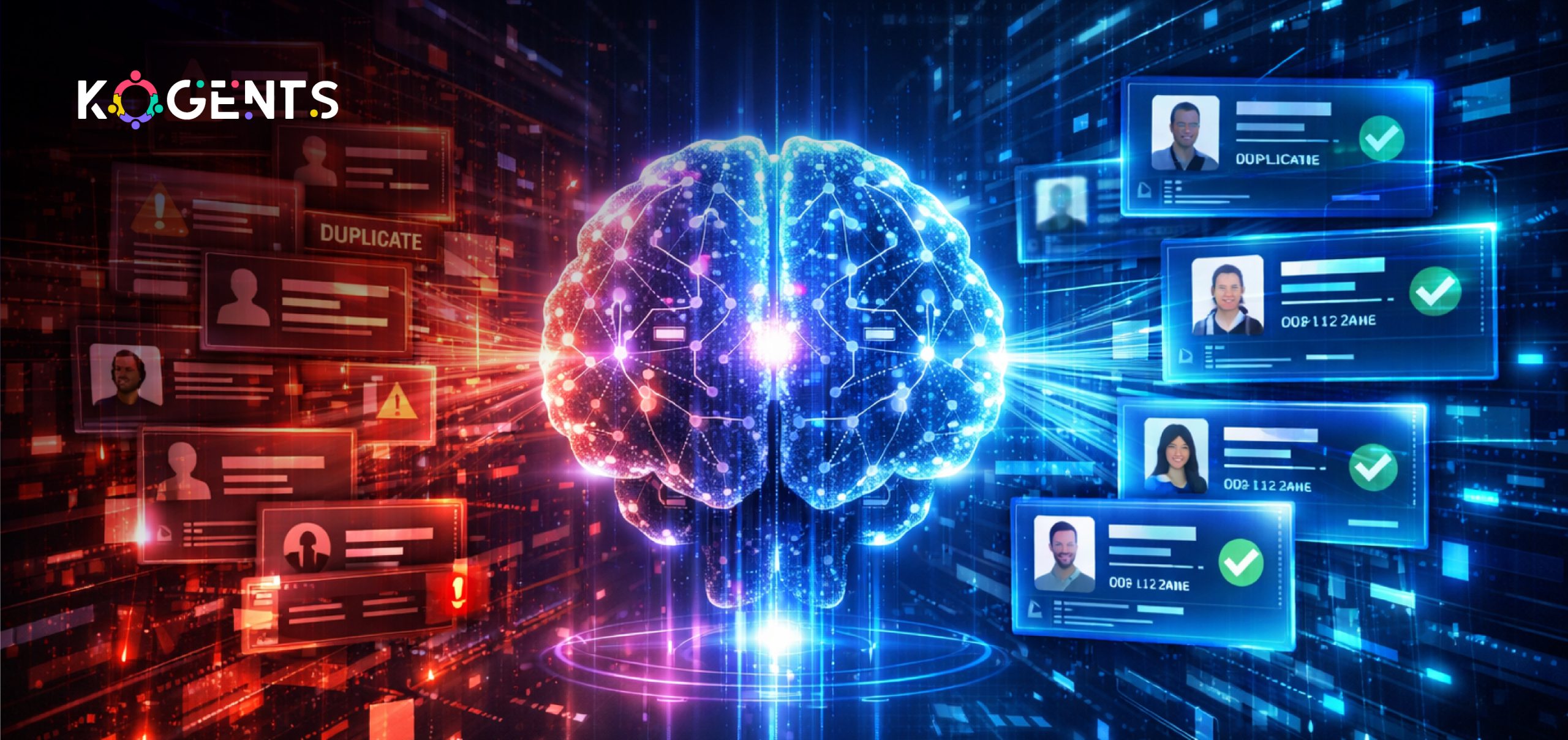
Duplicate customer records are the silent killers of data quality. They inflate database sizes, skew analytics, waste marketing budgets on redundant communications, and create frustrating customer experiences when different departments have conflicting information.
AI-powered identity resolution uses sophisticated matching algorithms that consider:
- Fuzzy name matching (accounting for typos, variations, and translations)
- Address similarity analysis (recognizing “123 Main St” and “123 Main Street” as identical)
- Behavioral pattern matching (identifying users based on browsing patterns, purchase history, and interaction sequences)
- Device fingerprinting (tracking users across multiple devices and sessions)
- Probabilistic matching (assigning confidence scores to potential matches)
Comprehensive Benefits of AI-Driven Customer Data Automation
1. Dramatic Reduction in Manual Labor and Operational Costs
Automated customer data operations eliminate the need for armies of data entry specialists and analysts performing repetitive cleanup tasks.
Statistics:
- Organizations save an average of 1,200 hours annually per data analyst after implementing customer data automation.
- Data management costs decrease by 45-60% within 18 months of automation deployment.
- Employee satisfaction increases as teams focus on strategic analysis rather than tedious data entry.
2. Enhanced Data Accuracy and Reliability
Human error is inevitable in manual data management. Typos, inconsistent formatting, and data entry mistakes compound over time, degrading data quality.
AI-powered customer data automation achieves:
- 99.2% data accuracy versus 67% for manual processes.
- 94% reduction in duplicate customer records.
- Real-time data validation prevents errors at the point of entry.
Business Impact: Improved data accuracy directly translates to better decision-making, more effective marketing campaigns, and enhanced customer experiences.
3. Real-Time Customer Insights and Personalization
Real-time customer insights powered by automated data collection and processing enable true data-driven personalization.
When customer data updates instantly across all systems, organizations can:
- Deliver personalized content based on the most recent interactions
- Trigger relevant marketing messages at optimal moments
- Provide customer service agents with a complete, current customer context
- Create dynamic customer journey analytics that adapt in real-time
4. Improved Customer Experience and Satisfaction
Nothing frustrates customers more than companies that don’t know them. Outdated records lead to:
- Sending promotions for products already purchased
- Addressing customers by incorrect names
- Shipping to old addresses
- Providing irrelevant recommendations
Automated customer data management ensures every interaction is informed by accurate, current information, creating seamless, personalized experiences that build loyalty.
5. Regulatory Compliance and Data Governance
Data compliance regulations like GDPR and CCPA require organizations to maintain accurate customer records, honor opt-out requests, and demonstrate data governance capabilities.
Customer data automation simplifies compliance through:
- Automated consent management tracking permissions across all touchpoints
- Audit trails documenting every data change and access event
- Data retention policies automatically archiving or deleting records per requirements
- Privacy request automation processing access, correction, and deletion requests instantly
Customer Data Automation Capabilities Comparison
| Capability | Manual Process | Basic Automation | AI-Powered Automation |
| Data Accuracy | 67% | 82% | 99.2% |
| Processing Speed | Hours to Days | Minutes to Hours | Milliseconds to Seconds |
| Duplicate Detection | 78% accuracy | 85% accuracy | 99.2% accuracy |
| Real-Time Updates | Not possible | Limited | Comprehensive |
| Predictive Capabilities | None | None | Advanced |
| Cost per Record | $$2.50 | $$0.80 | $$0.15 |
| Scalability | Limited | Moderate | Unlimited |
| Human Error Rate | 33% | 12% | <1% |
Real-World Case Studies: AI-Powered Customer Data Automation in Action
Case Study 1: Global Retailer Achieves 360-Degree Customer View
Challenge: A Fortune 500 retail company with 500+ stores and a significant e-commerce presence struggled with fragmented customer data across point-of-sale systems, e-commerce platforms, loyalty programs, and CRM systems.
Customers had an average of 3.7 duplicate records, leading to poor personalization and ineffective marketing.
Solution: The company implemented an AI-powered customer data automation platform integrated with their existing technology stack, leveraging:
- Machine learning-based identity resolution to merge duplicate records
- Real-time data synchronization across all customer touchpoints
- Automated data enrichment from third-party sources
- Behavioral data integration from web and mobile analytics
Results:
- 92% reduction in duplicate customer records within 90 days
- $$18 million increase in annual revenue attributed to improved personalization
- 37% improvement in email marketing performance
- 1,800 hours saved monthly in manual data management tasks
- Unified customer view accessible to all departments in real-time
Case Study 2: Financial Services Firm Enhances Compliance and Security
Challenge: A multinational bank faced increasing pressure to maintain accurate customer records for GDPR compliance while managing data across 47 different systems in 23 countries.
Manual data governance processes couldn’t keep pace with regulatory requirements and customer data subject access requests.
Solution: Deployment of an enterprise customer data automation platform with:
- Automated consent management tracks customer preferences across all channels
- AI-driven data validation ensuring compliance with regional regulations
- Intelligent data classification automatically tags sensitive information
- Automated data pipelines for consistent data quality across all markets
Results:
- Data subject access request processing time reduced from 28 days to 4 hours
- 100% compliance with GDPR and local regulatory requirements
- $$12.4 million saved annually in compliance-related costs
- Zero data breaches related to outdated or inaccurate customer information
- 76% reduction in data governance overhead
Case Study 3: B2B SaaS Company Accelerates Sales with Clean Data
Challenge: A rapidly growing B2B SaaS company experienced explosive growth from 1,000 to 50,000 customers in 18 months. Their sales and marketing teams struggled with:
- Incomplete customer profiles lacking key firmographic data
- Outdated contact information leading to 42% email bounce rates
- Fragmented data across Salesforce, HubSpot, and customer success platforms
- No unified customer view for account-based marketing efforts
Solution: Implementation of customer data workflow automation featuring:
- Automated data enrichment pulling firmographic data from multiple B2B databases
- Real-time customer data automation synchronizes information across all platforms
- Predictive lead scoring using machine learning on historical conversion data
- Customer identity graph connecting all contacts within target accounts
Results:
- Email deliverability improved from 58% to 96%
- Sales cycle reduced by 23% through better data intelligence
- Marketing qualified lead conversion rate increased by 41%
- $$8.7 million in incremental revenue attributed to improved data quality
- Account-based marketing campaign effectiveness improved by 67%
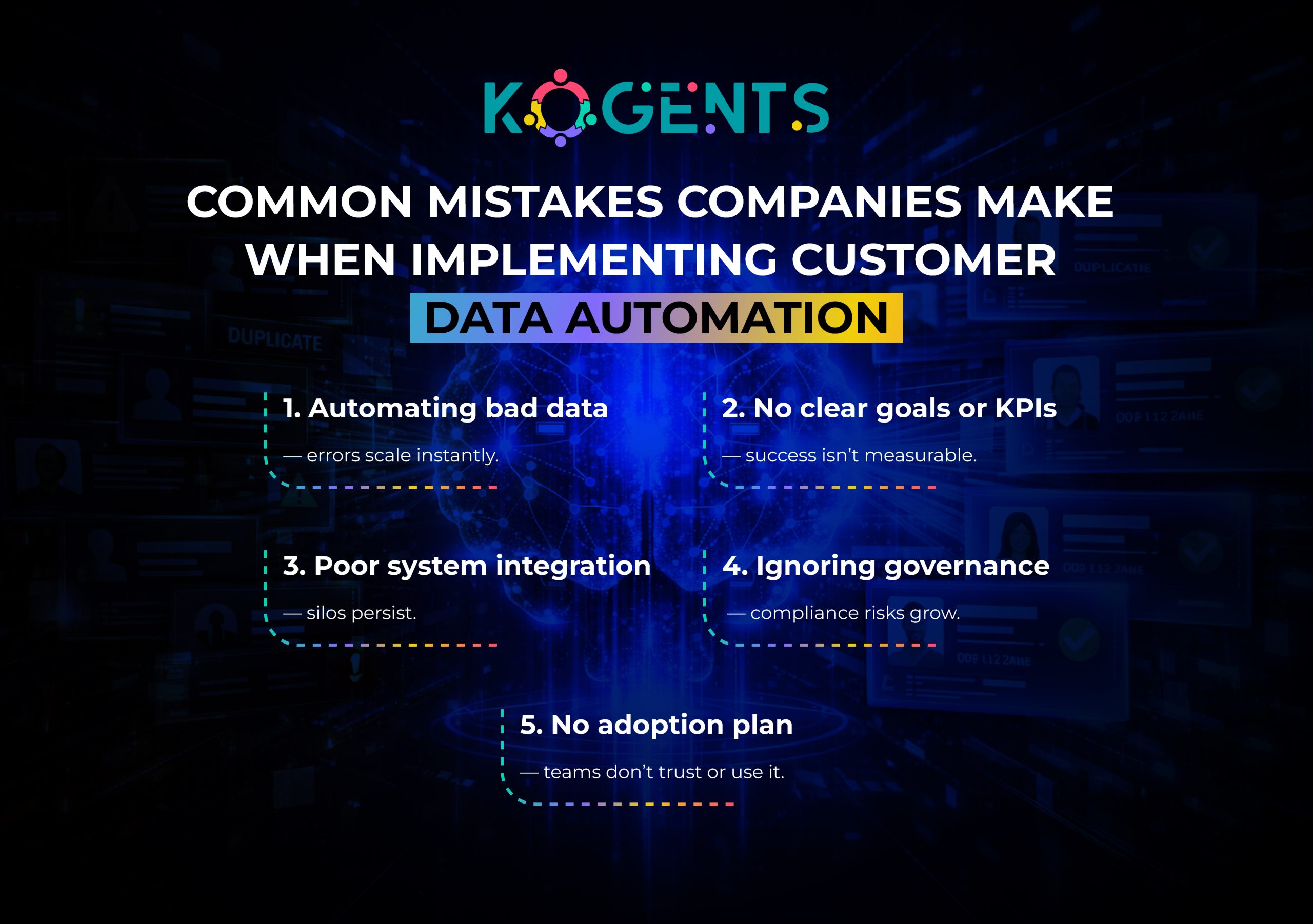
Overcoming Common Challenges in Customer Data Automation
Challenge 1: Data Silos and System Integration Complexity
Problem: Legacy systems often resist integration, creating persistent data silos.
Solution:
- Leverage modern API-first data platforms that simplify connectivity
- Implement ETL/ELT processes to extract data from resistant systems
- Use data orchestration layers to create abstraction from underlying complexity
- Consider gradual migration strategies rather than wholesale replacement
Challenge 2: Data Privacy and Security Concerns
Problem: Centralizing and automating customer data raises data security and privacy stakes.
Solution:
- Implement encryption at rest and in transit
- Deploy role-based access controls, limiting data visibility
- Ensure data compliance with GDPR, CCPA, and industry standards
- Conduct regular security audits and penetration testing
- Obtain relevant certifications (ISO 27001, SOC 2 Type II)
Challenge 3: Change Management and User Adoption
Problem: Teams accustomed to manual processes resist new automated customer data operations.
Solution:
- Demonstrate quick wins showing time savings and improved accuracy
- Provide comprehensive training on new tools and data workflows
- Involve key stakeholders in design and implementation decisions
- Create champions within each department to advocate for adoption
- Celebrate and communicate successes organization-wide
The Future of AI in Customer Data Management
- Agentic AI for Autonomous Data Management
The next frontier in customer data automation is agentic AI, autonomous agents that don’t just execute predefined rules but make intelligent decisions independently:
- Self-healing data pipelines that automatically recover from failures
- Autonomous data quality agents that identify and resolve issues proactively
- Intelligent data orchestration adapts workflows based on changing conditions
- Decision intelligence systems recommending optimal data strategies
- Enhanced Predictive Data Quality
Advanced predictive analytics will anticipate data issues before they occur:
- Predicting which customers are likely to change their contact information
- Forecasting when data enrichment is needed
- Identifying emerging data governance risks
- Recommending proactive data collection strategies
- Deeper Integration with Business Processes
Customer data automation will become seamlessly embedded in every business process:
- Real-time personalization engines powered by instant data updates
- Automated customer journey orchestration responding to behavioral signals
- Integrated consent management across all customer touchpoints
- Dynamic segmentation that adapts continuously
- Advanced Identity Resolution Across Digital and Physical
Future identity resolution will unify customer interactions across:
- Digital channels (web, mobile, IoT devices)
- Physical locations (stores, events, kiosks)
- Voice assistants and conversational AI
- Augmented and virtual reality experiences
Transform Your Customer Data Strategy with Kogents’ Agentic AI Excellence!
The era of manual customer data management is over. Organizations that cling to outdated processes face mounting costs, declining data quality, and an inability to deliver the personalized experiences customers demand.
In contrast, forward-thinking enterprises embracing AI-powered customer data automation unlock transformative benefits:
Kogents.ai stands at the forefront of agentic AI technology, delivering next-generation customer data automation solutions that go beyond traditional platforms. Our approach combines:
Our best AI agents for customer support don’t just execute predefined rules; they think, learn, and adapt.
Kogents’ agentic AI systems:
- Independently identify and resolve data quality issues without human intervention
- Continuously optimize data pipelines and workflows based on performance patterns
- Proactively detect emerging data challenges and implement solutions automatically
- Learn from every interaction to improve accuracy and efficiency over time
Take the Next Step Now!
Don’t let poor customer data quality hold your organization back. Our agentic AI solutions transform your customer data from a liability into your most valuable strategic asset.
Schedule your personalized consultation today. Let’s build your data-driven future together.
FAQs
What is customer data automation, and how does it work?
Customer data automation refers to using artificial intelligence, machine learning, and intelligent data workflows to automatically collect, clean, validate, enrich, and synchronize customer information across all enterprise systems without manual intervention. It works by deploying automated data pipelines that continuously monitor data sources, apply data validation rules, perform identity resolution, and ensure real-time data synchronization across platforms. The system uses predictive analytics to anticipate data quality issues and machine learning algorithms that improve accuracy over time through continuous learning.
How does AI improve data quality compared to manual processes?
AI-powered data quality management achieves 99.2% accuracy versus 67% for manual processes by leveraging machine learning to identify patterns across millions of records, applying consistent data validation rules without human error, performing real-time data processing that catches errors instantly, using predictive analytics to anticipate quality issues before they occur, continuously learning optimal data formats and standards, executing automated data enrichment from multiple sources, and maintaining data consistency through intelligent data orchestration. Unlike humans who fatigue and make inconsistent judgments, AI maintains perfect consistency across billions of records.
What is identity resolution, and why is it important for customer data?
Identity resolution is the process of accurately matching and merging customer records across multiple systems to create a single, comprehensive customer identity graph. It’s crucial because customers interact through numerous touchpoints—websites, mobile apps, stores, customer service, social media—often creating separate records in each system. AI-powered identity resolution uses sophisticated algorithms considering fuzzy name matching, address similarity, behavioral data patterns, device fingerprinting, and probabilistic matching to achieve 99.2% accuracy in identifying duplicates. This creates a unified customer view, ew enabling true personalization, eliminating wasted marketing spend on duplicates, and providing complete context for customer service interactions.
How does customer data automation ensure compliance with GDPR and CCPA?
Customer data automation simplifies data compliance by implementing automated consent management that tracks customer permissions across all channels, maintaining comprehensive audit trails documenting every data access and modification, automatically processing data subject access, correction, and deletion requests within hours instead of weeks, enforcing data retention policies that archive or delete records per regulatory requirements, applying data classification and protection measures automatically, generating compliance reports for regulatory audits, and ensuring data security through encryption, access controls, and monitoring. This automation reduces compliance costs by 60% while ensuring 100% regulatory adherence.
What technologies power modern customer data automation platforms?
Modern customer data automation platforms integrate multiple AI technologies including: machine learning for pattern recognition and predictive quality management, natural language processing (NLP) for extracting insights from unstructured data, robotic process automation (RPA) for workflow orchestration, real-time data processing engines for instant synchronization, cloud-native architectures (AWS, Google Cloud, Microsoft Azure) for scalability, API-first integration frameworks connecting diverse systems, graph databases for identity resolution, event streaming platforms for real-time data pipelines, and blockchain for immutable audit trails in regulated industries.