But today, conversational AI automation has reached a turning point.
Modern AI conversational agents don’t just respond to users; they interpret, learn, act, and trigger workflows with precision, once possible only through human intervention.
Customers can speak, type, or even upload media.
AI agents understand it and deal in real-time AI chat to decide what must happen.
AI agents execute, creating tickets, routing requests, documenting interactions, launching sequences, and updating systems in real time.
This shift is redefining customer service, sales operations, and internal workflows.
Enterprises are no longer asking “Should we adopt conversational AI?” but rather:
“How do we orchestrate large-scale workflow automation using AI agents?”
Key Takeaways
- AI agents transform natural conversations into structured, trackable workflows through real-time intent detection, NLP, and orchestration.
- Modern enterprises adopt conversational AI automation to reduce operational costs while increasing resolution speed.
- Conversational workflows integrate with CRMs, ticketing systems, EHRs, ERPs, billing tools, and more, turning chats and calls into actionable processes.
- Large Language Models + AI orchestration layers allow agents to not only understand conversations but also take actions across systems.
- Industries from healthcare to retail are leveraging AI-powered automation to improve accuracy, compliance, and scalability.
What Exactly Is Conversational AI Automation?
At its core, conversational AI automation refers to the process of using conversational AI platforms, AI agent automation, and automated conversational systems to convert natural conversations into structured actions inside business workflows.
This includes technologies such as:
- AI-powered chatbot automation
- Voice AI automation
- Multimodal conversational agents
- Intelligent virtual assistants
- Dialogue management systems
- NLP conversational models
- AI-driven communication platforms
- Automated customer interactions
How AI Agents Convert Conversations into Clear & Trackable Workflows?
AI agents follow a predictable, repeatable, highly accurate sequence:
1. Intent Detection — Understanding What the User Wants
Using Natural language understanding (NLU), intent classification engines, and machine learning pipelines, the AI determines:
- What is the user actually asking?
- Is this a support request? Sales inquiry? Complaint?
- Does the user need triage, escalation, or step-by-step instructions?
This is where intent detection, the best AI agents for customer agents, and dialogue systems play a major role.
2. Entity Extraction — Pulling Out the Details
- AI identifies actionable elements, dates, order numbers, symptoms, locations, product codes, and account data.
- This is crucial for workflow accuracy and compliance.
3. Dialogue Management — Context Retention & Guidance
Through dialogue management systems, the AI agent uses:
- Predictive context
- Dynamic decision trees
- Large language models (LLMs)
- Multimodal processing
Note: This allows intelligent back-and-forth interactions that feel human.
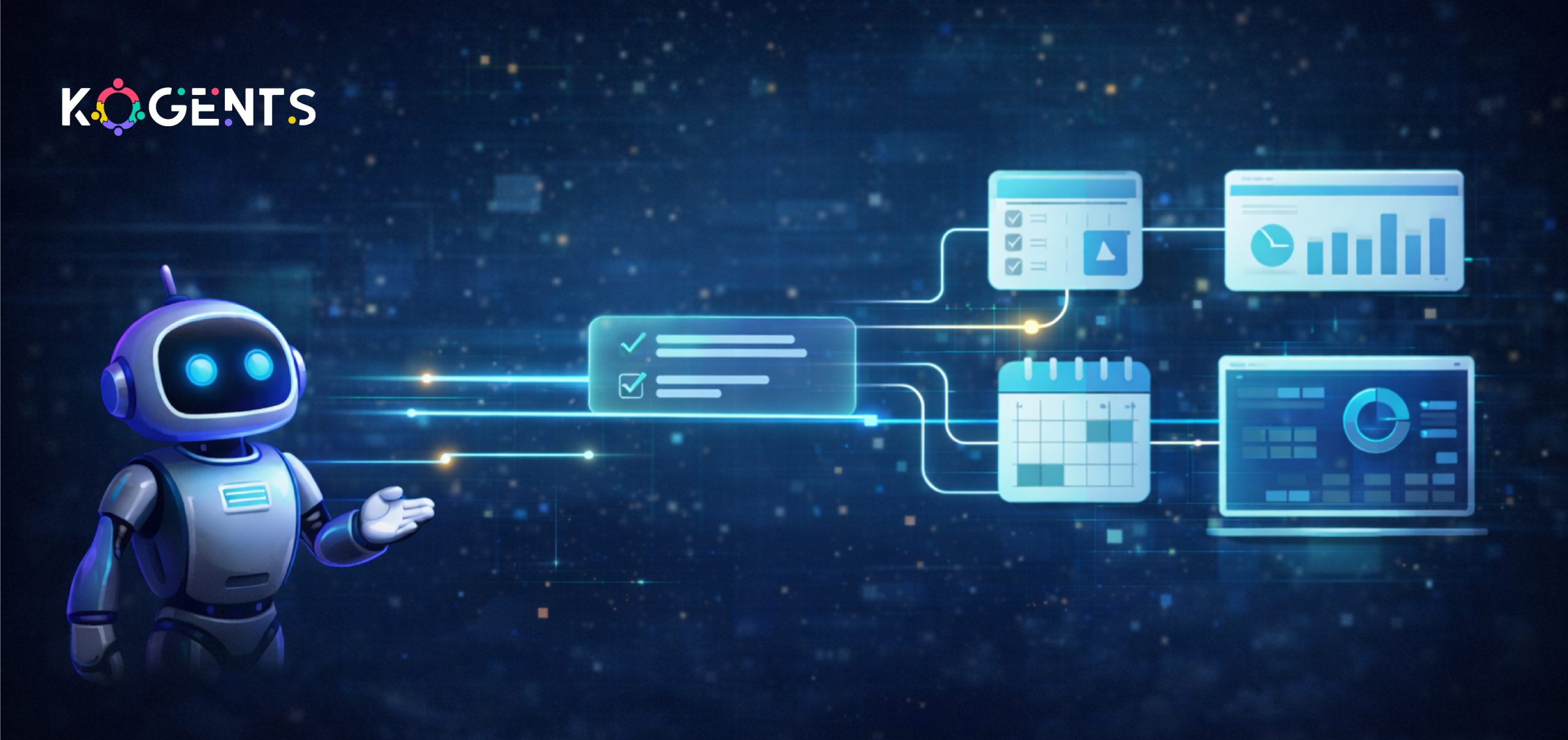
4. AI Orchestration Layer — Executing the Workflow
This is where automation happens.
The AI orchestration layer triggers actions via:
- CRM integrations
- ERP systems
- Ticketing software
- RPA bots
- APIs
- Backend databases
The agent can now:
- Create support tickets
- Update order statuses
- Route issues to technicians
- Schedule appointments
- Generate onboarding tasks
- Log compliance data
This is AI automation workflows at scale.
Significant Table: How AI Agents Transform Conversations Into Workflows
| Department | Before AI | After Conversational AI Automation |
| Customer Support | Manual ticket creation, long wait times | Automated triage, instant ticketing, AI-driven routing |
| Sales | Manual lead qualification | AI-qualified leads based on intent, urgency & buyer signals |
| HR | Manual onboarding steps | Automated onboarding workflows triggered via conversation |
| Healthcare | Manual symptom intake | AI triage systems with structured EHR-ready outputs |
| Banking | Slow KYC checks | Digital banking assistants completing compliance steps |
Challenges & Limitations
Even with rapid growth, conversational AI automation faces challenges:
- Maintaining accuracy across languages
- Handling highly ambiguous queries
- Integrating with outdated legacy systems
- Ensuring GDPR/HIPAA compliance
- Reducing hallucinations in LLMs
Why Conversational AI Automation Matters Today?
Modern enterprises are accelerating toward AI-driven communication, AI workflow automation, and end-to-end orchestration not because it is trendy, but because it directly impacts efficiency, profitability, and customer experience.
Below is a richer, insight-driven explanation, each with a credible statistic and source link.
1. Cost Reduction Through Automated Customer Interactions
Conversational AI automation dramatically lowers operational spending by replacing repetitive manual tasks with automated customer interactions, support automation systems, and self-service AI.
Enterprises using AI-enabled customer service have seen up to 60% reduction in service costs, according to McKinsey.
Why it matters uniquely: AI does not just reduce labor costs, but also reduces costs from:
- Agent misrouting
- Documentation errors
- SLA breaches
- Overtime and peak-season staffing
- Training hours for basic tasks
AI turns your contact center into a scalable on-demand workforce.
2. Higher Customer Satisfaction Through Precision NLU & Real-Time Routing
When AI agents use natural language understanding (NLU) and intent classification, they resolve queries faster and more accurately, even in complex omnichannel contexts.
According to Forrester, companies implementing conversational automation achieve higher CSAT.
Unique insight: Unlike humans, AI agents remember:
- Past interactions
- Customer preferences
- Service history
- Product ownership
- Behavioral patterns
This enables hyper-personalized responses at scale, something previously impossible.
3. Radical Reduction in Resolution Times
Using AI-driven service routing and predictive intent engines, businesses shorten wait times, triage instantly, and automate next steps.
IBM reports that virtual agents reduce handle time.
Unique insight:
- AI agents operate with “anticipatory workflows,” meaning:
- They predict what the user needs before they finish typing.
- This is next-generation CX optimization.
4. 24/7 Availability With Consistent Quality
Contact centers no longer need to rely on human schedules.
Intelligent virtual assistants and automated conversational systems operate 24/7 with full accuracy.
Salesforce revealed that 71% of customers expect support anytime, anywhere.
5. Drastic Reduction in Human Error & Compliance Risks
In industries like healthcare, banking, and insurance, compliance mistakes cost millions.
AI reduces manual-entry errors and ensures consistent, audit-ready documentation.
Gartner reports that AI will help reduce compliance costs by 2027.
Unique insight: AI agents enforce compliance during conversations:
- HIPAA checks
- GDPR consent reminders
- Identity verification
- Required disclosure prompts
Compliance is no longer a human-dependent process; it becomes programmatically guaranteed.
Case Study 4: Global Bank Uses AI for KYC & Account Unlock Workflows
A European global bank implemented digital banking assistants powered by conversational automation.
AI automated:
- KYC verification questions
- Document request workflows
- Account unlock procedures
- Fraud alerts triage
Impact:
- Reduced manual KYC review time
- Increased fraud detection accuracy
- Cut call center volume by 23%
This showcases how conversational AI optimizes high-compliance financial workflows.
Case Study 5: Telecom Provider Deploys AI for Billing & Technical Troubleshooting
A leading telecom provider leveraged call center automation using voice agents.
Tasks automated:
- Billing inquiries
- Plan upgrades
- Modem resets
- Network outage updates
- Technician appointment scheduling
Results:
- 45% reduction in live agent transfers
- 3× faster technical troubleshooting
- 20% drop in churn
AI provided real-time device diagnostics, reducing technician dispatch costs dramatically.
Case Study 6: Retail Brand Uses AI to Automate Order Management Workflows
A multinational retailer adopted retail automation chatbots integrated with their inventory and order systems.
AI handled:
- Order tracking
- Exchange/return workflows
- Refund processing
- Inventory checks
- Personalized product recommendations
Outcome:
- Resolution time: 12 hours → 5 minutes
- 35% increase in automated return processing
- Customer satisfaction improved by 22%
This demonstrates how conversational AI creates frictionless post-purchase workflows.
Technical Architecture of Conversational AI Automation
Modern AI agents don’t operate as chatbots.
They operate as autonomous workflow engines. Below is a broader, more technical breakdown.
1. Advanced NLP Engines as the Understanding Core
These engines power linguistic intelligence across languages, domains, and user intent patterns.
They interpret syntax, semantics, sentiment, and context using:
- Transformer-based models
- Large language models (LLMs)
- NLU/NLG components
- Neural network language models
Why this matters: They allow AI agents to adapt to unseen user statements rather than rely on rigid rules.
2. Language Model Inference Layer
This layer performs real-time reasoning, including:
- Evaluating user intent
- Predicting next best actions
- Generating dynamic responses
- Executing logic workflows through APIs
It allows agents to support multimodal conversational agents that handle text, images, PDFs, screenshots, and voice.
3. Speech-to-Text (STT) & Text-to-Speech (TTS) Systems
These systems enable voice AI automation across call centers, kiosks, mobile apps, and IVR.
They rely on:
- Speech recognition AI
- Acoustic modeling
- Speaker adaptation
This extends automation to voice-based environments, a major requirement for telecom and healthcare.
4. AI Orchestration Layer (The Brain of Workflow Automation)
This layer decides which workflow to trigger and where the data goes. It integrates with:
- CRMs (Salesforce, HubSpot)
- Ticketing systems (Zendesk, Freshdesk, ServiceNow)
- Banking systems
- EHR/EMR platforms
- ERP systems
- Knowledge bases
It links conversational intent to API-based chatbot automation, enabling end-to-end workflow execution.
5. RPA + Conversational AI for Structured Workflow Execution
Robotic Process Automation handles repetitive tasks such as:
- Data entry
- Copying information between systems
- Running payroll operations
- Updating records
When paired with conversational AI, it enables enterprise-grade automation that combines understanding + execution.
Future of AI Workflow Automation
The future isn’t about chatbots, it’s about fully autonomous AI agents operating as digital employees.
1. Autonomous AI Agents Running Entire Business Functions
AI agents will independently manage:
- Billing
- Procurement
- Support
- Employee onboarding
- Logistics
- Compliance
These agents will collaborate, negotiate, and coordinate workflows automatically.
2. Enterprise AI Operating Systems
Companies will have internal AI OS layers:
- Monitoring tasks
- Predicting bottlenecks
- Automatically optimizing workflows
- Coordinating multiple AI agents
These will behave like “digital CEOs” for each department.
3. Multimodal Understanding Will Become Standard
AI agents will process:
- Voice
- Video
- Screenshots
- Documents
- Sensor data
This will unlock industrial automation, medical AI assistants, and autonomous retail support.
4. Predictive Workflow Orchestration
AI will predict business needs before they occur:
- Predict surges in support volume
- Forecast onboarding requirements
- Identify at-risk customers
- Trigger proactive tasks
Automation will shift from responsive to anticipatory.
5. AI Safety, Compliance, & Governance Will Strengthen
Frameworks such as:
- ISO/IEC 23053
- NIST AI RMF
- GDPR-compliant AI systems
- HIPAA-secure conversational workflows
Before You Leave!
Whether you’re optimizing churn now, converting unstructured human conversations into structured, trackable workflows automatically, our platform performs conversational AI automation profoundly at Kogents.ai, and delivers intelligent, data-driven results.
See how we can elevate your personalization strategy and improve CSAT and retention now.
Transform experiences. Delight customers. Drive loyalty.
FAQs
What is conversational AI automation?
Conversational AI automation uses advanced conversational AI platforms, dialogue systems, and natural language understanding (NLU) to translate user conversations into actionable workflows. Instead of simply responding, the AI extracts intent, identifies entities, and triggers automated processes across CRMs, ticketing systems, ERPs, and APIs. It eliminates manual steps and ensures fast, accurate, consistent execution.
How does conversational AI differ from traditional chatbots?
Traditional chatbots follow scripted decision trees. They break easily.
Conversational AI uses:
- Large language models (LLMs)
- Intent detection
- Predictive analytics
- AI orchestration layers
This allows AI agents to understand unstructured language, ask follow-up questions, manage ambiguity, and dynamically execute workflows. The difference is similar to a calculator vs. a personal assistant.
Can conversational AI automate customer service workflows?
Yes — it can automate:
- Ticket creation
- Routing
- Troubleshooting steps
- Refund workflows
- Billing adjustments
- Order tracking
- Subscription changes
AI agents improve self-service AI while working alongside humans for edge cases. This reduces call center load and increases resolution speed dramatically.
Which industries benefit most from conversational automation?
Industries handling high-volume interactions and strict workflows see the largest ROI:
- Healthcare (triage automation)
- Banking (KYC automation)
- Insurance (claims automation)
- Telecom (technical troubleshooting)
- Retail (order workflows)
Each industry gains specialized automation with compliance baked in.
What’s required to deploy workflow automation?
You need:
- An AI engine capable of NLP, NLG, and intent classification
- An orchestration layer for decision-making
- APIs to connect systems
- Compliance frameworks (GDPR, HIPAA)
- A knowledge base or vector database
Enterprises often adopt a hybrid human + AI model initially.
Does conversational AI reduce call center costs?
Yes. AI handles repetitive queries, reducing the need for large frontline teams.
Examples include balance checks, shipment updates, appointment scheduling, and password resets.
The larger your ticket volume, the stronger your ROI.
Can AI agents manage complex workflows?
Yes, they can perform multi-step operations such as:
- Verifying identity
- Checking order systems
- Booking logistics
- Updating CRMs
- Generating documents
- Triggering RPA bots
This makes AI suitable for full end-to-end workflow automation beyond basic conversations.
How does voice automation fit in?
Voice automation uses speech recognition AI and text-to-speech engines to extend automation to call centers and IVR systems.
It allows users to speak naturally and receive workflow-driven outcomes without human intervention.
Does conversational AI integrate with CRMs & ERPs?
Absolutely. Enterprise-grade AI platforms connect with:
- Salesforce
- HubSpot
- Zendesk
- ServiceNow
- SAP
- Oracle
- Workday
This integration turns conversational insights into real business actions.
What is the long-term future of conversational automation?
The future includes:
- Autonomous AI teams
- Multimodal agents
- Predictive orchestration
- Fully automated departments
- Real-time compliance engines
Enterprises will treat AI agents as essential digital employees.