Category: customer service ai agent

  • Building an AI Customer Experience Platform for Scalable Business Growth

    Building an AI Customer Experience Platform for Scalable Business Growth

    Today, it has become a challenge to provide standout service; it’s not a “nice-to-have”, it’s a growth engine. 

    Whether you’re a solopreneur or an entrepreneur leading a startup or small business, leveraging the right technology can help you punch above your weight. 

    A bold AI customer experience platform offers that edge: it enables smarter interactions, deeper personalization, improved operational efficiency, and ultimately scales your business growth.

    Let’s dive deep into how to build a customer experience AI platform from the ground up, what it is, why it matters, how to architect it, and how to deploy it in a way that empowers both solopreneurs and entrepreneurs. 

    Key Takeaways

    • Implementing a customer experience platform with AI is not just a tech initiative; it’s a strategic shift in how you manage the customer journey analytics, omni-channel customer experience, and real-time customer engagement.
    • For solopreneurs, focus on personalisation at scale, automation in CX operations, and affordable tools; don’t over-engineer.
    • For entrepreneurs (leading growing teams), you’ll need an enterprise mindset: cloud AI customer experience platform, AI-driven customer support experience platform architecture, data governance, scalability, integration with your CDP, and existing tech stack.
    • Core features to look for: conversational AI for customer experience, agent-assist AI for customer service, AI-based customer feedback analysis, sentiment analysis in customer experience, and machine-learning customer experience improvements.
    • Don’t forget trust, privacy, and ethics: building a human-centric AI experience matters, especially when collecting rich data for personalization and automation.

    customer experience AI platform

    What is an AI Customer Experience Platform?

    A customer experience platform with AI is a software solution that combines traditional CX management tools with artificial intelligence capabilities (machine learning, natural language processing, sentiment analysis, automation, conversational AI, predictive analytics).

    The market for AI in customer service is projected to hit $47.82 billion by 2030, with a growth rate (25.8% CAGR) from 2024-2030. 

    The Business Impact

    • Personalized experiences increase loyalty and lifetime value. For example, 86% of buyers say they’d pay more for a better experience. 
    • Automation of repetitive service tasks frees up your time (if you’re solo) or your team’s time (if you’re an entrepreneur) to focus on growth, innovation, and relationship-building.
    • Real-time insights from AI (via sentiment analysis, predictive analytics, journey analytics) allow you to intervene proactively rather than reactively, shifting from support to strategic growth.

    How to Build an AI Customer Experience Platform: Step By Step

    Step 1 – Define your vision & strategy

    • Clarify the business growth objective: Are you looking to increase retention, reduce service cost, improve NPS/CSAT, drive upsell, or personalise at scale?
    • Map the customer journey analytics: Understand key touchpoints, pain points, and moments of truth from awareness → purchase → support → loyalty.
    • Decide on scope: Start small (pilot) or go big (enterprise rollout). For solopreneurs, a minimal viable version is smart; for entrepreneurs, build a scalable platform from day one.
    • Establish success metrics: CSAT, NPS, CES (customer effort score), first-contact resolution (FCR), time to resolution, churn rate.
    • Keep trust, ethics, and privacy central: compliance with GDPR, ethical-AI frameworks; build a human-centric AI experience.

    Step 2 – Choose your technology stack

      • Cloud infrastructure: A cloud AI customer experience platform gives flexibility, scalability, and global reach.
      • Customer data platform (CDP): Unified profile, segmentation, AI enrichment.
      • AI modules:
    • Conversational engine (chat/voice)
    • Sentiment/feedback analysis
    • Predictive analytics & next-best-action
    • Agent assist tools
    • Orchestration and workflow engine: To automate across channels.
    • Integration layer: CRM (e.g., Salesforce), marketing tools, service desk (e.g., Zendesk), e-commerce, chat systems.
    • Analytics dashboard: Real-time insights, KPIs, journey visualisation.
    • Security & governance: Data encryption, role-based access, audit logs, compliance certifications.

    Step 3 – Design architecture & data flows

    • Data ingestion: Customer interactions (chat, voice, email, social), behavioural data, purchase history.
    • Data storage: Clean, centralised, structured/unstructured.
    • AI layer: Model training (ML/NLP), inference (real-time chat/voice bot), feedback loops.
    • Workflow/orchestration: Trigger next-best action, routing, escalation, feedback loop.
    • Front-end channels: Web portal, mobile app, chat widget, voice bot, social messaging.
    • Reporting & monitoring: Journey analytics, model performance, KPI dashboards.

    Step 4 – Build & deploy a minimum viable component.s

    • For solopreneurs: Start with one or two channels (e.g., website chat + email AI triage). Integrate with your CRM and CDP. Deploy AI chatbots for customer service with NLP and AI-based feedback classification.
    • For entrepreneurs: Begin pilot in one customer segment; deploy agent-assist AI, sentiment analysis, and journey analytics dashboards. 
    • Establish integrations and governance frameworks.
    • Train your AI models with your data: Deploy for routing, next-best-action, and automated responses.
    • Roll out gradually, channel by channel. 
    • Monitor metrics.

    Step 5 – Monitor, iterate, scale

    • Use analytics: Track CSAT, NPS, CES, FCR, resolution time, and churn improvement.
    • Use machine-learning feedback loops: Improve your models as more data comes in.
    • Expand channels: Add social, voice-bot, mobile app.
    • Scale infrastructure: Ensure architecture supports higher volume and global reach.
    • Maintain governance and ethics: Regularly audit AI models for bias, review data collection, and maintain transparency.
    • Automate operations further: The goal is to convert routine service into self-service or AI-driven service; humans then focus on high-value engagement.

    31% of CX leaders say their top goal for AI-driven customer experience is personalization.
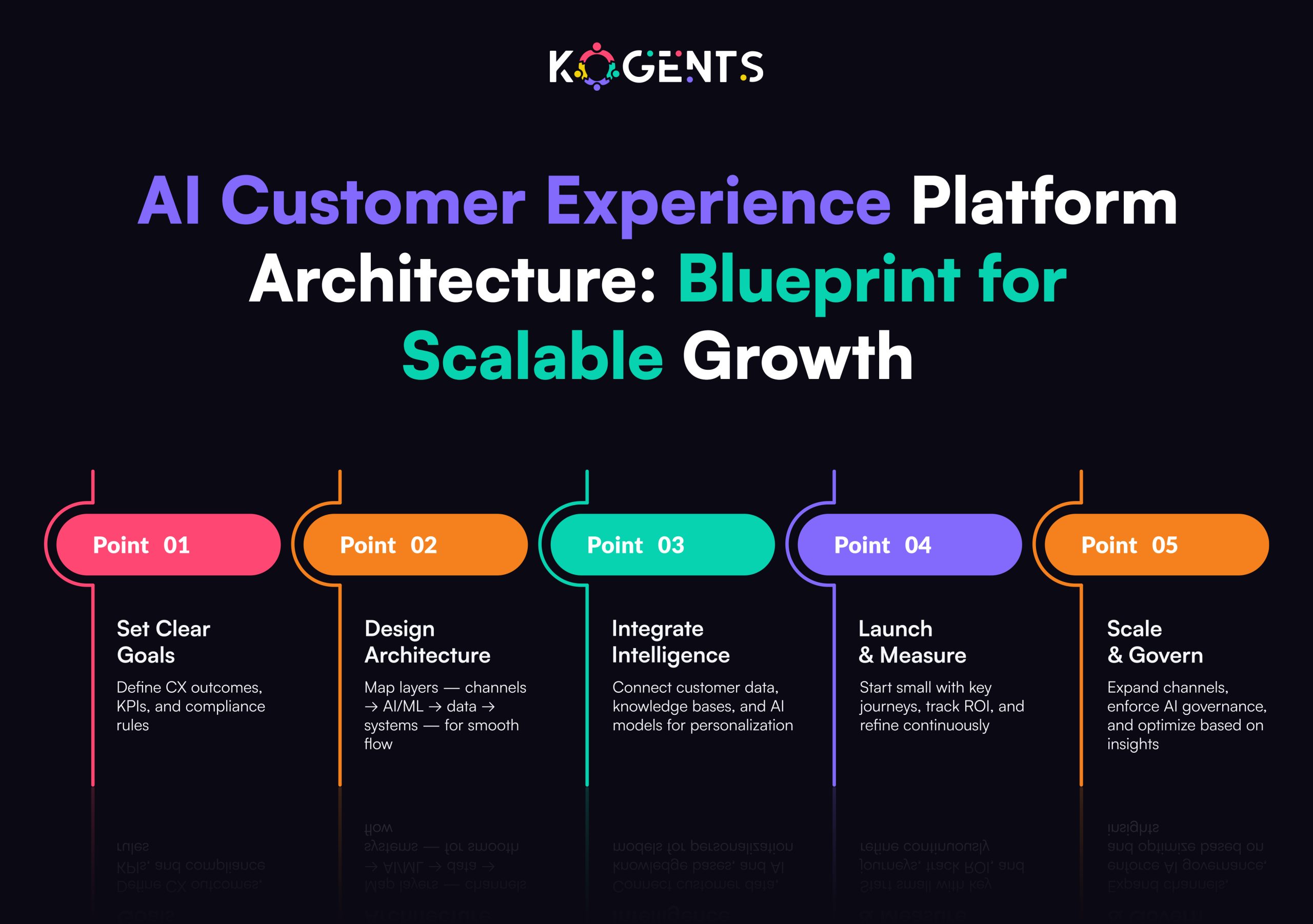
    ai customer experience platform architecture

    Case Studies: Real-world Examples of AI CX Platforms in Action

    Case Study 1: Verizon’s use of Google AI for customer service

    In 2025, Verizon deployed a large-scale AI assistant (based on Google’s Gemini model) that leverages ≈15,000 internal documents. 

    The result: Nearly 40% sales increase via its 28,000-agent service team once the AI platform is fully implemented. 

    This demonstrates how an enterprise AI customer experience platform can shift service teams into growth engines, not just cost centers.

    Case Study 2: Platform vendor accuracy claim

    Salesforce’s AI platform handles customer inquiries with 93% accuracy, according to  CEO Marc Benioff. 

    While this is vendor-specific, it shows that major players are delivering real accuracy and value, and underscores that as you select a customer experience platform with AI, performance matters.

    Know The Challenges & How to Mitigate Them

    Even the best-planned platform can falter without attention to key risks. Let’s cover them:

    • Data silos & integration issues: As noted in research, many companies struggle because systems are fragmented.

    Mitigation: Prioritise CDP and data layer first; ensure your AI models can access all relevant customer data.

    Mitigation: Start small, measure metrics, and build a business case before scaling.

    • Trust, privacy & ethics: Customers may be skeptical of automation or AI decisions.

    Mitigation: Be transparent about AI use, allow human override, and audit your models for bias

    • Change management & adoption: For teams (and even solo operators), moving from manual to automated workflows is a shift.

    Mitigation: Provide training, create early wins, celebrate efficiency gains, and involve users early.

    • Over-reliance on AI and losing human touch: The data shows that ven though automation grows, many customers still value human interaction. 

    Mitigation: A Hybrid model in AI handles routine, humans handle empathy, complex cases, and brand relationship building.

    • Model performance & maintenance: AI models degrade if not updated; sentiment, language, and channel trends change.

    Mitigation: Establish monitoring, feedback loop, retraining process, KPIs for model accuracy and business outcomes.

    Implementation Roadmap Table

    Here’s a table summarising a phased roadmap for building your AI customer experience platform, with key milestones, deliverables, and success metrics.

    Phase Deliverables Success Metrics
    Phase 1 – Foundation Select CDP + chatbot/AI tool; integrate 2 channels; set up basic analytics Chatbot deflection rate > 20%; CSAT ≥ 80%; setup cost under budget
    Phase 2 – Expansion Add voice/phone channel, sentiment/feedback analysis, and agent-assist AI First-Contact-Resolution (FCR) improves by 15%; Average Handling Time (AHT) reduces by 10%; agent satisfaction increases
    Phase 3 – Orchestration Full omni-channel orchestration, predictive analytics, next-best-action workflows, and  generative AI capabilities Churn rate reduces by 10%; Upsell rate increases by 12%; AI handles > 40% of interactions
    Phase 4 – Scale & Optimise Global deployment (if relevant), multi-language bots, advanced models, governance & ethics audit, continuous learning ROI > 3x investment; NPS increases by 20 points; new-customer acquisition cost reduces

    Conclusion

    Building an AI customer experience platform is one of the most powerful strategic moves an entrepreneur or solopreneur can make, if done thoughtfully. 

    Rather than simply automating service, it transforms how you design, deliver, and scale customer experience by leveraging artificial intelligence, automation, and orchestration across the full journey.

    For solopreneurs, the opportunity is enormous: you can deliver high-touch, personalized service at scale, stand out from competitors, and free time to focus on growth. 

    For entrepreneurs scaling teams, the platform becomes the backbone of a growth engine: from predictive insights to omni-channel orchestration, from inbound service to outbound growth.

    With a well-designed customer experience platform with AI, you’re not just keeping up, you’re setting new standards, driving loyalty, and delivering growth. 

    Need help with that? Contact the team of the best AI agents for customer support at Kogents for further assistance.

    FAQs

    What is an AI customer experience platform?

    An AI customer experience platform is a solution that combines traditional CX capabilities (ticketing, CRM, multi-channel engagement) with AI features such as conversational AI, predictive analytics, sentiment analysis, automation, and experience orchestration, enabling smarter, more personalized, and scalable customer journeys.

    How does an AI-powered CX platform work?

    It ingests data across channels (web, chat, email, voice, social), uses a CDP to unify customer profiles, applies AI/ML for tasks like routing, chatbots, feedback analysis, next-best-action, then orchestrates workflows across channels to automate or assist human agents, thus delivering real-time, personalized, omni-channel engagement.

    What are the benefits of a customer experience platform with AI?

    Benefits include: faster response times, higher CSAT/NPS, lower cost per interaction, personalized customer interactions at scale, proactive engagement (via predictive analytics), improved agent productivity (via agent-assist AI), and higher retention and upsell.

    What are the key features to look for in an AI CX platform software?

    Key features: omni-channel support, conversational AI (chat/voice), virtual assistants, agent-assist modules, CDP + AI enrichment, journey analytics, predictive analytics, sentiment & feedback analysis, workflow/orchestration engine, automation, integration capabilities, scalability and cloud readiness, data governance and ethics.

    What challenges face deploying an AI CX platform?

    Challenges: data silos/integration, cost and ROI uncertainty, tool adoption by teams, trust/privacy/ethics, maintaining human touch, model maintenance, and accuracy drift. 

    Best AI customer experience platforms 2025 – what should I compare?

    If you’re evaluating vendors, compare: channel coverage (chat, voice, social), AI capabilities (agent-assist, generative AI, predictive analytics), integration with CDP/CRM, scalability (cloud readiness), governance/security certifications (SOC 2, ISO 27001), pricing model, ease of use, and reported ROI/accuracy metrics. 

    What differences exist between a traditional CX platform and an AI customer-experience platform?

    Traditional CX platforms focus on ticketing, case management, basic routing, and reporting. An AnAI-enabled platform goes beyond: it uses ML/NLP for chat/voice bots, sentiment analysis, predictive analytics, next-best-action, orchestration, automation, and personalization at scale. It transforms CX from reactive to proactive, from human-only to hybrid human+AI.
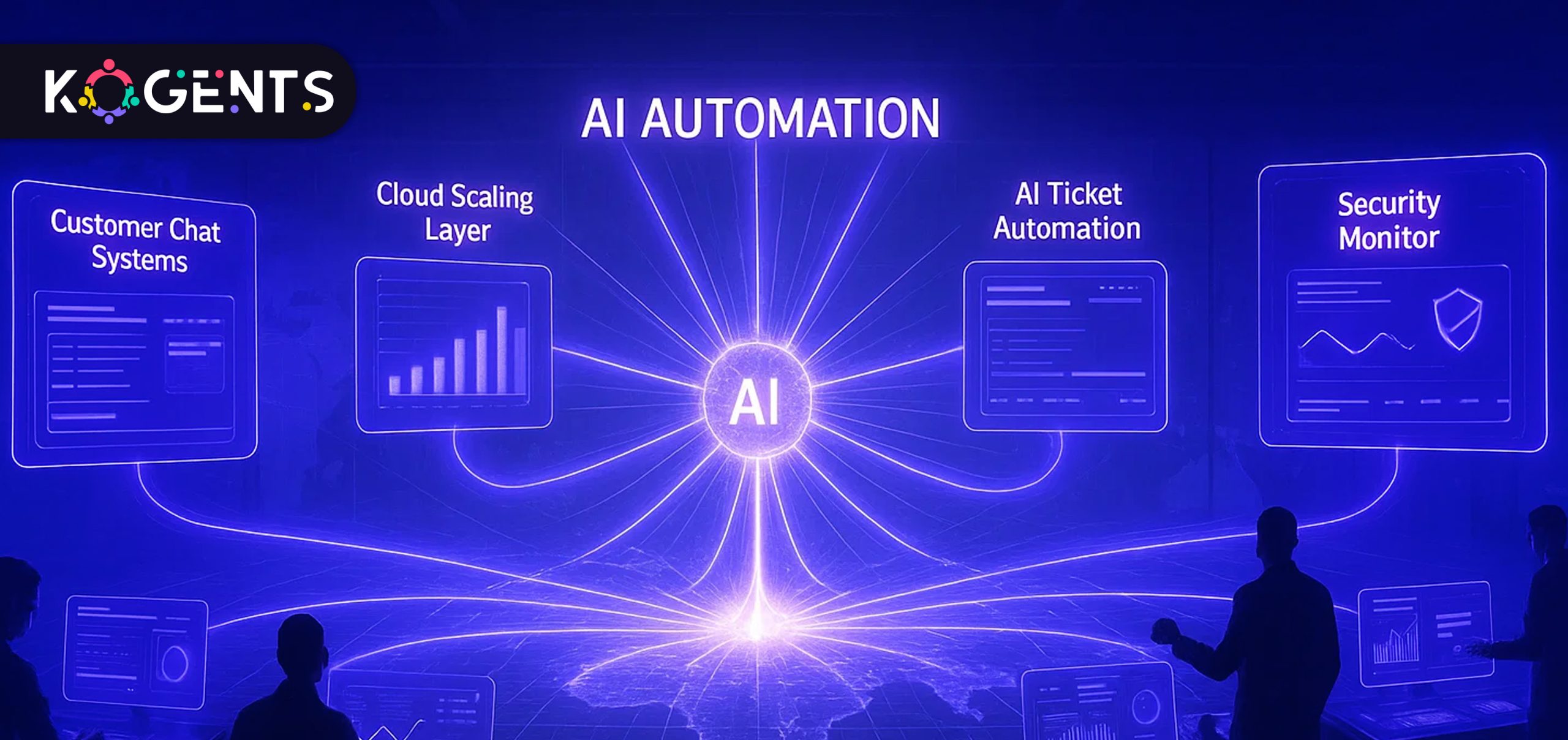
  • Automated Customer Service Solutions to Scale Your AI Infrastructure

    Automated Customer Service Solutions to Scale Your AI Infrastructure

    Imagine you run a solo digital-services business, or a lean startup, and you’re scaling, not just in terms of revenue, but in customers, support tickets, inquiries, and expectations

    Now imagine the enquiries flooding in at odd hours, across chat, email, phone, and social DMs. 

    Without the right infrastructure, you’ll quickly drown in repetitive questions, your support quality will drop, your customer-effort score will soar, and your growth will stall.

    That’s where automated customer service systems come in. 

    They let you respond 24/7, reduce average response times, triage queries intelligently, deploy chatbots and AI virtual assistants for businesses, automate knowledge-base interactions, and free you to focus on growth and high-value work.

    According to industry data, mature adopters of AI-powered customer service solutions report roughly 17% higher customer satisfaction.

    For a solopreneur/entrepreneur, that’s a game-changer.

    This blog is designed to help you architect your support automation infrastructure with clarity, depth, and context so that you can scale confidently.

    Key Takeaways

    Before we dive into the meat of the article, here are five core insights to carry forward:

    • Scalability first: Automated solutions allow even small teams to handle large volumes of inquiries without linear cost increases.
    • Customer experience (CX) enhancement is not sacrificed for automation; when done right, you can improve first-contact resolution (FCR) and reduce customer effort.
    • Omnichannel and workflow automation are essential: leveraging chatbots, voice bots, IVR automation, ticket-routing, and self-service portals in concert.
    • Human‐agent augmentation remains critical: complementing automated systems with knowledgeable live agents adds trust and handles complexity.
    • Metrics matter: to demonstrate ROI, you must measure things like cost-reduction in customer service, automated resolution rate (ARR), CSAT, CES, and agent productivity. 

    automated customer service systems

    What Are Automated Customer Service Solutions?

    Automated customer service solutions combine artificial intelligence (AI), machine learning (ML), and workflow automation to streamline customer interactions. 

    These tools handle repetitive inquiries, reduce response times, and free human agents, or founders themselves, to focus on high-value tasks.

    Core Components:

    • Chatbots & Virtual Assistants: conversational AI for customer service tools that resolve common issues, guide self-service, and route complex requests.
    • Knowledge Base & Self-Service Portals: Interactive FAQs and wizards that let customers solve problems independently.
    • Voice & IVR Automation: Voice bots handle phone-based support with natural language processing (NLP).
    • Workflow Automation: Automatically categorize and prioritize tickets, triggering the right responses or hand-offs.
    • Proactive Support: Predictive AI detects potential issues (like failed payments) and reaches out before they escalate.

    Why Now? The Case for Automated Customer Service Solutions 

    1. Rising Expectations

    • Customers now expect rapid, personalized support on every channel, at any time. 
    • Studies show nearly nine out of ten consumers will switch brands after a single poor experience. 
    • Automation ensures responsiveness and consistency even when your team is small.

    2. Operational Efficiency

    AI automation reduces manual workload by handling repetitive tasks, freeing human capacity for high-complexity or emotionally sensitive cases. 

    An IBM report shows that chatbots can handle up to 80% of routine inquiries, cutting customer support costs by 30%.

    3. Nonlinear Scalability

    • Traditional scaling, hiring more agents, is expensive and slow. 
    • Automated solutions let you grow without expanding headcount, making your customer service infrastructure as scalable as your software stack.

    4. From Reactive to Proactive

    • Predictive analytics turns support into a forward-looking function. 
    • By analyzing behavior patterns and past tickets, AI can resolve issues before they occur, improving loyalty and reducing churn.

    5. Competitive Edge

    • Most small businesses still rely on manual service. 
    • Early adopters of automation build reputations for speed, precision, and reliability, gaining both trust and differentiation.

    How Automation Intersects with AI Infrastructure? 

    Automation can’t function in isolation; it relies on a well-structured AI infrastructure underneath. Think of it as the “digital backbone” that connects your automation tools, data, and models into one cohesive system.

    According to one study, almost two-thirds of customer service tasks and up to 70% of contacts can be automated with an AI-powered system. That means lower labor cost per ticket and higher throughput.

    1. Data Pipelines & Integration

    • At the core of scalable automation lies clean, connected data. 
    • Every chat, email, or call becomes structured input that trains machine-learning models. 
    • Robust data pipelines ensure that this information flows seamlessly from your CRM, support desk, and analytics tools into the AI layer.

    2. Model Deployment & Orchestration

    • When a chatbot answers a question or a virtual assistant routes a ticket, it’s powered by language models hosted on scalable cloud environments. 
    • Automated infrastructure enables continuous deployment, load balancing, and latency management so responses remain instant and reliable, even under surge conditions.

    3. API and Microservice Architecture

    • Automation solutions plug into APIs that connect systems like Salesforce, HubSpot, or Zendesk. 
    • A microservice-based infrastructure allows each component, chatbots, ticketing, and analytics, to evolve independently, reducing downtime and simplifying upgrades.

    4. Continuous Learning & Feedback Loops

    • Each interaction becomes training data. 
    • Feedback loops capture whether an AI response satisfied the customer or required escalation, allowing the model to improve over time. 
    • Over weeks and months, automation becomes smarter and more aligned with your brand voice.
    1. Infrastructure as a Multiplier
    • In essence, automation scales as effectively as the infrastructure beneath it. 
    • Businesses that invest early in flexible, API-driven, cloud-native systems see exponential efficiency gains, because AI thrives on connectivity, not isolation.

    Building the Right AI Infrastructure

    Once your automation strategy is in place, the next step is strengthening the technical foundation that supports it. Here’s what to prioritize:

    1. Cloud vs. On-Premise vs. Hybrid

    • It offers speed and scalability without upfront hardware costs, ideal for small teams. 
    • Hybrid models, combining local control with cloud compute, suit businesses handling sensitive customer data.

    2. Data Foundations

    • Clean, labeled, and compliant data pipelines are essential. 
    • Data should be anonymized, encrypted, and organized by intent and category. 

    Note: Poor data leads directly to poor automation outcomes.

    3. Model Lifecycle Management

    Your automation tools rely on continuously trained models. 

    MLOps frameworks ensure smooth cycles of training, deployment, and monitoring, keeping your systems adaptive to real-world changes.

    4. Observability & Monitoring

    • Set up metrics dashboards for latency, ticket resolution rates, and user satisfaction. 
    • Monitor model drift to ensure the system doesn’t degrade over time.

    5. Security & Compliance

    • Choose vendors compliant with SOC 2, GDPR, or ISO 27001
    • Automation handles sensitive data; security should scale with functionality. 

    6. Practical Scaling for Solopreneurs

    Use managed APIs and infrastructure from providers like AWS, OpenAI, or Google Cloud AI. 

    Learn It: They handle compute scaling, uptime, and data redundancy, so you focus on customer experience, not server maintenance.

    Common Pitfalls & How to Avoid Them

    Even with strong technology, implementation missteps can limit results. Avoid these traps:

    • Over-automation: Don’t automate empathy. Keep human escalation for complex or emotional cases.
    • Poor data hygiene: An outdated knowledge base or unclean data pipeline ruins customer trust.
    • Siloed channels: Ensure chat, email, and phone systems share customer context.
    • Ignoring analytics: Without measuring ARR, CSAT, and cost per interaction, you can’t scale intelligently.
    • Neglecting training: As automation grows, train your human support to handle edge cases and reinforce the AI loop.

    Trends on the Horizon: Unravel Now!

    Here are four trends reshaping customer service for small businesses:

    • Generative & Agentic AI – AI agents can now reason, personalize, and act across workflows, handling not just questions but entire processes.
    • Predictive & Proactive Support – Systems will soon reach out before a customer even reports an issue.
    • Human-AI Orchestration – Instead of replacing people, automation will coordinate them, assigning tasks dynamically based on skill and workload.
    • Ethical & Transparent AI – Customers increasingly demand clarity about AI involvement and data use. Trust will be a defining competitive edge.

    fully automated customer service solutions

    Case Studies: Real-World Evidence

    Case Study 1: Enterprise-Scale Automation at IBM

    In their “The Future of AI in Customer Service” report, IBM noted that mature AI adopters, organisations operating or optimising AI-powered customer service solutions, reported 17 % higher customer satisfaction. 

    IBM While this is enterprise scale, the principles apply to smaller businesses: deploying automation pays off in improved customer experience.

    Case Study 2: Chatbot Automation Gains

    According to Answer Connect, the market for AI customer service technologies was valued at US $308 million in 2022, with expectations of nearly US $3 billion by 2032.

    Startups Leveraging Generative AI

    A 2023 study on generative AI in customer support found that AI-assisted agents were 14–34% more productive, depending on experience level. 

    companies using automated customer service solutions


    Feature / Capability Basic Self-Service Portal Chatbot / Virtual Assistant Full Omnichannel Automation Platform
    Routine query resolution Knowledge base + FAQ Automated answers + hand-off + predictive routing, ML, voice bots
    Live agent escalation Manual Logical hand-off Seamless human-agent integration
    Multichannel support Usually, one channel (web) Chat + web Chat, email, voice/IVR, social, mobile
    Workflow automation Very limited Basic routing Advanced routing, SLA automation, analytics
    Human-agent augmentation Minimal Some suggestion features Full AI assist: suggestion, auto-categorisation, analytics
    Scalability Moderate Good Excellent—designed for high volume
    Suitability for a solopreneur Good entry point Strong for a small team More suited when volume scales (but can be used modularly)
    Typical investment Low Moderate Higher—but many vendors offer modular/usage-based pricing

    Before You Leave!

    For entrepreneurs and solopreneurs, deploying automated customer service solutions is not just about cost-cutting; it’s about enabling growth, freeing your time to focus on the core business, and delivering a superior customer experience (CX) even as volume and expectations ramp up.

    By investing early in a lean, scalable self-service customer support automation infrastructure, one that leverages chatbots, a knowledge base, workflow automation, and seamless human hand-offs, you set yourself apart from competitors stuck in purely manual support.

    Over time, you can layer in predictive customer service, voice bots, omnichannel automation, and analytics.

    We’ve shown you the path, the technologies, the metrics, and the pitfalls; it’s now your decision to act.

    With the right automated customer service platform and strategy, you can scale without sacrificing quality. So, partner up with Kogents.ai for the best AI agents for customer support now!

    FAQs

    What are automated customer service solutions?

    These are software and systems (chatbots, virtual assistants, workflow automation, self-service portals) designed to automate customer service for. Businesses, enabling faster, 24/7 support, and reducing cost and manual intervention.

    What are the benefits of automated customer support solutions for US businesses?

    Benefits include faster response times, lower cost per interaction, improved first-contact resolution, higher customer satisfaction, better scalability, and enabling support teams to focus on higher-value tasks.

    What trends are shaping the US customer service automation market in 2025?

    Rising adoption of generative AI, voice bots, predictive support, omnichannel automation, and human-agent orchestration.

    What are the differences between chatbots and human support in contact centres?

    Chatbots handle high-volume, routine queries quickly and consistently; human agents handle complex, emotional, or high-impact issues requiring empathy and judgment. Optimal systems integrate both via escalation workflows.

    What is the pricing for customer service automation platforms?

    Pricing varies widely: simple chatbot tools for solopreneurs might cost a few dollars per month; enterprise platforms can run thousands per month. Many vendors offer usage-based or modular pricing to scale with you.

    For a solopreneur, which automated customer care solutions USA are most suitable?

    Focus on lightweight tools that integrate with your website/chat, automate your top three routine queries, provide a fallback to live support, and scale as your business grows. Prioritize cost-effectiveness and ease of setup.

  • How AI Virtual Assistants Revolutionize Business Operations in Customer Service

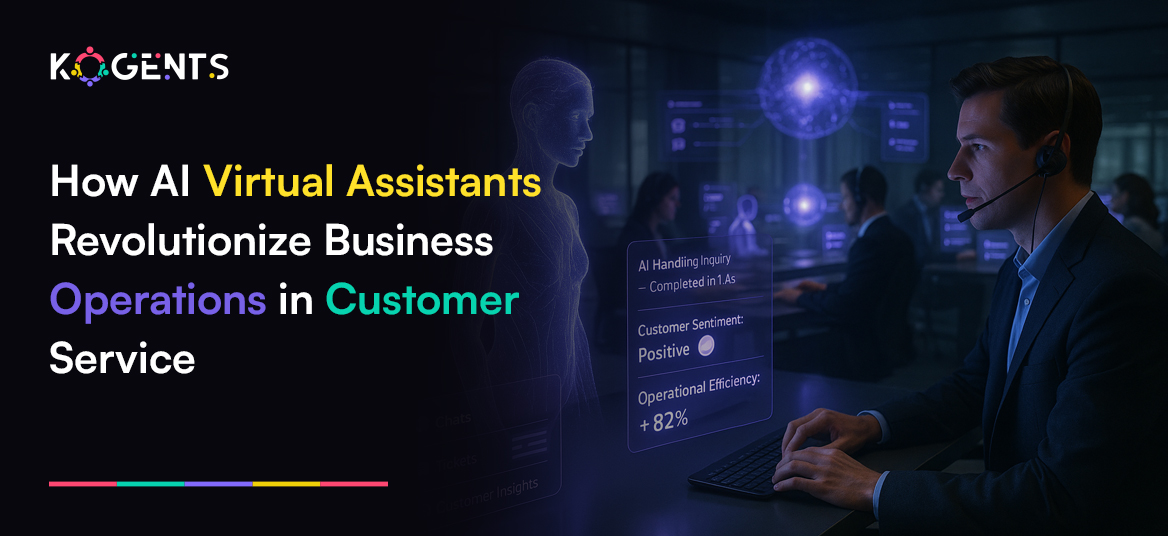
    How AI Virtual Assistants Revolutionize Business Operations in Customer Service

    Imagine a world where routine inquiries vanish, where your human agents have more time for meaningful conversation, where your CRM, ERP, and knowledge base coordinate behind the scenes and deliver answers before a customer has to press ‘’1’’.

    That’s what an enterprise-ready AI-driven business virtual assistant can do, and organizations are already staking a competitive advantage on it.

    In this deep dive, I’ll walk you through what these systems really are, how they transform business operations in customer service, why they matter now more than ever, and how you can put one to work in your organization, complete with credible case studies, best practices, pitfalls, and a comparison table to help the decision-makers. 

    Strap in: the virtual assistant revolution is not just coming, it’s already here.

    Key Takeaways

    • A properly implemented AI virtual assistant for businesses can handle routine inquiries and dramatically reduce support costs.
    • The core technologies, conversational AI, natural language processing (NLP), and machine learning, enable these assistants to evolve beyond simple chatbots.
    • Integration with CRM/ERP, omnichannel support, and workflow automation are critical differentiators for enterprise-grade solutions.
    • ROI is realistic: many companies see improved first-contact-resolution, shorter wait times, cost reductions, and higher CSAT scores within 6-18 months.
    • Implementation is not plug-and-play: success depends on change management, data readiness, continuous training, human-AI collaboration, and privacy/compliance safeguards.

    ai virtual assistant for business

    What is an AI virtual assistant for businesses?

    At its core, a business AI virtual assistant is a software agent powered by artificial intelligence that interacts with customers via chat, voice, or messaging, performing tasks traditionally handled by human agents, from simple FAQ responses to guided workflows, scheduling, transaction processing, and escalation logic.
    Here’s a breakdown of terminology and how it fits:

    • Virtual assistant powered by AI for enterprises = the overarching concept: a digital helper that uses AI to support business operations.
    • AI-driven business virtual assistant = emphasises the intelligence and automation layer.
    • AI virtual assistant for business operations / virtual AI assistant for business productivity = shifts focus to internal workflows, not just external customer queries.
    • AI-powered virtual assistant for corporate use / intelligent virtual assistant for business = emphasises large-scale, enterprise readiness.
    • An AI virtual assistant for business customer service = highlights the customer support domain.
    • An AI virtual assistant in business workflow = emphasizes process integration, task automation, and internal efficiency.

    How the technology works – behind the scenes

    A business-grade AI virtual assistant blends several technologies and components; here’s a breakdown:

    Conversational AI & NLP

    At the foundation is natural language processing (NLP), enabling the system to convert human language (text or voice) into machine-readable input, identify intent, parse entities (customer name, account number, product), and craft a relevant reply. 

    Over time, machine learning models train on past interactions, improving accuracy. 

    According to IBM, by analysing customer data and behaviours, AI can deliver highly personalised recommendations, responses, and support journeys.” 

    Machine learning & deep learning

    Behind the scenes, data from prior interactions, knowledge bases, ticket histories, and CRM are used to train models that predict the best response, escalate when needed, route to the correct agent, or trigger workflows. 

    According to Grand View Research, the machine-learning & deep-learning segment led the AI for customer-service market in 2024 (43.5% share) with chatbots & virtual assistants leading application share (28.1%). 

    Integration with business workflows

    The virtual assistant doesn’t operate in isolation. It needs to plug into your:

    • CRM (customer history)
    • Ticketing system (escalation workflows)
    • Knowledge base (answers, guides)
    • ERP/back-office systems (refunds, order status, billing)
    • Omnichannel channels (web chat, voice, mobile app, social media)

    Integration enables the assistant to access context (“John Smith, order #123”) and perform actions, not just answer questions.

    Automation & workflow management

    Beyond conversation, the assistant triggers backend automation: e.g., ticket creation, routing, proactive outreach, scheduling callbacks, and self-service resolution. 

    Some systems use intent detection, sentiment analysis, and contextual cues to decide when to escalate vs remain automated customer service solutions

    Omnichannel & real-time capabilities

    A modern AI business virtual assistant supports channels seamlessly, whether a customer is on a mobile app, website chat, voice call, or social media message, delivering a consistent experience and capturing the full conversation history.

    Analytics & continuous learning

    Finally, analytics feed back into the system: tracking first-contact-resolution (FCR), escalation rate, customer-effort scores, CSAT/NPS, and cost per interaction. 

    These KPIs inform model retraining and process optimisation. 

    Core business operations impacted in customer service

    When implemented effectively, the AI virtual assistant for businesses touches multiple facets of customer-service operations and broader business workflows. Let’s walk through the key impact areas.

    3.1 Workflow automation & routine task deflection

    One of the strongest business cases: the best AI agents for customer support and virtual assistants deflect routine inquiries (order status, password reset, shipping info) so human agents focus on higher-value work.

    By automating these tasks, you:

    • Reduce average handling time (AHT)
    • Free up human resources for complex cases
    • Scale support without a linear increase in headcount
    • Improve consistency of responses across channels

    3.2 24/7 support & self-service

    Customers expect responsiveness around the clock. An AI virtual assistant enables continuous availability (unlike human-only staffing), thereby increasing customer satisfaction, reducing abandonment, and enabling self-service. 

    According to one study, “95% of customer interactions expected to be AI-powered by 2025.” 

    Self-service is a key pillar: many customers prefer to solve problems themselves if given the right tools. 

    The assistant acts as the front-line self-service layer and escalates only when necessary.

    3.3 Omnichannel & unified experience

    Today’s customers may engage via web chat, mobile app, voice call, social media, or messaging. 

    A true enterprise virtual AI assistant for business productivity ensures seamless hand-offs, remembers context, and gives a unified experience across channels. 

    This integration enhances brand consistency, data coherence, and customer satisfaction.

    3.4 Personalisation & proactive engagement

    Because the system accesses CRM and customer history, the assistant can deliver personalised responses (“Hi Sarah, your order is on its way”), can proactively trigger outreach (shipping delay alert), upsell opportunities, and recommend next steps. 

    3.5 Agent-assist & human-machine collaboration

    Rather than fully replacing human agents, many deployments elevate human-agent capability. The assistant serves as an “agent-assist” tool: summarising prior conversation, suggesting next steps, and routing intelligently. 

    This reduces agent workload, increases resolution speed, and improves job satisfaction. 

    3.6 Cost-reduction & operational efficiency

    Automating routine interactions, reducing escalation loops, and improving handling times all drive down cost per interaction.

    3.7 Data insights & continuous improvement

    Because all interactions are digital, the assistant provides rich data: which queries are common, where are bottlenecks, sentiment trends, and agent performance.

    These insights feed continuous improvement, enabling smarter staffing, knowledge-base improvements, and strategic decisions.

    Benefits & ROI

    When you map out metrics, adopting an enterprise AI virtual assistant solution yields tangible business and CX benefits:

    Case studies

    Case study 1: Global energy provider — internal IT service desk

    An energy sector leader engaged Cognizant to implement a virtual assistant powered by AI for customer service automation and their internal IT service desk (22,000 employees). 

    The assistant (WorkNEXT) leveraged an AI virtual assistant for business operations, handling chat queries, integrating into the intranet, knowledge base, routing, and self-help. 

    Results: user-satisfaction increased by 60%; 100% of chat-channel queries handled via VA; 58% of user queries resolved; 36% of emails deflected to VA/live chat. 

    Why it matters: demonstrates the internal productivity impact (employee self-service) rather than just external customer service.

    Case study 2: Telecom provider – example from literature

    According toAI Customer Service Case Studies Driving Change in 2025”, companies saw up to 77% reduction in request processing time, up to 30% operational-cost reduction, and FCR improvements of ~40%. 

    Why it matters: Shows broad-based industry benchmark improvements and makes the business case for investment.

    These case studies show reproducible benefits across industries — internal operations, retail, telecom.

    how an ai virtual assistant for businesses

    Challenges & limitations

    Even the best AI virtual assistant for business customer service implementations comes with caveats. Some of the common challenges and how to mitigate them:

    Human-touch vs automation

    While automation is powerful, customers still expect empathy and human support for complex or emotional issues. A pure bot-only approach can lead to frustration. According to a WSJ/Forrester survey, although 71% of companies use chatbots, only 16% of consumers say they use them often.

    Mitigation: Always provide a smooth hand-off to human agents; let AI handle routine and let humans handle nuance.

    Data readiness and quality

    If you don’t have clean, structured data, your AI assistant will struggle with accuracy. Many firms report that data assets aren’t ready.

    Mitigation: Invest time upfront in data preparation, knowledge base building.

    Integration complexity

    Integrating with legacy CRM/ERP, ticketing systems, and multiple channels can be tricky and require change management.

    Mitigation: Use phased rollout, API-first design, vendor support, and pilot the easiest use-cases first.

    Cost and ROI expectations

    While ROI is real, unrealistic expectations can derail projects. Fullview reports ROI materialises typically in 12-18 months.

    Mitigation: Set realistic KPIs, communicate expected timelines, and monitor regularly.

    Ethics, bias, security & compliance

    AI assistants process sensitive customer data; ensuring privacy, avoiding bias, and providing transparency is critical.

    Mitigation: Apply data safeguards, audit AI outputs, build governance frameworks, and ensure SOC 2/ISO 27001 (or equivalent) compliance.

    Over-automation and customer push-back

    Over-reliance on automation may annoy customers if the assistant is poorly designed or cannot escalate. A poor experience will undermine trust.

    Mitigation: Focus on design, monitor user satisfaction, and keep human backup.

    Virtual assistant vs traditional support vs simple chatbot

    Feature Traditional human-agent only Simple chatbot (rule-based) Enterprise AI virtual assistant for businesses
    Task handling All tasks by humans Limited to defined rules/FAQ Handles complex & routine via NLP/ML, escalates when needed
    Response time Varies (minutes to hours) Fast for simple flows (seconds) Instant for many, human hand-off for complex
    Scalability Linear cost with volume Good, but limited logic High scalability, handles peak load, multiple channels
    Personalisation Depends on agent memory/CRM Minimal Deep personalisation via integrated CRM, past context
    Omnichannel consistency Varies by agent/channel Often single channel Unified across chat, voice, app, web, social
    Automation of backend tasks Manual Very limited Automates workflows, ticketing, escalation, and data logging
    Continuous learning Dependent on training Static unless reprogrammed Learns via ML, improves responses over time
    Cost per interaction Relatively high Lower but limited benefit Significantly lower cost per interaction over time
    24/7 availability Difficult/expensive Possible but limited logic True 24/7 support with a human escalation route
    Human-agent collaboration Human does all Minimal fallback Assistant + human agent collaboration (agent-assist)

    Conclusion 

    Adopting an AI virtual assistant for businesses is no longer a nice-to-have; it’s a strategic imperative.

    From automating mundane tasks to enabling personalised, real-time engagement, from 24/7 availability to scaling cost-effectively, the benefits are compelling and measurable.

    As we have seen through technology-explainer, operational-impact, benefits, case-studies, and best-practices, a well-designed and integrated virtual assistant powered by AI transforms how organizations deliver customer service, manage workflows, and gain business intelligence. 

    If you’re an entrepreneur, solopreneur, or healthcare provider looking to revolutionise your business operations and customer-service workflows, now is the time to act. 

    The brand edge belongs to those who adopt, integrate, and optimise smart assistants today.

    Ready for the next step? See how Kogents.ai  empowers entrepreneurs, solopreneurs, and healthcare providers.

    FAQs

    How does an AI virtual assistant work in a company?

    It works by receiving customer (or employee) input, using conversational AI and natural language processing (NLP) to interpret the intent, retrieving data from backend systems (CRM/ERP/knowledge-base), performing an action or response, and learning over time via machine learning. Integration into workflow automation means tasks like ticket creation, routing, and escalation happen automatically.

    What are the benefits of using a business AI virtual assistant?

    Key benefits include: faster response times, 24/7 availability, improved first-contact resolution, cost reduction, higher customer satisfaction and employee productivity, scalability, and rich analytics for continuous improvement.

    What’s the difference between an AI virtual assistant for business customer service and a simple chatbot?

    A simple chatbot typically handles rule-based questions (FAQs) and requires numerous scripts. An enterprise-grade AI virtual assistant for business operations uses conversational AI, learns over time via machine learning, integrates with CRM/ERP, automates workflows, supports multiple channels, and provides analytics. Essentially, it’s a much more capable, adaptive tool.

    What features should a virtual AI assistant for business productivity have?

    Important features include: advanced NLP, machine-learning capability, omnichannel support (chat/voice/app/social), CRM/ERP integration, workflow automation (ticketing, routing, escalation), analytics/BI dashboard, agent-assist tools, human-agent hand-off, data privacy and compliance (ISO 27001/SOC 2), and multilingual support.

    How to implement an enterprise AI virtual assistant solution in customer service?

    Steps include: assess readiness (data, workflows), define KPIs, clean and structure data, choose the right solution, pilot high-volume use-cases, integrate systems (CRM/knowledge-base), train the assistant, deploy at scale, monitor and optimise, manage change (human-agent collaboration), and ensure privacy/compliance governance.

    What are the trends in AI virtual assistants for business in 2025?

    Trends include: increased adoption of generative-AI assistants, 24/7 omnichannel service, deeper personalisation via customer data, predictive/proactive support, agent-assist tools (human-machine collaboration), unified platforms combining chat/voice/knowledge, and a greater focus on data privacy/ethics.

  • AI for Customer Service Automation: A Game-Changer for Enterprise Operations

    AI for Customer Service Automation: A Game-Changer for Enterprise Operations

    This age where customers expect instant responses, 24/7 availability, and truly personalised interactions, traditional service desks simply can’t keep up. 

    AI for customer service automation is the silent revolution that’s turning enterprise support teams into high-velocity engines of delight and efficiency.

    From chatbots that instantly resolve routine issues, to intelligent workflow automation that frees human agents to handle the tricky stuff, and finally to predictive analytics that anticipate problems before they arise, this isn’t just incremental improvement. It’s a game-changer. 

    For entrepreneurs, solopreneurs, and healthcare providers alike, investing in customer service automation with AI means getting access to scalability, boosting client satisfaction, slashing costs, and carving out a competitive edge. 

    Let’s dive deep into how this transformation works, why it matters, and how you can ride the wave.

    Key Takeaways

    • Automation of routine support tasks via AI can free up human agents for higher-value work.
    • Speed, availability, and consistency are major advantages of AI-driven customer service workflow automation.
    • Entrepreneurs and healthcare providers can scale AI-driven customer support without linear headcount growth.
    • The success of AI in service lies in blending machine efficiency with human empathy (human-in-the-loop).
    • Real-world data show strong ROI and performance improvements when organisations adopt chatbots & AI automation for customer support.

    term ai for customer service automation

    What is AI for Customer Service Automation?

    The term AI for customer service automation (and its variations: artificial intelligence for customer service automation, AI-powered customer service automation, automated customer service with AI) describes the use of machine learning, natural language processing (NLP), conversational AI, intelligent virtual assistants (IVAs), and workflow automation to handle customer support tasks that were traditionally manual.
    These tasks include:

    • Ticket creation and triage (incoming queries via chat, email, and voice are classified and routed)
    • Automated responses (chatbots provide instant answers from a knowledge base)
    • Sentiment and intent analysis to escalate high-priority cases and personalise responses
    • Workflow orchestration (ticket updates, cross-department coordination, follow-ups)
    • Self-service portals empowered by AI (reducing dependency on live agents)
    • Predictive analytics to anticipate peaks in support demand and pre-empt issues. 

    According to IBM, mature adopters of AI in customer service reported 17% higher customer satisfaction.  

    Why Enterprises Are Embracing It? 

    Benefits & Statistics

    Strategic Impact for Enterprises

    • Entrepreneurs and large firms alike can handle spikes in inquiries (e.g., during product launch or seasonal surge) without hiring dozens of extra agents.
    • Support becomes a differentiator rather than a cost centre: speed, personalization, and reliability are all deliverables.
    • Data-driven insights: AI collects rich support interaction data, feeding into product improvement, proactive outreach, and loyalty.
    • Risk mitigation and compliance: With proper safeguards (data privacy, human audit, transparency), AI can support industries like healthcare or regulated sectors.

    How does Customer Service Automation Using AI Operate in Practice? 

    Underlying Technologies

    1. NLP / NLU (Natural Language Understanding): deciphers customer intent, extracts entities, and triggers workflows.
    2. Conversational AI (chatbots/voice bots): handles dialogue in natural language on chat, voice, social, and SMS.
    3. Machine Learning and Predictive Analytics: learns from past tickets, predicts ticket volume, and recommends responses.
    4. Knowledge-Graphs & FAQ automation: AI links customer questions to existing knowledge base articles and gives instant answers.
    5. Workflow Automation & Orchestration: automating ticket routing, status updates, agent hand-offs, escalation workflows.
    6. Sentiment & Emotion Detection: chooses human escalation when frustration or risk is detected.

    Workflow Example

    • Customer initiates a chat on the website → AI chatbot greets and asks the nature of the request.
    • NLP engine identifies the intent (e.g., “return request”, “billing query”) and routes accordingly.
    • If it’s routine, the chatbot answers with a knowledge-base article; if complex or negative sentiment, the ticket is escalated to a human with full context.
    • Behind the scenes, analytics monitor volume, flag peaks, allocate extra human resources, or deploy self-service flows.
    • After interaction ends, AI captures feedback, sentiment, and updates the knowledge base with new insight for future automation improvements.

    Use Cases for Entrepreneurs, Solopreneurs & Healthcare 

    For Entrepreneurs & Solopreneurs

    Small business owners often wear many hats: sales, marketing, support, and operations. With limited resources, every minute counts. Deploying AI customer service bots and automation enables:

    • 24/7 availability: Even when you’re offline (sleeping, meeting, on the road), your AI chatbot handles common queries like order status, returns, and product info.
    • Lead qualification: The automation engages website visitors, asks qualifying questions, routes high-value prospects to you personally, while lower-level leads are nurtured via automated messages.
    • Cost-effective scaling: As your customer base grows, you don’t need to hire a support team. The AI handles volume, you handle relationships.
    • Personalised experience: AI uses dynamic data (previous purchases, browsing behaviour) to customise responses.

    For Healthcare Providers

    In healthcare, support automation must balance efficiency with empathy, privacy, and compliance. Using conversational AI for customer service automation in this sphere yields:

    • Patient inquiries handled instantly: appointment scheduling, medication queries, and general guidance without waiting on human admin staff.
    • Multilingual and multi-channel reach: patients can message via WhatsApp, web portal, or voice bot, thus widening accessibility.
    • Triage and routing: AI can ask preliminary questions and direct patients to an appropriate specialist/human agent, reducing busy-line calls and improving first-touch resolution.

    Benefit: Healthcare teams can focus less on administrative burden and more on patient care, outcomes, and satisfaction.

    AI Agents vs Traditional Tools

    Feature Traditional Customer Service Tools AI-Driven Automation & Intelligent Customer Service Automation
    Response Time Human agents only; limited hours; slower FRT Instant responses via chatbot/voice bot 24/7
    Scalability Linear scaling with head-count Elastic scaling: cover peaks without linear cost
    Consistency & Availability Variability across agents/channels Uniform responses, consistent tone, omnichannel
    Data Utilisation Often, siloed data, manual analytics Real-time analytics, sentiment, intent, knowledge graphs
    Cost Efficiency High fixed cost (agents + infrastructure) Lower cost per interaction via automation
    Personalisation Limited; depends on agent memory/workload High-volume personalisation via ML & data
    Human–Machine Collaboration Agents do most; limited tool support AI handles routine; humans focus on high-value tasks
    Deployment Complexity Manual setup, heavy training Many low-code/no-code platforms exist
    Compliance & Risk Human oversight is needed; errors are more frequent Requires guardrails, but scalable and auditable

    Challenges, Risks & Ethics of AI-Driven Customer Service Automation

    While the benefits of intelligent customer service automation are compelling, implementing it in enterprise operations must take into account:

    • Bias & fairness: AI models can inadvertently perpetuate bias in responses or escalation if training data is skewed.
    • Privacy & compliance: For healthcare and regulated sectors, AI must align with standards such as ISO/IEC 27001, HIPAA, GDPR, and maintain secure data handling.
    • Human-in-the-loop: Even the best AI agents for customer support aren’t meant to replace humans entirely, as empathy, complex judgment, and trust still require a human touch. IBM emphasises combining the speed and data insights of AI with the empathy of people.
    • Change management: Agents may feel threatened or uncertain; training and cultural readiness are key.
    • Integration complexity: Aligning AI-bots with existing CRM, knowledge-base, and ticketing systems can be non-trivial.
    • Maintenance & drift: AI models degrade over time if not monitored and updated; continuous feedback loops are necessary.
    • Transparency & accountability: Customers must understand when they’re interacting with AI, and human escalation must be available when needed.
    • Over-automation risks: Pushing too much automation without fallback can frustrate customers who want human interaction. 

    Future Trends: Intelligent Customer Service Automation

    Looking ahead, the domain of AI in customer support automation is evolving rapidly:

    • Generative AI for customer service automation: LLMs are increasingly used to generate responses, summarise interactions, and provide contextual answers.
    • Conversational AI for customer service automation across voice and chat, multilingual, multimodal interactions.
    • Predictive analytics & proactive service: AI anticipates customer issues (e.g., delayed shipment) and proactively reaches out.
    • Omnichannel support: AI platforms will unify voice, chat, email, social, and mobile-app interactions seamlessly.
    • Human-agent assist and co-pilot models: Instead of full automation, AI will guide agents in real time, boosting agent efficiency and accuracy.
    • SME and solopreneur adoption surging: Tools and platforms are lowering cost and complexity, enabling small players to harness customer support automation AI.
    • Ethical AI and responsible automation frameworks: Enterprises increasingly focus on AI ethics, transparency, bias mitigation, and explainability.
    • Embedded AI in CRM/ERP workflows: AI becomes built-in to customer service suites rather than bolt-on.

    role of ai for customer service automation

    Wrapping Up!

    By embracing AI for customer service automation, enterprises can deliver faster, smarter, more personalised support at scale, while empowering human agents to focus on what matters most: building relationships, solving complex problems, and driving growth. 

    If you’re an entrepreneur, solopreneur, or healthcare provider ready to elevate your support ecosystem, now is the moment to collaborate with Kogents.ai and know it all!

    FAQs

    What is AI for customer service automation?

    It refers to the use of artificial intelligence for customer service automation — tools like chatbots, intelligent virtual assistants, NLP, and workflow automation that handle support tasks traditionally done by humans.

    How does AI automation work in customer service?

    The system uses technologies like NLP/NLU to understand customer intent, triggers automated responses, routes tickets automatically, uses sentiment analysis, and integrates with knowledge bases and workflows. This is the essence of customer service automation using AI.

    What are the benefits of using AI in customer support automation?

    Benefits include faster response times, 24/7 availability, scalability without linear cost, improved agent productivity, consistent multichannel service, and data-driven insights — all advantages of AI-powered customer service automation.

    What are the use cases of customer service automation with AI?

    Use cases include chatbots answering FAQs, virtual agents handling voice calls, automated ticket routing, self-service portals, sentiment detection, and proactive support. These are examples of automated customer service with AI.

    What are the challenges of implementing AI for customer service automation?

    Challenges include data privacy/compliance, integration complexity, ensuring human fallback, bias, update/maintenance of models, change management, and preserving human empathy while using AI in customer support automation.

    AI vs traditional customer service automation: what’s the difference?

    Traditional automation might use rule-based macros and workflow tools; AI customer service bots and automation bring learning, natural-language understanding, scalability, and data-driven decision-making—far more advanced.

    What is conversational AI for customer service automation?

    It’s the branch of AI that enables natural-language dialogue (chat, voice) between the customer and the machine. It powers conversational AI for customer service automation, enabling near-human-style interactions.

    What statistics exist on AI in customer service automation?

    For example, up to 70% of customer contacts could be automated with AI. AI-driven automation has led to ~30% operational cost reduction. These underscore the potency of customer service automation tools using AI.

    How do I select an AI solution for customer service automation?

    Evaluate the capability to integrate with your CRM/knowledge base, support for conversational AI/chatbots, multichannel reach, learning/maintenance overhead, vendor support, and cost/ROI. These are key considerations when choosing AI-customer-service-workflow automation tools.

    Can small businesses use AI for customer service automation?

    Absolutely. Recent trends show SMEs and solopreneurs adopting 24/7 customer service automation via AI through affordable platforms and chatbots, enabling a level of service previously reserved for large enterprises.

  • AI-Driven Customer Support Systems for Seamless Enterprise Integration

    AI-Driven Customer Support Systems for Seamless Enterprise Integration

    What if your customer support system could think, learn, and adapt, becoming an extension of your enterprise brain? 

    Imagine a setup where every question, chat, or call is handled intelligently across channels, chat, voice, social, or email, and every answer draws from unified company knowledge, predictive analytics, and customer history.

    This isn’t a futuristic dream, but a tangible reality of AI-driven customer support, systems fueled by machine learning (ML), natural language processing (NLP), and conversational AI, seamlessly integrated into enterprise ecosystems. 

    These systems transform customer experience (CX) from fragmented to frictionless, workflow automation from isolated to connected, and support desks from cost centers to value engines.

    The real power of AI in customer support doesn’t lie in building smarter chatbots; it lies in achieving seamless enterprise integration, where CRM, helpdesk, ERP, analytics, and communication platforms operate in synchrony. 

    When customer data, context, and sentiment flow effortlessly between these systems, support becomes predictive, proactive, and profoundly human-like in understanding.

    This post dives deep into how AI-enabled customer support achieves that integration, the architecture behind it, real-world case studies, and a practical playbook for implementation.

    Key Takeaways

    • Seamless enterprise integration, linking CRM, helpdesk, voice/chat channels, and analytics, is the differentiator between incremental efficiency and transformational support capability.
    • Entrepreneurs and solopreneurs can leverage AI-driven customer support even on lean budgets by starting with top intents, a single channel, and building outward.
    • In regulated environments like healthcare, governance, privacy, and human-in-loop workflows must be baked into the design of the intelligent customer support system.
    • Measuring key KPIs (deflection rate, first-response time, resolution time, CSAT) and linking them to business outcomes (retention, upsell, churn) enables a clear ROI story.
    • Use a structured implementation playbook: align goals, audit data, select vendor, design integration, pilot, scale, optimise. Continuous improvement is non-negotiable.

    Seamless Enterprise Integration: The Core of AI-Driven Customer Support

    Integration is the backbone of any modern AI-powered customer service strategy. Without it, AI becomes another siloed tool; with it, it becomes the central nervous system of enterprise support.

    1. Data Unification Across Systems

    • Enterprises typically manage fragmented systems, CRM (like Salesforce), helpdesk (Zendesk, Freshdesk), marketing automation, and analytics platforms. 
    • AI-driven support systems unify these silos by establishing API-based connectors that sync data in real-time. 
    • When a customer contacts support, the AI already knows their purchase history, sentiment trend, and past issues, enabling a personalized, context-rich response.

    2. Workflow Automation and Orchestration

    • The next step after unification is orchestration
    • With AI-based customer support platforms, tasks like ticket categorization, routing, escalation, and resolution follow automated workflows. 

    Example: a virtual assistant detects issue urgency through sentiment analysis, assigns high-priority cases to senior agents, and generates a summary using generative AI for faster handoff.

    3. Predictive & Proactive Support

    Integrated systems powered by the best AI agents for customer support don’t just react but anticipate customer needs.

    Using predictive analytics, they analyze recurring behavior patterns (e.g., subscription downgrades, cart abandonment) to trigger;

    • proactive support interventions
    • reducing churn 
    • boosting customer retention.

    4. Governance, Compliance & Security

    • Seamless integration introduces compliance complexity. 
    • Ethical AI design ensures data flow adheres to standards like GDPR, CCPA, and ISO/IEC 42001

    Key Point: Privacy-preserving models using federated learning and differential privacy enable secure, compliant data handling, even in sensitive sectors like healthcare.

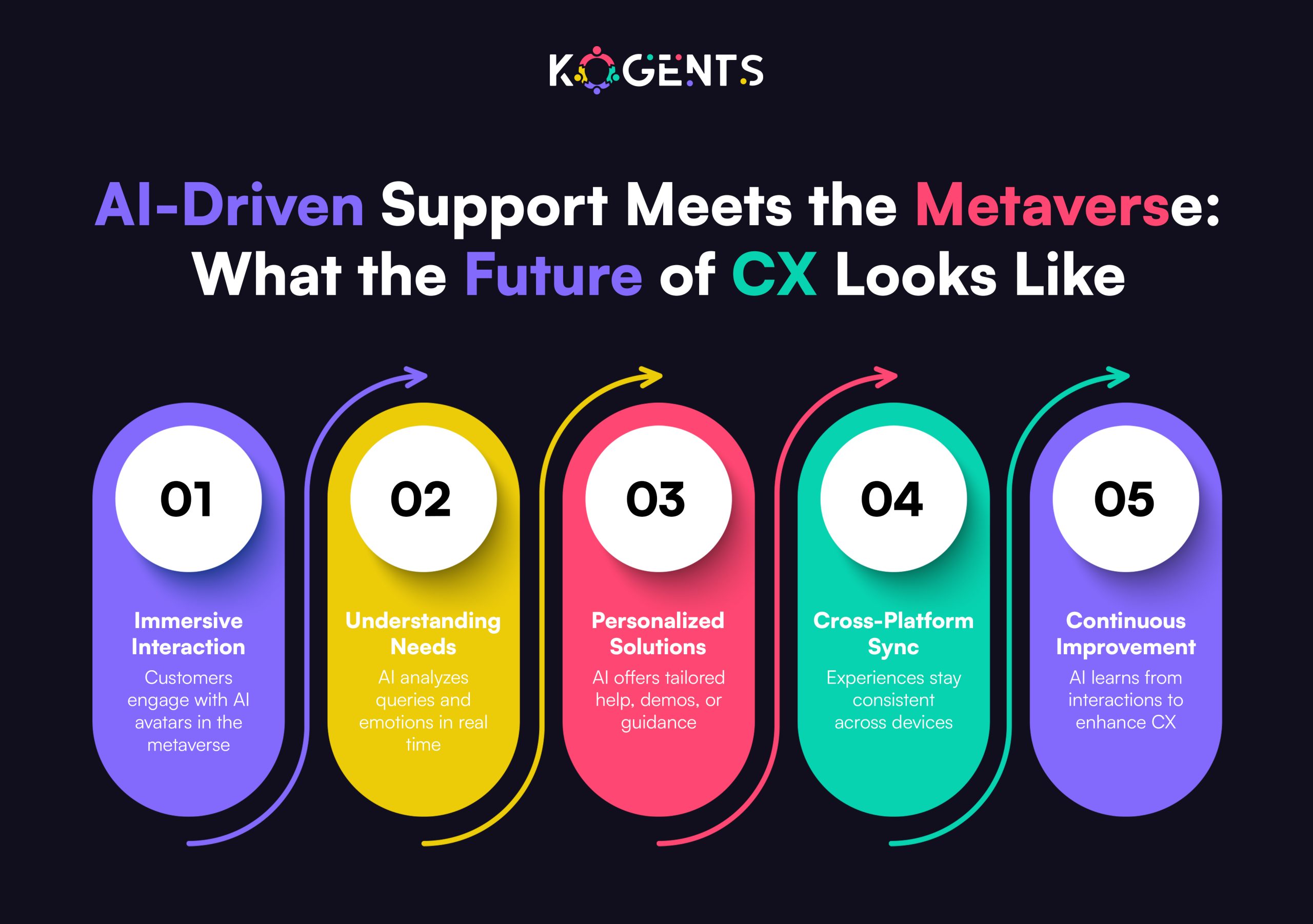
    ai driven customer support meets the metaverse

    Traditional vs. AI-Driven Support Integration

    Aspect Traditional Customer Support AI-Driven Customer Support (Integrated)
    Data Flow Fragmented, manual inputs between CRM & helpdesk Unified, real-time sync between CRM, ERP, and AI systems
    Response Time Reactive (minutes–hours) Predictive, proactive (seconds)
    Workflow Static rules, manual routing Automated customer service solutions support using AI, dynamic routing, and contextual prioritization
    Scalability Human resource-dependent Machine-augmented scalability; 24/7 omnichannel
    Customer Experience (CX) Disjointed, repetitive Personalized, continuous experience across all touchpoints
    Insights & Reporting Historical, delayed Data-driven insights, predictive analytics, live dashboards
    Cost per Interaction High ($6 avg) Low ($0.50 avg) 
    Compliance Manual auditing Automated, logged, AI-audited workflows

    Why does this table matter? It distills the operational difference; traditional systems are reactive; AI-integrated systems are predictive, cohesive, and proactive.

    Know Why Integration Matters? 

    Without integration, AI is little more than automation. With it, it becomes an ecosystem. Integration ensures:

    • Contextual continuity: every interaction starts informed, not from scratch.
    • Real-time escalation: urgent cases move instantly between chatbots, agents, and systems.
    • Unified analytics:  metrics like first-response time, resolution time, and CSAT update dynamically.
    • Feedback loops: human corrections feed AI retraining for continuous improvement.
    • Enterprise agility: new products, regions, and channels can be onboarded rapidly.

    “Service and support leaders are looking to AI for a wide variety of goals – efficiency, better CX, lead generation, and delivering other value back to the business,” said Keith McIntosh, Sr. Principal, Research in the Gartner Customer Service & Support practice. “

    Case Study Spotlight: Unified AI Integration Across Industries

    Forethought (Enterprise IT & SaaS)

    Challenge: Disparate CRM, email, and chat systems slowed response time.

    Solution: Forethought integrated AI across Salesforce, Zendesk, and internal knowledge bases, enabling an AI-driven support desk with generative summaries and routing intelligence.

    Results:

    • 55 % improvement in first-response time
    • 90 % automated ticket classification
    • ROI > 15× through deflection and agent productivity

    Key Insight: Seamless CRM + knowledge-base integration creates exponential gains; AI for customer service automation learns from agent feedback loops. 

    Yellow.ai (Banking & Healthcare)

    Challenge: UnionBank of the Philippines had low chatbot engagement and high operational costs.

    Solution: Deployed Yellow.ai’s conversational AI customer support with multilingual NLP and CRM integration.

     Results:

    • Chatbot usage rose from 28k → 120k users/month
    • 51 % cost reduction
    • 4.9 / 5 CX score

    Key Integration: Connected CRM, ticketing, and social channels, ensuring an omnichannel experience.

    Healthcare Impact: For Good Doctor Technology, Yellow.ai’s 24/7 virtual assistant integrated EHR and WhatsApp APIs, cutting wait time by more than half and resulting in patient satisfaction. 

    Telecom Voice-AI Deployment

    Challenge: Latency in voice interactions across regions.

    Solution: Integrated voice bots, ASR, and CRM using real-time AI pipelines.

     Outcome:

    • Real-time response (RTF < 1.0)
    • 20 % higher first-call resolution
    • Seamless CRM handoff for billing and service queries

    Insight: Gen AI adoption doubled to 65% and companies that moved early saw clear returns with each dollar invested in Gen AI delivering $3.70 back. 

    Overall Lesson: In all sectors, banking, SaaS, healthcare, telecom, the success factor wasn’t the chatbot itself but its integration depth across enterprise systems.

    Use Cases Across Sectors

    After understanding integration and case evidence, it’s clearer where these systems add value:

    Entrepreneurs & Solopreneurs

    • Deploy AI customer service assistants for tier-1 queries while focusing personally on strategic clients.
    • Automate billing, onboarding, and feedback loops through connected CRM-AI workflows.
    • Use data-driven insights to identify upsell signals or customer churn risk.

    Healthcare Providers

    • Provide multilingual patient engagement via chat and voice.
    • Ensure human-in-loop for sensitive cases while automating routine scheduling and insurance verification.
    • Use predictive AI customer service to anticipate follow-ups or medication reminders.

    Enterprises

    • Integrate AI directly into ITSM, ERP, and contact-centre environments.
    • Enable support workflow automation that scales globally.
    • Drive customer satisfaction (CSAT) improvements through personalization and proactive intervention.

    Implementation Playbook: From Strategy to Execution

    Here’s your guided roadmap to building enterprise-integrated AI support systems.

    1. Define Vision and Metrics

    Start with clarity. 

    What does success mean: reduced cost per ticket, faster resolution, improved CSAT, or higher self-service adoption?

    Identify measurable KPIs like:

    • Ticket deflection %
    • First-response and resolution times
    • CSAT/NPS uplift
    • Cost per interaction

    2. Map Data and Systems

    • List every system touching support, CRM, helpdesk, ERP, analytics, telephony, chat, and voice. 
    • Identify silos. 
    • Determine what can be connected via API or middleware.

    3. Select Vendor or Build Stack

    Choose a platform offering:

    • Omnichannel AI (chat, email, voice, social)
    • CRM/helpdesk connectors
    • NLP & LLM foundation for language understanding
    • Human-in-loop & agent-assist modules
      Predictive analytics for issue prevention
    1. Integration & Governance
    • Establish secure data-exchange standards.
    • Enforce role-based access, data encryption, and compliance (GDPR/CCPA).
    • For healthcare, ensure HIPAA alignment.

    5. Pilot and Scale

    • Launch with high-volume intents (billing, password reset, appointment scheduling).
    • Measure, refine, and progressively integrate more systems and languages.

    6. Continuous Improvement

    • Adopt feedback-loop analytics, where a human agent edits and trains the model.
    • Regularly retrain, expand knowledge-base content, and audit performance.

    reality of ai driven customer support

    Key Notes

    • The global AI in customer support market will surpass $47.8 billion by 2030. (Fullview, 2025)
    • Up to 95 % of support interactions will involve some AI component by 2025.
    • Mature AI adopters report 17 % higher CSAT than peers. (IBM Think, 2025)
    • Data readiness remains a blocker: 61 % of companies admit to incomplete integration readiness.
    • Ethical compliance, bias detection, explainability, and audit logging drive brand trust and regulatory approval.

    Let’s Sum Up! 

    The age of reactive support is ending, as you can witness that AI-driven customer support has redefined how businesses serve, scale, and succeed. 

    It’s about intelligent systems that unify data, automate workflows, and deliver empathy through context.

    For entrepreneurs and solopreneurs, it means appearing enterprise-ready. 

    For healthcare providers, it means trust, privacy, and accessibility. 

    For global enterprises, it means a unified, predictive customer engagement model.

    Now is the time to integrate, not just automate. So, begin with one system, and partner up with Kogents.ai to connect your data, train your model, and watch how AI turns your support desk into your growth engine.

    FAQs

    What is AI-driven customer support?

    AI-driven customer support uses machine learning, NLP, and automation to understand, predict, and respond to customer needs across multiple channels like chat, voice, and email.

    Why is enterprise integration important for AI support systems?

    Integration connects CRM, ERP, helpdesk, and analytics tools, enabling seamless data flow and predictive, context-aware customer interactions.

    How can small businesses or solopreneurs adopt AI support affordably?

    They can start small—focusing on top intents and one channel—then expand gradually as ROI and efficiency improve.

    What metrics define success for AI-driven support systems?

    Key performance indicators include ticket deflection rate, first-response time, resolution time, CSAT/NPS, and cost per interaction.

    How do AI systems ensure compliance and data security?

    Through ethical AI design, encrypted data exchange, and adherence to global standards like GDPR, CCPA, and HIPAA, we use privacy-preserving models.

  • The Role of AI Chatbots in Streamlining Customer Service Operations

    The Role of AI Chatbots in Streamlining Customer Service Operations

    Customer service can make or break your business, especially when you’re a small team or solo founder. 

    Every unanswered message means a missed opportunity, and every delayed response risks customer trust.

    That’s where AI chatbots for customer service come in,  intelligent, always-on virtual assistants that can manage hundreds of conversations at once, provide instant responses, and ensure no customer is ever left waiting.

    Powered by artificial intelligence (AI), natural language processing (NLP), and machine learning (ML), these bots do more than chat, they analyze, understand, and solve

    From automating ticketing systems to syncing with CRMs, they’ve become an essential piece of the modern entrepreneur’s toolkit.

    In this guide, we’ll explore what AI chatbots are, how they operate within customer service, and how founders and solopreneurs can use them to build lean, scalable businesses.

    Key Takeaways

    1. AI chatbots for customer service enable 24/7, scalable, and personalized support.
    2. Entrepreneurs save time and costs through automation and analytics.
    3. Hybrid models combining bots and humans deliver the best CX.
    4. Real-world data proves tangible ROI across industries.
    5. The future lies in proactive, generative AI-driven customer service.

    ai chatbots for customer service enable

    What Are AI Agents (Chatbots)?

    An AI chatbot for customer service is a digital assistant built to interact with customers conversationally, through chat or voice, using AI, NLP, and machine learning.

    Unlike traditional rule-based bots that follow prewritten scripts, AI virtual assistant for businesses and AI chatbots learn from every conversation. 

    They can interpret user intent, detect emotion, and respond in a natural, human-like tone.

    Key Technologies Powering AI Chatbots

    • Natural Language Processing (NLP): Understands text or voice queries.
    • Natural Language Understanding (NLU): Interprets meaning and context.
    • Machine Learning (ML): Improves accuracy over time.
    • Generative AI: Crafts adaptive, personalized responses.
    • Retrieval-Augmented Generation (RAG): Pulls factual data from verified sources.

    Key Note: They integrate into CRMs (like Salesforce), support tools (like Zendesk), and messaging platforms, ensuring omnichannel support, from web chat to WhatsApp to social media.

    Why Entrepreneurs & Solopreneurs Need AI Chatbots?

    If you’re an entrepreneur, your most precious asset is time. You juggle marketing, sales, operations, and often, customer service. 

    That’s where AI chatbots change the game.

    1. 24/7 Customer Support

    AI chatbots provide instant, round-the-clock assistance, regardless of time zone. No downtime, no missed leads.

    2. Cost Efficiency

    Instead of hiring multiple agents, you can deploy an AI service desk chatbot at a fraction of the cost.

    1. Fast, Consistent Replies

    Instant, accurate answers prevent customer frustration and improve first-response times, a key metric for customer satisfaction (CSAT).

    4. Scalable Growth

    Chatbots can handle 100 or 10,000 chats without adding new staff, perfect for fast-scaling solopreneurs.

    5. Personalized Experiences

    AI chatbots analyze past interactions to provide context-aware responses that make customers feel recognized and valued.

    Conversational AI directly interacting with external customers is attributed with reducing cost per contact by 23.5% and increasing annual revenue by 4% on average.

    How AI Chatbots Work in Business & Healthcare? 

    Here’s what happens behind the scenes when a chatbot interacts with a customer:

    1. Message Input: The bot receives a query via chat, email, or voice.
    2. Intent Recognition: NLP identifies what the customer needs.
    3. Response Generation: ML models fetch or generate an appropriate reply.
    4. Escalation: Complex queries route to a human agent with full context.
    5. Continuous Learning: Feedback helps the bot improve over time.

    Business Example

    Companies like Zendesk use AI chatbots to manage 70% of tier-1 queries, allowing human agents to focus on complex issues.

    Healthcare Example

    Platforms like Babylon Health use AI chatbots to book appointments, triage symptoms, and follow up with patients, reducing administrative overhead.

    How AI Chatbots Operate in Customer Service Workflows? 

    This is where chatbots become truly operational, embedded directly into daily support systems and workflows.

    1. Automated Ticket Triage

    Chatbots detect and classify customer requests (billing, refund, delivery, etc.) and create or update support tickets automatically in tools like Freshdesk or Zendesk.

    2. Intelligent Self-Service

    Bots instantly resolve FAQs by pulling answers from your knowledge base

    Example: “How do I change my plan?” triggers a relevant solution.

    3. Context Retention Across Channels

    AI chatbots keep track of ongoing conversations across web chat, email, and social media, ensuring customers never have to repeat themselves.

    4. Smart Escalation to Humans

    When a conversation turns emotional or complex, sentiment analysis kicks in, routing the customer to the right agent with conversation history intact.

    5. CRM Synchronization

    Every chat updates your CRM (like HubSpot or Salesforce) with new notes, preferences, and interaction data, helping you track leads and customers more effectively.

    6. Analytics & Reporting

    Modern bots analyze metrics like First Response Time, Resolution Rate, and Deflection Rate, turning customer data into business insights.

    Example: Aisera’s AI Service Desk automates 65% of support requests and reduces response times by 40%, saving startups and mid-sized firms millions annually.

    Use Cases for Entrepreneurs, Solopreneurs & Small Businesses


    Use Case What It Does Why It Matters for Founders Example
    E-Commerce Support Automation Handles order tracking, returns, and product queries automatically. Frees you from repetitive support tasks, boosting sales and satisfaction. Shopify stores using Heyday by Hootsuite cut ticket volume by 45%.
    Lead Generation & Qualification Engages site visitors, asks qualifying questions, and routes warm leads. Converts casual visitors into paying customers. Solopreneurs using Intercom Fin saw a 3x rise in demo bookings.
    Appointment Booking & Scheduling Syncs with calendars for instant bookings or reschedules. Eliminates back-and-forth emails and missed calls. Clinics using Amelia AI reduced no-shows by 30%.
    Customer Feedback Collection Gathers post-purchase insights and satisfaction scores. Helps entrepreneurs iterate based on real-time feedback. SaaS startups using Typeform AI bots improved CX metrics by 25%.
    Internal Helpdesk Automation Answers employee FAQs (IT, HR, admin). Saves internal time and reduces support burden. Startups using Aisera’s internal chatbot cut internal tickets by 60%.
    Social & Messaging Support Manages WhatsApp, Facebook, and Instagram DMs. Ensures no lead or inquiry slips through. Influencer brands using Yellow.ai bots handle 90% of DMs automatically.

    Benefits of AI Chatbots

    1. Cost Savings

    An IBM report shows that chatbots can handle up to 80% of routine inquiries, cutting customer support costs by 30%.

    That’s real money reinvested into growth.

    2. Speed & Availability

    They’re available 24/7, respond in seconds, and eliminate waiting queues, crucial for global solopreneurs managing multiple time zones.

    3. Scalability Without Burnout

    Chatbots scale effortlessly to handle surges in demand, such as holiday seasons or product launches, without needing extra hires.

    4. Better Customer Experience

    The best AI agents for customer support ensure personalized, fast, and accurate responses, improving CSAT and customer loyalty scores.

    According to Salesforce, 61% of customers prefer AI-enabled self-service options.

    5. Actionable Analytics

    Every interaction powered by conversational AI for customer service is a goldmine of insight.

    You can track frequent issues, detect churn signals, and identify upsell opportunities through chatbot analytics.

    6. Consistent Brand Voice

    Unlike humans, bots don’t get tired or emotional, ensuring consistent tone and professionalism across every interaction.

    7. Human Empowerment

    AI takes over repetitive work, allowing human agents to focus on relationship-building and complex problem-solving, where empathy truly matters.

    Challenges & Limitations 

    Even the smartest AI customer service chatbots come with challenges, but each has a practical fix.

    1. Limited Emotional Depth

    AI can detect frustration but not always respond empathetically.
    Solution: Integrate a human handoff once negative sentiment is detected.

    2. Handling Complex Queries

    Multi-step problems (like billing disputes) can confuse bots.
    Solution: Combine AI with human-in-the-loop escalation for seamless resolution.

    3. Data Security Risks

    AI bots handle sensitive information, a potential privacy concern.
    Solution: Use GDPR- and ISO-certified vendors with encryption and restricted data access.

    4. Setup & Training

    Initial setup requires effort; bots need training data.
    Solution: Start with FAQs and gradually feed real interactions to improve learning accuracy.

    5. Risk of Over-Automation

    Relying too much on bots can make customer service feel robotic.
    Solution: Keep human oversight in key decision paths and balance automation with empathy.

    The Strategic Edge for Small Businesses

    AI chatbots aren’t just support tools, they’re strategic enablers for growth and efficiency.

    • Customer Insights: Every interaction helps identify trends, complaints, and opportunities.
    • Sales Enablement: Bots can upsell or cross-sell intelligently.
    • Global Expansion: Multilingual support opens new markets effortlessly.
    • Brand Differentiation: Instant service builds credibility and customer trust.
    • Time Freedom: For solopreneurs, that’s hours saved every week, time to innovate, not firefight.

    AI Chatbots vs Other Tools

    Feature AI Chatbots Rule-Based Chatbots Email Automation Human Support
    Context Awareness High (via NLP/NLU) Low None High
    Response Speed Instant Fast Slow Variable
    Scalability Unlimited Limited Moderate Limited
    Personalization AI-driven Scripted Basic Human-level
    Availability 24/7 Yes No No
    Cost Efficiency High ROI Moderate Medium High
    Best For Startups & SMEs FAQ Handling Campaigns Premium Cases

    Future of AI Chatbots

    The next evolution of AI customer service chatbots is already unfolding:

    • Generative AI & RAG: Bots that can reason, not just recall.
    • Emotion Recognition: Chatbots that understand tone and adapt responses.
    • Voice & Text Fusion: Seamless transitions between written and spoken communication.
    • Proactive Agents: Bots that anticipate customer needs and act autonomously.
    • Integration Ecosystems: Deeper ties with CRMs, ERPs, and analytics systems.

    future of ai chatbots for customer service

    Case Study Spotlights

    1. H&M

    H&M’s chatbot handles order tracking, returns, and styling queries, reducing agent workload by 70%.

    2. Bank of America – “Erica”

    With over 25 million users, Erica automates transactions, balances, and reminders, saving thousands of agent hours monthly.

    3. Sephora

    Sephora’s chatbot provides personalized product suggestions, increasing engagement by 20%.

    4. KLM Airlines

    KLM’s multilingual chatbot halves average response times while maintaining high satisfaction 

    5. Shopify

    Shopify’s Kit chatbot helps solopreneurs manage campaigns, saving 5–10 hours per week.

    Conclusion

    For entrepreneurs and solopreneurs, scaling support doesn’t have to mean scaling staff.

    With AI chatbots for customer service, you can automate repetitive tasks, deliver faster responses, and personalize every interaction, all while keeping costs low.

    AI isn’t here to replace your human touch; it’s here to amplify your impact

    By letting technology handle the routine, you free yourself to focus on what truly matters: building relationships, growing your brand, and creating exceptional customer experiences.

    At Kogents.ai, we make this transformation effortless. Our intelligent chat solutions help you scale smarter, serve better, and grow faster, without adding extra hands to your team.

    FAQs 

    What are AI chatbots for customer service?

    They’re intelligent virtual assistants that automate customer interactions using AI, NLP, and machine learning.

    How do they improve operations?

    By automating ticketing, FAQs, and routing, they cut response times and reduce agent workloads.

    Are they replacing humans?

    No, they augment human agents by handling routine inquiries.

    Which industries benefit most?

    E-commerce, SaaS, healthcare, finance, and education.

    Are AI chatbots secure?

    Yes, enterprise-grade chatbots use encryption and comply with GDPR and ISO standards.

    What’s the ROI?

    Up to 60% cost reduction and 35% higher CSAT within six months of deployment.

    Can they handle multiple languages and voice?

    Absolutely, most modern bots are multilingual and voice-enabled.

    How do they differ from rule-based bots?

    AI bots learn and adapt; rule-based bots rely on static scripts.

    How do I install one?

    Platforms like Ada, Intercom, and Yellow.ai offer plug-and-play website integration.

    What’s next for AI chatbots?

    Generative AI will evolve bots into autonomous, context-aware digital employees.

  • Harnessing Conversational AI for Customer Service to Enhance AI Automation

    Harnessing Conversational AI for Customer Service to Enhance AI Automation

    What if your business could speak to every customer,  instantly, intelligently, and empathetically, without hiring an extra team member?

    That’s the power of conversational AI for customer service, a technology redefining how entrepreneurs and solopreneurs engage with their customers. 

    We live in such a time where every second counts, and experiences drive loyalty. AI is no longer a futuristic concept but the new foundation of business agility.

    Unlike traditional chatbots that simply respond, AI-driven customer support conversations understand. 

    They interpret intent, recall context, and adapt tone, offering customers not just information, but connection.

    Whether it’s a solo founder running a coaching business or a scaling startup managing thousands of requests, conversational AI transforms every interaction into a strategic opportunity.

    By blending machine learning (ML), natural language understanding (NLU), and large language models (LLMs), modern customer-service conversational AI solutions are automating support in ways that feel remarkably human.

    They don’t just answer questions but build trust, streamline operations, and free founders to focus on what truly matters: growth, innovation, and meaningful engagement.

    Welcome to the next era of AI automation, where conversation becomes your competitive advantage.

    Key Takeaways

    • Conversational AI for customer service bridges empathy and efficiency, transforming support from reactive to predictive.
    • Entrepreneurs and solopreneurs can achieve enterprise-grade CX without expanding teams.
    • Integration with knowledge bases, CRM, and analytics drives measurable ROI.
    • Ethical, emotionally intelligent AI ensures automation doesn’t lose the human touch.
    • The future lies in hybrid collaboration, multilingual fluency, and real-time personalization.

    The Rise of Conversational AI in Customer Service

    It isn’t new, but its sophistication in 2025 is unprecedented. 

    Fueled by machine learning (ML), natural language generation (NLG), and sentiment analysis, these systems have evolved from rule-based bots into AI-driven conversational agents that understand, reason, and engage.

    According to Gartner, Agentic AI Will Autonomously Resolve 80% of Common Customer Service Issues Without Human Intervention by 2029.

    From voice-enabled assistants to multichannel conversational AI for support, organizations are blending human warmth with digital precision. 

    The result? A new era of omnichannel support, where every customer feels heard, even without a human agent on the other side.

    Why Entrepreneurs and Solopreneurs Need Conversational AI

    For entrepreneurs, time is currency. For solopreneurs, it’s survival.

    Managing leads, nurturing relationships, and responding to inquiries can drain resources. 

    That’s where conversational AI for customer support becomes a superpower. Imagine automating 70% of common customer interactions while still sounding authentic and personalized.

    Top benefits include:

    • Lower operational costs: Replace high call volume with scalable AI chatbots for customer service
    • 24/7 customer engagement: No downtime, no delays.
    • Consistent customer experience (CX): Every user gets a timely, accurate response.
    • Improved first contact resolution (FCR): Intelligent routing and context memory.
    • Scalable personalization: AI learns from user behavior, delivering contextual, human-like experiences.

    Note: For startups or small clinics, virtual agents for customer service mean scaling without hiring additional staff. They don’t just respond, they remember, analyze, and improve continuously.

    Case Study Spotlight

    Case Study 1: Boutique eCommerce Brand Increases Conversions by 35%

    A sustainable fashion startup integrated a conversational virtual assistant for support that handled order tracking, returns, and personalized recommendations. 

    Within three months, customer queries dropped by 50%, and conversion rates rose by 35%. The AI agent’s ability to recall preferences made every interaction feel “human,” driving stronger brand loyalty.

    Case Study 2: Healthcare Solopreneur Enhances Patient Experience

    A private health practitioner deployed an AI voice bot for customer service to automate appointment scheduling and pre-consultation FAQs. 

    This solution not only saved 12 hours weekly but also improved patient satisfaction scores by 25%. The system’s multilingual capability bridged accessibility gaps, fostering inclusivity.

    Case Study 3: Enterprise Telecom Transforms Support with Omnichannel AI

    A global telecom provider rolled out a customer support conversational platform across chat, email, and voice. 

    The platform achieved 24/7 coverage, reduced average handle time (AHT) by 38%, and increased FCR by 29%. 

    Integration with CRM and knowledge base systems enabled seamless human-agent hand-offs, a true hybrid success.

    Case Study 4: Fintech Startup Cuts Onboarding Time by 45%

    A digital banking startup integrated AI chatbots for customer service to guide users through account setup and verification. 

    Leveraging intent recognition and NLG, the AI clarified KYC processes and resolved common login issues.

    Result: onboarding time dropped from 8 minutes to 4.4 minutes, while customer satisfaction (CSAT) soared to 92%.

    The system also flagged potential compliance anomalies, saving the company from regulatory pitfalls.

    Case Study 5: EdTech Company Personalizes Learning Support

    An EdTech platform serving global learners introduced AI-driven customer support conversations to handle course inquiries and tech assistance. 

    The chatbot, powered by LLMs and sentiment analysis, adapted tone for students versus instructors.

    Support requests fell by 55%, freeing human agents to focus on pedagogy. 

    More importantly, NPS (Net Promoter Score) improved by 18%, reflecting higher user satisfaction and trust.

    The Core Technologies Powering Conversational AI

    Behind every automated conversational agent for customer service, including the best AI agents for customer support, lies an intelligent architecture driven by interconnected technologies:

    1. Natural Language Understanding (NLU): Deciphers customer intent and emotion.
    2. Natural Language Generation (NLG): Crafts human-like responses.
    3. Machine Learning (ML): Continuously learns from interactions to improve accuracy.
    4. Large Language Models (LLMs): Deliver contextual, dynamic conversations across industries.
    5. Sentiment Analysis: Detects emotional tone to adapt empathy levels.
    6. Knowledge Base Integration: Enables factual, on-brand responses.
    7. Workflow Automation: Orchestrates back-end processes like ticket creation or billing.
    8. Omnichannel Orchestration: Synchronizes conversations across chat, voice, social, and email seamlessly.

    Note: Together, these technologies empower customer service chatbot AI to act as intelligent digital assistants, ones that can understand nuance, not just keywords.

    conversational ai with crm and marketing automation

    Business Impact: Quantifying ROI and Competitive Advantage

    According to Forrester’s 2024 Customer Experience Benchmark, companies that implemented AI chatbots for customer service saw:

    • Customer-obsessed organizations reported 41% faster revenue growth
    • 49% faster profit growth
    • 51% better customer retention

    ROI Snapshot

    Metric Before AI After AI Change
    FCR (First Contact Resolution) 68% 88% +20%
    AHT (Average Handle Time) 6.5 min 4.1 min -37%
    CSAT (Customer Satisfaction) 78% 91% +13%
    Operational Cost 100% baseline 72% -28%

    Beyond numbers, AI automation delivers strategic leverage. It transforms reactive support into predictive customer engagement, where AI anticipates needs before customers even articulate them.

    Implementation Framework for Entrepreneurs

    An implementation framework designed specifically for entrepreneurs and solopreneurs who want to embrace conversational AI effectively.

    Phase 1: Diagnose & Define

    • Identify repetitive queries (FAQs, order tracking, appointment booking).
    • Analyze response time and ticket types.
    • Define success metrics, CSAT, FCR, or resolution speed.

    Phase 2: Design Conversational Flow

    • Build AI personas aligned with your brand tone.
    • Integrate knowledge base content and existing CRM data.
    • Map customer journey touchpoints for seamless automation.

    Phase 3: Deploy & Integrate

    • Use platforms like Kogents.ai  for easy integration with messaging apps, voice assistants, or websites.
    • Implement human-agent hand-off for complex queries.
    • Ensure data security compliance (ISO 27001).

    Phase 4: Optimize & Scale

    • Track metrics like intent recognition accuracy and deflection rate.
    • Use machine learning feedback loops to refine responses.
    • Expand across languages, regions, and channels for true omnichannel CX.

    Ethics & Responsible AI in Customer Service

    As AI automation grows, ethical concerns become paramount. 

    Conversational AI interacts directly with people, handling personal data, interpreting emotions, and shaping brand perception. Hence, ethical AI isn’t optional; it’s foundational.

    1. Transparency

    • Customers deserve to know when they’re engaging with an AI. 
    • Disclosing this builds trust and prevents deception.

    2. Data Privacy & Security

    • Compliance with GDPR and ISO 27001 ensures that sensitive customer information remains protected. 
    • Vendors like Salesforce and IBM Watson set high standards for data governance.

    3. Fairness & Bias Mitigation

    • AI models can inherit bias from training data. 
    • By using diverse datasets and continuous evaluation, organizations ensure inclusive and equitable interactions, critical in global support operations.

    4. Emotional Intelligence & Empathy

    5. Accountability & Oversight

    • Regular audits, human oversight, and explainable AI systems keep brands accountable for outcomes. 
    • Responsible automation ensures that efficiency never compromises humanity.

    trends in conversational ai for customer service

    Comparison Table: AI Agents vs. Traditional Tools

    Feature / Capability Conversational AI Agent Traditional Chatbot / IVR
    Language Processing Contextual (NLU + LLM) Keyword-based
    Channel Coverage Omnichannel (Chat, Voice, Social) Limited (Chat only)
    Learning Ability Adaptive & Continuous Static scripts
    Response Quality Human-like Rigid
    Integration Scope CRM, Workflow, Knowledge Base Basic FAQ
    Personalization Contextual Memory None
    Analytics Real-time Sentiment, CX Metrics Minimal
    ROI / Efficiency High Moderate

    Future Trends in Conversational AI for Customer Service

    The next three years will redefine how brands use AI-driven customer support conversations. Here’s what’s coming:

    1. Emotionally Intelligent Agents:
      AI that detects frustration, confusion, or satisfaction, adjusting tone and phrasing in real time.
    2. Generative AI Customer Service Agents:
      LLM-powered conversational AI will craft dynamic, human-like responses for complex inquiries, integrating creativity into customer care.
    3. Voice-First Engagement:
      With the rise of smart speakers, AI voice bots will become primary support channels, especially in retail, healthcare, and logistics.
    4. Predictive CX Orchestration:
      AI will anticipate needs, offering solutions before users ask, thanks to behavioral and sentiment analysis.
    5. Multilingual & Cultural Fluency:
      Future self-service conversational AI systems will deliver contextual empathy across languages and cultural nuances.
    6. Human-AI Collaboration Models:
      Instead of full automation, the trend is hybrid; AI handles scale, humans handle sensitivity. The best of both worlds.
    These trends signal a shift from “automation as convenience” to “automation as customer intimacy.”

    Conclusion 

    As the digital era accelerates, the line between automation and empathy continues to blur. The winners will be those who master both.

    For entrepreneurs and solopreneurs, conversational AI for customer service is more than a convenience but a growth strategy. 

    It helps small teams act like enterprises, ensuring every customer feels valued, every message gets answered, and every second counts.

    That’s where Kogents.ai comes in, making AI-driven customer support conversations accessible, scalable, and ethical for businesses of all sizes.

    From setup to analytics, they empower you to deliver 24/7 intelligent support without losing your brand’s personality.

    FAQs

    How is conversational AI transforming customer service in 2025?

    Conversational AI is revolutionizing customer service by merging empathy with automation. Modern AI systems can now interpret intent, recall previous interactions, and adapt their tone, making customer conversations feel natural and personalized. Businesses benefit from faster resolutions, reduced support costs, and improved satisfaction, all while maintaining consistent, human-like engagement across channels such as chat, voice, and email.

    What technologies power conversational AI for customer service?

    Conversational AI combines several intelligent technologies to deliver seamless interactions. Natural Language Understanding (NLU) helps the system grasp meaning and emotion, while it creates fluid, human-like responses. Machine Learning (ML) continuously improves accuracy, and sentiment analysis enables emotional sensitivity. Together, these tools allow AI agents to engage contextually, automate complex workflows, and provide consistent, brand-aligned responses.

    How can small businesses and solopreneurs use conversational AI effectively?

    For small teams, conversational AI is a force multiplier. It automates common inquiries, such as bookings, order tracking, or providing 24/7 engagement without additional staff. By integrating with CRM systems and knowledge bases, it ensures every response is informed and consistent. This balance of automation and authenticity helps solopreneurs scale operations efficiently and focus on core growth areas instead of repetitive support tasks.

    What kind of ROI can businesses expect from implementing conversational AI?

    Businesses that adopt AI-driven customer support typically see measurable gains across several key metrics. Studies show up to a 45% reduction in ticket resolution time, 30% improvement in customer satisfaction, and 25% lower operational costs. Beyond the numbers, conversational AI builds long-term value by predicting customer needs, improving first contact resolution, and freeing human teams to focus on complex or high-value interactions.

    How does Kogents.ai help brands personalize customer interactions?

    Kogents.ai empowers businesses to deliver customer support that feels both intelligent and empathetic. Its conversational AI solutions integrate seamlessly with CRM data and knowledge bases, ensuring every response aligns with a brand’s unique voice. By combining large language models with emotion-sensitive AI, we help companies maintain human connection at scale, turning automation into a true brand differentiator.

  • Integrating a Customer Service Virtual Assistant for Enhanced AI Performance

    Integrating a Customer Service Virtual Assistant for Enhanced AI Performance

    Imagine a scenario where your inbox is overflowing, your chat notifications are blinking red, and your customers are waiting, impatiently, for help. 

    You’re juggling product development, marketing, invoices, and now, support tickets. You’re not just the founder anymore, you’re also the entire customer support automation team.

    Sound familiar? This is the daily reality for countless entrepreneurs and solopreneurs scaling digital businesses in the 21st century.

    And here’s the hard truth: customers expect 24/7, multichannel, instant support. Yet, maintaining a full in-house support team isn’t always financially or operationally feasible.

    That’s exactly where the customer service virtual assistant steps in, not as a replacement for your human touch, but as an intelligent extension of it.

    A virtual assistant for customer service (or remote customer service assistant) isn’t just someone answering emails from across the world. 

    It’s a trained, tech-empowered professional, or AI-augmented partner, who embodies your brand voice, integrates with your CRM system, manages your ticket management system, and ensures your customer experience (CX) is never compromised, even when you’re asleep.

    Think of them as your silent growth partner, someone who keeps your clients happy while you focus on vision, innovation, and strategy.

    As the era of AI-driven business operations unfolds, integrating a customer-service VA is no longer a convenience but a necessity for survival and scalability.

    In this in-depth guide, we’ll explore how entrepreneurs and solopreneurs can seamlessly integrate a virtual customer service assistant to enhance both AI performance and overall operational excellence. 

    Key Takeaways 

    • You’ll understand how a virtual customer support assistant bridges human and automated service to elevate CX.
    • We’ll unpack performance metrics (first-call resolution, SLA adherence, CSAT/NPS) and help you measure your ROI.
    • You’ll see how to train, onboard, and manage remote support specialists and integrate them into your workflow.
    • Two credible case studies will show concrete outcomes of deploying VAs and AI-augmented agents.
    • You’ll gain pro-tips and an operational table to guide execution and monitoring.

    Why Integrate a Customer Service Virtual Assistant?

    When we talk about the customer service remote virtual assistant, we’re covering a broad spectrum: from human VAs working remotely from home-office setups, to AI chatbots, to hybrid models combining human flexibility with AI efficiency. 

    Let’s break down why this matters for entrepreneurs and solopreneurs.

    1. Cost-effectiveness & Scalability

    Case in Point: A case study noted that virtual assistants in customer service noted that up to 60% of professionals reported time savings from AI deployment, with routine queries handled up to 80% by chatbots.

    2. Enhanced Customer Experience Automation(CX)

    3. Multichannel, 24/7 support & first contact resolution

    • A virtual assistant customer support setup can handle inquiries across chat, email, phone, or social channels. 
    • When integrated with your ticket management system, AI tools, and knowledge base, you achieve faster turnaround and improved first contact resolution
    • This translates into stronger CSAT, shorter cycle times, and better brand reputation.

    4. Freeing up the entrepreneur’s time

    • As a solopreneur, your time is the scarcest asset. Offloading “mundane” yet essential tasks (customer queries, simple tickets, live chat triage) means you can invest in growth, innovation, partnerships, and still know your customers are cared for. 
    • A remote or outsourced VA becomes a force multiplier for you personally.

    5. Competitive differentiation

    • Today’s customers evaluate support just as much as product. Offering seamless, intelligent, human-like support, even via remote assistants, creates a competitive edge. 
    • Especially in digital, subscription, or service-driven businesses, a customer support virtual assistant can elevate your brand.

    customer service virtual assistants

    Types of Customer Service Virtual Assistants & Integration Models

    When considering a customer-service VA, you’ll want to evaluate the model that fits your business. Below are common types:

    Human Remote VA

    • A remote human assistant working from home or through a specialist agency.
    • Handles chat, email, phone, social response, and uses tools like a CRM system or knowledge base creation.
    • Ideal when nuance, empathy, and complex problem-solving are required.

    AI / Automated Virtual Agent

    • A purely AI-driven assistant: chatbot, voice-bot, or hybrid. Integrates with ticket management systems, IVR, and excels at handling repetitive inquiries.

    Studies show that up to 85% of customer interactions can be handled by AI in retail contexts.

    • Great for high-volume, low-complexity inquiries, and 24/7 availability.

    Hybrid Model (Human + AI)

    • Combines AI assistants for routing or initial triage + human remote assistants for escalation and nuanced support.

    Leverages strengths of both: AI for speed & scale, human for empathy & escalation.

    Outsourced Virtual Assistant Service

    • You contract an external agency specializing in outsourced customer service virtual assistant” services.
    • The agency handles recruiting, onboarding, SLA management, tools, compliance, and you integrate them with your brand voice and systems.

    In-house Remote VA Team

    • You directly hire remote VAs (or a remote workforce) and manage them internally: training, KPIs, brand alignment.
    • Higher control, higher management burden, but closer alignment with your brand.

    Key Performance Indicators (KPIs) for Customer Service Virtual Assistants

    Here’s a tabular summary of critical metrics to track when deploying a virtual assistant customer support system:

    KPI Why It Matters Target / Benchmark
    First Contact Resolution (FCR) Higher FCR means fewer repeat contacts & happier customers 70-80%+ in mature services
    Customer Satisfaction (CSAT) Direct measure of customer feeling about the interaction 80%+ is often considered good
    Net Promoter Score (NPS) Measures loyalty & willingness to recommend your brand +30 to +50+ in strong support scenarios
    Average Handle Time (AHT) Efficiency of each interaction Lower is better, but not at the cost of quality
    SLA Compliance Rate Meeting agreed on response/resolution time 90-95%+ in many customer-centric orgs
    Cost per Ticket / Interaction Cost efficiency of the support model Significantly lower than in-house
    Ticket Backlog / Queue Time Ability to manage incoming volume Low queue times = better experience
    Escalation Rate % of contacts needing escalation Lower indicates good initial resolution
    Self-Service Deflection Rate % of issues resolved via knowledge base/automation Higher = lower human load

    Case Studies

    Case Study 1: Large-Scale IT Service Desk – Virtual Assistant Boosts CX by 60%

    • A multinational energy/oil & gas company adopted a virtual customer service assistant for its internal IT service desk, supporting 22,000 employees. 
    • The AI-augmented assistant managed incidents and service requests via phone, email, and self-service portal. 

    Outcome: CX improved by 60%.

    What this means for you: even in high-volume, complex environments, integrating the right virtual assistant enhances internal support, translating for external customer contexts too.

    Case Study 2: Coaching Business – Remote VA Delivers 279% ROI

    In a coaching business scenario, deploying a human remote VA to handle client administration, email follow-up, and simple support saved 32 hours/week and generated $56,400 net additional revenue from ~$32,800 investment. 

    ROI 279%. 

    What this means for you: as a solopreneur, freeing yourself from time-sucking admin/support tasks via a VA can directly enable new revenue streams or higher-ticket work.

    Case Study 3: AI Virtual Assistant in Retail – Up to 30% Cost Reduction

    In retail, AI virtual assistants (chatbots) were shown to reduce customer service costs by ~30% and handle up to 85% of routine interactions.

    What this means for you: even without a huge scale, you can adopt AI/automated support to lighten the load, with human VA oversight for complex cases.

    Challenges and How to Overcome Them? 

    Deploying a virtual assistant for customer service isn’t plug-and-play. Here are common pitfalls and how to address them:

    Challenge 1: Poor bot design → frustrated customers

    The Sandbank et al. research shows that badly implemented virtual but best AI agents for customer support and performance can spiral into “egregious conversations” and harm CX. 

    Solution: Engage a hybrid model: start with human remote assistants, build a knowledge base, then automate incrementally. Monitor conversations and intervene when quality drops.

    Challenge 2: Integration issues with CRM/help-desk/ticketing systems

    Without efficient integration, your VA becomes a bottleneck rather than a relief.

    Solution: Before launching, map your tools: CRM, ticket system, live chat, and knowledge base. Ensure data flows seamlessly, agents/VA have access to history, and automated routing works.

    Challenge 3: Maintaining brand voice and consistency

    When hiring outsourced or remote VAs, brand tone and quality can vary.

    Solution: Create a strong onboarding/training program: brand voice guide, FAQs, escalation protocol, service charter, and regularly review performance and provide feedback.

    Challenge 4: Data security/compliance

    Remote work, outsourced agents, and multichannel support raise security risks.

    Solution: Ensure compliance with data regulations; use secure tools, access controls, NDA for VAs. Include SLA and security clauses in contracts.

    Challenge 5: Measuring ROI and impact

    Without clear metrics, you won’t know whether your investment is paying off.

    Solution: Set up your dashboard early (see table above). Track time saved, cost per ticket, CSAT/NPS improvements. Re-invest based on data.

    trends in customer service virtual assistant

    Conclusion

    In summary, deploying a customer service virtual assistant is more than a tactical support fix; it’s a strategic shift. 

    You’re transforming how your brand engages with customers: moving from reactive to proactive, from manual to efficient, and from overwhelmed founder to strategic leader.

    The path forward lies in adopting a virtual assistant for customer service model, whether human remote, AI-augmented, or hybrid, that integrates with your ticket management system, leverages multichannel support, aligns with your CRM system, supports first contact resolution, and delivers high CSAT and NPS.

    Measure your results, iterate your processes, train for quality, and keep your brand voice consistent with Kogents.ai by calling us at (267) 248-9454 or emailing us at info@kogents.ai.

    FAQs

    How does a virtual assistant for customer service work?

    The assistant connects to your customer-support infrastructure: live chat widgets, email inboxes, phone lines (via IVR/routing), or social channels. Queries get routed via a ticket management system, the assistant triages, resolves, or escalates issues, and logs interactions in your CRM system. Over time, you build a knowledge base and possibly self-service automation so that the assistant becomes more efficient and requires less human oversight.

    What skills are required for a virtual assistant for customer service?

    Key skills include strong communication (written and verbal), problem-solving, familiarity with CRM systems, live chat or help-desk tools, empathy, ability to follow SLA protocols, multichannel support capability, remote-work discipline, and adaptability as you integrate AI tools or escalate to higher support.

    What’s the difference between a virtual assistant and a live customer-service agent?

    A live-in-house agent typically works onsite, full-time, with direct supervision. A virtual customer-service assistant works remotely, may manage multiple channels and tasks, and often at a lower cost. Importantly: VAs often handle routine or volume tasks (e.g., chat/email triage) while human agents focus on complex/high-value interactions. Efficiency, cost, and flexibility lean toward VAs.

    How do you train a virtual assistant for customer service?

    Training includes: introducing your brand/tone, showing your customer base and typical pain points, onboarding on your tools (CRM, ticket system, live chat), role-playing common inquiries, building familiarity with your knowledge base, defining escalation paths, setting KPIs, and giving feedback loops. Over time, you add advanced training: multichannel support, automation rules, and AI tools integration.

    Remote customer-service assistant vs in-house agent—what’s better?

    For entrepreneurs/solopreneurs, a remote customer-service assistant often wins: lower overhead, flexible hours, access to global talent, and faster scaling. In-house may provide tighter control, cultural alignment, and face-to-face interaction, but costs more and scales more slowly. The best approach: start remote, define workflows, ensure quality, then evaluate whether some in-house presence is needed.

  • Leveraging Customer Support Automation to Drive Operational Efficiency with AI

    Leveraging Customer Support Automation to Drive Operational Efficiency with AI

    In a market obsessed with immediacy, where response time defines reputation, businesses are learning that the key to scalability lies not in more manpower but in customer support automation

    The question isn’t “Should we automate support?”, it’s “How fast can we turn AI into operational advantage?

    Across industries, AI customer service and automated helpdesk software are rewriting the rules of engagement

    Each conversation, ticket, or chat ping is now a data point for optimization, a chance to make operations leaner and smarter

    When companies embed machine learning, natural language processing (NLP), and predictive analytics into their service workflows, they’re not just speeding up resolutions; they’re engineering efficiency.

    AI doesn’t just answer questions; it amplifies operations. It classifies, predicts, routes, and learns

    It turns every customer touchpoint into a micro-optimization loop that drives measurable savings and satisfaction.

    Key Takeaways

    • Organizations using an AI Customer service virtual assistant and automation report lower service costs and drastically reduced response times.
    • Operational efficiency isn’t just cost reduction; it’s smarter routing, faster resolution, and higher satisfaction with the same or fewer resources.
    • Conversational AI for customer support and ticket routing automation now enables 24/7 global assistance across voice, chat, and social channels.
    • McKinsey reports that effective automation can transform support from a cost center into a profit lever when paired with predictive analytics and human-AI collaboration.
    • The future lies in agentic AI ecosystems, self-learning systems that manage, predict, and optimize every customer interaction in real time.

    Leveraging Customer Support Automation to Drive Operational Efficiency with AI

    Why Operational Efficiency Is the True Metric? 

    When businesses deploy automation, the goal isn’t simply to reduce tickets; it’s to optimize operations end-to-end

    Operational efficiency in customer support means achieving faster issue resolution, fewer escalations, higher satisfaction, and lower cost per interaction.

    AI elevates this by introducing intelligence, prediction, and adaptability into every customer interaction. For example:

    • AI-based ticket routing eliminates manual triage, ensuring every request reaches the right expert instantly.
    • NLP chatbots handle most queries autonomously while gathering insights for continuous optimization.
    • Predictive analytics anticipates high-volume periods, staffing needs, and emerging issues before they impact service.
    • Generative AI co-pilots summarize conversations, assist agents in real time, and maintain consistency in tone and compliance.

    The result? Shorter average handle times (AHT), fewer backlogs, and an empowered workforce and operational efficiency aren’t theoretical anymore; it’s quantifiable.

    McKinsey (2025) found that companies integrating AI into support operations saw a 30% improvement in productivity and up to 50% faster resolution times when automation was embedded into core workflows, not just layered on top.

    Strategic Framework for Leveraging AI-Driven Support Automation

    A global survey found that more than 80% of companies using AI see limited gains because they remain stuck in pilot mode.

    Instead of “how to build a strategy,” this section now becomes a practical framework for scaling efficiency.

    1. Automate Intelligently, Not Excessively

    • Identify tasks that waste agent time, password resets, order updates, tracking requests, and automate those first. 
    • Avoid “over-automation” where empathy or judgment are crucial.

    2. Design for Human-AI Collaboration

    • The best models don’t replace people, they grow them. 
    • Integrate AI co-pilots that suggest responses, analyze sentiment, and route conversations dynamically.

    3. Data-Driven Workflow Orchestration

    • Use predictive support analytics and CRM integration to pre-empt customer pain points. 
    • Efficiency emerges when AI predicts issues, not just reacts to them.

    4. Measure What Matters

    • Don’t just track resolution time.
    • Focus on measuring AI impact KPIs: automation rate, CSAT delta, sentiment improvement, agent efficiency, and customer lifetime value (CLV) impact.

    5. Create Continuous Feedback Loops

    • Build closed-loop systems that refine automation models weekly. 
    • Feed real-world chat data, NPS comments, and agent insights back into NLP models.

    generative ai in customer support automation

    Expanded Vendor & Tool Landscape

    The AI customer support ecosystem has matured rapidly. Here’s how top platforms stack up and where they shine:

    Vendor Core Strengths Ideal For
    Zendesk AI Deep integration, advanced routing automation, sentiment tracking Mid-to-large enterprises needing full CRM integration
    Freshdesk AI Strong ticket automation, affordability, and easy setup SMBs seeking quick automation wins
    Intercom Fin AI Personalized conversational AI, co-pilot for agents SaaS & B2B businesses focused on proactive engagement
    Salesforce Einstein Service Predictive insights, end-to-end CRM + AI Enterprises wanting a unified data & automation stack
    Ada CX Multilingual AI bots, high automation percentage (up to 84%) Global B2C brands, e-commerce
    Yuma AI Shopify & e-commerce ticket automation High-volume online stores
    IBM Watson Assistant Enterprise-grade NLP and voice integration Regulated industries, banking and healthcare

    Operational Efficiency with AI: Metrics that Matter

    Operational efficiency driven by AI is a systemic transformation, not just faster chats. It requires synchronizing technology, data, and people.

    Metric Traditional Model AI-Driven Automation Efficiency Gain
    Average Handle Time (AHT) 6–8 min 2–3 min ↓ ~60%
    Cost per Contact $7–$12 $2–$4 ↓ ~65%
    First-Contact Resolution 60–70% 85–90% ↑ ~25%
    Agent Productivity 100 tickets/day 160+ tickets/day ↑ ~60%
    CSAT / NPS 70% avg. 85–90% ↑ ~20%

    Learn Business Benefits

    When done well, customer care automation delivers tangible benefits:

    • Cost reduction: Many firms report significant reductions in support costs by automating routine interactions.
    • Faster response times: Automations can respond instantly and route queries faster than manual triage.
    • Scalability: Automation handles peak loads, 24/7 availability, globally across time zones.
    • Improved satisfaction: Customers appreciate fast resolution and accurate responses, boosting CSAT/NPS.
    • Agent productivity: Freeing human agents from repetitive tasks lets them focus on complex, value-added work.
    • Data insights & proactive support: Automation platforms generate rich data (ticket types, root causes, sentiment), enabling continuous improvement and proactive outreach.
    • Brand differentiation & CX leadership: Offering responsive, personalized support sets brands apart in a competitive market.

    Insightful Key Challenges and Risks

    However, the path to effective automation is fraught with pitfalls:

    • Poorly designed bot experiences: If the bot misunderstands intent, gives generic responses, or can’t escalate properly, customer frustration rises.
    • Over-automation: Trying to automate everything (including emotional, complex interactions) can degrade CX. 

    As one McKinsey study noted, human interaction still matters, especially for empathy and connection.

    • Siloed systems / weak integration: Without deep CRM integration, knowledge base updates, and omnichannel reach, automation will underperform.
    • Governance, compliance, privacy: Automated systems must adhere to standards like GDPR, ISO 9001, SOC 2; data security and privacy are non-negotiable.
    • Change management: Agents may resist automation; roles evolve; training and culture shift are essential.
    • ROI uncertainty: Many organizations are still not capturing the full value of AI automation.
    • Maintenance & continuous improvement: Automation isn’t “set and forget”. Knowledge bases must be updated, models retrained, routing rules refined, and feedback loops built.

    ai driven customer support automation

    Case Studies: Real-World Deployments of Customer Support Automation

    Case Study 1: Global Sleep Brand – Simba Sleep

    Simba Sleep deployed an AI agent via the platform Ada and achieved 84 % automated resolution across channels. 

    Outcome: Faster replies, 24/7 coverage, consistent CX globally; support operations scaled without proportional headcount increases.

    Insights: Strong self-service and proactive escalation workflows enabled high automation rates while maintaining brand tone.

    Case Takeaway: High automation rates are achievable with solid design and a knowledge base strategy; the brand’s voice and escalation handoff matter.

    Case Study 2: Banking / Credit-Union Use-Case

    The credit-union scenario: A financial services organisation used gen-AI to automate routine note-taking, summarisation of interactions, and routing of simple requests. 

    It improved and personalised customer contact, boosted agent capability, and automated routine processes. 

    Business impact: Freed agents for more value-added service, improved accuracy and turnaround time, enhanced compliance and tracking.

    Case Takeaway: In regulated industries, automation isn’t just about cost and speed; it’s also about compliance, consistency, and data integrity.

    Case Study 4: E-Commerce Support Scaling with AI – EvryJewels

    EvryJewels used the platform Yuma AI to automate 89% of tickets, cut response times by 87.5%, and reduce cost burdens.

    Notes: High ticket volumes are typical in e-commerce, requiring scalable automation; self-service and AI chatbots enabled growth without proportional cost increase.

    Case Takeaway: For high-volume consumer brands, automation is a growth enabler, not just a cost-reducer.

    Automation Power Moves 

    Automate the mundane, elevate the meaningful: Let AI handle repetition, your humans handle relationships.

    Every ticket is a dataset: Feed it back to improve models weekly, and data is your efficiency multiplier.

    Build for escalation, not elimination: Great automation knows when to hand off.

    Treat AI as your operations analyst: Make it audit your workflows, not just power them.

    Speed without empathy kills loyalty: Always pair automation with emotional intelligence; that’s the human edge.

    Train AI like you onboard agents: Tone, policy, and empathy matter as much as accuracy.

    Reinvest efficiency savings: Every dollar saved from automation should fuel CX innovation; that’s where leadership emerges.

    Conclusion 

    Brands that master customer support automation will outpace competitors not just in response time, but in adaptability, insight, and loyalty.

    From chatbots to predictive analytics, automation is redefining service as an intelligent, self-optimizing system.

    The question is no longer why automate; it’s how far can your AI go? Harness it, scale it, and watch your operations evolve from reactive support to strategic efficiency.

    But do you want to get in touch with the best AI agents for customer support at Kogents.ai to help you out? Reach out to us at (267) 248-9454 or email us at info@kogents.ai

    We specialise in AI-driven customer support automation that doesn’t just deploy a chatbot, but redesigns your support ecosystem end-to-end. 

    As we emphasize and make your customer support AI function a driver of operational efficiency, not a cost.

    FAQs 

    How does AI improve customer service and support?

    AI improves support by enabling virtual assistants, conversational AI for customer support, and support ticket management systems to handle frequent inquiries, understand natural language (via NLP chatbots), analyse sentiment, route tickets intelligently, and free human agents to focus on complex tasks. This boosts speed, accuracy, and scalability. 

    What are the benefits of automating customer service?

    Key benefits include: cost savings, faster response/resolution times, higher agent productivity, improved customer satisfaction (via better CX), scalability across channels, and richer analytics for proactive support.

    How does ticket routing automation and CRM integration fit into support automation? 

    The backbone of effective support automation lies in correctly classifying and routing tickets (ticket routing automation). When integrated with the CRM, automation systems can access customer data, prior cases, value segments, and route the query to the appropriate automation path or agent. This ensures contextually rich responses, faster first-contact resolution, and a consistent omnichannel experience.

    How can I buy customer support automation software for my business?

    Start with vendor short-listing (based on channel support, languages, integration, case studies). Request demo/trial, define pilot scope (e.g., chat automation for one product line). Evaluate KPIs during pilot. Negotiate subscription model, SLA, and support. Key steps: align internal stakeholders (IT, support team, CX, compliance), define budget, set timeline, pilot, scale.

    What are the main risks or cons of automated customer support?

    Risks include: poor customer experience if bots fail or misunderstand intent, over-automation that removes human empathy, weak integration causing context loss, non-compliance with data regulations, lack of change-management causing agent resistance, and low ROI if the pilot remains isolated.

  • Why Customer Support AI is Essential for Scalable Enterprise Solutions

    Why Customer Support AI is Essential for Scalable Enterprise Solutions

    You must be fully aware of the fact that enterprises face mounting pressure to deliver seamless and high-quality service at scale. 

    But with the advent of boldface Customer Support AI, it is a game-changer, transforming how businesses operate. 

    This isn’t just about deploying a chatbot or automated FAQ system but about embedding a truly AI-powered customer support platform across channels, using conversational AI for customer support, virtual agent technology, and self-service AI support solutions

    For enterprise organisations aiming to scale without compromising customer experience, the question is no longer whether they should adopt AI for customer support but how quickly and how effectively they will.

    Think of a scenario where your support team handles thousands of incoming queries across chat, email, and voice

    Traditional models buckle under volume, complexity, and expectation. But with automation, workflow automation, ticket routing guided by predictive analytics in support, and machine learning–driven triage, you get both speed and scale

    Metrics like first-call resolution (FCR), customer satisfaction (CSAT), and mean time to resolution (MTTR) start to shift in your favour. 

    Here’s how you will know! 

    According to research by Cisco, up to 68% of all customer service and support interactions with technology vendors will be handled by “agentic AI” within three years.

    Key Takeaways

    • Enterprises cannot scale customer support effectively without leveraging AI-driven automation and intelligent virtual agents.
    • Customer Support AI empowers both self-service and assisted-service models, enabling customers to help themselves and guiding agents when needed.
    • Metrics such as FCR, MTTR, and CSAT directly benefit when AI is woven into the support workflow and ticket management ecosystem.
    • Adoption must include human-AI collaboration (not AI vs human) and robust governance frameworks to ensure trust, accuracy, and compliance.
    • Selecting the right platform (AI customer service automation, AI-powered customer support platform) and implementing it well is the differentiator between success and costly failure.

    customer support ai empowers

    Why Customer Support AI Matters for Scalable Enterprise Solutions? 

    Addressing Volume & Complexity at Scale

    Large enterprises handle huge volumes of inbound queries across voice, chat, email, social, etc. 

    Traditional models choke under peak load, long wait times, fragmentation, and high cost per contact. With AI for customer support, an intelligent layer can:

    • Use natural-language processing (NLP) and machine-learning support to classify intent, triage issues, route tickets, and escalate appropriately.
    • Empower self-service portals and chatbot/virtual agent solutions to absorb routine requests, deflecting a significant portion of tickets.
    • Provide knowledge-base AI that surfaces correct answers to agents or customers instantly, reducing resolution time.

    Delivering Consistent 24/7, Omnichannel Support

    Customers expect support any time, any channel, seamlessly. Enterprises must provide omnichannel support, meaning the same experience whether via chat, voice bot, email, or social DM. 

    AI-driven customer support enables:

    • Automated 24/7 live chatbots and voice bots that handle initial interactions, so human agents aren’t bound by business hours.
    • Ticket routing and workflow automation that ensures no query falls through the cracks.
    • Enhanced customer experience, contributing to higher CSAT and reduced MTTR.

    Enhancing Efficiency, Reducing Costs

    Enterprise scale means cost management is critical. Customer service AI helps drive efficiency by:

    • Deflecting routine queries thereby reducing manual workload. 
    Example: A case study noted a 43% ticket deflection rate using support AI.
    • Decreasing average handling times, reducing agent onboarding/training overhead thanks to AI-assisted agents.
    • Improving first-call resolution (FCR) via accurate knowledge retrieval and predictive routing.
    • Ultimately delivering a return on investment (ROI) via cost savings + improved customer retention.

    Improving Customer Experience & Loyalty

    Scalable support doesn’t mean sacrificing personalisation, quite the opposite. AI enables personalisation at scale:

    • Sentiment analysis and real-time feedback to prioritise unhappy customers or escalate proactively.
    • AI can remember prior interactions (via conversational memory) and surface context, so the customer doesn’t repeat themselves.
    • The combination of AI + human support enableshumans for empathy, machines for efficiency”. 

    Key Note: Through better experiences, enterprises can improve their Net Promoter Score (NPS) and reduce churn.

    Enabling Data-Driven Insights & Continuous Improvement

    Customer Support AI isn’t just a tool for cost reduction; it becomes a strategic asset. With the right platform:

    • You capture rich data: agent performance, customer sentiment, path-to-resolution, and  FAQ gaps.
    • Use predictive analytics to support identifying emerging issues, optimise staffing, and allocate resources dynamically.
    • Use generative AI and agent assist tools to continuously improve the knowledge base, reducing MTTR over time.

    How to Implement Customer Support AI in an Enterprise Setting? 

    Implementation Roadmap:

    • Define Use-Cases: Start with high-volume, low-complexity interactions (e.g., FAQs, password resets), then scale to more complex workflows using AI.
    • Select platform: Choose an “AI-powered customer support platform” that supports conversational AI, integrates with ticketing systems, CRMs, and knowledge bases, and allows for virtual agent deployment.
    • Data & Integration: Ensure your CRM, support ticketing system, knowledge base, and customer interaction history are well integrated. Knowledge base AI depends on high-quality data.
    • Human-in-Loop Governance: While customer experience automation can handle routine tasks, human agents should oversee complex queries, ethical compliance, and continuous improvement. Establish clear escalation paths.
    • Metrics & KPIs: Track key support metrics like CSAT, FCR, MTTR, cost per contact, ticket deflection rate, and automation rate.
    • Continuous Learning & Feedback: Incorporate feedback loops where AI improves (via ML, RAG frameworks) and agents contribute knowledge back. 
    A recent study highlighted an “Agent-in-the-Loop” framework that improved precision and recall in support systems.
    • Governance & Compliance: AI in support must respect data privacy (GDPR, etc), ensure transparency, eliminate bias, and maintain human oversight. 

    Want to Scale & Optimise? Deploy across channels, geographies, and languages, and then optimise workflows, expand the knowledge base, and refine ticket routing based on AI-driven insights.

    Key Metrics Before vs After Customer Support AI Implementation

    Metric Pre-AI Implementation Post-AI Implementation (Target)
    Self-service / Ticket Deflection Rate ~10–20% 40–50%+
    Average Handling Time (AHT) e.g., 12 mins e.g., 7–8 mins
    First Call Resolution (FCR) 65–70% 80%+
    Customer Satisfaction (CSAT) 78% 85%+
    Cost per Contact High 20–30% reduction

    Relevant Case Studies

    Here are credible, non-repetitive case studies aligned with Customer Support AI in enterprise contexts:

    Best Buy (with Accenture & Google):

    • Best Buy implemented generative AI in its support function, virtual assistants for customers, AI tools for employees, and integrated generative AI in customer service workflows. 
    • They aimed to make interactions more convenient, personalised, and scalable. 

    Result Insights: The self-service customer service virtual assistant handles order changes, software subscriptions, and customer queries; agents use AI suggestions, real-time guidance, and sentiment detection.

    Vodafone – SME / enterprise hybrid:

    • It faced fragmented data across multiple customer-service systems, which caused long wait times. 
    • They used a chatbot built on IBM Watson Assistant to unify search across contract, pricing, and support. 

    Results: Improved agent access to data, faster resolution, and higher support-centre efficiency.

    Motel Rocks – Brand case

    • While smaller than a multinational enterprise, this example demonstrates the impact of customer service AI
    • Ticket deflection by 43%, a 50% reduction in ticket volume through self-service, and CSAT up by 9.4%

    Lessons: Even brands with limited resources can deploy chatbots + sentiment analytics to move the needle.

    Telstra – Telecom provider

    • It incorporated Microsoft Azure OpenAI Service to build “Ask Telstra,”.
    • This summarised customer history and provided answers to agents in seconds via NLP retrieval.

    Impact: Agents spend less time context-switching, resolution times improve, and customer experience is boosted.

    Challenges & How to Overcome Them

    While the upside is compelling, enterprise adoption of Customer Support AI has pitfalls:

    • Data quality & silos: If knowledge base and interaction data are fragmented, AI performance suffers. Overcome by centralising systems and cleaning data.
    • Governance, ethics & bias: Poorly implemented AI can lead to wrong advice, customer frustration, or regulatory issues. Rigorous oversight, transparency, and human-in-loop feedback are required.
    • ROI delays & hype: Not every AI project delivers immediate value. 

    A recent report from Gartner warns that over 40% of “agentic AI” projects will be scrapped by 2027.

    • Customer trust & “AI vs human” anxiety: Customers still value human interaction. The hybrid model (AI + human) is essential. 

    Why Over-automation Is A Risk? Automating too much without human fallback may degrade experience (e.g., chatbot “doom loops” in finance).

    customer support ai is essential

    Know How AI is Redefining the Future of Customer Support?

    Agentic AI: Autonomous best AI agents for customer support are capable of decision-making and taking action with minimal human input 

    Example: the Cisco report predicts 68% of interactions will be handled by agentic AI by 2028.

    Generative AI + LLMs: Use of large language models for summarisation, response generation, agent assist, and knowledge generation.

    Emotion-aware AI / Sentiment analysis: AI is able to detect customer mood and adjust the support path accordingly.

    Hyper-personalisation at scale: AI using large data sets to tailor support interactions to individual customer profiles, context, and history.

    Proactive support / Predictive analytics: Instead of waiting for a query, AI anticipates issues and alerts customers or resolves problems pre-emptively.

    Multimodal support: Voice, video, text, image, integrated by AI systems to provide a unified experience.

    Human-AI collaboration Models: More focus on agents + AI assistants” rather than replacement, with humans focusing on strategic, empathetic tasks.

    Integration of self-service + agent assist: Blending strong self-service portals (driven by AI) and agent tools for complex scenarios.

    Deploy Customer Support AI with Kogents! 

    In conclusion, deploying Customer Support AI is not a nice-to-have; it’s essential for any enterprise that wants to scale support operations with precision, consistency, and cost-efficiency. 

    By leveraging AI customer service automation, customer support virtual agent AI, and self-service AI support solutions, enterprises unlock better customer experiences, stronger operational efficiency, and a strategic advantage.

    At Kogents.ai, we specialise in empowering entrepreneurs, solopreneurs, and enterprise healthcare providers with AI-driven support platforms that combine powerful AI, seamless integration, and human-in-loop design. 

    So, contact us at (267) 248-9454 or email us at info@kogents.ai

    FAQs

    What is Customer Support AI, and how does it work?

    Customer Support AI is the use of artificial intelligence technologies like chatbots, virtual agents, conversational AI for customer support, and self-service AI support solutions to automate and improve customer service operations. It works by using natural-language processing (NLP), machine-learning support, ticket routing, and knowledge base AI to understand customer intent, provide automated responses, escalate issues when needed, and optimize the support workflow.

    How is AI transforming customer service operations in large enterprises?

    Enterprises use AI to streamline high-volume interactions, implement self-service portals, route tickets intelligently, assist support agents in real time, personalise interactions, reduce backlog, and escalate the right issues more quickly.

    What metrics improve when using customer support AI?

    Key metrics include Customer Satisfaction (CSAT), First Call Resolution (FCR), Mean Time to Resolution (MTTR), automation/deflection rate, cost per contact, and agent productivity.

    What are the challenges of deploying customer support AI, and how can they be mitigated?

    Challenges include data silos, poor knowledge bases, customer resistance, over-automation, governance & ethics, and unrealistic ROI. Mitigations: clean data, pilot programs, hybrid human-AI model, clear escalation, training, governance frameworks, incremental deployment.

    How can small to medium enterprises (SMEs) or solopreneurs benefit from Customer Support AI?

    While enterprise scale leads to big numbers, SMEs/solopreneurs can also benefit. Self-service portals and AI-chatbots allow them to deliver “enterprise-level” support without large support teams, enabling 24/7 availability and freeing founders/owners to focus on growth. Starting small, then scaling, is key.

    What does the future hold for Customer Support AI?

    The future includes more widespread adoption of agentic AI (autonomous AI agents capable of decision-making), deeper generative AI integration, emotion/sentiment-aware support, proactive problem resolution, multimodal support (voice, video, chat), and tighter human-AI collaboration. Organisations that adopt early and well will gain a competitive edge.