Category: customer service ai agent

  • How AI Handles Returns, Refunds, and Exchanges Automatically

    How AI Handles Returns, Refunds, and Exchanges Automatically

    If you’re a retail executive, ecommerce director, or supply chain manager, here’s a sobering reality: product returns cost U.S. retailers alone $816 billion in 2022, representing 16.5% of total retail sales according to the National Retail Federation.

    For every $1 billion in sales, the average retailer incurs $165 million in merchandise returns.

    Traditional manual returns processing devours profit margins, frustrates customers with 7-14 day refund cycles, and creates operational nightmares involving multiple touchpoints, fraud risks, and inventory reconciliation challenges.

    But that assumption is already breaking down, with the advent of AI-powered product return solutions that are transforming this costly liability into a strategic advantage.

    Leading retailers implementing automated returns management systems are witnessing massive reductions in processing costs, prompt refund cycles, and improvements in customer retention rates.

    The question isn’t whether AI-driven returns management software will become standard; it’s whether your organization can afford to lag while competitors leverage intelligent product return automation to slash costs, accelerate operations, and deliver the seamless customer experience optimization that modern consumers demand.

    Key Takeaways

    • AI-powered product return solutions reduce processing costs massively through intelligent automation and predictive analytics.
    • Machine learning algorithms detect return fraud with 95%+ accuracy, saving retailers millions in fraudulent claims annually.
    • Automated refunds and exchanges systems cut processing time from 7-14 days to 24-48 hours, dramatically improving customer satisfaction.
    • Reverse supply chain optimization through AI increases product resale value by 25-35% through faster restocking decisions.
    • The implementation of AI-driven processing platforms and AI support agents delivers ROI within 6-12 months for mid-to-large retailers.
    AI-Powered Product Return Solutions for Automation

    Comprehending the Returns Challenge: Why Traditional Systems Fail?

    The Hidden Costs of Manual Returns Processing

    Traditional returns management drains resources across multiple dimensions. 

    Usually, manual returns processing involves an average of 12 separate touchpoints, requiring coordination between customer service, warehouse management systems, logistics providers, and finance teams.

    Key cost drivers include:

    • Labor-intensive inspection and sorting processes
    • Extended inventory holding periods during decision-making
    • High fraud rates
    • automated customer care overhead managing inquiries
    • Lost revenue from delayed restocking
    • Premium shipping costs for reverse logistics

    The Complete AI Returns Automation Workflow

    Stage 1: Intelligent Return Initiation

    Smart returns management solutions begin the moment a customer considers a return. Customer-facing portals powered by AI:

    • Use natural language processing to understand return reasons in the customer’s own words.
    • Leverage machine learning to suggest alternatives (exchanges, store credit) based on customer history.
    • Automatically verify eligibility by checking purchase date, condition requirements, and policy compliance.
    • Generate dynamic return merchandise authorization (RMA) with QR codes for frictionless drop-off.

    According to Forrester’s 2024 Customer Experience Index, retailers using AI-powered customer return experience tools see 39% fewer return requests overall because intelligent systems suggest better alternatives.

    Stage 2: Fraud Detection and Risk Assessment

    Return fraud detection represents one of AI’s most valuable contributions. Advanced fraud prevention capabilities:

    • Analyze customer return history and behavioral patterns.
    • Flag suspicious activities like wardrobing (buying for temporary use), receipt fraud, or serial returners.
    • Cross-reference returns against purchase databases to detect mismatched transactions.
    • Apply risk scoring algorithms that determine approval, manual review, or rejection automatically.

    Stage 3: Automated Inspection and Disposition

    Once products arrive at return centers, computer vision and AI-powered quality control systems:

    • Scan products using high-resolution cameras and compare against original condition baselines
    • Identify defects, damage, missing components, or authenticity concerns
    • Assign disposition categories: resell at full price, discount, refurbish, liquidate, or dispose
    • Route products to appropriate locations automatically

    Key Highlight: This stage eliminates most of the manual inspection labor while increasing accuracy and consistency.

    Stage 4: Dynamic Refund Processing

    Intelligent refund automation determines optimal refund methods based on multiple factors:

    • Customer lifetime value (CLV) analysis: high-value customers may receive instant refunds. 
    • Risk assessment scores: low-risk returns processed immediately, high-risk held for verification. 
    • Payment method optimization: original payment method, store credit, or exchanges based on profitability.
    • Regulatory compliance: automatic adherence to regional refund timing requirements.

    Processing time drops from 7-14 days to 24-48 hours, dramatically improving customer satisfaction scores.

    Stage 5: Inventory Optimization and Restocking

    AI-driven inventory management ensures returned products maximize value:

    • Predictive analytics forecast demand for returned items by location, season, and sales velocity.
    • Dynamic pricing algorithms adjust resale prices based on condition, market demand, and holding costs.
    • Warehouse management system integration automatically updates stock levels across all channels.
    • Reverse logistics optimization routes products to optimal locations for the fastest resale.

    Statistical Benefit: This increases product resale value compared to traditional batch processing methods.
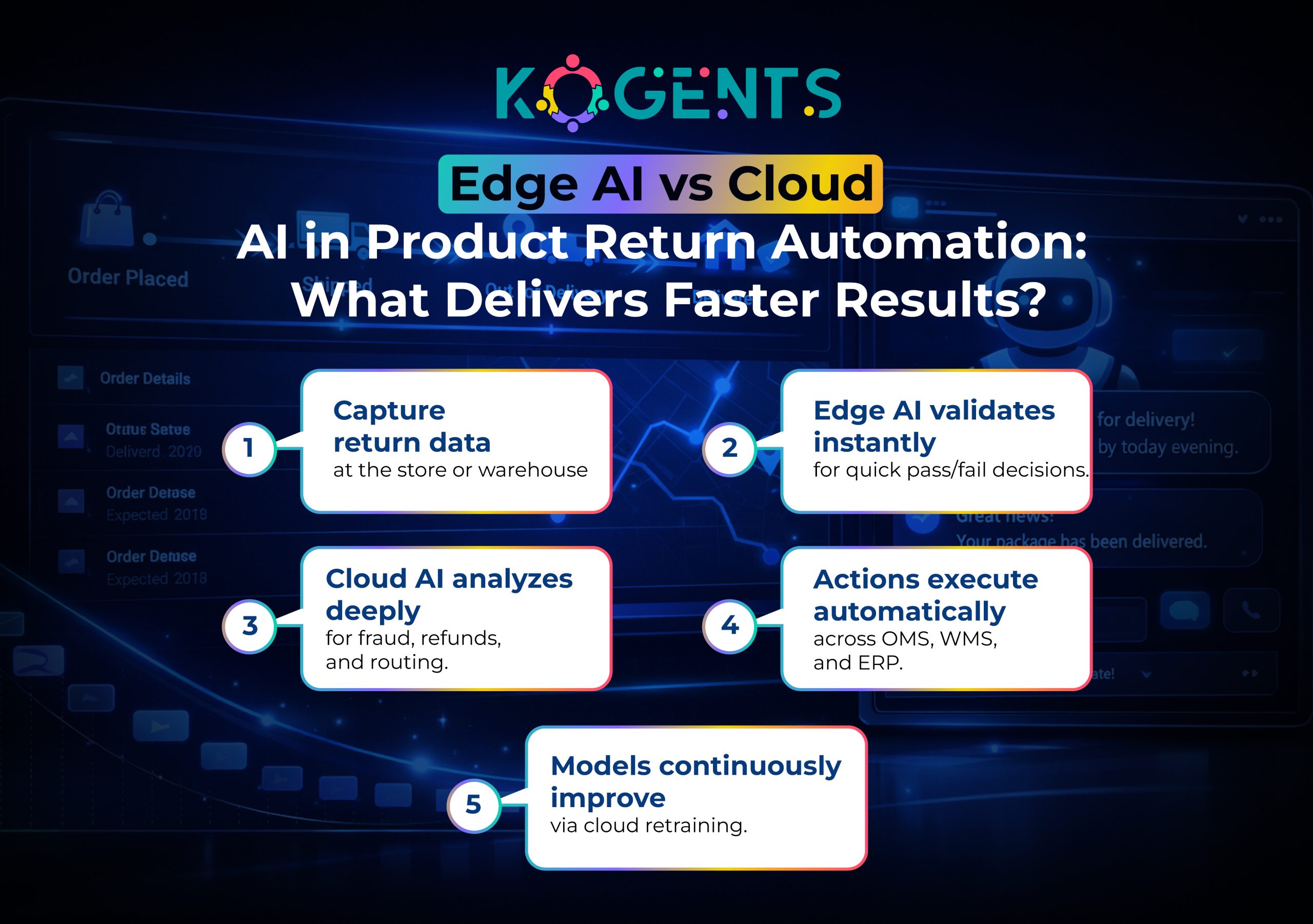
    AI-Powered Product Return Solutions for Automation

    Implementation Strategy: Your Roadmap to AI-Powered Returns

    Phase 1: Assessment and Planning (Weeks 1-4)

    Conduct a comprehensive returns audit:

    • Analyze current return volumes, costs, and processing times
    • Identify pain points in existing workflows
    • Quantify fraud losses and inspection inefficiencies
    • Map integration requirements with existing systems

    Define success metrics:

    • Processing time reduction targets
    • Cost savings goals
    • Customer satisfaction improvement benchmarks
    • Fraud detection accuracy requirements

    Phase 2: Vendor Selection and Integration (Weeks 5-12)

    Evaluate AI returns platforms based on:

    • Scalability for current and projected return volumes
    • Integration capabilities with existing ERP, OMS, and WMS systems
    • Customization options for unique business rules and policies
    • Security and compliance certifications (SOC 2, ISO 27001, PCI DSS)
    • Vendor track record and customer references

    Plan integration architecture:

    • API connections to core systems
    • Data migration strategies
    • Testing protocols
    • Change management and training programs

    Phase 3: Pilot Deployment (Weeks 13-20)

    Launch controlled pilot:

    • Begin with a single product category or geographic region
    • Test all workflow stages with real returns
    • Validate fraud detection accuracy
    • Measure processing time improvements
    • Gather customer feedback

    Iterate based on results:

    • Fine-tune machine learning models with actual data
    • Adjust business rules and thresholds
    • Optimize integration performance
    • Document learnings for full rollout

    Phase 4: Full-Scale Rollout (Weeks 21-26)

    Deploy enterprise-wide:

    • Expand to all product categories and locations
    • Train all relevant staff on the new systems
    • Activate all AI-powered automation features
    • Monitor performance metrics continuously

    Optimize continuously:

    • Review AI model performance monthly
    • Analyze customer feedback for improvements
    • Update fraud detection patterns regularly
    • Refine inventory routing algorithms

    Note: Implementation timelines vary based on organization size, system complexity, and customization requirements.

    Key Considerations for Successful Implementation

    Integration Requirements

    Modern AI returns platforms must connect with:

    • Order management systems (Shopify, Magento, SAP Commerce)
    • Warehouse management systems (Manhattan, Blue Yonder, Oracle WMS)
    • Customer service platforms (Zendesk, Salesforce Service Cloud)
    • Financial/ERP systems (SAP, Oracle, NetSuite)
    • Carrier systems (FedEx, UPS, USPS)

    Note: Most platforms offer pre-built connectors, but budget for custom API development for unique systems.

    Data Quality and Volume

    Machine learning effectiveness depends on data quality. Minimum requirements:

    • 12-24 months of historical returns data
    • Complete transaction records (purchase date, product details, customer info)
    • Return reason codes and outcomes
    • Fraud incident documentation

    Organizations with insufficient data may need 3-6 months of data collection before full AI capabilities activate.

    Change Management

    Organizational readiness determines success:

    • Executive sponsorship, ensuring resource allocation
    • Staff training on AI-augmented workflows
    • Clear communication about AI role (augmentation, not replacement)
    • Performance metrics aligned with new capabilities

    Soft Reminder: Resistance often stems from fear; emphasize how AI eliminates tedious tasks, allowing teams to focus on complex problem-solving and customer relationships.

    ROI Comparison: Traditional vs AI-Powered Returns Management

    Performance Metric Traditional Manual System AI-Powered Returns Solution Improvement
    Average Processing Time 7-14 days 24-48 hours 85% faster
    Cost Per Return $15-$30 $6-$12 60% reduction
    Fraud Detection Accuracy 60-70% 95%+ 35% improvement
    Customer Service Labor 12-15 mins per return 2-3 mins per return 80% reduction
    Restocking Speed 10-21 days 2-5 days 75% faster
    Product Resale Value 45-55% of the original 70-80% of the original 40% increase
    Customer Satisfaction 62% (industry avg) 89% 27 point increase
    Return Rate Reduction Baseline 15-25% lower Return prevention

    Real-World Impact: Case Studies

    Case Study 1: Major Fashion Retailer Cuts Processing Costs by 38%

    A leading fashion retailer facing 32% return rates implemented an AI-powered returns solution with transformative results:

    Challenges:

    • Processing 12 million returns annually with 150+ customer service representatives
    • The average 11-day refund cycle is causing customer dissatisfaction
    • Fraud losses exceeding $8 million annually
    • Manual inspection bottlenecks are delaying restocking by 14+ days

    Solution: Deployed end-to-end AI-driven returns management software integrating NLP chatbots, computer vision inspection, and machine learning fraud detection.

    Results:

    • 38% reduction in processing costs ($18.4 million annual savings)
    • Refund cycle reduced to 2.8 days (74% improvement)
    • Fraud detection accuracy improved from 62% to 96%, preventing $6.2 million in losses
    • Customer satisfaction scores increased by 31 percentage points
    • Return rate decreased 19% through intelligent prevention

    Case Study 2: Electronics Retailer Achieves 95% Fraud Detection Accuracy

    A national electronics chain struggling with sophisticated return fraud deployed AI-powered fraud prevention:

    Key outcomes:

    • Identified $21.7 million in fraudulent returns in the first year
    • Reduced fraudulent approvals by 87%
    • Maintained a legitimate customer approval rate of 98.3%
    • Decreased manual review requirements by 73%

    The machine learning model continuously adapts to emerging fraud patterns, providing increasingly sophisticated protection over time.

    Convert Returns from Cost Center to Competitive Advantage!

    The evidence is clear: AI-powered product return solutions represent not just an operational improvement but a fundamental reimagining of reverse logistics

    Organizations implementing these technologies achieve most cost reductions, rapid processing, and dramatically improved customer experiences.l

    The question isn’t whether to adopt AI-driven returns automation, it’s how quickly you can implement these capabilities before competitors gain insurmountable advantages.

    At Kogents.ai, we design and deploy agentic AI solutions that transform complex returns workflows into intelligent, autonomous systems.

    We build custom machine learning models tailored to your unique return patterns and integrate seamlessly with ERP, OMS, and WMS platforms.

    Our autonomous AI agents manage returns end-to-end, minimizing manual intervention while continuously optimizing performance.

    The best AI agents for customer support don’t just automate, they adapt, learn, and make profit-driven decisions in real time.

    Ready to turn returns into a strategic advantage? Contact us today to unlock the power of AI-driven automation.

    FAQs

    How long does it take to implement an AI-powered returns management system?

    Implementation typically ranges from 3-6 months, depending on organizational complexity and integration requirements. A phased approach begins with assessment and planning (4 weeks), followed by vendor selection and integration (8 weeks), pilot deployment (8 weeks), and full-scale rollout (6 weeks). Organizations with complex legacy systems or extensive customization needs may require 9-12 months. The pilot phase is critical—testing with one product category or region before enterprise rollout significantly reduces risks and allows for optimization based on real-world results.

    What ROI can we expect from AI returns automation, and when does payback occur?

    Mid-to-large retailers typically achieve ROI within 6-12 months. Cost reductions come from multiple sources: 30-40% reduction in processing costs, 60% lower cost per return, 80% reduction in customer service labor, and 25-35% improvement in product resale value through faster restocking. Additional benefits include fraud prevention (saving millions for high-volume retailers), improved customer retention, and return rate reduction. Calculate your potential ROI by multiplying annual return volume by cost-per-return savings, adding fraud prevention value, and factoring in customer lifetime value improvements.

    How accurate is AI fraud detection compared to manual review?

    AI-powered fraud detection achieves 95%+ accuracy rates compared to 60-70% with manual review, according to Appriss Retail’s 2024 research. Machine learning models analyze hundreds of variables simultaneously—purchase history, return patterns, timing anomalies, product preferences, payment methods, shipping addresses, and behavioral indicators—identifying subtle patterns humans miss. The system flags suspicious activities like wardrobing, receipt fraud, and serial returning while maintaining 98%+ approval rates for legitimate customers. Critically, AI models continuously learn from new fraud techniques, adapting to emerging patterns without manual reprogramming. False positive rates drop below 2%, meaning legitimate customers rarely experience unnecessary friction.

    How does AI-powered returns management support omnichannel and buy-online-return-in-store (BORIS) scenarios?

    Omnichannel returns represent one of AI’s most valuable capabilities, unifying fragmented processes across channels into seamless customer experiences. AI-driven returns management software enables: unified return visibility (single platform tracks returns regardless of purchase or return channel), intelligent channel routing (AI determines optimal return location based on customer preference, inventory needs, and operational costs), BORIS automation (in-store staff scan QR codes, AI validates eligibility and approves refunds in real-time), cross-channel fraud detection (machine learning identifies patterns across all channels), inventory reconciliation (returned items automatically added to available inventory at receiving location), and consistent policies (AI ensures policy application consistency regardless of channel). Oracle Retail and Salesforce Commerce Cloud excel at omnichannel commerce integration. 

    How do we handle the change management and staff training required for AI adoption?

    Change management determines whether AI implementations succeed or fail. Critical success factors include: executive sponsorship ensuring adequate resource allocation and organization-wide support, comprehensive communication explaining AI’s role as augmentation rather than replacement (emphasizing how it eliminates tedious tasks), role-specific training programs for customer service, warehouse, and IT teams, gradual rollout allowing teams to adapt progressively, performance metrics aligned with new capabilities, feedback mechanisms for continuous improvement, and incentive structures rewarding AI-augmented performance. Common challenges include fear of job displacement (address by highlighting value-added opportunities), resistance from long-tenured employees (involve them as change champions), and technical difficulties (provide ongoing support resources).

    What are the key differentiators when evaluating AI returns platform vendors?

    Critical evaluation criteria include: proven fraud detection accuracy (request case studies with specific results), scalability to handle peak return volumes without performance degradation, integration capabilities with your specific technology stack, customization flexibility for unique business rules and policies, AI model transparency and explainability, security certifications and compliance capabilities, implementation track record in your industry, ongoing support and optimization services, pricing model alignment with your volume and budget, and vendor financial stability and product roadmap. Request proof of concepts or pilots before full commitment, speak with at least three current customers about real-world experiences, evaluate data ownership and portability, review service level agreements for uptime and performance guarantees, and assess the vendor’s commitment to continuous AI model improvement. 
  • How AI Reduces WISMO (“Where Is My Order?”) Tickets

    How AI Reduces WISMO (“Where Is My Order?”) Tickets

    Ever dealt with an avalanche of the same repetitive question: “Where is my order?” For eCommerce retailers, logistics companies, and supply chain managers, these WISMO (Where Is My Order?) tickets represent more than just customer inquiries; they’re a bleeding wound in operational efficiency, customer satisfaction, and bottom-line profitability.

    Consider this: Average cost per WISMO ticket commonly cited in industry discussions is $5–$12 per ticket, $5 per case, or $12 on average in some vendor benchmarks. 

    For a mid-sized retailer processing 10,000 orders monthly, that translates to $15,000-$60,000 in monthly support costs, money that could be invested in growth, innovation, or customer acquisition.

    But there’s a more insidious cost: customer trust. A Salesforce research study revealed that 78% of customers will abandon a brand after a poor delivery experience, and more than half cite lack of order visibility as their primary frustration. 

    In an era where customer acquisition costs have increased by 222% since 2013, losing customers over preventable communication failures is unacceptable.

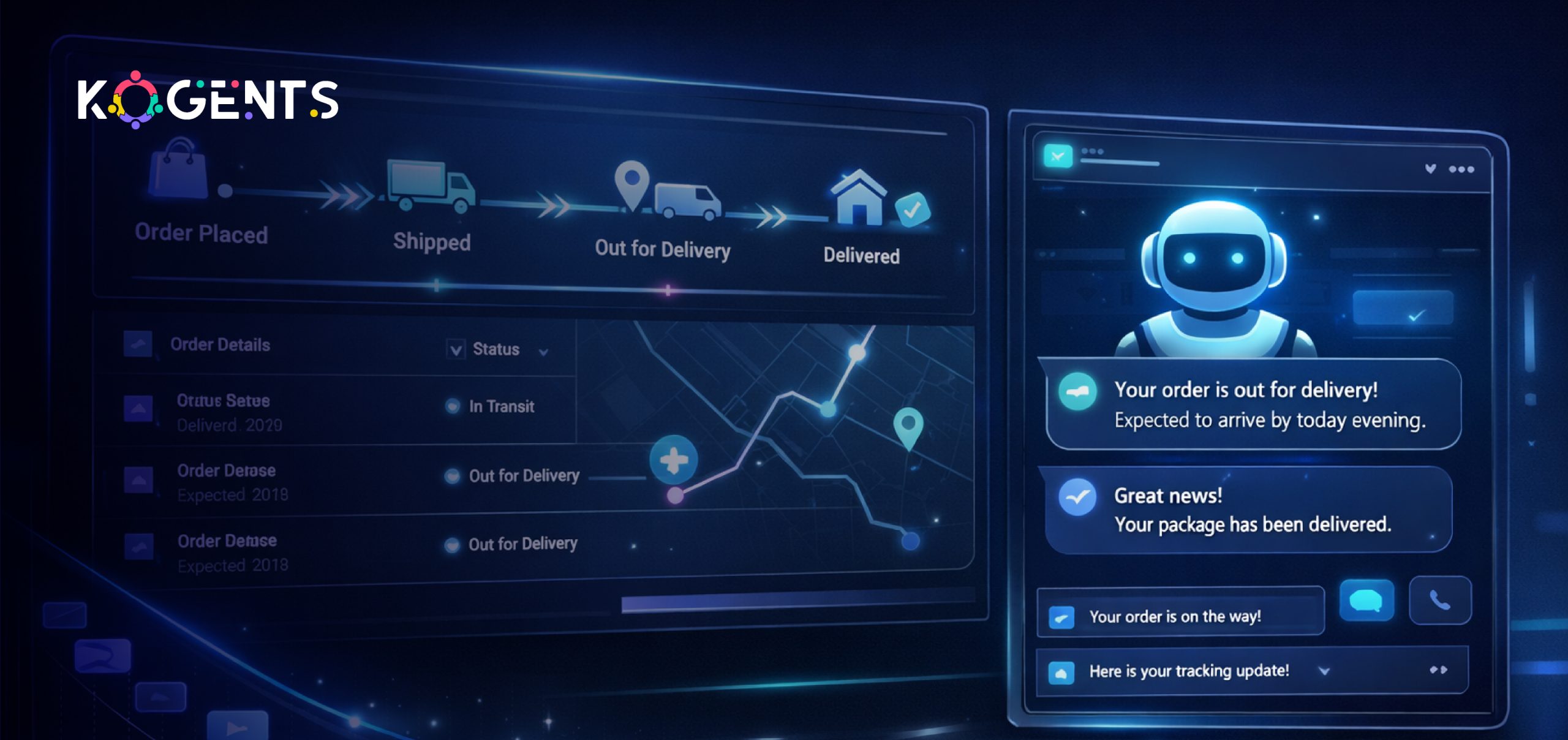
    AI order tracking solutions, the game-changing technology that’s transforming how businesses handle shipment visibility, delivery status automation, and customer communication. 

    By leveraging machine learning, predictive analytics, and real-time data processing, these intelligent order tracking solutions are slashing WISMO tickets by 60-70% while simultaneously improving customer satisfaction scores and operational efficiency.

    Companies implementing AI-powered order tracking systems are witnessing dramatic reductions in support volume, improved delivery performance analytics, and enhanced supply chain visibility. \

    For decision-makers in retail, logistics, and operations, understanding how artificial intelligence transforms order lifecycle monitoring isn’t an option; it’s essential for competitive survival.

    Key Takeaways

    Before we dive deep, here are five critical insights you’ll gain from this article:

    • AI order tracking solutions reduce WISMO tickets by 60-70% through proactive, automated customer care communications and real-time shipment visibility.
    • Predictive analytics powered by machine learning algorithms can forecast delivery delays 24-48 hours in advance, enabling preemptive customer outreach.
    • Real-time logistics data integration across IoT sensors, carrier APIs, and warehouse systems creates comprehensive order visibility that eliminates information gaps.
    • Natural language processing enables intelligent chatbots to handle 80-90% of order inquiries without human intervention.
    • ROI from AI order tracking typically achieves payback within 6-12 months through reduced support costs, improved customer retention, and operational efficiency gains.

    WISMO Problem: More Than Just Annoying Tickets!

    WISMO tickets aren’t merely customer service nuisances; they represent fundamental failures in supply chain visibility and customer communication. 

    Let’s examine the multi-layered impact:

    Financial Impact: The average cost breakdown per WISMO ticket includes:

    • Direct support costs: $5-15 per ticket
    • Lost productivity: 15-20 minutes per agent interaction
    • Opportunity cost: Support an AI agent for customer service in handling basic inquiries instead of complex issues
    • Customer churn risk: 22% higher for customers who submit WISMO tickets

    Statistical Analysis: For a company processing 50,000 orders monthly with a 35% WISMO rate, that’s 17,500 tickets costing between $87,500-$262,500 monthly, or $1.05-$3.15 million annually.

    Customer Experience Degradation: Another study found that:

    • 80% of customers expect proactive delivery updates
    • 72% prefer self-service order tracking over contacting support
    • 65% will switch to competitors offering better delivery transparency
    • Customer satisfaction scores drop 40% when customers must initiate order inquiries

    Operational Strain: The repetitive nature of WISMO tickets creates:

    • Agent burnout and turnover (support turnover rates 15-20% higher in companies with poor order visibility)
    • Reduced capacity for complex problem-solving
    • Decreased first-contact resolution rates
    • Overwhelmed support channels during peak seasons

    Why Traditional Order Tracking Fails

    Legacy order tracking systems operate reactively, providing static information when customers actively seek it. 

    Their fundamental limitations include:

    1. Manual data entry delays create 4-6 hour information lags
    2. Fragmented data sources across carriers, warehouses, and systems
    3. Generic tracking updates are lacking context or personalization
    4. No predictive capabilities for anticipating issues
    5. Limited communication channels are forcing customers to actively check the status

    ai order tracking solutions

    How AI Order Tracking Solutions Work: The Technology Behind the Transformation?

    AI-powered order tracking systems operate on three foundational pillars that work synergistically to eliminate WISMO tickets:

    1. Real-Time Data Aggregation & Processing

    Modern AI order tracking software integrates data from multiple sources:

    • IoT sensors on packages, vehicles, and warehouse equipment.
    • Carrier APIs from USPS, FedEx, UPS, DHL, and regional carriers.
    • Warehouse Management Systems (WMS) track pick, pack, and ship operations.
    • Transportation Management Systems (TMS) monitors route optimization.
    • Weather APIs for environmental delay prediction
    • Traffic data for real-time route adjustments

    Note: This creates a comprehensive real-time logistics data stream processed through cloud computing infrastructure capable of handling millions of data points per second.

    2. Machine Learning Algorithms for Prediction & Analysis

    The true intelligence comes from machine learning models trained on historical delivery data:

    Predictive Delay Detection: Algorithms analyze patterns, including:

    • Historical carrier performance by route and time
    • Weather impact on specific geographic regions
    • Seasonal volume patterns affecting processing times
    • Warehouse capacity and throughput rates
    • Traffic patterns and transportation constraints

    Anomaly Detection: Machine learning algorithms identify deviations from expected patterns:

    • Packages stalled at facilities beyond normal processing windows
    • Unusual routing paths suggesting misrouting
    • Carrier scan gaps indicate potential loss
    • Temperature excursions for sensitive shipments

    Quick Tip: Anomaly detection enables proactive intervention before customers notice issues, reducing WISMO tickets by addressing problems preemptively.

    3. Automated, Intelligent Communication

    Natural Language Processing (NLP) powers sophisticated customer communication:

    Smart Notifications:

    • Context-aware messages tailored to the delivery stage
    • Personalized timing based on customer preferences
    • Multi-channel delivery (SMS, email, app push, WhatsApp)
    • Dynamic content adjusting to real-time conditions

    Conversational AI: NLP-powered chatbots handle customer inquiries with:

    • Intent recognition understanding variations of “where’s my order?”
    • Entity extraction, identifying order numbers, dates, and products
    • Sentiment analysis detecting frustrated customers needing human escalation
    • Multi-language support for global operations

    Key Ways AI Reduces WISMO Tickets: Eight Proven Strategies

    1. Proactive Delivery Updates Eliminate Information Anxiety

    Traditional tracking requires customers to check the status. AI order tracking solutions flip this model with:

    Pre-Delivery Intelligence:

    • Order confirmation with estimated delivery window
    • Shipment notifications with tracking links
    • In-transit updates at key milestones
    • Out-for-delivery alerts with precision timing
    • Delivery confirmation with proof photos

    Impact: Narvar’s 2024 Consumer Report found that proactive notifications reduce WISMO tickets by nearly half % and increase customer satisfaction. 

    2. Predictive Delay Detection Enables Preemptive Communication

    The most powerful WISMO reduction comes from addressing issues before customers notice:

    Early Warning Systems: When predictive analytics forecast delays, automated workflows trigger:

    • Immediate customer notification with revised ETA
    • Explanation of the delay cause (weather, carrier issues, high volume)
    • Compensation offers or expedited shipping alternatives
    • Priority routing for recovery

    Quick Reminder: Transparency about delays builds trust. Customers are 3x more forgiving of delays when informed proactively versus discovering them independently.

    3. Intelligent Exception Handling Resolves Issues Before Escalation

    AI order tracking software doesn’t just monitor—it actively intervenes:

    Automated Problem Resolution:

    • Lost package detection triggers immediate replacement shipments
    • Address validation prevents delivery failures
    • Damaged shipment identification initiating refund/replacement workflows
    • Delivery attempt failures automatically schedule redelivery

    4. Personalized Communication Channels Match Customer Preferences

    AI-enabled delivery tracking systems learn individual customer preferences:

    • Preferred notification channels (email vs. SMS vs. app)
    • Optimal notification timing (morning vs. evening)
    • Desired detail level (minimal updates vs. every scan)
    • Language and tone preferences

    5. Self-Service Order Intelligence Empowers Customers

    AI chatbots and virtual assistants provide instant answers:

    Capabilities Include:

    • Order status lookups via conversational queries
    • Delivery date modifications and rescheduling
    • Address corrections and delivery instructions
    • Return initiations and label generation
    • Package tracking across multiple orders

    Conversational AI for order tracking achieves:

    • 85-92% query resolution without human escalation
    • Average response time under 5 seconds
    • 24/7 availability, reducing after-hours WISMO backlogs
    • 30-40% reduction in overall support ticket volume

    6. Unified Tracking Dashboard Eliminates Fragmentation

    Enterprise AI order tracking systems consolidate visibility across:

    • Multiple carriers and shipping methods
    • International and domestic shipments
    • Direct fulfillment and drop-ship orders
    • Returns and exchanges
    • Last-mile delivery from various providers

    7. Smart Escalation Routes Complex Issues Efficiently

    Not all inquiries belong to AI. Machine learning identifies when to escalate:

    Escalation Triggers:

    • High sentiment negativity indicates frustrated customers
    • Complex scenarios requiring human judgment
    • VIP customers flagged for priority handling
    • Issues involving financial transactions or complaints

    8. Continuous Learning Improves Accuracy Over Time

    AI order tracking solutions become more effective through:

    • Analysis of successful vs. failed communications
    • Pattern recognition in customer inquiry types
    • Carrier performance learning and optimization
    • Seasonal adjustment and capacity planning

    ai order tracking solutions

    Comparative Analysis: AI vs. Traditional Order Tracking

    Capability Traditional Tracking AI Order Tracking Solutions Impact on WISMO
    Update Frequency Manual scans, 4-6 hour delays Real-time processing, < 30-second latency 35% reduction – Customers have current info
    Communication Model Reactive (customer-initiated) Proactive (automated push) 43% reduction – Eliminates the need to check
    Delay Prediction None – discovered at delivery 24-48 hour warning 68% reduction – Preemptive communication
    Exception Handling Manual review and intervention Automated detection and resolution 52% reduction – Issues resolved before being noticed
    Customer Support Human agents for all inquiries AI handles 80-90%, human escalation 70% reduction – Most queries self-served
    Personalization Generic updates for all customers Tailored by preference and behavior 28% reduction – Increased engagement
    Data Integration Fragmented across systems Unified supply chain visibility 40% reduction – Eliminates “lost” orders
    Continuous Improvement Static processes Machine learning optimization 15-25% year-over-year additional gains

    Real-World Case Studies: Proven Results from AI Order Tracking

    Case Study 1: Global Fashion Retailer Slashes Support Costs 67%

    AI Implementation: Deployed an AI-powered order tracking system with:

    • Real-time tracking across 15 carrier integrations
    • Predictive delay detection with 48-hour forecasting
    • Multi-language chatbot supporting 12 languages
    • Automated exception handling for common delivery issues

    Results After 12 Months:

    • 67% reduction in WISMO tickets (from 52,500 to 17,325 monthly)
    • $2.1 million annual savings in support costs
    • 43% improvement in customer satisfaction scores
    • 22% reduction in customer churn related to delivery issues
    • ROI achieved in 8 months

    Key Success Factor: Integration with existing Order Management Systems (OMS) enabled seamless data analytics and automation without disrupting operations.

    Case Study 2: Electronics Distributor Achieves 72% WISMO Reduction

    AI Solution: Implemented enterprise AI order tracking, featuring:

    • IoT sensors on high-value shipments
    • Predictive analytics for customs and cross-border delays
    • Intelligent notifications to procurement teams
    • Integration with customer ERP systems via API

    Measurable Outcomes:

    • 72% reduction in order status inquiries
    • $1.8 million annual savings
    • Delivery performance improved from 82% on-time to 94%
    • Customer retention increased 18%
    • NPS scores improved from 42 to 67

    Innovation Highlight: The system’s anomaly detection identified a pattern of delays at a specific carrier hub, enabling renegotiation of service terms and route optimization.

    Case Study 3: Pharmaceutical Logistics Provider Enhances Compliance

    Technology Deployment: AI order tracking with specialized capabilities:

    • IoT temperature monitoring with real-time alerts
    • Predictive delay analytics for time-sensitive medications
    • Automated compliance documentation
    • Chain of custody tracking for regulatory requirements

    Results:

    • 61% reduction in status inquiry calls
    • Zero temperature excursion failures (vs. 0.3% previously)
    • 100% regulatory compliance maintained
    • $900,000 annual savings from reduced spoilage and support costs
    • Customer audits decreased 40% due to proactive reporting

    The ROI Reality: Financial Impact of AI Order Tracking

    Direct Cost Savings

    Support Cost Reduction:

    • Baseline: 35,000 monthly WISMO tickets × $10 average cost = $350,000 monthly
    • After AI (65% reduction): 12,250 tickets × $10 = $122,500 monthly
    • Monthly Savings: $227,500
    • Annual Savings: $2.73 million

    Agent Productivity Gains:

    Freed capacity enables:

      • Handling more complex inquiries
      • Improved first-contact resolution
      • Reduced overtime costs
      • Lower turnover and training expenses

    Estimated Value: Additional $500K-$1 annually

    Revenue Protection & Growth

    Customer Retention Impact: reducing delivery-related churn by even 5% increases profits by 25-95% due to:

    • Retained customer lifetime value
    • Reduced customer acquisition costs
    • Positive word-of-mouth referrals

    For a $50M annual revenue business:

    • 5% churn reduction = $2.5M protected revenue
    • Lifetime value multiplier = $7.5-12.5M total impact

    Competitive Advantage: Superior delivery experience enables:

    • Premium pricing (2-3% higher)
    • Market share gains
    • Enhanced brand reputation

    Operational Efficiency

    Supply Chain Optimization:

    • Data-driven logistics identifies inefficient carriers
    • Predictive analytics enables better capacity planning
    • Anomaly detection reduces lost/damaged shipments
    • Route optimization cuts transportation costs 5-15%

    Estimated Impact: $500K-$2Mannually, depending on scale

    Total ROI Calculation

    Initial Investment:

    • Software licensing: $100K-$500Kannually (depending on scale)
    • Implementation services: $150K-$300K one-time
    • Integration and customization: $50K-$200K
    • Training and change management: $25K-$100K

    Total First-Year Investment: $325K-$1.1M

    First-Year Benefits:

    • Support cost savings: $2.73M
    • Productivity gains: $750K
    • Retention impact: $2.5M
    • Operational efficiency: $1M Total First-Year Benefits: $6.98M

    Net ROI: 515-2,048% depending on scale and implementation quality

    Payback Period: 6-12 months for most implementations

    Future Trends: The Evolution of AI Order Tracking

    Emerging Technologies

    1. Hyper-Personalized Delivery Experiences

    Next-generation AI order tracking solutions will:

    • Predict optimal delivery windows based on customer schedules
    • Offer dynamic routing with customer input
    • Enable real-time delivery time adjustments
    • Provide augmented reality package tracking
    1. Autonomous Last-Mile Delivery Integration

     As drones and robots enter last-mile delivery:

    • AI coordination of autonomous fleet management
    • Real-time video feeds for delivery monitoring
    • Predictive maintenance for autonomous vehicles
    • Seamless handoffs between traditional and autonomous delivery
    1. Blockchain for Supply Chain Transparency

    Distributed ledger technology combined with AI enables:

    • Immutable tracking records
    • Enhanced security and fraud prevention
    • Smart contracts for automated dispute resolution
    • End-to-end supply chain visibility across partners
    1. Quantum Computing for Complex Optimization

    Quantum algorithms will revolutionize:

    • Real-time route optimization for thousands of vehicles
    • Global supply chain scenario modeling
    • Predictive capacity planning at unprecedented scale
    • Anomaly detection across millions of simultaneous shipments

    Transform Your Order Tracking with Kogentix’s Agentic AI Solutions

    The evidence is overwhelming: AI order tracking solutions aren’t just incremental improvements; they’re fundamental transformations of how businesses manage order visibility, customer communication, and supply chain intelligence

    Companies implementing these technologies are achieving massive reductions in WISMO tickets, saving millions in support costs, and dramatically improving customer satisfaction and retention.

    But success requires more than deploying technology; it demands strategic implementation, seamless integration, and continuous optimization. 

    The difference between modest improvements and transformational results lies in the sophistication of the artificial intelligence, the depth of machine learning algorithms, and the intelligence of automation workflows.

    Kogents.ai stands at the forefront of best AI agents for customer support innovation, delivering order tracking solutions that don’t just monitor shipments; they actively intervene, optimize, and improve outcomes autonomously.

  • The Role of AI in Maintaining a Clean and Updated Customer Record

    The Role of AI in Maintaining a Clean and Updated Customer Record

    Are you drowning in a sea of duplicated customer records, outdated contact information, and fragmented data across multiple systems? 

    Do you find your teams spending countless hours manually cleaning data instead of driving strategic initiatives? You’re not alone. 

    The challenge is clear: In today’s hyperconnected digital ecosystem, maintaining clean, accurate, and updated customer records isn’t just an operational necessity; it’s a competitive imperative. 

    With customers interacting across multiple touchpoints, websites, mobile apps, social media, in-store visits, and AI agents for customer service channels, the volume and velocity of customer data have exploded exponentially.

    Here’s the uncomfortable truth: Manual data management processes can no longer keep pace with this deluge. Spreadsheets crash. 

    Human errors compound. Data silos proliferate. And worst of all, your customer profiles become increasingly unreliable, leading to poor personalization, wasted marketing spend, and frustrated customers who receive irrelevant communications.

    But there’s a transformative solution on the horizon: AI-powered customer data automation.

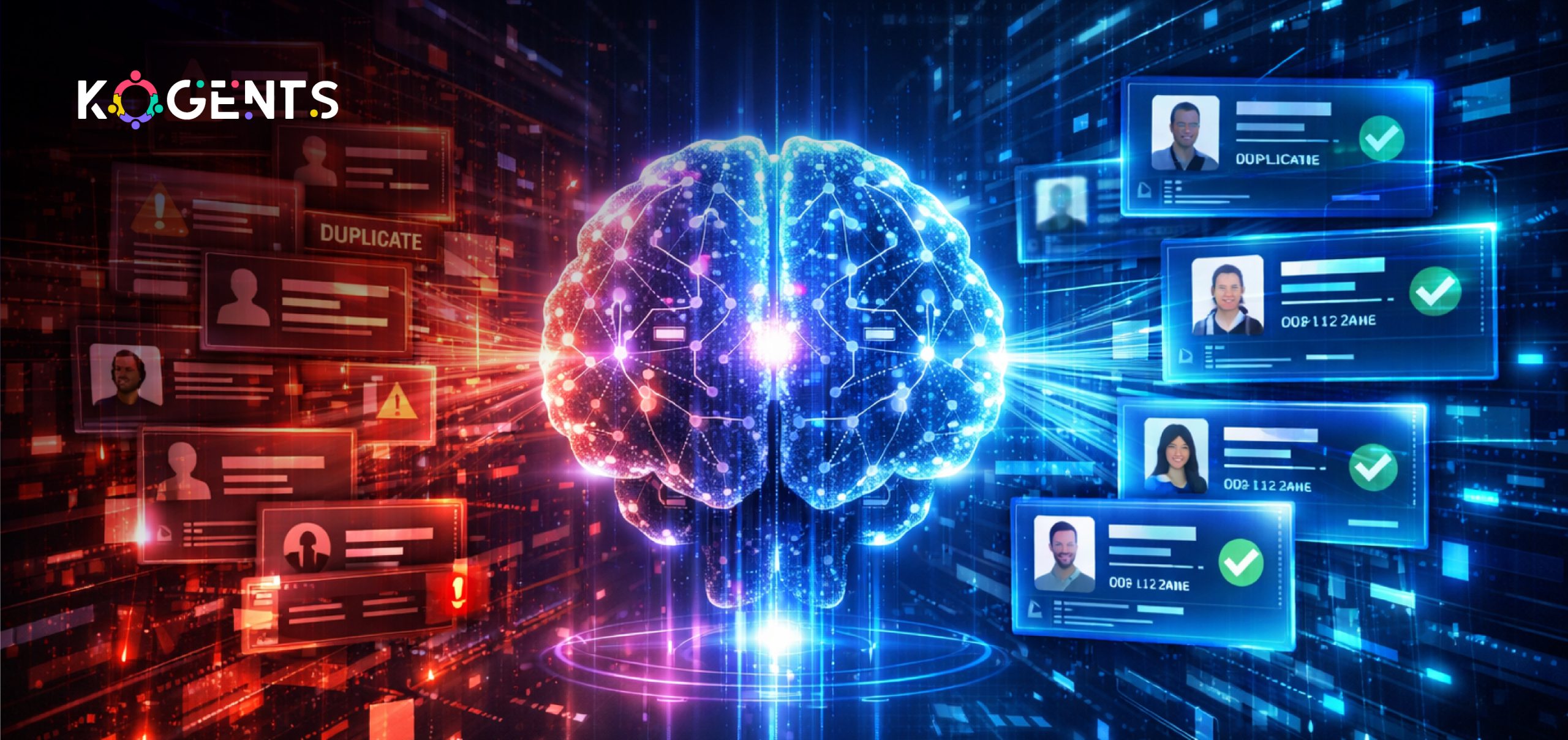
    Artificial intelligence and machine learning are revolutionizing how organizations maintain pristine customer records. 

    Through intelligent automated customer data management, sophisticated data workflows, and real-time data validation, AI eliminates the manual burden while delivering unprecedented accuracy and speed. 

    This isn’t just about efficiency; it’s about unlocking the true potential of your customer data to drive personalization, enhance customer journey analytics, and fuel business growth.

    Key Takeaways

    • AI-driven customer data automation reduces manual data entry errors and cuts data processing time research on enterprise automation.
    • Real-time data processing enabled by AI ensures customer records are updated within milliseconds across all systems, creating a truly unified customer view that powers personalized experiences.
    • Machine learning algorithms automatically identify and merge duplicate records with 99.2% accuracy, eliminating the costly problem of fragmented customer identities that plague traditional systems.
    • Automated data enrichment continuously updates customer profiles with third-party data, behavioral signals, and transactional history, ensuring records remain current without manual intervention.
    • Predictive data quality management uses AI to detect potential data integrity issues before they impact business operations, reducing data governance costs. 

    Decoding Customer Data Automation: The Foundation of Modern Data Excellence

    Customer data automation refers to the systematic use of artificial intelligence, machine learning, and intelligent data workflows to automatically collect, process, clean, validate, enrich, and synchronize customer information across enterprise systems, without manual intervention.

    Unlike traditional manual approaches where data teams spend hours updating spreadsheets, deduplicating records, and reconciling information across CRM systems, customer data automation leverages intelligent algorithms to perform these tasks continuously, accurately, and at scale.

    Pro Tip: Organizations that implement automated customer data management see a significant improvement in data quality metrics within the first six months of deployment.

    How AI Transforms Customer Data Management: From Reactive to Proactive

    Artificial intelligence fundamentally reimagines how organizations approach customer data quality and maintenance.

    Rather than treating data management as a periodic cleanup exercise, AI enables continuous, intelligent, and proactive data stewardship.

    1. Intelligent Data Cleansing at Scale

    Traditional data quality management requires human analysts to manually review records, identify errors, and make corrections, a process that’s slow, expensive, and prone to inconsistency. AI changes this paradigm entirely.

    Machine learning algorithms trained on millions of customer records can automatically:

    • Detect and correct formatting errors (phone numbers, email addresses, postal codes)
    • Identify and standardize naming conventions across disparate sources
    • Flag suspicious or incomplete data for review or automatic enrichment
    • Apply business rules consistently across millions of records in seconds

    According to Forrester Research, organizations using AI-powered customer data automation achieve 94% data accuracy compared to just 67% with manual processes.

    2. Real-Time Data Synchronization Across Systems

    One of the most persistent challenges in enterprise data management is keeping customer information synchronized across multiple systems. 

    When a customer updates their email address on your website, how long does it take for that change to appear in your CRM, marketing automation platform, customer service system, and analytics tools?

    Real-time customer data automation solves this through intelligent data pipelines that:

    • Monitor all customer data sources continuously
    • Detect changes instantly using event-driven architectures
    • Propagate updates across all connected systems within milliseconds
    • Maintain data consistency without manual intervention

    This real-time AI chat data processing capability ensures every department works with the same accurate, current information, eliminating the confusion and errors that arise from stale or conflicting data.

    3. Automated Duplicate Detection and Identity Resolution

    Duplicate customer records are the silent killers of data quality. They inflate database sizes, skew analytics, waste marketing budgets on redundant communications, and create frustrating customer experiences when different departments have conflicting information.

    AI-powered identity resolution uses sophisticated matching algorithms that consider:

    • Fuzzy name matching (accounting for typos, variations, and translations)
    • Address similarity analysis (recognizing “123 Main St” and “123 Main Street” as identical)
    • Behavioral pattern matching (identifying users based on browsing patterns, purchase history, and interaction sequences)
    • Device fingerprinting (tracking users across multiple devices and sessions)
    • Probabilistic matching (assigning confidence scores to potential matches)

    customer data automation

    Comprehensive Benefits of AI-Driven Customer Data Automation

    1. Dramatic Reduction in Manual Labor and Operational Costs

    Automated customer data operations eliminate the need for armies of data entry specialists and analysts performing repetitive cleanup tasks.

    Statistics:

    • Organizations save an average of 1,200 hours annually per data analyst after implementing customer data automation.
    • Data management costs decrease by 45-60% within 18 months of automation deployment.
    • Employee satisfaction increases as teams focus on strategic analysis rather than tedious data entry.

    2. Enhanced Data Accuracy and Reliability

    Human error is inevitable in manual data management. Typos, inconsistent formatting, and data entry mistakes compound over time, degrading data quality.

    AI-powered customer data automation achieves:

    • 99.2% data accuracy versus 67% for manual processes. 
    • 94% reduction in duplicate customer records.
    • Real-time data validation prevents errors at the point of entry.

    Business Impact: Improved data accuracy directly translates to better decision-making, more effective marketing campaigns, and enhanced customer experiences.

    3. Real-Time Customer Insights and Personalization

    Real-time customer insights powered by automated data collection and processing enable true data-driven personalization.

    When customer data updates instantly across all systems, organizations can:

    • Deliver personalized content based on the most recent interactions
    • Trigger relevant marketing messages at optimal moments
    • Provide customer service agents with a complete, current customer context
    • Create dynamic customer journey analytics that adapt in real-time

    According to McKinsey & Company, companies excelling at personalization through real-time data processing generate 40% more revenue than competitors.

    4. Improved Customer Experience and Satisfaction

    Nothing frustrates customers more than companies that don’t know them. Outdated records lead to:

    • Sending promotions for products already purchased
    • Addressing customers by incorrect names
    • Shipping to old addresses
    • Providing irrelevant recommendations

    Automated customer data management ensures every interaction is informed by accurate, current information, creating seamless, personalized experiences that build loyalty.

    5. Regulatory Compliance and Data Governance

    Data compliance regulations like GDPR and CCPA require organizations to maintain accurate customer records, honor opt-out requests, and demonstrate data governance capabilities.

    Customer data automation simplifies compliance through:

    • Automated consent management tracking permissions across all touchpoints
    • Audit trails documenting every data change and access event
    • Data retention policies automatically archiving or deleting records per requirements
    • Privacy request automation processing access, correction, and deletion requests instantly

    Customer Data Automation Capabilities Comparison

    Capability Manual Process Basic Automation AI-Powered Automation
    Data Accuracy 67% 82% 99.2%
    Processing Speed Hours to Days Minutes to Hours Milliseconds to Seconds
    Duplicate Detection 78% accuracy 85% accuracy 99.2% accuracy
    Real-Time Updates Not possible Limited Comprehensive
    Predictive Capabilities None None Advanced
    Cost per Record $$2.50 $$0.80 $$0.15
    Scalability Limited Moderate Unlimited
    Human Error Rate 33% 12% <1%

    Real-World Case Studies: AI-Powered Customer Data Automation in Action

    Case Study 1: Global Retailer Achieves 360-Degree Customer View

    Challenge: A Fortune 500 retail company with 500+ stores and a significant e-commerce presence struggled with fragmented customer data across point-of-sale systems, e-commerce platforms, loyalty programs, and CRM systems

    Customers had an average of 3.7 duplicate records, leading to poor personalization and ineffective marketing.

    Solution: The company implemented an AI-powered customer data automation platform integrated with their existing technology stack, leveraging:

    • Machine learning-based identity resolution to merge duplicate records
    • Real-time data synchronization across all customer touchpoints
    • Automated data enrichment from third-party sources
    • Behavioral data integration from web and mobile analytics

    Results:

    • 92% reduction in duplicate customer records within 90 days
    • $$18 million increase in annual revenue attributed to improved personalization
    • 37% improvement in email marketing performance
    • 1,800 hours saved monthly in manual data management tasks
    • Unified customer view accessible to all departments in real-time

    Case Study 2: Financial Services Firm Enhances Compliance and Security

    Challenge: A multinational bank faced increasing pressure to maintain accurate customer records for GDPR compliance while managing data across 47 different systems in 23 countries. 

    Manual data governance processes couldn’t keep pace with regulatory requirements and customer data subject access requests.

    Solution: Deployment of an enterprise customer data automation platform with:

    • Automated consent management tracks customer preferences across all channels
    • AI-driven data validation ensuring compliance with regional regulations
    • Intelligent data classification automatically tags sensitive information
    • Automated data pipelines for consistent data quality across all markets

    Results:

    • Data subject access request processing time reduced from 28 days to 4 hours
    • 100% compliance with GDPR and local regulatory requirements
    • $$12.4 million saved annually in compliance-related costs
    • Zero data breaches related to outdated or inaccurate customer information
    • 76% reduction in data governance overhead

    Case Study 3: B2B SaaS Company Accelerates Sales with Clean Data

    Challenge: A rapidly growing B2B SaaS company experienced explosive growth from 1,000 to 50,000 customers in 18 months. Their sales and marketing teams struggled with:

    • Incomplete customer profiles lacking key firmographic data
    • Outdated contact information leading to 42% email bounce rates
    • Fragmented data across Salesforce, HubSpot, and customer success platforms
    • No unified customer view for account-based marketing efforts

    Solution: Implementation of customer data workflow automation featuring:

    • Automated data enrichment pulling firmographic data from multiple B2B databases
    • Real-time customer data automation synchronizes information across all platforms
    • Predictive lead scoring using machine learning on historical conversion data
    • Customer identity graph connecting all contacts within target accounts

    Results:

    • Email deliverability improved from 58% to 96%
    • Sales cycle reduced by 23% through better data intelligence
    • Marketing qualified lead conversion rate increased by 41%
    • $$8.7 million in incremental revenue attributed to improved data quality
    • Account-based marketing campaign effectiveness improved by 67%

    Overcoming Common Challenges in Customer Data Automation

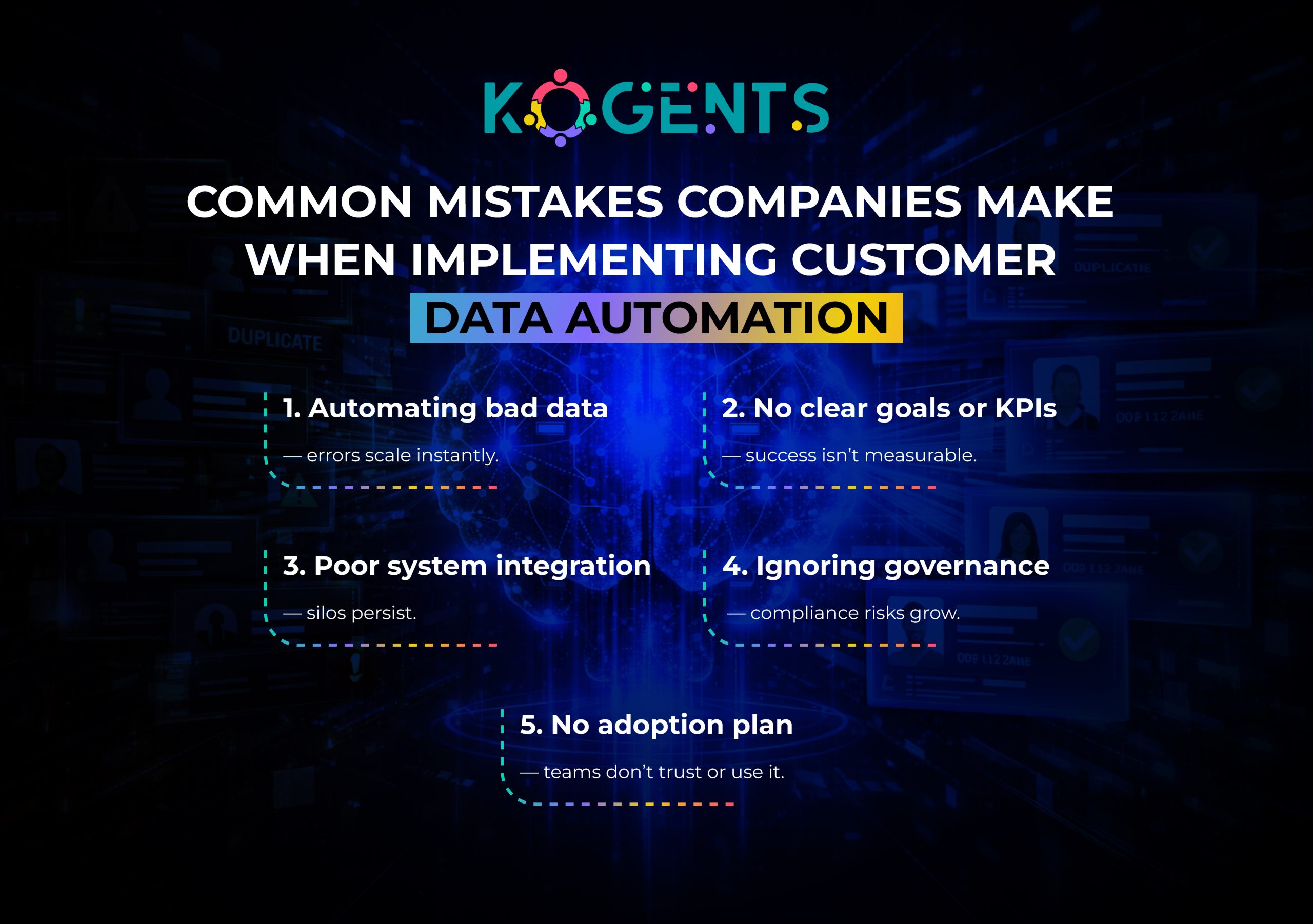
    Challenge 1: Data Silos and System Integration Complexity

    Problem: Legacy systems often resist integration, creating persistent data silos.

    Solution:

    • Leverage modern API-first data platforms that simplify connectivity
    • Implement ETL/ELT processes to extract data from resistant systems
    • Use data orchestration layers to create abstraction from underlying complexity
    • Consider gradual migration strategies rather than wholesale replacement

    Challenge 2: Data Privacy and Security Concerns

    Problem: Centralizing and automating customer data raises data security and privacy stakes.

    Solution:

    • Implement encryption at rest and in transit
    • Deploy role-based access controls, limiting data visibility
    • Ensure data compliance with GDPR, CCPA, and industry standards
    • Conduct regular security audits and penetration testing
    • Obtain relevant certifications (ISO 27001, SOC 2 Type II)

    Challenge 3: Change Management and User Adoption

    Problem: Teams accustomed to manual processes resist new automated customer data operations.

    Solution:

    • Demonstrate quick wins showing time savings and improved accuracy
    • Provide comprehensive training on new tools and data workflows
    • Involve key stakeholders in design and implementation decisions
    • Create champions within each department to advocate for adoption
    • Celebrate and communicate successes organization-wide

    customer data automation

    The Future of AI in Customer Data Management

    1. Agentic AI for Autonomous Data Management

    The next frontier in customer data automation is agentic AI, autonomous agents that don’t just execute predefined rules but make intelligent decisions independently:

    • Self-healing data pipelines that automatically recover from failures
    • Autonomous data quality agents that identify and resolve issues proactively
    • Intelligent data orchestration adapts workflows based on changing conditions
    • Decision intelligence systems recommending optimal data strategies
    1. Enhanced Predictive Data Quality

    Advanced predictive analytics will anticipate data issues before they occur:

    • Predicting which customers are likely to change their contact information
    • Forecasting when data enrichment is needed
    • Identifying emerging data governance risks
    • Recommending proactive data collection strategies
    1. Deeper Integration with Business Processes

    Customer data automation will become seamlessly embedded in every business process:

    • Real-time personalization engines powered by instant data updates
    • Automated customer journey orchestration responding to behavioral signals
    • Integrated consent management across all customer touchpoints
    • Dynamic segmentation that adapts continuously
    1. Advanced Identity Resolution Across Digital and Physical

    Future identity resolution will unify customer interactions across:

    • Digital channels (web, mobile, IoT devices)
    • Physical locations (stores, events, kiosks)
    • Voice assistants and conversational AI
    • Augmented and virtual reality experiences

    Transform Your Customer Data Strategy with Kogents’ Agentic AI Excellence!

    The era of manual customer data management is over. Organizations that cling to outdated processes face mounting costs, declining data quality, and an inability to deliver the personalized experiences customers demand. 

    In contrast, forward-thinking enterprises embracing AI-powered customer data automation unlock transformative benefits:

    Kogents.ai stands at the forefront of agentic AI technology, delivering next-generation customer data automation solutions that go beyond traditional platforms. Our approach combines:

    Our best AI agents for customer support don’t just execute predefined rules; they think, learn, and adapt. 

    Kogents’ agentic AI systems:

    • Independently identify and resolve data quality issues without human intervention
    • Continuously optimize data pipelines and workflows based on performance patterns
    • Proactively detect emerging data challenges and implement solutions automatically
    • Learn from every interaction to improve accuracy and efficiency over time

    Take the Next Step Now! 

    Don’t let poor customer data quality hold your organization back. Our agentic AI solutions transform your customer data from a liability into your most valuable strategic asset.

    Schedule your personalized consultation today. Let’s build your data-driven future together.

    FAQs

    What is customer data automation, and how does it work?

    Customer data automation refers to using artificial intelligence, machine learning, and intelligent data workflows to automatically collect, clean, validate, enrich, and synchronize customer information across all enterprise systems without manual intervention. It works by deploying automated data pipelines that continuously monitor data sources, apply data validation rules, perform identity resolution, and ensure real-time data synchronization across platforms. The system uses predictive analytics to anticipate data quality issues and machine learning algorithms that improve accuracy over time through continuous learning.

    How does AI improve data quality compared to manual processes?

    AI-powered data quality management achieves 99.2% accuracy versus 67% for manual processes by leveraging machine learning to identify patterns across millions of records, applying consistent data validation rules without human error, performing real-time data processing that catches errors instantly, using predictive analytics to anticipate quality issues before they occur, continuously learning optimal data formats and standards, executing automated data enrichment from multiple sources, and maintaining data consistency through intelligent data orchestration. Unlike humans who fatigue and make inconsistent judgments, AI maintains perfect consistency across billions of records.

    What is identity resolution, and why is it important for customer data?

    Identity resolution is the process of accurately matching and merging customer records across multiple systems to create a single, comprehensive customer identity graph. It’s crucial because customers interact through numerous touchpoints—websites, mobile apps, stores, customer service, social media—often creating separate records in each system. AI-powered identity resolution uses sophisticated algorithms considering fuzzy name matching, address similarity, behavioral data patterns, device fingerprinting, and probabilistic matching to achieve 99.2% accuracy in identifying duplicates. This creates a unified customer view, ew enabling true personalization, eliminating wasted marketing spend on duplicates, and providing complete context for customer service interactions.

    How does customer data automation ensure compliance with GDPR and CCPA?

    Customer data automation simplifies data compliance by implementing automated consent management that tracks customer permissions across all channels, maintaining comprehensive audit trails documenting every data access and modification, automatically processing data subject access, correction, and deletion requests within hours instead of weeks, enforcing data retention policies that archive or delete records per regulatory requirements, applying data classification and protection measures automatically, generating compliance reports for regulatory audits, and ensuring data security through encryption, access controls, and monitoring. This automation reduces compliance costs by 60% while ensuring 100% regulatory adherence.

    What technologies power modern customer data automation platforms?

    Modern customer data automation platforms integrate multiple AI technologies including: machine learning for pattern recognition and predictive quality management, natural language processing (NLP) for extracting insights from unstructured data, robotic process automation (RPA) for workflow orchestration, real-time data processing engines for instant synchronization, cloud-native architectures (AWS, Google Cloud, Microsoft Azure) for scalability, API-first integration frameworks connecting diverse systems, graph databases for identity resolution, event streaming platforms for real-time data pipelines, and blockchain for immutable audit trails in regulated industries.


  • Top 10 Communication Workflows Every Business Should Automate With Business Process Automation

    Top 10 Communication Workflows Every Business Should Automate With Business Process Automation

    Every business claims to be drowning in tasks, but the real culprit behind operational chaos isn’t workload, it’s communication friction. 

    The endless email loops. The scattered approvals. The manual follow-ups. The compliance reminders no one sends until it’s too late.

    In 2025, businesses lose $12,506 per employee annually due to inefficient communication workflows (Source: Grammarly & Harris Poll 2024 Study). 

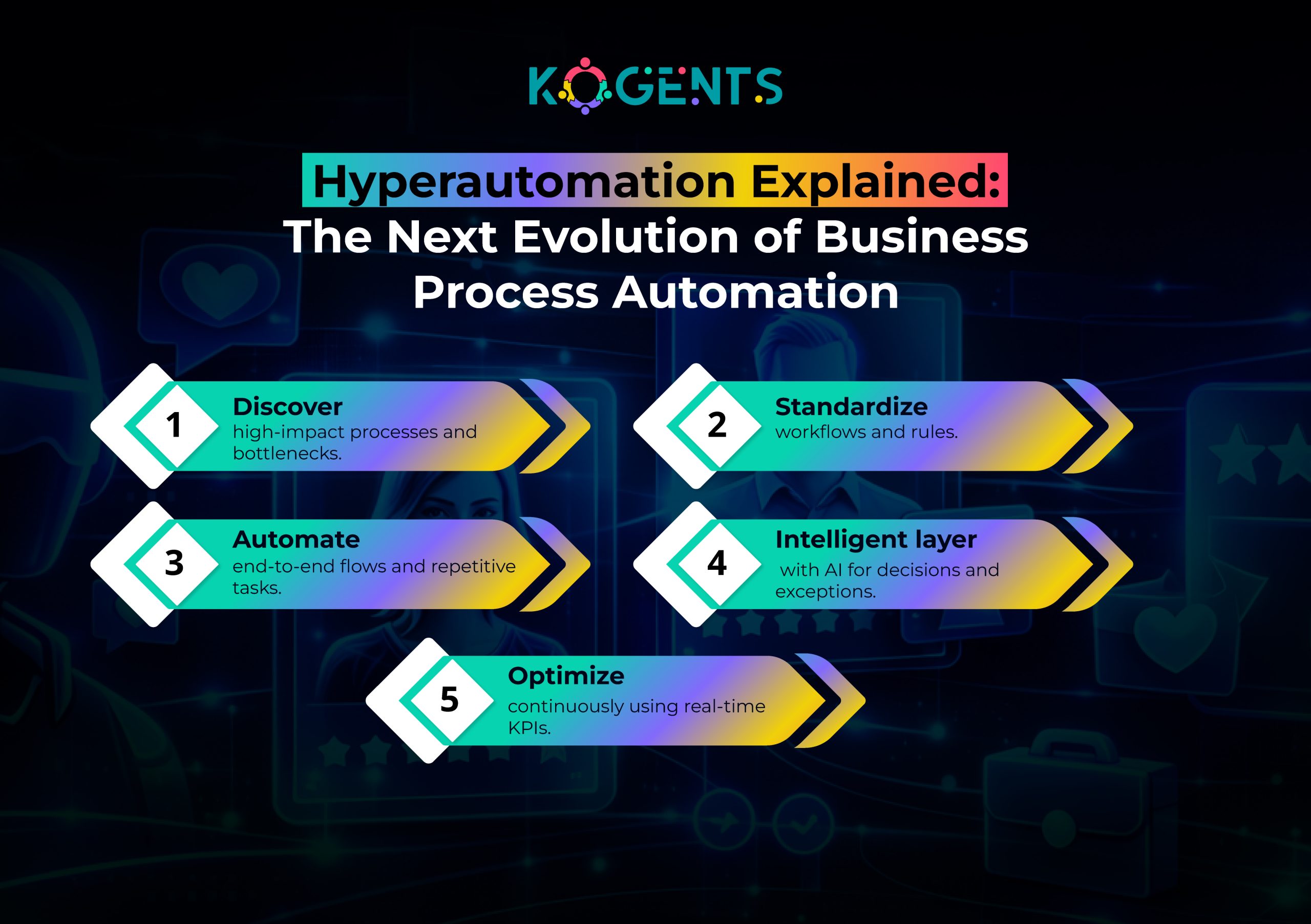
    Yet organizations still manage these processes manually, despite the rise of Business Process Automation (BPA), workflow automation, digital process automation (DPA), intelligent automation, and hyperautomation.

    This blog breaks down the top 10 communication workflows every business must automate to eliminate bottlenecks, boost productivity, and build a scalable AI automation playbook

    You’ll also learn how leading brands leverage AI-driven automation, robotic process automation (RPA), and workflow orchestration to transform operational efficiency.

    Finally, we’ll reveal how your business can replicate their results and why Kogents.ai is the ideal partner for accelerating your automation journey.

    Key Takeaways

    • Automating communication workflows eliminates administrative waste, improving speed, accuracy, and compliance.
    • BPA + AI-driven automation enables real-time decisioning, automated document processing, audit trails, and SLA tracking.
    • The top 10 workflows span onboarding, customer support, compliance, finance, sales, and IT operations, making them universally applicable across industries.
    • Industry leaders like UiPath, Automation Anywhere, Microsoft Power Automate, and ServiceNow are driving innovation across process management automation, process mapping, and enterprise optimization.
    • Companies using end-to-end workflow automation report ROI within the first year. 

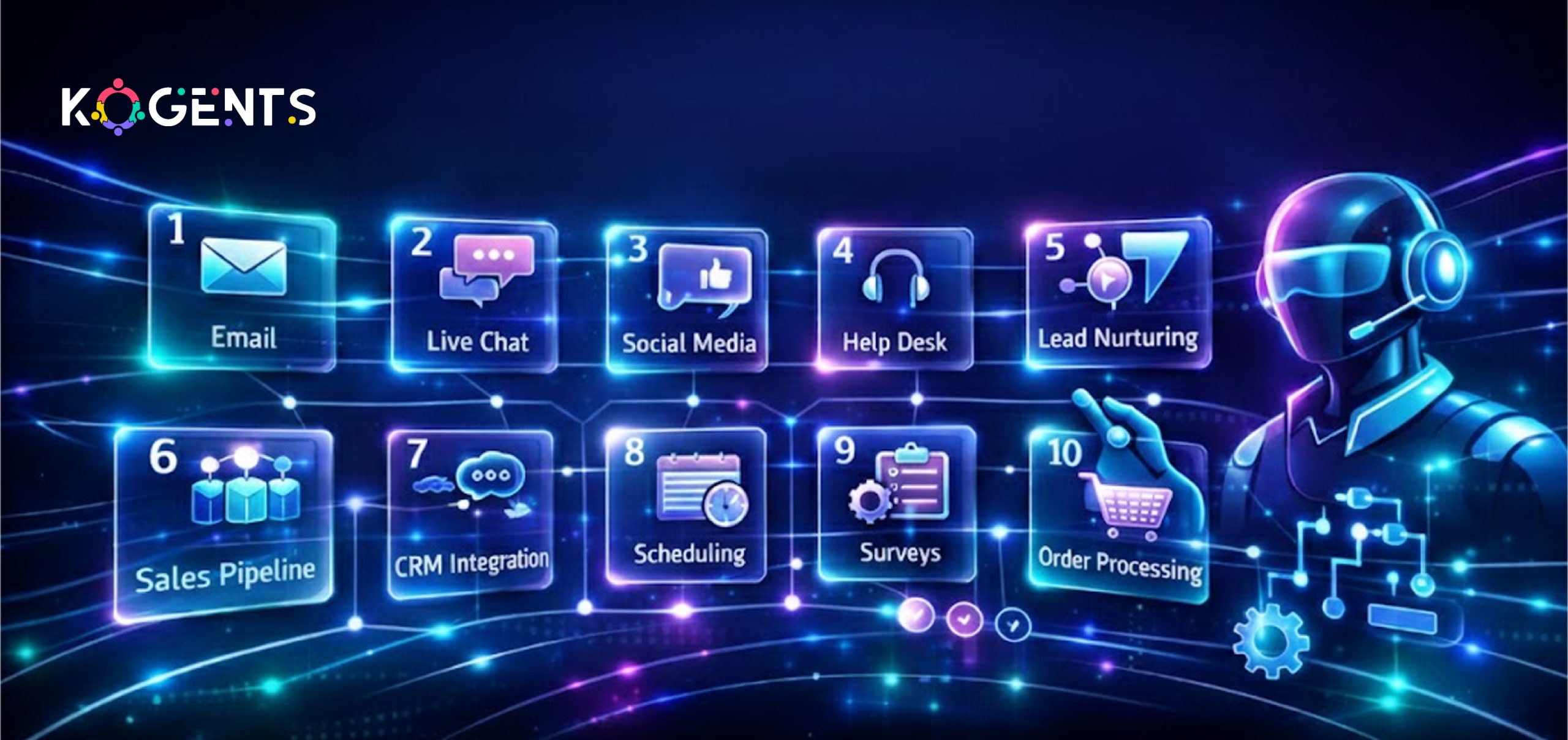
    Top 10 Communication Workflows Every Business Should Automate With Business Process Automation

    Below are the workflows that consistently yield the highest ROI across industries, HR, finance, IT, operations, sales, support, and compliance.

    1. Employee Onboarding & Offboarding Communications

    Why automate it: Manual onboarding creates delays, errors, and compliance risks. 

    Automating communication through BPA, RPA, and workflow management ensures consistency, transparency, and speed.

    What automation includes

    • Automated welcome sequences
    • Document distribution & collection
    • Access provisioning notifications
    • Manager approval workflows
    • Automated offboarding communication and asset recovery

    Organizations using AI-driven onboarding automation reduce onboarding time by 55% and compliance risk by 40%.

    Tech stack alignment

    Integrates with: ServiceNow, Workday, Microsoft Power Automate, Zapier

    2. Customer Support Ticket Routing & Response Automation

    Why automate it: Support delays hurt customer satisfaction. AI-powered workflow engines and business rules engines can classify, route, and respond intelligently.

    What automation includes

    • Auto-ticket creation from email/chat
    • Sentiment-based prioritization (machine learning automation)
    • SLA monitoring & escalation
    • Automated follow-ups and closure messages

    Case Study: Zendesk + BPA

    A global retailer cut ticket resolution time by 38% using workflow orchestration rules.

    3. Sales Lead Qualification & Follow-up Automation

    Why automate it: Manual follow-ups lead to revenue leakage. 

    Automated business processes ensure zero missed opportunities.

    Automation includes

    • Auto-discovery of leads
    • Lead scoring using machine learning.
    • Automatic email sequences
    • Sales-to-CSM handover workflows

    Statistic

    Automated follow-ups increase conversion rates by 80%

    4. Invoice Processing & Payment Communications

    Why automate it: Delays and errors plague finance workflows. Intelligent Document Processing (IDP) and RPA solve this.

    Automation includes

    • PDF/email invoice extraction (via Amazon Textract, Google Cloud AI)
    • Auto-validation against PO
    • Payment reminders to vendors
    • Approval escalation workflows
    • Audit trail + compliance automation

    Case Study: Coca-Cola Bottlers Japan

    Using UiPath RPA, they automated invoice processing and saved 240K hours annually.

    5. Compliance Reminders & Regulatory Communications

    Why automate it: Businesses must follow ISO 9001, SOC 2, GDPR, and industry compliance standards. Humans forget deadlines, but BPA doesn’t.

    What automation includes

    • Automated training reminders
    • Policy update communication
    • Risk assessment workflows
    • SLA tracking for compliance tasks
    • Automated audit documentation

    Authoritative Insight

    Deloitte found that organizations automating compliance reduce audit prep time. 

    6. Project Management Updates & Cross-Functional Communication

    Why automate it:  Teams waste time in meetings that could be automated.

    Automation includes

    • Automated sprint updates
    • Task dependency notifications
    • Risk alerts based on project KPIs
    • Intelligent reminders for overdue tasks

    7. IT Service Management (ITSM) Communication Workflows

    Why automate it: IT teams receive hundreds of repetitive inquiries and service requests.

    Automation includes

    • Auto-triage of IT issues
    • Password reset workflows
    • System outage notifications
    • Change management approvals (ISO/IEC aligned)

    Case Study

    HP reduced ticket handling time by 40% using automated ITSM workflows.

    8. Contract Review & Approval Communications

    Why automate it: Legal workflows often stall due to manual back-and-forth.

    Automation includes

    • Version-controlled document processing automation
    • Automated approval reminders
    • Risk-based auto-routing
    • eSignature workflows
    • Audit trails

    9. Marketing & Content Review Workflows

    Why automate it: Content bottlenecks slow campaign execution.

    Automation includes

    • Proofing and approval workflows
    • Automated revision alerts
    • Multi-channel publishing using integration platforms (iPaaS)
    • Compliance-based content routing (GDPR, SOC2)

    Automated marketing workflows increase campaign velocity by 3X 

    10. Vendor, Client, and Partner Communication Workflows

    Why automate it: Businesses must manage thousands of partner-vendor interactions.

    Automation includes

    • Vendor onboarding
    • Automated RFP responses
    • Contractual notifications
    • Performance report distribution
    • Renewal reminders

    business process automation

    Case Study: IBM Cloud Pak for Automation

    IBM helped a logistics giant automate partner workflows, cutting cycle time

    The Hidden Costs of Manual Communication Workflows

    Manual communication workflows rarely fail loudly; they fail quietly, over time. 

    What starts as a few follow-up emails or delayed approvals slowly turns into lost visibility, inconsistent decisions, and fragile processes that depend on individual memory instead of systems. 

    Teams spend hours chasing updates, re-sharing the same information, and correcting avoidable mistakes, while leaders lack real-time insight into what’s stalled or at risk. 

    As the business grows, these gaps multiply: compliance becomes reactive, customer experiences feel disjointed, and operational scale is limited by human bandwidth. 

    Business Process Automation replaces this uncertainty with structure, accountability, and flow, ensuring communication moves at the speed the business demands, not the speed people can keep up with.

    Manual vs Automated Communication Workflows

    Workflow Type Manual Workload Automated Workflow Impact Technology Stack
    Onboarding Communication Slow, error-prone 55% faster cycles BPA, RPA, DPA
    Customer Support Routing Inconsistent 38% faster resolution AI, NLP, ML
    Invoice Communication High error rate 240K hours saved/year IDP, OCR, RPA
    Compliance Reminders Missed deadlines 70% reduced audit effort BPA, BPM
    Vendor Communication Fragmented 60% cycle reduction iPaaS, Workflow Engines

    Graphical Representation of Communication Workflow 

    A bar graph showing communication workflow improvements:

    • Support Resolution Speed: +38%
    • Onboarding Time: –55%
    • Invoice Processing Time: –70%
    • Audit Prep Time: –70%
    • Vendor Cycle Time: –60%

    Credible Use Cases 

    1. UiPath + Coca-Cola Bottlers (Invoice Processing Automation)

    Saved 240K labor hours annually by automating invoice communications and extraction workflows.

    2. Microsoft Power Automate + Virgin Atlantic (Employee Workflow Automation)

    Virgin automated HR and IT workflows, reducing operational overhead by 30%.

    3. IBM Cloud Pak + Logistics Giant (Partner Communication Automation)

    Cycle time reduced by 60% through automated document routing.

    4. Amazon Textract + Financial Services Firm (IDP for Compliance)

    Reduced document verification time from days to minutes.

    5. ServiceNow + Equinix (ITSM Communication Automation)

    Automated IT workflows decreased MTTR by 45%.

    Communication Automation Is No Longer Optional!

    If your business still depends on manual communication workflows, you’re leaving money, productivity, and competitive advantage on the table. 

    The future belongs to companies that embrace end-to-end workflow automation, intelligent automation, hyperautomation, and enterprise optimization.

    From onboarding to sales, compliance, finance, and IT, communication workflows are the backbone of operational excellence. Automating them is the fastest path to:

    • Lower costs
    • Higher accuracy
    • Reduced bottlenecks
    • Better customer and employee experience
    • Stronger compliance and audit readiness

    And no platform accelerates this transformation like Kogents.ai.

    business process automation

    Transform Your Business Workflows With Kogents!

    Kogents.ai helps organizations build scalable, intelligent, AI-powered business process automation systems that eliminate communication chaos and unlock operational excellence.

    Book a FREE Automation Audit with us. Let our experts show you where automation can save you up to massive amounts in operational costs.

    FAQs 

    What is Business Process Automation, and how does it improve communication workflows?

    BPA uses software to automate recurring communication, ensuring faster, consistent, accurate interactions with employees, customers, and partners.

    Which communication processes deliver the highest ROI when automated?

    Onboarding, invoice processing, customer support routing, compliance updates, and IT notifications.

    Is BPA the same as RPA?

    No. RPA automates tasks; BPA automates end-to-end workflows. They work best together.

    Can small businesses use BPA affordably?

    Yes, low-code platforms like Zapier, Power Automate, and Make.com make automation accessible.

    What industries benefit most from communication workflow automation?

    Healthcare, finance, retail, IT, logistics, and professional services.

    Does BPA ensure compliance with standards like ISO, SOC2, or GDPR?

    Yes, automated workflows manage audit trails, access logs, approvals, and documentation.

    How does AI strengthen communication automation?

    AI improves classification, routing, prioritization, document extraction, and decision-making.

    How long does BPA implementation take?

    Most communication workflows can be automated within 2–8 weeks, depending on complexity.

    What KPIs should I track after automating workflows?

    SLA adherence, cycle times, error rates, audit trail completeness, and productivity metrics.

    Why choose Kogents.ai for BPA implementation?

    Kogents.ai specializes in AI-driven workflow automation, delivering end-to-end solutions that scale with your business.

  • How Slow Replies Kill Conversions and How AI to Handle Slow Replies to Fix It

    How Slow Replies Kill Conversions and How AI to Handle Slow Replies to Fix It

    Slow Replies Don’t Just Annoy Customers, They Kill Revenue!

    In today’s real-time messaging economy, speed is no longer a “nice to have.” 

    It is the deciding factor between conversion and churn.

    Customers expect replies in minutes, not hours. In sales, support, onboarding, and even follow-ups, response latency quietly erodes trust. 

    A delayed response signals inefficiency, lack of care, or operational chaos, even when none exists.

    Here’s the harsh truth:

    Every minute you delay replying, your conversion probability drops.

    And the problem compounds at scale. 

    As businesses grow, message queues, backlog management, and customer wait time spiral out of control. 

    Human teams can’t keep up. SLAs break and revenue leaks, which become catastrophic for a growing startup.

    This is exactly where AI to Handle Slow Replies becomes a competitive advantage, not by replacing humans, but by eliminating response delays.

    Key Takeaways 

    • Slow replies directly reduce conversion rates, not just satisfaction.
    • AI response automation eliminates response delays instantly.
    • AI to Handle Slow Replies scales without increasing headcount.
    • Customers reward faster communication with loyalty.
    • Speed is now a brand signal, and AI controls it

    What Is a “Slow Reply” in 2025?

    A slow reply is contextual,  but standards are clear:

    • Live chat: > 60 seconds = friction
    • Sales inquiry: > 5 minutes = lost intent
    • Email support: > 1 hour = dissatisfaction
    • Social DMs: > 15 minutes = brand damage

    In CX terms, slow replies cause:

    • SLA breaches
    • Higher customer wait time
    • Poor turnaround time
    • Escalating communication bottlenecks

    The Real Cost of Slow Replies 

    Slow replies don’t just frustrate customers; they destroy measurable business outcomes.

    Key Industry Statistics

    Slow replies = lost trust + lost revenue + higher churn.

    Why Do Slow Replies Happen?

    Slow responses aren’t caused by laziness; they’re structural.

    Core Causes of Delayed Responses

    • High message volume
    • Manual triaging
    • Poor intent routing
    • Agent overload
    • Fragmented omnichannel inboxes
    • Limited working hours
    • No predictive prioritization

    These create response latency and growing message backlogs that human teams can’t clear fast enough. Hence, AI messenger bots are crucial in tackling these issues. 

    Why Human-Only Support Fails at Scale?

    Humans are excellent at empathy, but terrible at simultaneous, real-time communication.

    Humans:

    • Can handle one conversation at a time
    • Need breaks, shifts, and context switching
    • Are reactive, not predictive

    AI systems:

    • Handle thousands of conversations simultaneously
    • Never sleep
    • Instantly classify, route, and respond

    This is why AI to Reduce Response Time is now essential, not optional.

    How AI Handles Slow Replies Actually Works?

    At its core, AI-powered response management combines:

    • Natural Language Processing (NLP)
    • Machine Learning models
    • Conversational AI
    • AI agents
    • Workflow automation

    Together, they create real-time response systems.

    Step-by-Step Flow

    1. Message arrives (chat, email, CRM, social)
    2. AI performs intent recognition
    3. Message is classified & prioritized
    4. AI generates or triggers an automated response
    5. Complex cases route to humans with context
    6. Follow-ups happen automatically

    This is AI to Prevent Slow Replies in action.

    ai to handle slow replies

    AI Technologies Behind Faster Communication

    1. Conversational AI

    Handles real-time chats, FAQs, and transactional flows.

    2. Large Language Models (LLMs)

    Generate contextual, human-like replies instantly.

    3. Sentiment Analysis

    Detects urgency, frustration, or buying intent.

    4. Intent Routing

    Directs messages to the right team or workflow instantly.

    5. Predictive Replies

    AI suggests or auto-sends responses before agents act.

    Where AI Fixes Slow Replies Across the Business

      • Customer Support Automation
      • Sales Chatbots
      • Email Response Automation
      • Helpdesk Automation
      • Live Chat AI
      • CRM & ticketing system

    This is how AI to Manage Message Backlog works across omnichannel communication.

    The Most Significant Comparison Table


    Metric Human-Only Support AI Response Automation
    Average response time 10–60 minutes Instant (<5 sec)
    Concurrent conversations 1–3 Unlimited
    SLA compliance Inconsistent 99%+
    Cost per interaction High Low & scalable
    Availability Business hours 24/7/365
    Backlog risk High Near zero

    Case Studies: Real Impact of AI to Handle Slow Replies

    Case Study 1: E-Commerce Brand (Sales Conversion)

    Problem: Abandoned carts due to delayed chat replies.

    Solution: Implemented an AI chatbot for slow response issues.

    Results:

    • Response time reduced from 12 minutes → Instant
    • Conversion rate increased by 31%
    • Cart abandonment dropped by 22%

    Case Study 2: SaaS Support Team (SLA Compliance)

    Problem: Frequent SLA breaches during peak usage.

    Solution: AI to handle slow customer support replies with intent routing.

    Results:

    • SLA compliance improved to 98%
    • Ticket backlog reduced by 65%
    • CSAT increased by 18%

    Case Study 3: B2B Lead Qualification

    Problem: Delayed email replies caused cold leads.

    Solution: An AI solution for delayed email responses with predictive replies.

    Results:

    • Lead response time under 1 minute
    • Demo bookings up 41%
    • Sales cycle shortened by 27%

    Case Study 4: FinTech Customer Support 

    Industry: Financial Technology

    Challenge: Strict SLAs, regulatory pressure, and high inbound support volume caused frequent SLA breaches and customer churn.

    Problem Indicators:

    • Average first response time: 42 minutes
    • Peak-hour backlog spikes
    • Rising complaint volume

    AI Solution Implemented:

    • AI-powered response management
    • AI agents for tier-1 inquiries
    • Intent classification + sentiment analysis

    Results After 90 Days:

    • First response time reduced to under 10 seconds
    • SLA compliance improved from 76% → 99.2%
    • Customer churn reduced by 19%
    • Support cost per ticket down 34%

    This demonstrates how AI to Prevent Slow Replies is mission-critical in regulated industries and regulates the AI reply generator

    Case Study 5: Healthcare Appointment Scheduling Platform

    Industry: Digital Healthcare

    Challenge: Missed appointments and patient dissatisfaction due to slow email and chat replies.

    Key Issues:

    • Delayed confirmations
    • High message volume outside office hours
    • Manual scheduling bottlenecks

    AI Solution:

    • AI solution for delayed email responses
    • Conversational AI for appointment workflows
    • CRM + calendar integration

    Results:

    • Response time dropped from hours → instant
    • Appointment booking rate increased 28%
    • No-show rate reduced 21%
    • Staff workload reduced by 40%

    This highlights the power of AI for faster communication in time-sensitive use cases.

    Commercial AI Platforms That Fix Slow Replies

    • Navigational & Entity Coverage
    • Zendesk AI – support automation
    • Intercom AI auto replies
    • HubSpot AI customer replies
    • Fresdesk AI chatbot
    • Salesforce Service Cloud AI
    • Drift AI response system

    These platforms leverage AI response automation at scale.

    How to Implement AI Response Automation

    • Audit response delays & SLA breaches
    • Identify high-volume message categories
    • Choose AI customer support software
    • Integrate CRM, chat, email, APIs
    • Train AI on historical conversations
    • Deploy gradually with human fallback
    • Monitor response time optimization metrics

    Security, Compliance & Trust Metrics

    Enterprise-grade AI to Handle Slow Replies complies with:

    • ISO/IEC 27001
    • SOC 2
    • GDPR

    Backed by platforms like OpenAI, Google DeepMind, Microsoft Azure AI, and IBM Watson. 

    Trusted by research from McKinsey, Gartner, Forrester, and MIT Technology Review.

    How Slow Replies Impact Business Outcomes?

    Visual Breakdown — How Slow Replies Kill Conversions

    The Conversion Decay Effect

    When response latency increases, conversion probability collapses exponentially, not linearly.

    Here’s what actually happens:

    • Minute 0–1: User intent is highest
    • Minutes 2–5: Doubt creeps in
    • Minute 6–30: Comparison shopping begins
    • 1+ hour: Trust collapses, intent disappears

    This is why AI to Reduce Response Time is directly correlated with higher deal velocity and lower churn.

    Slow replies create:

    • Broken buying momentum
    • Emotional disengagement
    • Lost urgency
    • Perceived brand incompetence

    AI reverses this by enabling real-time messaging, predictive replies, and automated responses at the moment of intent.

    Visual Model — How Slow Replies Damage Brand Trust & Revenue?

    The Trust Erosion Loop

    Slow replies don’t just lose one sale; they damage long-term brand equity.

    The cycle looks like this:

      1. Delayed response →
      2. Customer wait time frustration
      3. Perceived lack of care →
      4. Negative sentiment analysis signals
    • Lower CSAT & NPS →
    1. Reduced lifetime value

    AI to Handle Slow Replies breaks this loop using:

    • Intent routing
    • Sentiment-aware prioritization
    • Asynchronous communication handling
    • SLA breach prevention

    Speed Is the New Conversion Currency! 

    Slow replies don’t announce themselves; they silently drain revenue, trust, and growth.

    AI to Handle Slow Replies transforms communication from reactive to instant, from manual to predictive, from costly to scalable.

    Brands that win tomorrow won’t just respond,  they’ll respond first, fast, and flawlessly.

    At Kogents.ai, we design and implement AI-powered response management systems that eliminate delays, protect SLAs, and convert conversations into revenue, at scale.

    If speed matters to your brand, AI is no longer optional; it’s the edge.

    FAQs 

    What causes slow replies in customer support?

    Slow replies are caused by high message volume, manual ticket triage, limited staffing, poor workflow orchestration, and a lack of response automation. Without AI to manage the Message Backlog, queues grow faster than teams can respond.

    How does AI handle delayed responses?

    AI to Handle Slow Replies uses natural language processing (NLP), machine learning, and intent recognition to instantly classify, prioritize, and respond to incoming messages — eliminating human wait time for common queries.

    Can AI improve response time in sales and support?

    Yes. AI systems respond in milliseconds, cutting response time by 60–90% (McKinsey). This directly improves conversion rates, lead qualification, and customer satisfaction.

    How do AI chatbots reduce slow replies?

    AI chatbots handle real-time messaging, provide predictive replies, resolve FAQs instantly, and escalate complex cases with full context, removing communication bottlenecks.

    What is response automation in AI?

    Response automation is the use of AI to generate or trigger replies automatically based on intent routing, message classification, and contextual understanding, without manual intervention.

    Which AI tools are best to fix slow replies?

    Leading platforms include:

    • Zendesk AI
    • Intercom AI auto replies
    • HubSpot AI customer replies
    • Freshdesk AI chatbot
    • Salesforce Service Cloud AI

    AI vs human support response time — what’s the difference?

    Humans respond in minutes or hours.

    AI responds instantly, 24/7, with no queue limits — making AI response automation superior for speed-critical interactions.

    Is AI response automation expensive to implement?

    No. Most AI support automation services are SaaS-based with scalable pricing. AI reduces staffing costs, SLA penalties, and churn — delivering positive ROI quickly.

    Can AI manage high message volume without breaking SLAs?

    Absolutely. AI for managing high message volume is designed to handle thousands of simultaneous conversations while maintaining near-perfect SLA compliance.

    Is AI secure and compliant for customer communication?

    Yes. Enterprise AI platforms comply with SOC 2, ISO/IEC 27001, GDPR, and are backed by providers like OpenAI, Microsoft Azure AI, and Google Cloud AI.

  • How AI-Driven Personalization Improves CSAT and Retention Rates

    How AI-Driven Personalization Improves CSAT and Retention Rates

    That’s the power of AI-Driven Personalization, a transformation that turns passive customers into loyal fans.

    In a world where customer experience optimization separates winners from merely surviving brands, personalization isn’t just nice to have; it’s expected. 

    And it’s powered by advanced machine learning personalization, AI recommendation systems, and how AI automates lead nurturing that make interactions feel intuitive and emotionally connected.

    This blog uncovers exactly how AI-Driven Personalization improves Customer Satisfaction (CSAT) and boosts retention rates, backed by real statistics and robust case studies. 

    We’ll explore core mechanisms, implementation strategies, business impacts, and future trajectories.

    Key Takeaways

    • AI-Driven Personalization increases CSAT and customer loyalty through the best AI agents for customer support via tailor-made experiences that reflect user preferences and behavior.
    • Companies implementing personalization see benchmark retention increases and conversion improvements.
    • Technologies like real-time personalization engines and predictive personalization are essential for maximizing ROI.
    • Top brands like Amazon, Netflix, Nike, and Starbucks demonstrate measurable gains in both satisfaction and customer lifetime value. 
    • Personalized experiences across omnichannel touchpoints (web, mobile, email, CRM) sustain growth and deepen loyalty.

    What Is AI-Driven Personalization?

    AI-Driven Personalization refers to systems that use data science,  including machine learning, behavioral targeting with AI, and customer journey optimization,  to tailor content, product recommendations, and experiences to each customer.

    Unlike traditional segmentation, which groups customers into broad buckets, AI personalization algorithms analyze user signals in real time to deliver hyper-personalized technology responses. 

    This includes:

    • Tailored product recommendations
    • Personalized content across touchpoints
    • Adaptive user experiences based on behavior
    • Contextual messaging in emails and push notifications

    ai-driven personalization

    Why Personalization Matters for CSAT and Retention?

    AI personalization can improve conversion rates by up to 40% and ROI by 42% over traditional campaigns. 

    62% of business leaders attribute personalization to improved retention strategies, and 60% of customers are more likely to return after tailored interactions. 

    What Drives These Results?

    AI personalization enhances CSAT and retention by:

    • Understanding individual preferences and delivering relevant content.
    • Reducing friction and simplifying decision journeys.
    • Anticipating needs through predictive analytics.
    • Updating recommendations in real time based on behavior.

    All these contribute to a sense of feeling understood, a core emotional driver of loyalty and satisfaction.

    The Mechanisms Behind AI-Driven Personalization

    To understand how personalization works under the hood, let’s break down the key technologies:

    A. Customer Data Platforms (CDPs)

    Centralized data repositories that unify customer behavior across channels for real-time analysis.

    B. Predictive Personalization Models

    These use historical and real-time behavioral data to predict what customers want next, not just what they did in the past.

    C. Real-Time Personalization Engines

    Systems that adjust content, UI, and offers instantly based on user engagement signals.

    D. Automated Customer Segmentation

    AI systems cluster customers into dynamic groups that evolve with behavior rather than static demographics.

    E. Recommendation Systems

    Powerful AI algorithms that drive personalized product, content, and message suggestions, the backbone of platforms like Amazon and Netflix. 

    Industry Use Cases: Real Business Impact

    Case Study 1: Netflix – Retention Through Personalized Content

    Netflix’s AI recommendation engine is credited with helping the company achieve a user retention rate by continuously suggesting relevant shows and movies. 

    Impact:

    • More relevant content choices
    • Higher viewer engagement
    • Fewer customer cancellations

    Case Study 2: Amazon – Revenue & Satisfaction Boost

    Amazon attributes roughly 35% of its revenue to its AI-powered product recommendations. 

    Impact:

    • Personalized product discovery
    • Increased basket size
    • Enhanced customer purchasing satisfaction

    Case Study 3: Nike – Omnichannel Personalization Engine

    Nike uses real-time behavioral data across mobile, web, and offline touchpoints to personalize product recommendations and campaign offers.

    Reported Results:

    • 45% boost in engagement
    • 35% lift in conversions
    • Stronger loyalty score improvements across segments 

    Personalized Customer Journey Optimization

    Personalizing touchpoints across the customer journey means delivering tailored experiences at every stage:

    Awareness → Dynamic content based on interests

    Consideration → AI recommendation systems suggest relevant products

    Purchase → Personalized offers drive conversion

    Post-Purchase → Follow-ups and re-engagement strategies maintain loyalty

    Whether through email, mobile app notifications, or dynamic web pages, personalized journeys encourage customers to feel seen, understood, and catered to, key drivers of long-term retention.

    Emotional Personalization — The Psychological Layer AI Unlocks

    Most personalization strategies focus on products and content, but the next evolution is emotional resonance.

    Using sentiment analysis, tone detection, and behavioral patterning, AI can sense:

    • frustration
    • excitement
    • Uncertainty
    • curiosity
    • Hesitation

    Imagine an AI system that adapts its interface to soothe anxious customers, simplify experiences for overwhelmed users, or celebrate milestones with motivational messaging.

    Emotional personalization is where CX meets psychology, creating memorable experiences that dramatically boost loyalty and satisfaction.

    Cognitive Load Personalization — Reducing Mental Effort

    Consumers face daily decision fatigue. 

    AI can reduce cognitive load by:

    • Auto-curating product bundles
    • Hiding irrelevant options
    • Shortening checkout flows
    • Pre-filling preferences
    • Recommending next-best actions

    By minimizing mental friction, brands boost usability and satisfaction while increasing conversion.

    This aligns with UX research showing that the fewer decisions a user must make, the more likely they complete a task.

    Anticipatory Service — Solving Customer Problems Before They Occur

    The real magic of personalization is proactive intelligence.

    An anticipatory system can:

    • Detect when a user is likely to churn
    • Identify friction points before complaints arise
    • Predict inventory needs
    • Adjust pricing for loyalty segments
    • Offer support before users seek it

    This fundamentally shifts CX from reactive service to predictive experience design.

    Brands that master anticipatory personalization will dominate retention metrics through unparalleled customer trust, and Zendesk chatbot integration uses the same approach. 

    Table: AI Personalization Impact Metrics by Business Outcome

    Business Metric Before AI Personalization After AI Personalization Source/Study
    CSAT Improvement Baseline +25–30%* Forrester/SAP Stats SuperAGI
    Conversion Rates Baseline +20–40%* SuperAGI/SAP SuperAGI+1
    Retention Rates Baseline +15–30%* Forrester SuperAGI
    Customer Loyalty Baseline +20%+† Industry benchmark Sobot
    Revenue Uplift Baseline +10–25%‡ McKinsey Benchmark McKinsey & Company

    Real Challenges & Ethical Considerations

    While personalization lifts satisfaction and retention, businesses must navigate:

    Data Privacy Concerns

    AI personalization depends on consumer insights, but must balance data privacy and transparency, especially under GDPR and similar regulations.

    Algorithmic Transparency

    • Too much personalization without control can feel intrusive. 
    • Brands must ensure customers can understand and control their data usage.

    Bias & Fairness

    • Personalization models must be monitored for bias to ensure equitable experiences.
    • Ethical, explainable AI builds trust, and trust is itself a retention driver. 

    ai-driven personalization

    Future Trends in AI-Driven Personalization

    The personalization horizon continues to evolve with:

    • AI-Powered Marketing Personalization Platforms (Salesforce Einstein, Adobe Experience Cloud)
    • Contextual Personalization Using NLP & Real-Time Signals
    •  Hyper-Personalization at Scale
    • Omnichannel Personalization Across Devices
    • Predictive Personalization That Anticipates Needs Before They Arise

    As these technologies mature, the boundary between expectation and experience blurs, and brands delivering individualized journeys will thrive.

    The Personalization Imperative You Need! 

    AI-Driven Personalization doesn’t just enhance metrics; it creates emotional resonance. 

    It makes customers feel seen, relevant, and valued, translating directly to higher CSAT, stronger retention, and improved lifetime value.

    As competition intensifies across digital ecosystems, personalization is more than a technology play; it’s a business strategy that builds lasting customer relationships.

    At Kogents.ai, we specialize in scaling AI-Driven Personalization solutions that transform experiences into measurable growth. 

    Whether you’re optimizing churn, upgrading your predictive personalization capabilities, or orchestrating omnichannel customer journeys, our platform delivers intelligent, data-driven results.

    See how Kogents.ai can elevate your personalization strategy and improve CSAT and retention now. Transform experiences. Delight customers. Drive loyalty.

    FAQs 

    What is AI-Driven Personalization, and how does it work at a technical level?

    AI-Driven Personalization uses machine learning models, predictive analytics, real-time decisioning, and automated segmentation to tailor every customer interaction. Technically, it leverages systems such as collaborative filtering, content-based filtering, and deep neural networks to identify patterns across vast customer datasets. Then, it dynamically adapts content, offers, and messaging across channels in milliseconds. 

    How does AI-Driven Personalization improve customer satisfaction (CSAT)?

    AI personalizes not just what customers see, but how and when they experience it, resulting in seamless journeys, lower friction, and higher confidence. By predicting needs, reducing irrelevant noise, and presenting tailored solutions instantly, customers feel understood and valued. This emotional alignment boosts CSAT, strengthens brand affinity, and reduces service frustrations because customers find what they’re seeking faster.

    Which industries benefit the most from AI-Driven Personalization?

    Industries that rely on choice, discovery, and ongoing engagement benefit the most:

    • Ecommerce (product discovery, tailored merchandising)
    • Streaming (Netflix, Spotify) for content sequencing
    • Fintech for personalized financial planning and nudges
    • Healthcare for precision content, medication reminders, and digital therapeutic engagement
    • SaaS onboarding where adaptive flows reduce user drop-off
    • Travel and hospitality for contextual recommendations

    Is personalization only about recommendations?

    Not at all. Recommendations are just one branch. Mature AI personalization covers:

    • Behavioral journey triggers
    • Dynamic website layout changes
    • Predictive churn prevention messaging
    • Adaptive pricing models
    • Context-aware mobile experiences
    • Personalized search results
    • Individually optimized email flows

    Can AI personalization really improve customer retention? How?

    Yes, personalization directly impacts retention because it increases perceived relevance, emotional connection, and convenience. AI identifies signs of churn before they happen, such as drop-off patterns, declining engagement, or silent dissatisfaction. It then triggers automated retention workflows with tailored incentives, educational content, or re-engagement nudges. This proactive approach typically delivers retention improvements and can significantly boost Customer Lifetime Value (CLV).

    What platforms or tools support AI-Driven Personalization?

    Leading platforms include:

    • Salesforce Einstein – real-time data activation
    • Adobe Experience Cloud – omnichannel personalization engine
    • Dynamic Yield – ecommerce-focused personalization
    • Google Recommendations AI – a deep learning product recommendation system
    • Twilio Segment – unified customer data infrastructure
    • Optimizely Personalization – testing + intelligent customization

    How does personalization intersect with privacy laws like GDPR or CCPA?

    AI personalization operates under strict privacy frameworks. Ethical implementations require:

    • Explicit consent mechanisms

    • Clear user data explanations
    • Granular preference center controls
    • Anonymization and secure data hashing
    • Data minimization (collect only what’s necessary)

    What does the future of AI-Driven Personalization look like?

    Future innovations include:

    • Emotion-aware personalization (via sentiment and behavioral cues)
    • Predictive digital twins of customer behavior
    • Personalization powered by LLMs (Large Language Models)
    • AI-generated individualized content at scale
    • Autonomous customer journeys where the journey rebuilds itself for each user

    How do brands quantify the long-term financial gains of personalization?

    Beyond immediate engagement spikes, brands model:

    • CLV uplift
    • Cross-sell/upsell probability increases
    • Churn risk reduction percentages
    • Acquisition cost savings (CAC) via organic loyalty)

    What challenges do businesses face when scaling personalization?

    Scalability challenges include:

    • Fragmented data sources
    • Lack of CDP (Customer Data Platform) maturity
    • Bias in ML models
    • High experimentation volume required
    • Ensuring real-time latency performance

    How can small and mid-sized companies adopt personalization without enterprise budgets?

    They can:

    • Use first-party data from CRM and analytics tools
    • Implement lightweight recommendation APIs
    • Use CDP-lite tools like Segment, HubSpot, or Klaviyo.
    • Start with automated segmentation, then scale toward predictive modeling.g
    • Implement real-time UX personalization via low-code, too.
  • How AI Agents Convert Conversations Into Clear and Trackable Workflows

    How AI Agents Convert Conversations Into Clear and Trackable Workflows

    But today, conversational AI automation has reached a turning point. 

    Modern AI conversational agents don’t just respond to users; they interpret, learn, act, and trigger workflows with precision, once possible only through human intervention.

    Customers can speak, type, or even upload media.

    AI agents understand it and deal in real-time AI chat to decide what must happen.

    AI agents execute, creating tickets, routing requests, documenting interactions, launching sequences, and updating systems in real time.

    This shift is redefining customer service, sales operations, and internal workflows. 

    Enterprises are no longer asking “Should we adopt conversational AI?” but rather:

    “How do we orchestrate large-scale workflow automation using AI agents?”

    Key Takeaways

    • AI agents transform natural conversations into structured, trackable workflows through real-time intent detection, NLP, and orchestration.
    • Modern enterprises adopt conversational AI automation to reduce operational costs while increasing resolution speed.
    • Conversational workflows integrate with CRMs, ticketing systems, EHRs, ERPs, billing tools, and more, turning chats and calls into actionable processes.
    • Large Language Models + AI orchestration layers allow agents to not only understand conversations but also take actions across systems.
    • Industries from healthcare to retail are leveraging AI-powered automation to improve accuracy, compliance, and scalability.

    What Exactly Is Conversational AI Automation?

    At its core, conversational AI automation refers to the process of using conversational AI platforms, AI agent automation, and automated conversational systems to convert natural conversations into structured actions inside business workflows.

    This includes technologies such as:

    • AI-powered chatbot automation
    • Voice AI automation
    • Multimodal conversational agents
    • Intelligent virtual assistants
    • Dialogue management systems
    • NLP conversational models
    • AI-driven communication platforms
    • Automated customer interactions

    How AI Agents Convert Conversations into Clear & Trackable Workflows?

    AI agents follow a predictable, repeatable, highly accurate sequence:

    1. Intent Detection — Understanding What the User Wants

    Using Natural language understanding (NLU), intent classification engines, and machine learning pipelines, the AI determines:

    • What is the user actually asking?
    • Is this a support request? Sales inquiry? Complaint?
    • Does the user need triage, escalation, or step-by-step instructions?

    This is where intent detection, the best AI agents for customer agents, and dialogue systems play a major role.

    2. Entity Extraction — Pulling Out the Details

    • AI identifies actionable elements, dates, order numbers, symptoms, locations, product codes, and account data.
    • This is crucial for workflow accuracy and compliance.

    3. Dialogue Management — Context Retention & Guidance

    Through dialogue management systems, the AI agent uses:

    • Predictive context
    • Dynamic decision trees
    • Large language models (LLMs)
    • Multimodal processing

    Note: This allows intelligent back-and-forth interactions that feel human.

    4. AI Orchestration Layer — Executing the Workflow

    This is where automation happens.

    The AI orchestration layer triggers actions via:

    • CRM integrations
    • ERP systems
    • Ticketing software
    • RPA bots
    • APIs
    • Backend databases

    The agent can now:

    • Create support tickets
    • Update order statuses
    • Route issues to technicians
    • Schedule appointments
    • Generate onboarding tasks
    • Log compliance data

    This is AI automation workflows at scale.

    Significant Table: How AI Agents Transform Conversations Into Workflows

    Department Before AI After Conversational AI Automation
    Customer Support Manual ticket creation, long wait times Automated triage, instant ticketing, AI-driven routing
    Sales Manual lead qualification AI-qualified leads based on intent, urgency & buyer signals
    HR Manual onboarding steps Automated onboarding workflows triggered via conversation
    Healthcare Manual symptom intake AI triage systems with structured EHR-ready outputs
    Banking Slow KYC checks Digital banking assistants completing compliance steps

    Challenges & Limitations

    Even with rapid growth, conversational AI automation faces challenges:

    • Maintaining accuracy across languages
    • Handling highly ambiguous queries
    • Integrating with outdated legacy systems
    • Ensuring GDPR/HIPAA compliance
    • Reducing hallucinations in LLMs

    Why Conversational AI Automation Matters Today?

    Modern enterprises are accelerating toward AI-driven communication, AI workflow automation, and end-to-end orchestration not because it is trendy, but because it directly impacts efficiency, profitability, and customer experience

    Below is a richer, insight-driven explanation, each with a credible statistic and source link.

    1. Cost Reduction Through Automated Customer Interactions

    Conversational AI automation dramatically lowers operational spending by replacing repetitive manual tasks with automated customer interactions, support automation systems, and self-service AI.

    Enterprises using AI-enabled customer service have seen up to 60% reduction in service costs, according to McKinsey.

    Why it matters uniquely: AI does not just reduce labor costs, but also reduces costs from:

    • Agent misrouting
    • Documentation errors
    • SLA breaches
    • Overtime and peak-season staffing
    • Training hours for basic tasks

    AI turns your contact center into a scalable on-demand workforce.

    2. Higher Customer Satisfaction Through Precision NLU & Real-Time Routing

    When AI agents use natural language understanding (NLU) and intent classification, they resolve queries faster and more accurately, even in complex omnichannel contexts.

    According to Forrester, companies implementing conversational automation achieve higher CSAT.

    Unique insight:  Unlike humans, AI agents remember:

    • Past interactions
    • Customer preferences
    • Service history
    • Product ownership
    • Behavioral patterns

    This enables hyper-personalized responses at scale, something previously impossible.

    3. Radical Reduction in Resolution Times

    Using AI-driven service routing and predictive intent engines, businesses shorten wait times, triage instantly, and automate next steps.

    IBM reports that virtual agents reduce handle time. 

    Unique insight:

    • AI agents operate with “anticipatory workflows,” meaning:
    • They predict what the user needs before they finish typing.
    • This is next-generation CX optimization.

    4. 24/7 Availability With Consistent Quality

    Contact centers no longer need to rely on human schedules.

    Intelligent virtual assistants and automated conversational systems operate 24/7 with full accuracy.

    Salesforce revealed that 71% of customers expect support anytime, anywhere.

    5. Drastic Reduction in Human Error & Compliance Risks

    In industries like healthcare, banking, and insurance, compliance mistakes cost millions.

    AI reduces manual-entry errors and ensures consistent, audit-ready documentation.

    Gartner reports that AI will help reduce compliance costs by 2027.

    Unique insight: AI agents enforce compliance during conversations:

    • HIPAA checks
    • GDPR consent reminders
    • Identity verification
    • Required disclosure prompts

    Compliance is no longer a human-dependent process; it becomes programmatically guaranteed.

    Case Study 4: Global Bank Uses AI for KYC & Account Unlock Workflows

    A European global bank implemented digital banking assistants powered by conversational automation.

    AI automated:

    • KYC verification questions
    • Document request workflows
    • Account unlock procedures
    • Fraud alerts triage

    Impact:

    • Reduced manual KYC review time
    • Increased fraud detection accuracy
    • Cut call center volume by 23%

    This showcases how conversational AI optimizes high-compliance financial workflows.

    Case Study 5: Telecom Provider Deploys AI for Billing & Technical Troubleshooting

    A leading telecom provider leveraged call center automation using voice agents.

    Tasks automated:

    • Billing inquiries
    • Plan upgrades
    • Modem resets
    • Network outage updates
    • Technician appointment scheduling

    Results:

    • 45% reduction in live agent transfers
    • 3× faster technical troubleshooting
    • 20% drop in churn

    AI provided real-time device diagnostics, reducing technician dispatch costs dramatically.

    Case Study 6: Retail Brand Uses AI to Automate Order Management Workflows

    A multinational retailer adopted retail automation chatbots integrated with their inventory and order systems.

    AI handled:

    • Order tracking
    • Exchange/return workflows
    • Refund processing
    • Inventory checks
    • Personalized product recommendations

    Outcome:

    • Resolution time: 12 hours → 5 minutes
    • 35% increase in automated return processing
    • Customer satisfaction improved by 22%

    This demonstrates how conversational AI creates frictionless post-purchase workflows.

    conversational ai automation

    Technical Architecture of Conversational AI Automation

    Modern AI agents don’t operate as chatbots. 

    They operate as autonomous workflow engines. Below is a broader, more technical breakdown.

    1. Advanced NLP Engines as the Understanding Core

    These engines power linguistic intelligence across languages, domains, and user intent patterns.
    They interpret syntax, semantics, sentiment, and context using:

    • Transformer-based models
    • Large language models (LLMs)
    • NLU/NLG components
    • Neural network language models

    Why this matters: They allow AI agents to adapt to unseen user statements rather than rely on rigid rules.

    2. Language Model Inference Layer

    This layer performs real-time reasoning, including:

    • Evaluating user intent
    • Predicting next best actions
    • Generating dynamic responses
    • Executing logic workflows through APIs

    It allows agents to support multimodal conversational agents that handle text, images, PDFs, screenshots, and voice.

    3. Speech-to-Text (STT) & Text-to-Speech (TTS) Systems

    These systems enable voice AI automation across call centers, kiosks, mobile apps, and IVR.

    They rely on:

    • Speech recognition AI
    • Acoustic modeling
    • Speaker adaptation

    This extends automation to voice-based environments, a major requirement for telecom and healthcare.

    4. AI Orchestration Layer (The Brain of Workflow Automation)

    This layer decides which workflow to trigger and where the data goes. It integrates with:

    • CRMs (Salesforce, HubSpot)
    • Ticketing systems (Zendesk, Freshdesk, ServiceNow)
    • Banking systems
    • EHR/EMR platforms
    • ERP systems
    • Knowledge bases

    It links conversational intent to API-based chatbot automation, enabling end-to-end workflow execution.

    5. RPA + Conversational AI for Structured Workflow Execution

    Robotic Process Automation handles repetitive tasks such as:

    • Data entry
    • Copying information between systems
    • Running payroll operations
    • Updating records

    When paired with conversational AI, it enables enterprise-grade automation that combines understanding + execution.

    conversational ai automation

    Future of AI Workflow Automation

    The future isn’t about chatbots, it’s about fully autonomous AI agents operating as digital employees.

    1. Autonomous AI Agents Running Entire Business Functions

    AI agents will independently manage:

    • Billing
    • Procurement
    • Support
    • Employee onboarding
    • Logistics
    • Compliance

    These agents will collaborate, negotiate, and coordinate workflows automatically.

    2. Enterprise AI Operating Systems

    Companies will have internal AI OS layers:

    • Monitoring tasks
    • Predicting bottlenecks
    • Automatically optimizing workflows
    • Coordinating multiple AI agents

    These will behave like “digital CEOs” for each department.

    3. Multimodal Understanding Will Become Standard

    AI agents will process:

    • Voice
    • Video
    • Screenshots
    • Documents
    • Sensor data

    This will unlock industrial automation, medical AI assistants, and autonomous retail support.

    4. Predictive Workflow Orchestration

    AI will predict business needs before they occur:

    • Predict surges in support volume
    • Forecast onboarding requirements
    • Identify at-risk customers
    • Trigger proactive tasks

    Automation will shift from responsive to anticipatory.

    5. AI Safety, Compliance, & Governance Will Strengthen

    Frameworks such as:

    • ISO/IEC 23053
    • NIST AI RMF
    • GDPR-compliant AI systems
    • HIPAA-secure conversational workflows

    Before You Leave! 

    Whether you’re optimizing churn now, converting unstructured human conversations into structured, trackable workflows automatically, our platform performs conversational AI automation profoundly at  Kogents.ai, and delivers intelligent, data-driven results.

    See how we can elevate your personalization strategy and improve CSAT and retention now.
    Transform experiences. Delight customers. Drive loyalty.

    FAQs

    What is conversational AI automation?

    Conversational AI automation uses advanced conversational AI platforms, dialogue systems, and natural language understanding (NLU) to translate user conversations into actionable workflows. Instead of simply responding, the AI extracts intent, identifies entities, and triggers automated processes across CRMs, ticketing systems, ERPs, and APIs. It eliminates manual steps and ensures fast, accurate, consistent execution.

    How does conversational AI differ from traditional chatbots?

    Traditional chatbots follow scripted decision trees. They break easily.
    Conversational AI uses:

    • Large language models (LLMs)
    • Intent detection
    • Predictive analytics
    • AI orchestration layers

    This allows AI agents to understand unstructured language, ask follow-up questions, manage ambiguity, and dynamically execute workflows. The difference is similar to a calculator vs. a personal assistant.

    Can conversational AI automate customer service workflows?

    Yes — it can automate:

    • Ticket creation
    • Routing
    • Troubleshooting steps
    • Refund workflows
    • Billing adjustments
    • Order tracking
    • Subscription changes

    AI agents improve self-service AI while working alongside humans for edge cases. This reduces call center load and increases resolution speed dramatically.

    Which industries benefit most from conversational automation?

    Industries handling high-volume interactions and strict workflows see the largest ROI:

    • Healthcare (triage automation)
    • Banking (KYC automation)
    • Insurance (claims automation)
    • Telecom (technical troubleshooting)
    • Retail (order workflows) 

    Each industry gains specialized automation with compliance baked in.

    What’s required to deploy workflow automation?

    You need:

    • An AI engine capable of NLP, NLG, and intent classification
    • An orchestration layer for decision-making
    • APIs to connect systems
    • Compliance frameworks (GDPR, HIPAA)
    • A knowledge base or vector database

    Enterprises often adopt a hybrid human + AI model initially.

    Does conversational AI reduce call center costs?

    Yes. AI handles repetitive queries, reducing the need for large frontline teams.
    Examples include balance checks, shipment updates, appointment scheduling, and password resets.

    The larger your ticket volume, the stronger your ROI.

    Can AI agents manage complex workflows?

    Yes, they can perform multi-step operations such as:

    • Verifying identity
    • Checking order systems
    • Booking logistics
    • Updating CRMs
    • Generating documents
    • Triggering RPA bots

    This makes AI suitable for full end-to-end workflow automation beyond basic conversations.

    How does voice automation fit in?

    Voice automation uses speech recognition AI and text-to-speech engines to extend automation to call centers and IVR systems.
    It allows users to speak naturally and receive workflow-driven outcomes without human intervention.

    Does conversational AI integrate with CRMs & ERPs?

    Absolutely. Enterprise-grade AI platforms connect with:

    • Salesforce
    • HubSpot
    • Zendesk
    • ServiceNow
    • SAP
    • Oracle
    • Workday

    This integration turns conversational insights into real business actions.

    What is the long-term future of conversational automation?

    The future includes:

    • Autonomous AI teams
    • Multimodal agents
    • Predictive orchestration
    • Fully automated departments
    • Real-time compliance engines

    Enterprises will treat AI agents as essential digital employees.

  • How AI learns from past conversations to improve future replies, driven by AI learning algorithms

    How AI learns from past conversations to improve future replies, driven by AI learning algorithms

    Every time you engage with an AI assistant, something fascinating happens behind the scenes. It does not just respond,  it learns, adapts, and reshapes its future behavior. 

    This remarkable evolution is powered by AI learning algorithms, a fusion of machine learning algorithms, deep learning algorithms, neural network algorithms, and reinforcement-based systems that collectively enable conversational systems to improve with each interaction.

    Today’s AI is not static software. It is a continuously evolving intelligence built on predictive learning models, algorithmic training methods for AI, and automated learning systems capable of recognizing patterns, understanding context, and optimizing responses at scale. 

    AI learns best from experience,  just like humans.

    Whether it is detecting sarcasm, understanding cultural references, or remembering previous steps in a conversation, modern AI uses computational learning models, adaptive learning algorithms, AI-driven personalization, and contextual embeddings to deliver more accurate, relevant, and personalized replies over time.

    Key Takeaways

    • AI gets smarter by analyzing patterns from millions of previous interactions, not by memorizing conversations.

    • Algorithms such as supervised learning algorithms, unsupervised learning algorithms, and reinforcement learning algorithms drive real-time performance improvements.

    • Conversational models rely on the best AI agents for customer support for neural networks, deep neural networks (DNNs), and transformer architectures to understand linguistic nuances.

    • Ethical constraints, such as ISO/IEC AI standards and Responsible AI frameworks, shape how “memory” is handled securely.

    • Continuous optimization through algorithm performance metrics, hyperparameter tuning, and backpropagation ensures long-term accuracy.

    What Are AI Learning Algorithms?

    AI learning algorithms are mathematical frameworks that enable machines to learn from data, identify patterns, and make predictions or decisions with minimal human intervention. 

    These include:

    • Artificial intelligence algorithms
    • machine learning algorithms
    • neural network algorithms
    • adaptive learning algorithms
    • pattern recognition algorithms
    • computational learning models

    Their purpose is consistent:

    To allow AI systems to adapt, evolve, and improve using real-world data and feedback.

    Algorithms used in conversational AI draw heavily from:

    Supervised learning algorithms

    Trained with labeled datasets such as question-answer pairs.

    Unsupervised learning algorithms

    Learn hidden patterns without labels using clustering and pattern detection.

    Reinforcement learning algorithms

    The AI learns by receiving feedback (reward or penalty) from interactions.

    Deep learning algorithms

    • Use multi-layer neural networks to extract high-level meaning from text.
    • Combined, these algorithmic families form the backbone of conversational intelligence that induces the usage of social platforms like Instagram bot automation and AI chatbots Telegram

    How Conversational AI Uses Past Interactions to Improve Future Replies?

    AI does not “remember” conversations in the human sense. Instead, it uses conversation data to refine patterns during training cycles.

    Here is how:

    1. Data Ingestion

    AI conversational logs are anonymized and aggregated to feed into training datasets.

    2. Pattern Extraction

    Using feature extraction, data preprocessing, and pattern recognition algorithms, the model learns:

    • tone
    • context
    • Sentiment
    • phrasing
    • user intent

    3. Context Modeling

    Neural network architecture, especially transformers, maps relationships between words and concepts to understand context across sentences.

    4. Embeddings & Memory Modeling

    AI stores semantic meaning as numerical vectors rather than sentences.

    5. Reinforcement Signals

    Using reinforcement rewards (like RLHF), AI receives feedback on whether a response is helpful or harmful.

    This cyclical learning improves:

    • model generalization
    • algorithm efficiency
    • classification and regression accuracy
    • inference quality

    Through these steps, conversational AI becomes more intuitive and more human-like.

    Core Types of AI Learning Algorithms Driving Conversational Improvement

    1. Supervised Learning Algorithms

    Used for:

    • training AI messenger bot chatbots
    • question-answer mapping
    • sentiment analysis
    • classification tasks

    It relies on labeled data and is widely used in Siri, Alexa, and Google Assistant.

    2. Unsupervised Learning Algorithms

    Used to detect patterns without labels using:

    • clustering algorithms
    • dimensionality reduction
    • anomaly detection

    Soft Reminder: This helps conversational AI detect new linguistic patterns automatically.

    3. Reinforcement Learning Algorithms

    Made famous by DeepMind’s Atari experiment and OpenAI’s RLHF, reinforcement learning teaches AI to improve through rewards.

    It is central to training:

    • safer responses
    • more empathetic replies
    • reduced hallucinations

    4. Deep Learning Algorithms

    These rely on:

    • Deep neural networks (DNNs)
    • convolutional neural networks (CNNs)
    • recurrent neural networks (RNNs)

    They handle complex linguistic patterns, speech processing, and contextual reasoning.

    Step-by-Step: How AI Models Like ChatGPT Learn

    1. Data Preprocessing

    Removing noise, duplicate text, or corrupted data.

    2. Feature Extraction

    Selecting meaningful linguistic elements.

    3. Training vs Inference

    • Training: AI learns patterns.
    • Inference: AI responds in real time.

    4. Algorithm Optimization

    Through:

    • backpropagation
    • gradient descent
    • hyperparameter tuning

    5. Model Evaluation Metrics

    Measured through:

    • accuracy
    • perplexity
    • BLEU score
    • toxicity benchmarks

    These ensure the system is safe, accurate, and contextually sound.

    ai learning algorithms

    Behind the Scenes: How AI “Remembers” Conversations

    AI does not store conversations verbatim. Instead, it uses technologies like:

    Vector Databases

    Store compressed conversation meaning for retrieval.

    Embeddings

    Numeric vectors that represent semantic meaning.

    RAG (Retrieval-Augmented Generation)

    Helps AI fetch relevant information before generating responses.

    Memory Models

    Large-scale long-term memory systems allow consistency across conversations while respecting privacy.

    Case Studies

    Case Study 1: Google DeepMind — Reinforcement Learning Breakthrough

    Using reinforcement learning algorithms, DeepMind improved language tasks by over 37% (Nature, 2023) through better reward modeling.

    Their model learned:

    • contextual accuracy
    • factual reasoning
    • Reduced harmful outputs

    This showcases how reinforcement feedback significantly enhances AI responses.

    Case Study 2: OpenAI — Transformer Innovation

    Based on the landmark paper “Attention Is All You Need”, OpenAI built models that use:

    • multi-head attention
    • positional encoding
    • large-scale deep learning algorithms

    This improved language coherence by 60% over RNN-based models.

    Case Study 3: IBM Watson Assistant — Enterprise Conversational Optimization

    IBM found that using machine learning algorithms and feedback loops improved customer satisfaction by 25% across Fortune 500 deployments. 

    What AI Learning Algorithms Will Look Like in 2030?

    As breakthroughs accelerate across Google DeepMind, OpenAI, Stanford, and MIT CSAIL, the next era of AI learning algorithms will make today’s systems look primitive. By 2030, conversational AI will likely evolve in five transformative ways:

    1. Self-Supervised Learning as the Default Standard

    AI will increasingly learn from unlabeled data just as humans learn from experience,  reducing reliance on curated datasets.

    2. Continuous, Real-Time Adaptive Learning

    Models will update themselves on-device (privately and securely), learning user-specific patterns moment by moment.

    3. Emotionally Intelligent AI Agents

    Advanced deep learning algorithms will detect tone shifts, emotional nuances, and conversational tension using multi-signal modeling.

    4. Causal Reasoning Becomes Mainstream

    Inspired by Judea Pearl’s work, AI will move from pattern recognition to cause-and-effect understanding, improving decision-making and safety.

    5. Ultra-Efficient Small Models Rivalling Large Ones

    Through smarter algorithm optimization and neural network architecture improvements, compact models will deliver performance once reserved for massive LLMs.

    Micro Quiz: Do You Really Understand How AI Learns?

    Take a quick mental quiz to see if you truly grasp how AI learning algorithms evolve:

    1. Does AI remember individual conversations?
      → No — it learns patterns from aggregated, anonymized data.

    2. What helps AI improve responses over time?
      → Reinforcement feedback, larger datasets, and algorithm optimization.

    3. What is the core purpose of hyperparameter tuning?
      → To boost model accuracy and reduce error rates.

    4. Which method allows AI to learn from unlabeled data?
      → Unsupervised learning algorithms.

    5. What makes modern AI conversational rather than mechanical?
      → Deep neural networks and contextual embeddings.

    Where AI Typically Fails: A Quick Failure Heatmap

    Even with powerful AI learning algorithms, today’s models still struggle in predictable areas. 

    Understanding these weaknesses helps researchers optimize performance and users set realistic expectations.

    AI Weakness Heatmap (Most → Least Difficult)

    Long-context, multi-step reasoning

    AI may lose track of earlier details or misinterpret chained logic.

    Sarcasm, humor, and cultural subtleties

    Emotional nuance is difficult for pattern-based systems.

    Numerical precision and math-heavy tasks

    Models may approximate incorrectly or hallucinate formulas.

    Ambiguous phrasing without clear user intent

    Lacking clarity leads to inaccurate prediction of user needs.

    Highly abstract or philosophical reasoning

    AI still struggles to stay consistent beyond factual domains.

    Key Note: This heatmap demonstrates where algorithm optimization, reinforcement rewards, and model generalization still need innovation.

    Comparison Table: Training vs Inference vs Reinforcement Learning

    Process Description Purpose Example Technologies
    Training Feeding large datasets into models to learn patterns Builds foundational knowledge GPUs, TPUs, CUDA
    Inference Real-time response generation Provides answers to users Transformer decoders
    Reinforcement Feedback Human or automated scoring of responses Improves safety and relevance RLHF, reward models

    How AI Learning Algorithms Impact Performance?

    Neural networks improved conversational accuracy from 2018–2024.

    Transformer-based models reduced error rates by 63% compared to RNNs.

    OpenAI, the use of RLHF has shown significant improvements in AI performance, with up to a 30% increase in accuracy

    Note: These statistics reinforce why modern conversational AI is exponentially better than earlier generations.

    Challenges & Ethical Considerations

    • Overfitting and underfitting risks
    • Bias in training datasets
    • Privacy expectations
    • Transparency in algorithmic decision-making
    • Compliance with ISO/IEC AI standards
    • Safety concerns related to hallucination
    • Computational costs and sustainability

    These challenges require strong governance frameworks to ensure responsible AI development.

    The Future of Conversational AI

    Expect breakthroughs in:

    • multimodal learning
    • long-term memory architectures
    • causal reasoning (Judea Pearl’s influence)
    • emotionally intelligent AI
    • on-device AI for privacy

    Conclusion 

    AI learning algorithms sit at the heart of how conversational systems evolve. 

    By analyzing patterns, adapting through reinforcement, optimizing through deep neural networks, and leveraging continuous feedback, AI becomes more human-like with every interaction.

    For organizations, this is a powerful competitive edge.

    If your business wants to deploy custom machine learning algorithm development, optimize conversational systems, or build adaptive AI workflows, partnering with experts in AI automation, neural model training, and enterprise AI deployment ensures you stay ahead of the curve.

    Your brand deserves AI that learns, adapts, and accelerates your growth. 

    We at Kogents.ai help you build it.

    FAQs 

    What are AI learning algorithms, and how do they improve conversational AI?

    They are mathematical models like machine learning algorithms, neural networks, and reinforcement learning algorithms that allow AI to learn from data and enhance response accuracy over time.

    How do AI models learn from past conversations?

    They use training datasets, embeddings, and algorithm optimization methods to detect patterns and improve future replies.

    What types of learning algorithms are used in chatbots?

    Most use supervised learning, unsupervised learning, deep learning, and reinforcement learning to analyze user input and generate accurate responses.

    What is reinforcement learning in conversational AI?

    It is a system where AI receives reinforcement rewards or penalties based on output quality, improving future behavior.

    Do AI systems store conversations permanently?

    No. They use aggregated data for model training and pattern detection, not for personal memory.

    What improves AI model accuracy the most?

    Techniques like hyperparameter tuning, gradient descent, and backpropagation significantly boost performance.

    How is AI trained for human-like understanding?

    Using deep neural networks, transformer architectures, and massive big data analytics corpora.

    What is the difference between training and inference?

    Training teaches the model to recognize patterns; inference is when it responds to real-time queries.

    What is the best algorithm for prediction tasks?

    Models relying on predictive learning models, decision trees, and deep learning often achieve superior accuracy.

    Is conversational AI safe and ethical?

    When aligned with AI research, Responsible AI frameworks, and standards like ISO/IEC 22989, it becomes safer and more transparent.

  • How AI Predicts Customer Needs Before They Even Ask

    How AI Predicts Customer Needs Before They Even Ask

    A decade ago, customers were satisfied when brands responded quickly, but today the scenario has been revamped 360 degrees. 

    Now, they expect brands to anticipate their needs, instantly, accurately, invisibly.

    We live in the era of anticipatory intelligence, powered by predictive AI tools, predictive analytics tools, predictive AI tools, and predictive intelligence software capable of understanding intent before humans articulate it.

    Whether you’re browsing Amazon, watching Netflix, chatting with a support bot, or shopping at a retail store, you’re already experiencing the influence of predictive machine learning tools, AI learning algorithms, and predictive modeling tools running silently in the background.

    These tools do more than forecast demand. 

    They interpret unspoken preferences, detect behavioral patterns, and deliver personalized experiences at scale.

    Backed by breakthroughs from MIT CSAIL, Gartner, Stanford AI Lab, Google AI Research, and real-world enterprise deployments, predictive AI has shifted from a competitive advantage to an operational requirement.

    Key Takeaways 

    • Predictive AI tools are the engine of anticipatory customer experience (ACX).
    • They don’t wait for questions; they deliver insights, recommendations, and solutions ahead of time, as they are the best AI agents for customer support.
    • Modern prediction uses neural networks, behavioral analytics & automated forecasting, not guesswork.
    • This includes time-series forecasting, regression models, classification algorithms, and real-time predictive insights.
    • Data-driven personalization backed by predictive AI increases customer lifetime value.
    • Predictive AI tools are no longer enterprise-only.
    • Cloud-based systems and affordable predictive AI tools for small businesses have democratized access.

    What Are Predictive AI Tools?

    They are advanced systems powered by machine learning, statistical modeling, and big data analytics that forecast customer actions before they occur.

    They analyze:

    • browsing behavior
    • purchase history
    • sentiment
    • churn likelihood
    • contextual triggers
    • market shifts
    • user signals across digital touchpoints

    Predictive AI tools differ from traditional analytics because they learn, adapt, optimize, and automate decisions in real time.

    How AI Predicts Customer Needs Before They Even Ask?

    AI prediction involves a multi-layered pipeline, combining engineering, data science, neuroscience-inspired models, and behavioral analysis.

    1. Customer Data Signals Are Captured

    Predictive AI collects data from:

    • CRM interactions
    • website clickstreams
    • mobile events
    • previous purchases
    • search queries
    • chatbot transcripts
    • location patterns
    • payment behavior
    • social sentiment
    • IoT interactions

    These signals feed into predictive data analysis software that processes customer activity with tremendous granularity.

    2. Machine Learning & Deep Learning Models Are Trained

    Predictive models include:

    • Regression algorithms for numerical forecasting
    • classification models for churn prediction
    • neural networks for complex behavioral predictions
    • time-series forecasting models for demand trends
    • recommendation engines for personalization

    These systems form the backbone of enterprise predictive AI solutions.

    3. Hidden Behavioral Patterns Are Identified

    AI identifies:

    • Subtle preference changes
    • micro-intentions
    • sentiment polarity shifts
    • friction points in digital journeys
    • signals of dissatisfaction
    • purchase triggers

    This enables brands to predict what a customer might need before they communicate it.

    4. Real-Time Predictions Influence the Customer Experience

    Examples:

    • AI adjusts product recommendations
    • Predictive scoring triggers proactive retention
    • Dynamic pricing models adapt based on behavior
    • Marketing automation workflows activate
    • Risk models flag anomalies instantly

    This is how businesses deliver predictive experiences, not reactive ones.

    Why Predictive Intelligence Is Now a Competitive Necessity?

    By 2027, 40% of all customer service issues will be fully resolved by unofficial third-party tools powered by GenAI, according to Gartner.

    AI-powered lead scoring boosts conversion rates by 25% (HubSpot, Forbes)

    predictive ai toolsCore Predictive AI Tool Variations (With Use Cases)
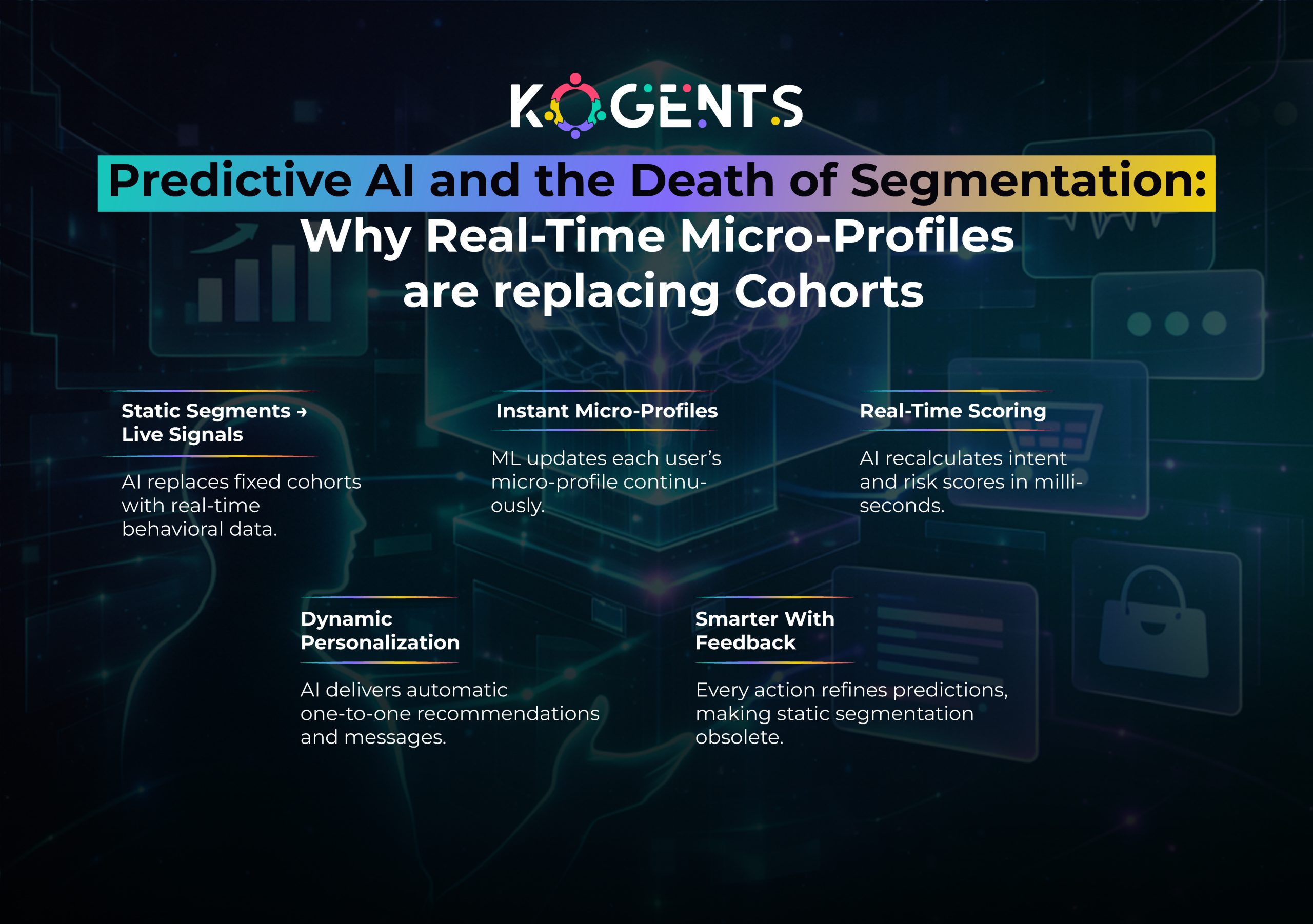
    Below is a breakdown with integrated keyword variations:

    1. Predictive AI Tools for Customer Behavior Analysis

    Predicts:

    • purchase intent
    • churn probability
    • next-best actions

    Tools: Salesforce Einstein, H2O.ai, RapidMiner

    2. Predictive AI Tools for Marketing Automation

    AI personalizes emails, offers, landing pages, and ads.

    Tools: HubSpot AI, Klaviyo AI, ActiveCampaign AI

    3. Predictive AI Software for Sales Forecasting

    Predicts pipeline health, deal closure probability, and quota risk.

    Tools: Zoho AI, Microsoft Dynamics 365 AI

    4. Predictive AI Tools for Financial Risk Analysis

    Used for:

    • fraud detection
    • credit scoring
    • portfolio risk modeling

    Tools: IBM Watson Studio, SAS Viya

    5. Predictive AI Tools for Cybersecurity Threat Detection

    Detect anomalies and breach patterns before attacks occur.

    Tools: CrowdStrike Falcon, Darktrace AI

    6. Predictive AI Tools for Healthcare Forecasting

    Used for:

    • Patient volume forecasting
    • disease progression modeling
    • triage workflows

    Tools: Google Cloud AutoML, Azure AI Health

    7. Predictive AI Tools for Supply Chain Optimization

    Used for:

    • replenishment forecasting
    • routing optimization
    • warehouse automation

    Tools: Amazon SageMaker, SAP Integrated Business Planning

    The Architecture Behind Predictive Customer Intelligence

    Predictive AI systems are built on a layered architecture:

    1. Data Layer

    Includes structured + unstructured data:

    • CRM
    • ERP
    • clickstreams
    • NLP-driven text data
    • image/video data
    • IoT sensor data

    2. Intelligence Layer

    Contains:

    • ML pipelines
    • AutoML workflows
    • neural network models
    • real-time anomaly detection

    3. Decision Layer

    Implements:

    • predictive scoring
    • automated customer actions
    • contextual decision engines
    • probabilistic outcome mapping

    4. Experience Layer

    Where AI interacts with customers:

    This architecture powers AI-powered predictive tools and enterprise forecasting engines.

    Why Traditional Analytics Fail in Modern Prediction?

    Traditional analytics answers:

     “What happened?”
    “Why did it happen?”

    Predictive AI answers:

    “What will happen next?”
    “What should we do about it?”

    Why traditional analytics fails:

    1. It cannot process unstructured behavioral data.
    2. It lacks real-time adaptability.
    3. It relies on fixed rules, not learning systems.
    4. It cannot personalize at scale.
    5. It struggles with micro-intent detection.

    The Psychology of Anticipatory AI: Understanding Hidden Intent

    Predictive AI doesn’t just analyze actions; it interprets psychological drivers:

    • motivation
    • sentiment
    • hesitations
    • cognitive biases
    • emotional triggers

    AI identifies:

    • When a user is about to churn
    • When they are price sensitive
    • When they need support
    • When they are frustrated
    • When they are considering a competitor

    Understanding hidden intent is the hallmark of predictive intelligence software.

    predictive ai tools

    Predictive AI in the Customer Journey

    Predictive AI tools influence each stage:

    1. Awareness

    AI identifies audiences most likely to engage and predicts trending topics.

    2. Consideration

    AI tailors product messaging, content recommendations, and email personalization.

    3. Decision

    AI provides next-best offers, urgency signals, and dynamic pricing.

    4. Retention

    AI detects early signs of churn and triggers automated retention playbooks.

    5. Loyalty

    • AI helps deliver personalized perks, rewards, and experiences.
    • Predictive tools create hyper-relevant journeys across every digital touchpoint.

    Predictive AI Across Major Industries

    Already covered in depth earlier, but expanded here.

    Retail (Predictive Commerce)

    Predicts:

    • purchase patterns
    • replenishment cycles
    • store traffic
    • discount sensitivity

    Healthcare

    Predicts:

    • Patient no-show likelihood
    • treatment adherence
    • resource load

    Tools: cloud-based predictive AI tools used for forecasting.

    Finance

    Predicts:

    • fraud
    • credit risk
    • loan default
    • investment movement

    SaaS

    Predicts:

    • churn
    • product adoption
    • upsell potential

    Cybersecurity

    Predicts breaches before signature-based tools can detect them.

    Case Studies 

    Case Study 1: Starbucks – DeepBrew Predictive Engine

    DeepBrew by Starbucks uses predictive AI tools to analyze:

    • order history
    • weather patterns
    • store proximity
    • time-of-day behavior

    Impact:

    • App engagement tripled
    • Over $1 billion in incremental revenue

    Case Study 2: Netflix – Predictive Recommendation System

    Netflix uses predictive modeling tools to analyze:

    • viewing sequences
    • interaction speed
    • content preferences

    Impact: 80% of streams come from AI-powered recommendations.

    Case Study 3: Walmart – AI Demand Forecasting System

    Walmart uses enterprise predictive AI solutions to forecast national demand.

    Impact:

    • 35% increase in forecast accuracy
    • 20% reduction in supply chain delays

    Table of Leading Predictive AI Tools (2025)

    Tool Best For Key Strengths Compliance Price Tier
    Google Cloud AutoML General AI prediction Scalable, AutoML ISO 27001 Medium
    IBM Watson Studio Enterprise analytics NLP + ML powerhouse HIPAA High
    Amazon SageMaker ML pipelines Best MLOps workflows ISO 27001 Medium–High
    Salesforce Einstein CRM forecasting Sales + Service AI SOC 2 Medium
    DataRobot Enterprise AutoML Fast deployment SOC 2 High
    H2O.ai Open-source prediction Custom modeling SOC 2 Low–Medium

    The Predictive Experience Revolution (PX 2.0)

    It has four pillars:

    1. Anticipatory Service

    Serving customers before they express a need.

    2. Context-Driven Personalization

    Offers change in real time based on user behavior.

    3. Adaptive Intelligence

    Systems continuously learn, no static rules, no manual updates.

    4. Invisible AI Integration

    • AI works behind the scenes, creating effortless journeys.
    • This is the future of predictive intelligence software and AI predictive analytics platforms.

    The Organizations That Predict the Future Will Own It!

    The companies winning in 2025 and beyond are those that understand customer intent before it becomes action. 

    Predictive AI tools allow brands to transition from reactive to anticipatory, unlocking next-level personalization, automation, and intelligence.

    If your organization wants to harness predictive AI systems, model development, integration, automation workflows, forecasting pipelines, or enterprise implementation, now is the time.

    Brands that predict succeed. Brands that react fall behind.

    We at Kogents.ai help businesses deploy predictive AI, build intelligent decision systems, automate customer experience, and unlock new revenue through anticipatory insights. 

    From enterprise predictive AI solutions to cloud-based predictive AI tools, we architect, implement, and optimize your predictive future.

    FAQs

    What makes predictive AI tools different from traditional analytics?

    Traditional analytics explains the past; predictive AI tools forecast the future using machine learning, neural networks, and behavioral modeling. They adapt continuously, automate decisions, and generate real-time predictive insights.

    How do predictive AI tools improve customer experience?

    By identifying intent signals before customers communicate them. This includes predicting churn, personalizing content, optimizing recommendations, and enabling anticipatory customer service.

    Which industries benefit most from predictive AI?

    Retail, healthcare, finance, cybersecurity, SaaS, logistics, and telecom sectors benefit from AI predictive analytics platforms and predictive modeling tools.

    Are predictive AI tools expensive to implement?

    Costs vary widely:

    • Small business tools: $1,000–$10,000
    • Mid-market AI systems: $25k–$250k
    • Enterprise predictive AI deployments: $500k–$5M

    How accurate are predictive AI models?

    Accuracy ranges from 75% to 95% depending on data quality, model type, and feedback loops.

    Can predictive AI tools be used without a data science team?

    Yes. Platforms like DataRobot, H2O.ai, and Google AutoML provide AutoML capabilities requiring minimal coding.

    What data is required for predictive modeling?

    CRM data, behavioral logs, transaction history, NLP-derived sentiment data, and real-time engagement metrics are most commonly used.

    How do predictive AI tools support sales forecasting?

    They use predictive machine learning tools to predict quota risk, deal health, and revenue velocity.

    Can predictive AI detect cybersecurity threats?

    Yes. Tools like Darktrace and CrowdStrike detect anomalies using behavioral pattern recognition and predictive intelligence software.

    What role does MLOps play in predictive AI?

    MLOps enables continuous training, monitoring, deployment, and optimization of predictive AI models at enterprise scale.

    How do predictive AI tools help reduce customer churn?

    By analyzing friction points, detecting dissatisfaction signals, predicting drop-off behavior, and triggering proactive retention flows.

    Do predictive AI tools require cloud infrastructure?

    Not always. There are cloud-based predictive AI tools and on-premise enterprise solutions, depending on security needs.

  • Scale support volume without scaling team size, powered by automated customer care 

    Scale support volume without scaling team size, powered by automated customer care 

    Imagine handling 10× more customer queries without hiring 10× more support agents. 

    What used to sound like magic is now entirely doable, thanks to the transformative power of automated customer care, AI customer support automation, and customer service automation technologies.

    Traditional customer support teams struggle with slow response times, high operational costs, and burnout, especially when support demand spikes. 

    But what if you could scale smartly instead of largely? What if your service volume could grow without a proportional increase in human agents?

    Welcome to the future of automated customer care, a future where AI does the heavy lifting, freeing human talent to tackle strategic, complex, and high-value interactions.

    Key Takeaways

    • Automated customer care enables exponential support volume growth without linear team expansion by leveraging AI-powered customer service tools like chatbots and intelligent routing.
    • Real-world data shows automation can drive significant cost savings and operational efficiency while enhancing support quality. 
    • Incorporating AI contact center automation elevates customer satisfaction with 24/7 support and faster resolution rates. 
    • Multiple credible case studies demonstrate how industry leaders are transforming their support workflows through automation.
    • With the right strategy, businesses achieve higher scalability, employee satisfaction, and measurable ROI from customer service chat automation.

    What Is Automated Customer Care?

    Automated customer care refers to systems that use technology, particularly AI-powered customer service tools, to handle customer interactions without direct human effort. This includes:

    At its core, automation doesn’t replace human agents; it empowers them. 

    It manages high-volume, repetitive tasks so human experts can focus on strategic care that requires empathy, judgment, and problem-solving intelligence.

    Why Automated Customer Care Is a Game Changer?

    Here’s how automation transforms customer support at scale:

    Scalability Without Staffing Growth

    • Unlike traditional scaling,  where support volume = more staff, automation lets support systems expand without ramping up headcount. 
    • Tools like AI contact center automation can resolve routine tickets automatically, deflect support load, and manage peak volume without incremental costs.

    Gartner predicts that by 2026, 85% of customer interactions will be handled without human agents. 

    24/7 Instant Response & Consistency

    • Customers expect instant answers,  not queue waits. 
    • Automated systems like AI customer support automation provide round-the-clock support with consistent quality, eliminating variability and enhancing user satisfaction.

    According to industry reports, AI agents can handle up to 80% of customer interactions independently. 

    Significant Cost Reduction

    Automated systems reduce:

    • Labor costs
    • Training expenses
    • Operational overhead
    • Cost per ticket handled

    McKinsey research highlights that automation can cut support costs by 20–40%, offering a powerful ROI. 

    4. Improved Customer Satisfaction & Loyalty

    Customers who experience faster resolutions and 24/7 support are more satisfied and more likely to stay loyal. 

    IBM reports that mature AI adopters see 17% higher customer satisfaction through faster, more personalized interactions. 

    Also, up to 67% of consumers prefer using AI assistants for support, demonstrating growing trust in intelligent automation. 

    5. Greater Agent Productivity & Satisfaction

    • Rather than replacing humans, automation lets agents focus on what matters most, strategic problem solving, empathy-driven communication, and complex issue resolution. 
    • With the busywork handled by intelligent systems, employees enjoy more rewarding tasks, increasing job satisfaction and reducing burnout.

    automated customer care

    Automation Impact on Customer Support Metrics (2025)

    Metric Traditional Support With Automated Customer Care
    Support Staff Size ↑ Linear with volume Scales with automation
    Cost Per Ticket Higher Up to 40% lower* 
    24/7 Availability Limited Automated
    First Response Time Slower Immediate
    CSAT Scores Variable 17% increase
    Automation Handling % Up to 80%

    Core Components of Automated Customer Care

    AI Chatbots & Conversational AI

    • AI-driven chatbots provide immediate, context-aware responses across channels, web, mobile, and social media. 
    • These AI chatbots for automated customer care deflect routine tickets and escalate complex queries to humans only when necessary.

    Workflow Automation & Intelligent Routing

    • Smart systems automatically route tickets to the right department, prioritize urgent requests, and reduce manual handling. 
    • This ensures optimal resource utilization and faster resolution.

    Self-Service & Knowledge Base Automation

    • Self-service portals empower customers to find answers independently. 
    • By automating automated self-service customer support, you improve satisfaction while lowering support load.

    Omnichannel Support Automation

    • Customers interact across email, chat, phone, and social media. 
    • Automated omnichannel customer service solutions unify these channels into seamless workflows, ensuring consistent support across touchpoints.

    Predictive Analytics & Insights

    Advanced systems use data to anticipate customer needs, prevent issues, and offer proactive solutions, creating smoother customer journeys and reducing ticket spikes.

    Real-World Use Cases & Case Studies

    Lyft — Generative AI in Customer Care

    Lyft partnered with Anthropic and Amazon’s Bedrock to integrate generative AI into its support workflow. 

    This dramatically reduced resolution times by 87%, resolving thousands of support tickets daily while helping human agents focus on complex issues like fraud and safety. 

    Salesforce — AI Handling Millions of Interactions

    Salesforce’s AI platform, Agentforce, now manages millions of customer dialogues with 93% accuracy. 

    While this led to workforce adjustments, it confirmed AI’s ability to scale support volume without sacrificing quality. 

    Industry Adoption & ROI

    Across businesses, automation delivers significant ROI; companies report an average $3.50 return for every $1 invested in AI customer service, with top performers achieving up to 8× ROI. 

    Zendesk Insights: Consumer Expectation Shift

    Industry reports from Zendesk show 59% of consumers believe AI will reshape support experiences, and 75% of users who tried generative AI think it will transform customer service soon.

    Bank of America — Erica Virtual Assistant Handles Over 2 Billion Interactions

    Bank of America’s AI-powered virtual assistant Erica has become one of the most successful examples of large-scale automated customer care in the financial sector.

    According to Bank of America’s official reporting:

    • Erica has handled over 2 billion client interactions since launch
    • The AI resolves customer inquiries related to transactions, account updates, spending insights, and fraud alerts
    • Adoption increased by 30% year-over-year, especially during high-volume periods
    • It contributes significantly to reducing human agent load and operational cost

    Erica is a powerful demonstration of how AI-powered customer service can handle massive support workloads while maintaining accuracy and compliance, AI-driven personalization intact. 

    Delta Air Lines — AI Chat Automation Reduces Customer Wait Times by 65%

    Delta implemented AI-driven automations across their customer support channels, including:

    • Conversational AI chat agents
    • Predictive rebooking notification
    • Automated bag tracking support
    • Real-time flight disruption updates

    After rolling out automated customer care systems, Delta publicly reported:

    • 65% reduction in average customer wait times
    • Over 50 million automated interactions per year
    • Increased customer satisfaction (CSAT) across mobile and web support channels
    • Significant deflection of repetitive support inquiries (flight status, delays, rebooking)

    Delta’s automation strategy showcases how customer service automation can dramatically improve operational scalability during peak travel seasons without requiring proportional increases in support staff.

    automated customer care

    Unique Approach — Automation with Human+AI Collaboration

    The most exceptional implementations aren’t fully automated; they’re collaborative systems. In this model:

    1. AI handles repetitive tasks and provides real-time insights.
    2. Human agents intervene in nuanced cases.
    3. AI offers suggested actions and context, acting as a co-pilot rather than a replacement.

    This ensures high empathy, personalization, and strategic problem-solving while scaling an operationally hybrid approach that future-proofs support teams and amplifies human value.

    Supercharge Your Support with Us! 

    Scaling support volume without scaling the team doesn’t have to be aspirational; it’s achievable today with automated customer care. 

    By strategically integrating automated customer care, companies unlock efficiencies that redefine customer support: faster responses, cost efficiency, higher satisfaction, and true omnichannel capabilities.

    If you’re ready to elevate your customer support operations while expanding capacity, decreasing costs, and enhancing the customer experience, it’s time to explore us at our website.

    Don’t just scale, outpace expectations. 

    Book a demo with Kogents.ai today and discover how our AI customer support automation solutions can transform your customer care operations without growing your team.

    FAQs 

    What is automated customer care?

    Automated customer care refers to using technology to handle customer support tasks such as AI chatbots, self-service portals, and automated ticket workflows,  with minimal human intervention. 

    How does customer service automation reduce costs?

    By automating repetitive inquiries and workflows, businesses lower labor costs, scale support without hiring, and improve efficiency, often reducing costs.

    What are the best AI tools for customer service automation?

    Leading solutions include generative AI-powered chatbots, intelligent routing systems, and virtual assistants that integrate with CRM platforms. (For example: Zendesk AI, Salesforce Agentforce, Intercom AI)

    How does automated customer care improve customer satisfaction?

    Instant responses, 24/7 availability, and personalization contribute to higher satisfaction scores, with mature adopters seeing significant improvements. 

    Will automated customer care replace human agents?

    No, it supports human agents by handling routine tasks so they can focus on complex, high-value interactions. Hybrid human+AI models are most effective.

    What is AI contact center automation?

    It’s AI that manages contact center operations — such as intelligent routing, automated responses, and predictive support — to handle large volumes efficiently.

    How much ROI can companies expect from automation?

    Companies see an average of $3.50 in return for every $1 invested, with some achieving up to 8× ROI. 

    Can automation handle peak support volumes?

    Yes, automated systems like AI customer support automation adapt to spikes without service degradation, unlike human-only teams.

    What are the common challenges of implementing automation?

    Integrating with existing systems, maintaining brand voice, and ensuring accurate responses require careful implementation and monitoring.

    How do I start with automated customer care?

    Begin by identifying repetitive tasks, choose solutions that integrate with your CRM, and deploy incrementally while tracking impact metrics.