Category: AI Teacher Assistant

  • Why the Best AI Teaching Assistants for Online Learning Beat Generic AI Add-Ons

    Why the Best AI Teaching Assistants for Online Learning Beat Generic AI Add-Ons

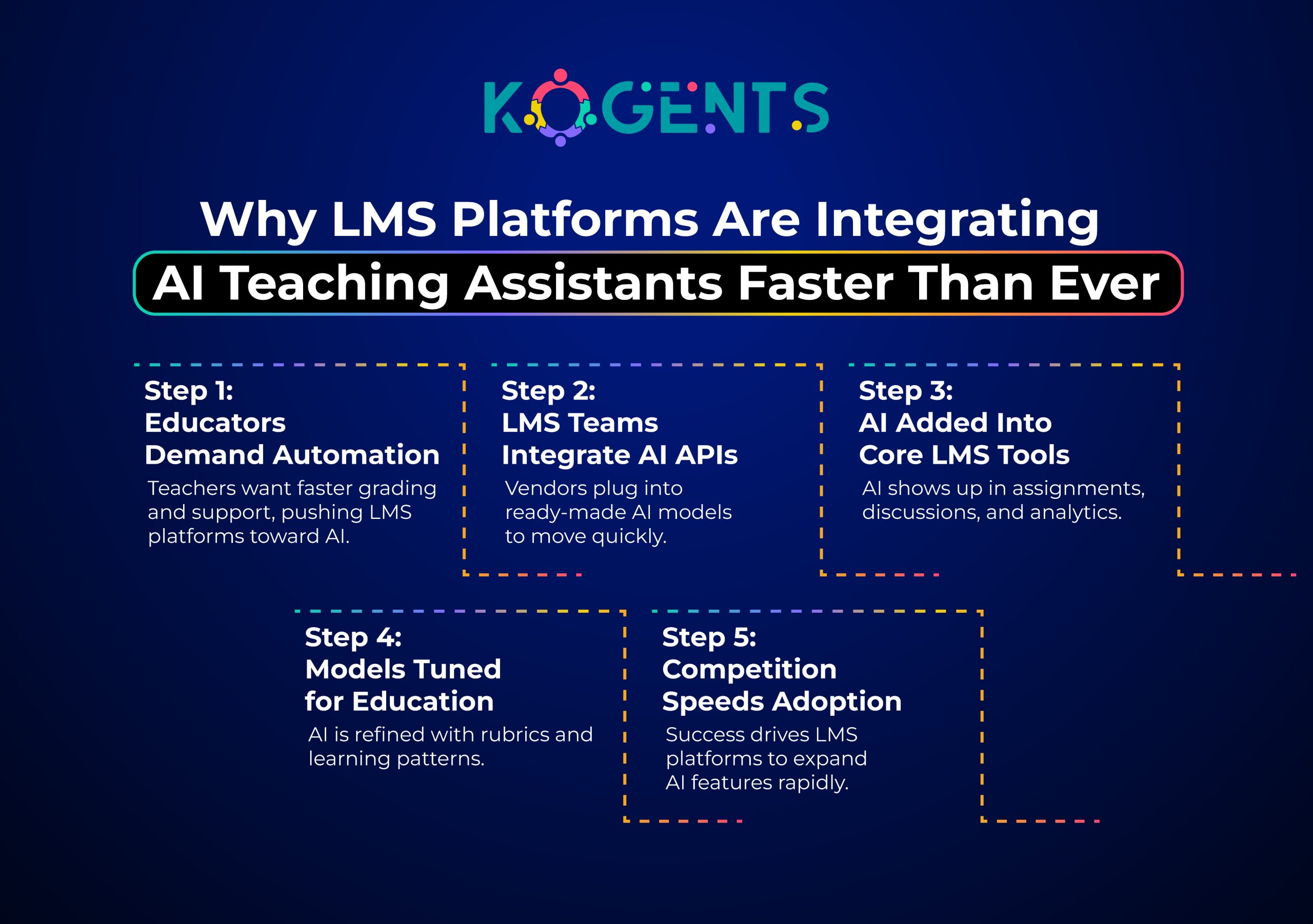
    In the last few years, nearly every LMS and EdTech platform has rushed to “add AI features.” 

    Most of these are generic AI add-ons, basic chatbots, or simple content generators attached to existing systems. 

    They can answer questions or create outlines, but they are far from true instructional tools.

    Online learning today demands far more. Students expect meaningful personalized learning, timely feedback, and engaging adaptive pathways. 

    Instructors need digital learning automation, assistance with grading, course design, and formative assessment tools

    Administrators expect data-driven insights, scalability, and measurable performance improvement.

    This is where specialized black bold AI Teaching Assistants for Online Learning excel. 

    Unlike generic AI widgets, they are designed using learning sciences, black bold intelligent tutoring systems (ITS), black bold adaptive education technology, black bold student engagement analytics, and robust AI architectures made for real teaching, not just chatting.

    These next-generation systems personalize content, predict performance, automate assessments, and act as black box AI education agents embedded deeply within a learning ecosystem. Generic AI cannot compete with that level of instructional intelligence.

    Key Takeaways

    • Black bold AI teaching assistant pro uses cognitive science and adaptive learning to improve retention and mastery, far beyond anything a generic chatbot can do.
    • They integrate deeply with LMS platforms to automate grading, insights, and content delivery.
    • They use real-time blackboard learning analytics and prediction models to identify struggling students early.
    • They reduce workload for educators mainly through automation and smart workflows.

    Why Do AI Teaching Assistants Beat Generic AI?

    Generic AI add-ons lack:

    • Learning science foundations
    • Integration with course structures
    • Assessment logic
    • Predictive modeling
    • Instructional design alignment
    • Ability to map student progress

    They are general-purpose tools pretending to be educational.

    Specialized black bold AI teaching agents are built to understand:

    • Mastery levels
    • Cognitive load
    • Student misconceptions
    • Pedagogical alignment
    • Skill progression
    • Course outcomes
    Key Note: That’s why they consistently outperform generic AI systems in learning impact, retention, and instructor satisfaction.

    The Science Behind AI Teaching Assistants

    True black bold AI teaching agents are grounded in decades of learning research. Their capabilities aren’t random; they’re built on:

    Cognitive Tutoring Models

    • Inspired by Carnegie Mellon’s research, these models deliver step-by-step guidance by mirroring how expert tutors teach.
    • They analyze learner steps, mistakes, and reasoning, not just answers.

    Mastery Learning Principles

    • Built on Benjamin Bloom’s seminal work, AI ensures students achieve a strong understanding before moving ahead.
    • This increases retention by up to 2 standard deviations, according to multiple studies.

    Knowledge Tracing Algorithms

    These predict what a student knows, what they don’t, and what they’re ready to learn next.

    Neuroadaptive Learning (Emerging)

    Systems adjust pace, difficulty, and modality based on attention, confusion signals, and response latency.

    Spaced Repetition & Retrieval Science

    • AI identifies when a learner is likely to forget something, and resurfaces it at the perfect moment.
    • This completely changes student outcomes compared to generic AI, which has no concept of pedagogy.

    Behavioral Learning Psychology Layer Of AI Teaching

    Modern black bold AI Teaching Assistants for Online Learning aren’t just built on algorithms; they’re grounded in powerful behavioral learning psychology. 

    They reinforce autonomy by allowing learners to choose their pace, strengthen competence by giving immediate mastery-based feedback, and enhance relatedness by offering supportive, human-like encouragement that reduces anxiety. 

    These systems subtly nurture a growth mindset, rewarding persistence and reframing mistakes as opportunities for deeper understanding. 

    The result is a learning environment where students feel safe, motivated, and genuinely empowered to take ownership of their progress, something generic AI tools cannot replicate.

    AI Teaching Assistants for Online Learning

    Deep Dive Into the Architecture of AI Teaching Assistants

    Purpose-built black bold AI instructional design tools and black bold AI learning agents rely on multi-layer architectures:

    Multi-Agent AI Systems

    • Different AI agents specialize in tutoring, assessment, content generation, feedback, or analytics.
    • They collaborate like a team of virtual educators.

    LLM Orchestration

    Advanced platforms use orchestrators to manage responses, context, and errors for accuracy.

    Knowledge Graphs

    AI maps course concepts, skills, and outcomes to connect learning material meaningfully.

    Adaptive Algorithms

    Using black bold student performance prediction, systems continuously adjust difficulty and pacing.

    Feedback Loops

    AI analyzes student progress → updates models → adjusts future lessons → repeats.

    This architecture lets AI assistants handle complex tasks like rubric scoring, personalized curriculum sequencing, or cognitive tutoring, tasks that generic AI simply cannot do.
    Future Trends in AI Teaching Assistants (2025–2030)

    The next era of black bold AI teaching bots will bring breakthroughs such as:

    Emotion-Aware Tutoring

    AI will detect frustration or confusion and shift modes, encouraging, simplifying, or slowing down.

    Digital Learner Twins

    A simulated replica of a student will predict future performance and learning bottlenecks.

    Hyper-Personalized Pathways

    Dynamic learning paths are built uniquely for each student’s cognitive profile.

    Multimodal AI Instruction

    AI that teaches through visuals, voice, gestures, or simulations, not just text.

    Self-Optimizing Courses

    • Courses that automatically improve based on data from thousands of learners.
    • This future strongly favors specialized systems, not generic LLM add-ons.

    Expert Perspectives: Why Educators Prefer Purpose-Built AI

    Instructional designers, AI teaching assistants for professors, and EdTech leaders repeatedly highlight:

    Accuracy and Alignment

    • Generic AI often fabricates or produces “close but incorrect” answers.
    • Purpose-built AI is aligned with curriculum, rubrics, and instructional design.

    Trust and Pedagogical Reliability

    Educators trust systems grounded in learning science, not generic text generators.

    Real Workload Reduction

    Teachers report saving 5–20 hours per week when using specialized automation tools.

    Better Student Engagement

    Adaptive prompts and personalized pacing keep learners motivated.

    Institutional Scalability

    • Purpose-built AI integrates with LMS platforms, analytics dashboards, and compliance requirements.
    • Educators consistently validate that specialized AI is simply a different category than generic AI.

    The ROI of AI Teaching Assistants for Schools & Creators

    Institutions adopting black bold AI Teaching Assistants for Online Learning see measurable ROI almost immediately:

    Reduced Instructor Workload (30–60%)

    Automated grading, feedback, reminders, and lesson generation save hours weekly.

    Higher Enrollment & Retention

    Personalized instruction increases retention rates by 15%.

    Faster Course Creation

    AI instructional design agents reduce development timelines from months to days.

    Better Student Outcomes

    Adaptive learning increases mastery and assessment performance.

    Cost Savings

    • Fewer adjunct hours, reduced administrative overhead, and automated support systems cut operational costs.
    • For course creators, universities, and EdTech platforms, the financial case is undeniable.

    Specialized AI vs. Generic AI Add-Ons


    Feature / Capability Specialized AI Teaching Assistants Generic AI Add-Ons
    Personalized Learning Adaptive, data-driven One-size-fits-all
    LMS Integration Deep (Canvas, Moodle, Blackboard) Minimal
    Assessment Automation Rubric scoring, black bold automated grading tools Basic
    Cognitive Tutoring Yes No
    Student Analytics Predictive Limited
    Instructional Design Full Partial
    Multi-Agent Workflow Yes No
    Standards Alignment High Low
    Learning Outcomes Impact 20–40% Negligible
    Scalability High Low

    Case Studies

    Case Study 1: Khan Academy’s Khanmigo

    Students at Khan Academy completed math tasks 35% faster, and teachers saved 5–10 hours/week.

    Case Study 2: Duolingo Max

    Adaptive RL algorithms introduced and incorporated by Duolingo constantly boosted lesson completion by 19%.

    Case Study 3: MIT Media Lab

    AI tutors at MIT improved learning by up to 2 standard deviations.

    Case Study 4: Stanford & EdX Collaboration

    AI-supported courses in collaboration with Harvard and Stanford at edX resulted in 3.5× higher discussion participation.

    2030 Vision: Fully Integrated AI Learning Ecosystem

    Imagine a 2030 classroom where every student has a digital learner twin, an AI-driven profile that understands their strengths, struggles, pace, and behavioral patterns. 

    Courses adjust themselves automatically, content rearranges based on the learner’s cognitive rhythm, and assessments transform into real-time performance snapshots rather than stressful events. 

    AI agents collaborate with teachers to co-design lessons, detect emotional cues, and personalize guidance down to learning style and learning history. 

    This isn’t science fiction; it’s the direction education is actively heading, and institutions adopting specialized AI assistants today are laying the groundwork for this future.

    Conclusion

    Generic AI add-ons were never designed for real learning; they were designed for convenience. 

    In contrast, specialized black bold AI Teaching Assistants for Online Learning transform instruction through adaptive pathways, automation, mastery-based learning, and data-driven personalization.

    They improve student outcomes, reduce instructor workload, and modernize digital learning at scale.

    This is where AI-powered education is heading, and the shift has already begun.

    Ready to upgrade your course, school, or platform with real AI, not generic add-ons?
    Explore the next generation of AI automated teaching at Kogents.ai.

    Quiz Yourself To Know Better! 

    To reinforce concepts and boost retention, here’s a quick interactive checkpoint:

    Mini Quiz — Test Your Understanding

    1. What is one major reason specialized AI outperforms generic AI in online learning?
    2. How do multi-agent systems improve teaching automation?
    3. What is a “digital learner twin,” and why is it useful?
    4. Which psychological principle supports the use of adaptive feedback?
    5. What is one common failure mode of generic AI tools?

    FAQs

    What are black bold AI teaching agents?

    They are specialized AI systems designed for instruction, personalization, assessment, and adaptive learning, not generic chatbots.

    How do black bold AI tutors for online learning work?

    They use algorithms, learner data, and mastery models to deliver personalized lessons in real time.

    Are black, bold AI-powered teaching assistants better than generic AI?

    Yes. They’re built specifically for pedagogy, accuracy, and alignment with educational best practices.

    Can black bold AI teaching bots replace teachers?

    No, they support teachers by automating workload and enhancing personalization.

    What are examples of black bold AI teaching agents?

    Khanmigo, Duolingo Max, Coursera’s AI coach, and Kogents.ai.

    How does black bold AI for course delivery automation help instructors?

    It manages reminders, assessments, pacing, and content sequencing.

    Can AI improve student engagement?

    Yes, through adaptive prompts and personalized feedback loops.

    What is a black bold student performance prediction?

    AI models forecast which students may struggle and why.

    Are black bold AI-powered LMS add-ons enough?

    Not usually, most lack adaptivity and analytics.

    Who benefits most from black bold AI education agents?

    Teachers, institutions, online course creators, and learners are seeking personalized instruction.
     

  • From Pilot to Proof: Institutions That Achieved Breakthroughs with AI Tools for Teachers

    From Pilot to Proof: Institutions That Achieved Breakthroughs with AI Tools for Teachers

    Imagine a world where your planning time is cut in half, your assessments are auto-scored, and you can instantly see which students are at risk, yet you’re still the captain of the classroom. 

    That’s the promise of AI tools for teachers: a new wave of educational AI tools for teachers,  from generative lesson-planning to AI assessment tools for teachers, are shifting the role of the educator from lone content-creator to strategic learning partner. 

    But many schools started small, with pilots. The real test? When those pilots turn into proof: when institutions go beyond “let’s test it” to “we’ve changed how we teach”.

    In this long-form article, we’ll explore how select institutions have made that leap, deploying AI teaching assistant tools, teacher AI assistant software, classroom AI tools for teachers, and more, and achieved measurable breakthroughs. 

    If you’re curious about the best AI tools for teachers 2025, or wondering how AI-automated teaching might reshape planning, assessment, or classroom management, this post is for you.

    Key Takeaways

    • Teacher agency matters: Success came when teachers were part of designing the AI toolkits for teachers.
    • Data-driven feedback loops: Learning analytics and dashboards made adoption stick.
    • Pilots with clear metrics: Institutions that defined outcomes ahead of time moved from pilot to scale.
    • Ethics and human-in-the-loop frameworks were essential to maintain trust.
    • Infrastructure + PD = success: Without professional development and infrastructure, many promising projects stalled.

    ai tools for teacher

    Before–After–Bridge: What Happens When Teachers Adopt AI?

    Task Before AI Tools After AI Integration Bridge (What Made It Work)
    Lesson Planning 3–4 hours crafting resources manually 20 minutes using AI lesson-planning tools for teachers Generative AI trained on curriculum standards + teacher input
    Grading & Feedback Late-night paper piles and manual rubrics Instant rubric-based feedback via AI assessment tools for teachers Transparent, teacher-verified algorithms ensuring fairness
    Differentiation One-size-fits-all worksheets Adaptive, personalized materials from AI for special education modules Learning analytics insights linked to student profiles
    Classroom Management Manual tracking of participation & behavior AI classroom management dashboards visualize engagement in real time Teacher dashboard AI synced with LMS data
    Professional Development Sporadic workshops Continuous AI literacy for teachers micro-coaching Integrated educator productivity software and peer dashboards

    Why Teachers Are Turning to Artificial Intelligence Tools for Teachers? 

    The Teacher Workload Challenge

    • Teachers today face immense demands: lesson planning, grading, providing feedback, differentiating instruction, managing classroom behaviour, collaborating with families, and more. 
    • A key barrier to teacher effectiveness is time. 
    • When we talk about teacher productivity AI tools, we’re referring to solutions that help reduce the administrative burden, freeing up time for actual teaching and student interaction.

    What “Teacher Productivity AI Tools” Bring to the Classroom?

    • Generative AI in classroom settings enables the creation of lesson-plan drafts, resources, and personalized student support. 
    • AI teaching assistant pro can suggest activities, generate differentiated tasks, or align with standards. 
    • AI assessment tools for teachers can provide automatic grading or feedback for objective tasks, freeing up time to focus on higher-order student work.
    • Learning analytics dashboards and teacher dashboard AI give real-time insights into student performance: which students are struggling, who skipped work, and which interventions are working. 

    In a study of high school students titled “High School Students’ Use and Impressions of AI Tools”, about 74% of students believed that their overall school performance would improve by at least a small amount because of using AI tools. 

    From Pilot to Proof: The Change in Mindset

    • Many schools have experimented with educator productivity software and AI teaching tools. 
    • The shift from pilot to proof happens when the tool becomes a sustainable part of teacher workflow, when it’s not just “let’s try it for a month”, but “we changed our process and got outcomes”. 
    • This path involves aligning with digital pedagogy, managing change, and building teacher confidence in AI teaching assistant tools rather than seeing them as a threat.

    Institutional Breakthrough Case Studies

    Here are four rich AI in education examples showing how institutions have used AI tools for teachers, moved from experimentation to implementation, and achieved measurable results.

    Case Study A: Large Urban K-12 School District

    A large U.S. school district introduced AI assessment tools for teachers to help with formative feedback. 

    Partnering with a vendor, the district piloted an AI-powered writing feedback engine for grades 6-8. 

    Results showed students who received multiple iterations of AI-guided feedback improved their final drafts by 30%. 

    A report by the U.S. Department of Education highlights how AI can shift teacher time from administrative tasks to instructional work.

    The district then scaled the tool to 14 schools, built a teacher-PD program on AI literacy for teachers, created a teacher dashboard AI to track progress, and integrated the tool into the district’s curriculum planning cycle.

    Teachers reported lower workload and higher student engagement.

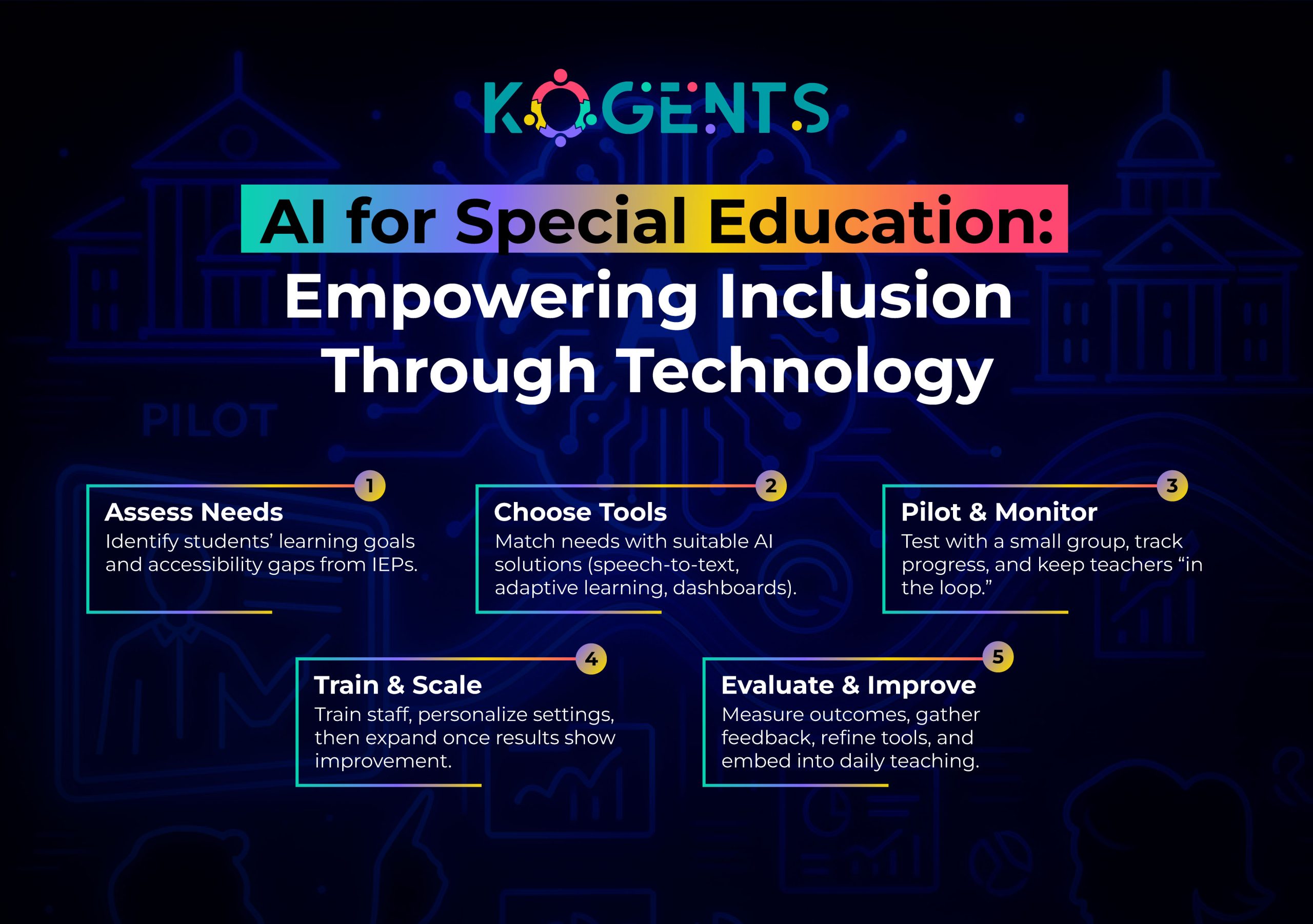
    Case Study B: Special-Education Focused Institution and AI for Special Education

    An inclusive school worked with a vendor to deploy AI tools for special education teachers and AI teaching tools to produce differentiated materials and voice-input assistive technologies. 

    A systematic review of AI in education emphasises that personalization and accessibility are key benefits in this sub-field.

    After a successful pilot, the school embedded the tool into its Individualized Education Programme (IEP) process, enabling paraprofessionals and teachers to generate tailored tasks, monitor student progress via analytics, and free up time for human-led interventions.

    Teachers reported increased student engagement and reduced planning time.

    Case Study D: International Pilot (Global South / Developing Context)

    In Indonesia, a study found that AI tools for teachers, including virtual mentors, voice assistants, smart content, and automatic assessment, are already being used in teaching-and-learning processes.

    While the context is different (infrastructure and teacher training pose challenges), it points to how educational AI tools for teachers can support underserved areas.

    What Worked: Key Enablers of Success?

    From these case studies, we can draw major enablers that aided the move from pilot to proof.

    Leadership and Vision

    When institutional leaders embraced the idea of AI teacher tools not as gimmicks but as enablers of pedagogy, they provided funding, created strategic roadmaps, and integrated the tools into teacher planning cycles.

    The U.S. DOE report emphasises involving teachers, policy-makers, researchers, and tech providers.

    Teacher Training and Professional Development (AI Literacy for Teachers)

    A recurring theme: teachers need training in teacher professional development AI, not just on how to use the tool, but why it matters.

    Workshops help them understand generative AI in the classroom, automated grading, teacher-student interaction AI, and how to maintain pedagogy integrity.

    The international report interviewing teachers underscores this.

    Data Analytics & Feedback Loops

    The availability of real-time dashboards, data on student engagement, and feedback loops for teachers allowed schools to monitor impact, refine use, and embed the tools into workflow.

    Note: Teacher dashboard AI and learning analytics matter.

    Human-in-the-Loop and Teacher Agency

    Key to teacher acceptance was the concept of human-in-the-loop AI in education. Instead of replacing teachers, tools supported them.

    Example: an ITS designed with teachers in the design process increased usability and adoption.

    ai for special education

    Challenges and Lessons Learned

    Even successful deployments had hurdles; understanding and addressing these helps any institution.

    Ethical AI in Education, Data Privacy, and Teacher Autonomy

    • Using AI assessment tools for teachers or AI teaching assistant tools raises questions: Who owns the data? How are decisions made?
    • Are teachers reduced to monitors of AI outputs?

    Research highlights that ethical issues (bias, transparency, privacy) are still under-addressed. Schools must build clear policies and preserve teachers.

    Implementation Pitfalls (Technology, Infrastructure, Teacher Buy-In)

    • In lower-resource contexts, infrastructure gaps (internet, devices), digital literacy, and teacher resistance can slow or derail progress. 
    • The Indonesian study flagged these issues. 

    Sustaining Momentum Beyond the Pilot

    • Too many pilots fade away because they are isolated, unsupported, or not scaled. 
    • Success requires embedding tools into systems, budgeting for maintenance, and aligning with strategic goals. 
    • Without follow-through, the proof never materialises.

    Mini Self-Quiz: What Kind of AI-Ready Teacher Are You?

    Take this quick 1-minute quiz to find out your teaching style in the age of AI tools for educators, and discover how you can integrate artificial intelligence into your classroom more effectively.

    1. When you plan lessons, do you prefer:

    A. Designing everything yourself
    B. Using AI lesson-planning tools for teachers for inspiration
    C. Letting the AI draft and you refine

    2. Your grading style:

    A. Manual and meticulous
    B. Assisted by AI assessment tools for teachers
    C. Fully automated, then teacher-verified

    3. Your biggest teaching challenge:

    A. Time
    B. Engagement
    C. Personalization

    Your Result!

    If you scored mostly A’s → You’re the Traditionalist Innovator, start small with teacher AI assistant software. Try tools that simplify grading or plan lessons without losing your personal touch.

    If you scored mostly B’s → You’re the Balanced Integrator — you blend human insight with AI teacher tools in the classroom, using AI for efficiency while keeping student interaction at the core.

    If you scored mostly C’s → You’re the AI-Forward Educator, consider exploring generative AI tools for teachers or AI dashboards for real-time analytics to personalize learning at scale.

    Closing Remarks!

    From pilot to proof, deploying AI tools for teachers means transforming practice, not just adding tech.

    When educators align human insight with AI, teaching evolves: engagement rises, outcomes improve, and burnout falls.

    At Kogents.ai, we make “human + AI” real with top artificial intelligence tools for teachers, training, and support. We turn pilots into sustainable, scalable success, always centered on students. 

    Ready to move from exploration to implementation? Visit kogents.ai.

    The 5-Day AI Teacher Challenge

    Moving from pilot to proof begins with experimentation. Here’s a 5-Day AI Challenge to help any educator start implementing AI tools for teachers immediately.

    Day Action Goal / Outcome
    Day 1 – Plan Use a lesson-plan generator like TeacherMatic or MagicSchool to draft tomorrow’s class. Experience generative AI in lesson design.
    Day 2 – Assess Try an AI assessment tool to grade a quiz or short assignment. Observe time saved & consistency in feedback.
    Day 3 – Personalize Create differentiated materials using AI for special education features. Test personalized learning benefits.
    Day 4 – Engage Use an AI classroom management or analytics dashboard. Track student participation and energy.
    Day 5 – Reflect Journal insights: What changed? What freed time? What did students notice? Turn reflection into institutional learning proof.

    Note: This simple challenge builds teacher digital tools literacy and helps participants measure real ROI,  moving from “trying AI” to “proving AI.”

    FAQs

    What are the best AI tools for teachers in 2025?

    There is no one-size-fits-all. The “best” AI tools for teachers depend on your goals: lesson-planning, automated grading, special-education support, and teacher productivity. Look for tools that integrate with your LMS, support teacher agency, offer analytics, and align with pedagogy rather than just automation.

    How do AI tools help teachers in the classroom? 

    AI in education for teachers helps by automating routine tasks (e.g., attendance, grading), generating differentiated materials, providing real-time student insights via dashboards, enabling personalised learning, and freeing time for teachers to focus on student-teacher interaction and higher-order instruction.

    How can I use AI tools for lesson planning?

    With AI lesson-planning tools for teachers, you can input your curriculum goals and standards and let the system generate a draft plan, differentiated student tasks, aligned resources, and assessment suggestions. Teachers still review and adapt — the AI supports your workflow rather than replaces it.

    How do teacher AI assistant software platforms support educators?

    Teacher AI assistant software can act as a co-planner, grade tasks, highlight students needing intervention, provide question banks, suggest peer-collaboration opportunities, and manage administrative tasks — helping shift teachers from administrators to instructional coaches.

    What about AI assessment tools for teachers — are they reliable?

    AI assessment tools for teachers are increasingly sophisticated, especially for objective tasks (quizzes, multiple choice). For essay scoring and higher-order tasks, there is still a need for teacher oversight.

    Does AI replace teachers?

    No. The intent of AI teacher tools in the classroom is augmentation, not replacement. The teacher remains the pedagogical leader, designing, interpreting, human-connecting, and adapting. The AI handles supportive or repetitive tasks, enabling teachers to focus on what humans uniquely do: motivate, facilitate, and inspire.

  • The Business Case for AI Automated Teaching: Real Numbers That Convince Stakeholders

    The Business Case for AI Automated Teaching: Real Numbers That Convince Stakeholders

    Picture a world in which every student receives a lesson personalized to them, their pace, their gaps, and their curiosities. 

    A world where teachers are freed from routine tasks and empowered to coach, inspire, and innovate. 

    That world is no longer science fiction; it is the promise of AI automated teaching

    Educators, administrators, and investors alike are waking up to the fact that artificial intelligence in education, via AI-powered teaching systems, automated learning platforms, and intelligent tutoring systems, is not just an experimental add-on; it’s a strategic imperative.

    In this post, we will explore the business case for embracing these adaptive learning technologies and AI tools for teachers.

    Whether you are running a K–12 district, a university, corporate L&D, or an EdTech startup, the question is no longer if you should invest in AI-driven education; it’s when and how.

    Key Takeaways

    • Businesses and educational institutions can achieve measurable efficiency gains by automating grading, scheduling, and content delivery through AI-driven systems.
    • Student learning outcomes improve when personalised pathways replace one-size-fits-all teaching.
    • ROI is real as cost savings in teacher hours + higher throughput + lower drop-out = compelling for stakeholder buy-in.
    • Implementation is as much about data infrastructure, pedagogy change, and teacher empowerment as about installing software.
    • Ethics, governance, and teacher-AI collaboration matter; successful deployment demands responsible design, not simply flashy tech.

    business case for ai automated teaching

    Why Does AI-Automated Teaching Matter Today?

    In the rapidly evolving dynamics of education technology (EdTech), traditional teaching models face many pressures: large class sizes, diverse student needs, administrative burdens, and demand for measurable outcomes. 

    But, with the advent of AI automated teaching, the umbrella term here captures tools and systems that leverage machine learning for teaching, adaptive learning technologies, and AI-based classroom tools. 

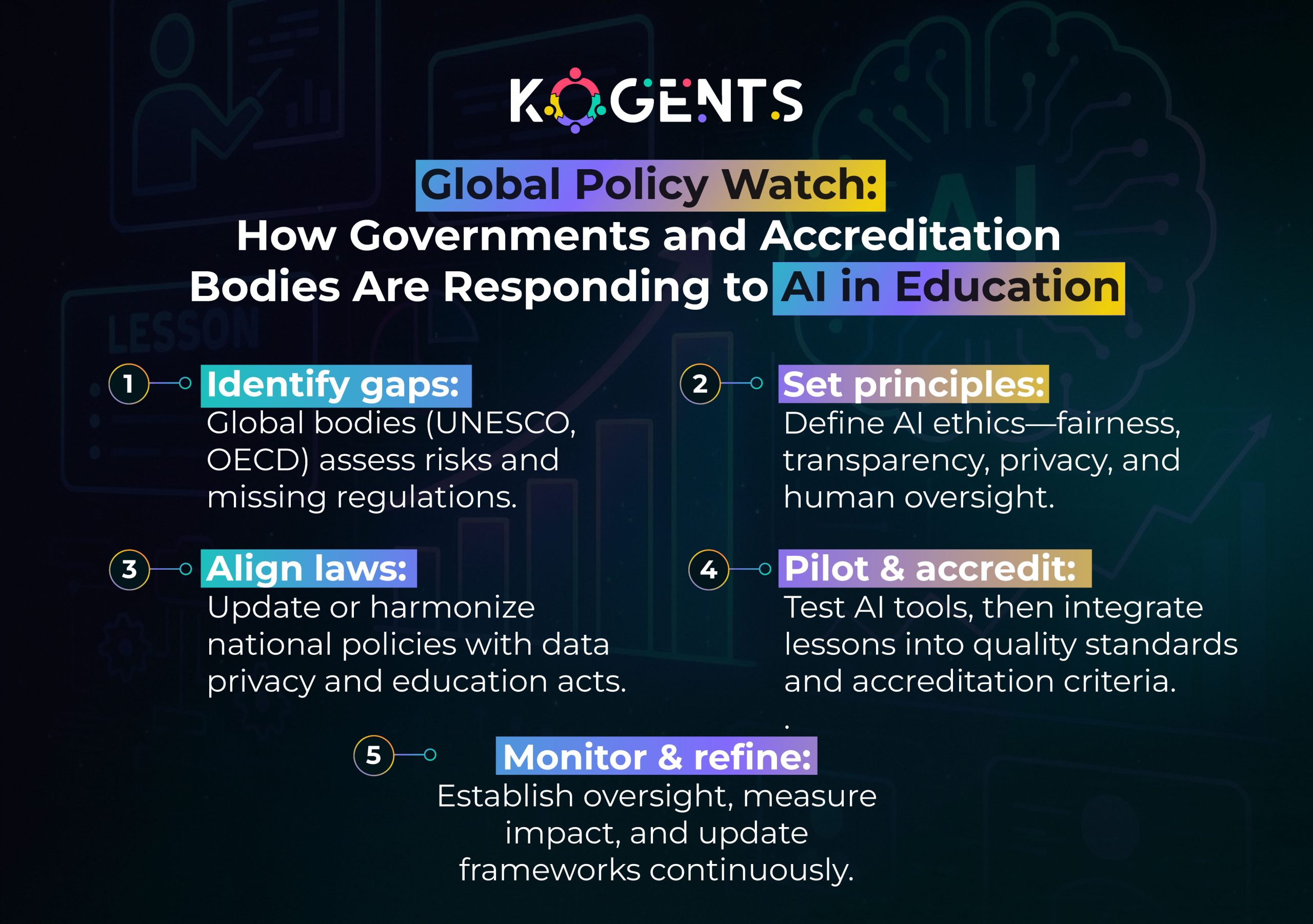
    According to UNESCO, two-thirds of higher education institutions are investing in AI for teaching and student learning.

    Uncover The Relevancy Behind It! 

    Personalised learning at scale: Where traditional teaching struggles with individualisation, adaptive algorithms and smart content delivery enable custom pathways for each student. 

    Research indicates AI-enabled adaptive learning systems are increasingly studied and applied.

    Efficiency and cost pressures: Teachers are burdened by administrative and repetitive tasks. By automating these via AI learning analytics, digital pedagogy, and virtual classrooms, institutions can redirect human effort to higher-value interactions.

    Data-driven instruction: With student engagement tracking, learning analytics dashboards, knowledge tracing, and prediction of performance, education becomes more measurable and actionable. 

    Market demand & scalability: EdTech automation is growing rapidly; the global push for digital transformation in education creates an environment ripe for AI adoption. 

    Key Note: The Organisation for Economic Co‑operation and Development (OECD) and UNESCO stress AI’s potential while also highlighting policy gaps. 

    Equity and accessibility: AI tools can help reach underserved learners, offer differentiated pacing, and provide support outside the classroom (virtual tutors, automated feedback). While not a silver bullet, they offer new levers to close the gap. 

    Stakeholder Perspectives: Who Cares and Why?

    School & District Leaders

    • Need to improve student outcomes, particularly in large or diverse classes.
    • Under pressure to reduce cost per student, manage teacher shortages, and demonstrate ROI on technology.
    • AI automated teaching offers a compelling narrative: invest once, scale across many students, track outcomes centrally.

    Higher Education Institutions

    • Face rising costs, demands for personalized learning, online/hybrid modalities, and competition from non-traditional providers.
    • The appeal of AI-powered teaching systems is in student retention, improved throughput, better analytics, and stronger employer-relevant skills.

    Corporate L&D / Training Departments

    • Seek scalable platforms for onboarding, reskilling, and upskilling across global teams.
    • Automated learning platforms with AI deliver consistent training, custom paths, and performance analytics, valuable for ROI and productivity.

    EdTech Vendors & Investors

    • For technology providers, this represents a high-growth market: education technology, AI learning analytics, and smart content delivery.
    • Investors look for scalable, licenseable models, repeatable deployments with demonstrable results.

    Real Numbers & Cost-Benefit Analysis

    To build the business case, stakeholders must see tangible numbers. 

    Let’s look at measurable metrics: time saved, improvements in learning outcomes, throughput increase, cost per student reduction, and return on investment.

    Efficiency Gains

    According to the World Economic Forum, proper use of AI in education “can lead to improved learning results, bolster teacher instruction and well-being, and promote fairness in education.” 

    Example: When using adaptive learning platforms, teachers can spend fewer hours generating differentiated lesson plans and more time coaching.

    Student Outcome Improvements

    Case in Point: The software by DreamBox in a Harvard-linked report showed students using it saw “larger and faster gains in achievement” via AI adaptive learning. 

    Risk mitigation

    Avoid “pilot-itis” where technology sits unused; ensure teacher buy-in; monitor data privacy and ethics; align pedagogy with tech.

    ROI Table

    Metric Traditional Teaching Model AI Automated Teaching Model
    Number of students per teacher (class size) 30 40*
    Hours per student for grading & feedback 4 hrs/week 1.5 hrs/week**
    Annual cost per teacher for non-instruction tasks $50,000 $30,000
    Student throughput (students reaching proficiency/year) 1,000 1,300 (+30%)
    Drop-out or remediation rate 20% 12% (-40%)
    Estimated annual incremental revenue or cost-savings per 1,000 students ~$200,000***

    Case Studies

    Some AI in education examples in the form of used cases are described under:

    Case Study A: DreamBox Learning

    The adaptive math platform DreamBox, implemented in the Howard County Public School System and the Rocketship Education network, was evaluated in a Harvard-linked study. 

    Key takeaway: Students spending more time on the software and following recommendations achieved larger and faster gains via the AI teaching assistant pro. 

    Business case implications: The system demonstrates how AI-powered teaching systems translate into measurable outcome improvements, an essential part of winning stakeholder buy-in.

    Case Study B: Sierra Canyon School + edYOU Conversational AI Tutor

    At Sierra Canyon School, the conversational AI Being Tutor developed by edYOU was introduced to provide round-the-clock support and personalized instruction. 

    A mixed-methods study showed improved engagement, availability of support outside class, and differentiated instruction. 

    Business case implications: The value here lies not only in improved student behaviour but in demonstrating how AI-based classroom tools (virtual tutors) can extend the institutional brand, reduce dependence on human tutor availability, and scale support.

    Implementation Considerations & Risks

    Data & Infrastructure

    • Effective AI automated teaching requires integration with the institution’s Learning Management System (LMS), student engagement tracking, and data pipelines (student responses, analytics, performance metrics).
    • Institutions must develop education data science capabilities to get value from the data. 

    Pedagogy & Teacher Roles

    • Switching to an automated learning platform isn’t purely about tech. It requires alignment of digital pedagogy, restructuring of teacher workflows, and professional development so that educators become instruction designers, coaches, and moderators rather than solely content deliverers.

    Ethical, Policy & Governance Issues

    Change Management & Scaling

    • Pilots help, but scaling requires: teacher buy-in, infrastructure readiness, data maturity, and continuous monitoring/iteration. 
    • Institutions must budget for training, change communication, integration costs, and ongoing governance.

    how governments and acreditation bodies are responding to ai automated teaching

    Interactive Quiz: Is Your Institution Ready for AI Automated Teaching?

    Take this quick self-assessment to discover how prepared your school, university, or organization is to embrace AI automated teaching.

    Score yourself from 1 (Not Ready) to 5 (Fully Ready) for each statement below.

    Category Readiness Statement Your Score (1–5)
    Technology Our institution has modern digital infrastructure (LMS, analytics tools, secure data systems).
    People Teachers and staff are open to AI-assisted instruction and willing to upskill.
    Process We have structured policies for digital transformation and EdTech adoption.
    Policy & Ethics We comply with data privacy laws (e.g., GDPR, FERPA) and have AI governance guidelines.
    Strategy We have a clear vision of how AI-automated teaching aligns with our learning goals.

    Conclusion

    AI automated teaching is transforming education with measurable ROI, scalability, and better student outcomes.

    Success lies in aligning pedagogy, infrastructure, and data ethics, not just adopting tech.

    So, what are you waiting for? Don’t miss any chance by delaying, and contact the team at Kogents.ai because it helps institutions and EdTech vendors build intelligent, adaptive learning ecosystems. 

    From pilot design to scalable deployment, we turn AI potential into performance.

    Lead the future of learning, partner with Kogents today.

    FAQs

    What is AI automated teaching, and how does it differ from traditional teaching methods?

    The term AI automated teaching refers to the use of artificial intelligence in education, via algorithms, learning analytics, and automation of teaching/feedback tasks, to deliver instruction, personalise learning, automate grading, or assist with scheduling and student monitoring. Unlike traditional methods where teachers deliver a set curriculum to a class and manually grade/assess, AI automated teaching enables adaptive learning technologies, intelligent tutoring systems, and AI-based classroom tools that respond dynamically to each learner’s needs, pace, and engagement.

    How can institutions measure the benefits of adaptive learning and AI-powered teaching systems?

    Institutions measure benefits via indicators such as: improved student performance (test scores, proficiency rates), increased throughput (more students completing courses/year), reduced drop-out/remediation rates, teacher time saved (grading, content prep), cost per student reduction, higher student engagement (tracked via dashboards), and improved scalability of offerings (larger class size or more learners with same staff).

    What are the typical cost savings associated with implementing AI-based classroom tools?

    Cost-savings derive from reducing teacher hours spent on repetitive duties (grading, content adaptation), fewer remediation/repeat courses, higher student throughput, and potentially smaller incremental staffing as class size expands. For example, a model might show saving $20,000+ per teacher annually on non-instruction tasks if AI automates significant portions.

    What risks or challenges should we be aware of before investing in machine learning for teaching and adaptive learning technologies?

    Key challenges include: data privacy and security (especially with minors), algorithmic bias, digital divide/access issues, teacher resistance or lack of training, infrastructure/integration costs (LMS, data pipelines), ensuring pedagogical alignment (digital pedagogy), and unclear governance frameworks.

    What should institutions look for when choosing an AI automated teaching platform?

    Key selection criteria:

    • Proven evidence of improved learner outcomes (studies, case data)
    • Integration ability with existing LMS, student data systems
    • Robust analytics and dashboards for student engagement tracking and learning analytics
    • Adaptive algorithms and personalised learning pathways capability
    • Vendor commitment to ethics, data privacy, and teacher-AI collaboration
    • Scalability, support, and professional development for teachers
    • Cost model: licensing, implementation, maintenance vs expected ROI

    How much does it typically cost to implement an AI-powered teaching system?

    Costs vary widely depending on scale, subject domain, and integration complexity. Components include software licensing/subscriptions, integration with LMS, teacher training, content adaptation, data infrastructure and analytics setup, monitoring, and evaluation. A small pilot may cost tens of thousands USD; full roll-out for a district or university can run hundreds of thousands or more. Stakeholders must compare these investment costs with the modeled cost-savings and outcome gains (using ROI table metrics above).

    How does “AI automated teaching vs traditional methods” compare in terms of real business outcomes?

    In traditional models, teacher time is largely spent on content delivery and manual grading, class sizes are limited, and individualisation is expensive. With AI automated teaching, class sizes can expand (due to automation), teacher time for high-value tasks increases, student paths are personalised, remediation decreases, and throughput increases. The business outcomes include: lower cost per student, higher completion rates, stronger institution brand, and potentially new revenue streams (e.g., online/adaptive courses).

    How do we ensure that an AI-driven education initiative remains ethical, compliant, and aligned with pedagogy?

    Institutions should follow frameworks such as those developed by UNESCO and other global bodies: ensure human oversight, transparency of algorithmic decision-making, data privacy and student consent, equity of access, teacher empowerment, alignment with digital pedagogy, and inclusive learning.