Your teams are drowning in disconnected systems. Right now, your support team is manually logging customer issues in one platform while your sales team operates in a completely different CRM universe, and your operations team struggles with spreadsheets that should have been automated years ago.
But here’s the game-changer: AI agents aren’t just another technology buzzword; they’re the missing bridge connecting your fragmented business operations ecosystem.
These intelligent systems, powered by artificial intelligence for operational efficiency, are transforming how organizations streamline, optimize, and scale their cross-functional workflows.
Imagine a world where your customer support inquiry automatically triggers relevant sales follow-ups, updates inventory systems, adjusts operational workflows, and provides predictive analytics for future demand, all without human intervention.
This isn’t science fiction; it’s the reality of AI-driven operational efficiency that forward-thinking enterprises are leveraging today.
The stakes couldn’t be higher. Companies implementing AI solutions for operational efficiency report faster turnaround times, substantial error reduction, and average annual savings.
Yet, 70% of organizations still operate with disconnected systems that hemorrhage resources, frustrate customers, and stifle growth.
Key Takeaways
- AI agents eliminate data silos by creating unified intelligence layers across support, sales, and operations, improving data-driven decision-making by more than half.
- Intelligent automation powered by AI reduces manual handoffs between departments, achieving productivity improvement in cross-functional processes.
- Real-time analytics and predictive modeling enable proactive issue resolution, increasing customer satisfaction scores by an average.
- AI-powered operational optimization delivers cost optimization, ranging from process orchestration and resource optimization.
- Enterprises implementing enterprise AI for operational efficiency achieve competitive advantages with faster innovation cycles and enhanced operational resilience.
How AI Agents Actually Bridge Support, Sales, and Operations?
Most enterprises do not suffer from insufficient software; they suffer from uncoordinated intelligence.
- Support systems resolve issues without influencing sales or operations
- Sales systems close deals without operational awareness
- Operating systems optimize internally without a customer or revenue context
This creates systemic inefficiency: delayed resolutions, broken promises, revenue leakage, and reactive operations.
The issue is not data availability; it’s data isolation and delayed decision-making.
AI agents solve this by acting as cross-system decision layers, not just connectors.
What Makes AI Agents Different From Traditional Automation?
AI agents are autonomous, context-aware orchestration systems that operate across platforms.
Unlike rule-based automation or RPA, AI agents:
- Interpret unstructured signals (tickets, conversations, documents)
- Make probabilistic decisions under uncertainty
- Coordinate actions across departments, not within one workflow
- Improve over time through feedback and outcome learning
They do not simply move data; they decide what should happen next, based on business context.
Think of AI agents as operational intelligence, not automation scripts.
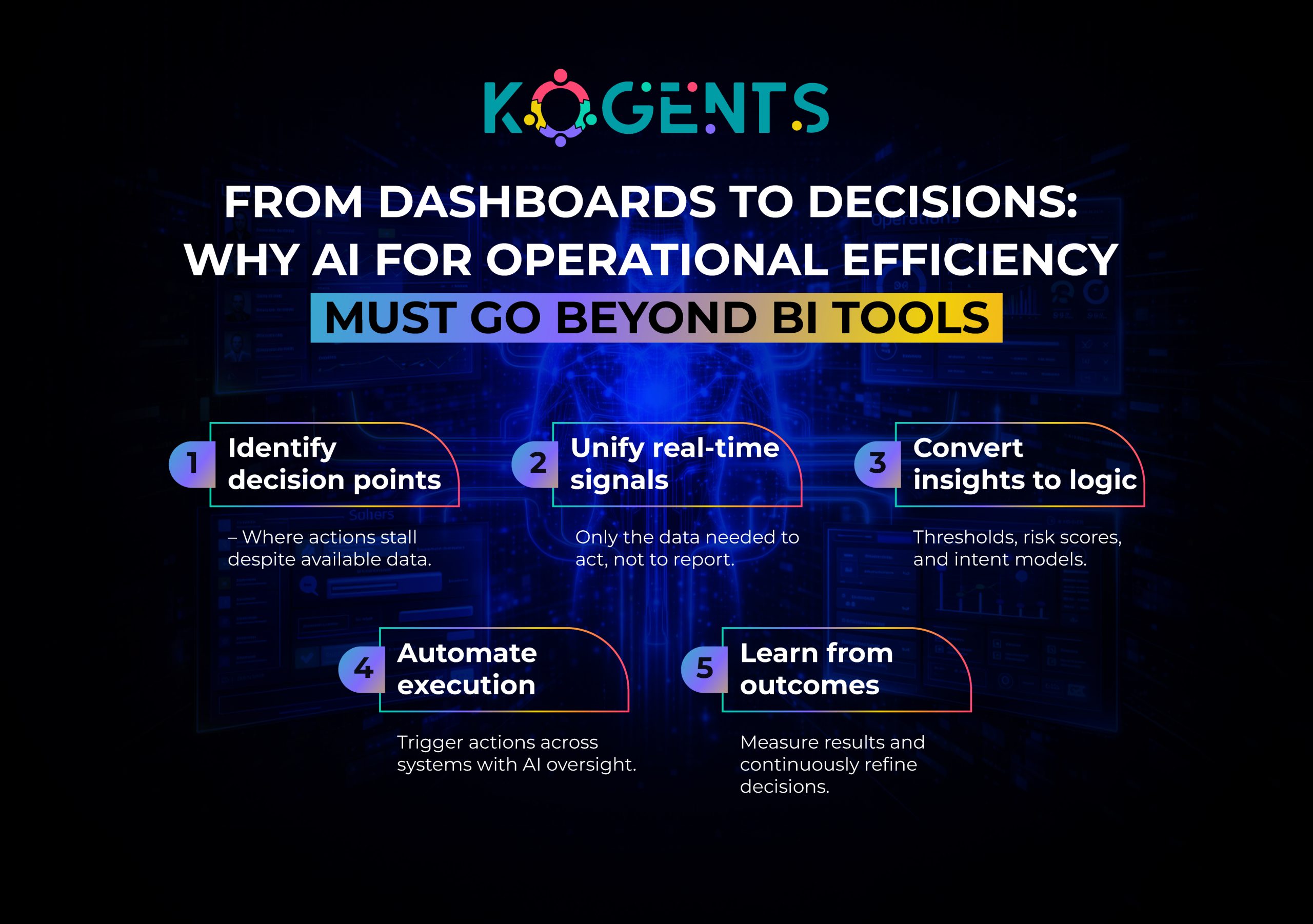
The Three Capabilities That Enable Cross-Functional Intelligence
1. Intelligent Data Orchestration (Single Source of Action)
AI agents create a virtual intelligence layer across CRM, support platforms, ERP, inventory, and analytics systems.
Key outcomes:
- Real-time synchronization instead of batch updates
- Unified customer, order, and capacity views
- Elimination of manual reconciliation
This enables decisions to be made on current reality, not stale reports.
2. Context-Aware Process Automation
AI agents do not follow static rules. They understand why something is happening.
Examples:
- A support ticket is escalated not because of keywords, but because sentiment + customer value + order risk exceed a threshold.
- A sales opportunity is deprioritized because operational capacity is expected to be constrained next quarter.
- Inventory workflows adjust because support tickets signal a quality issue before defects spike
This reduces errors dramatically compared to rule-based systems, enabling anticipatory operations.
3. Autonomous Decision Orchestration
The real value emerges when AI agents coordinate actions across teams without human handoffs.
Examples:
- Support issues automatically trigger operational adjustments and sales outreach.
- Sales forecasts dynamically reconfigure production schedules.
- Operations constraints feed back into pricing, promotions, and deal qualification.
This replaces fragmented decision chains with continuous, closed-loop execution.
Transforming Support Into a Strategic Intelligence Engine
From Ticket Resolution to Revenue and Retention Intelligence
AI agents turn support systems into early-warning and opportunity-detection platforms.
They unify:
- Omnichannel interaction history
- Customer purchase and usage data
- Delivery status and operational constraints
- Sentiment and churn risk indicators
This allows support to act proactively, not reactively.
High-Impact Capabilities
Intelligent Routing
Issues are routed based on business impact, not queue logic.
Churn Prevention
AI detects dissatisfaction patterns and triggers coordinated retention workflows before customers leave.
Support-to-Sales Bridging
Upsell and expansion opportunities are identified during support interactions and passed to sales with full context, no manual qualification.
Result: Support becomes a growth signal, not a cost center.
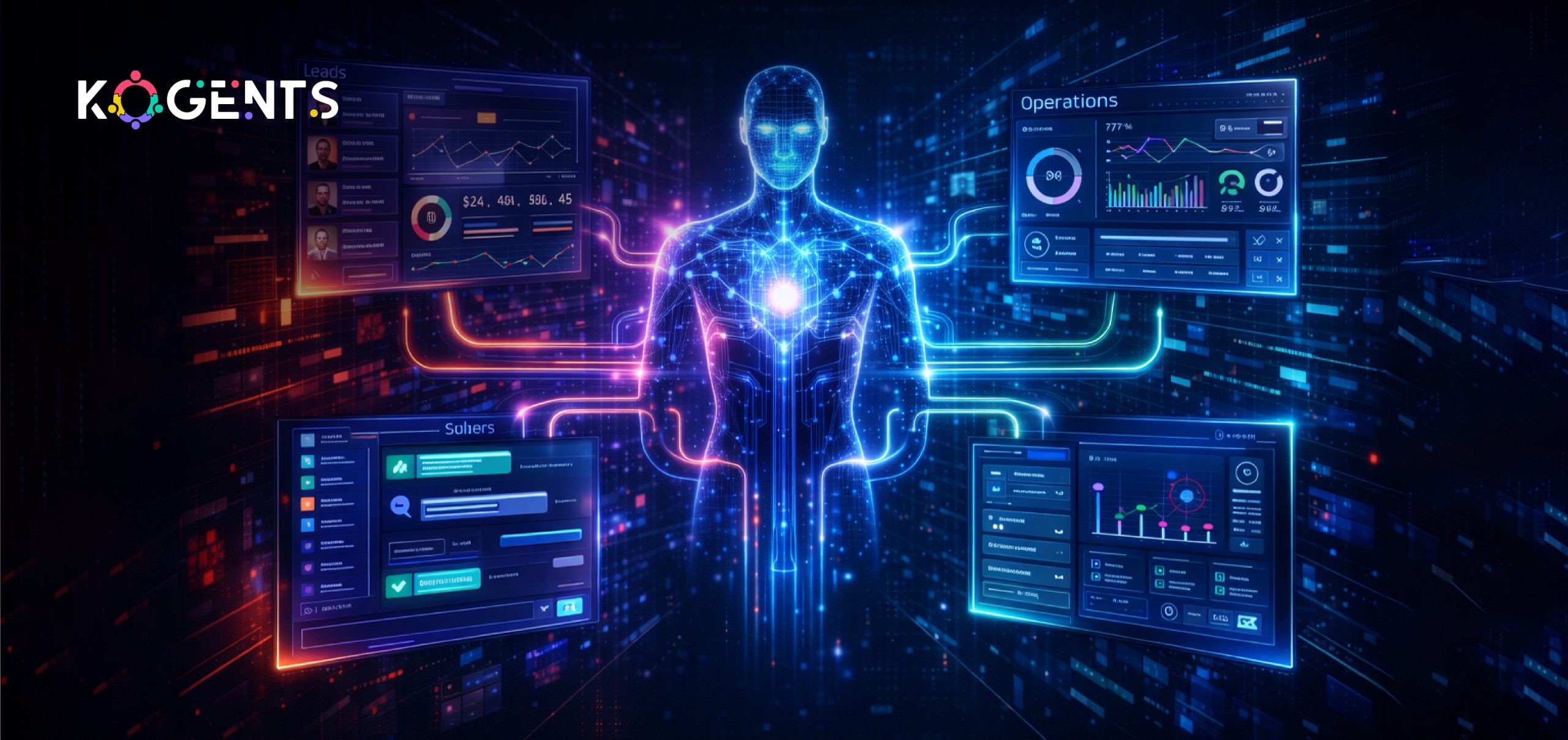
Sales Becomes Operations-Aware This Way!
Ending the Gap Between Promises and Delivery
AI agents connect CRM systems to real-time operational reality.
Sales teams gain:
- Live inventory and capacity visibility
- Awareness of customer support history and unresolved issues
- Predictive insights into customer readiness and risk
This prevents overcommitment, reduces post-sale friction, and shortens sales cycles.
Predictive Revenue Operations
Instead of static forecasts, AI agents evaluate pipelines using:
- Historical sales patterns
- Support satisfaction trends
- Operational readiness indicators
This produces more accurate forecasts and prioritizes deals that can actually be fulfilled profitably.
Operations Become Demand-Driven and Self-Correcting
Operations as the Execution Layer of Enterprise Intelligence
AI agents convert signals from support and sales into operational action.
Key capabilities include:
Demand-Driven Planning
Production, staffing, and inventory adjust dynamically based on real demand signals, not historical averages.
Quality Feedback Loops
Support issues feed directly into process and quality improvements, reducing defects and rework.
Resource Optimization
- AI reallocates capacity based on customer value, urgency, and margin impact.
- This creates adaptive operations that respond in real time instead of quarterly cycles.
What High-Performing Implementations Get Right?
Integration-First Architecture
Successful organizations treat AI agents as connective tissue, not standalone tools.
They prioritize:
- API-first design
- Event-driven workflows
- Shared data models
- Central governance
This prevents new silos from replacing old ones.
Human-AI Collaboration by Design
Trust is built through:
- Confidence thresholds for autonomous decisions
- Human-in-the-loop approvals for high-risk actions using AI chatbots for lead generation.
- Full auditability and rollback capability
Note: Autonomy increases gradually, based on performance, not ambition.
Value Measurement Beyond Cost Savings
Leading teams track success across four dimensions:
- Financial – cost reduction, revenue lift, capital efficiency
- Operational – cycle time, error rates, utilization
- Customer satisfaction, retention, and experience consistency
- Strategic – agility, innovation speed, competitive differentiation
Soft Reminder: This prevents short-term ROI thinking from limiting long-term advantage.
Industry-Specific Differentiation: Where AI Agents Matter Most?
Healthcare
- Coordinated patient journeys
- Reduced administrative burden
- Compliance-aware automation
Manufacturing
- Sales-to-production alignment
- Predictive maintenance
- Quality intelligence loops
Retail & E-commerce
- Real-time omnichannel inventory
- Dynamic pricing tied to operations
- Fewer cancellations and stockouts
In each case, the advantage comes from cross-functional intelligence, not isolated AI features.
Unravel The Strategic Reality
AI agents are not “another AI tool.”
They represent a structural shift in how enterprises operate.
Organizations that deploy them effectively move from:
- Reactive → Predictive
- Siloed → Coordinated
- Manual handoffs → Autonomous execution
The competitive gap will not be defined by who uses AI, but by who uses AI to think and act across the entire business.
The Financial Impact of Disconnection
| Impact Area | Average Annual Cost | Efficiency Loss | Source |
| Manual Data Entry & Reconciliation | $878,000 per enterprise | 1,200 employee hours/year | MIT Sloan Management Review |
| Duplicate Customer Communications | $342,000 per enterprise | 15% customer satisfaction drop | Harvard Business Review |
| Missed Cross-Sell Opportunities | $1.2M per enterprise | 28% revenue leakage | McKinsey & Company |
| Operational Delays from Poor Coordination | $654,000 per enterprise | 18% delivery delays | World Economic Forum |
Real-World Case Studies: Proven Results
Case Study 1: Global Telecommunications Provider – Unified Customer Operations
The organization deployed AI agents, creating integration bridges:
- Support Integration: Unified ticketing system connected to network operations, CRM, and billing systems.
- Sales Synchronization: Real-time service availability checking during sales conversations.
- Operations Coordination: Automated network capacity allocation based on sales forecasts.
Measurable Outcomes
| Metric | Before AI | After AI | Improvement |
| Customer Churn Rate | 23% annually | 14% annually | 39% reduction |
| Support Resolution Time | 48 hours avg | 18 hours avg | 62% faster |
| Sales Conversion Rate | 12% | 19% | 58% increase |
| Operations Cost per Customer | $24 | $16 | 33% reduction |
| Network Capacity Utilization | 67% | 89% | 32% improvement |
Financial Impact: $180M annual revenue protection through churn reduction plus $45M operational savings
Success Factor: Integration-first architecture where AI agents operated as connective tissue rather than standalone tools.
Case Study 2: E-Commerce Platform – Revenue-Operational Synchronization
The company implemented AI-driven operational efficiency solutions:
- Inventory Intelligence: Real-time stock visibility across sales channels
- Support Predictive Staffing: Predictive modeling for support volume forecasting
- Dynamic Pricing: AI agents adjusting prices based on inventory levels and demand
Implementation Timeline:
- Month 1-2: Data analytics infrastructure and system integration
- Month 3-4: AI agent development and testing
- Month 5-6: Phased rollout with continuous process optimization
Business Transformation Results
Operational Metrics:
- Order cancellation rate: 18% → 4% (78% reduction)
- Support ticket volume during peak: 15,000/day → 8,500/day (43% reduction)
- Inventory accuracy: 82% → 97% (15-point improvement)
Revenue Metrics:
- Gross Merchandise Value: +32% growth year-over-year
- Customer Lifetime Value: +41% increase
- Operational margin: +8.3 percentage points
Total Impact: $96M additional revenue with $18M operational savings in the first year
Build an AI-Connected Enterprise With Kogents!
If your support, sales, and operations systems still operate as silos, no amount of incremental automation will fix the problem.
What you need is an AI agent architecture designed to unify decision-making across the enterprise.
At Kogents.ai,we specialize in designing and implementing AI for operational efficiency agent ecosystems that bridge fragmented systems, orchestrate workflows end-to-end, and deliver measurable outcomes.
Our approach is not tool-driven; it is outcome-driven, integration-first, and built for real enterprise complexity.
Whether you are:
- Struggling with disconnected CRMs, support platforms, and ERPs
- Losing revenue due to poor cross-team coordination
- Preparing for AI-driven scale without adding operational overhead
Kogents helps you move from siloed execution to intelligent, AI-powered operations.
Visit us to explore how AI agents can bridge the gap between your support, sales, and operations systems and turn operational complexity into a durable competitive advantage.
FAQs
What are AI agents in enterprise operations?
AI agents are autonomous, context-aware systems that analyze data, make decisions, and execute actions across multiple business platforms without manual handoffs.
How do AI agents bridge support, sales, and operations systems?
They act as an intelligent coordination layer, sharing real-time data and triggering cross-functional actions based on customer, revenue, and operational context.
How are AI agents different from traditional automation or RPA?
Traditional automation follows fixed rules; AI agents understand intent, adapt to changing conditions, and improve decisions through learning.
What business problems do AI agents solve first?
They reduce system silos, prevent revenue leakage, improve response times, and eliminate manual coordination between teams.
Can AI agents work with existing legacy systems?
Yes. AI agents integrate via APIs, middleware, RPA bridges, or data replication without requiring full system replacement.
How quickly can enterprises see results from AI agents?
Most organizations see measurable improvements within 8–12 weeks through targeted pilot implementations.
Are AI agents secure and compliant with data regulations?
When designed correctly, they follow strict access controls, encryption, audit logging, and regulatory frameworks like GDPR and SOC 2.
Do AI agents replace human teams?
No. They augment teams by handling coordination and decision execution, while humans focus on strategy, judgment, and exceptions.
How is success measured beyond cost savings?
Success includes faster cycle times, improved customer experience, higher forecast accuracy, and stronger cross-team alignment.
Which industries benefit most from AI agents?
Industries with complex operations, such as SaaS, healthcare, finance, manufacturing, and e-commerce, see the highest impact.