Category: AI Law Agent

  • The Fastest Way for Lawyers to Respond to FAQs, Documents And Case Questions

    The Fastest Way for Lawyers to Respond to FAQs, Documents And Case Questions

    Picture this: It’s 9 PM on a Tuesday. A potential client with a time-sensitive personal injury case visits your firm’s website, desperate for answers. 

    They submit a contact form asking three critical questions about statute of limitations, case viability, and your firm’s experience. 

    By the time your team responds the next morning, they’ve already hired a competitor who answered within minutes.

    This scenario plays out thousands of times daily across law firms nationwide. 

    In an era where consumers expect immediate gratification, where Amazon delivers within hours, and Netflix streams instantly, attorney-client–client communication delays are no longer acceptable. 

    They’re deal-breakers.

    For partners, managing attorneys, and legal operations directors: your firm’s response time isn’t just a customer service metric. 

    It’s a revenue metric. The financial implications are staggering. The average law firm loses most of its potential clients due to slow response times. 

    For a mid-sized firm generating $2 million annually, that’s $600,000-$800,000 in missed revenue, year after year.

    Enter chatbots for law firms, the transformative legal technology that’s reshaping how attorneys handle FAQs, documents, and case questions. 

    These AI legal assistants don’t just respond faster; they respond smarter, qualifying leads, gathering critical information, and integrating seamlessly with your case management systems.

    Key Takeaways

    • law firm automation using legal chatbots responds to inquiries 24/7 within seconds, capturing more qualified leads than firms relying solely on traditional methods.
    • Client intake automation handles routine inquiries, freeing attorneys to focus on complex legal strategy and billable work, increasing productivity. 
    • AI chatbots for lawyers pre-screen prospects using sophisticated natural language processing, ensuring your team only engages with high-value, qualified leads.
    • Modern attorney chatbot software maintains strict legal compliance standards, including HIPAA and GDPR requirements for sensitive client data.
    • The most effective law firm chatbots integrate directly with your legal CRM and practice management platforms, creating seamless legal workflow automation.
    chatbots for law firms

    How Legal Chatbots Work

    At their core, AI assistants for law firms operate through three critical components:

    Natural Language Understanding (NLU): The chatbot interprets client questions, recognizing legal terminology, identifying intent, and understanding context, even when queries are phrased colloquially.

    Knowledge Base Integration: Connected to your firm’s FAQ database, practice area information, and case evaluation criteria, the chatbot retrieves accurate, firm-specific information instantly.

    Intelligent Routing: When queries exceed the chatbot’s scope, it seamlessly transfers conversations to appropriate team members, having already gathered preliminary information through legal lead qualification protocols.

    The Three Pillars of Chatbot Implementation for Law Firms

    Pillar 1: FAQ Automation—Eliminating Repetitive Inquiries

    Law firms field the same questions repeatedly: “What are your fees?” “Do you handle cases in my jurisdiction?” “What’s the statute of limitations for my case type?” 

    These queries consume countless staff hours without generating immediate revenue.

    Client intake chatbots for lawyers excel at handling these repetitive interactions. 

    According to Clio’s Legal Trends Report, firms implementing FAQ automation reduce administrative workload, allowing support staff to focus on client relationship management and law firm operations strategy.

    Implementation Best Practices:

    • Map Your Most Common Questions: Analyze your intake forms, email inquiries, and phone logs to identify the top 50 questions prospects ask.
    • Create Conditional Logic Flows: Design chatbot conversations that adapt based on practice area, case type, and jurisdiction.
    • Maintain Brand Voice: Ensure your law firm virtual assistant reflects your firm’s personality, professional yet approachable.

    Pillar 2: Document Handling—Streamlining Information Exchange

    Modern legal chatbot software goes beyond conversation; it facilitates document exchange, enabling prospects to upload case-relevant materials during initial contact. 

    This capability transforms the intake process.

    Consider chatbots for immigration law firms: prospects can upload visa documentation, employment verification, and identification documents before the first consultation. 

    Immigration attorneys receive organized, pre-screened materials, reducing consultation prep time by 50%.

    Key Feature Table: Document Handling Capabilities

    Capability Traditional Method AI Chatbot Solution Time Saved
    Document Upload Manual email exchange Automated collection during chat 75%
    File Organization Staff categorization AI-powered automatic sorting 85%
    Information Extraction Attorney review NLP-based data extraction 60%
    Security Compliance Manual encryption protocols Built-in HIPAA/GDPR compliance 90%
    Client Confirmation Follow-up emails required Instant acknowledgment with tracking 100%

    Quick Reminder: Always ensure your legal AI chatbot solution includes bank-level encryption and complies with your jurisdiction’s data protection requirements.

    Pillar 3: Case Question Management—Providing Preliminary Guidance

    Perhaps the most valuable function of AI chatbots for lawyers is their ability to provide preliminary case assessments. 

    While they never dispense legal advice, they can guide prospects through eligibility criteria, help them understand case viability, and set realistic expectations.

    For personal injury law firms, a chatbot might ask:

    • When did the incident occur?
    • Have you sought medical treatment?
    • Was a police report filed?
    • Are you still within your state’s statute of limitations?
    Insight: Based on responses, the chatbot for personal injury law firms can indicate whether the case merits consultation, schedule the appointment, and gather preliminary documentation, all before human intervention.

    Real-World Success: Case Studies in Legal Chatbot Implementation

    Case Study 1: Mid-Size Personal Injury Firm Increases Intake by 156%

    A 12-attorney personal injury practice in Texas implemented a client intake chatbot on its website in Q1 2023. 

    The results were transformative:

    Before Implementation:

    • Average response time: 6-8 hours
    • Monthly qualified leads: 45
    • Conversion rate: 22%
    • After-hours inquiries lost: 67%

    After Implementation:

    • Average response time: 12 seconds
    • Monthly qualified leads: 115
    • Conversion rate: 41%
    • After-hours inquiries captured: 94%

    Case Study 2: Immigration Law Firm Reduces Intake Time by 73%

    A boutique immigration practice serving 300+ clients annually faced overwhelming intake bottlenecks. 

    Implementing a chatbot for immigration law firms with multilingual support and document upload capabilities delivered remarkable improvements:

    • Intake completion time dropped from 45 minutes to 12 minutes
    • Document collection errors decreased by 89%
    • Client satisfaction scores increased from 3.2 to 4.7 (out of 5)
    • Staff overtime has been reduced by 40 hours monthly

    The legal workflow automation allowed the firm to handle 60% more cases with the same team size.

    Compliance and Ethics: Navigating Legal Chatbot Regulations

    ABA Guidelines on Legal Technology

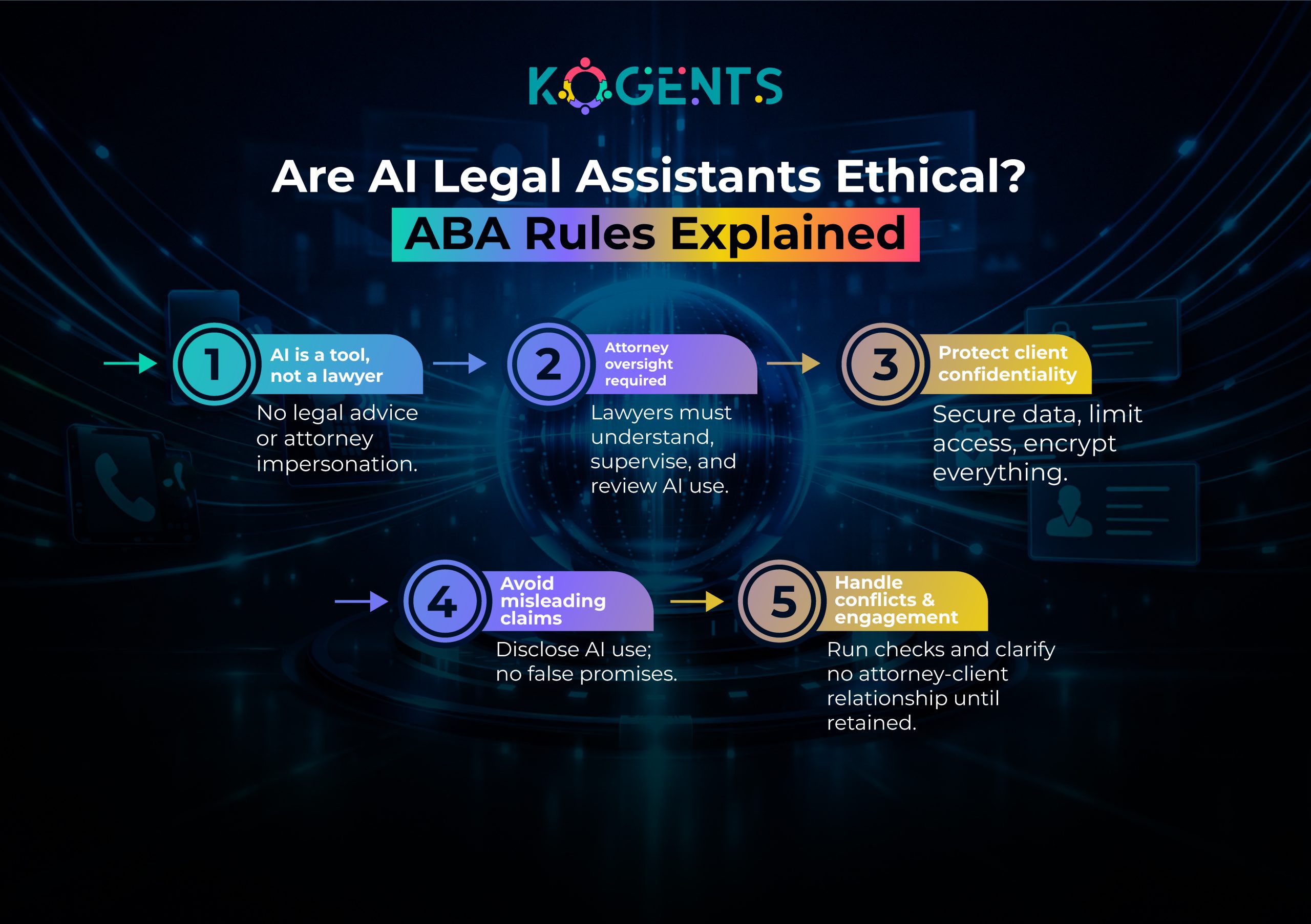
    The American Bar Association provides clear guidance on legal technology adoption through Model Rule 1.1 (Competence), which includes understanding “benefits and risks associated with relevant technology.” 

    Firms must:

    • Maintain reasonable efforts to prevent unauthorized access to client information
    • Supervise AI systems to ensure quality and accuracy
    • Never allow chatbots to provide actual legal advice
    • Clearly disclose when clients interact with automated systems

    HIPAA and GDPR Compliance

    For firms handling sensitive health information (personal injury, medical malpractice) or serving international clients, HIPAA-compliant chatbots for law firms and GDPR compliant legal chatbots are essential. 

    Look for solutions offering:

    • End-to-end encryption
    • Data residency controls
    • Audit logging
    • Business Associate Agreements (BAAs)
    • Right to deletion functionality

    Integration Strategies: Connecting Chatbots to Your Legal Ecosystem

    CRM and Practice Management Integration

    The power of legal chatbots multiplies when integrated with your existing legal CRM integration and case management systems. 

    Leading solutions connect with platforms like:

    • Clio: Automatically create matters, capture time entries, and log communications
    • Salesforce: Sync lead data, track conversion metrics, and manage follow-up campaigns
    • Lawmatics: Trigger automated workflows based on chatbot interactions
    • MyCase: Schedule consultations and update case notes in real-time

    Key Note: This legal software implementation ensures no prospect falls through the cracks, every interaction is documented, every lead is tracked, and every opportunity is maximized.

    Selecting the Right Chatbot Solution for Your Practice

    Essential Features Checklist

    ✓ Practice Area Customization: Templates for your specific legal niches 

    ✓ Multi-Channel Deployment: Website, Facebook Messenger, text messaging integration 

    ✓ Advanced Lead Scoring: AI-powered qualification algorithms 

    ✓ Appointment Scheduling: Calendar integration with conflict checking 

    ✓ Document Intelligence: OCR and extraction capabilities 

    ✓ Analytics Dashboard: Conversion tracking, conversation insights, ROI metrics 

    ✓ White-Label Options: Branded experience matching your firm’s identity

    Measuring ROI: Analytics That Matter

    Key Performance Indicators

    Lead Volume Metrics:

    • Total conversations initiated
    • Qualified leads generated
    • Conversion rate (chatbot to consultation)
    • After-hours inquiry capture rate

    Efficiency Metrics:

    • Average response time
    • Staff hours saved
    • Cost per lead
    • Time to first consultation

    Quality Metrics:

    • Client satisfaction scores
    • Chatbot resolution rate
    • Escalation frequency
    • Case acceptance rate from chatbot leads

    According to a study, firms tracking these metrics see average ROI of 340% within 12 months of chatbot for attorneys implementation.

    Common Implementation Challenges and Solutions

    Challenge 1: Staff Resistance

    Solution: Frame chatbots as tools that eliminate tedious work, not job replacements. Demonstrate how legal workflow automation allows staff to focus on meaningful client interactions.

    Challenge 2: Complex Legal Questions

    Solution: Design escalation protocols that smoothly transfer complicated inquiries to appropriate attorneys while preserving conversation context.

    Challenge 3: Maintaining Accuracy

    Solution: Implement quarterly content reviews, monitor chatbot transcripts for problematic responses, and maintain version control for all legal information.

    The Future of Legal Chatbots: Emerging Trends

    Predictive Case Analytics

    Next-generation AI assistants for law firms will analyze historical case data to predict outcomes, recommend a strategy, and estimate case value, all during initial client interaction.

    Voice-Enabled Legal Assistants

    Integration with voice platforms (Alexa, Google Assistant) will allow clients to initiate consultation conversationally: “Alexa, ask Johnson Law about divorce filing requirements in California.”

    Blockchain-Verified Communications

    To address authentication concerns, future legal chatbots may leverage blockchain technology to create immutable records of client communications and consent.
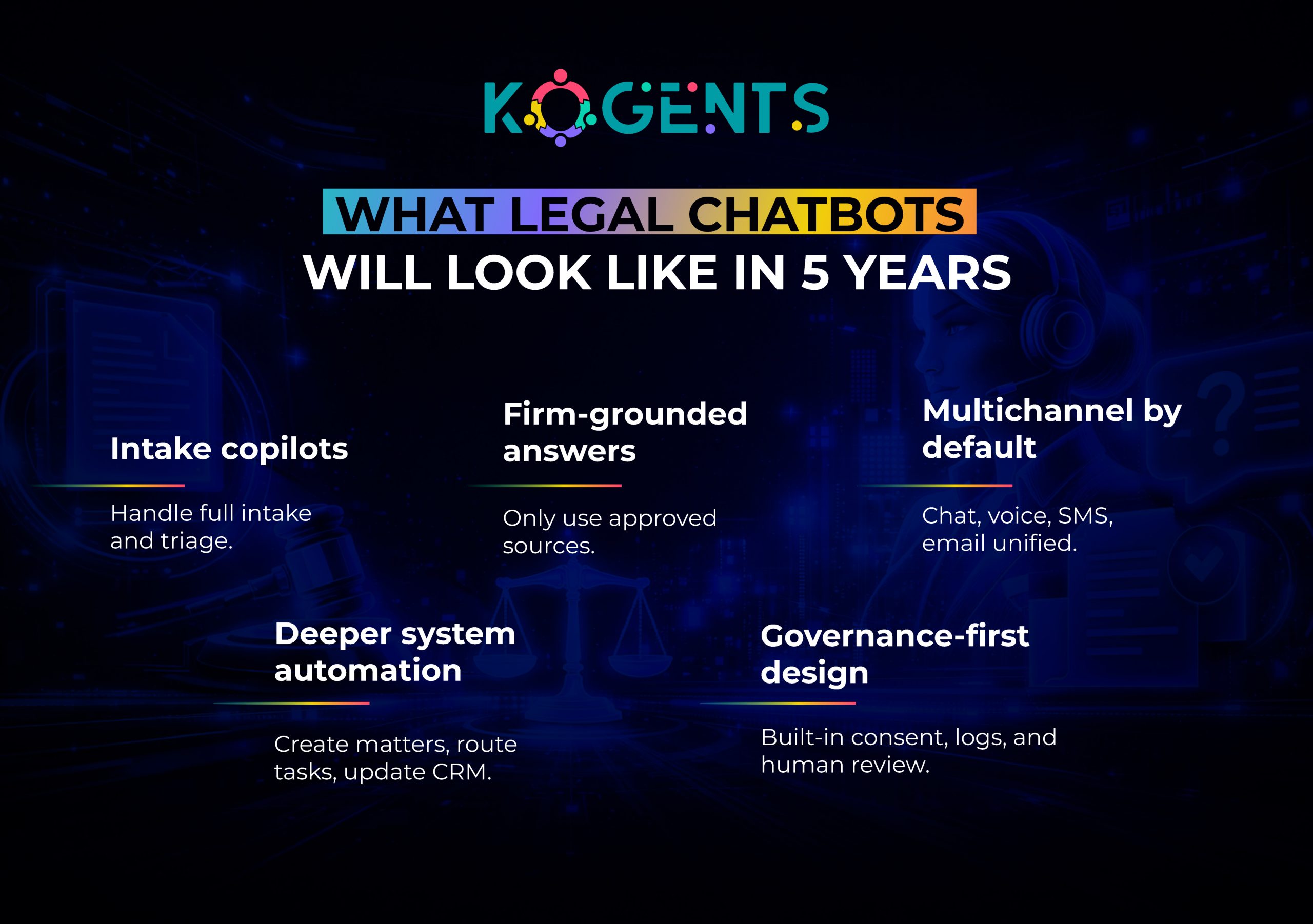
    chatbots for law firms

    We Are The Leaders in Agentic AI for Legal Innovation!

    Chatbots for law firms aren’t futuristic luxuries; they’re competitive necessities that separate thriving practices from those losing ground.

    By implementing legal chatbots via Kogents.ai, your firm gains:

    ✓ Competitive Advantage: Capture leads your competitors miss through after-hours availability 

    ✓ Operational Efficiency: Automate routine tasks, freeing your team for high-value work 

    ✓ Revenue Growth: Convert more prospects through immediate engagement and intelligent qualification 

    ✓ Client Satisfaction: Deliver the responsive, modern experience today’s clients demand 

    ✓ Scalability: Handle growing inquiry volume without proportionally increasing staff. 

    FAQs

    What are chatbots for law firms, and how do they differ from regular customer service bots?

    Legal chatbots are specialized AI-powered tools designed specifically for law firm operations. Unlike generic customer service bots, they understand legal terminology, maintain strict legal compliance standards (including attorney ethics rules), integrate with case management systems, and handle sensitive client information with appropriate security protocols. They’re programmed to never provide legal advice, instead focusing on information gathering, qualification, and routing.

    How do legal chatbots work with client intake automation?

    Client intake automation through chatbots transforms the traditional intake process. When prospects visit your website, the client intake chatbot for lawyers initiates a conversation, asks qualifying questions based on practice area, collects contact information, gathers case details, uploads relevant documents, checks conflicts, schedules consultations, and integrates all data into your CRM, completing in minutes what traditionally took days.

    Are AI chatbots ethical for attorneys according to bar association guidelines?

    Yes, when properly implemented. The American Bar Association recognizes legal technology as essential to modern practice. However, attorneys must ensure chatbots: clearly disclose they’re automated systems, never provide legal advice, maintain client confidentiality, are supervised for accuracy, and comply with professional responsibility rules. Many state bars have issued ethics opinions supporting chatbot use for administrative tasks and information gathering.

    Can chatbots replace legal assistants or paralegals?

    No. AI chatbots for lawyers augment rather than replace human staff. They handle repetitive, routine tasks, freeing legal assistants and paralegals to focus on substantive work requiring human judgment, empathy, and legal knowledge. The most successful firms view chatbots as tools that enhance team productivity, not workforce replacements.

    What are the best chatbots for law firms in terms of features and pricing?

    Top legal chatbot software options include LawDroid (comprehensive AI with strong practice area customization, $500-2,000/month), Smith.ai (hybrid AI-human model with live receptionist backup, $240-2,400/month), and custom solutions using IBM Watson or OpenAI APIs ($1,000-5,000+ for development). The “best” solution depends on your firm’s size, practice areas, integration requirements, and budget. Most platforms offer free trials.

    How do HIPAA-compliant chatbots for law firms protect sensitive health information?

    HIPAA-compliant chatbots for law firms implement multiple security layers: end-to-end encryption for all communications, secure data storage with restricted access controls, Business Associate Agreements (BAAs) with vendors, audit logging of all data access, automatic session timeouts, and data retention policies aligned with HIPAA requirements. For personal injury and medical malpractice practices handling protected health information, HIPAA compliance is mandatory.

    What’s the difference between AI chatbots and live chat for lawyers?

    AI chatbots operate autonomously 24/7 using artificial intelligence and natural language processing, handling unlimited simultaneous conversations without human intervention. Live chat requires staff availability, can only handle 2-3 conversations simultaneously, and operates during business hours. Many firms use hybrid models: chatbots handle initial contact and routine questions, escalating complex inquiries to live chat agents.

    How much does law firm chatbot implementation cost?

    Chatbot for attorneys implementation costs vary significantly: Basic Solutions ($200-500/month for SaaS platforms with standard templates), Mid-Range Solutions ($500-2,000/month for customizable platforms with CRM integration), and Enterprise Solutions ($2,000-5,000+/month for fully custom development with advanced AI). Most firms achieve positive ROI within 6-9 months through increased lead capture and reduced administrative costs.

    Can chatbots integrate with existing case management systems?

    Yes. Modern legal AI chatbots offer native integrations or API connections with major platforms, including Clio, MyCase, PracticePanther, Smokeball, Lawmatics, and Salesforce. This legal CRM integration ensures chatbot-gathered information flows directly into your existing workflows—eliminating manual data entry and reducing errors. When evaluating solutions, prioritize platforms with pre-built integrations for your specific tech stack.

    What ROI can law firms expect from chatbot implementation?

    Firms typically see 300-400% ROI within the first year. Specific benefits include: 50-100% increase in qualified leads, 40-60% reduction in administrative time, 24/7 availability capturing after-hours inquiries (typically 30-40% of total volume), 35-50% improvement in lead response time, and 20-30% increase in consultation bookings. According to legal technology studies, the average mid-sized law firm generates $4-7 in revenue for every $1 spent on chatbot implementation.
     

  • How AI Keeps Every Legal Interaction Consistent, Clear And Compliant 

    How AI Keeps Every Legal Interaction Consistent, Clear And Compliant 

    When a Single Email Can Cost $50 Million then imagine what a routine email can do. A data attachment. A compliance violation. 

    In 2025, a Fortune 500 company paid $47 million in regulatory penalties because one employee unknowingly breached data protection laws. 

    Your legal team reviewed policies. 

    Training was completed. 

    Yet human error still happened, and it nearly destroyed shareholder value overnight. 

    Here’s the uncomfortable truth: Chief Compliance Officers, General Counsels, and Legal Operations Managers are fighting an unwinnable war.

    You’re managing 300+ regulations simultaneously. Your teams spend 40% of their time on repetitive compliance workflows. 

    Regulatory penalties now average $4.1 million per violation. Traditional manual processes cannot scale, cannot operate fast enough, and cannot eliminate the human variability that creates catastrophic gaps. 

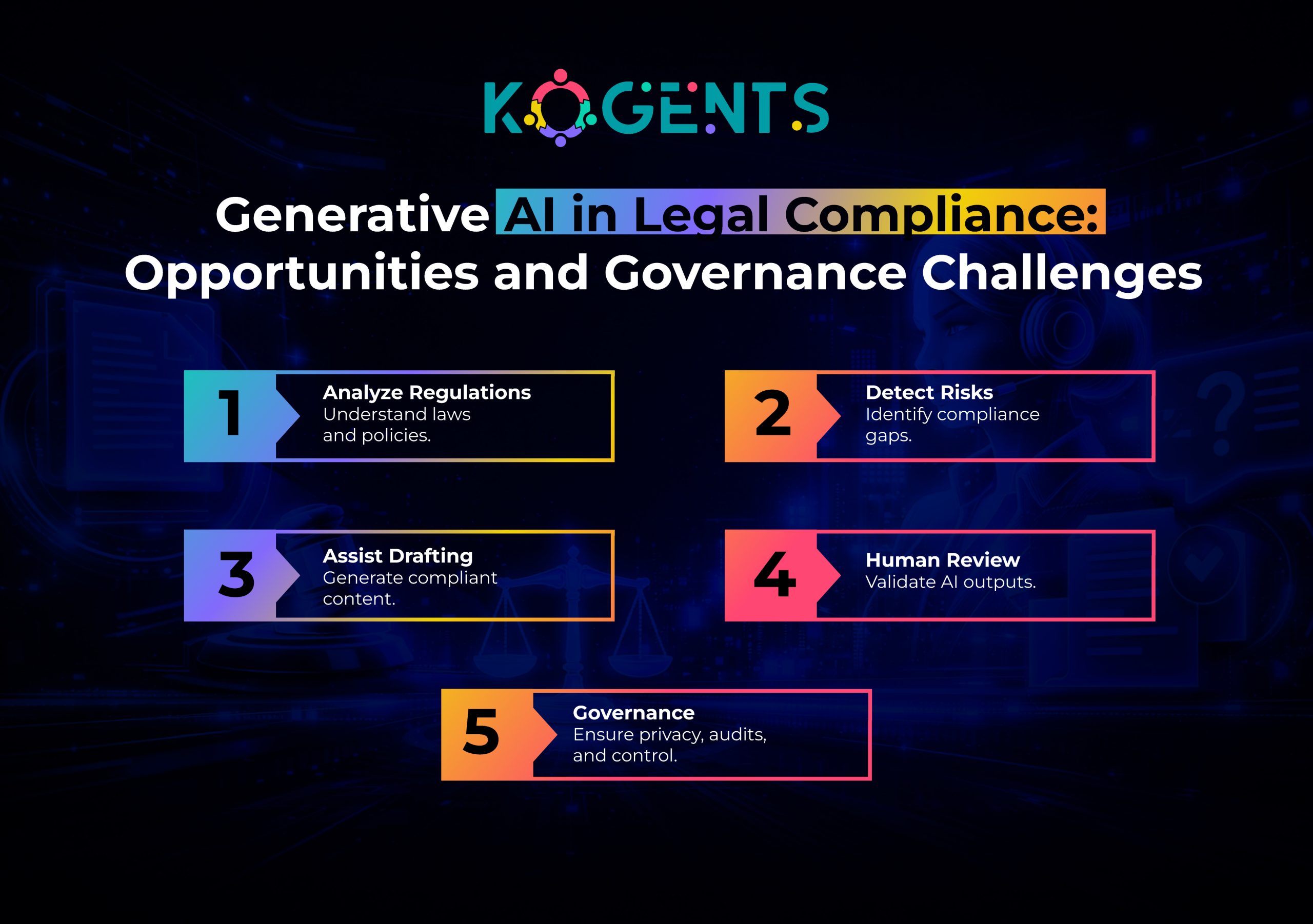
    But, AI for legal compliance changes everything. 

    Artificial intelligence for regulatory compliance doesn’t just assist your legal operations; it fundamentally transforms how organizations maintain absolute consistency across thousands of interactions, ensure clarity in complex governance frameworks, and achieve real-time compliance that manual processes can never deliver. 

    This guide reveals how AI-powered compliance management delivers what seemed impossible: zero-tolerance consistency in policy enforcement, unprecedented clarity in regulatory reporting, and ironclad compliance across every legal touchpoint, without multiplying headcount or budgets. 

    Key Takeaways 

    • AI legal compliance software eliminates human variability by applying identical standards across millions of transactions without deviation. 
    • Compliance monitoring platforms detect potential violations 24/7, identifying anomalies before issues escalate into compliance violations
    • Enterprise AI compliance software manages complex requirements across jurisdictions simultaneously, adapting to new regulations without complete overhauls. ● Explainable AI (XAI) provides comprehensive audit trails, demonstrating exactly how compliance decisions are made for audit readiness
    • AI governance and compliance tools free legal professionals from routine tasks to focus on high-value strategic initiatives. 

    ai for legal compliance

    Understanding AI for Legal Compliance 

    AI compliance solutions represent the convergence of machine learning, natural language processing, and legal data governance into integrated systems that automate, monitor, and optimize regulatory compliance operations. 

    Unlike traditional rule-based software, these AI-driven regulatory compliance solutions learn from patterns, adapt to changing requirements, and improve accuracy continuously. 

    The Core Problem It Solves 

    Compliance automation using AI addresses three fundamental challenges:

    Scale Limitations: Human teams cannot review every contract, transaction, or communication for compliance issues. 

    AI compliance monitoring platforms analyze millions of data points simultaneously, applying consistent standards across entire organizational ecosystems without fatigue. 

    Complexity Management: Modern compliance obligations span GDPR, ISO/IEC 27001, NIST AI Risk Management Framework, and industry-specific regulations. 

    AI compliance management systems map relationships between requirements, identifying overlaps, conflicts, and gaps that would take legal teams months to discover. 

    Dynamic Adaptation: Automated legal compliance systems ingest regulatory changes in real-time, automatically updating logic and flagging affected processes before deadlines expire. 

    The Technology Foundation 

    Natural Language Processing (NLP) interprets legal language, extracts obligations from regulations, and analyzes contracts against compliance standards. 

    This enables AI tools for legal compliance teams to understand context and nuance, not just keywords. 

    Machine Learning Algorithms identify patterns indicating potential legal risk management issues, predict compliance vulnerabilities, and continuously improve detection accuracy. 

    Robotic Process Automation (RPA) executes policy enforcement actions, generates compliance reporting, and manages remediation workflows automatically. 

    Predictive Analytics anticipates future compliance risks based on historical data, regulatory trends, and organizational changes. 

    Human variability creates compliance gaps. 

    Different attorneys interpret clauses differently. 

    Reviewers miss details during busy periods. 

    Standards drift as teams change. AI legal compliance software eliminates this variability.

    Standardized Decision Logic: AI-powered compliance management applies identical criteria to every evaluation, the first contract and the ten-thousandth receive the same rigorous analysis. 

    This consistency extends across contract clause analysis, transaction monitoring, communication screening, vendor compliance verification, and employee policy adherence tracking. 

    Instant Policy Updates: When GDPR guidance changes or ISO standards are revised, compliance automation platforms update all active monitoring simultaneously, no training sessions, no gradual implementation periods where different teams operate under different rules. 

    Cross-Jurisdictional Consistency: Multinational organizations maintain jurisdiction-specific requirements while ensuring consistent brand standards where regulations permit. 

    Clarity Through Advanced Language Understanding 

    Legal ambiguity creates compliance gaps. 

    AI compliance solutions transform unclear obligations into actionable requirements. 

    Obligation Extraction: NLP-powered systems read thousand-page regulations and automatically extract specific obligations, deadlines, and responsible parties. 

    Rather than legal teams manually parsing documents, AI governance and compliance tools identify every “must,” “shall,” and “required” statement, categorize obligations by department, and create enforcement checkpoints automatically. 

    Plain Language Translation: Complex legal language confuses non-legal stakeholders. Artificial intelligence for regulatory compliance translates requirements into clear operational instructions. 

    GDPR Article 32’s security requirements become specific technical controls for IT teams; Article 15’s access request obligations become step-by-step procedures for customer service. 

    Contextual Understanding: Advanced legal data governance systems distinguish between “data transfer” requiring data protection laws safeguards versus routine internal reporting. 

    Compliance Through Continuous Monitoring 

    Real-Time Transaction Analysis: Financial transactions are screened against sanctions lists instantaneously. Contracts are flagged during negotiation if clauses violate policies. 

    Data access requests trigger immediate compliance workflows verifying legitimate business purposes.

    Anomaly Detection: Machine learning establishes baseline patterns, then flags deviations indicating potential compliance violations. 

    Unusual employee data access or unexpected vendor payment patterns trigger investigation protocols automatically. 

    Regulatory Intelligence Integration: Best AI compliance platforms for enterprises continuously monitor regulatory developments worldwide. 

    Audit Trail Generation: Every decision generates immutable audit trails. 

    When auditors arrive, systems produce complete documentation showing what was monitored, when issues were detected, how they were addressed, and who was responsible. 

    Critical Components of AI Compliance Systems

         1. Intelligent Compliance Monitoring 

    • AI compliance monitoring continuously observes organizational activities against regulatory requirements, integrating with CRM platforms, financial systems, communication tools, and document management systems. 
    • Machine learning algorithms compare activities against compliance rules derived from GDPR, ISO standards, OECD AI Principles, and internal policies. 
    1. Risk Assessment and Mitigation
    • AI-driven regulatory compliance solutions perform continuous risk scoring, updating assessments as conditions change. 
    • Predictive risk modeling analyzes regulatory changes, business environment shifts, operational metrics, and historical data to forecast where compliance failures are most likely. 

    Note: When elevated risks are identified, automated legal compliance systems trigger mitigation workflows automatically. 

    1. Policy Management and Enforcement 
    • Dynamic policy libraries ensure stakeholders have access to current versions with role-appropriate guidance. 
    • A sales representative sees required contract clauses; a data analyst sees applicable data protection laws requirements. 
    • Enforcement automation can block policy-violating actions pending compliance review approval.
    1. Regulatory Change Management 
    • Regulatory intelligence monitors legislative databases, regulatory agency 

    announcements, court decisions, and industry guidance, identifying relevant changes. ● Natural language processing determines whether changes create new obligations or modify existing requirements. 

    • Impact assessment automation generates implementation roadmaps showing what must change, by when, and who’s responsible. 
    1. Reporting and Analytics 
    • Compliance reporting automation generates regulatory submissions from continuously collected data. 
    • Executive dashboards provide compliance posture visibility: current risk levels, 

    trending issues, regulatory change pipelines, and resource allocation effectiveness. 

    AI Compliance Framework: Essential Components

    Component  Primary Function  Key 

    Technologies

    Business 

    Impact

    Regulatory 

    Alignment

    Monitoring & 

    Detection

    Continuous 

    surveillance against compliance rules

    Machine 

    Learning, NLP, 

    Real-time 

    Analytics

    70% reduction in compliance 

    incidents

    GDPR Article 32, 

    ISO/IEC 27001

    Risk Assessment  Automated 

    vulnerability 

    identification and 

    scoring

    Predictive 

    Analytics, AI Risk Models

    Proactive 

    resolution before violations

    NIST AI Risk 

    Management 

    Framework

    Policy Enforcement 

    Regulatory 

    Intelligence

    Automated 

    compliance rule 

    application 

    Tracking regulatory changes across 

    jurisdictions

    RPA, Workflow Automation, 

    Access Controls 

    NLP, Regulatory Monitoring APIs

    85% improvement in policy 

    adherence 

    3-month 

    advantage in 

    adaptation

    ISO/IEC 42001 

    EU AI Act, OECD AI Principles

    Audit & Reporting  Automated evidence collection and report generation Data Integration, Audit Trail 

    Systems

    90% reduction in audit preparation time GDPR Article 30, SOC 2

    Real-World Success: Case Studies 

    Case Study 1: Global Bank Transforms AML Compliance 

    A multinational bank operating in 45 countries faced 120,000 analyst hours spent annually on manual anti-money laundering reviews, with rising false positive rates missing sophisticated laundering schemes. 

    After deploying an AI-powered compliance management platform with machine learning-based transaction monitoring, false positive rates decreased 60%, reducing analyst workload by 75,000 hours annually. 

    Suspicious activity detection improved 40% while achieving full regulatory compliance across all jurisdictions and reducing costs by $12 million annually. 

    Case Study 2: Healthcare Network Achieves HIPAA Excellence 

    A 150-facility healthcare network struggled with HIPAA compliance around patient data access controls across thousands of users and millions of patient records. 

    An AI compliance monitoring platform with anomaly detection configured for healthcare data governance reduced unauthorized data access incidents by 82% in the first year. 

    The AI detected and prevented breaches that manual processes missed, including three credential misuse instances by terminated employees. 

    Compliance workflows automated 90% of routine access requests, reducing approval times from 48 hours to 15 minutes while avoiding an estimated $8 million in potential penalties. 

    Critical Considerations: Explainability and Accountability The Explainability Imperative 

    Regulatory bodies increasingly demand explainable AI (XAI), systems where decision-making logic can be understood and verified. 

    Leading AI governance and compliance tools use hybrid architectures: complex models provide initial assessments while rule-based explainable systems validate and document decisions, ensuring both accuracy and audit trail transparency. 

    Algorithmic Accountability 

    Algorithmic accountability requires ensuring AI systems don’t perpetuate biases or create discriminatory outcomes.

    Effective approaches include regular bias audits, diverse training data, human oversight for high-impact decisions, and continuous outcome monitoring. 

    ISO/IEC 42001 and OECD AI Principles provide frameworks for responsible AI model governance. 

    Data Governance 

    AI compliance monitoring platforms require extensive organizational data access. 

    Solutions involve data minimization, anonymization where possible, strict access controls, encryption, and comprehensive legal data governance frameworks ensuring AI systems operate within privacy boundaries. 

    Transform Compliance into Competitive Advantage with Us! 

    AI for legal compliance is no longer optional; it’s the foundation for sustainable, scalable compliance operations. 

    Organizations implementing AI-driven regulatory compliance solutions consistently report transformative outcomes: 30-50% operational cost reductions, 70-80% fewer compliance incidents, dramatically improved audit readiness, and strategic reallocation of legal talent from 

    We specialize in AI-powered compliance management solutions designed for enterprises navigating complex regulatory landscapes. 

    Our platform combines advanced compliance monitoring, regulatory intelligence, and explainable AI capabilities, integrating seamlessly with your existing systems. 

    Whether implementing your first AI compliance solution or enhancing existing governance frameworks, we deliver proven expertise across GDPR, ISO standards, NIST frameworks, and industry-specific regulations. 

    So, contact the team at Kogents.ai to drive legal excellence now! 

    FAQs 

    What is AI for legal compliance, and how does it differ from traditional compliance software? 

    AI for legal compliance uses machine learning and natural language processing to continuously monitor and enforce regulatory requirements automatically. Unlike traditional rule-based software requiring manual programming for each scenario, AI compliance

    solutions learn from patterns, adapt to regulations, and improve accuracy without constant reprogramming. 

    How does AI handle regulatory compliance across multiple jurisdictions? 

    Enterprise AI compliance platforms map requirements across jurisdictions, identifying overlapping obligations and conflicts. Using natural language processing to interpret regulations from different regulatory bodies, systems automatically extract obligations and create jurisdiction-specific controls while maintaining consistent governance. 

    What are the main benefits of AI compliance software for regulated industries? 

    AI compliance software delivers consistency through standardized policy application, scalability for millions of simultaneous activities, real-time violation detection, adaptability to regulatory changes, and transparency through comprehensive audit trails. Industries report 30-50% operational cost reductions while improving outcomes. 

    Is AI compliance monitoring effective at detecting violations? 

    Yes. AI compliance monitoring platforms detect 3-5 times more potential violations than human review with 60-80% fewer false positives. Effectiveness stems from 24/7 operation, pattern recognition across vast datasets, and adaptive learning, improving accuracy continuously. 

    How do AI compliance solutions handle regulatory changes? 

    AI-driven regulatory compliance solutions include regulatory intelligence that continuously monitors legislative databases and agency publications. Natural language processing identifies relevant changes, determines new obligations, and assesses policy impact. Systems automatically update monitoring logic while flagging complex amendments requiring legal interpretation. 

    What is explainable AI (XAI) and why does it matter for compliance? 

    Explainable AI (XAI) provides decision-making logic that humans can understand and validate. Regulatory bodies and auditors must verify that decisions are appropriate and legally defensible. XAI-capable AI governance tools provide detailed reasoning showing which regulations were considered and why determinations were made. 

    How much does an AI compliance management system implementation cost? 

    Pricing varies based on organization size and complexity. Entry-level solutions start around $50,000-$100,000 annually. Mid-market implementations range $250,000-$500,000 initially, plus $100,000-$300,000 annually. Enterprise AI compliance software requires $1M+ initially and $500,000+ annually. Organizations report ROI within 18-24 months.

    Can AI compliance tools integrate with existing systems? 

    Modern AI compliance platforms offer pre-built connectors for enterprise systems (Salesforce, SAP, Microsoft 365), APIs for custom integrations, and data import/export capabilities. Integration enables compliance automation across contract management, financial platforms, HR systems, and communication tools. 

    What industries benefit most from AI-powered compliance management? 

    Five industries see disproportionate value: Financial Services (AML, KYC), Healthcare (HIPAA, patient data), Technology (multi-jurisdictional data protection), Life Sciences (FDA, clinical research), and Energy/Utilities (environmental, safety regulations). These face complex, frequently changing landscapes where manual compliance becomes impossible. 

    How do organizations ensure AI compliance systems don’t create new risks? 

    Ensuring AI governance requires implementing algorithmic accountability frameworks that regularly audit AI decision-making, maintaining human oversight for high-impact decisions, establishing robust data governance, following the NIST AI Risk Management Framework and ISO/IEC 42001, and conducting regular third-party audits.

  • How Law Firms Automate Client Intake Without Losing Professionalism

    How Law Firms Automate Client Intake Without Losing Professionalism

    Your newest client hired you at 11 PM on a Sunday, not because you were cheaper, and not because a competitor failed, but because you responded in four minutes while others waited until Monday.

    When she searched for an estate planning attorney after her father’s sudden hospitalization, she never spoke to a human at first. 

    An intelligent system captured her details, assessed urgency, sent a personalized video from the attorney who’d handle her case, scheduled a Monday consultation, and shared resources for estate planning during medical emergencies. 

    By Monday morning, she’d paid the retainer and uploaded documents before competitors even opened.

    This happens daily. Law firm automation isn’t lowering service standards; it’s expanding your ability to deliver a premium experience when clients actually need you, often after hours. 

    The professionalism concern is backwards: clients don’t see speed as impersonal, they see delay and friction as unprofessional. 

    Strategic automation elevates professionalism and wins clients.

    Key Takeaways

    • Successful firms automate repetitive tasks while preserving human touchpoints for relationship-building and complex advisory interactions.
    • A Modern AI legal assistant will require seamless integration between case management systems, client intake automation platforms, and practice management software to create cohesive client experiences.
    • Automation enables, rather than diminishes, personalization by freeing staff to focus on meaningful client interactions while systems handle routine communications and workflow orchestration.
    • Automated law firm workflows must prioritize GDPR compliance, SOC 2 compliance, and ISO/IEC 27001 standards to protect client data and maintain ethical obligations.
    • Firms implementing comprehensive automation for law firms report a reduction in intake processing time, an increase in conversion rates, and significant improvements in client onboarding satisfaction scores.

    law firm automation

    Understanding Law Firm Automation in Modern Legal Practice

    Law firm automation is the strategic use of technology to streamline legal operations while preserving the quality and personal attention clients expect. 

    It supports digital transformation in law by reducing administrative load, so attorneys can focus on high-value work requiring judgment, creativity, and empathy.

    Modern legal practice automation spans multiple areas: document automation minimizes repetitive drafting, legal workflow management coordinates complex processes across teams, and time tracking automation plus legal billing automation improve accuracy without added burden. 

    Compliance automation also helps maintain regulatory adherence with less manual oversight.

    Successful automation hinges on one insight: legal service runs on two parallel tracks, transactional and relational

    Robotic process automation (RPA) excels at transactional tasks like data capture, routing, validation, and scheduling. 

    But relational work, trust-building, strategic counseling, and emotional intelligence remain inherently human.

    Firms with structured automation strategies often see measurable gains. 

    Research from the International Legal Technology Association cites a productivity improvement and reduction in operational costs within the first year, driven by fewer errors and better allocation of human capital. 

    Meanwhile, AI in law now extends beyond task automation into pattern analysis, outcome prediction, and decision support. 

    Cloud platforms have also made advanced automation accessible, leveling the competition and making adoption increasingly essential.

    The Client Intake Challenge: Where Professionalism Meets Efficiency

    It is the most critical touchpoint in the attorney-client relationship, where first impressions, expectations, and trust are formed (or lost). 

    Yet traditional intake often creates unnecessary friction that hurts both efficiency and client satisfaction.

    A manual intake journey typically includes multiple handoffs, redundant data collection, slow responses, and inconsistent follow-up. 

    A prospect submits a form, someone re-enters the details into case management, another person schedules the consult, and someone else sends engagement documents. 

    Every handoff adds delay and increases the risk of errors.

    From the client’s perspective, this fragmentation signals disorganization. 

    Today’s clients compare firms online and expect the same seamless experience they get in other industries. 

    If they must repeat information or wait days for basic replies, confidence drops immediately.

    Many attorneys worry that automation will feel impersonal. 

    But that’s a misconception. 

    Professionalism isn’t defined by manual work; it’s defined by attentiveness and clarity. 

    Client intake automation should remove delays and administrative clutter so staff can focus on real relationship-building.

    In most firms, intake coordinators spend most of time on admin tasks and only 30% on client interaction. 

    Automation flips that, enabling more meaningful engagement. 

    Automation Strategies That Preserve Professionalism

    Implementing automated law firm workflows requires strategic thinking about what to automate, what to preserve, and how to blend technology with human touchpoints. 

    The most successful firms follow a framework that prioritizes client experience while achieving operational efficiency.

    The Human-Digital Balance Framework

    Automate the mechanical, elevate the meaningful. 

    This principle guides every implementation decision. 

    Mechanical tasks, data capture, document routing, appointment scheduling, conflict checks, consume time without creating relationship value. 

    These are prime automation candidates. 

    Meaningful interactions, initial consultations, case strategy discussions, and negotiation conversations require human judgment and emotional intelligence. 

    These should receive the time freed by automation.

    Intelligent intake forms represent the first touchpoint optimization. 

    Unlike static PDF forms, modern client onboarding platforms use conversational interfaces with conditional logic. 

    They ask relevant questions based on previous answers, explain why information is needed, and provide estimated completion times. 

    This approach collects comprehensive information while respecting client time, a hallmark of professionalism.

    Automated acknowledgment and routing ensure no inquiry falls through the cracks. 

    When someone submits an intake request, they receive immediate confirmation with clear next steps and timelines. 

    Behind the scenes, workflow orchestration routes their information to the appropriate attorney based on practice area, availability, and case characteristics. 

    What feels instant to the client represents sophisticated legal workflow management operating invisibly.

    Personalization at Scale

    Dynamic communication sequences maintain consistent touchpoints without generic mass messaging. 

    Modern law firm automation software can personalize communications based on case type, client demographics, urgency level, and interaction history. 

    A personal injury inquiry receives a different messaging cadence than a corporate transaction, even though both follow automated workflows.

    Video introduction messages blend automation with personal presence. 

    When intake forms are completed, clients immediately receive a personalized video from their assigned attorney introducing themselves, explaining next steps, and providing direct contact information. 

    This automated delivery of personal content creates warmth that text-based communication cannot achieve.

    The Technology Stack

    Automation Layer Function Professionalism Impact Key Vendors
    Intake Forms Data collection & qualification Reduces redundant questions, respects client time Clio Grow, Lawmatics, Documate
    CRM Integration Contact management & tracking Ensures no client falls through the cracks Salesforce Legal, Clio Manage
    Document Automation Engagement letter generation Accelerates onboarding, reduces errors HotDocs, Contract Express
    Communication Email sequences & SMS updates Maintains consistent touchpoints Lawmatics, Smokeball
    Scheduling Calendar management Eliminates back-and-forth delays Calendly Legal, Acuity
    Payment Processing Retainer collection Simplifies financial transactions LawPay, Clio Payments

    Compliance and Security Considerations

    Data security isn’t just technical, it’s professional. 

    Clients entrust you with sensitive information, and client data protection represents a core ethical obligation. 

    Your legal automation solutions must meet stringent security standards, including SOC 2 compliance and GDPR compliance where applicable.

    Audit trails in the chatbots for law firms provide accountability that manual processes cannot match. 

    Every client interaction, document access, and data modification is logged with timestamps and user attribution. 

    This compliance automation protects both clients and the firm from disputes while satisfying regulatory requirements.

    Role-based access controls ensure information reaches appropriate team members without exposing sensitive details to unauthorized personnel. 

    Case Studies: Automation Success Stories

    Case Study 1: Mid-Market Litigation Firm Transformation

    A 45-attorney litigation firm faced a client intake crisis. 

    Their manual process averaged 4.2 days from inquiry to consultation scheduling, resulting in a 34% inquiry-to-client conversion rate. 

    Competitors were winning business simply by responding faster.

    They implemented a comprehensive client intake automation system integrating Clio Grow for intake forms, Lawmatics for communication workflows, and Salesforce for CRM functionality. 

    The implementation included:

    • Intelligent intake forms with conditional logic reduce completion time.
    • Automated routing to the appropriate practice group attorneys within minutes.
    • Personalized video introductions from assigned attorneys.
    • Automated scheduling with integrated calendar management.
    • Document automation for engagement letters and conflict waivers.

    Results after six months:

    • Average response time reduced from 4.2 days to 47 minutes (94% improvement).
    • Inquiry-to-client conversion increased from 34% to 56% (65% improvement).
    • Intake coordinator capacity increased from handling 15 new inquiries weekly to 52.
    • Client satisfaction scores for the intake experience increased from 6.8/10 to 9.2/10.
    • ROI achieved within 4 months through increased conversion alone.

    Case Study 2: Solo Practitioner Scaling Through Automation

    A solo immigration attorney was turning away potential clients due to intake capacity constraints. 

    She spent 15+ hours weekly on intake administration, leaving insufficient time for billable work and business development.

    She implemented automation tools for small law firms using Documate for intake forms, Smokeball for practice management, and LawPay for payment processing. 

    The streamlined system:

    • Captured comprehensive client information through guided online forms
    • Automatically generated engagement letters and fee agreements
    • Processed retainer payments without manual intervention
    • Scheduled consultations based on availability rules
    • Sent automated updates at key process milestones

    Results after three months:

    • Intake administration time reduced from 15 hours to 2 hours weekly.
    • Client capacity increased by 40% without hiring additional staff.
    • Revenue increased 28% through improved efficiency.
    • Ability to accept cases previously turned away due to capacity.
    • Professional image enhanced through consistent, responsive communication.

    Your Competitive Advantage Awaits!

    The choice facing law firms today isn’t whether to embrace law firm automation; it’s whether to lead or follow the inevitable transformation of legal service delivery

    Well, professionalism in modern legal practice means meeting clients where they are, responding when they need you, and delivering seamless experiences that demonstrate competence and care. 

    Your competitors are already moving. 

    The question is whether you’ll watch them capture market share or position your firm to lead your market through strategic automation for law firms.

    Kogents.ai specializes in helping law firms implement legal automation solutions that enhance professionalism while driving measurable results. 

    Ready to transform your client intake? Visit us or contact us today for a complimentary automation assessment.

    FAQs

    What is law firm automation, and how does it differ from traditional legal technology?

    Law firm automation refers to the strategic use of technology to streamline repetitive tasks and workflows within legal practices, enabling attorneys and staff to focus on high-value activities. Unlike traditional legal technology that simply digitizes existing processes (like moving paper files to PDFs), true legal process automation fundamentally redesigns workflows using artificial intelligence, machine learning, and robotic process automation to eliminate manual steps. Modern legal automation solutions make intelligent decisions, route information automatically, and orchestrate complex multi-step processes without human intervention while maintaining professional standards and ethical compliance.

    How can small law firms afford automation technology when budgets are tight?

    Cloud-based law firm automation has dramatically reduced cost barriers, with many automation tools for small law firms offering subscription models starting at $50-150 monthly per user. The ROI of legal automation typically manifests within 3-6 months through increased client conversion, reduced administrative costs, and enhanced attorney productivity. Additionally, phased implementation allows firms to start with core functionality like client intake automation before expanding to comprehensive legal workflow management. Many vendors offer tiered pricing where you pay only for features actually used, and the productivity improvement often generates sufficient revenue increase to self-fund the technology investment without requiring upfront capital allocation.

    Can automation help with conflict checks and other compliance requirements?

    Yes, compliance automation represents one of automation’s highest-value applications. Automated conflict checking systems can instantaneously search your entire client database, matter history, and relationship networks to identify potential conflicts—a process that might take hours or days manually and still risk missing connections. These systems can enforce mandatory fields, ensuring complete information capture, trigger alerts when specific risk factors appear, require supervisory approval for exceptions, and generate complete audit trails demonstrating compliance diligence. Modern law firm automation software can also automate compliance tracking for deadlines, statute of limitations, trust accounting rules, and other regulatory requirements. The consistency and thoroughness that automation provides actually enhances ethical compliance while reducing the risk of human oversight that leads to disciplinary issues.

    How does AI automation differ from basic workflow automation in legal practices?

    Basic workflow automation follows predetermined rules and decision trees: if X happens, then do Y. This effectively handles routine, structured processes like moving documents through approval chains or sending reminder emails. AI automation for law firms leverages machine learning to make contextual decisions based on patterns in data, improving over time without explicit programming. AI systems can review intake forms and predict case viability based on historical outcomes, analyze communication to detect client sentiment requiring human intervention, optimize scheduling based on attorney expertise and availability patterns, and even identify potential conflicts by understanding relationships beyond explicit database matches. While rule-based automation provides consistency, artificial intelligence in law provides adaptability and continuous improvement, making it particularly valuable for complex legal service delivery scenarios where rigid rules prove insufficient.

    What security and data protection considerations are critical when automating client intake?

    Client data protection represents both an ethical obligation and a competitive necessity. Your legal automation solutions must employ encryption for data in transit and at rest, implement multi-factor authentication for user access, maintain SOC 2 compliance certification demonstrating security controls, provide granular role-based access limiting information exposure, enable audit trails logging all data access and modifications, and ensure GDPR compliance where applicable, including data retention and deletion policies. Beyond technical controls, establish clear policies governing acceptable use, train staff on security protocols, conduct regular security assessments, maintain incident response procedures, and verify that vendor support includes security patch management and threat monitoring. Cloud-based systems from reputable vendors often provide superior security compared to on-premise systems at small firms lacking dedicated IT security expertise, but require careful vendor evaluation.


  • Never Miss a Client Again: How AI Handles Legal Inquiries 24/7

    Never Miss a Client Again: How AI Handles Legal Inquiries 24/7

    Do you know the $2.3 million question your firm isn’t asking?

    Your law firm is hemorrhaging money while you sleep. Every night, while your attorneys rest and phones roll to voicemail, potential clients desperately search for legal help. 

    They find your website, read your accolades, and then all they do is vanish into the digital void, never to return.

    But, if you analyze the brutal mathematics, if your firm receives 200 web inquiries annually and loses 40% to response delays, that’s 80 missed opportunities. 

    At a conservative $15,000 average client value and 25% conversion rate, you’ve just watched $300,000 evaporate. 

    According to Harvard Business Review, companies responding within 5 minutes are 100 times more likely to qualify leads than those waiting just 30 minutes.

    Your competitors aren’t losing these clients. While you operate on 9-to-5 schedules, savvy firms deploy an AI legal assistant that never sleeps, never takes breaks, and never lets qualified leads slip away.

    The uncomfortable truth: You’re competing against client expectations shaped by Amazon, Uber, and instant gratification culture. 

    Unless you provide 24/7 availability and intelligent triage, you’re already losing; you just haven’t seen the balance sheet impact yet. 

    Key Takeaways

    • Firms responding within 5 minutes are 100x more likely to convert leads than those responding after 30 minutes, making 24/7 availability mission-critical.
    • Virtual legal assistant AI systems handle initial inquiries, case intake, and triage without human intervention, ensuring zero missed opportunities.
    • Machine learning algorithms assess case viability, conflict checks, and jurisdiction alignment before human lawyers invest time.
    • Modern legal consumers expect immediate responses to inquiries, driven by experiences with consumer tech platforms.
    • Modern law firm automation connects with existing case management and CRM systems through no-code solutions.

    DECODE: Why Response Time Makes or Breaks Client Acquisition? 

    The legal services market operates under a brutal reality: speed is the winner, and for law firms, delayed responses translate directly to lost revenue.

    The After-Hours Abandonment: legal inquiries occur outside standard business hours. Without an automated legal assistant, these leads sit unanswered for 12-48 hours while prospective clients contact 3-4 competing firms.

    The Competitive Disadvantage: When clients submit inquiries to multiple firms simultaneously, the firm responding within minutes gets the retainer, not the one calling back days later.

    The Opportunity Cost: Every 10 missed inquiries at conversion and $15,000 average client value represents $30,000 in lost revenue. Annually, that compounds into hundreds of thousands in foregone billings.

    Problem: The problem intensifies for small law firms and solo practitioners lacking dedicated intake staff, with firms losing potential clients to intake bottlenecks.

    ai legal assistant

    How AI Legal Assistants Transform Client Intake

    24/7 Availability Without Human Burnout

    An intelligent chatbot for law firms powered by artificial intelligence provides continuous coverage across all communication channels, website chatbots, SMS, email, and voice calls through conversational AI.

    Key Capabilities:

    • Instant Acknowledgment: Responds within seconds, confirming receipt and setting expectations.
    • Multi-Language Support: Handles inquiries in 50+ languages, expanding addressable markets.
    • Omnichannel Presence: Maintains availability across web forms, live chat, mobile apps, and social media.
    • Holiday/Weekend Coverage: Captures leads during peak inquiry periods when staff are unavailable.

    Instant Response Mechanisms

    Modern AI-powered legal assistant systems leverage natural language processing (NLP) to understand client inquiries contextually. 

    When someone asks about landlord disputes, the system:

    • Identifies Practice Area: Recognizes this as tenant-landlord litigation.
    • Assesses Jurisdiction: Determines applicable statutes and regulations.
    • Gathers Critical Information: Collects timeline, documentation, and damages.
    • Provides Immediate Value: Offers preliminary guidance and next steps.
    • Schedules Consultation: Books appointments with appropriate attorneys.

    Reminder: This entire process happens in 3-5 minutes while the client remains engaged.

    Intelligent Triage and Case Qualification

    AI legal assistant tools excel at pre-qualifying cases based on:

    • Financial Viability: Assessing whether the case value justifies attorney fees.
    • Jurisdictional Alignment: Confirming licensure in relevant jurisdictions.
    • Practice Area Fit: Matching inquiries to firm expertise (contract review, litigation, compliance).
    • Conflict Checks: Flagging potential conflicts before attorney involvement.
    • Statute of Limitations: Identifying time-sensitive matters requiring immediate escalation.

    Key Note: Well-configured systems route high-value, qualified leads directly to attorneys while redirecting mismatched inquiries, saving hundreds of hours annually.

    Core Technologies Powering Always-On Legal Support

    Natural Language Processing (NLP) for Legal Context

    • Legal NLP represents specialized AI trained on case law, legal drafting, and legal research documentation. 
    • These systems understand legal terminology, contextual nuances, and procedural requirements. 
    Leading platforms integrate with LexisNexis, Thomson Reuters, and Westlaw databases for accurate, jurisdiction-specific information.

    Machine Learning and Large Language Models (LLMs)

    • Large language models like those powering Harvey, CoCounsel, and OpenAI’s legal applications continuously improve through interaction. 
    • Every conversation trains the system to improve response accuracy, predict client needs, optimize routing logic, and personalize communication. 
    • This machine learning capability means your AI legal assistant becomes more effective over time.

    Integration with Case Management Systems

    AI legal assistant platforms integrate seamlessly with existing technology:

    • Case Management Software: Automatically creates matter records with pre-populated intake data.
    • CRM Systems: Updates lead scoring and tracks conversion metrics.
    • Document Management: Stores uploaded documents in the correct matter folders.
    • Calendaring Tools: Syncs consultations across attorney schedules.
    • Billing Systems: Captures engagement letters and retainer agreements.

    Real-World Case Studies

    Case Study 1: Boutique Litigation Firm Increases Lead Conversion by 340%

    Firm Profile: 12-attorney firm specializing in business litigation and contract disputes.

    Challenge: Missing 60% of after-hours inquiries; 36-hour average response time.

    Solution: Implemented CoCounsel-powered intake bot with calendar integration.

    Results:

    • Response time dropped from 36 hours to 2 minutes
    • After-hours inquiry capture increased from 40% to 98%
    • Consultation booking rate improved from 15% to 51%
    • Annual revenue increased by $1.2M from previously missed opportunities

    Case Study 2: Solo Practitioner Scales Without Hiring

    Firm Profile: Solo immigration attorney handling 200+ cases annually.

    Challenge: Spending 15 hours/week on initial consultations, many unqualified.

    Solution: Deployed a legal AI assistant for intake screening and scheduling.

    Results:

    • Reduced unqualified consultations by 82%
    • Freed up 12 hours/week for billable work
    • Increased client capacity by 40% without additional staff
    • Improved work-life balance

    Case Study 3: Mid-Sized Firm Expands Market Reach

    Firm Profile: 45-attorney full-service firm in competitive metro market.

    Challenge: Losing legal tech-savvy clients to more responsive competitors.

    Solution: Implemented Harvey AI with multi-language support and SMS integration.

    Results:

    • Expanded client demographics by 35% through Spanish and Mandarin support.
    • Mobile inquiry conversion rate increased by 127%.
    • Net Promoter Score improved from 42 to 71.
    • Captured leads from 3 previously underserved market segments.

    Comparative Analysis: Traditional vs. AI-Powered Intake

    Metric Traditional Intake AI-Powered Intake Improvement
    Average Response Time 24-48 hours 90 seconds 98% faster
    After-Hours Availability 0% (voicemail only) 100% (full functionality) Complete coverage
    Lead Qualification Accuracy 60% (manual screening) 89% (AI-assisted) 48% increase
    Cost Per Lead Captured $85 (staff time) $12 (system cost) 86% reduction
    Consultation Booking Rate 23% 47% 104% increase
    Multi-Language Support Limited (1-2 languages) 50+ languages Expanded market
    Data Entry Time 15 min/lead 30 sec/lead 96% reduction
    Client Satisfaction Score 6.8/10 8.9/10 31% improvement

    The Behavioral Economics of Client Acquisition

    Understanding why immediate response matters requires examining the psychology of decision-making under stress. 

    When potential clients seek legal help, they’re anxious, confused, and seeking immediate reassurance.

    The Peak-End Rule in Legal Services

    Behavioral economist Daniel Kahneman’s research reveals that people judge experiences based on their peak emotional moment and the final moment. 

    For legal intake:

    The Peak: The moment of first contact when anxiety is highest. 

    The End: The confirmation that help is coming

    • An AI legal assistant optimizes both moments through instant acknowledgment and structured intake processes. 
    • Traditional firms miss both opportunities, creating doubt about case prioritization.

    Decision Fatigue and Multi-Firm Inquiries

    Legal consumers typically contact 3-5 firms before deciding. 

    But they don’t wait to hear from all; they hire the first firm that responds quickly, demonstrates understanding, provides clear next steps, and makes engagement easy.

    The firm capturing the client isn’t necessarily the most qualified; it’s the most accessible at the decision moment. 

    Practical Application: Designing AI Conversations for Conversion

    The best AI legal assistant software implementations are architected around behavioral principles:

    • Immediate Emotional Acknowledgment: “I understand this situation is stressful. You’ve taken the right step.”
    • Competence Signaling: Asking informed questions demonstrating practice area expertise.
    • Progressive Commitment: Building engagement through small asks before larger ones.
    • Scarcity and Urgency: “Based on your timeline, I’m checking our earliest available consultation…”
    • Social Proof Integration: “Our firm has helped over 300 clients with similar matters.”

    Note: These evidence-based approaches reduce client anxiety and facilitate informed decision-making.

    Addressing Concerns: Ethics, Security, and Limitations

    Ethical Considerations

    The American Bar Association emphasizes that lawyers must understand how AI tools work, protect client communications with the same rigor as attorney-client conversations, and review AI-generated output before client reliance.

    Best practice: Configure your AI legal assistant to include disclaimers that no attorney-client relationship exists until formal engagement, AI responses constitute general information, and all communications are reviewed by human attorneys.

    Data Security and Privacy

    Choose platforms providing SOC 2 Type II certification, ISO 27001 compliance, end-to-end encryption, and GDPR compliance.

    Understanding System Limitations

    AI legal assistants excel at pattern recognition, information gathering, scheduling, and answering common procedural questions. 

    They struggle with novel legal issues, highly fact-specific judgment calls, emotional intelligence, and complex ethical dilemmas.

    The optimal model pairs AI efficiency with human empathy and expertise, intelligent augmentation, not replacement.

    ai legal assistant

    Conclusion

    Client expectations have permanently shifted toward immediate availability and tech-enabled convenience. 

    AI legal assistants aren’t futuristic speculation; they’re an operational reality delivering measurable results today.

    At Kogents.ai, we specialize in implementing AI-powered legal assistant solutions personalized to your firm’s unique needs. 

    Our services include AI readiness assessment, platform selection guidance, custom integration with your case management and CRM infrastructure, workflow automation, change management support, ethical compliance review, and performance analytics.

    We’ve helped law firms from solo practitioners to 100+ attorney firms implement legal automation that captures missed opportunities, improves client satisfaction, and frees attorneys for high-value work.

    Don’t lose another midnight inquiry. 

    Contact Kogents.ai today for a complimentary AI readiness assessment. Visit or email us to schedule your consultation right away! 

    FAQs

    What is an AI legal assistant?

    An AI legal assistant is specialized software trained on legal research, case law, and legal workflows to understand and respond to legal inquiries contextually. Unlike generic chatbots, AI-powered legal assistants use natural language processing and machine learning to comprehend legal nuances, triage cases intelligently, and integrate with law firm systems.

    How does it work in law firms?

    It monitors all incoming inquiry channels 24/7, uses NLP to understand legal inquiries, asks clarifying questions, performs preliminary qualification, schedules consultations, integrates data into case management systems, and provides clients with next steps—all while maintaining legal ethics compliance.

    Can AI replace lawyers?

    No. AI legal assistants handle administrative and information-gathering aspects, but human attorneys remain essential for legal judgment, strategy, and relationship building. The American Bar Association emphasizes that AI should augment, not replace, professional legal judgment.

    What are the benefits for small vs. large firms?

    Small law firms gain enterprise-level availability without enterprise staffing costs, leveling the competitive field. Large firms benefit from standardizing intake across multiple offices and practice groups. Both see ROI through reduced missed opportunities and freed attorney time.

    What’s the cost and ROI?

    Pricing ranges from $200-500/month for solo practitioners to $10,000+/month for enterprise implementations. If the system captures just 2-3 additional clients monthly who would otherwise be lost, it typically pays for itself. Most firms report 300-500% ROI within the first year.

    What are the highest-impact use cases?

    After-hours inquiry capture, multi-language client intake, high-volume practice areas like personal injury and immigration, document review automation, legal research acceleration, compliance monitoring, and eDiscovery. AI handles repetitive, pattern-based work while humans focus on strategy.

    Is AI in law ethical?

    Ethical AI in law is permissible under ABA rules, requiring competent oversight, maintaining confidentiality, supervising AI output, appropriate client disclosure, and avoiding misleading capability statements. The key is viewing AI as a tool requiring professional judgment.

    How does it integrate with existing technology?

    Modern platforms offer pre-built integrations with Clio, MyCase, PracticePanther, Salesforce, HubSpot, Google Workspace, Microsoft 365, NetDocuments, and payment processors. Integration happens via APIs requiring minimal IT resources, creating seamless data flow.

    What are the limitations?

    AI legal assistants cannot provide legal advice, struggle with highly nuanced scenarios, lack emotional intelligence for trauma-informed interactions, can’t perform comprehensive conflict checks, have limited legal knowledge to training cutoff dates, and require ongoing monitoring.

    What should firms consider when comparing solutions?

    Assess practice area specialization, NLP capabilities, integration breadth, customization flexibility, compliance certifications (SOC 2, ISO 27001, GDPR), legal ops reporting, support and training resources, and pricing transparency. Request demos with actual intake scenarios.