Category: agentic ai development

  • AI Agents vs Virtual Assistants: Which is Better for Solopreneurs in 2025?

    AI Agents vs Virtual Assistants: Which is Better for Solopreneurs in 2025?

    If you’re a solopreneur wearing every hat, marketer, salesperson, customer-service rep, creator, and analyst, you’ve probably asked yourself: Should I hire a virtual assistant or use an AI agent?

    In 2025, that question defines the next era of one-person entrepreneurship. The distinction between AI agents vs virtual assistants isn’t trivial. 

    It’s the difference between a tool that waits for your command and a digital team member that takes initiative.

    According to IBM, AI agents are “proactive systems capable of performing tasks autonomously to achieve specific goals”, while AI assistants are “reactive, performing actions only when prompted.” 

    For solopreneurs, choosing correctly can mean freeing 40 hours a month and doubling output without hiring. This blog will help you decide. 

    Key Takeaways

    • Autonomy is the dividing line: virtual assistants are reactive; AI agents act independently toward a goal.
    • Solopreneur fit depends on workflow: simple repetitive tasks → virtual assistant; multi-step strategic tasks → AI agent.
    • Cost vs Leverage: assistants are cheaper and quicker to deploy, agents provide greater scalability and ROI.
    • Hybrid models win: start with a virtual assistant, then for complex tasks, automate with AI agents.
    • Future advantage: early adoption of agentic AI helps solopreneurs scale like micro-enterprises.
    ai agents vs virtual assistant

    What Are Virtual Assistants?: The Reactive Helpers

    A virtual assistant (VA) is a user-initiated, conversational agent that performs tasks when prompted, schedules a meeting, drafts an email, and summarizes a document.

    They rely on natural-language processing (NLP) and human-computer interaction (HCI) principles to interpret your request and act.

    • Typical traits: reactive, single-step, predictable.
    • Examples: Google Assistant, Siri, or business tools like ChatGPT for drafting or scheduling.
    • Best for: simple automation, quick replies, and routine tasks.

    AI Agents: The Autonomous Operators

    An artificial intelligence (AI) agent is a system that autonomously performs tasks by designing workflows with available tools.

    • Traits: proactive, multi-step workflow automation, contextual decision-making.
    • Powered by: large language models (LLMs), machine learning (ML), and multi-agent systems.
    • Best for: lead generation, content pipelines, business process automation (BPA), and decision-support tasks.

    Why Solopreneurs Care about AI Agents in 2025?

    As a solopreneur, you wear many hats: marketer, seller, service-deliverer, admin, and customer support. Your time is finite; your resources are constrained.

    According to one Medium piece:

    “In 2025, the smartest solopreneurs aren’t working 80-hour weeks — they’re automating half their business.” 

     “AI agents can now automate 80% of a solo entrepreneur’s workload. From lead generation to content creation and client fulfilment, the use cases are growing.”

    Key priorities: scale without hiring, reduce time on repetitive tasks, keep quality and personal touch, stay agile and lean.

    Deep Dive: AI Agents vs Virtual Assistants

    Here’s a detailed comparison tailored for solopreneurs:

    Feature  Virtual Assistant  AI Agent 
    Initiation method User initiates (you say “Draft blog post”) Goal initialized (you say “Generate content strategy for next quarter”)
    Autonomy level Low, waits for input High, can operate, monitor, and act without constant prompts
    Workflow length Short (single or few steps) Multi-step, may span systems, time, tasks
    Decision complexity Simple decisions (yes/no, choose an option) Complex decision-making (prioritise leads, select content topics, trigger campaigns)
    Learning/adaptation Modest, improves via rules/customisation Strong — uses feedback/metrics, adapts over time, may integrate memory
    Integration with tools Basic (calendar, email, chat) Deep (CRM, analytics, APIs, multiple systems)
    Setup & maintenance cost Lower, easier onboarding Higher cost, more setup, requires monitoring
    Risk & oversight Lower risk, easier to control Higher risk if mis-configured, needs governance
    Best for a solopreneur when … Need assistance with routine tasks, want quick wins Need to scale workflows, automate growth processes, and handle complexity
    ROI-timeframe Shorter Longer but potentially larger payoff

    Autonomy, Decision-Making, Integrations

    • Virtual assistants are essentially responsive: they wait for your command, then act. They help lighten the load, but you still decide what to ask.
    • AI agents are proactive: you establish a goal (e.g., “qualify 500 leads this month”), the agent breaks it down, acts (runs outreach, scores leads, enters CRM), monitors progress, and adjusts.
    • For solopreneurs, this means: if your workflow is linear and repeatable (e.g., “post blog → send to email list → schedule social”), a virtual assistant may suffice. 
    • If your workflow is more complex (e.g., capture leads from multiple channels, score them, nurture, schedule a call, send a tailored proposal), an AI agent offers more value.

    When a Virtual Assistant Suffices?

    • When your tasks are predictable, repeatable, and low-risk (scheduling, email replies, formatting content).
    • When you don’t yet have the budget/time for a complex system set-up.
    • When you want to stay simple and maintain direct control.
    • When you prefer human-like flexibility and can tolerate more manual input.

    When is an AI Agent Preferable?

    • When you have growth goals that exceed what one person can manually handle.
    • When you need to orchestrate workflows across systems (CRM, email, calendar, analytics).
    • When you want tasks completed autonomously, then AI agents’ benefits can’t be overlooked.
    • When you’re looking for scalability and time leverage.
    • When you can invest in setup, governance, and ongoing monitoring (to avoid “agent misbehaviour”, data issues, etc.).
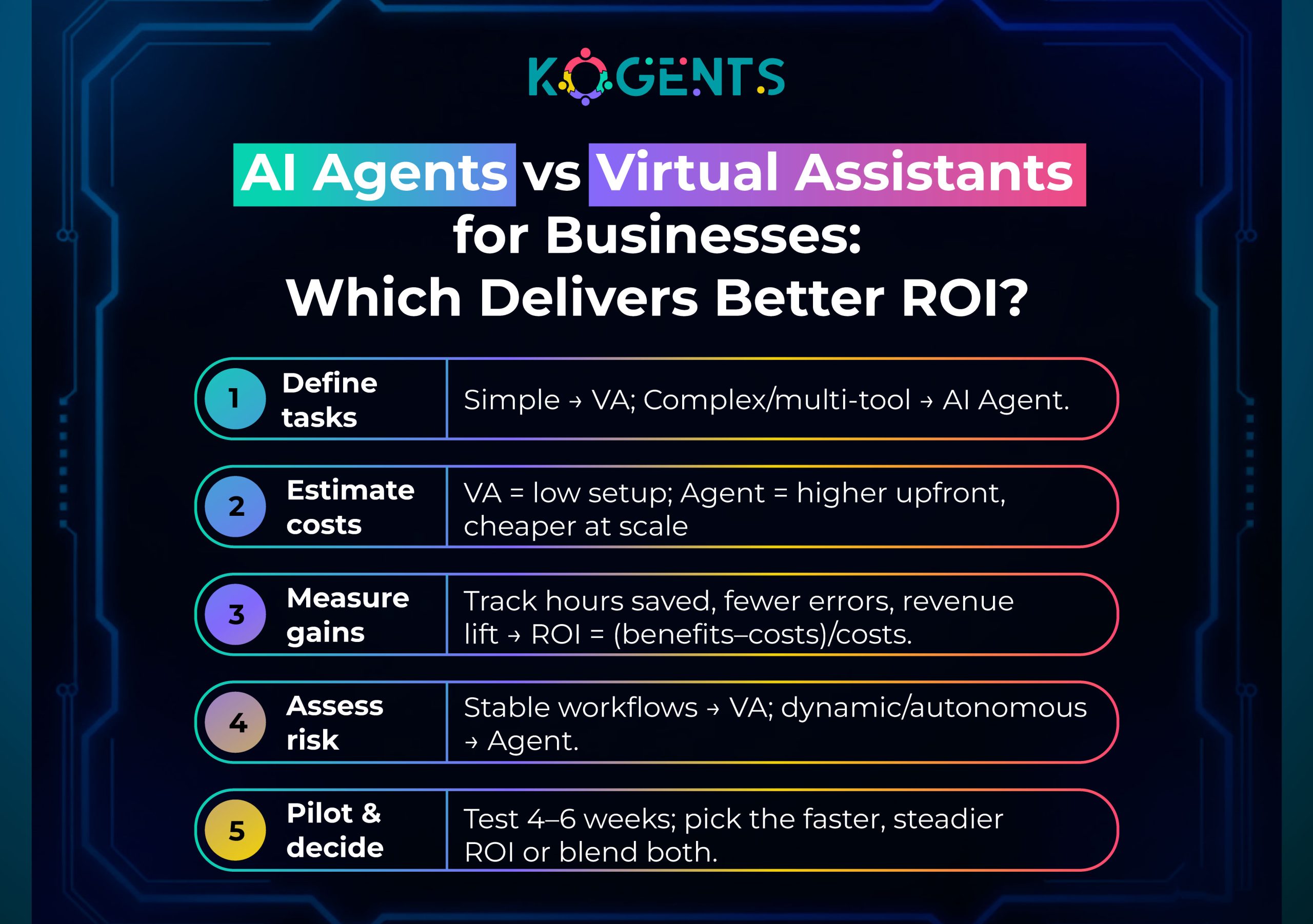
    ai agents vs virtual assistants for businesses which delivers better roi

    Use-Cases and Case Studies for Solopreneurs

    Case Study 1: Content Creation & Scheduling

    Context: A freelance writer/solo content marketer needs to produce four blogs/month, repurpose them into eight social posts, send a weekly newsletter, and engage with comments.

    Virtual Assistant Approach: Use a conversational assistant (e.g., GPT-4 via chat) for drafting blog posts, schedule posts manually through a social-media scheduler, and send newsletters via email software. 

    Outcome: Time spent is still significant; still lots of manual input.

    AI Agent Approach: 

    Deploy an AI agent that: 

    • (a) monitors trending topics in a niche, 
    • (b) draft blog outline and first draft, 
    • (c) formats into social posts, 
    • (d) schedules posts in the calendar, 
    • (e) monitors engagement metrics and loops feedback into the next batch. 

    Outcome: Content pipeline becomes semi-autonomous, the solopreneur spends time refining, not producing from scratch.

    Result: The agent automates ~70% of the repetitive content creation process. The solo writer focuses on voice, strategy, and client work. 

    Case Study 2: Lead Qualification & Outreach Automation

    Context: A consultant running a solo business wants to convert leads from website form, LinkedIn, and email; needs to qualify, score, and schedule discovery calls.

    Virtual Assistant Approach: A virtual assistant tool handles form responses, sends templated replies, and alerts the consultant to manual follow-up. Some manual scoring required.

    AI Agent Approach: An AI agent monitors lead sources in real time, enriches each lead with public data (LinkedIn, company info), scores leads with an ML model, sends personalised outreach email, sets up a meeting if criteria are met, updates CRM, and escalates to a human if the lead meets “hot” threshold. 

    Outcome: The solopreneur wakes up to a list of qualified leads with meeting slots scheduled; less manual sorting and chasing.

    Result: Lead conversion increases (e.g., conversion rate 15–20% instead of 5–7%). Time freed to focus on closing, not sorting. 

    This mirrors the AlphaGamma example:

    “Automated lead lists … value-first outreach converting at 15–20% … majority of time spent on strategic work.” 

    Future Trends: Looking Ahead!

    A StackSpot blog cites that “by 2028, at least 15% of all business decisions will be made by AI agents.”

    • Multi-agent systems (teams of agents interacting) will mature. 
    • MoveWorks identifies this as an evolution from single agents.
    • Cost barriers continue to drop; more platforms are offering no-code or low-code agent creation for solo businesses. 
    • Example: “Most solopreneurs are building AI agents completely backwards,” suggests that accessible frameworks now exist.
    • Increased autonomy but also increased need for oversight and governance (ethical AI, data privacy, safety).
    • For solopreneurs: early adopters of agentic automation will gain an advantage; those sticking with manual or reactive tools risk falling behind.

    Conclusion

    In the debate of AI Agents vs Virtual Assistants, it’s not about which is better, but which aligns with your stage and goals.

    Virtual assistants boost efficiency for routine tasks, while AI agents scale workflows and revenue through autonomy.

    The smart solopreneur blends both, starting small, automating one workflow, then evolving into a micro “AI-powered team.” Success depends on clear goals, good processes, and iterative refinement.

    Ready to build your next-generation solo system? Visit the best agentic AI company in town, named Kogents.ai, and turn automation into acceleration.

    FAQs

    How do AI agents work compared to virtual assistants?”

    Virtual assistants typically rely on conversational AI or natural-language processing (NLP) to interpret user commands and execute simple tasks. AI agents go further: they decompose goals into subtasks, integrate tools/APIs, monitor context, and adapt decisions over time. 

    Are AI agents smarter than virtual assistants?”

    “Smarter” depends on context. AI agents are more capable in workflows that require decision-making, tool integrations, and autonomy. Virtual assistants may suffice (and be smarter from a cost/time perspective) for simpler tasks. Intelligence here is functional rather than intrinsic.

    What makes an AI agent autonomous vs a virtual assistant reactive?

    Autonomy means the system can act without constant human prompts, monitor progress, and choose actions. Reactivity means the system responds when asked. The difference lies in goal-orientation and initiative. 

    Which is better for my business: a virtual assistant or an I agent?

    It depends on your business needs, workflow complexity, budget, and growth targets. For many solopreneurs, starting with a virtual assistant makes sense. If you have scalable workflows and want to amplify output, an AI agent is better, or a hybrid strategy. Refer to the decision framework above.

    Can a solopreneur without technical skills use AI agents?

    Yes, many no-code or low-code platforms now offer AI-agent builders tailored for small businesses. The key is to pick a manageable workflow, follow best practices (goal definition, monitoring, feedback loops). Solopreneurs don’t need to build from scratch.

    Will virtual assistants become obsolete because AI agents will replace them?

    Unlikely in the near term. Virtual assistants serve many simpler tasks efficiently and low cost. AI agents scale complexity. For many solo businesses, a hybrid model (virtual assistant for certain tasks, agent for others) makes sense. They complement each other rather than one replacing the other entirely.
  • Hire an AI Automatic Video Editor Implementation Blueprint for Enterprise Teams

    Hire an AI Automatic Video Editor Implementation Blueprint for Enterprise Teams

    Well, you must be aware that enterprises are quite overwhelmed to create more video content, faster and at lower cost, while maintaining brand consistency, creative quality, and technical precision. 

    That’s where the decision to hire an AI automatic video editor comes into the spotlight.

    It’s not just about speeding up cuts or adding captions; it’s about transforming video creation into a smart, data-driven process where AI handles the heavy lifting, and human editors focus on creativity, storytelling, and strategy.

    This blog delivers a step-by-step implementation blueprint for enterprise teams looking to integrate an AI automatic video editor, covering vision settings for you so you can build a scalable and future-ready video production engine.

    Key Takeaways

    • AI-powered video editing automation can cut editing turnaround time compared to traditional workflows.
    • Hiring or engaging with an AI automatic video editor isn’t simply replacing human editors; it’s about creating a hybrid workflow where human creativity is amplified by technological power.
    • Enterprise adoption of AI in video editing requires strong change management, clear stakeholder engagement, and a detailed implementation plan, not just tool selection.
    • Data governance, brand safety, and ethical considerations must be built into the strategy from the start.
    • Measuring success demands both qualitative (creative output, brand alignment) and quantitative indicators so that you can make the business case for scaling.

    Why Enterprise Teams Should Hire an AI Automatic Video Editor?

    An AI automatic video editor refers to an AI automation platform, service, or tool that uses artificial intelligence to perform editing tasks automatically or semi-automatically: scene detection, shot selection, audio transcript alignment, auto-captions, auto-dubbing, stabilisation, colour matching, motion graphics, and short-form generation from long-form content.

    The key is automation of repetitive tasks and scaling of output, while maintaining brand quality.

    Today’s enterprise organisations are generating video content across marketing, training, internal communications, product demos, customer testimonials, onboarding, and more. 

    Analysts report that more than 60% of brands using AI say it’s used for pre-production or post-production editing—including captions, dubbing, and other editing automation. 

    Challenges in Traditional Editing Workflows

    Traditional video editing workflows involve manual labour: ingesting footage, logging clips, syncing audio, locating best takes, rough cuts, transitions, colour grading, motion graphics, exporting for formats, captions/dubbing. 

    These tasks consume time, cost, and scale poorly, especially when you need to produce dozens or hundreds of videos per month.

    Studies find that AI tools in post-production reduce editing time significantly: one case reported that footage grouping and scene detection improved by 70% using AI. 

    Meanwhile, creative teams often get bogged down in repetitive or mechanical tasks, leaving less time for story, brand nuance, and creativity.

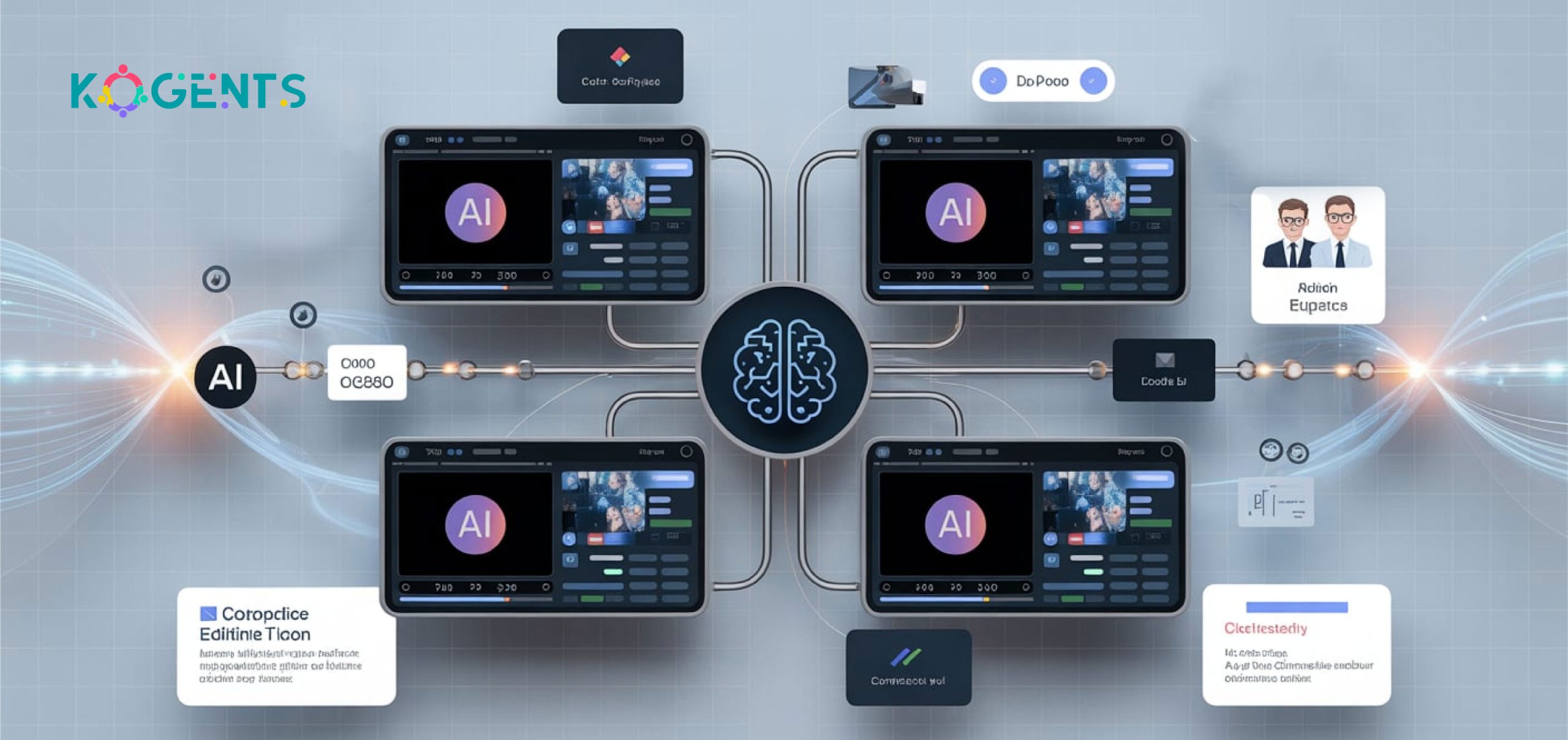
    enterprise teams should hire an ai automatic video editor

    Implementation Blueprint for Enterprise Teams

    Let’s now walk through a step-by-step blueprint for enterprise teams to hire an AI automatic video editor and embed it into production workflows.

    Step 0: Establish Vision & Business Objectives

    Before selecting any tool, you need to define why you are doing this. For example:

    • Objective: Reduce the turnaround time of marketing videos from 10 days to 3 days.
    • Objective: Reduce the cost per training video by 40 %.
    • Objective: scale to regional versions (e.g., 10 languages) within the existing team.
    • Objective: maintain brand standard across 500+ videos per year. 
    • Set measurable KPIs (e.g., videos/month, cost/video, time/video, reuse rate, brand compliance scores).
    • Define success criteria. Tie to business outcome: fast campaign launch → more leads, better training engagement → lower onboarding cost, etc.

    Step 1: Audit Existing Video Workflow & Content Inventory

    • Inventory all existing video content: by type (marketing, training, internal comms), formats (long form, short form), and volumes.
    • Map current workflow: who does what (producers, editors, motion graphics, export), tools used, hand-offs, timelines.
    • Identify bottlenecks: “We wait two days for a rough cut”, “We outsource colour grading and motion graphics cost is high”, etc.
    • Identify reuse potential: “Can we repurpose a webinar into five social clips?”, “Do we need 20 language variants?”.
    • Assess brand consistency: do current videos vary in look/feel? Are manual edits introducing variation?

    Step 2: Define Use-Cases, Personas, Volumes & KPIs

    Define exactly where an AI automatic video editor will be deployed. Examples:

    • Use-Case A: Marketing campaign videos (2–4 min) for social & web.
    • Use-Case B: Internal training modules (10–30 min) with multiple language subtitles.
    • Use-Case C: Product demo videos (1–3 min) repurposed into 15-sec shorts for social.

    Step 3: Select the Right AI Video Editing Service / Platform

    Here is your key decision: whether to hire an AI automatic video editor (as a service) or implement a tool in-house, or a hybrid.

    • Build in-house: You develop tooling or integration with existing editors. High control and brand fit, but high cost and time.
    • Buy a platform: Use an AI video editing tool for AI automation testing and implement it with your editors. Easier to scale.
    • Hire a service: Engage an external team that uses an AI automatic video editor tooling, an outsourced model. Lower internal overhead but less control. 

    Evaluation criteria for enterprise teams

    • Scalability: Can it handle your volume and variety (formats, languages, aspect ratios).
    • Brand compliance: Does the tool support brand templates, style guides, and auto-brand elements?
    • Integration: Does it integrate with your DAM, CMS, marketing stack, and cloud storage?
    • Security & governance: Does it handle enterprise data securely? Is it compliant with data-privacy laws?
    • AI capabilities: scene detection, transcript alignment, auto-captions, multilingual dubbing, motion graphics automation, and short-form extraction.
    • Human-in-loop flexibility: Can editors override AI decisions, maintain creative control?
    • Vendor stability & maturity: Are there credible case studies, enterprise references?
    • Cost model: Subscription, per-video fee, service rate.

    Vendor shortlist & evaluation

    Use your criteria: hold demos, run proof-of-concept. 

    One case study shows enterprise teams replaced many manual tasks with automated tagging, scene detection, and reduced editor hours by 70%. 

    Step 4: Pilot Implementation

    Once you’ve selected a tool/service, run a controlled pilot.

    Pilot scope:

    • Choose 1–2 use-cases (from Step 2) that are high impact but safe.
    • Define pilot team: marketing/training lead + editors + IT + vendor.
    • Workflow definition: define how the AI automatic video editor plugs in: upload raw footage → AI processes (scene detection, auto cuts) → human editor reviews → output formats.
    • Define pilot duration and volume: e.g., 10 videos over 4 weeks

    Training & onboarding:

    • Train your team on tool features, workflows, and change-management aspects.
    • Establish handles for brand templates, naming conventions, and the digital asset library.

    Metrics & evaluation:

    • Track time per video (pre-pilot vs pilot).
    • Track cost (editor hours, vendor fees).
    • Track output volume and rework rates.
    • Gather qualitative feedback: editor satisfaction, brand lead satisfaction, and end-user reception. 

    Review & iterate:

    • Identify friction (integration issues, brand inconsistencies, export problems).
    • Adjust templates, workflows, and custom rules.
    • Decide go/no-go for scale.

    Step 5: Scale & Embed into Enterprise Production

    If the pilot is successful, roll out across the full operation.

    Governance & standards:

    • Define video production standards: aspect ratios, durations, templates for marketing/training/internal.
    • Create brand-compliance rules: logo placement, colour palette, typography. The AI tool must enforce or assist with this.
    • Centralised asset management: connect tool to your DAM, CMS, metadata standards, and version control.
    • Team roles: assign AI-editing champion, workflow manager, vendor liaison.

    Collaboration and workflow integration:

    • Integrate with existing marketing planning, training scheduling, and content calendar.
    • Provide training for editors to shift from manual heavy-lifting to oversight and creative refinement.
    • Change management: communicate benefits (speed, lower cost, more creative time) to gain buy-in from human editors and stakeholders.

    Scaling volumes:

    • Implement into multiple content streams (marketing, training, social, product).
    • Expand regionally: define localisation workflows (subtitles, dubbing). AI can help here.

    Continuous monitoring & improvement:

    • Set up dashboards showing: videos produced, cost per video, time to publish, reuse rate, brand-compliance score, and audience engagement.
    • Use feedback loops: review editor overrides of AI, track errors, and refine AI tool rules/templates.

    Budgeting & resource planning:

    • Forecast volumes and cost savings. Reallocate human resources freed up to higher-value tasks (storyboarding, creative direction, analytics).
    • Negotiate vendor/service contracts with volume discounts.

    Step 6: Measure & Optimise KPI’s

    Metrics are critical. Your enterprise implementation must deliver measurable value. 

    Example KPI dashboard:

    Metric Baseline (Before AI) Target After 6 Months Current
    Average editing time per video e.g., 48 hours 20 hours
    Cost per video (USD) e.g., 3,000 1,500
    Number of videos/month e.g., 50 75
    Brand-compliance issues e.g., 15% <5%
    Editor rework rate e.g., 10% 4%
    Internal satisfaction score e.g., 3.5/5 4.5/5

    Case Studies

    Case Study A: Enterprise Platform Deployment

    • A multinational enterprise adopted an AI-based editing tool for its internal communications team. 
    • By deploying automated scene detection, transcript alignment, and brand template enforcement, the team reduced editing time by 70%. 

    “According to Vidico, their systems-based production model helped clients reduce cost per video asset by up to 60%.”

    Key lessons: choose a use-case with high volume and standardisation; invest in templates upfront; monitor human-in-loop metrics.

    Case Study B: Global Multi-Region Implementation

    • A large consumer brand implemented an AI video editing service across its marketing, product, and social teams. 
    • They onboarded the AI tool/service across 12 countries and 15 languages. 
    • By enforcing brand templates and automating export formats (16:9, 9:16, 4:5), they launched 3X more social videos per quarter without hiring additional editors.

    While this case is less publicly disclosed (vendor-confidential), various articles point to similar outcomes.

    Key lessons: when scaling globally, central standards + AI templates matter; training and change management are critical.

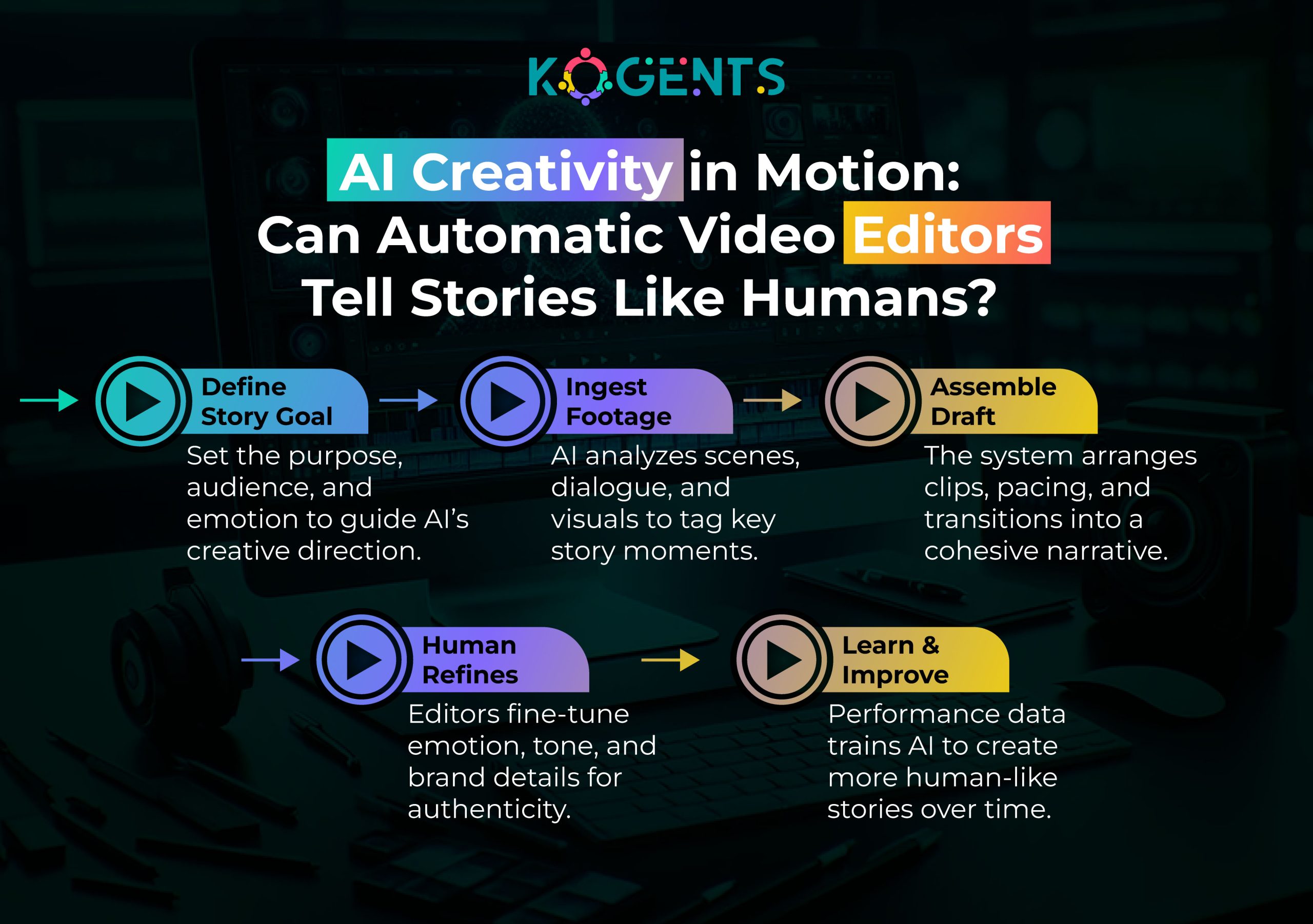
    ai creativity in motion can automatic video editors tell series like human

    Summing Up!

    For enterprise teams facing rising video demands, deciding to hire an AI automatic video editor can be transformative. 

    This approach streamlines workflows, reduces costs, and boosts creative output. With clear vision, smart tool selection, and careful scaling, teams achieve faster production and stronger brand consistency. 

    At Kogents.ai, we help enterprises design, integrate, and optimize AI-driven video workflows, empowering you to move beyond manual editing and lead the next wave of intelligent, scalable content creation. So, leverage the perks of the best agentic AI company today! 

    FAQs

    How do AI video editors work?

    They work by analysing raw video data (images, audio, transcripts) with algorithms that detect scene changes, recognise objects/people (computer vision), generate transcripts (speech-to-text), match audio to video, apply brand templates, generate captions/dubbing, and export required formats. Many tools integrate human-in-loop interfaces so editors can approve or adjust automatic suggestions. 

    How accurate and reliable are AI video editing systems?

    They are increasingly reliable for tasks like scene detection, caption generation, and motion graphics templates. Some studies report 70%+ improvements in time efficiency.SuperAGI.However, accuracy depends on footage quality, brand complexity, language variation, and human oversight. Enterprises should pilot before full deployment.

    What’s the cost model when you hire an AI automatic video editor?

    Cost models vary: subscription to a SaaS tool, per-video pricing, service-based model (pay per edited video via vendor). Enterprises should factor in onboarding, templates, human review time, localisation cost, and potential cost savings from reduced manual hours. The cheapest isn’t always best—ensure brand compliance, scalability, and governance.

    How do I select the best AI video editing platform or service for my enterprise?

    Evaluate on criteria such as scalability (volume, languages, formats), brand template support, workflow integration, data security/governance, human-in-loop flexibility, and vendor maturity. Run demos, pilot selected use-cases, and check references. Use pilot metrics to compare cost/benefit.

    What are the main risks or challenges of implementing AI video editing in enterprise workflows?

    Risks include brand misalignment, quality issues if AI is over-trusted, data security/privacy concerns, change-resistance from human editors, over-automation without oversight, and ethical issues (e.g., AI-generated content credibility). Industries must build governance and train teams.

  • How Often Is AI Wrong? A Practical Guide to Building Reliable Production-Ready AI-Models

    How Often Is AI Wrong? A Practical Guide to Building Reliable Production-Ready AI-Models

    “How often is AI wrong?” It’s a deceptively simple question, yet one that hides a complex web of considerations, caveats, and real-world surprises.

    In an age where we increasingly entrust decisions, from medical diagnoses to legal briefs, from customer-service chatbots to autonomous driving systems, to artificial intelligence, the question of how reliable these systems truly are matters more than ever. 

    We hear glowing success stories of AI breakthroughs. But equally, we see embarrassing missteps: models hallucinating plausible-but-false facts; image-recognition systems biased by demographic skew; decision-support tools misclassifying rare cases. 

    These failures raise a vital point: what is the error rate of AI systems in practice, and how do we build them so they are production-ready, dependable, and trustworthy?

    This blog explores how often AI gets it wrong, why errors occur, and how to build reliable, real-world AI systems through practical strategies and case-backed insights.

    Key Takeaways

    • Error is inevitable: Even the best AI models have non-zero error rates; the question is how much and what kind.
    • Context matters: The acceptable error threshold for an AI model depends heavily on domain (healthcare vs. chatbots) and risk tolerance.
    • Monitoring and maintenance matter more than just initial development: Production-ready models require continuous evaluation, drift detection, and corrective processes.
    • Transparency and governance build trust: Being clear about performance metrics, failure modes, and fallback procedures is key to reliability and user confidence.
    • Building for reliability is not just a technical task; it’s organisational: Data pipelines, model lifecycle, human-in-the-loop design, and operational readiness all play a role.

    Why Does This Question Matter: How Often Does AI Make Mistakes?

    At first glance, the question “How often is AI wrong?” may seem academic. But in real-world applications, the cost of AI error can range from minor inconvenience to serious harm. 

    Consider: in healthcare, a mis-classification could lead to a wrong treatment; in law, a hallucinated fact could lead to a malpractice suit; in finance, a misprediction could cost millions. 

    Therefore, asking what the accuracy of AI systems is or how many errors AI makes is not just about metrics; it’s about trust, safety, governance, and responsibility.

    When deploying models in production, especially in regulated industries, questions like how reliable AI is and how well it aligns with enterprise AI development standards become central.

    Does the model meet a minimum acceptable error threshold? Are users aware of the error rate and limitations? 

    Are fallback/override procedures in place? With growing regulation, organisations are being held accountable not just for model performance, but for error transparency, bias mitigation, auditability, and monitoring.

    how often does ai make mistakes

    How Often Is AI Wrong: Domain-By-Domain Statistics and Real-World Data?

    The frequency of AI errors depends on the domain, model type, and context, but leveraging AI agent benefits, such as automation, accuracy, and adaptive learning, can greatly reduce errors and enhance overall reliability. 

    Healthcare

    One survey among staff at a radiology department found that participants believed an acceptable error rate for AI systems should be around 6.8%, compared to 11.3% for human clinicians in the same context.

    Note: These figures suggest that even in high-stakes domains like medicine, error rates of 5–20% are realistic depending on context.

    Legal / Knowledge Work

    A study of proprietary legal AI tools (RAG-based) found hallucination (fabricated or incorrect output) rates between 17% and 33%.

    Note: These error rates are alarmingly high for legal/knowledge work, where factual accuracy is critical.

    Generative AI / LLMs / Search & Information Retrieval

    A 2024 study found hallucination rates in generative LLMs (regarding references) were substantial.

    A review of generative AI noted that hallucination rates can range widely by domain: from 1.4% in speech recognition to >16% in more complex reasoning domains.

    Case Studies

    Case Study 1: Legal Research AI & Hallucination

    In Mata v. Avianca Inc. (S.D.N.Y., 2023), two lawyers used ChatGPT for legal research and unknowingly submitted a court brief citing six non-existent cases fabricated by the AI. 

    When the court verified the references, it found that every cited authority was fake. 

    The attorneys were fined $5,000 and publicly reprimanded. 

    This case underscored how over-reliance on generative AI without human validation can severely damage credibility and trust in AI systems.

    Case Study 2: Production-drift & Model Maintenance

    According to IBM:

    “Model drift refers to the degradation of machine learning model performance due to changes in data or in the relationships between input and output variables.” 

    For example, imaging AI might perform well in hospital A but degrade in hospital B with different devices.

    Lessons learned:

    • Building production-ready models requires not only initial validation, but post-deployment monitoring and maintenance.
    • Organisations must invest in continuous evaluation, drift detection, logging of errors, and a pipeline for re-training.

    Why AI Goes Wrong: Root Causes of Errors in AI Models?

    Below are some primary drivers of error.

    Data Quality & Bias

    • Poor, incomplete, or non-representative training data lead to model misgeneralisation.
    • Bias in data leads to systematic errors.
    • Label noise or mis-annotation also increases error rates.

    Domain shift / Deployment mismatch

    • Models trained on one population or environment may fail when data distribution changes.
    • When production data diverges from training data, error rates increase.

    Model complexity / Over-fitting vs Under-fitting

    • Over-fitted models may perform well in training/validation but poorly in production.
    • Under-fitting leads to high baseline error.
    • Both lead to a higher machine learning error rate than anticipated.

    Algorithmic limitations, hallucinations & reasoning failures

    • Especially for generative and reasoning AI, hallucinations are a major error mode: plausible but false output. 
    • Some theoretical work suggests that calibrated language models must hallucinate at a non-zero rate given statistical constraints. 
    • Models may lack domain knowledge, or context may be ambiguous.

    Integration & Operational factors

    • Even a good model can fail if deployed in a flawed pipeline.
    • Automation bias occurs when humans over-trust AI outputs and fail to check when the AI is wrong. 
    • Lack of monitoring, absence of error-logging, and absence of fallback mechanisms amplify failure risk.

    Building Production-Ready & Reliable AI Models: A Practical Guide

    Let’s turn to the practical question: How do you build an AI model that is production-ready, reliable, and trusted?

     A recent news study found that nearly 45% of responses from leading AI assistants contained at least one significant error.

    Step 1: Define clear performance and error-threshold goals

    • Establish the acceptable error threshold for your domain. Ask: What error rate is tolerable? What error types are unacceptable?
    • Benchmark human performance if applicable, and set a target for your model (often equal or better than human, or at worst equivalent with strong oversight).
    • Use domain-specific metrics: precision, recall, F1-score, false-positive rate, and false-negative rate. 
    • For generative models: hallucination rate, factual accuracy, citation accuracy.

    Step 2: Data and training process

    • Ensure your data is high quality, well-labelled, representative of the production environment, covers edge cases, and diverse.
    • Perform data audits for bias, demographic coverage, missing data, and class imbalance.
    • Use cross-validation, hold-out test sets, and, if possible, out-of-distribution test sets to simulate a real production shift.
    • Build for robustness during data augmentation, simulate variation, and emphasize rare classes if risk-critical.

    Step 3: Model evaluation & validation

    • Use CA on the confusion matrix and performance metrics to deeply understand the error breakdown.
    • Analyse error modes (which classes are mis-classified? false positives vs false negatives?).
    • For generative AI, evaluate the hallucination rate, factual accuracy, and citation correctness. 

    Example: one study found 61.6% of citations in an LLM test were inaccurate.

    • Use domain experts in evaluation loops for high-stakes applications.

    Step 4: Deployment readiness & monitoring

    • Develop logging of predictions, inputs, confidence scores, and error events.
    • Build dashboards and alerts for drift detection (distribution changes), performance decay.
    • Implement a human-in-the-loop (HITL) system, especially for edge cases or high-risk decisions.
    • For generative models, include content verification / human review/fallback procedures for unverifiable outputs.

    Step 5: Explainability, transparency & trust

    • Implement explainability (XAI) so users can understand model reasoning.
    • Provide documentation: model limitations, training data description, error rates, and known failure modes.
    • Encourage users to verify high-impact outputs, and design UI to discourage over-trust of AI. 
    • Use disclaimers, request human verification in critical workflows.

    Step 6: Maintenance, drift & lifecycle management

    • Continuously monitor production performance. If error rates creep up, trigger an investigation.
    • Re-train or fine-tune when distributions shift.
    • Update models and pipelines as business/data context evolves.
    • Periodically audit for bias, performance across sub-populations, and edge cases.
    • Adopt governance frameworks: model versioning, change logs, audit trails.

    Step 7: Governance, audit & regulatory compliance

    • Align with standards: NIST AI Risk Management Framework, IEEE standards for trustworthy AI, ISO efforts around AI system reliability.
    • Document error rates, risk assessments, and mitigation strategies.
    • In regulated industries (healthcare, finance, legal), pursue certification or compliance with sector-specific regulations (FTC oversight, U.S. AI Regulations and Frameworks).
    • Create an audit function for AI behaviour; error logs, incident reviews, and root-cause analysis when things go wrong.

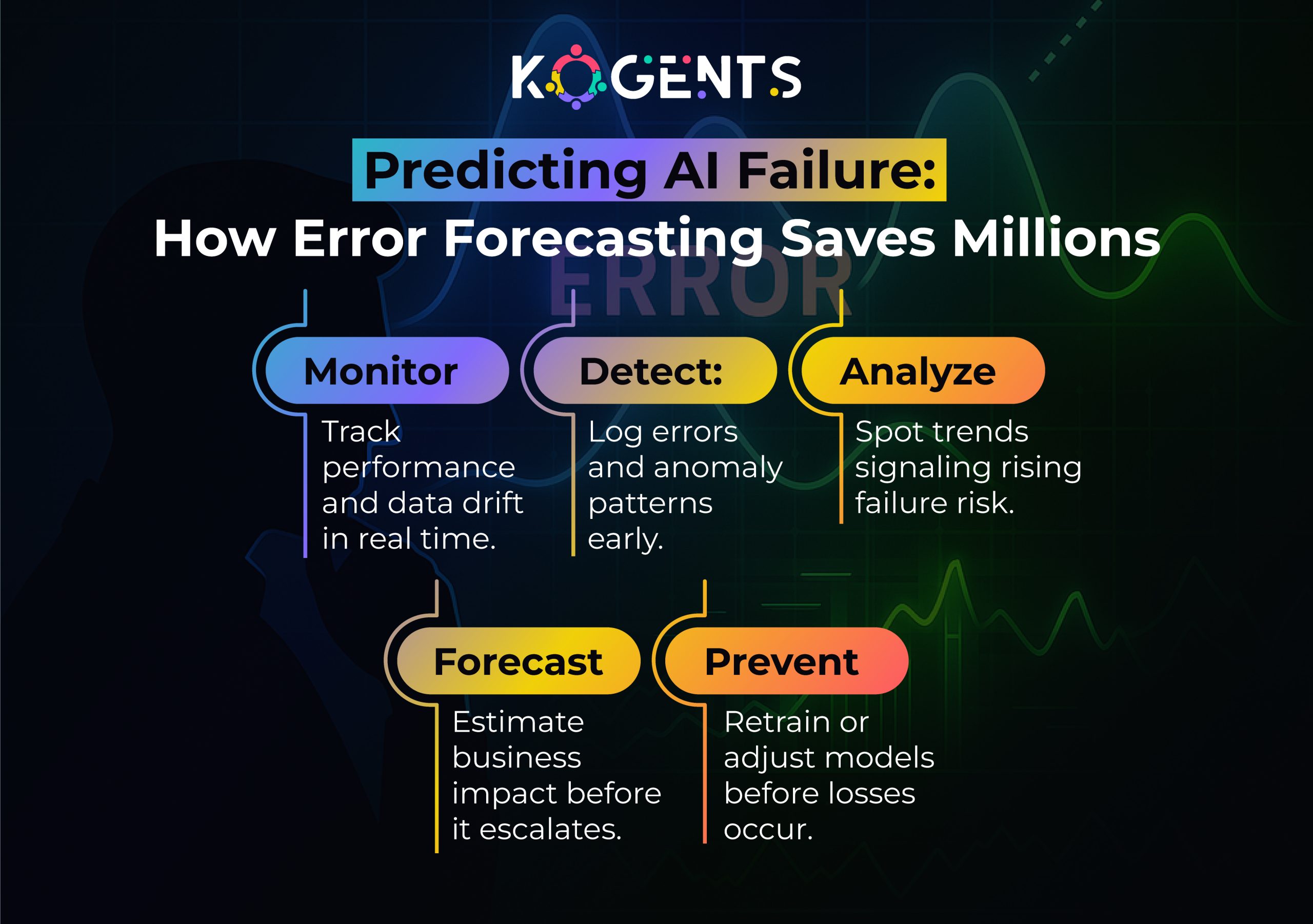
    predicitng ai failure how error forecasting saves millions

    Table: Comparison of AI Error Rates & Context Across Domains

    Domain Typical Error / Hallucination Rate Context & Notes Implications
    Radiology / low-risk diagnostic AI ~6.8% (acceptable by staff) vs human 11.3% in survey  Survey of acceptable error, not actual measured error In high-stakes domains, the threshold is low
    Internal Medicine Diagnostic Tools Error drop from 22% → 12% after AI tools  Real-world deployment of AI assistance Even aided systems still have 12% error
    Legal Research AI (hallucinations) 17%-33% hallucination rate in RAG legal tools  High-risk domain (legal citations) Indicates need for strong verification
    Generative LLMs – references 61.6% of the references in a study were erroneous  Open-ended generation with citation task Shows the magnitude of hallucination problems
    AI Assistants (news queries) 45% of responses contained at least one significant error  Consumer-facing AI assistants in production Trust risk for public information

    Conclusion 

    If you’re building or deploying an AI model, treat the question of how often is AI wrong and how frequently it makes mistakes as central, not only at development time, but as an ongoing operational metric. 

    Use the frameworks above, data quality, evaluation metrics, deployment readiness, monitoring, explainability, and governance, as your blueprint for building truly production-ready, trustworthy AI.

    At Kogents.ai, we specialise in building AI systems that don’t just perform well in the lab; they stay robust, reliable, and intelligent in production. 

    As the best agentic AI company, we believe AI reliability isn’t just a feature; it’s a business-critical capability that defines long-term success.

    FAQs 

    What is the typical error rate of AI systems?

    There is no single “typical” error rate because it depends on domain, task complexity, model maturity, and data quality. In healthcare diagnostic AI, you might see error rates of 10%, in generative LLM tasks, you might see hallucination rates of 30–60%+. 

    Why does artificial intelligence make mistakes?

    Mistakes may arise due to poor training data, domain or distribution shift when the production context differs from training, algorithmic limitations, model over-fitting or under-fitting, lack of human-in-loop verification, and opacity/automation bias where users rely uncritically on model outputs.

    How reliable is AI in practice?

    Reliability depends on how well the system is built, deployed, and monitored. A well-designed AI pipeline with robust data, monitoring, ground-truth checking, and human fallback can achieve high reliability (low error) in constrained tasks. But in open-ended or complex tasks, reliability can be much lower. 

    How many errors does AI make?

    The numerical count depends on the volume of predictions and the error rate. If a model has a 10% error rate and processes 1 million cases, you’d expect 100,000 errors. But more important than raw count is the type of errors, their impact, and whether you have a mechanism to flag and rectify them.

    What are AI hallucinations, and how often do they occur?

    AI hallucinations refer to outputs that are plausible-looking but factually incorrect, fabricated, or unsupported. Occurrence varies: e.g., one study found ~61.6% of generated references were erroneous.

  • AI Automation Testing Implementation Methodology for Mission-Critical AI Systems

    AI Automation Testing Implementation Methodology for Mission-Critical AI Systems

    This age calls for artificial intelligence-driven systems that literally determine human lives, business continuity, and national security; the stakes around quality assurance have never been higher.

    Picture a self‐driving car, a diagnostic AI for healthcare, or an autonomous defence system; any failure, bug, or unintended behaviour could provoke catastrophic outcomes. 

    That’s why taking a standard test automation approach simply won’t cut it. What you need is AI automation testing, an advanced, intelligent, adaptive regime of software quality assurance that doesn’t just check boxes, but reasons, learns, and evolves in tandem with the system under test.

    In this blog, you will discover a full‐fledged implementation methodology for deploying AI automation testing in mission-critical AI systems. So, delve now!

    Key Takeaways

    • AI automation testing elevates QA from scripted, brittle automation to intelligent, adaptive systems that learn and self-heal.
    • Mission-critical AI systems demand specialised test strategies: synthetic data, defect-prediction models, anomaly detection, and continuous validation.
    • Integration with CI/CD, DevOps, QA, and tool ecosystems is essential; test automation cannot be an afterthought.
    • Measuring value is key: implement the right metrics for test-coverage optimisation, ROI, defect-escape rate, self-healing rate, and reliability.
    • Governance, scaling, and maintenance matter: even intelligent frameworks can degrade without oversight, versioning, and continuous improvement built in.

    implement ai automation testing

    Why does AI automation testing matter for mission-critical AI systems?

    The term AI automation testing and its variations,  such as AI for automation, have rapidly advanced over recent years.

    Traditional automation frameworks struggle with complexity, fragility, maintenance overhead, and scale. 

    According to a systematic literature review, AI techniques have been applied to test-case generation, defect prediction, test-case prioritization, and more, improving coverage, reducing manual effort, and enhancing fault detection. 

    In mission-critical AI systems, you confront additional unique risks: model drift, adversarial inputs, ethical/regulatory constraints, real-time performance requirements, and high availability demands. 

    Key reasons why AI automation testing is vital:

    • Scale & Complexity: AI systems may involve thousands of data permutations, complex model decision paths, edge cases, and continuous learning loops, making manual or traditional automation insufficient.
    • Adaptivity: Models change, data evolves, and new behaviour emerges; test automation must adapt dynamically.
    • Safety & Reliability: Mission‐critical systems can’t fail silently; you need predictive defect analytics, anomaly detection, and continuous test-coverage optimisation.
    • Continuous Delivery & DevOps: Modern AI systems deploy often; test automation must integrate in CI/CD to keep pace.
    • Governance and Auditability: Certifications like ISO/IEC JTC 1/SC 7 25010 for quality and ISO/IEC 27001 for security matters, test frameworks must support traceability, versioning, ethical/AI compliance.

    Defining the scope: What “Mission-critical AI systems” entail?

    These are systems where failure, major defect, or unmitigated drift will lead to significant harm,  human safety, financial loss, regulatory non-compliance, reputational catastrophe, or national security exposure. 

    Examples include:

    • Autonomous vehicles or aircraft (self-driving cars, drones)
    • Medical diagnostic AI or robotic surgery assistants
    • Financial trading systems using ML for real-time trading
    • Military/defence autonomous systems
    • Critical infrastructure control systems (power grid, utilities) with embedded AI

    Implementation methodology – step-by-step

    Each phase ties into the core and variation keywords; you’ll see how AI-based automated testing, AI-enabled test frameworks, predictive test automation, self-healing automation, and adaptive testing are all built in.

    A: Strategy and Governance

    • Establish Test Automation Strategy: Understand why you need AI automation testing.
    • Identify stakeholders: QA leads, ML engineers, DevOps, compliance/regulatory.
    • Risk assessment: Map mission-critical components, model failure modes, data-drift risk, and regulatory impact (e.g., for healthcare AI).
    • Define KPIs: test-coverage optimization, self-healing failure reduction, time-to-detect anomaly, and ROI of test automation.
    • Governance & compliance: Align with standards (e.g., ISTQB AI Testing Specialist certification, ISO/IEC 25010).
    • Build a cross-functional team: QA automation, ML assurance, DevOps, security.

    B: Architecture & Tool Selection

    • Does your system use traditional scripted automation (e.g., Selenium, Appium, Cypress) alongside AI-enabled frameworks?
    • Select AI test automation tools: e.g., mabl, Tricentis, SmartBear, Applitools, Testim. Recent research identified ~55 tools in a systematic review. 
    • Architecture must accommodate continuous testing, integration with CI/CD pipeline, test-data management, logging/telemetry for anomaly detection.
    • Design for extensibility: modules for synthetic test data generation, defect-prediction analytics, and self-healing test scripts.
    • Choose metrics and dashboards early (test‐suite reliability, defect escape, test-cycle time, self-healing rate).

    C: Test-Data Preparation and Synthetic Test Data Generation

    • For AI models, the input space is huge: they need high-quality, varied, representative data and edge/adversarial scenarios.
    • Use synthetic test data generation: either via generative-AI, data-augmentation, or simulation.
    • Ensure data privacy/compliance (esp. in healthcare/finance).
    • Incorporate anomaly detection for data drift, out-of-distribution inputs.
    • Prepare labelled data for defect-prediction modelling and for regression automation.
    • Ensure test-coverage optimisation across data dimensions: classes, edge cases, adversarial attacks, fairness/unbiased dimensions.

    D: Test-Case Generation, Prioritisation & Coverage Optimisation

    • Leverage ML techniques for test-case generation and test-case prioritisation
    • Use model-based testing, metamorphic testing, and fuzzing for AI model inputs
    • Define coverage metrics: code coverage, model-decision path coverage, data path coverage, and adversarial input coverage.
    • Automate regression sets and prioritise flows via adaptive testing; when system changes occur, the test suite adjusts.
    • Incorporate defect prediction models to anticipate where bugs are likely and allocate test effort accordingly.

    E: Building the AI-Enabled Test Framework

    • Self-healing test scripts: when UI structure or model API changes, scripts adapt automatically (part of “self-healing automation”).
    • Autonomous testing agents: AI agents benefit from discovering new flows, generating tests, and monitor system behaviour.
    • Intelligent heuristics: use computer vision, NLP for UI testing, and model output validation.
    • Built-in analytics: combine test results with telemetry and defect data to feed back into test design.
    • Scriptless interfaces: enabling non-technical testers to define test scenarios via natural language (highlighting AI in software testing).

    F: Integrating with CI/CD & DevOps QA Pipelines

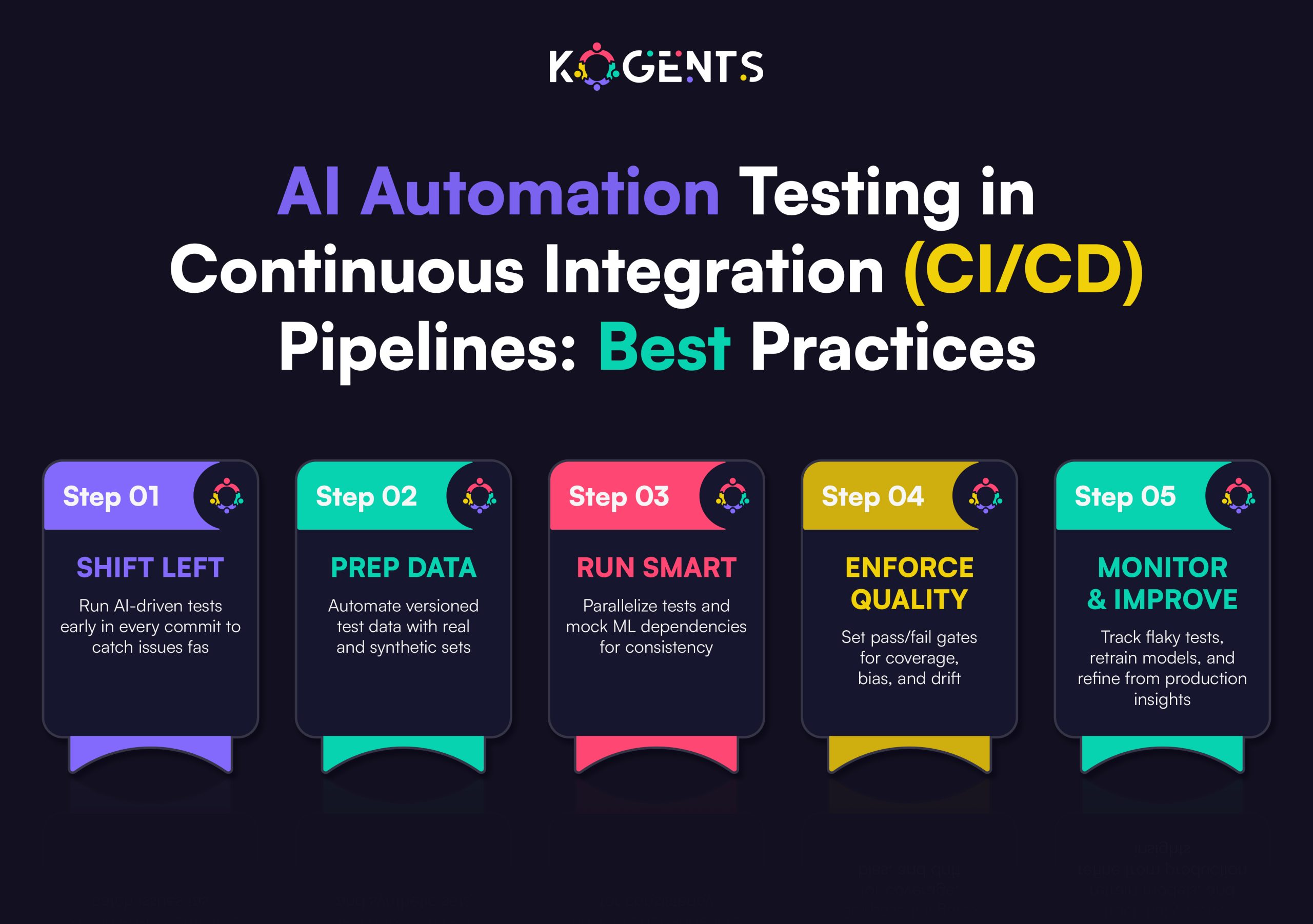
    • Integrate test suite execution into CI/CD pipeline (build → unit tests → AI-enabled tests → staging → production).
    • Shift-left testing: earlier in the lifecycle, earlier detection of issues.
    • Monitor metrics: test-cycle time, failure rate, defect escape, and time to fix.
    • Implement feedback loops: production telemetry → test‐suite updates → refined test generator.
    • Align with DevOps QA culture: cross-team collaboration, automated feedback, quality gate enforcement.

    G: Self-healing, Adaptive & Predictive Test Automation

    • Self-healing automation: Test scripts detect when UI or API changes and adapt without manual intervention.
    • Predictive test automation: Using ML/analytics to forecast defect-prone modules or flows and trigger targeted tests.
    • Adaptive testing workflows: When the system under test evolves, e.g., a new model version, a changed behaviour, the test suite adapts automatically or semi-automatically.
    • Leverage anomaly detection in production data to inform new test case generation.

    ai automation testing in continuous integration

    H: Performance, Security, Anomaly Detection & Monitoring in AI Systems

    • Performance test automation: generate load on model APIs, simulate high-traffic or extreme conditions.
    • Security testing: adversarial inputs to ML models, vulnerability scanning, and fuzzing of AI modules.
    • Anomaly detection: monitor production model behaviour for drift, out-of-distribution inputs, and unexplained decisions.
    • Reliability & fail-over testing: ensure backup systems, redundant channels, and graceful degradation.
    • Compliance: test audit trails, traceability, explainability (XAI), and ensure QA trace aligns with regulations.

    I: Validation, Verification, Metric Tracking & ROI of Test Automation

    • Defect escape rate 
    • Test-cycle time reduction
    • Self-healing rate 
    • Test-coverage improvement 
    • ROI of test automation: cost saved, defects found earlier, production defects avoided
    • Test-suite reliability 
    • Mean time to detect an anomaly in model production
    • Percentage of automated tests vs manual

    J: Maintenance, Scale-Up, Governance, and Continuous Improvement

    • Maintenance of test scripts, frameworks, and tool integrations. Even intelligent frameworks need upkeep.
    • Scale-up: As AI system complexity grows, test automation needs to scale accordingly via modularity, cloud execution, and parallelisation.
    • Governance: Version control, audit logs, test plan approvals, compliance checklists.
    • Continuous improvement: Use telemetry and analytics to refine test-case generation, adapt to drift, retire obsolete tests, and refine metrics.
    • Ethical considerations: especially in AI systems (bias testing, fairness, explainability).
    • Documentation & certification: Align with QA standards, ensure auditability.

    Case Study Spotlight

    Case Study: Financial-Trading AI Platform

    A global investment bank deployed a machine-learning-based trading algorithm that makes real-time decisions across multiple asset classes. 

    The system qualified as mission-critical due to financial exposure, regulatory oversight, and 24/7 live operations.

    Implementation Highlights 

    • Introduced synthetic test data to simulate real and extreme market conditions, including high-volatility and “flash crash” scenarios.
    • Deployed a predictive defect analytics module to prioritise test cases using historical defect data, focusing on high-risk trading modules.
    • Integrated an AI-enabled, self-healing automation framework within the CI/CD pipeline to enable continuous testing, anomaly detection, and adaptive test flow execution.

    Outcomes

    • Achieved a 40% reduction in defect escape rate, a 6× faster test cycle (24 h → 4 h), and a 30% improvement in decision-path coverage within six months.
    • Self-healing automation cut flaky-test failures by 25%, while early model-drift detection prevented potential trading losses.

    Summary of Implementation Methodology

    Phase Key Activities Metrics / Tools Typical Challenges
    Strategy & Governance Define goals, risk profile, and KPIs Defect escape rate, ROI, ISO audit metrics Lack of stakeholder alignment
    Architecture & Tool Selection Choose stack, AI-test tools, CI/CD integration Tool adoption rate, automation coverage Tool fragmentation, integrations
    Test-Data Preparation Synthetic data, data-drift modelling Data-coverage %, adversarial case count Data privacy, edge-case completeness
    Test-Case Generation & Coverage ML-based test generation, prioritisation Test-suite size, coverage, defect density Test-generation reliability, maintainability
    AI-Enabled Test Framework Self-healing scripts, autonomous agents Self-healing rate, script failure rate Complexity, team learning curve
    CI/CD & DevOps QA Integration Integrate into pipeline, shift-left Build-to-test cycle time, feedback loop latency Pipeline bottlenecks, flaky tests
    Self-healing / Adaptive / Predictive Automation Adapt to changes, anticipate defects Prediction accuracy, adaptive coverage Model drift, false positives
    Performance/Security/Anomaly Testing Load, adversarial, anomaly detection Response times, security incidents, and rift alarms Complexity, tool overlap
    Validation & ROI Tracking Measure value, QA traceability ROI %, mean time to defect detection Data collection, accurate measurement
    Maintenance & Scale-Up Governance, scaling, continuous improvement Test-suite growth, maintenance cost, compliance audit pass-rate Technical debt, framework rot

    Conclusion 

    Implementing AI automation testing for mission-critical AI systems is not a luxury; it’s a necessity. 

    By following the methodology outlined here, strategy, architecture, synthetic data, intelligent frameworks, self-healing, integration with CI/CD, non-functional testing, metrics, governance, and maintenance, you can move from brittle test suites to a robust AI-enabled test framework.

    At Kogents.ai, we empower organisations to transcend traditional QA, leveraging intelligent test automation, predictive test analytics, and autonomous testing agents. So, get in touch now with the best agentic AI company in town! 

    FAQs

    What is AI automation testing?

    AI automation testing is the practice of using artificial intelligence in test automation to design, generate, prioritise, execute, and maintain test cases in a more intelligent, adaptive, and autonomous way. It extends beyond traditional scripted automation by enabling AI-driven test automation, self-healing automation, predictive test automation, and adaptive testing workflows.

    What are the benefits of using AI-based QA automation in mission-critical systems?

    Benefits include greater reliability with fewer defects, faster test cycles through continuous testing, and broader coverage of complex AI features. Self-healing automation cuts maintenance costs while boosting ROI. It also enables proactive detection of anomalies, model drift, and security issues.

    Which tools are available for AI test automation in 2025?

    Examples include:

    • mabl — focuses on intelligent functional test automation with ML backing.
    • Tricentis offers AI-enabled automation for enterprise testing and risk-based testing.
    • SmartBear — provides vision-based testing and automation with AI capabilities.
    • Applitools — specialised in visual-AI testing, anomaly detection in UI/UX.
    • Testim — emphasises self-healing test automation scripts.

    What are the challenges of deploying AI-based automated testing?

    Key challenges include data quality, model drift, immature tools, and high maintenance demands. Teams also face skill gaps, compliance pressures, and difficulty measuring ROI without solid baselines.

    How do you test for model-drift, adversarial inputs, and anomalies in AI systems?

    Use synthetic and adversarial test data to simulate edge cases, detect anomalies, and track model drift. Automate fuzzing, high-risk tests, and anomaly monitoring to maintain AI reliability and security.

  • AI Integration for Legacy Systems Without Disrupting Critical Enterprise Workflows

    AI Integration for Legacy Systems Without Disrupting Critical Enterprise Workflows

    In the modern enterprise, agility isn’t just an advantage but survival. Yet, many global organizations still depend on legacy systems built decades ago.

    From COBOL-based banking software to monolithic healthcare databases, these systems handle mission-critical operations, but they also constrain innovation, scalability, and speed.

    The challenge: how can you bring artificial intelligence (AI) into such fragile ecosystems without breaking workflows that millions rely on daily?

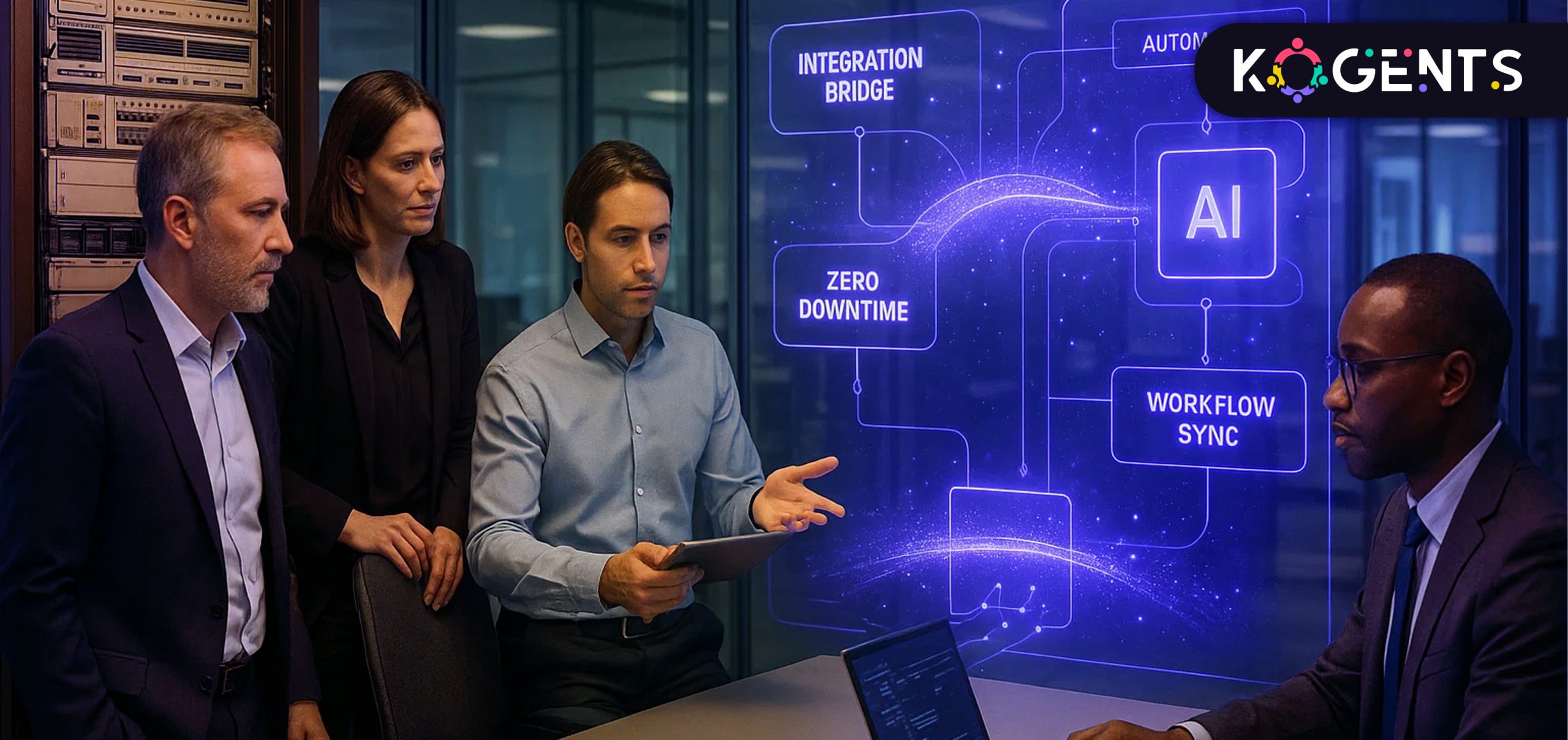
    The solution isn’t a “rip and replace.” It’s AI integration for legacy systems, a layered modernization approach that preserves stability while infusing intelligence, automation, and predictive analytics.

    Done right, this strategy transforms rigid infrastructures into adaptive, insight-driven platforms, without a single day of downtime.

    This guide explores how to execute that transformation. So, let’s uncover how to evolve your enterprise systems from legacy-bound to AI-powered, securely, incrementally, and intelligently.

    Key Takeaways

    • AI integration modernizes without disruption.
    • Prioritize architecture, not just AI models.
    • Pilot, measure, iterate, and govern continuously.
    • Treat modernization as an enterprise-wide evolution.
    • With structured planning, legacy doesn’t limit innovation; it fuels it.

    Strategic Insights At A Glance

    1. Legacy ≠ Liability. Treat legacy systems as strategic assets with rich data and proven logic; AI should augment, not erase them.
    2. Continuity is King. Modernize incrementally using hybrid overlays and sandbox pilots that preserve uptime.
    3. Architecture Over Algorithms. Focus first on data readiness, APIs, and interoperability before deploying models.
    4. Governance Before Genius. Compliance, data lineage, and explainability must precede scaling.
    5. Hybridization Wins. Combine legacy cores with cloud-based AI microservices and automation overlays to achieve agility without chaos.

    ai integration for legacy system

    Why AI Integration for Legacy Systems is a Business Imperative?

    In 2019, a U.S. Government Accountability Office (GAO) report found that the federal government spends more than $100 billion on IT and cyber-related investments annually. Of this amount, agencies have typically spent about 80% on the operations and maintenance of existing IT investments, including legacy systems.

    AI integration offers a smarter path: enhancing existing systems rather than dismantling them and replacing them outright is often risky and cost-prohibitive.

    Many enterprises also ask, “How much does it cost to build an AI system?, but the truth is that integration often delivers higher ROI at lower cost compared to a full rebuild.

    Benefits include:

    • Unlocking siloed data for real-time analytics.
    • Embedding intelligence through predictive models and process automation.
    • Reducing technical debt via AI-driven refactoring and dependency mapping.
    • Maintaining compliance and audit trails during transformation.

    Note: With AI integration with legacy systems, organizations can modernize without stopping the business clock.

    Architectural Frameworks & Real-World Modernization Models

    AI-driven modernization isn’t one-size-fits-all. Here are the five leading architectural frameworks enterprises use to modernize intelligently:

    1. Overlay Integration (Minimal Disruption Model)

    • Concept: Layer AI microservices over legacy systems via APIs.
    • Example: A global bank adds AI-powered fraud detection through an API connected to its legacy transaction system.  
    • Suggestion: For teams exploring how to create an AI agent from scratch, this framework offers a foundation, showing how modular AI agents can interact with legacy APIs safely and effectively.
    • Benefit: Non-intrusive, quick to deploy, zero downtime.

    2. Modular Refactoring (Evolutionary Model)

    • Concept: Break legacy monoliths into microservices, modernizing each component with AI.
    • Example: A logistics firm adds an AI forecasting agent to its refactored order module.
    • Benefit: Gradual modernization without full rebuilds.

    3. Hybrid Cloud Integration (Elastic Model)

    • Concept: Shift select workloads to the cloud while legacy data remains on-prem.
    • Example: Healthcare providers run AI diagnostic models in the cloud using anonymized EHR data from on-prem systems.
    • Benefit: Flexible scaling, lower infra cost, minimal risk.

    4. Automated Code Modernization (AI-First Model)

    • Concept: Use AI tools to analyze and refactor code automatically (COBOL → Java). 
    Example: Abt teams have the experience to know why the first output from a GenAI tool is often the best, especially when using deterministic settings, because GenAI is initially anchored on the most probable output. On follow-up, these tools may become less accurate as they navigate the embedding space, leading to less probable outputs.
    • Benefit: Faster modernization with less human intervention.

    5. Digital Twin Environments (Risk-Free Sandbox)

    • Concept: Create a digital replica of your system to test AI integrations safely.
    • Benefit: Zero-risk experimentation and rapid iteration.
    Framework Disruption Level Integration Speed Ideal Use Case
    Overlay Minimal Fast Continuous workflows
    Modular Refactoring Medium Gradual Modular systems
    Hybrid Cloud Low Moderate AI analytics
    Automated Refactoring Medium Fast Code conversion
    Digital Twin None Iterative Safe AI testing

    Step-by-Step: Achieving AI Integration Without Disruption

    Modernization through AI should feel like evolution, not surgery. Here’s a detailed six-step blueprint for intelligent, disruption-free transformation.

    Assess Your Legacy Footprint

    • Every modernization journey begins with visibility. 
    • Most legacy systems contain undocumented dependencies and brittle code that can collapse under pressure if not mapped.

    Actions to take:

    • Catalog all systems, databases, and batch jobs.
    • Map mission-critical workflows (billing, HR, compliance).
    • Identify outdated frameworks, unsupported code, and security gaps.
    • Use AI-based discovery tools (CAST Highlight, IBM Watson AIOps) for automated dependency analysis.

    Outcome: A full “digital MRI” of your ecosystem, pinpointing what’s stable, what’s risky, and what’s integration-ready.

    Build an AI-Ready Data Architecture

    Data is the lifeblood of AI, but legacy systems often store it in silos or outdated formats.

    Actions to take:

    • Clean, classify, and standardize all data sources.
    • Deploy data pipelines using Snowflake, Databricks, or Apache NiFi.
    • Establish metadata management and lineage tracking.
    • Introduce real-time data streaming (Kafka, Pulsar) for live analytics.
    • Secure and anonymize sensitive data per GDPR/HIPAA.

    Outcome: Unified, AI-ready data pipelines that enable automation and decision-making without manual effort.

    Deploy Middleware/API Layer for Interoperability

    • Think of this as a “translator” between your old and new systems. 
    • Middleware enables the AI and legacy application integration you need for smooth communication.

    Actions to take:

    • Implement integration platforms like MuleSoft, IBM App Connect, or WSO2.
    • Wrap legacy functions as RESTful APIs for modular access.
    • Standardize data formats and implement rate limits.
    • Use monitoring tools to track latency and prevent overload.

    Example: A manufacturer uses APIs to connect a legacy ERP with an AI engine for predictive supply-chain analytics, without changing the core ERP logic.

    Pilot with a High-ROI Workflow

    • Start where risk is low and value is high. 
    • This validates the approach while maintaining operational safety.

    Actions to take:

    • Choose a contained process—e.g., invoice automation, demand forecasting, or customer query handling.
    • Define measurable KPIs: speed, cost reduction, and accuracy.
    • Run parallel operations (AI + legacy) for comparison.
    • Measure gains and gather stakeholder feedback.

    Outcome: A tangible proof-of-concept showing AI’s impact, paving the way for enterprise-wide adoption.

    Measure KPIs & Iterate Continuously

    • AI integration is iterative. 
    • Constant performance measurement ensures you’re improving, not just changing.

    Actions to take:

    • Define dual KPIs: technical (latency, uptime) and business (ROI, error reduction).
    • Track metrics with observability tools like Grafana, Datadog, or Prometheus.
    • Feed back real-world data into models for retraining.
    • Create executive dashboards to visualize progress.

    Outcome: Continuous optimization cycle, every iteration makes systems smarter, faster, and more reliable.

    Scale with Governance and Compliance

    • As AI expands across your enterprise, governance becomes your anchor. 
    • Poor oversight risks data breaches, bias, and compliance violations.

    Actions to take:

    • Implement model governance (versioning, retraining, explainability).
    • Conduct bias audits using SHAP, LIME, or Google’s Model Card Toolkit.
    • Align frameworks with ISO/IEC 27001, SOC 2, and GDPR.
    • Form an AI Modernization Council combining IT, Legal, and Compliance leaders.
    • Maintain rollback plans to disable AI modules safely if needed.

    Outcome: A stable, compliant, scalable ecosystem where AI coexists safely with mission-critical operations.

    Pro Insight: Document every policy in a living AI Operations Manual, your enterprise’s playbook for consistent, ethical modernization.

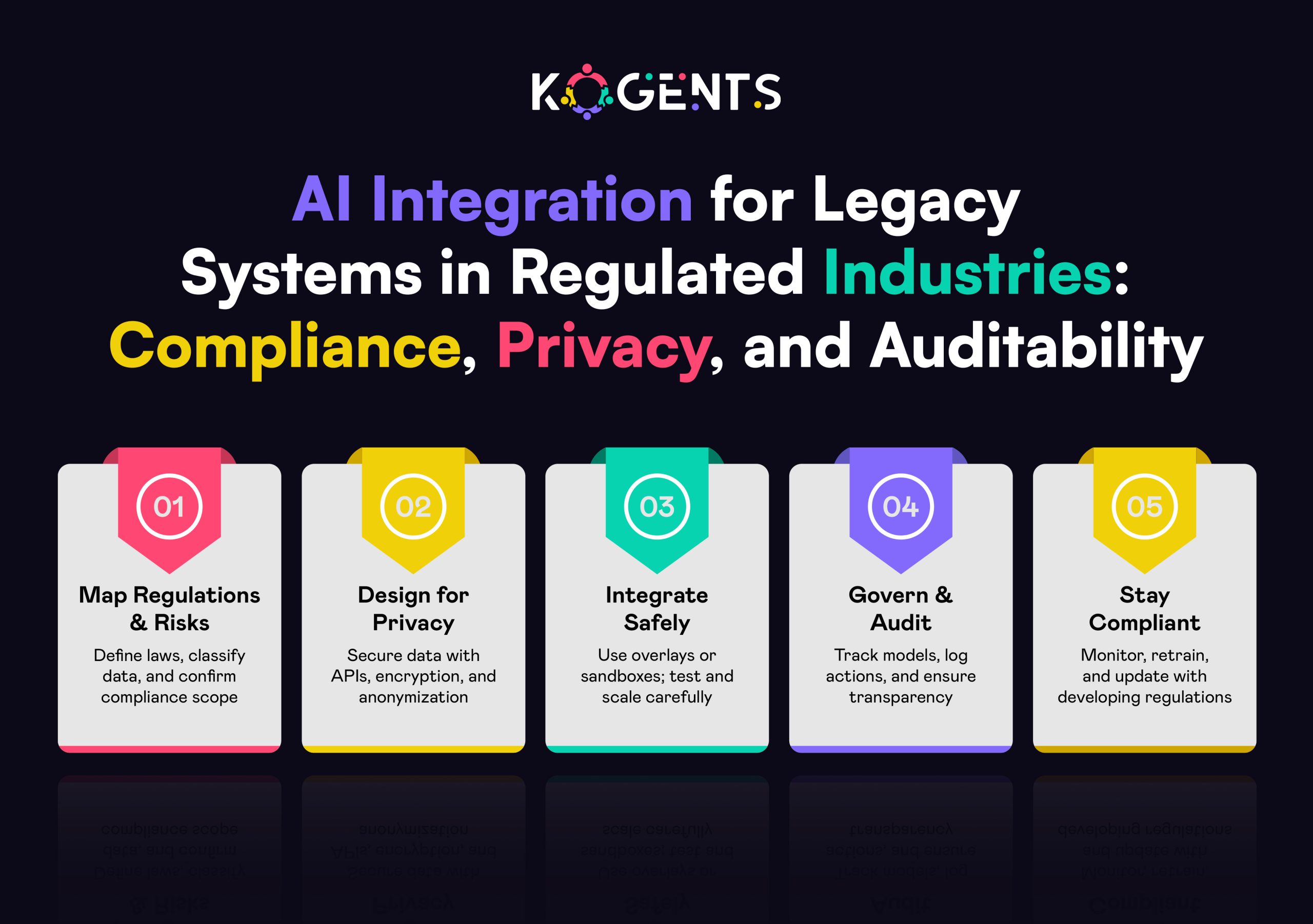
    ai integration for legacy systems in regulated industries

    Field-Tested Implementation Tactics & Expert Moves

    • Build a digital twin sandbox to safely test AI overlays.
    • Introduce API bridges for communication between systems.
    • Automate code analysis using AI-driven tools for faster documentation.
    • Embed AI incrementally, starting with augmentation, not replacement.
    • Monitor compliance and explainability to maintain trust.
    • Upskill teams through fusion squads blending legacy and AI expertise.
    • Track performance continuously using precision KPIs.

    “When systems evolve faster than leaders, disruption is inevitable.” — John Chambers (former CEO, Cisco)

    Case Study Spotlight

    1. Federal Legacy Code Conversion (Abt Global)

    A federal agency used AI to refactor COBOL code into Java, preserving workflows while enhancing maintainability. 

    Result: 50% faster modernization, 93% code accuracy, zero downtime.

    2. Wearable Tech Migration (WNS)

    AI and automation migrated data from legacy ERP to the cloud.

    Result: 40% faster migration, 30% fewer data errors.

    3. Financial Services Testing (McKinsey)

    A global insurer used AI agents to automate regression testing on legacy apps.

    Result: 50% faster test cycles and reduced manual QA.

    4. Healthcare Digital Twin Integration (SymphonyAI)

    Hospitals deployed digital twins for AI diagnostics, keeping patient systems stable.

    Result: +23% diagnostic accuracy with zero disruption.

    AI Agents vs Traditional Modernization Tools

    Feature Traditional Tools AI-Driven Modernization
    Speed Slow, manual 5x faster (automated)
    Downtime High risk Minimal (overlay model)
    Cost High CapEx ~40% reduction (McKinsey, 2024)
    Accuracy Human-dependent 93% AI code accuracy (arXiv, 2024)
    Scalability Limited Elastic & modular

    Conclusion

    Legacy systems have powered industries for decades, but they weren’t built for the intelligent era.

    Now, with AI integration for legacy systems, enterprises can fuse stability with innovation, unlocking agility, insight, and growth without breaking critical workflows.

    From architecture audits to governance frameworks, this guide provides your roadmap to modernization that’s intelligent, compliant, and sustainable.

    Brand Edge: Kogents.ai

    At Kogents ai, we help organizations modernize safely. Our AI overlay solutions empower enterprises to extend legacy lifecycles, automate operations, and unlock data intelligence, without downtime or risk.

    Whether you manage a 20-year-old system or a hybrid infrastructure, we commit to being the best agentic AI company that coexists with legacy, securely and seamlessly.

    FAQs 

    What is AI integration for legacy systems?

    It’s embedding AI into existing infrastructure to add intelligence, automation, and analytics, without full replacement.

    How can I modernize without downtime?

    Use overlay architectures, API gateways, and sandbox pilots that run parallel to production.

    What are the key challenges?

    Technical debt, fragmented data, compliance risks, and a lack of documentation.

    Which industries benefit most?

    Healthcare, finance, logistics, and government, where uptime and compliance are mission-critical.

    What is a digital twin?

    A replica of your system used to test AI safely before production rollout.

    How does data quality affect AI?

    Poor data leads to inaccurate predictions. Clean, structured data ensures reliable AI output.

    What’s the typical ROI?

    Studies show up to 2.7x ROI and 40% cost reduction within 18 months of AI-enabled modernization.

    Can AI automatically refactor code?

    Yes, AI can translate and optimize legacy code with 90%+ accuracy, reducing modernization time dramatically.

    How do small businesses start?

    Use no-code AI overlays or SaaS tools for incremental automation, no deep IT investment required.

    What’s the first step today?

    Audit your systems, pick one workflow to pilot, measure ROI, and scale strategically.

  • AI Governance and Compliance Frameworks Every CTO Needs Before Deployment

    AI Governance and Compliance Frameworks Every CTO Needs Before Deployment

    It’s the 21st century, and shipping AI without a governance plan is like deploying microservices without observability.

    AI governance and compliance ensure your models align with law, ethics, and business risk appetite.

    Governance defines the principles, roles, and controls; compliance ensures continuous adherence to standards and regulations such as the EU AI Act, GDPR/CCPA, ISO/IEC 42001, and the NIST AI Risk Management Framework (AI RMF). 

    Across sectors, from fintech to healthcare, companies that adopt trustworthy AI early reduce audit friction, unlock procurement, and shorten enterprise sales cycles. 

    And regulators are moving: the EU AI Act introduces a risk-tiered regime with strict requirements for “high-risk” systems. 

    Moreover, NIST AI RMF provides a practical backbone (Govern, Map, Measure, Manage) used by industry; ISO/IEC 42001 formalizes an AI management system you can certify.

    This article gives CTOs a clear deployment-ready playbook: frameworks to adopt, controls to implement, metrics to track, loopholes to avoid, and case studies where governance made or broke outcomes.

    Key Takeaways 

    • Governance is a growth lever as it unlocks enterprise sales, reduces audit drag, and mitigates crisis risk.
    • Standards and laws converge by using NIST AI RMF for risk ops, ISO/IEC 42001 for management systems, and align with the EU AI Act.
    • Continuous, not one-and-done, means bias, privacy, and explainability controls must operate before and after launch, with logs and recourse.
    • Learn from failures, knowing Dutch benefits, A-levels, Amazon recruiting, and Apple Card, each exposes specific governance gaps to close. 

    The Business Impact of AI Governance and Compliance

    The global AI Governance Market size is expected to reach USD 5,776.0 million by 2029 from USD 890.6 million in 2024, to grow at a CAGR of 45.3%. 

    Revenue Enablement: 

    • Enterprise buyers increasingly require AI risk & compliance attestations (policy, testing, audit logs). 
    • Aligning with NIST AI RMF and ISO/IEC 42001 accelerates vendor assessments and certifications.

    Regulatory Readiness

    • The EU AI Act mandates transparency, data quality, risk management, and human oversight for high-risk AI. 
    • Your governance posture becomes a license to operate, a standard that even the best agentic AI company must uphold when navigating high-risk or regulated AI systems.

    Brand Trust & PR Resilience

    Recent investigations and enforcement actions (e.g., FTC “Operation AI Comply”; Italy’s fine regarding ChatGPT) show how poor oversight can trigger fines and reputational damage. 

    Bottom line: Governance reduces the cost of change, and crises create a repeatable compliance muscle, and turn “Are we compliant?” into “We can prove it.”

    ai governance and compliance frameworks

    Real-World Impact: When Governance Works, and When It Doesn’t? 

    • NYC AEDT (Local Law 144): Requiring bias audits, notices, and published summaries for automated hiring tools created market pressure for bias testing and documentation, a governance win pushing vendors to up their game.
    • Dutch Childcare Benefits Scandal: An algorithm flagged thousands of families for fraud, disproportionately harming those with foreign backgrounds; authorities later found the practices unlawful and discriminatory, with severe GDPR violations. Governance gaps, including data policy, oversight, and redress.
    • UK A-Level Grading (2020): The grading algorithm lacked transparency and uncertainty bounds; public backlash forced withdrawal. Governance gaps identified were explainability, stakeholder communication, and impact assessment.
    • Amazon Recruiting Tool (2018): Internal model learned to downgrade women’s resumes, illustrating the cost of biased historical data and insufficient bias controls. Governance gaps were majorly in data curation, fairness testing, and change control.
    • Apple Card (2019): Allegations of gender bias triggered a state investigation, reminding fintechs that explainability and adverse-action transparency are table stakes. Governance gaps were in interpretability and fair-lending explainability.
    • Enforcement & Claims: The FTC has targeted deceptive AI marketing and fake-review tooling; Italy’s Garante fined an AI provider for transparency and legal-basis shortcomings. Governance gaps were truthful claims, privacy/legal basis, and age gating.

    Loopholes & Failure Modes You Need to Close 

    • Shadow AI & Untracked Models
    • Loophole: Teams spin up models without registration or review.
    • Fix: Central Model Registry with mandatory risk tiering, owners, data lineage, and pre-launch checklists mapped to NIST AI RMF.
    • Explainability Theater
    • Loophole: Post-hoc plots with no policy link.
        • Fix: Tie XAI methods to concrete adverse-action and user-recourse workflows (esp. lending, employment).
    • Bias Testing Once, Not Continuously
        • Loophole: One-time fairness test at launch.
        • Fix: Continuous bias monitoring with drift detection; publish NYC-style bias audit summaries for high-stakes settings.
    • Compliance by Vendor Slide Deck
        • Loophole: Relying on provider assurances.
        • Fix: Contractual DPAs, DPIAs/AIAs, data-residency, and audit rights; align with ISO/IEC 42001 supplier oversight requirements.
    • No Redress
        • Loophole: Users can’t contest or appeal decisions.
        • Fix: Human-in-the-loop escalation, clear appeals, and Article-22-style safeguards (automated decisions) when applicable.
    • Unverified Marketing Claims
      • Loophole: “AI replaces lawyers/doctors” claims.
      • Fix: Substantiation and internal legal review; FTC has signaled scrutiny of deceptive AI claims. 

    The CTO’s Governance Operating Model (GOM)

    • Policy: Define AI principles (fairness, safety, transparency, privacy by design), decision rights, and acceptable-use rules tied to NIST AI RMF and ISO/IEC 42001.
    • Structure: Name Accountable Owners (product + data science), an Ethical Review Board, and an independent audit function.
    • Process: Pre-deployment risk/impact assessments (AIA), data protection impact assessments (DPIA), threat modeling (including prompt-injection/ data exfil risk).
    • Controls: Bias testing, XAI, logging/audit trails, privacy controls, security hardening, and content safety/red teaming.
    • Assurance: Internal audits, external certifications; align high-risk use cases with EU AI Act obligations.

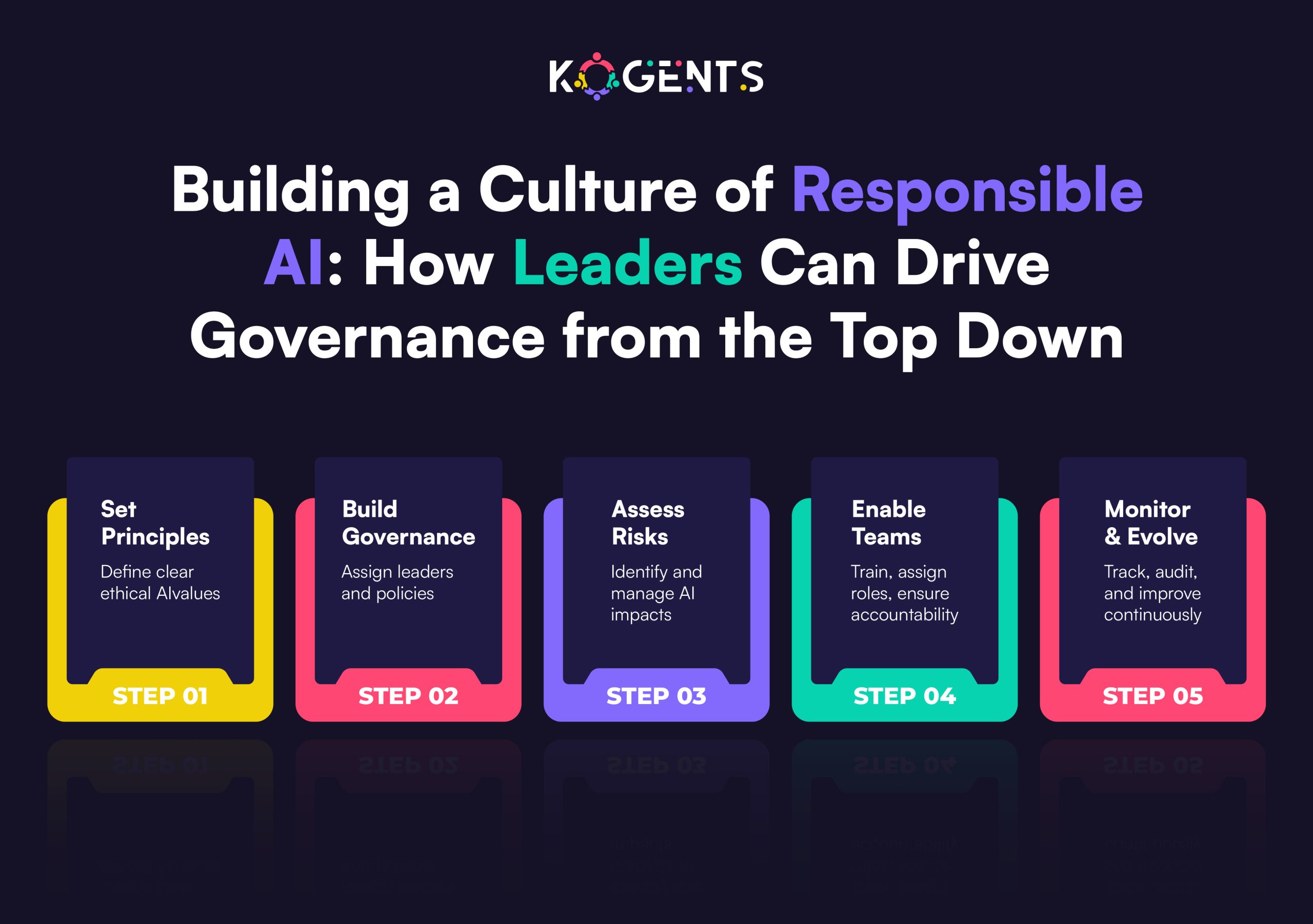
    how leaders can drive governance from the top down

    AI Agents vs. Other Tools

    Dimension AI Agents (Governed) Traditional Automation Generic AI APIs
    Risk Tiering & Registry First-class citizen (model cards, owners, AIA/DPIA) Ad-hoc Varies by vendor
    Explainability (XAI) Local & global methods linked to user recourse Minimal Often opaque
    Bias / Fairness Pre-launch & continuous audits; publish summaries in regulated contexts Rare Vendor-dependent
    Privacy & Data Gov. Privacy-by-design, consent, data lineage Limited Varies; data residency may be unclear
    Compliance Mapping Explicit alignment: EU AI Act, NIST AI RMF, ISO/IEC 42001 None Partial
    Human Oversight Role-based approvals, override, appeals Manual Limited
    Auditability Tamper-evident logs, model/version control Basic logs Vendor black box
    Post-Market Monitoring KPIs, drift, incident playbooks Minimal Provider-defined


    Why it matters: For high-stakes uses (hiring, lending, health), the NYC AEDT rule and the EU AI Act set a direction: bias audits, transparency, oversight, and ongoing monitoring. Build for that target now.

    Technical Controls That Satisfy Auditors and Operators

    • Data Governance: Source vetting, data lineage/provenance, minimization, PII controls, consent.
    • Bias & Fairness: Group fairness metrics (TPR/FPR parity, adverse impact), counterfactual tests, and synthetic gap analysis.
    • Explainability: SHAP/LIME and policy-linked explanations (adverse-action notices, patient explanations).
    • Safety & Robustness: Red teaming, adversarial tests, jailbreak prevention, rate-limiting, and content filters.
    • Security: Secrets isolation, retrieval governance, audit trail/logging, confidential computing where feasible.
    • Monitoring: Concept drift, performance decay, bias drift, automatic rollback, and incident runbooks.
    • Documentation: Model cards, system cards, training/validation datasets, evaluation harnesses, mapped to NIST AI RMF and ISO/IEC 42001 clauses for audit. 

    Cases: Healthcare/Mental Health, Fintech, and SMB Automation

    Healthcare/Mental Health Assistive Triage

    • Risk: Misclassification, privacy breaches.
    • Controls: Clinical validation; human-in-the-loop; consent and minimal-necessary data; explainable outputs to clinicians.
    • Why: Aligns with AI RMF (risk management) and data-protection expectations under GDPR. 

    Fintech Credit Decisions

    • Risk: Fair-lending bias, opaque denials, state investigations (Apple Card scrutiny).
    • Controls: Fairness metrics, feature constraints, explainability suitable for adverse actions, and governance for model changes. 

    SMB/Startup Hiring Agents

    • Risk: Disparate impact in screening; legal exposure under NYC AEDT rule.
    • Controls: Independent bias audits; candidate notices; publish audit summaries; opt-out and appeal channels.

    What Still Breaks: Structural Gaps the Industry Must Address

    • Multi-Vendor Chains: When chat orchestration calls multiple providers, liability and auditability blur. 

    Solution: end-to-end logs with request/response signatures and vendor addenda.

    • Synthetic Data Overconfidence: Synthetic augmentation can hide bias or shift distributions; mandate real-data spot checks and robust drift monitoring.
    • Metrics Without Thresholds:  Teams report AUC/precision but lack policy thresholds (e.g., “halt if adverse-impact ratio < 0.8”) and turn metrics into guardrails.
    • Incident Underreporting: Many teams lack post-market monitoring and user redress. Borrow from safety-critical incident reporting and codify SLAs for fixes.
    • Marketing ≠ Proof: Compliant” isn’t a claim, it’s an evidence chain (tests, logs, approvals). FTC actions show the cost of puffery. 

    Case Study Spotlight 

    Startup Helpdesk Agent (B2B SaaS):

    • A seed-stage startup rolled out an LLM helpdesk agent. 
    • Enterprise pilots stalled until they added a governance bundle: DPIA, model cards, bias tests on escalation routing, and drift monitoring. 
    • Sales cycles shortened, and two pilots converted to annual contracts, explicitly citing the governance posture as a factor.

    Mental Health Intake (Clinic Network): 

    • The clinic adopted a triage assistant. 
    • They required clinician override, explainability to providers, and consent workflows. 
    • The project passed privacy review and increased provider satisfaction due to a transparent rationale.

    What to Measure: KPIs for Governed AI?

    • Compliance Coverage: % of models with completed AIA/DPIA & model cards.
    • Bias Metrics in Compliance Range: Adverse-impact ratio, equalized odds deltas within thresholds.
    • Explainability SLA: % of decisions with user-readable reasons delivered under X seconds.
    • Drift & Incident MTTR: Time to detect and resolve drift or bias spikes.
    • Audit Readiness: Time to compile evidence pack for customer/regulator; ISO/IEC 42001 audit pass.

    Summing Up! 

    The companies winning with AI aren’t the ones moving recklessly; they’re the ones moving responsibly and measurably. 

    Strong AI governance and compliance transform risk into advantage: faster enterprise approvals, smoother audits, and durable trust with customers and regulators. 

    If you’re a CTO, entrepreneur, or solopreneur, the path is clear: register your models, test for bias, explain decisions, monitor continuously, and document everything. 

    That’s the difference between AI that merely works and AI that your buyers, clinicians, and regulators can trust. See how Kogents.ai can do it for you. 

    So, contact us at the given number at +1 (267) 248-9454 or drop an email at info@kogents.ai

    FAQs 

    What is “AI governance and compliance” in practice?

    Governance sets the policies, roles, and controls for responsible AI; compliance proves you meet laws and standards (e.g., EU AI Act, GDPR, NIST/ISO).

    How has governance actually changed outcomes?

    Bias-audit rules in hiring (NYC AEDT) and enforcement actions (FTC, Italy’s Garante) shifted teams from “launch first” to “audit first.”

    What are the biggest loopholes teams miss?

    Shadow AI, one-time bias tests, vendor black boxes, and lack of user recourse; fix with registries, continuous monitoring, and appeal mechanisms.

    Do small teams really need this?

    Yes. Minimal governance (registry, bias checks, explainability) reduces sales friction and future rework; scalable tools make it affordable.

    What frameworks should we start with?

    Adopt NIST AI RMF for risk management; target ISO/IEC 42001 for certifiable management systems; map obligations to EU AI Act.

    How do we handle hiring or credit decisions?

    Run independent bias audits, publish summaries as required (e.g., NYC AEDT), offer notices and appeals, and maintain explainability artifacts.

    What’s the cost of getting it wrong?

    Investigations, fines, and reputational damage (see Apple Card scrutiny, Dutch scandal, enforcement actions).

    Which controls matter most at launch?

    Bias testing, privacy impact assessments, explainability tied to user recourse, secure logging, and a rollback plan.

    What tools help?

    Platforms that combine governance workflows, audits, explainability, and monitoring, like Kogents.ai, plus external certs (e.g., ISO/IEC 42001 readiness). 

  • Scalable AI Solutions That Accelerate Enterprise-Wide Deployment Success

    Scalable AI Solutions That Accelerate Enterprise-Wide Deployment Success

    Every entrepreneur or solopreneur dreams of taking advantage of artificial intelligence to automate processes, uncover insights, and outperform competition

    Yet, most AI projects never make it beyond the lab. 

    According to McKinsey’s Seizing the Agentic AI Advantage, they state: “more than 80 percent of companies still report no material contribution to earnings from their gen AI initiatives.”

    This is where scalable AI solutions come into play, designed to transform isolated models into production-grade, enterprise-scale AI systems that adapt dynamically, handle massive workloads, and drive continuous ROI.

    Whether you’re an early-stage founder building on limited compute resources or a healthcare enterprise managing petabytes of patient data, scalable artificial intelligence systems offer the architectural backbone to deliver results at scale, in real time, and on budget.

    In this blog, we’ll unpack what enterprises can learn from startups that successfully deployed scalable machine learning solutions and how the next generation of distributed AI systems is shaping the landscape of enterprise-wide deployment success.

    So, give it a thorough read now. 

    Key Takeaways 

    • Scalable AI solutions are the foundation for sustainable digital transformation.
    • They enable real-time inference, automated scaling, and reliable governance across departments.
    • Case studies show measurable ROI, faster deployments, higher accuracy, and cost savings.
    • The future of scalable AI architecture will blend edge computing, MLOps, and autonomous orchestration.
    • Entrepreneurs who adopt scalable AI platforms early will future-proof their business for exponential growth.

    The Need for Scalability: Beyond One-Off AI Wins

    It is not just about running bigger models but creating sustainable, adaptable, and fault-tolerant systems that evolve as data grows.

    Imagine deploying a chatbot that handles 1,000 queries a day, then suddenly needs to serve 100,000 as your startup goes viral. 

    Without a scalable AI infrastructure, your once-efficient model crashes under pressure.

    Scalable AI solutions solve this through:

    • Elastic resource allocation: Using cloud-native autoscaling (AWS, Azure, or GCP) to match computational demand dynamically.
    • Horizontal and vertical scaling: Expanding compute nodes or upgrading GPU/TPU cores to maintain real-time inference speeds.
    • Fault tolerance: Ensuring no downtime during retraining, deployment, or updates.
    Outcome: A scalable AI deployment pipeline that grows effortlessly with your business, ensuring consistent performance from startup MVPs to enterprise workloads.

    The Architecture of Scalable AI Systems 

    To scale AI successfully, you need the right architecture, an intelligent ecosystem that balances speed, flexibility, and reliability.

    Core Components of a Scalable AI Architecture

    Data Engineering Layer

    • Ingestion: Streaming or batch data collected through APIs or sensors.
    • Processing: ETL pipelines ensure clean, structured data.
    • Storage: Distributed databases and object storage (e.g., Snowflake, BigQuery, S3).

    Model Development Layer

    • Modular model design using frameworks like TensorFlow, PyTorch, or ONNX.
    • Reusable model architectures for transfer learning and rapid experimentation.
    • Experiment tracking via MLflow or Weights & Biases.

    Training & Orchestration

    • Distributed training on clusters (using Ray, Horovod).
    • Autoscaling compute nodes for optimal resource utilization.
    • Integration with AIOps / MLOps pipelines for version control and CI/CD automation.

    Model Serving & Inference

    • Microservices-based serving (TensorFlow Serving, TorchServe).
    • Load balancing and real-time scalable AI inference with GPUs/TPUs.
    • Low latency is achieved via caching, batching, and sharding.

    Monitoring & Governance

    • Model performance tracking (drift detection, bias monitoring).
    • Data lineage and governance tools (e.g., Great Expectations, Monte Carlo).
    • Security protocols (ISO/IEC 27001, NIST AI framework).

    Insight: A scalable AI pipeline built on this architecture ensures that from training to serving, every step is automated, monitored, and resilient.

    Common Challenges and Limitations in Scaling AI 

    Building an AI model is easy, but scaling it efficiently? That’s where most organizations stumble.
    Here are the key limitations that hinder enterprise AI development and deployment. 

    • Data fragmentation: Siloed or inconsistent data pipelines disrupt training and inference flow.
    • Infrastructure overhead: GPUs and high-performance hardware inflate costs without smart orchestration.
    • Model drift: AI systems degrade over time as real-world data diverges from training sets.
    • Latency and throughput bottlenecks: Without scalable inference systems, predictions lag during high traffic.
    • Governance and compliance: Scaling AI across departments introduces new privacy, ethics, and data governance challenges.
    For solopreneurs, that might mean integrating lightweight, scalable AI frameworks like FastAPI + PyTorch Lightning; for enterprises, it involves multi-cloud orchestration using Kubernetes or Kubeflow pipelines.

    ai projects fail to scale

    AI Agents vs. Other Tools

    Feature AI Agents (Scalable AI Solutions) Traditional Automation Tools Manual Operations
    Learning Capability Continuously improves via ML/DL Static, predefined rules Human-dependent
    Scalability Built on a scalable AI architecture with autoscaling Limited by server capacity None
    Deployment Speed Instant via containerized deployment Requires manual setup N/A
    Adaptability Context-aware and data-driven Fixed logic Human flexibility only
    Cost Efficiency Pay-per-use on cloud, optimized compute License or hardware-heavy Labor cost-intensive
    Accuracy Over Time Increases via retraining and feedback loops Declines without updates Inconsistent
    Use Case Fit Perfect for enterprise-scale AI apps Simple automations Creative or ad-hoc tasks

    Case Study Spotlight: Scaling AI in Action 

    Case Study 1: E-commerce Optimization at Scale

    A mid-sized retailer struggled to forecast demand across 10,000 SKUs, by deploying a scalable machine learning solution on Google Cloud Vertex AI, the company automated inventory management.

    • Result: Forecast accuracy improved by 37%, while cloud costs dropped by 28% due to autoscaling and real-time inference.

    Case Study 2: Healthcare Triage with Scalable AI Systems

    A telemedicine startup built an AI at scale triage system using federated learning to preserve data privacy across hospitals.

    • Result: Patient routing efficiency increased by 60%, while maintaining HIPAA compliance.

    Case Study 3: Solopreneur AI Content Platform

    A single-founder business integrated scalable AI deployment pipelines on AWS Lambda for content personalization.

    • Result: Reduced content generation time from hours to minutes, saving 20 hours weekly.

    Note: These examples demonstrate that scalable AI infrastructure is not just for big tech; it’s the democratizing layer that allows anyone to deploy intelligence at enterprise-grade scale.

    Enablers of Successful Enterprise-Wide AI Deployment 

    Scaling AI is not just about technology but about strategy, governance, and the alignment of people, processes, and infrastructure. This approach is exemplified by the best agentic AI company in the enterprise industry.

    Organizations that succeed with scalable AI solutions share a few core enablers that distinguish them from those perpetually stuck in pilot mode.

    1. Unified Data Foundation

    The backbone of any scalable AI architecture is a unified, governed, and high-quality data ecosystem.

    • Data integration and governance: Enterprises must establish robust data pipelines and metadata tracking for every source, ensuring consistency, compliance, and lineage.
    • Example: IBM’s “AI Readiness Framework” emphasizes that data accessibility and standardization are the first checkpoints in scaling AI effectively.

    2. Modular and Elastic Infrastructure

    Modern AI scalability depends on infrastructure that grows and shrinks on demand.

    • Cloud-native, containerized environments like Kubernetes and Docker ensure models are portable across clusters and clouds.
    • Elastic AI systems leverage horizontal and vertical scaling in AI, allocating GPUs/TPUs dynamically to balance cost and performance.

    Case Insight: A report from McKinsey claims that organizations must move from AI experimentation to industrialized scalability, designing systems that anticipate integration, monitoring, and cost control. Unlike traditional IT, gen AI’s recurring costs can exceed initial build costs, making economic sustainability essential.

    3. Cross-Functional AI Operating Model

    Technology alone doesn’t scale; teams do.

    • A centralized AI Center of Excellence (CoE) with data scientists, domain experts, and ML engineers accelerates reuse and governance.
    • MLOps and AIOps practices streamline model delivery, automating retraining, drift detection, and rollout across departments.
    1. Continuous Monitoring and Optimization

    Scalable AI deployment doesn’t end at launch.

    • Enterprises must track model performance, drift, and bias in production to ensure fair, accurate predictions.
    • Real-time scalable AI pipelines with built-in observability tools (like Prometheus or Grafana) help sustain reliability under unpredictable workloads.

    5. Compliance, Security, and Trust

    As models scale, so does their ethical and regulatory footprint.

    • Ensure adherence to frameworks such as ISO/IEC 27001, NIST AI RMF, and emerging EU AI Act standards.
    • Apply explainability tools (e.g., SHAP, LIME) to maintain transparency and stakeholder confidence.
    The GenAI Divide is starkest in deployment rates; only 5% of custom enterprise AI tools reach production.

    scalable ai solution

    Conclusion

    The age of scalable AI solutions is here, and it’s redefining what’s possible for businesses of every size. 

    Whether you’re an emerging entrepreneur, a healthcare innovator, or an enterprise CTO, the ability to deploy and scale AI seamlessly determines how quickly you can innovate, compete, and grow.

    Scalable artificial intelligence systems ensure that your ideas don’t stay in the lab; they evolve into production-ready models that learn, adapt, and thrive in dynamic business environments.

    At its heart, scalability isn’t just a technical choice; it’s a growth philosophy. It’s about building AI that grows with you, intelligently, efficiently, and ethically.

    But, are you ready to accelerate your AI journey?

    Then have a look at how Kogents deploys scalable AI effortlessly.

    FAQs

    What are scalable AI solutions?

    Scalable AI solutions are systems engineered to maintain performance as workloads and data volumes grow. They use cloud computing, distributed architectures, and MLOps to deliver high-performance AI systems capable of serving thousands, or millions, of users simultaneously.

    How do scalable AI architectures differ from traditional AI setups?

    Traditional setups are static and local; scalable AI architectures are dynamic, distributed, and cloud-native. They can expand horizontally (adding more nodes) or vertically (adding power to existing nodes) to handle demand.

    Why do many enterprises struggle to scale AI?

    Lack of data strategy, fragmented infrastructure, and poor model monitoring hinder scalability. Enterprises often deploy models without considering autoscaling, load balancing, or latency optimization.

    Which industries benefit most from scalable machine learning systems?

    Healthcare, e-commerce, logistics, fintech, and education benefit significantly due to fluctuating workloads and real-time decision-making needs.

    Can solopreneurs use scalable AI platforms without coding?

    Absolutely. Platforms like Kogents.ai offer low-code environments enabling individuals to train, deploy, and scale AI models without deep technical skills.

    How do elastic AI systems reduce operational costs?

    Elastic systems scale resources automatically, reducing idle compute costs by only using what’s needed. For example, autoscaling GPU clusters can cut expenses by up to 40%.

    What’s the role of MLOps in enterprise-scale AI?

    MLOps integrates DevOps principles for machine learning, automating deployment, testing, and rollback. It ensures the continuous delivery of scalable AI models across production environments.

    Is edge AI part of scalable AI infrastructure?

    Yes. Edge AI brings inference closer to the data source, reducing latency. Combined with cloud AI, it creates hybrid scalable AI systems ideal for IoT, manufacturing, and real-time monitoring.

    What’s the difference between horizontal and vertical scaling in AI?

    • Horizontal scaling: Adding more machines (nodes). 
    • Vertical scaling: Adding more power (CPU/GPU) to existing machines.
      Both are crucial for achieving enterprise-scale AI performance.

    How can I start building a scalable AI pipeline today?

    Begin with a cloud-native infrastructure (AWS, GCP, or Azure), containerize your models, and adopt CI/CD pipelines. Use tools like Airflow, Kubeflow, or MLflow for orchestration and monitoring.

  • Enterprise AI Development that Reduces Integration Risk for Global Teams

    Enterprise AI Development that Reduces Integration Risk for Global Teams

    Do you know that the new era of enterprise AI development is not defined by who can build the smartest model, but by who can integrate AI securely, seamlessly, and globally?

    For entrepreneurs, solopreneurs, and enterprise leaders managing distributed teams, the challenge is no longer whether AI works; it’s whether it works everywhere, across multiple systems, time zones, and compliance frameworks.

    AI pilots often thrive in isolation but stumble when integrated across ERP systems, CRMs, or regional data infrastructures.

    This is where the true craft of AI development for enterprises begins: reducing integration risk without slowing innovation.

    In this comprehensive guide, we’ll explore how custom enterprise AI development empowers organizations to scale across borders safely, ethically, and efficiently. So, let’s delve into this guide.

    Key Takeaways

    • Understand the true nature of integration risk in enterprise AI projects.
    • Learn the complete enterprise AI development lifecycle, from discovery to global deployment.
    • Explore actionable methods to mitigate integration risk across regions and tech stacks.
      Compare in-house vs vendor-led approaches in one concise table. 
    • Study credible enterprise AI solutions development case studies with measurable ROI.
    • End with strategic imperatives to future-proof your AI roadmap.

    The Hidden Bottleneck: Integration Risk in Enterprise AI 

    Integration risk is the silent killer of enterprise AI success. While teams often celebrate model accuracy or training speed, the true battlefield lies in how well AI integrates with existing systems, finance, HR, supply chain, customer service, or compliance databases.

    For enterprise-level AI development, even a minor schema mismatch or version conflict between APIs can lead to cascading failures. 

    This is a challenge the best agentic AI company models anticipate and mitigate through modular orchestration and adaptive governance.

    Consider global rollouts where teams use different data standards, privacy laws, or latency thresholds; these variations multiply integration risk exponentially.

    Large enterprise AI development projects often fail not because models are poor, but because integration pipelines break under real-world complexity. 

    As systems evolve, dependencies drift, and governance frameworks tighten, AI must adapt continuously. 

    This is why modern AI integration for legacy systems demands modular architecture, strict governance, and resilient orchestration layers, the backbone of reliable global AI deployment.

    Generative AI has moved beyond buzz to become an essential tool across content creation, software development, and product design. In 2025, 65% of organizations report active use of generative AI, up from around 32% the previous year.

    custom enterprise ai development

    The Enterprise AI Development Lifecycle

    A well-structured enterprise AI development lifecycle ensures AI systems progress from concept to global scalability with minimal friction. 

    Below is a narrative walkthrough of each stage and how integration risk can be mitigated throughout the process.

    Stage 1: Discovery and Strategy

    • This phase involves defining business objectives, identifying AI opportunities, and evaluating system readiness. 
    • Entrepreneurs should perform a data and systems audit to assess integration touchpoints. 
    • Understanding where APIs, databases, and workflows intersect reveals early risk zones.

    Stage 2: Data Architecture and Preparation

    • Once objectives are clear, teams build the data pipelines and architectures to fuel AI. 
    • Integration risk emerges when data originates from multiple global systems. 
    • To mitigate this, adopt standardized data schemas, establish ETL consistency (e.g., Apache Airflow, Kafka), and create metadata catalogs for traceability.

    Stage 3: Model Development and Experimentation

    • Here, machine learning (ML) and deep learning models are built, tested, and refined.
    • While technical accuracy is key, integration foresight matters equally. 
    • Define consistent model input-output schemas, set up feature stores, and ensure models remain modular, capable of integrating with multiple business functions.

    Stage 4: Testing and Validation

    • AI must be validated both technically and operationally. 
    • Conduct integration sandbox tests simulating real-world environments: regional data rules, latency, and system load. 
    • This stage also validates AI governance and compliance, security, and explainability (XAI) requirements to ensure compliance across jurisdictions.

    Stage 5: Enterprise AI Deployment

    • The deployment phase is where many teams encounter friction. 
    • Using a microservices architecture and containerization (Docker, Kubernetes) reduces dependency conflicts. 
    • Each AI service can be updated independently, supporting scalable enterprise AI development across global teams. 
    • Incorporate CI/CD pipelines and blue-green or canary deployments for safe rollouts.

    Stage 6: Integration and Scaling Across Regions

    • After successful deployment, scaling AI globally introduces new integration risks: latency, localization, and cross-region compliance. 
    • Adopt federated learning for sensitive data, regional caching for latency reduction, and cloud-agnostic orchestration to ensure resilience in hybrid or multi-cloud setups.

    Stage 7: Monitoring, Governance, and Continuous Improvement

    • AI never “ends.” Models drift, data evolves, and systems change. 
    • Set up monitoring pipelines, AIOps dashboards, and feedback loops. 
    • Monitor data drift, bias, and performance. 
    • Integration risk decreases when governance becomes continuous, not reactive.
    • Each stage feeds into the next, reinforcing an iterative ecosystem, one where integration readiness is designed, tested, and matured before global scaling begins.

    Integration Risk Mitigation Strategies Explained

    Integration risk mitigation is not a checklist; it’s a mindset. 

    To design resilient enterprise AI, entrepreneurs and solopreneurs must embed mitigation practices across people, process, and technology layers.

    1. Design for Modularity

    • Adopt API-first design principles. 
    • Every AI module, whether NLP, computer vision, or predictive analytics, should communicate through well-documented APIs. 
    • This allows teams in different regions to build independently while maintaining interoperability.

    2. Implement Version Control Across Systems

    • Version drift can cripple integration.
    • Use schema versioning, feature store registries, and backward-compatible APIs. 
    • This ensures older systems continue functioning even as new models roll out.

    3. Build with Compliance in Mind

    • Global teams face varying data privacy laws (GDPR, HIPAA, CCPA).
    • Integrate data masking, encryption, and access control at the architecture level. 
    • Secure enterprise AI development is not optional; it’s a compliance mandate.

    4. Use Federated or Hybrid Learning

    For highly regulated industries, federated learning enables AI model training across distributed datasets without moving data across borders, a crucial practice for enterprise AI platform development in healthcare and finance.

    5. Embrace Continuous Monitoring

    • Integration success depends on ongoing observability. 
    • Tools like Prometheus, Grafana, and MLflow allow teams to detect anomalies, drift, or bottlenecks in real-time.

    6. Design for Failure

    • Global AI systems should fail gracefully. 
    • Use fallback mechanisms, circuit breakers, and redundancy protocols. 
    • When a regional system fails, others must continue operating.

    Key Note: By embedding these strategies throughout the lifecycle, teams reduce integration incidents, maintain consistent performance, and ensure system longevity,  transforming AI from an experimental tool into a global operational advantage.

    advanced enterprise ai development

    Vendor vs In-House: The Strategic Decision 

    Choosing between in-house custom enterprise AI development and enterprise AI consulting & development vendors determines not just cost, but control, scalability, and long-term risk.

    Decision Factor In-House / Custom Enterprise AI Development Vendor / Third-Party Enterprise AI Consulting & Development
    Control & Customization Full control over architecture, data, and IP. Ideal for proprietary systems. Prebuilt modules reduce setup time but limit deep customization.
    Integration Risk Higher initially; managed internally via CI/CD, testing, and documentation. Lower short-term risk but potential long-term vendor dependency.
    Cost Profile High upfront investment (CapEx) but lower recurring cost. Lower startup cost (OpEx) but possible recurring licensing fees.
    Time to Market Slower initially; faster for future iterations. Rapid deployment with existing frameworks and tools.
    Compliance & Security Complete ownership of compliance implementation. Vendor must align with your governance frameworks.
    Scalability Scales deeply if infrastructure is modular. Scales faster but depends on the vendor’s tech stack.
    Maintenance Internal teams manage updates and bug fixes. Vendor-driven; governed by SLAs and support terms.

    For entrepreneurs and solopreneurs, a hybrid approach often works best, using vendors for foundational infrastructure (like MLOps platforms) while building proprietary models in-house to retain control and innovation.

    Real-World Case Studies

    Case Study 1: Guardian Life Insurance — Reducing Integration Friction

    Guardian Life modernized its analytics stack using enterprise AI software development practices. 

    By containerizing all models and enforcing strict API contracts, the company reduced integration failures by 35% across global branches and cut deployment time from weeks to days.

    Case Study 2: Italgas — AI-Powered Predictive Maintenance

    Italgas adopted a scalable enterprise AI development approach with edge inference for real-time monitoring of pipelines. 

    Using federated learning, the company minimized cross-border data transfer while complying with EU privacy mandates, saving €4.5M annually through predictive maintenance.

    Strategic Imperatives for Global AI Success

    As AI adoption matures, entrepreneurs must evolve from experimentation to strategic execution. Here are the strategic imperatives shaping the next wave of enterprise AI automation development:

    • Adopt Compound AI Architectures: Blend LLMs, predictive analytics, and agentic AI frameworks like LangChain to create flexible, compound systems that integrate easily across functions.
    • Prioritize Governance and Transparency: Build governance APIs that monitor bias, explainability, and compliance at runtime, not after deployment.
    • Invest in Interoperability: Use open standards (ONNX, MLflow, Apache Kafka) to ensure future compatibility.
    • Foster AI Maturity Culture: Encourage teams to document lessons, share integration templates, and track adoption metrics.
    • Think Globally, Act Modularly: Every new region should plug into a predefined architecture template, minimizing reinvention and ensuring uniform quality.

    Wrapping Up!

    In the interconnected global landscape, enterprise AI development is both a technological and organizational discipline. 

    Reducing integration risk isn’t just about protecting systems; it’s about empowering innovation, ensuring reliability, and uniting global teams under a shared digital framework.

    Whether you’re a solopreneur exploring AI-driven automation or an enterprise leader scaling across continents, the path to sustainable AI success begins with intelligent integration.

    Know that Kogents.ai is here to make your experience risk-free and an enterprise-grade AI deployment. Give us a call at +1 (267) 248-9454 or drop an email at info@kogents.ai.

    FAQs

    What is enterprise AI development?

    It’s the process of creating scalable, secure AI systems designed to integrate into complex enterprise ecosystems.

    How does enterprise AI differ from consumer AI?

    Enterprise AI development emphasizes governance, integration, and compliance across distributed systems — unlike consumer AI, which focuses on individual user experience.

    What are the main phases of enterprise AI development?

    Discovery, data architecture, model development, testing, deployment, scaling, and continuous governance.

    Why is integration risk so critical?

    Integration failures lead to downtime, compliance breaches, and lost trust — even if the AI model itself performs well.

    What tools help manage enterprise AI integration?

    Apache Airflow, MLflow, Kubernetes, TensorFlow Serving, and MLOps tools like Kubeflow.

    How can solopreneurs apply enterprise AI strategies?

    By adopting modular design, cloud-based AI services, and using prebuilt APIs for faster scaling.

    What is federated learning, and why is it useful?

    It’s a privacy-preserving method that trains models on distributed data sources without moving the data, ideal for regulated industries.

    What role does AI governance play?

    Governance ensures accountability, fairness, and compliance, critical for secure enterprise AI development.

    What is the ROI of enterprise AI deployment?

    Returns include reduced manual workload, lower integration costs, improved compliance, and faster innovation cycles.

    What’s the future of enterprise AI?

    The future lies in enterprise generative AI development, where intelligent agents autonomously coordinate workflows, guided by strong governance frameworks.