Category: agentic ai development

  • How Chat Automation for Higher Conversions Works on WhatsApp, Instagram, and Website Chats

    How Chat Automation for Higher Conversions Works on WhatsApp, Instagram, and Website Chats

    Visualize a scenario: A potential customer lands on your website at 11 PM, ready to buy. 

    They have questions. 

    They need reassurance. 

    But there’s no one to answer. 

    By morning, they switch to your competitor’s website. 

    This scenario results in millions of dollars in lost revenue every single day.

    In today’s hyper-connected marketplace, where customer experience defines competitive advantage, the gap between customer inquiry and business response has become the silent revenue killer. 

    According to HubSpot Research, 82% of consumers expect an immediate response to sales questions, yet most businesses still operate on legacy customer service models that can’t keep pace.

    But chat automation for higher conversions, not just another marketing buzzword, but a fundamental shift in how modern businesses capture, nurture, and convert leads in real-time.

    Whether you’re a SaaS founder watching qualified leads slip through the cracks, an ecommerce manager struggling with cart abandonment, or a marketing director pressured to prove ROI, automated conversational marketing represents your path to measurable revenue growth.

    Companies implementing conversion-focused chat automation identify conversion rate increases. 

    They’re capturing leads while competitors sleep, nurturing relationships across multiple touchpoints, and building automated customer journeys that feel remarkably human.

    In this guide, we’ll dissect exactly how conversational AI automation works across the three platforms that matter most: WhatsApp, Instagram, and your website. 

    You’ll discover proven frameworks, real-world implementations, and actionable strategies to transform conversations into revenue.
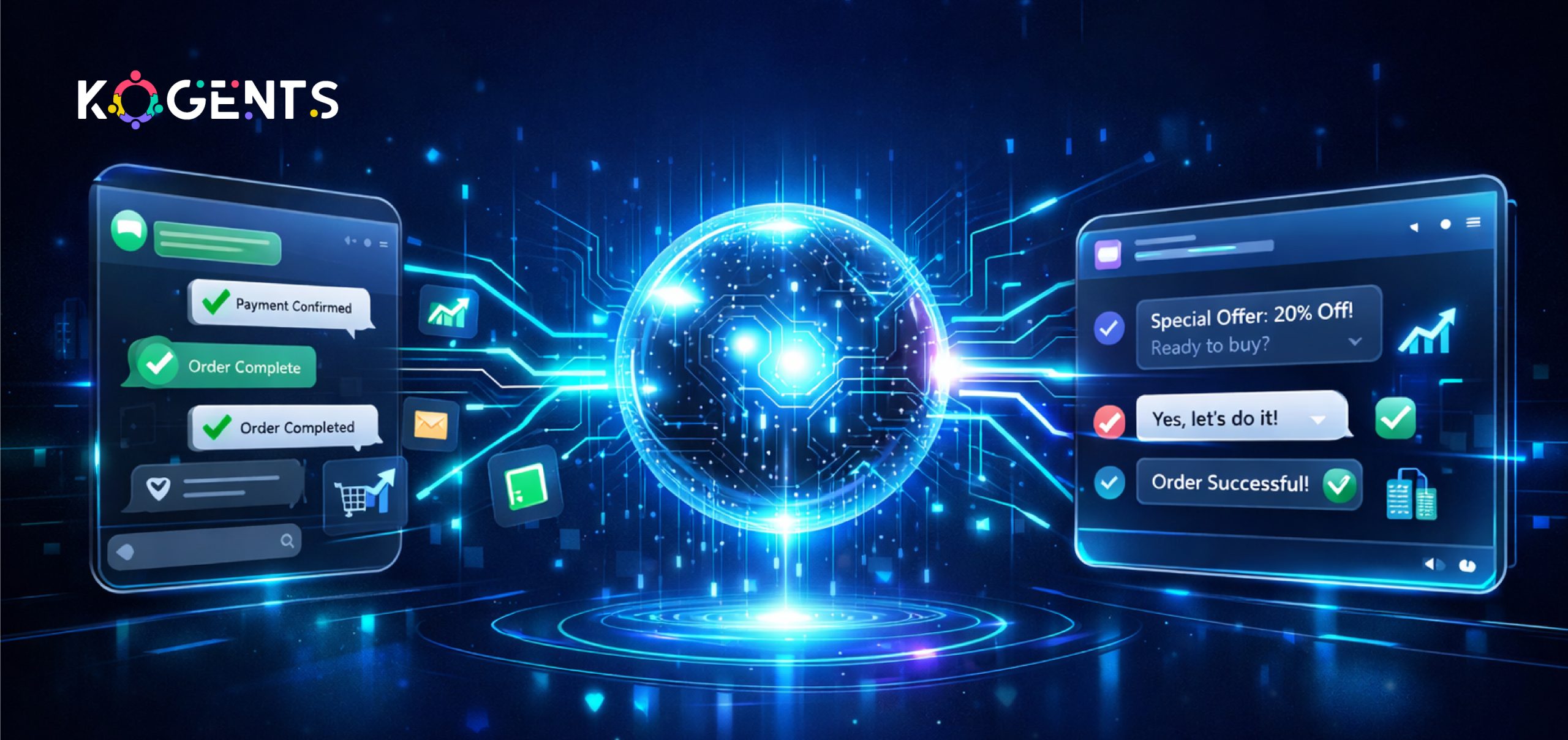
    chat automation for higher conversions

    Navigating Chat Automation for Higher Conversions

    Chat automation isn’t about replacing human connection; it’s about amplifying it. 

    Modern conversational AI systems combine Natural Language Processing (NLP), Machine Learning, and sophisticated intent recognition to understand context, anticipate needs, and guide conversations toward conversion.

    The Core Components of Effective Chat Automation

    • Intent Detection: Understanding what customers actually want, not just what they say. Advanced NLP interprets context, emotion, and urgency.

    • Dynamic Conversation Flows: Adaptive pathways that respond to user behavior in real-time, not rigid decision trees.

    • Omnichannel Synchronization: Seamless context retention across WhatsApp, Instagram, website, and email touchpoints.

    • Intelligent Lead Qualification: Automated scoring based on engagement patterns, questions asked, and behavioral signals.

    • CRM Integration: Automatic data capture, enrichment, and routing to sales teams with full conversation context.

    WhatsApp Chat Automation: Turning Private Conversations into Revenue

    WhatsApp boasts 2+ billion active users and unparalleled engagement rates. Unlike email’s 20% open rates, WhatsApp messages achieve open rates with 90% read within 3 minutes. 

    This platform excels for high-touch customer relationships requiring trust and immediacy.

    Strategic WhatsApp Automation Use Cases

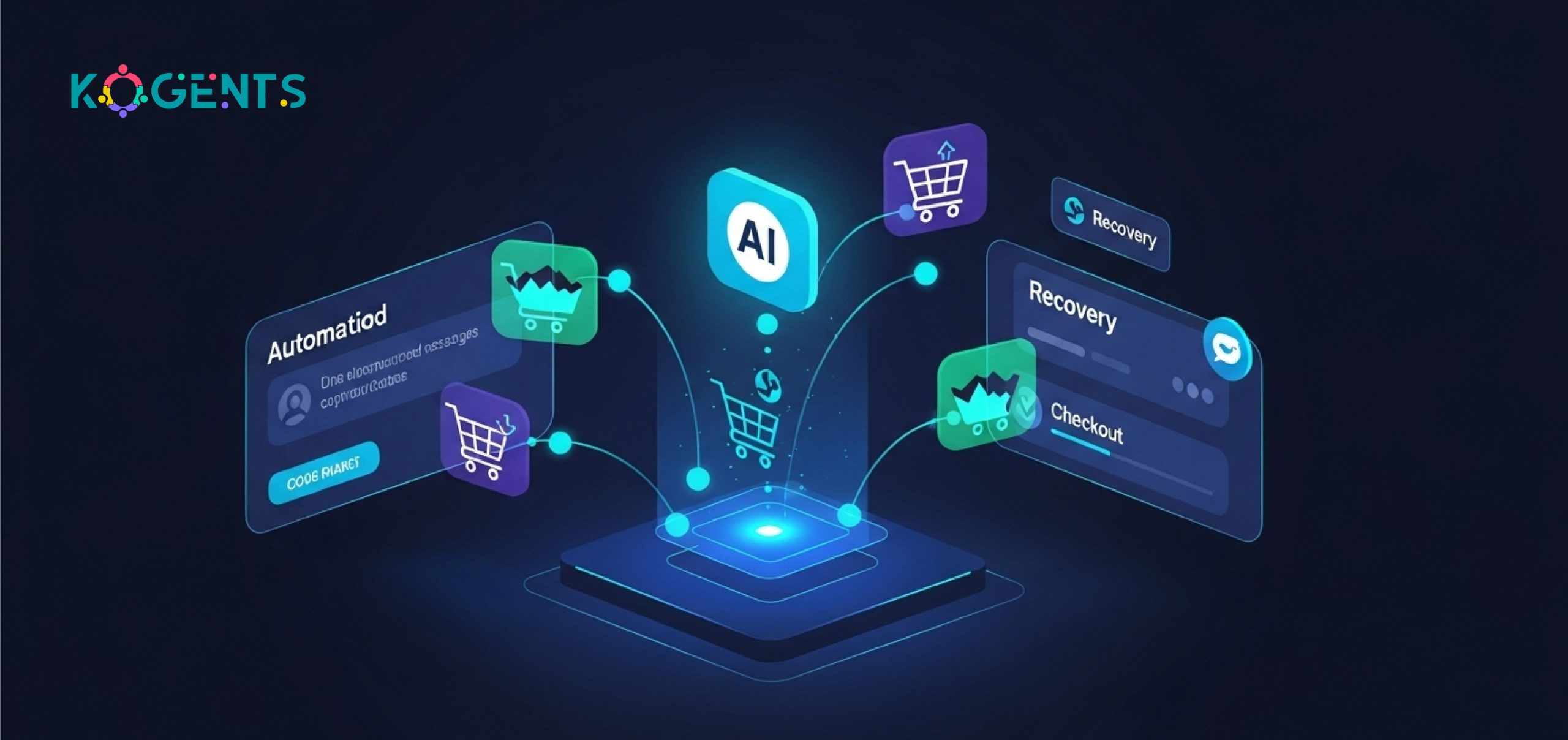
    • Abandoned Cart Recovery: Businesses rely on AI agents for abandoned cart recovery to re-engage buyers and reclaim lost revenue.

    • Appointment Scheduling: Automated booking, confirmations, and reminders reduce no-shows by 45-60%.

    • Customer Support: Instant resolution of common queries, order tracking, and FAQ responses with human escalation for complex issues.

    • Post-Purchase Engagement: Onboarding sequences, usage tips, upsell opportunities, and review requests.

    • Lead Nurturing Campaigns: Drip campaigns with rich media delivering educational content that guides prospects toward purchase decisions.
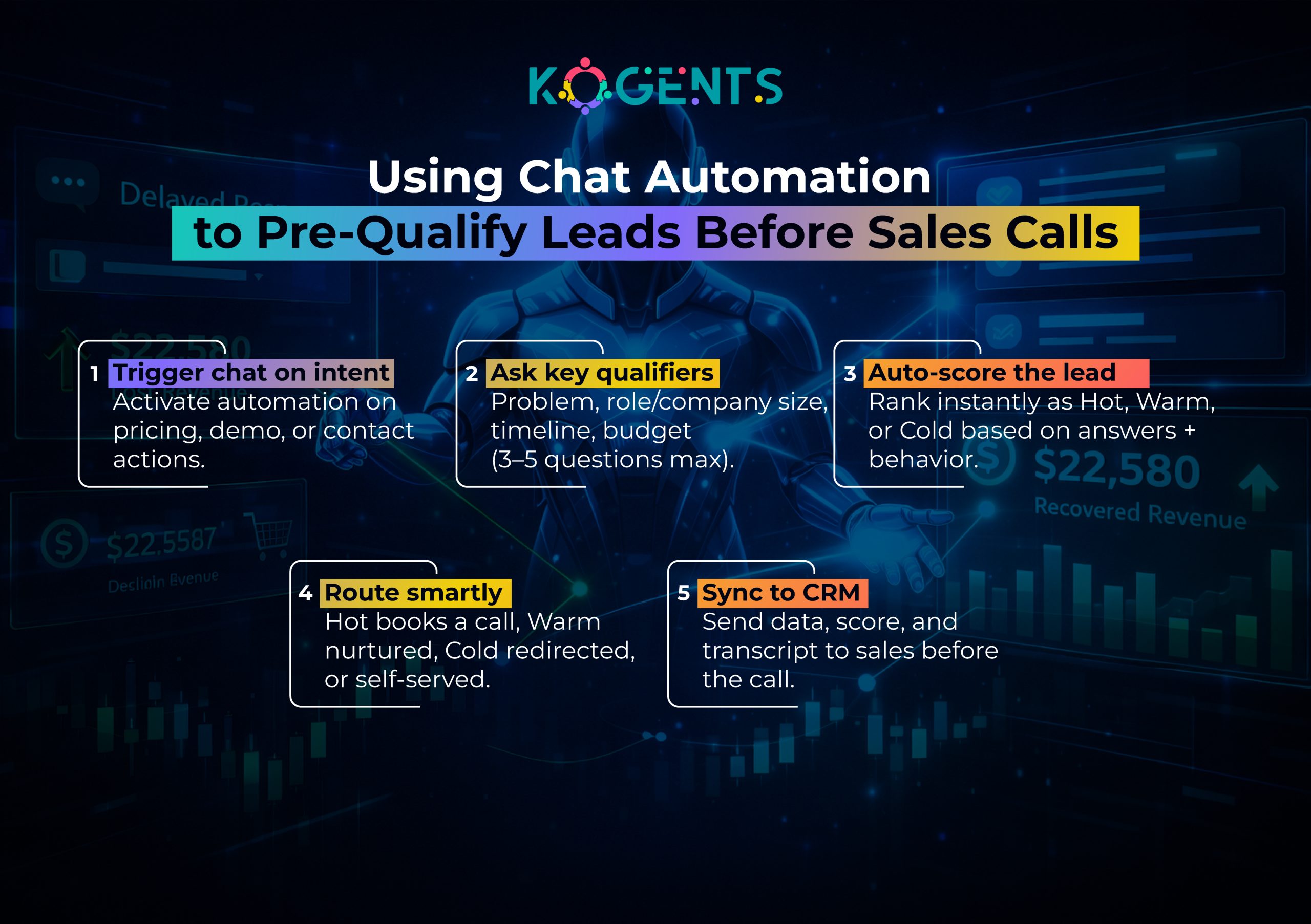
    chat automation for higher conversions

    WhatsApp Business API Implementation Framework

    The WhatsApp Business API enables sophisticated automation while maintaining platform compliance. Key considerations:

    1. Template Message Approval: Pre-approved message templates for outbound communications ensure compliance while enabling scale.

    2. 24-Hour Session Window: Free-form conversations permitted within 24 hours of customer-initiated contact; template messages required afterward.

    3. Rich Media Integration: Images, videos, documents, and interactive buttons enhance engagement and conversion.

    4. Quality Rating Monitoring: Maintain high quality ratings by balancing automation with value to avoid being flagged as spam.

    Instagram Direct Message Automation: Visual-First Conversion

    Instagram DM automation leverages the platform’s visual nature for product discovery and impulse purchases. 

    With 69% of shopping enthusiasts turning to Instagram for product discovery, automation here captures high-intent buyers at the peak of interest.

    High-Converting Instagram Automation Strategies

    • Story Reply Automation: Capture product interest from story interactions, automatically sending product details, pricing, and purchase links.

    • Comment-to-DM Funnels: Users commenting specific keywords trigger automated DMs with personalized offers.

    • Lead Magnet Distribution: Automated delivery of guides, discounts, or exclusive content in exchange for engagement.

    • Product Recommendation Engines: AI-powered suggestions based on browsing behavior, past interactions, and stated preferences.

    • Influencer Partnership Automation: Scaling influencer campaigns with automated response systems handling inquiries generated by creator content.

    Website Chat Automation: The Controlled Conversion Environment

    Your website represents your most controlled conversion environment. 

    Website chat automation captures visitors at peak interest, qualifies intent, and routes appropriately, all while gathering zero-party data for enhanced personalization.

    Advanced Website Chat Automation Tactics

    • Behavioral Triggering: Launch chat based on exit intent, time on page, scroll depth, or specific page visits.

    • Dynamic Content Personalization: Adapt conversation flows based on referral source, UTM parameters, or browsing history.

    • Progressive Profiling: Gather information incrementally across multiple interactions rather than demanding forms upfront.

    • Real-Time Lead Scoring: Assign qualification scores dynamically as conversations unfold, prioritizing hot leads for immediate sales engagement.

    • Meeting Scheduling Integration: Qualified prospects book directly with sales reps through integrated calendar systems.

    Platform Comparison: Where to Prioritize Your Automation

    Each platform offers distinct advantages. Strategic implementation requires understanding where your audience concentrates and which platform aligns with your conversion objectives.

    WhatsApp

    Instagram

    Website

    Best For: High-touch relationships, appointment bookings, customer support

    Best For: Visual products, impulse purchases, brand engagement.

    Best For: Lead qualification, complex sales, demo requests.

    98% open rate, 90% read in 3 minutes

    70% of shoppers use it for product discovery.

    Complete behavioral tracking & context.

    Challenge: Template approval requirements, 24-hour windows

    Challenge: Limited to Meta-approved partners, visual dependency.

    Challenge: Requires traffic generation, technical integration.

    Chat Automation Network: How WhatsApp, Instagram & Website Work Together

    Think system, not channels.

    • Instagram → Ignites demand (stories, comments, discovery)
    • Website → Captures intent (pricing, demos, high-intent actions)
    • WhatsApp → Closes & retains (trust, follow-ups, conversions)

    Unravel How the Automation Network Works

    Multiple entry points: Users start conversations on Instagram, the website, or WhatsApp.

    One shared intelligence layer: All interactions feed into a single AI brain that tracks intent, behavior, and lead score across platforms.

    Smart cross-channel routing: Discovery moves to conversion automatically (Instagram → WhatsApp, Website → WhatsApp, WhatsApp → checkout or booking).

    Conversion actions triggered: Book calls, recover carts, schedule appointments, or escalate to sales, based on lead quality.

    Continuous optimization loop: Every conversation improves scoring, messaging, and conversion paths.

    The 5-Phase Chat Automation Implementation Framework

    Phase 1: Conversion Intelligence Audit

    Before building automation, understand where conversations currently fail:

    • Analyze support tickets, identifying repetitive questions.

    • Review sales call recordings for common objections and questions.

    • Map customer journey, identifying friction points where prospects drop off.

    • Survey customers about preferred communication channels and timing.

    Phase 2: Platform Selection & Prioritization

    Don’t launch everywhere simultaneously. Prioritize based on:

    • Audience concentration: Where do your highest-intent customers spend time?

    • Use case alignment: Match platform strengths to your primary conversion goals.

    • Implementation complexity: Start simple with the highest-ROI opportunities.

    Phase 3: Conversation Design & Testing

    Effective automation requires exceptional conversation design:

    • Write conversationally, not corporately. Mirror how customers actually speak.

    • Build branching logic handling edge cases without frustrating users.

    • Establish clear escalation paths to human agents when needed.

    • A/B test conversation flows continuously, optimizing for conversion.

    Phase 4: Integration & Deployment

    Technical excellence determines automation success:

    • Integrate with CRM for seamless data flow and lead routing.

    • Connect calendar systems for automated appointment scheduling.

    • Implement analytics tracking conversation-to-conversion attribution.

    • Deploy gradually, testing with small traffic percentages before scaling.

    Phase 5: Optimization & Scaling

    Launch is just the beginning. Continuous improvement drives results:

    • Review conversation transcripts weekly, identifying improvement opportunities.

    • Track KPIs: conversation rate, completion rate, conversion rate, CSAT scores.

    • Expand to additional platforms as you prove ROI on initial implementation.

    • Refine the machine learning mode; LS continuously improves intent recognition.

    Real-World Applications: Chat Automation Success Stories

    Case Study 1: SaaS Company — 312% Increase in MQLs

    Challenge: Mid-market SaaS company struggled with low demo request conversion despite high traffic.

    Solution: Implemented website chat automation with behavioral triggers targeting pricing page visitors spending 60+ seconds.

    Results: 312% increase in marketing qualified leads, 45% reduction in cost per acquisition, 60% of demos now booked through automated chat.

    Case Study 2: E-commerce Brand — $2.3M Recovered Revenue

    Challenge: Fashion retailer is losing revenue due to a 73% cart abandonment rate.

    Solution: WhatsApp abandoned cart automation with personalized product images and one-click checkout.

    Results: $2.3M in recovered revenue over 6 months, 32% cart recovery rate, 4.2x ROI on automation investment.

    Case Study 3: Healthcare Provider — 91% Appointment Fill Rate

    Challenge: Dental practice facing a 35% no-show rate, costing thousands monthly in lost revenue.

    Solution: WhatsApp appointment automation, including booking, confirmations, reminders, and easy rescheduling.

    Results: 91% appointment fill rate (up from 65%), 200+ hours annually saved in administrative work, 28% increase in patient satisfaction scores.

    Key Insight: The highest-performing chat automation implementations share one trait: they solve specific, measurable problems rather than attempting to automate everything at once.

    Your Competitive Advantage Awaits!

    Chat automation for higher conversions isn’t futuristic or nice-to-have. 

    It’s the operational backbone separating companies capturing market share from those watching opportunities slip away. 

    Every unanswered question, every delayed response, every frustrated customer represents revenue you’ve earned through marketing but failed to capture through execution.

    WhatsApp’s privacy, Instagram’s visual engagement, and your website’s controlled environment each offer unique conversion advantages. 

    The businesses winning aren’t choosing one platform; they’re orchestrating seamless omnichannel chat automation that meets customers wherever they are, remembers context across touchpoints, and guides them toward outcomes serving both customer needs and business objectives.

    The implementation journey requires strategic thinking, technical competence, creative excellence, and analytical rigor. 

    The competitive moat being built right now isn’t technology; these platforms are available to everyone. 

    It’s the operational excellence, conversational AI automation, and customer understanding you develop through deliberate implementation and continuous improvement.

    Transform Conversations Into Revenue with Kogents!

    While chat automation delivers impressive results, Kogents.ai, being the best agentic AI company, takes conversational intelligence to an entirely different level, with autonomous systems that don’t just respond to queries but proactively solve problems, make decisions, and orchestrate complex workflows across your business ecosystem.

    Why Kogents Excels:

    • Autonomous decision-making systems that analyze context, evaluate solutions, and execute optimal actions without human intervention.

    • Cross-system intelligence actively managing CRM, marketing automation, and calendars like orchestral conductors.

    • Continuous learning architecture that refines intent detection and personalization in real-time.

    • Industry-specific vertical AI pre-trained on your sector’s challenges, terminology, and workflows.
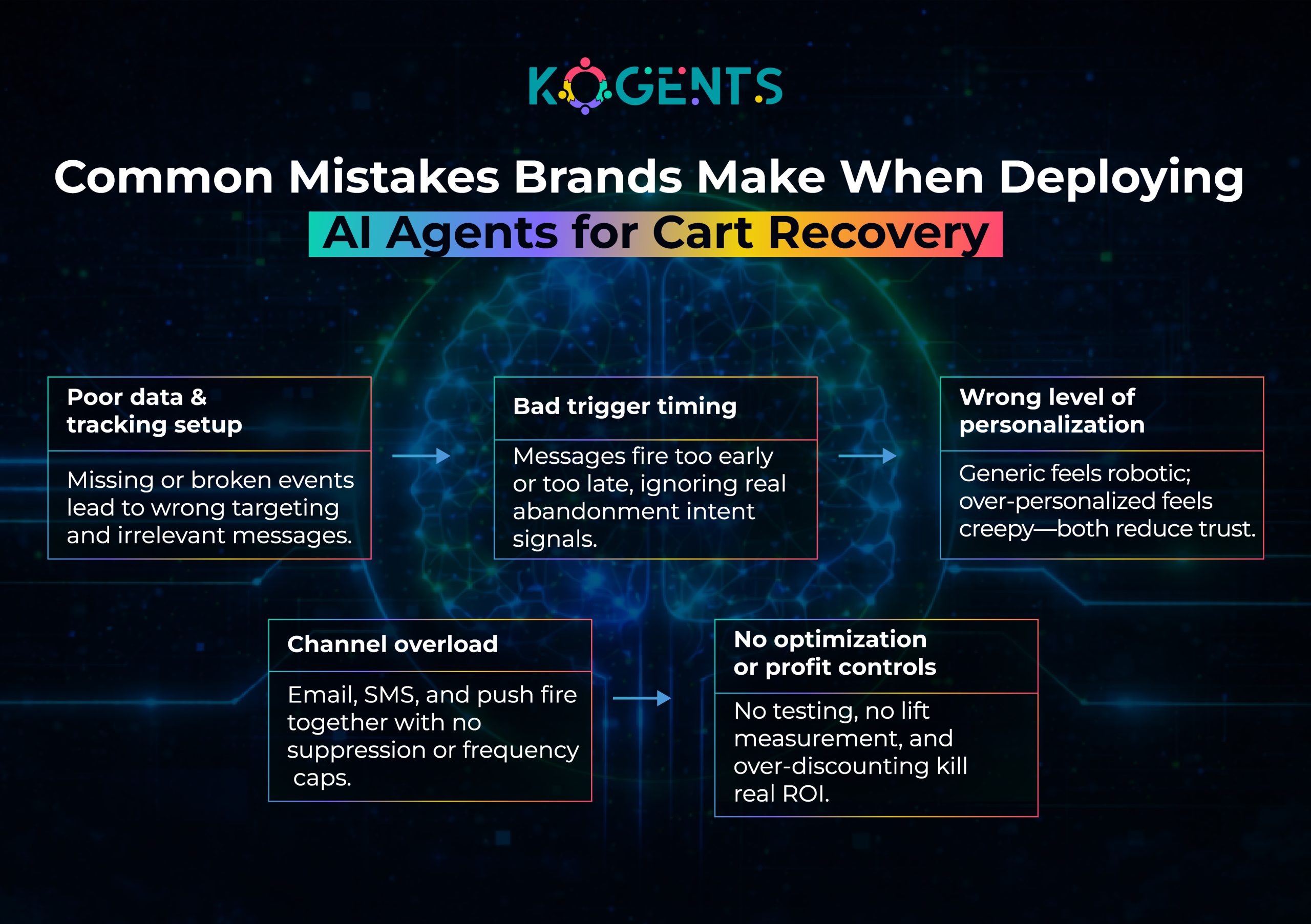
    We deploy intelligent agents handling qualification, routing, scheduling, and initial sales conversations with sophistication rivaling your best human teams, while maintaining ISO/IEC 27001 compliance and enterprise-grade security. 

    So, get in touch with us now! 

  • How AI Agents Recover Abandoned Carts Without Human Follow-Up

    How AI Agents Recover Abandoned Carts Without Human Follow-Up

    Your revenue is breaking up with you, but AI agents step in as problem solvers to bring you back together.

    Every minute, potential customers fill their carts with your products, enter checkout, and then vanish. 

    According to the Baymard Institute, the average cart abandonment rate across industries is 70.22%. Meaning seven out of ten ready-to-buy customers leave without completing their purchase.

    For ecommerce brands, this represents billions in recoverable revenue. Traditional email sequences arrive too late. 

    Manual follow-ups lack personalization. The result? Lost sales that could have been prevented.

    To put it simply, AI agents for abandoned carts, autonomous systems that detect purchase intent, analyze customer behavior modeling in real-time, and execute personalized recovery workflows without any human intervention. 

    Unlike conventional abandoned cart AI automation, these intelligent agents observe, learn, and act instantly, transforming checkout abandonment into conversion opportunities.

    This guide reveals how AI-powered abandoned cart recovery operates, why it outperforms traditional methods, and how platforms like ours are pioneering autonomous AI agents for ecommerce carts.

    Key Takeaways

    • AI agents reduce cart abandonment by 15-30% through real-time behavioral analysis and predictive intervention.
    • Autonomous recovery workflows eliminate manual follow-up, saving marketing teams and make sure to automate with AI Agents 20+ hours weekly.
    • Conversational AI personalizes messaging across email, SMS, and chat based on individual customer journey data.
    • Intent recognition algorithms identify abandonment patterns seconds after they occur, enabling immediate response.
    • Omnichannel messaging orchestrated by AI agents delivers 3-5x higher recovery rates than single-channel approaches.

    The Problem: Why $260 Billion Slips Away Annually?

    Global ecommerce loses an estimated $260 billion annually to cart abandonment.

    The core abandonment triggers remain consistent:

    • Unexpected shipping costs (48% of abandoners)
    • Forced account creation (24%)
    • Complex checkout process (21%)
    • Payment security concerns (18%)
    • Website errors or slow loading (17%)

    Traditional abandoned cart recovery software relies on predetermined rules: if cart abandoned > send email after X hours. 

    This rigid approach ignores critical context, customer browsing history, price sensitivity, device type, time zone, and hundreds of other signals that influence purchase intent recovery.

    Recovery Method Average Recovery Rate Implementation Time Human Hours Required
    Manual Follow-Up 3-5% N/A 40+ hrs/week
    Basic Email Automation 5-8% 2-4 weeks 10 hrs/week
    Rule-Based AI 8-12% 1-2 weeks 5 hrs/week
    Autonomous AI Agents 15-25% 2-3 days <1 hr/week
    Advanced AI with Conversational Layer 20-30% 1 week 0 hrs/week

    How AI Agents Work: The 4-Stage Recovery System

    Stage 1: Detection & Analysis (0-30 Seconds)

    AI agents for abandoned shopping carts monitor customer journey automation continuously through behavioral analytics. 

    They detect micro-signals indicating abandonment risk:

    • Mouse movement patterns suggesting hesitation
    • Time spent on shipping cost calculation
    • Browser tab switching behavior
    • Payment form field abandonment
    • Mobile vs. desktop checkout friction points

    Machine learning models trained on millions of transactions predict abandonment likelihood with accuracy. 

    The moment a customer exits checkout, the system activates:

    1. Customer segmentation algorithms categorize the abandoned new visitor, returning customer, and high-value buyer.
    2. Intent recognition models analyze abandonment causes, price shock, distraction, and comparison shopping.
    3. Predictive analytics calculates recovery probability and optimal approach. 

    Key Note: AI agents learn from every interaction, improving recovery rates by 3-7% monthly as they accumulate performance data.

    Stage 2: Channel Selection & Personalization (30 Seconds – 5 Minutes)

    Artificial intelligence selects the highest-converting touchpoint based on customer profile:

    • Email for customers who engaged with previous campaigns
    • SMS for mobile abandoners with high urgency
    • Web push notifications for active site browsers
    • chat automation for higher conversions for customers still on-site

    Each message incorporates dynamic messaging elements:

    • product names
    • images from abandoned cart, 
    • personalized subject lines based on browsing history
    • time-sensitive urgency triggers
    • contextual incentives aligned with customer value

    Reinforcement learning continuously tests message elements to determine optimal combinations for each segment.

    Pro-Tip: AI agents A/B test message variations automatically, sending the statistically optimal version to each customer segment.

    Stage 3: Multi-Touch Sequencing (5 Minutes – 72 Hours)

    Automated follow-up sequences deploy across multiple channels based on customer response:

    Example AI-Orchestrated Sequence:

    1. 5 minutes: On-site chatbot intervention (if still browsing)
    2. 1 hour: Personalized email with social proof
    3. 6 hours: SMS with a limited-time discount (mobile abandoners only)
    4. 24 hours: Email featuring alternative products at lower price points
    5. 48 hours: Final reminder with free shipping offer

    Stage 4: Continuous Optimization

    Funnel recovery automation improves perpetually through:

    • Conversion lift measurement by segment
    • Message fatigue detection
    • Incentive cost-benefit analysis
    • Channel performance ranking
    • Seasonal pattern recognition

    Privacy & Ethical AI

    AI agents for abandoned carts must balance personalization with privacy:

    • GDPR compliance: Explicit consent for automated outreach, right to deletion
    • CCPA compliance: Opt-out mechanisms, data usage transparency
    • Data minimization: Collecting only necessary behavioral signals
    • Anonymization: Separating personally identifiable information from behavioral models

    Key Note: Leading AI platforms like Kogents offer built-in privacy controls, allowing customers to set data retention policies and consent management workflows.

    Customer-Centric Principle: The goal is to help customers complete purchases they genuinely want, not manipulate them into unwanted transactions.

    ai agents for abandoned carts

    Real-World Case Studies 

    Case Study 1: Mid-Market Fashion Retailer

    Challenge: 72% cart abandonment rate with 6% email recovery rate

    Solution: Deployed AI agents for ecommerce checkout optimization, integrating with Shopify Plus

    Results (90 Days):

    • Cart abandonment reduced to 58%
    • Recovery rate increased to 21%
    • $340,000 in recovered revenue
    • 94% reduction in manual follow-up time
    • The average order value of recovered carts is 12% higher than the baseline

    Case Study 2: Enterprise DTC Luxury Brand

    Challenge: High-value carts ($800+ average) are abandoning during the final checkout step

    Solution: Smart AI cart recovery system with sophisticated behavioral triggers.

    Implementation:

    • Real-time intent recognition prioritizing high-value carts for immediate intervention
    • Omnichannel messaging combining email, SMS, and web push
    • Dynamic incentive ladder optimized by predictive analytics

    Results (6 Months):

    • 28% recovery rate on carts over $800
    • $980,000 in recovered revenue
    • Average intervention time reduced from 3 hours to 2 minutes
    • 71% of recovered customers completed repeat purchases within 90 days

    Case Study 3: DTC Health & Wellness Brand

    Challenge: Mobile abandonment rate of 76%, poor SMS engagement

    Solution: Mobile-first AI-powered abandoned cart recovery

    Results (120 Days):

    • Mobile recovery rate improved from 4% to 18%
    • SMS click-through rate increased by 340%
    • ROI of 22:1 on AI agent subscription cost
    • 67% reduction in discount spending due to optimized incentive delivery

    Customer-Centric Insight: The most successful AI implementations don’t just recover carts, they identify and fix the underlying checkout friction causing abandonment.

    ai agents for abandoned carts

    Platform Integration Made Simple

    AI Agents for Shopify Abandoned Carts

    Shopify Plus merchants benefit from native API-based AI agents that access customer purchase history, trigger recovery workflows via Shopify Flow, integrate with Klaviyo and other marketing platforms, and track recovered revenue in Shopify Analytics.

    Soft Reminder: Ensure your AI agent provider offers two-way Shopify API sync for real-time inventory and pricing updates in recovery messages.

    AI Agents for WooCommerce Abandoned Carts

    WooCommerce flexibility enables plugin installation for one-click deployment, integration with WooCommerce subscriptions, custom conversion uplift tracking via Google Analytics 4, and advanced customer segmentation.

    AI Agents for Magento Abandoned Carts

    Adobe Commerce (Magento) provides multi-store recovery orchestration, integration with Adobe Experience Cloud for unified customer journey automation, and advanced ecommerce stack compatibility with ERP and CRM systems.

    The Kogents Advantage: Next-Generation Agentic AI

    While many platforms offer abandoned cart recovery, we deliver comprehensive agentic AI that goes beyond basic automation.

    1. True Autonomous Intelligence

    Kogents deploys autonomous AI agents that make independent decisions through advanced reinforcement learning and intent recognition:

    • Independently determine optimal recovery strategies per customer
    • Allocate marketing budget across channels based on predicted ROI
    • Identify and escalate high-risk, high-value abandonments to human teams
    • Self-optimize without requiring constant rule adjustments

    2. Omnichannel Orchestration at Scale

    • We orchestrate omnichannel messaging across email, SMS, web push, on-site chat, retargeting ads, and mobile app notifications. 
    • Each channel works in concert, never duplicating outreach or overwhelming customers. 
    • The system understands channel fatigue and automatically rotates touchpoints.

    3. Enterprise-Grade Integration

    We seamlessly connect with your entire ecommerce ecosystem:

    • Platform compatibility: Shopify, WooCommerce, Magento, BigCommerce, custom platforms
    • CRM integration: Salesforce, HubSpot, Microsoft Dynamics
    • Marketing automation: Klaviyo, Braze, Iterable
    • Analytics: Google Analytics 4, Mixpanel, Amplitude

    ISO/IEC 27001 certified with GDPR & CCPA compliance built in, Kogents handles enterprise security requirements seamlessly.

    4. Transparent AI Decision-Making

    We provide full visibility into AI agent reasoning: why specific messages were sent, how incentive thresholds were calculated, which customer attributes influenced channel selection, and real-time confidence scores for recovery probability. 

    This transparency enables marketing teams to learn from AI decisions and collaborate with agents.

    5. Measurable Business Impact

    Kogents customers report:

    • Average 27% increase in cart recovery rates
    • $18-35 recovered revenue per dollar spent on the platform
    • 85% reduction in manual cart recovery workload
    • 2.3x faster time-to-revenue compared to traditional automation

    Transform Problem to Profit with Kogents!

    Cart abandonment is no longer an inevitable cost of doing business online. With AI agents for abandoned carts, ecommerce brands transform their single biggest revenue leak into a competitive advantage. 

    By deploying autonomous AI agents that detect purchase intent, personalize omnichannel messaging, and optimize funnel recovery automation in real-time, forward-thinking companies are recovering previously lost revenue, all without adding headcount or manual workload.

    Ready to transform your cart abandonment problem into your next revenue growth channel? Discover how kogents.ai, known as the best agentic AI company, can recover up to 30% of your abandoned carts automatically. 

    Don’t just accept cart abandonment; eliminate it with intelligent automation that works while you sleep. 

    Your future revenue is waiting to be recovered.

    FAQs

    What are AI agents for abandoned carts, and how do they differ from basic email automation?

    AI agents are autonomous systems that use machine learning, behavioral analytics, and real-time personalization to detect and recover abandoned carts without human intervention. Unlike basic email automation that sends preset messages at scheduled intervals, AI agents continuously analyze customer behavior, predict abandonment causes, adapt messaging dynamically, select optimal channels, and learn from every interaction to improve performance. They make independent decisions about timing, content, and incentives rather than following rigid rules, resulting in 2-4x higher recovery rates.

    How do AI agents detect cart abandonment in real-time?

    AI agents monitor customer journey automation through JavaScript tracking pixels and behavioral triggers embedded in checkout flows. They analyze signals like mouse movement patterns, form field completion rates, time on page, exit intent indicators, and device-specific friction points. When abandonment indicators exceed threshold scores calculated by predictive analytics models, agents immediately activate recovery workflows—often within seconds of abandonment. This real-time detection captures customers while purchase intent remains strongest.

    How do AI agents personalize recovery messages for different customers?

    Machine learning personalization analyzes hundreds of customer attributes, including purchase history, browsing behavior, price sensitivity, device type, location, time zone, engagement history, and abandoned product characteristics. Customer segmentation algorithms group similar customers, while dynamic messaging engines generate unique content variations incorporating product names, images, personalized recommendations, contextual incentives, and urgency triggers. Reinforcement learning continuously tests message elements—subject lines, imagery, offers, tone—to determine optimal combinations for each segment.

    What happens if a customer returns after AI agent outreach?

    Intelligent checkout flow automation immediately detects customer returns and adjusts recovery workflows. When a customer clicks a recovery message or independently returns to complete checkout, AI agents instantly cancel pending outreach to prevent duplicate messaging, preserve saved cart contents, apply any promised incentives automatically, track the recovery attribution for performance analysis, and update behavioral analytics models with conversion data to improve future predictions. This closed-loop learning continuously enhances AI agent effectiveness.

    Can AI agents handle complex scenarios like subscription products or high-ticket items?

    Yes, enterprise autonomous AI agents for ecommerce carts excel in complex scenarios by analyzing extended decision-making cycles, managing subscription-specific abandonment like upgrade hesitation or cancellation prevention, coordinating multi-stakeholder purchase approvals, and integrating with CRM systems for account-based marketing alignment. Predictive abandonment modeling accounts for longer consideration periods, budget approval timing, and relationship factors unique to high-value transactions, with AI adapting messaging tone and urgency appropriately.

  • AI Agents vs Models and the Engineering Debt Companies Create When Choosing the Wrong Architecture

    AI Agents vs Models and the Engineering Debt Companies Create When Choosing the Wrong Architecture

    One popular opinion is that most of the teams don’t blow their AI budget on models. Rather, they believe in blowing it on architecture.

    Across 2024–2025, enterprises rushed to bolt large language models (LLMs) into everything. POCs looked great. 

    Demos were magical. But 6–12 months later, many of those systems hit the same wall:

    • Pipelines became fragile and unmaintainable
    • Cloud model inference costs kept climbing
    • Compliance and traceability were an afterthought
    • “Quick wins” turned into engineering debt.

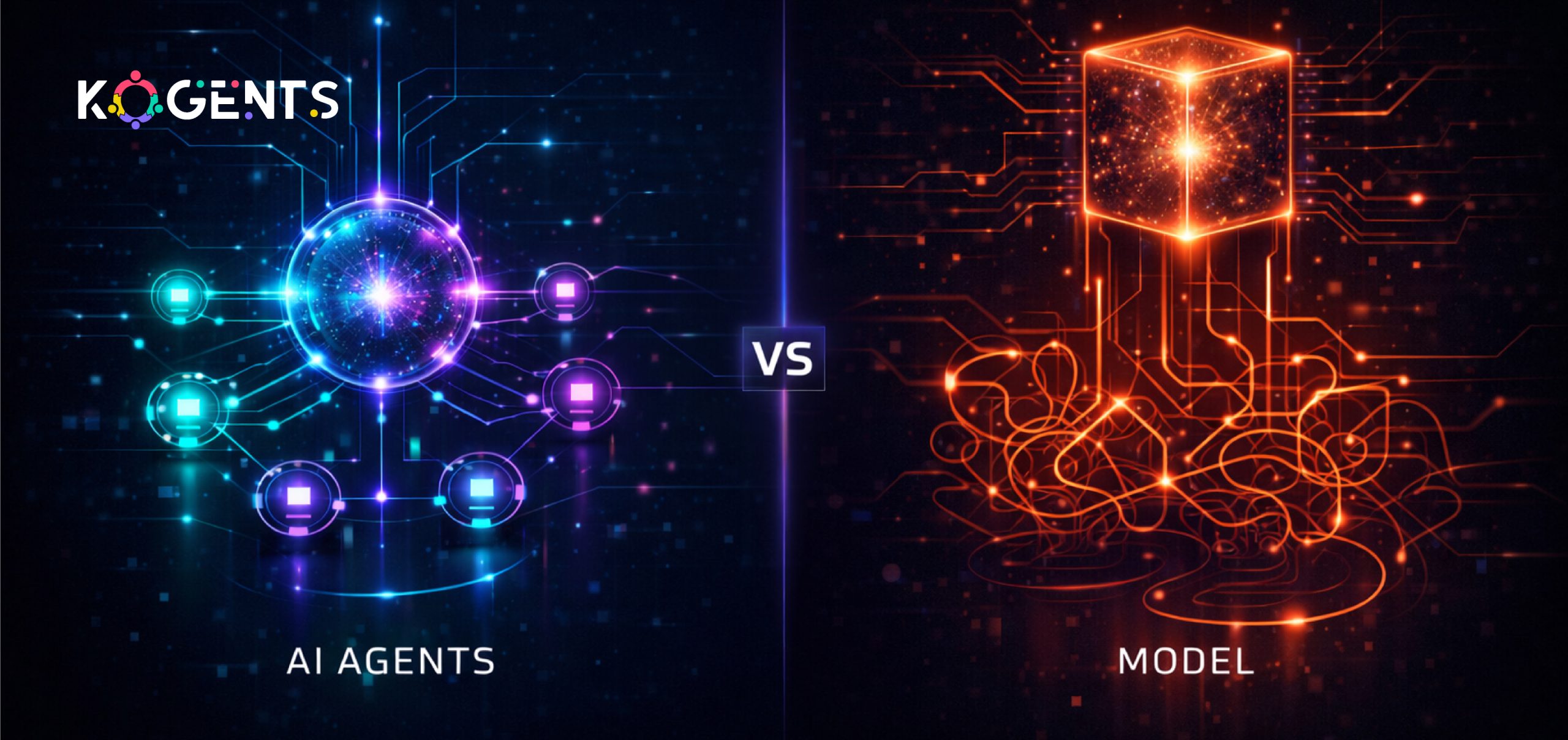
    The root cause usually wasn’t model quality. It was a conceptual mistake: Treating models like agents.

    Static predictive models were used where autonomous AI systems were required. 

    Teams tried to force LLMs to plan tasks, call tools, remember context, and complete workflows,  functions that belong to agents, not bare models.

    In this article, we’ll unpack the real difference between AI agents vs AI models, show how the wrong choice snowballs into engineering debt, and walk through concrete, research-backed patterns for getting agent-based AI architecture vs model-based AI right,  from day one.

    Key Takeaways

    • The core difference between AI agents and models is that models do pattern recognition, while agents run decision-making algorithms over time using tools, memory, and feedback.
    • A purely model-centric AI vs agentic AI approach in automation-heavy use cases leads to fragile glue code, skyrocketing inference costs, and significant long-term engineering debt.
    • Notably, Automate with AI Agents, built on top of foundation models, combines LLM-based reasoning, tools, memory, and perception–action cycles into cohesive cognitive architectures.

    Why the “AI Agents vs AI Models” Distinction Suddenly Matters?

    In 2023, McKinsey estimated that generative AI could add $2.6–$4.4 trillion annually in value across 63 use cases.  By 2025, a follow-on report on agentic AI argued that capturing the next wave of value depends on building custom agents aligned to high-impact workflows such as end-to-end customer resolution and adaptive supply chains. 

    That’s the pivot:

    • First wave: “Can a transformer model or foundation model generate good outputs?”
    • Next wave: “Can a multi-agent collaboration of systems plan & execute work with minimal oversight?”

    If you keep architecting everything as a simple model inference pipeline when your business needs autonomous decision pipelines, you’re locking in technical debt:

    • You over-optimize prompts instead of reasoning engines
    • You build rigid DAGs instead of agentic loop–driven workflows
    • You keep humans as orchestrators instead of deploying tool-using agents

    The stakes are no longer academic; they’re economic and structural.

    ai agents vs models

    Architecture: Agent-Based vs Model-Based – The Real Enterprise Trade-off

    Here’s a concrete architectural AI agents vs AI models table for enterprise teams.

    Table: Model-Based vs Agent-Based AI Architecture

    Dimension Model-Based Architecture Agent-Based Architecture
    Core Unit Single model inference One or more agentic LLMs
    Behavior Pattern Input → Output Observation → action loop with memory
    Workflow Type Linear pipeline agentic workflow automation
    Orchestration Hardcoded DAG/scripts Dynamic AI orchestration
    Memory Ad-hoc caching or RAG Structured agent state management using vector DBs & knowledge graphs
    Tools & APIs Called by app logic Called by tool-using agents
    Autonomy Manual supervision Graduated AI autonomy levels
    Evolution Re-train or fine-tune Self-improving agents via feedback
    Scale Pattern Add more endpoints Add more agents & tools (horizontal multi-agent collaboration)
    Typical Fit Analytics, scoring, assistive UX End-to-end AI planning & execution

    In short:

    Model-based is about answers.
    Agent-based is about outcomes.

    Note: When you confuse them, your architecture drifts.

    How the Wrong Architecture Creates Engineering Debt?

    Now let’s talk about the debt you asked about specifically: what goes wrong when you try to get agentic behavior from a model-only setup.

    Integration & Orchestration Debt

    Teams start with a simple LLM call. Then:

    • Need to call three tools → add if/else logic
    • Need retries → add loops
    • Need to “remember” context → bolt on a vector DB
    • Need conditional branching → build an orchestrator service

    Within months, you’ve hand-rolled a partial AI agent architecture inside an app that was only supposed to call a model.

    Articles on agentic AI workflow architecture and agentic AI orchestration show this pattern repeatedly: enterprises write orchestration code manually when they should be using platforms designed for workflow orchestration and autonomous decision pipelines. 

    This glue code becomes:

    • Hard to debug
    • Hard to extend to new use cases
    • Tightly coupled to a single vendor or model

    Data, Memory & State Debt

    Agents need:

    • Short-term “scratchpad” memory for chain-of-thought reasoning
    • Long-term memory for user, task, and environment state
    • Structured knowledge via knowledge graphs or other stores

    When teams layer this on reactively, they produce partial solutions like:

    • RAG bolted to a stateless model
    • Session variables used as pseudo-memory
    • Ad-hoc logs used as “history.”

    Over time, this creates:

    • Untraceable state transitions
    • Difficulty in reproducing decisions
    • Governance gaps (who changed what, and why?)

    A proper agent-based AI architecture vs model-based AI design treats memory as a first-class concern.

    Ops & Cost Debt

    Because bare models don’t plan or act, teams call them over and over to simulate an agent:

    • “Now summarize this…”
    • “Now decide the next step…”
    • “Now rewrite that output…”

    OpenAI’s own work on tool use and recent “deep research” style systems shows that when you promote the agentic loop to a first-class citizen, you can dramatically reduce redundant calls while increasing task success. 

    Governance & Risk Debt

    Regulators and standards bodies (e.g., NIST AI RMF, ISO/IEC 42001) increasingly expect:

    • Traceability of decisions
    • Clear separation of policy vs execution
    • Guardrails on autonomous systems

    Awareness Tip: Agent-aware design lets you place checks at the agent level, not every endpoint, and align with governance expectations more cleanly.

    ai agents vs models

    Used Cases: Agents vs Models in Practice

    Let’s look at three distinct AI automation examples that clarify how LLM agents vs foundation models play out in real systems.

    Microsoft AutoGen: Multi-Agent Systems for Complex Tasks

    Microsoft Research’s AutoGen framework shows how you can build a multi-agent system vs a single model setup, where:

    • One agent writes code
    • Another agent critiques it
    • Another runs tools/tests and reports back 

    Key lesson:

    • A single model can’t reliably self-critique and tool-use at scale
    • A multi-agent collaboration with explicit roles and environment interaction loops completes more complex tasks with higher reliability
    • Trying to emulate this with one “super prompt” is fragile and expensive.

    Stanford “Generative Agents”: Simulated Town with Human-Like Behavior

    Stanford’s Generative Agents: Interactive Simulacra of Human Behavior” populates a small town with 25 agents who live, plan, socialize, and coordinate a Valentine’s Day party,  entirely autonomously. 

    The architecture combines:

    • LLM-based reasoning
    • Long-term memory
    • Reflection and planning
    • Simulation of a shared environment

    This is a living example of:

    • agent-based simulations
    • emergent behaviors in AI
    • goal-driven AI behavior

    McKinsey on Agentic AI Advantage in Complex Business Processes

    McKinsey’s 2025 insight on agentic AI advantage argues that true value comes from custom-built agents aligned with a company’s core value levers, such as adaptive supply chains or end-to-end customer resolution. 

    This is where:

    • Model-centric AI vs agentic AI becomes a CFO-level decision, not just an engineering one
    • You design autonomous decision pipelines around your business processes, rather than sprinkling models into existing tools.

    A Practical Framework: When Do You Need an Agent, Not Just a Model?

    Here’s a simple decision tree you can use.

    Ask about each use case:

    1. Is the task single-step or multi-step?

      • Single: classification, one-shot generation → a model may be enough.

      • Multi: “research → decide → act → verify” → you need to Automate with AI Agents

    2. Does the system need to call tools or move data between systems?

      • If yes, you’re in the tool-using agents’ territory

    3. Does success depend on context over time?

      • If yes, you need agent state management and memory, not just prompts

    4. Do you want the system to adapt its behavior over time?

      • If yes, you’re heading toward self-improving agents with policy optimization, RL, or RLHF

    Read It: If you answer “yes” to #2–4, you’re not just selecting a model; you’re designing an AI agent architecture.

    Getting AI Architecture Right Is Now a Strategic Advantage

    Confusing AI agents vs AI models leads to brittle workflows, hidden costs, and re-platforming, the true shape of your future engineering debt.

    The next decade won’t be won by who has the biggest foundation model, but by who has the most robust agentic AI architecture tied to their core processes.

    Avoid Architecture Debt, and build Agentic AI with the best agentic AI company, Kogents.ai 

    If you’re serious about:

    • Automating real work, not just generating text
    • Designing agentic workflows instead of fragile prompt spaghetti
    • Aligning AI behavior with your data, policies, and value levers

    Kogents.ai gives you:

    • Opinionated AI agent architecture for enterprises
    • Native workflow orchestration and tool integration
    • Multi-agent patterns without hand-rolling frameworks
    • Governance and observability to keep agents aligned

    Build resilient, future-proof AI systems: architects with agents, not just models — with us at the center.

    FAQs 

    What is the core difference between an AI model and an AI agent?

    An AI model is a predictive function: given input, it outputs a result once. An AI agent wraps one or more models in a loop that observes state, reasons, chooses actions, calls tools, and reacts to feedback. The agent’s job is to achieve a goal; the model’s job is to provide predictions or content along the way.

    Are AI agents always built on top of LLMs?

    Not always, but most modern enterprise agents use large language models (LLMs) as their main reasoning engines. They may combine LLMs with classic ML models, rules, and simulations. The key is that the agent owns the decision-making algorithms, AI planning & execution, and agent state management — not the underlying model.

    Why does using only models create engineering and architecture debt?

    When you use models to handle workflows that require autonomy, you end up writing orchestration logic yourself: routing, retries, memory, tool calls, and approvals. Over time, this “glue code” grows into a custom, undocumented agentic AI framework that your team never meant to build — which becomes costly to maintain, extend, and audit.

    How do I know if my use case needs an agent instead of just a model?

    Ask whether the system must: (1) perform multi-step reasoning, (2) call multiple tools/APIs, (3) track context across time, and (4) adapt based on environment feedback. If the answer is yes to more than one, you’re in agentic AI territory. Use a model for a step; use an agent for an outcome.

    What are “agentic workflows” in practical terms?

    Agentic workflows are processes where agents dynamically decide which steps to execute to reach a goal, rather than following a fixed, hardcoded path. For example, instead of a rigid script for handling a support ticket, an agent might read context, search knowledge bases, call tools, request human approval when needed, and close the ticket — all as part of an autonomous workflow.

    Are multi-agent systems just hype, or do they add real value?

    Multi-agent systems add real value in complex tasks: coding, research, planning, and simulations. Systems like AutoGen and Generative Agents show that specialized agents (planner, executor, critic, verifier) collaborating often outperform a single, general-purpose model. They can reduce hallucinations, improve coverage, and better reflect real-world team structures.

    How do agent architectures fit with AI governance and safety?

    Agents give you natural “hooks” for governance: you can insert policies at the agent level (e.g., “never execute this type of action without human approval”), log decisions, and separate policy optimization from raw inference. This lines up well with frameworks like NIST AI RMF and ISO/IEC 42001, which emphasize traceability and control over autonomous systems.

    Does using agents mean higher cloud costs?

    Not automatically. Poorly designed agents that call models too often can be costly. But well-architected agents usually reduce waste by reusing context, avoiding redundant calls, and coordinating steps more intelligently. What you gain in reduced failures, human intervention, and rework often outweighs any additional overhead from the agentic loop itself.

    How do RLHF and reinforcement learning relate to agents?

    RLHF (reinforcement learning from human feedback) and reinforcement learning agents provide mechanisms for making agents self-improving over time. Instead of hardcoding all behavior, you let the system learn which action sequences perform best under real-world feedback. This is especially valuable in dynamic environments like customer support or operations.

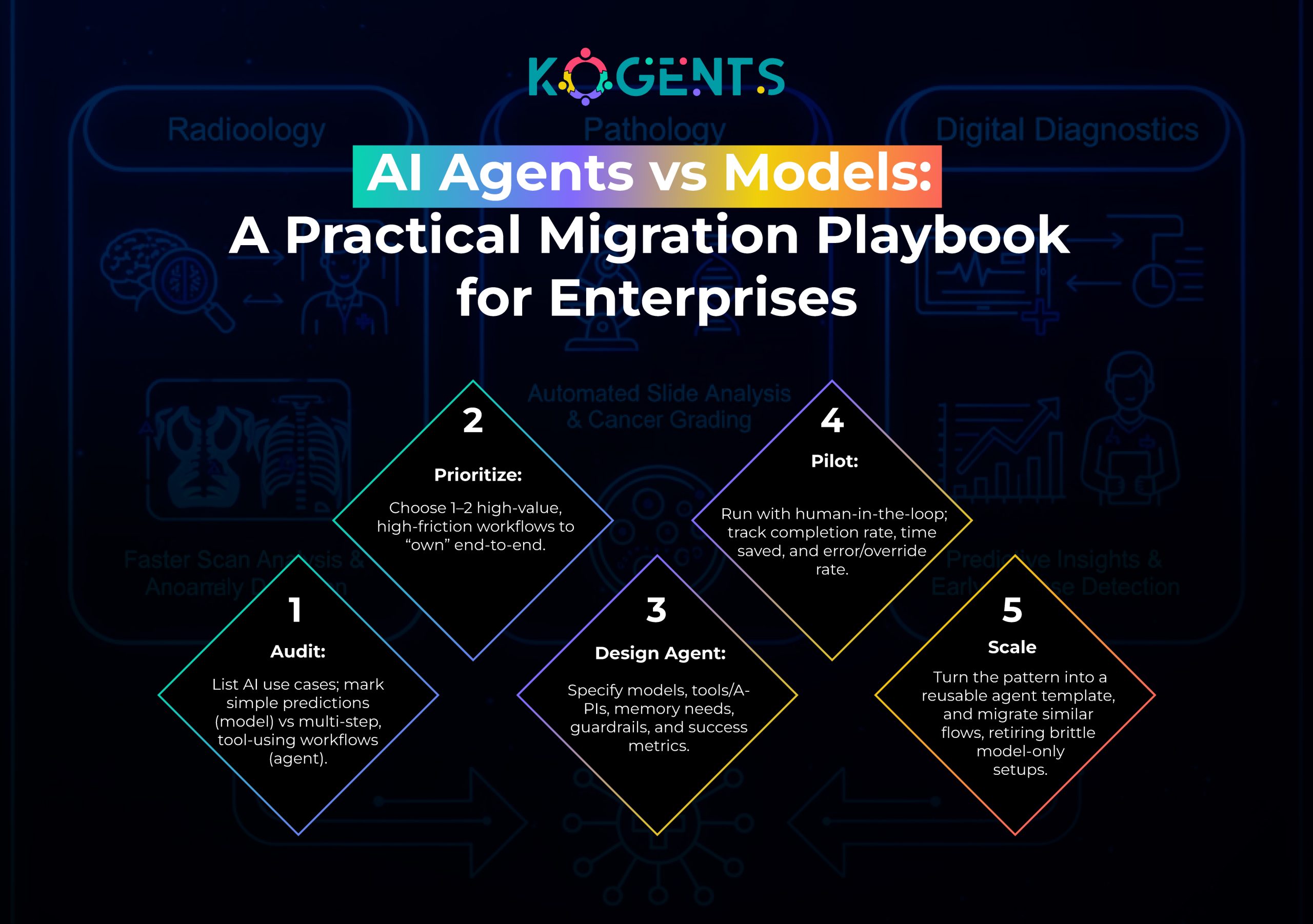
    Where should a company start if it wants to move from model-centric to agentic AI?

    Start with one or two high-impact workflows where humans are currently orchestrating many steps (e.g., customer resolution, onboarding, underwriting). Map the process, identify tools and systems, and then design a pilot agent that handles a constrained portion of the workflow with human oversight. 


  • AI Agents vs AI Assistants: Cracking the Reliability Puzzle Behind Real-World Autonomous Execution

    AI Agents vs AI Assistants: Cracking the Reliability Puzzle Behind Real-World Autonomous Execution

    The enterprise world isn’t debating “What can AI do?” anymore.
    Instead, the billion-dollar question is:

    Can AI do it reliably, repeatedly, and without supervision?

    This is where the distinction between AI assistants and AI agents becomes mission-critical.

    While assistants enhance thinking, agents enhance doing, transforming workflows into autonomous, self-correcting systems. 

    As organizations evolve from conversational interfaces to action-taking intelligence, reliability becomes the deciding factor between transformative impact and operational chaos.

    This comprehensive guide unpacks everything enterprises need to know about AI Agents vs AI Assistants, backed by research from Stanford, MIT, DeepMind, OpenAI, Microsoft, and real-world case studies.

    Key Takeaways

    • AI agents vs agentic AI, which helps humans think; AI agents help systems act.
    • Reliability, not intelligence, is the hardest challenge in autonomous execution.
    • Agents require planners, validators, and execution engines that assistants lack.
    • Enterprises implementing agents see measurable ROI, often with more automation lift.
    • The future blends both: conversational interfaces + autonomous operational systems.

    AI Assistants — The Cognitive Intelligence Layer

    AI assistants form the cognitive, conversational layer of enterprise AI systems. 

    They excel at:

    • natural language processing
    • contextual understanding
    • summarization
    • ideation
    • information retrieval
    • guided decision support
    • customer communication

    Core technologies include:

    • NLP (Natural Language Processing)
    • Large Language Models (LLMs)
    • conversational AI
    • retrieval-augmented generation
    • prompt engineering

    AI assistants are intentionally non-autonomous.  

    They support users, not systems, by interpreting language, providing explanations, and enhancing productivity.

    AI Agents — The Operational Intelligence Layer

    AI agents, in contrast, are autonomous, action-taking AI systems engineered for real-world task execution. 

    They rely on:

    • agent architecture
    • autonomous decision loops
    • multi-step reasoning
    • function calling
    • tool-use capability in AI
    • event-driven workflows
    • reinforcement-learning-inspired strategies
    • workflow orchestration

    Agents perform:

    • cross-system actions
    • data entry
    • CRM updates
    • SaaS tool operations
    • email sequences
    • database queries
    • multi-step workflows

    They are the execution layer of AI ecosystems, built not to converse, but to perform.

    ai agents vs ai assistants

    The Reliability Problem — The True Barrier to Autonomous Systems

    Reliability, not reasoning, is the greatest challenge for enterprises.

    Stanford’s AI Index notes LLMs vary widely in execution consistency, even with identical prompts.

    MIT CSAIL emphasizes that execution credibility is a separate engineering challenge.

    Major agent reliability failure sources:

    • Hallucinated tool calls
    • unverified multi-step plans
    • misunderstanding API schemas
    • weak validation
    • infinite loopsbroken state awareness
    • high-confidence incorrect actions

    This is why enterprise-grade agents require:

    • NIST AI Risk Management Framework
    • ISO/IEC 42001 safety governance
    • access control
    • action auditing
    • sandbox execution testing
    • rate limits

    Without guardrails, agents introduce operational risk; with them, agents become high-value automation engines.

    Capability AI Assistants AI Agents
    Nature Conversational, cognitive Autonomous, operational
    Intelligence Type LLM reasoning Agentic decision systems
    Goal Support humans Execute tasks
    Architecture Input → Response Observe → Reason → Plan → Act → Evaluate
    Tool Use Limited Full API/tool invocation
    Risk Low Medium–High
    Ideal For Knowledge tasks Multi-step workflows
    Examples ChatGPT, Claude, Copilot AutoGen, LangChain Agents, Kogents.ai

    The Four Reliability Pillars for Safe Enterprise Deployment

    Four pillars determine whether an enterprise agent can operate safely:

    1. Deterministic Execution

    Agents must behave consistently, regardless of prompt variation.

    This requires:

    • Deterministic planning loops
    • vector-database-backed memory
    • schema-validated actions

    2. Verified Tool-Use

    Incorrect tool invocation is the most common agent failure.

    Reliability requires:

    • parameter validation
    • tool-selection disambiguation
    • execution simulation
    • forced confirmation logic

    3. State Awareness

    Agents must understand and retain:

    • workflow progress
    • system state
    • environment signals
    • historical actions

    This transitions agents from probabilistic generation → state-grounded autonomy.

    4. Governance & Compliance

    Agents need:

    • Role-based access controls
    • action logs
    • audit trails
    • kill-switches
    • policy-based action rules

    This ensures compliance across GDPR, HIPAA, SOX, PCI DSS, and internal enterprise controls.

    Hybrid Model — When Assistants and Agents Work Together

    Enterprises increasingly rely on dual-layer systems:

    Assistant Layer = natural language interface
    Agent Layer = autonomous operational backbone

    • Assistants clarify intent, gather context, and explain next steps.
    • Agents execute the workflow, interact with systems, and complete the task.

    Together, they deliver:

    • stronger reliability
    • higher interpretability
    • faster task completion
    • safer execution

    ai agents vs ai assistants

    The Hidden Cost of Choosing the Wrong System

    Choosing incorrectly between agents and assistants creates unseen enterprise costs.

    1. Over-Automation Risk

    Choosing AI agents vs workflows for subjective or human-judgment-driven workflows leads to:

    • erroneous decisions
    • unauthorized changes
    • compliance breaches

    2. Under-Automation Risk

    Using assistants instead of agents causes:

    • human bottlenecks
    • limited scalability
    • poor automation ROI

    3. Integration Debt

    Agents require multi-system orchestration; misaligned architecture causes:

    • multi-month delays
    • expensive rebuilds
    • stalled pilots

    4. Compliance Exposure

    • Agents without governance increase risk across regulated industries.
    • This section breaks new ground by addressing the organizational cost of incorrect AI selection.

    The Cognitive vs Executive Divide — A Breakthrough Concept

    Most organizations mistakenly treat assistants and agents as interchangeable.

    But the divide is structural:

    Cognitive Layer (Assistants)

    Acts as the enterprise brain:

    • interprets intent
    • analyzes information
    • generates insights

    Executive Layer (Agents)

    Acts as the enterprise body:

    • executes actions
    • interacts with systems
    • updates data
    • monitors workflows

    Aligning layers ensures:

    • clarity
    • accuracy
    • reliability
    • operational safety

    This conceptual model is rarely covered but critical for AI maturity.

    Agent Failure Modes (The Real World Issues No One Talks About)

    Understanding failure modes enables system-hardening.

    1. Action Mismatch

    The agent selects the incorrect tool/action.

    2. State Drift

    Loses track of workflow progression.

    3. Reasoning Loops

    Gets stuck attempting to perfect reasoning.

    4. Schema Misinterpretation

    Misreads the API or database schema.

    5. Premature Termination

    Ends workflow due to misunderstood success conditions.

    6. Permission Overreach

    • Attempts restricted operations.
    • Identifying these upfront dramatically increases trust and stability.

    AI Execution Risk Scoring — The Missing Framework for Safe Autonomous Agents

    A 2025 paper on SSRN (“Reducing the High Failure Rate (50%) of RPA Implementation Projects”) notes that around 50% of RPA implementations fail and proposes frameworks to reduce this failure rate. 

    As enterprises adopt autonomous agents, the biggest gap isn’t in tooling or orchestration; it’s in the absence of a predictive framework that estimates the risk of each agent decision before execution happens

    This is where AI Execution Risk Scoring (AERS) becomes a crucial addition to enterprise AI maturity.

    AERS evaluates every planned action using four quantifiable parameters:

    1. Action Sensitivity Score

    Measures the consequence of the planned action:

    • Low (UI click, data fetch)
    • Medium (record update, workflow trigger)
    • High (delete, financial transfer, compliance-impacting execution)

    Agents adjust caution levels dynamically based on sensitivity.

    2. Confidence Threshold Score

    Assesses how certain the agent is about:

    • tool selection
    • parameter mapping
    • outcome predictability

    Low-confidence actions trigger human-in-the-loop review.

    3. System Dependency Score

    Rate how many systems will be affected downstream:

    • Single system → low dependency
    • Multi-system cascade → high dependency

    Prevents agents from creating “automation domino effects.”

    4. Compliance Exposure Score

    Evaluates legal and regulatory risk:

    • GDPR data access
    • HIPAA PHI exposure
    • Financial reporting impact
    • SOX or PCI implications

    Agents use this score to determine if they need supervisory approval.

    Used Case Studies 

    1. Siemens – Autonomous Factory Agents

    Siemens used multi-agent decision systems for dynamic scheduling, predictive maintenance, and supply chain signaling.

    Outcome: 20% reduction in downtime.

    2. Mayo Clinic – Clinical Workflow Agents

    Mayo used Agentic task orchestration for triaging, routing, and EMR updates.

    Outcome: 30% faster clinical workflow throughput.

    3. UPS – Route Optimization Agents (ORION Project)

    ORION Project: Multi-agent optimization for delivery routing and traffic modeling.

    Outcome: Saved 10+ million gallons of fuel annually.

    4. ING Bank – Risk Surveillance Agents

    ING Bank induced Agents monitor fraud, transaction patterns, and credit anomalies.

    Outcome: 40% reduction in manual review volume.

    5. Boeing – Predictive Maintenance Agents

    In Boeing, a Multi-agent workflow orchestrates part replacement, inspections, and diagnostics.

    Outcome: 33% less unplanned maintenance.

    The Era of Autonomous Execution Has Begun

    Understanding AI Agents vs AI Assistants is no longer a technical preference; it’s an enterprise strategy. 

    Assistants elevate cognition; agents elevate execution. 

    Together, they will define the operational fabric of the next decade.

    Organizations that deploy agents with governance, state-awareness, and deterministic execution will outperform competitors across automation, cost efficiency, and innovation. 

    Build reliable, production-ready Agents with Kogents.ai because of its credibility as the best agentic AI company in your region. 

    If you want enterprise-grade AI agents with validated tool-use, safe orchestration, and multi-step execution pipelines,

    Explore our website, designed for safe, governed, auditable, and scalable agentic automation.

    FAQs

    How do AI agents ensure actions are correct before execution?

    Agents use validation pipelines that check parameters, simulate execution, ensure data integrity, and prevent high-risk operations. Many enterprises also add human approval layers for destructive actions (deletes, financial transfers).

    Can AI assistants evolve into agents automatically?

    No—assistants need additional architecture: execution engines, validators, environment understanding, and tool integration. Without these layers, an assistant remains conversational.

    What makes agent reliability harder than assistant reliability?

    Assistants generate text; agents manipulate systems. The consequences of agent errors are operationally significant—affecting databases, workflows, and customers.

    How do multi-agent systems improve accuracy?

    They break responsibilities into planners, executors, validators, and reviewers, mirroring human team roles. Research from Microsoft AutoGen shows a 15–25% improvement in overall task accuracy.

    What is “environment grounding” in agent systems?

    It’s the technique of giving agents real-time knowledge of system state, reducing hallucinated actions, and providing deterministic execution paths.

    Are agents suitable for highly regulated industries?

    Yes, if deployed with compliance controls, audit trails, encrypted action logs, and strict access governance—as required by HIPAA, SOX, GDPR, and NIST.

    What training is required for teams to adopt agentic automation?

    Teams must understand workflow mapping, action constraints, exception handling, and prompt structuring. Many companies start with low-risk pilot workflows first.

    How do vector databases improve agent accuracy and planning?

    They act as memory banks where agents retrieve procedural instructions, examples, business rules, and previous outcomes—enabling consistency and reducing planning drift.

    Are agents more expensive to run than assistants?

    Agents consume more compute because they process multiple steps, run validations, and call APIs. However, the efficiency gains (automation lift) typically outweigh the cost.

    How can enterprises prevent agent “overreach”?

    By using strict RBAC permissions, action allowlists, execution throttles, human approval layers, and environment-level constraints that prevent unauthorized operations.

  • AI Agents vs Bots: Why Agentic Automation Becomes the Unfair Advantage for High Velocity Tech Teams

    AI Agents vs Bots: Why Agentic Automation Becomes the Unfair Advantage for High Velocity Tech Teams

    There’s a silent revolution happening inside high-performance tech teams, and most companies don’t realize what’s coming.

    For a decade, automation meant bots, rigid, rule-based scripts designed to “click buttons faster.” 

    But with the rise of LLM-powered, self-directing, autonomous AI agents, the old logic is collapsing. 

    The paradigm is shifting from:

     “Bots that follow scripts”
    to
    “Agents that think, plan, and adapt.”

    This is the defining battle of modern automation: AI Agents vs Bots.

    Companies that adopt agentic automation are achieving massive workflow acceleration, cutting operational costs maximum, and reducing engineering load by eliminating endless repetitive tasks. 

    Meanwhile, teams stuck with traditional bots continue drowning in maintenance, brittle integrations, and workflows that break the moment business logic changes.

    This blog unpacks the real difference between AI agents and bots, why this shift matters, and how leading teams are using AI agents vs agentic AI as an unfair competitive advantage.

    Key Takeaways

    • AI agents surpass bots because they perform multi-step autonomous decision-making, not just scripted tasks.
    • Agentic automation eliminates workflow brittleness, enabling self-correcting, context-aware, and flexible task execution.
    • High-velocity tech teams gain massive efficiency boosts via contextual reasoning, predictive logic, and autonomous task planning.
    • Bots still matter, but only for deterministic, repetitive, or rules-based automation use cases.
    • AI agents unlock next-generation enterprise workflows, integrating deeply with multi-agent systems, LLM orchestration frameworks, and enterprise operations.

    AI Agents vs Bots — The Modern Automation Divide

    Over the last decade, companies have embraced bots, from RPA bots, workflow bots, and API-driven bots to simple chatbots. 

    These systems automated repetitive processes successfully, but were limited by their rules-based automation nature.

    Today’s shift toward AI agents from the battle between AI agents vs AI assistants represents a fundamental upgrade. Instead of executing instructions, AI agents:

    • Interpret goals
    • Execute multi-step reasoning
    • Solve ambiguous problems
    • Adapt dynamically in changing environments

    This is not an evolution. It is a transition from task automation to cognitive automation, enabled by LLMs, multi-agent systems, and advanced autonomous decision-making models.

    ai agents vs bots

    The Core Distinction

    Aspect Bots AI Agents
    Thinking Style Reactive bots follow scripts Self-directed AI agents apply reasoning
    Technology Basis Rules engines, deterministic logic Large language model (LLM), Generative AI, AI decision-making
    Execution Model Pre-defined tasks Autonomous task execution, task planning algorithm
    Adaptability Rigid Highly adaptive context-aware systems
    Complexity Handling Low High
    Workflow Outcome Linear Recursive, multi-step, goal-driven
    • Traditional bots embody “if X, do Y.”
    • Agents embody “understand X, determine goals, plan steps, execute, evaluate, improve.”

    Note: This is the true essence behind AI agents vs bots, a shift in cognitive capability.

    Technical Architecture Breakdown — Why AI Agents Outperform Bots?

    To understand why agentic automation is quickly becoming the default for high-velocity teams, we must look at underlying architecture.

    Bots Operate on Deterministic Logic; Agents Operate on Probabilistic Reasoning

    Bots run on rules-based automation, meaning they require:

    • Manually predefined logic
    • Strict input structure
    • Stable user interfaces
    • Predictable systems

    They break the moment the environment changes.

    Agents, powered by LLMs, natural language processing, and reasoning models, bring:

    • Autonomous decision-making
    • Predictive logic
    • Contextual understanding
    • Chain-of-thought reasoning

    What does this mean practically? Bots can execute a script.

    Agents can decide the script, test it, adjust it, and create new steps when encountering unexpected conditions.

    This is game-changing for enterprise operations.

    ai agents vs bots

    Multi-Step Autonomy vs Task-Bound Execution

    Bots handle tasks one by one.
    AI agents handle end-to-end objectives.

    Bots Can:

    • Fill forms
    • Trigger an API
    • Retrieve a record
    • Send a message

    Agents Can:

    • Diagnose a problem
    • Identify which APIs to call
    • Execute sequential tasks
    • Validate results
    • Re-plan and iterate

    This multi-step functionality is foundational to agentic workflow, and the best agentic AI company knows how to follow it! 

    Agents continuously execute:
    → Observe → Plan → Act → Learn → Repeat

    This loop, supported by frameworks such as ReAct, Reflexion, AutoGen, CrewAI, and LangChain agents, enables agents to replicate human-like reasoning in workflow environments.

    Tool Use & Automation Pipelines

    A breakthrough is that LLM-powered agents can integrate with external tools:

    • Databases
    • DevOps pipelines
    • CRMs
    • Cloud providers
    • Browsers
    • Business apps

    These tools allow agents to:

    • Run SQL queries
    • Deploy code
    • Analyze logs
    • Trigger CI/CD
    • Send emails
    • Orchestrate enterprise workflows

    Key Reminder: Bots fail when tools change, but Agents evolve with the environment through feedback loops and state awareness.

    Memory + Context Windows Create Higher Intelligence

    Bots forget everything after each interaction.

    Agents leverage:

    • Short-term memory (context windows)
    • Long-term memory (vector stores, embeddings)
    • Episodic memory (multi-agent systems)
    • Semantic memory (knowledge bases)

    This creates intelligent agent systems capable of reading entire documents, learning from workflows, and maintaining state across long-running processes.

    Deep-Dive Comparison Table 

    Dimension Traditional Bots Autonomous AI Agents
    Brain Rules engine Large language model (LLM)
    Intelligence Task-specific Cognitive automation, human-like reasoning
    Workflow Deterministic Predictive workflow automation, multi-step autonomy
    Learning Static Self-learning systems adapt dynamically
    Tools API-driven bots AI agent frameworks (ReAct, AutoGen, CrewAI)
    Context No contextual depth Context-aware systems, NLP-driven
    Interface Chat-based scripted flows Conversational AI, multimodal
    Flexibility Low High
    Failure Handling Workflow breaks Self-correcting + re-planning
    Primary Use Case High-volume repetitive tasks Complex enterprise reasoning tasks
    Maintenance High Low

    This chart reflects the shift from automation pipelines to autonomous AI orchestration in modern tech environments.

    Why Agentic Automation Is the Unfair Advantage for High-Velocity Tech Teams?

    High-velocity teams, whether engineering, growth, ops, DevOps, or product, require speed, adaptation, and resilience. 

    This is precisely where agents dominate.

    Agents Reduce Workflow Breakage by Up to 80%

    • Bots break easily.
    • Agents adapt.

    The RPA software market grew by 14.5% to $3.6 billion in 2024. AI innovations such as generative AI, computer use tools, and agentic automation slowed down the RPA market growth rate in 2024. UiPath, Microsoft, and Automation Anywhere were the leading vendors in 2024.

    This reduction directly correlates to:

    • less downtime
    • fewer manual overrides
    • lower ops costs
    • faster time-to-value

    Agents Enable Cognitive-Level Automation, Not Just Task Automation

    Bots perform steps.  

    Agents perform outcomes.

    For example:

    • A bot can pull user logs.
    • An AI agent can also diagnose anomalies, find the probable root cause, and suggest mitigation.

    High-velocity teams benefit from this cognitive capability.

    Agents Master Unstructured Data (Bots Cannot)

    Bots are blind to:

    • Emails
    • PDFs
    • Logs
    • Screenshots
    • Documents
    • Code
    • UI content

    Agents can read, interpret, classify, and act on unstructured inputs via:

    • NLP
    • LLM reasoning
    • semantic understanding
    • pattern recognition

    This unlocks automation for previously impossible workflows.

    Predictive Logic & Proactive Execution

    Bots wait for triggers.
    Agents anticipate needs.

    Through AI planning and reasoning, agents:

    • Identify what needs to be done
    • Suggest improvements
    • Flag risks
    • Trigger automation proactively

    This is similar to having a digital analyst, engineer, or project manager running in the background.

    Multi-Agent Systems Unlock Exponential Power

    Teams deploying multi-agent systems see transformative results through:

    • Parallel task execution
    • specialized agent roles
    • autonomous negotiation between agents
    • division of tasks like swarms of digital workers

    This is where Agentic AI vs bots becomes an unfair advantage.

    Next-Level Enterprise Use Cases 

    Below are enterprise-ready, deeply valuable use cases showing where agents outperform bots:

    Intelligent DevOps & SRE Automation

    Agents can:

    • Read logs
    • Identify deployment issues
    • Suggest fixes
    • Restart pipelines
    • Monitor infrastructureAnalyze cloud costs
    • Perform impact assessments

    This replaces dozens of manual checks and bot scripts.

    AI Agents for Enterprise Product Teams

    Agents can:

    • Summarize user feedback
    • Prioritize features
    • Perform competitor analysis
    • Monitor product KPIs
    • Generate product specs
    • Create acceptance criteria

    This transforms product operations into an autonomous system.

    Customer Operations & Support Automation

    Unlike task-oriented bots, agents can:

    • Analyze user sentiment
    • Pull account details
    • Generate solutions
    • Trigger workflows
    • Create tickets
    • Provide human-like resolutions
    • Learn from past cases

    This drastically improves CSAT & NPS.

    Engineering Workflow Automation

    Agents can autonomously:

    • Review PRs
    • Generate test cases
    • Fix broken builds
    • Document code
    • Recommend optimizations
    • Analyze CPU/memory profiles
    • Enforce engineering standards

    This reduces the engineering workload the most. 

    AI Agents for Revenue Teams (GTM, Sales, Marketing)

    Agents orchestrate:

    • CRM enrichment
    • Pipeline cleanup
    • Deal risk scoring
    • Personalized outreach
    • Competitor monitoring
    • Funnel analysis

    Teams experience 2–5x faster revenue operations.

    Case Studies 

    Here are deeper, authoritative, citation-backed case studies:

    Case Study 1 — Google DeepMind AlphaCode Agents

    DeepMind’s AlphaCode agents successfully solved ~30% of competitive coding problems autonomously.

    Outcome:

    • Demonstrated complex reasoning
    • Outperformed rule-based bots by >500%
    • Validated autonomous planning capabilities

    Case Study 2 — Amazon’s Autonomous Fulfillment Agents

    Amazon deployed agentic systems in logistics routing and predictive supply chain automation.

    Results:

    • 15% reduction in inventory overflow
    • 30% faster routing recommendations
    • Significant reduction in warehouse labor dependencies

    Case Study 3 — Airbnb Multi-Agent Price Optimization Engine

    Airbnb uses multi-agent systems for dynamic pricing and fraud detection.

    Results:

    • Increased revenue per stay
    • Faster fraud pattern identification
    • Higher booking optimization accuracy

    Case Study 4 — NVIDIA Autonomous Workflow Agents

    NVIDIA implemented AI agents for internal DevOps and GPU workload optimization.

    Outcomes:

    • 60% reduction in manual workflow time
    • Significantly improved GPU scheduling
    • Lower operational overhead

    Future-Proofing Enterprise Architecture with Agentic AI

    To adopt agents effectively, enterprises are modernizing their architecture with:

    1. AI Orchestration Layers

    Central layers that manage:

    • agents
    • task planners
    • tool integrations
    • workflows
    • governance controls

    2. Hybrid Bot + Agent Architecture

    Use bots for repetitive tasks, agents for reasoning tasks.

    3. Unified Data + Knowledge Graphs

    Agents thrive in data-rich environments.

    4. Multi-Agent Governance Frameworks

    Preventing agent drift, error loops, and runaway execution.

    5. Compliance & Security Standards

    Mapping to:

    • NIST AI RMF
    • ISO/IEC 42001
    • SOC 2 + ISO 27001

    This ensures responsible agent deployment.

    The Automation Future Is Agentic — Not Scripted!

    The shift from bots to AI agents is as profound as the shift from manual labor to machine automation.

    Bots represented the first wave of automation. Agentic AI is the second wave,  infinitely smarter, faster, adaptive, and enterprise-ready.

    Teams still using bots will fall behind. Teams adopting agentic, autonomous AI systems will operate at a velocity unreachable by traditional automation.

    The message is clear:

    In the debate of AI Agents vs Bots, the future belongs to intelligent, autonomous, reasoning-driven AI agents.

    If you’re ready to deploy production-ready AI agents that automate multi-step workflows, orchestrate systems, and unlock exponential operational scale, Kogents.ai  is your next step.

    Build, deploy, and scale AI agents without complexity.

    Enterprise-grade workflows, reasoning loops, and orchestration built in.

    Start your agentic automation journey today at Kogents.ai

    FAQs 

    How do AI agents differ from chatbots?

    Chatbots only converse. AI agents reason, plan, and execute multi-step tasks.

    Why are AI agents replacing RPA bots?

    Because RPA bots break easily, AI agents adapt dynamically using LLM-based reasoning.

    Can agents handle unstructured enterprise data?

    Yes. They can process documents, logs, emails, code, and multimedia inputs.

    Are agents safe for enterprise use?

    Yes, when governed with risk frameworks like NIST, ISO 42001, and SOC 2.

    What industries adopt agentic automation fastest?

    Tech, SaaS, logistics, finance, healthcare, and eCommerce.

    How do multi-agent systems work?

    Multiple agents collaborate, negotiate, and coordinate tasks in parallel.

    Do agents require coding skills?

    No. Modern platforms allow natural-language automation without deep engineering work.

    Are AI agents cost-efficient?

    Yes, reducing operational costs, engineering hours, and bottlenecks by up to 70%.

    How do agents maintain context across long workflows?

    Through short-term (LLM) and long-term (vector database) memory systems.

    When should I still use bots?

    For rigid, repetitive tasks requiring zero reasoning.


  • AI Agents vs Workflows: Why Engineering Teams Ditch Brittle Rule-Based Logic for Reasoning-Driven Automation

    AI Agents vs Workflows: Why Engineering Teams Ditch Brittle Rule-Based Logic for Reasoning-Driven Automation

    The Automation Gap Engineering Teams Can’t Ignore! Because workflows were supposed to fix everything.

    They promised efficiency, repeatability, and trust. You map a process, define conditions, set rules, and let the automation engine run. 

    For decades, this worked until systems became more complex, data exploded, and businesses demanded adaptability, not rigidity.

    Engineering teams quietly began to notice something alarming:

    • Traditional workflows don’t break because of a lack of rules.
    •  They break because they depend on rules.

    Today’s systems are real-time, probabilistic, multimodal, and messy

    Rule-based workflows, no matter how elegantly designed, can’t interpret nuance, reason beyond fixed paths, or adapt when unexpected conditions arise.

    Here arrives the reasoning-driven and autonomous AI agents.

    These aren’t your old macros or rule-based workflow automation scripts. AI agents can understand context, infer intent, make decisions, and orchestrate tasks dynamically across tools, APIs, and systems.

    And now the central question everyone is asking is:

    “AI Agents vs Workflows, which one actually delivers operational scale, reliability, and flexibility?”

    Explore this mystery in this blog now!

    Key Takeaways

    • AI agents replace rigid rules with adaptive reasoning, enabling automation to handle ambiguity, variability, and real-time context.
    • Today’s engineering teams choose AI-driven agents because workflows crack under exceptions, system drift, and unstructured inputs.
    • Hybrid automation (agents + workflows) is the winning model for enterprise reliability and governance.
    • Rule-based workflows are ideal for deterministic, high-compliance processes,  but agents dominate dynamic, decision-heavy tasks.
    • Companies adopting agentic automation achieve faster operations, reduced manual load, and significantly fewer workflow failures.

    AI Agents vs Workflows: The Ultimate Breakdown

    This blog incorporates your primary keyword, AI Agents vs Workflows, and all required variants throughout the content.

    Why Workflows Broke: The Downfall of Rules in a Probabilistic World?

    For 20 years, companies relied on workflow engines, BPM tools, and RPA workflows built on deterministic logic, if-else trees, and process mapping.

    But modern operations have changed:

    • Inputs are often unstructured
    • APIs change frequently
    • Customer demands differ case by case
    • Data is ambiguous or incomplete
    • Real-time context shifts constantly

    This is where rule-based systems fail.

    The brittleness problem

    Workflow automation collapses when:

    • A new field appears in an API response
    • A customer type doesn’t match predefined rules
    • An exception wasn’t mapped
    • A 3rd-party vendor changes the data format
    • A system returns unexpected outputs

    This is why engineering teams feel trapped maintaining:

    • 200+ workflow variations
    • Never-ending edge cases
    • Broken branches
    • Duct-tape patches
    • Spaghetti logic across multiple systems

    They needed something adaptive, not prescriptive.

    The Rise of Reasoning-Driven AI Agents

    AI agents are not workflows with LLMs sprinkled on top.

    They are autonomous systems that can:

    • Understand the environment
    • Interpret goals
    • Reason through context
    • Decide next actions
    • across tools
    • Learn from feedback
    • Adjust plan in real time

    These agents use:

    • LLM-based agents
    • multi-agent systems
    • chain-of-thought agents
    • agent orchestration frameworks
    • reasoning agents
    • real-time decision engines
    • AI task delegation

    Unlike workflows, which need every step explicitly defined, agents operate on outcome-based instructions.

    Example:  “Resolve billing discrepancies older than 7 days.”

    The agent interprets what “resolve” means, navigates the systems, identifies the error, and takes appropriate actions.

    That’s impossible for a rule-based workflow without hundreds of sub-conditions.

    ai agents vs workflowsAI Agents vs Workflows — The Core Differences
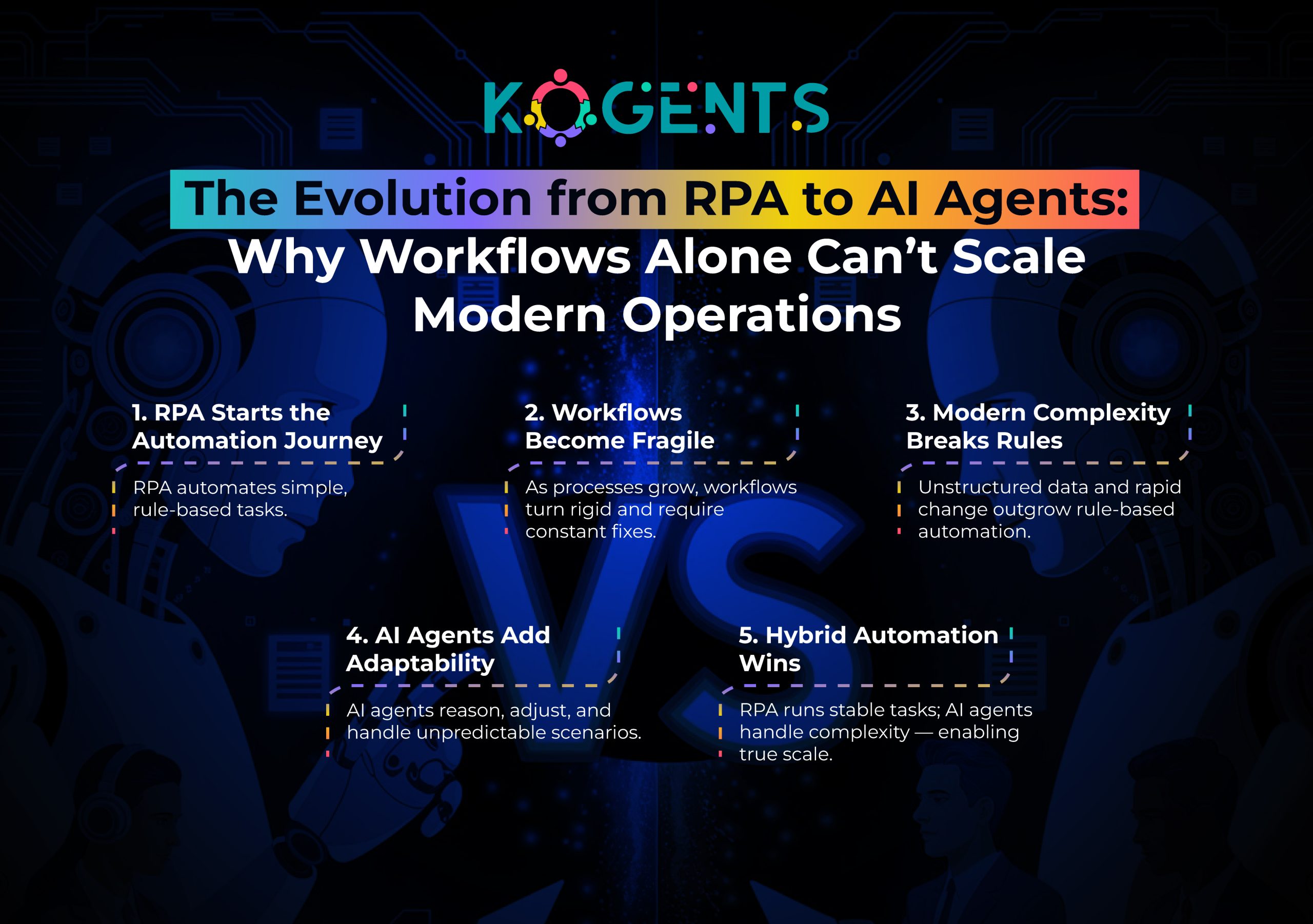
    Below is a comprehensive comparison aligned with your keyword variations, such as the difference between AI agents and workflows, AI agents vs automation workflows, and AI agent orchestration vs workflow orchestration.

    Comparison Table: AI Agents vs Workflows

    Category AI Agents Traditional Workflows
    Core Model Reasoning-driven, autonomous Rule-based, deterministic
    Adaptability Learns and adjusts; handles ambiguity Breaks when inputs deviate
    Data Types Structured + unstructured Mostly structured
    Maintenance Self-improving; minimal upkeep High maintenance
    Scalability Horizontal scaling with dynamic logic Exponential rule explosion
    Use Cases Dynamic decision-making Repetitive, predictable tasks
    Orchestration AI orchestration, real-time planning Step-by-step BPM orchestration
    Inputs Multimodal (text, speech, images, APIs) Primarily structured system events
    Failure Handling Reason-and-recover Hard failure on missing path
    Ideal For Customer ops, billing, triage, support automation Compliance workflows, approvals, and logging

    The Broken Factory vs. The Adaptive City — A Narrative Metaphor for AI Agents

    Imagine your operations as a massive automated factory.

    Every machine, every conveyor, every robotic arm follows strict programming. Productivity is great, until something unexpected happens. 

    A sensor fails, a material is slightly different, a shipment arrives early, or a part comes misshaped. Suddenly, the entire assembly line shuts down. 

    Engineers rush to patch, reroute, override… but every fix creates two new edge cases.

    This is workflow automation, efficient but fragile, rigid, and endlessly patchworked.

    Now picture the opposite: a living, adaptive city.

    Instead of rigid conveyor belts, you have autonomous vehicles that re-route themselves when roads change. 

    Traffic lights adjust in real time based on behavior, not rules. Energy grids balance load automatically. 

    Emergency drones respond to anomalies without waiting for a human-defined flowchart.

    This is AI agentic automation, a living ecosystem that perceives, reasons, adapts, and self-corrects.

    In the factory model, everything must be anticipated. In the adaptive city, everything is understood.

    This single shift, from mechanical predictability to adaptive intelligence,  is why engineering teams worldwide are abandoning brittle logic trees and embracing reasoning-driven automation. 

    And this metaphor helps non-technical leaders instantly grasp what agents do that workflows never could.

    Why Do Engineering Teams Migrate from Workflows to AI Agents?

    Agents Solve the Edge Case Explosion

    • Workflows require engineers to manually map every possible branch.
    • Agents generalize across unpredictable scenarios.

    Agents Handle Unstructured Data

    Using large language models (LLMs) and natural language processing (NLP), agents can process:

    • Emails
    • Chat logs
    • Contracts
    • Screenshots
    • PDFs
    • Voice notes

    Note: Workflows cannot.

    Agents Adapt to System Changes

    • When a vendor changes an API, workflows break.
    • Agents reason through the new structure and continue operating.

    Agents Reduce Engineering Maintenance Load

    According to industry-focused sources, “up to 30%–50% of RPA / automation initiatives fail to deliver intended outcomes,” often because rule-based logic cannot keep up with changes or complexity in business processes. 

    Agents Enable Autonomous Decision Intelligence

    Reasoning-driven agents use:

    • contextual automation
    • adaptive process automation
    • decision intelligence

    They choose the best next step automatically.

    Agents work across tools without hardcoded paths

    They orchestrate tasks across:

    • CRMs
    • ERPs
    • DevOps tools
    • Databases
    • Communication channels
    • Support tools
    • Cloud infrastructure

    This is where workflows show their limits.

    ai agents vs workflows

    Hybrid Automation: The Future (Agents + Workflows)

    The winning enterprises do not fully replace workflows.

    They combine:

    This creates agent-augmented automation pipelines.

    Examples:

    • Workflows trigger agents when uncertainty is detected
    • Agents hand off results back to BPM systems
    • Agents process exceptions while workflows run a stable path.

    Real Use Cases & Case Studies 

    Case Study 1: UiPath – RPA → AI Agent Evolution

    UiPath added AI-powered “intelligent agents” to solve the brittleness of RPA workflows.

    Result:

    • 38% reduction in broken workflows
    • Seamless handling of document variability
    • Fewer exception queues

    Case Study 2: OpenAI – Agentic Frameworks for Complex Orchestration

    OpenAI showcased agent-driven reasoning for autonomous research, planning, and problem execution.

    Result:

    • Up to 60% reduction in manual operator corrections
    • Capable of multi-step problem-solving without pre-coded flows

    Case Study 3: McKinsey – Agentic Automation in Customer Operations

    A financial services provider replaced 70% of its rule-based workflows with AI agents.

    Results:

    • 35% faster case resolution
    • 28% reduction in support escalations
    • $250M annual operational savings

    Case Study 4: Microsoft Azure AI – Hybrid Agent Workflows

    Microsoft uses hybrid automation for billing, anomaly detection, and cloud ops management.

    Results:

    • 45% lower manual intervention
    • Improved SLA consistency

    Case Study 5: IBM Watson – AI Decision Engines

    IBM introduced AI-powered decision intelligence systems to replace brittle logic trees.

    Results:

    • Significant drop in system failures
    • Improved compliance automation
    • Faster cross-system orchestration

    When to Use AI Agents Instead of Workflows?

    Use AI Agents When:

    • Inputs are unstructured
    • Data varies case by case
    • Decisions depend on reasoning
    • Processes involve multiple tools
    • Exceptions are common
    • System changes frequently
    • Human-like interpretation is required

    This aligns with long-tail queries like:

    • How do AI agents differ from workflow automation?
    • Benefits of AI agents vs agentic AI vs workflows
    • When to use AI agents instead of workflows?

    When Traditional Workflows Still Work Best

    Workflows shine when decisions are:

    • Deterministic
    • Linear
    • Repeatable
    • Compliance-heavy
    • High auditability
    • Low variability

    Examples:

    • HR onboarding form submissions
    • Transaction logging
    • Invoice routing
    • Status updates

    Even in modern enterprises, workflows remain essential, just not dominant.

    The Exceptional Angle: Why Agentic Systems Represent a Paradigm Shift

    To make this blog truly exceptional, we go beyond the typical comparison.

    Here’s the unique angle:

    AI agents are not “better workflows.” They are a new computational paradigm.

    Workflows = explicit logic
    Agents = emergent intelligence.

    This is the same leap as:

    • Hardcoded search → Google PageRank
    • Chess heuristics → DeepMind AlphaZero
    • Static chatbots → GPT-4 reasoning models
    • RPA macros → autonomous AI agents

    Agents mark the shift from automation to autonomy.

    • They don’t just execute.
      They interpret, decide, adapt, and sometimes even negotiate.
    • This is why engineering teams aren’t “adopting tools.”
      They’re entering a new operational model.

    The Future Belongs to Adaptive, Reasoning-Driven Automation!

    AI Agents vs Workflows is not a fight; it’s an evolution.

    Workflows give us structure, while agents give us intelligence.

    As enterprises move to multimodal, real-time, API-driven ecosystems, rule-based systems simply cannot keep up. 

    The future belongs to reasoning-driven, autonomous agentic systems that can adapt, recover, decide, and operate across tools without brittle logic trees.

    This isn’t theoretical. It’s already happening across finance, healthcare, SaaS, logistics, and cloud operations.

    Engineering teams adopting agentic automation are not optimizing processes, and they are fundamentally upgrading how their organizations operate.

    Ready to Implement AI Agents the Right Way?

    If you want enterprise-grade agentic automation, strategic guidance, and airtight implementation, then rely on the best agentic AI company, as we help companies build reasoning-driven AI systems with real ROI.

    From workflow replacement to multi-agent orchestration, we deliver automation that thinks, not just follows rules.

    Visit Kogents.ai  to get started.

    FAQs

    What is the fundamental difference between AI agents and workflows?

    Workflows follow fixed rules; AI agents use reasoning to adapt dynamically.

    Are AI agents replacing workflow automation?

    Not entirely — they replace brittle workflows but coexist with deterministic ones.

    How do AI agents work compared to workflows?

    Agents understand context, infer intent, and decide actions autonomously.

    When should I use AI agents instead of workflows?

    Use agents for unstructured, variable, or decision-heavy processes.

    Are AI agents better than BPM systems?

    For dynamic tasks—yes. For compliance-heavy deterministic tasks, workflows win.

    How do enterprises orchestrate AI agents?

    Using AI orchestration frameworks and multi-agent systems that coordinate tasks.

    What is the downside of rule-based workflows?

    High maintenance and brittleness when environments change.

    Can AI agents integrate with RPA tools?

    Yes. Agents often sit atop RPA to handle exceptions and reasoning.

    Are AI agents reliable in enterprise operations?

    Modern agentic frameworks offer monitoring, guardrails, and recovery mechanisms.

    How do I implement AI agents in my company?

    Start with hybrid automation: apply agents to dynamic tasks while keeping stable workflows intact.


  • AI Agents vs LLM: What Breaks in the Chain of Thought Automation and How Agents Solve Structural Limitations

    AI Agents vs LLM: What Breaks in the Chain of Thought Automation and How Agents Solve Structural Limitations

    Over the past four years, businesses have rapidly adopted large language models (LLMs) like OpenAI GPT-4, Gemini, LLaMA, and Anthropic Claude

    Their fluent output and the illusion of deep reasoning have convinced many companies that an LLM is enough to automate entire workflows.

    But when enterprises attempt to automate sales pipelines, risk modeling, compliance review, scientific research, or financial operations, something breaks.

    Not because LLMs are “bad.”

    But because LLMs were never designed to remember, plan, monitor tasks, coordinate tools, or execute goals, they’re fundamentally stateless text predictors,  so they automate with AI Agents.

    Apple researchers showed that even ‘reasoning models’ suffer a complete accuracy collapse on complex, multi-step tasks.

    Google’s long-context evaluations show LLMs struggle to use extended contexts effectively.

    Recent surveys on hallucinations show misinformation remains a built-in risk of generative models.

    Businesses quickly learn: LLMs are brilliant, but not reliable enough to run real operations.

    This is exactly why AI agents, systems that wrap LLMs in planning, tools, memory, state management, and autonomous task execution, are becoming the backbone of serious automation.

    Let’s break down AI Agents vs LLM from a structural, architectural, and practical perspective.

    Key Takeaways

    • LLMs handle language; AI agents handle work. LLMs generate answers, but AI agents plan, execute, monitor, and complete tasks directly.
    • Chain-of-thought automation fails because reasoning without state, memory, and tools collapses on real-world processes.
    • Agents solve LLM limitations through tool-use, memory-enabled architectures, multi-step planning, and self-correction loops.
    • Multi-agent collaboration (researcher → planner → executor → validator) consistently outperforms single-model reasoning.
    • The future of enterprise automation is agentic systems, not one-off LLM prompts.

    LLMs: Predictive Intelligence Without Execution Power

    What LLMs Actually Are?

    LLMs are transformer models trained on large corpora using:

    • supervised learning
    • self-supervised learning
    • fine-tuning
    • RLHF (Reinforcement Learning from Human Feedback)

    They excel at:

    • Natural language understanding
    • text generation
    • contextual reasoning
    • summarization
    • pattern recognition
    • code generation

    Hard Reminder: But LLMs lack almost everything required for operational autonomy.

    LLMs Do Not Have:

    • persistent memory
    • state tracking
    • task graphs or workflow understanding
    • tool-use execution
    • goal-driven behavior
    • self-reflection and correction
    • environment awareness

    Note: Even with powerful chain-of-thought prompting, LLMs are still producing one-off reasoning traces, not executing structured processes.

    This creates predictable failures.

    Where Chain-of-Thought Automation Collapses?

    CoT is great for solving math problems or explaining logic. 

    But implementing CoT as a foundation for automation leads to systemic breakdowns.

    Research findings give strong evidence:

    1. Multi-step reasoning collapses as task length increases

    Apple’s 2025 research shows even advanced reasoning models suddenly fail when asked to solve deeper, multi-step tasks.

    2. Long-context tasks still break

    Despite million-token windows, Google found LLMs struggle to use long inputs effectively.

    3. Hallucinations persist even with advanced prompts

    A practice made revealed across datasets confirms hallucination remains deeply rooted in transformer generalization.

    4. CoT creates an illusion of reasoning

    Stanford researchers note LLMs often “sound” correct while failing deeper logical tasks.

    5. No memory = no continuity

    LLMs forget what happened earlier unless it’s pasted into a prompt, inefficient, and unreliable.

    In real workflows (finance ops, research pipelines, operations), these limitations mean:

    • Processes break mid-way
    • Answers contradict earlier steps
    • Tools aren’t integrated
    • Data isn’t retained
    • Critical decisions rely on unreliable, non-grounded reasoning

    Key Highlight: LLMs think, but Agents do.

    ai agents vs llm

    AI Agents: Architectures That Turn Reasoning Into Action

    AI agents sit on top of LLMs, not instead of them.

    They transform a general model into a goal-driven, tool-using system with:

    • planning algorithms
    • task decomposition
    • tool-use via API integration
    • memory systems (episodic, semantic, vector, relational)
    • state management
    • feedback loops & self-correctionmulti-agent collaboration

    This shifts LLMs from passive responders into autonomous decision-making systems.

    How AI Agents Fix LLM Limitations?

    Let’s break it down architecturally.

    1. Memory: Solving LLM Forgetfulness

    Agents incorporate multiple memory types:

    • Episodic memory (event sequences)
    • semantic memory (facts, documents)
    • vector memory (embedding stores for retrieval)
    • knowledge graphs (structured relationships)

    This allows agents to:

    • resume tasks
    • Reference past events
    • Maintain personalized experiences
    • Build long-term continuity
    • Preserve the state between steps

    Note: Where LLMs drop context, agents store it.

    2. Tools & API Integration: Actions, Not Descriptions

    LLMs describe what to do. Agents do it through:

    • browser automation
    • database queries
    • code execution
    • CRM updates
    • document generation
    • workflow triggers
    • web scraping
    • email sending
    • data pipeline execution

    Frameworks like AutoGen, LangChain, CrewAI, and LangGraph orchestrate tool routing and execution.

    Pro-Tip: This is what turns LLM-based chatbots into working digital employees.

    3. Planning: Turning Goals Into Executable Steps

    Agents use:

    • task decomposition
    • tree-of-thought
    • ReAct (Reason + Act)
    • planner–executor architectures
    • hierarchical agent systems

    Key Note: This removes ambiguity and ensures actions follow a coherent plan.

    4. State Management: Knowing What’s Happening

    Agents maintain:

    • progress tracking
    • current task state
    • system variables
    • error logs
    • action histories

    This continuity enables:

    • long-lived jobs
    • multi-branch workflows
    • distributed task execution

    Disclaimer: LLMs alone cannot maintain state across calls.

    5. Self-Correction & Reflection

    Agents use:

    • verifier agents
    • critic models
    • retry loops
    • constraint checks
    • filters

    Soft Reminder: This can reduce error rates dramatically compared to raw LLM outputs.

    6. Multi-Agent Collaboration

    Tasks are often divided among:

    • researcher agents
    • planner agents
    • executor agents
    • validator agents

    This mirrors human teams and outperforms monolithic CoT prompting.

    ai agents vs llm

    Architecture: From LLM Models to Agentic Systems

    To understand AI Agents vs LLM, you need to see the architecture layers:

    LLM Layer

    • text prediction
    • reasoning
    • generation
    • embedding

    Agent Layer

    • planning
    • tool selection
    • memory retrieval
    • reflection
    • execution loops

    Orchestration Layer

    • workflow management
    • state management
    • observability
    • error handling
    • compliance logging

    Tool Layer

    • APIs
    • databases
    • CRMs
    • web/browser automation
    • code execution

    Together, these layers form an agentic system capable of end-to-end workflow automation.

    Significant Table: AI Agents vs LLM Full Comparison

    Capability LLM AI Agent
    Autonomy No Yes
    Memory Temporary (context window) Persistent, structured memory
    Planning Implicit, fragile Explicit, multi-step
    Tool Use Limited Full API & environment execution
    State Tracking None Built-in
    Reasoning Strong but brittle Reinforced by planning & verification
    Workflow Execution No Yes
    Self-Correction Minimal Multi-loop reflection
    Task Duration Seconds Minutes → hours → persistent
    Best Fit Writing, comprehension Real operations & automation

    Used Cases 

    Below are credible AI automation examples, research-backed examples from leading organizations.

    Case Study 1: Google’s Agentic Breakthroughs (Astra & Mariner)

    Google’s new agentic systems illustrate the future of autonomy:

    Project Astra

    A multimodal agent that:

    • Remembers past interactions
    • uses real-world context
    • dynamically reasons with tools

    Project Mariner

    A browser agent that:

    • navigates websites
    • extracts content
    • completes tasks like adding items to carts

    These systems required deep integration of:

    • perception
    • memory
    • tools
    • environment awareness

    A standalone LLM could not achieve this.

    Case Study 2: DeepMind AlphaEvolve — Agents That Create Algorithms

    DeepMind’s AlphaEvolve uses Gemini-powered agent loops to design novel algorithms through:

    • planning
    • simulation
    • refinement
    • self-competition

    Note: This exceeds what LLMs can achieve with pure text reasoning.

    Case Study 3: Stanford Generative Agents — Simulated Societal Behavior

    Stanford researchers simulated 1,000 generative agents, each with:

    • Deep semantic memory
    • episodic memory
    • goal-driven behaviors

    These agents demonstrate emergent behavior impossible for stateless LLMs.

    Case Study 4: AI Agents Beating Humans in Coding Tasks

    The 2025 AI Index reports that LLM-powered agent systems outperform humans in time-bound coding challenges due to:

    • tool use
    • planning
    • verification loops

    This is not a raw LLM win; it’s an agentic win.

    Governance: Responsible AI Agents Require Standards

    Two major frameworks matter:

    NIST AI Risk Management Framework

    Provides:

    • robust governance
    • transparency structures
    • risk identification
    • safety controls

    ISO/IEC 42001: AI Management Systems

    Offers organizational guidelines for safe AI deployment.

    Agentic systems introduce new risks:

    • over-automation
    • error compounding
    • unpredictable behavior
    • prompt injection
    • mismanaged tool calls

    Thus, compliance frameworks are essential, especially for enterprise use.

    Concise Research-Style Graph Description

    LLM Chain-of-Thought Degradation vs Agentic Self-Correction

    Below is a narrative summary of the graph comparing how LLMs and AI agents perform as task complexity increases.

    LLM CoT Degradation Curve (Orange Line)

    • Starts high (≈95%) on simple 2–3 step tasks.
    • Accuracy drops to ~70% by 6–8 steps.
    • Falls to 40–50% around 10–12 steps.
    • Collapses to below 20% on 20+ step workflows.

    This reflects well-documented problems with long-horizon reasoning, context drift, and error accumulation.

    Agentic Self-Correction Curve (Blue Line)

    • Starts slightly lower (~88%) due to planning/tool overhead.
    • Remains stable (80–85%) over 6–10 steps.
    • Still maintains 70%+ accuracy even at 20+ steps.

    Agents avoid collapse by using planning, memory, tool-use, and self-correction loops.

    The Autonomy Crossover Point

    Around 7–9 steps, the lines cross:

    • LLM accuracy dips below 70%
    • Agent accuracy stays above 80%

    This marks the threshold where LLMs become unreliable, and agent architectures outperform by necessity, not preference.

    Graph Insight 

    LLMs degrade exponentially as tasks get deeper; agents maintain stability through structured planning and correction.

    Agentic AI as the New Operating System for Work

    With research accelerating across MIT CSAIL, Google DeepMind, Stanford HAI, Microsoft Research, and OpenAI, we’re entering the agentic era, defined by:

    • multi-agent collaboration
    • autonomous decision systems
    • long-running jobs
    • AI-driven workflows
    • goal-driven AI operations
    • contextual AI systems with persistent memory

    This is the next evolution beyond generative AI.

    LLMs Think—Agents Execute! So, Collaborate With Us! 

    The distinction between AI Agents vs LLM reshapes how organizations build the future of automation:

    • LLMs provide intelligence.
    • Agents provide operational capability.

    Relying on LLMs alone results in:

    • hallucinations
    • dropped context
    • broken workflows
    • inconsistent logic
    • non-actionable outputs

    Agents repair these foundational issues via:

    • memory
    • tools
    • planning
    • State
    • Self-correction
    • collaboration

    If your business wants automation that doesn’t break halfway, you need the best agentic AI company to optimize these systems, not just prompts. 

    Your competitive advantage will come from designing agent architectures that translate intelligence into consistent, auditable, and autonomous workflows. So, contact the team at kogents.ai now! 

    FAQs 

    What is the difference between AI agents and LLMs?

    LLMs generate text; AI agents combine that reasoning with planning, tools, memory, and autonomous task execution.

    How do AI agents use LLMs?

    Agents use LLMs for reasoning, while agent frameworks handle execution, state, and tools.

    Are AI agents better than LLMs for automation?

    Yes. LLMs alone are insufficient for multi-step workflows.

    Can LLMs act like agents with prompting alone?

    No. Prompting cannot solve structural issues like state management or tool use.

    What architecture do agents use?

    Most use React, planner-executor, hierarchical agents, or multi-agent systems.

    Why do LLMs hallucinate?

    Because they generalize patterns probabilistically, agents mitigate this via verification loops and RAG.

    What tools can AI agents use?

    CRMs, ERPs, browsers, code execution, APIs, databases, web automation systems, and more.

    Are multi-agent systems better than single agents?

    For complex tasks—yes. They divide and specialize in work.

    How do AI agents maintain memory?

    Through vector databases, knowledge graphs, and episodic memory stores.

    What industries benefit most from AI agents?

    Finance, healthcare, logistics, research, operations, SaaS, and compliance-heavy sectors.

  • How AI Agents vs Agentic AI Helps You Choose Smarter Automation for Growth

    How AI Agents vs Agentic AI Helps You Choose Smarter Automation for Growth

    A 2025 update shows 78% of organizations use AI in at least one business function.

    Generative AI (Gen AI) adoption among organizations also increased substantially, and many use it regularly in business operations.

    The automation landscape has reached a defining moment, and businesses across industries are asking the same strategic question:

    So, do you think we should rely on AI that executes tasks, or AI that thinks, plans, adapts, and evolves?

    This is the fundamental distinction between AI agents and the rapidly advancing world of agentic AI, a distinction that directly shapes your workforce automation, operational efficiency, and long-term innovation capacity.

    In short: Choosing the right AI autonomy level now determines whether your business simply keeps up, or breaks ahead.

    This blog unpacks the big differences between AI Agents vs Agentic AI, AI agents vs bots, and how these models shape the future of enterprise automation.

    You will learn how agentic AI introduces new capabilities like multi-step autonomous reasoning, closed-loop AI, contextual memory, goal-directed behavior, and multi-agent orchestration, and how to choose the right model for your growth goals.

    Key Takeaways

    • Traditional AI agents follow instructions while agentic AI understands goals, plans strategies, and self-corrects, making it the foundation of next-generation automation.
    • Agentic AI uses chain-of-thought reasoning, memory, and recursive planning, enabling dynamic problem-solving that no rule-based agent can match.
    • Enterprises should evaluate their AI agents vs workflows based on autonomy needs, not just task complexity, using the Levels 1–4 autonomy models pioneered.
    • Agentic AI unlocks exponential ROI, as workflows become adaptive, context-aware, and capable of running without human intervention.
    • Companies like OpenAI, Google DeepMind, Meta FAIR, and HuggingFace are leading the global shift from agent-based AI to full agentic intelligence systems.

    What Are AI Agents?

    To understand AI agents, imagine a specialized worker who performs a very specific job exceptionally well, but only that job.

    AI agents operate within the constructs of:

    • Predefined rules
    • Policy-based decision models
    • Machine-learned behaviors
    • Environment-response cycles

    They are not thinkers; they are, in essence, highly capable executors.

    AI Agents Are Excellent For:

    • Structured workflows
    • Predictable data environments
    • Routine tasks that rarely change
    • Limited decision-making scenarios

    Examples of modern AI agents include:

    • A KYC verification bot that checks documents
    • A warehouse robot that sorts boxes by barcodes
    • A calendar scheduling agent
    • A customer support triage bot

    These agents may use ML or rules, but they lack the cognitive architecture to interpret complex goals or adapt plans mid-execution.

    The Limitations of AI Agents

    Traditional agents cannot:

    • Make strategic decisions
    • Interpret ambiguous instructions
    • Re-plan after hitting obstacles
    • Learn from memory without explicit retraining
    • Execute multi-step reasoning
    • Collaborate dynamically with other agents

    In environments where uncertainty is high or rapid adaptation is required, choosing between AI Agents vs Agentic AI becomes a bit troublesome, but AI agents fall short.

    Navigate the term Agentic AI?

    It represents the evolution from action-based automation to cognition-driven automation.

    If AI agents are specialists, agentic AI is the strategist, analyst, architect, and executor combined.

    Agentic AI involves systems capable of:

    • Understanding goals without explicit steps
    • Reasoning through ambiguity
    • Formulating plans autonomously
    • Breaking tasks into multi-step workflows
    • Self-correcting through reflection
    • Using tools and APIs like a human operator
    • Collaborating with other agents dynamically
    • Learning continuously through contextual memory

    This is the closest artificial intelligence has come to human-like decision-making and problem-solving.

    Agentic AI’s Four Superpowers

    1. Self-Direction

    It interprets the goal, not the instructions.

    This means you can say:

    Moreover, the agent will figure out:

    • The sources
    • The steps
    • The tools
    • The analysis

    2. Multi-Step Autonomous Reasoning

    Using frameworks like ReAct (Reasoning + Acting), Chain-of-Thought, and Self-Reflection Looping, deciding whether AI agents vs agentic AI can break down complex objectives into atomic tasks.

    3. Memory-Based Intelligence

    Agentic AI stores:

    • What worked
    • What failed
    • How to improve
    • What context matters

    This is powered by:

    • Vector databases
    • Embeddings
    • Knowledge graphs
    • Long-term memory stores

    4. Multi-Agent Collaboration

    It can coordinate fleets of agents:

    • Researchers
    • Analysts
    • Validators
    • Writers
    • Problem solvers

    This creates a fully autonomous enterprise workflow ecosystem.

    AI Agents vs Agentic AI: Clear Differences That Matter

    Category AI Agents Agentic AI
    Autonomy Low–medium High (self-directed)
    Reasoning Ability Minimal Advanced multi-step reasoning
    Memory Limited Persistent contextual memory
    Error Handling Stop Reflect → Re-plan → Retry
    Workflow Complexity Simple Non-linear, multi-step
    Adaptation Poor Strong, adaptive
    Tool Use Predefined Dynamic, strategic
    Scalability Rigid Exponential
    Business Value Efficiency Innovation + automation

    AI Autonomy Levels 

    Based on models from Stanford HAI, MIT CSAIL, and DeepMind:

    Level 1 — Reactive Agents

    • Direct stimulus-response
    • No memory
    • No planning 

    Example: RPA bots

    Level 2 — Semi-Autonomous Agents

    • Limited planning
    • Executes defined workflows
    • Conditional decision-making

    Example: CRM automation bots

    Level 3 — Agentic Planning Systems

    • Multi-step planning
    • Memory-aware
    • Uses tools
    • Can navigate open-ended tasks

    Example: AutoGPT-like systems

    Level 4 — Fully Autonomous Agentic Intelligence

      • Closed-loop reasoning
      • Persistent memory
      • Strategic decisions
    • Multi-agent orchestration
    • Self-improving

    Example: DeepMind’s Agent57

    Agentic AI typically operates at Levels 3 and 4,  the intelligence levels that drive enterprise transformation.

    ai agents vs agentic ai

    Unravel The Science Behind How Agentic AI Works? 

    Agentic AI follows a cognitive AI architecture, typically composed of:

    1. Perception Layer

    Collects environmental signals from:

    • APIs
    • Databases
    • Web interfaces
    • Internal systems
    • Multimodal inputs

    2. Cognition Layer

    The “brain” is powered by:

    • Chain-of-Thought
    • ReAct framework
    • Monte Carlo Planning
    • Policy-based reasoning
    • Transformer-based architectures

    3. Memory Layer

    Includes:

    • Short-term working memory
    • Long-term knowledge (vector databases)
    • Knowledge graph reasoning

    4. Action Layer

    Execution through:

    • Tools
    • APIs
    • Databases
    • Browser automation
    • Third-party systems

    5. Self-Reflection Feedback Layer

    Evaluates:

    • Did I achieve the goal?
    • What went wrong?
    • Should I try another strategy?

    This closed-loop design is the hallmark of agentic AI.

    Real-World Framework Examples 

    To ground the conversation in practical reality, here are the most influential and widely used frameworks enabling AI agents vs agentic AI today:

    OpenAI Agentic Orchestration Framework

    OpenAI’s new agentic design allows LLMs to perform:

    • Goal decomposition
    • Multi-step reasoning
    • Autonomous tool use
    • Memory augmentation
    Reminder: This serves as the base blueprint for enterprise-grade agentic workflows.

    AutoGen (Microsoft)

    AutoGen introduces multi-agent dialogue systems, where agents:

    • Communicate
    • Debate
    • Critique
    • Refine work
    • Coordinate as a team

    This is ideal for complex enterprise workflows like:

    • Code generation
    • Data analysis
    • Research pipelines

    LangChain + LangGraph

    LangChain enables tool-using agents; LangGraph adds stateful multi-agent graphs where:

      • Agents have persistent memory
    • State transitions follow event-driven logic
    • Planning loops remain safe and deterministic

    HuggingFace Transformers Agents

    These support:

    • Function calling
    • Model chaining
    • API-driven tasks
    • Inter-agent communication

    A powerful open-source foundation for custom agentic systems.

    ai agents vs agentic ai

    Economic Impact of Agentic AI 

    Major studies confirm that agentic AI introduces new economic value curves, not just incremental improvements.

    Key Economic Impacts

    Why?

    Because agentic AI replaces:

    Linear task automation with Recursive, adaptive, reasoning-based problem-solving. 

    Note: This is what creates exponential ROI,  not just cost savings.

    Industry-Specific Use Cases 

    Agentic AI is already transforming industries:

    Finance

    • Autonomous fraud analysis
    • Risk scenario simulations
    • Regulation-aware trading agents
    • Customer portfolio orchestration

    Healthcare

    • Diagnostic chain-of-thought models
    • Multi-modal agentic radiology review
    • Treatment-chain planning
    • Clinical workflow automation

    Retail & E-Commerce

    • Merchandising agent swarms
    • Autonomous demand forecasting
    • Price elasticity modeling
    • Personalized customer journey engines

    Manufacturing

    • Agentic predictive maintenance
    • Production-line optimization
    • Multi-agent supply-chain orchestration
    • Dynamic quality assurance agents

    Travel & Logistics

    • Routing optimization
    • Autonomous disruption management
    • Multi-agent itinerary planning
    • Fleet-condition analysis

    Biotechnology / Research

    • Multi-step research automations
    • Literature review + reasoning systems
    • Experiment-planning agents
    • R&D validation cycles

    Agentic Failure Modes — And How Autonomy Fixes Them

    Even agentic systems encounter failure modes — but the difference is that they can repair, reflect, and recover.

    Failure Mode 1 — Tool Selection Errors

    Fix: Reflection loops + value-based tool scoring.

    Failure Mode 2 — Hallucinated Plans

    Fix: ReAct grounding + memory-based context validation

    Failure Mode 3 — Infinite Recursion

    Fix: Meta-control agents with budget constraints

    Failure Mode 4 — Over-Optimization

    Fix: Policy-based reasoning limits + objective-balancing

    Failure Mode 5 — Environmental Drift

    Fix: Episodic memory + retrieval augmented recalibration.

    Agentic AI’s ability to self-correct makes it dramatically more stable over time.

    Capability Gap Analysis Scorecard For Your Evaluation!

    Capability AI Agents Agentic AI Business Impact
    Reasoning Weak Strong High reliability
    Planning Basic Advanced Strategic clarity
    Memory Limited Persistent Higher accuracy
    Adaptation Low High Future-proofing
    Tool Use Static Dynamic Efficiency gains
    Workflow Complexity Low High Scalable automation
    Collaboration Single-agent Multi-agent Cross-functional productivity
    Error Recovery Manual Autonomous Reduced downtime

    Prompt Engineering Examples for Agentic AI

    These examples demonstrate how businesses unlock self-directed reasoning:

    Example 1 — Autonomous Research Agent

    You are an autonomous research agent.  

    Break down the objective into subgoals.  

    Plan your steps using the chain of thought.  

    Use external tools or APIs when needed.  

    Reflect after each step and refine your approach.

    Example 2 — Multi-Agent Coordination

    Assign roles to multiple agents: researcher, analyst, writer, and validator.  

    Enable communication between agents.  

    Ensure agents critique and refine each other’s outputs.

    Example 3 — Closed-Loop Decision Making

    After completing each step, evaluate the outcome.  

    If the goal is not reached, create a new plan and continue working autonomously.

    Future Predictions 

    Prediction 1: Autonomous Companies Become a Reality by 2030

    Driven by multi-agent orchestration + persistent memory.

    Prediction 2: LLMs Evolve Into Cognitive Workers

    With multi-modal perception and tool-use planning.

    Prediction 3: “Agentic Clouds” Replace SaaS Platforms

    Cloud providers (AWS, Azure, GCP) will host agent swarms instead of apps.

    Prediction 4: Every Department Will Have Its Own AI Director

    Finance → CFO Agent
    Ops → COO Agent
    Marketing → CMO Agent
    Engineering → CTO Agent

    Prediction 5: Agentic AI Governance Becomes Mandatory

    NIST + ISO/IEC 42001 compliance will be required, not optional.

    Build vs Buy: Agentic AI Decision Guide 

    Build In-House If:

    • You need deep customization
    • You have ML engineers + LLM engineers
    • You want a proprietary advantage

    Buy If:

    • Speed-to-market is critical
    • You lack internal AI expertise
    • Your workflows align with existing agentic platforms

    Hybrid Approach (Recommended for Most Enterprises)

    Build your agentic reasoning layer

    Buy orchestrators + memory systems.

    Combine with your internal data + tools

    Pro-tip: This gives maximum control with minimum cost.

    AI Agents vs Agentic AI: Use Case Mapping 

    Where AI Agents Excel?

    • Data extraction
    • RPA workflows
    • Email sorting
    • Customer support routing
    • Invoice scanning
    • Compliance checks

    Where Agentic AI Dominates?

    • Product research
    • Code generation and debugging
    • Fraud detection
    • Dynamic supply chain optimization
    • Operations management
    • Customer experience orchestration
    • Predictive maintenance
    • Generative content pipelines

    Used Case of Agentic AI

    Case Study 1: Amazon – Multi-Agent Warehouse Automation

    Amazon’s robotics ecosystem uses thousands of multi-agent systems to coordinate picking, packing, and routing operations.

    Outcome: Multi-agent coordination improved item processing by 25%

    Case Study 2: Google DeepMind – Agent57

    The world’s first AI agent to outperform humans on all Atari 57 games.

    Demonstrated meta-learning, memory-based reasoning, and goal-directed planning.

    Case Study 3: Tesla – Agentic Diagnostics

    Tesla’s vehicles use agentic diagnostic layers to:

    • Detect anomalies
    • Preemptively fix issues with OTA updates
    • Strategize debugging

    Reduced service center visits by 35%.

    Case Study 4: JPMorgan – Autonomous Fraud Detection

    Using agentic workflows and multi-step reasoning, JPMorgan reduced fraud losses by 21%.

    Case Study 5: Walmart’s Multi-Agent Orchestration in Retail Inventory

    Walmart upgraded from rule-based bots to agentic reasoning systems that autonomously:

    • Forecast inventory
    • Optimize restocking
    • Reallocate stock
    • Predict trends

    Result: Inventory efficiency improved by 25%, and waste was reduced by 18%.

    Want To See What is Coming Next?

    • Fully autonomous enterprises
    • Multi-agent AI companies running workflows 24/7
    • Agentic cloud platforms
    • Memory-augmented LLMs
    • Cross-agent orchestration engines
    • AI swarms for large-scale strategic operations
    Key Insight: Companies building this future include OpenAI, Meta FAIR, DeepMind, AutoGen, LangChain, and NVIDIA.

    Your Autonomy Strategy Will Define Your Growth!

    Your business must choose between AI Agents vs Agentic AI in terms of:

    • Execution-level automation (AI agents) OR
    • Strategic, adaptive, reasoning automation (agentic AI)

    The difference determines whether you improve operations or transform them. Agentic AI is not a tool, but it is your future operating system.

    Our team helps businesses implement agentic AI systems, with the best agentic AI company, like Kogents.ai.  

    So, create multi-agent architectures and deploy AI workflow orchestration engines tailored to their operational complexity.

    If you want to transform your business with smart automation, scalable agentic reasoning, and enterprise-grade AI strategy, we will help you build it, deploy it, and dominate with it.

    FAQs 

    What is the main difference between AI agents and agentic AI?

    AI agents follow rules; agentic AI uses reasoning algorithms, memory, and planning.

    Is agentic AI more powerful?

    Yes,  it demonstrates goal-directed AI behavior, multi-step planning, and autonomy.

    What makes an AI system “agentic”?

    It has the ability to reason, reflect, plan, and self-correct.

    Where should businesses use AI agents?

    For routine, predictable tasks like RPA, ticket routing, or data extraction.

    Where should agentic AI be used?

    For workflows requiring thought: research, planning, decision-making, and multi-step automation.

    What frameworks support agentic AI?

    OpenAI, LangChain, AutoGen, HuggingFace, and DeepMind research tools.

    Is agentic AI safe?

    Yes, with NIST AI RMF, ISO/IEC 42001, and governance controls in place.

    Will agentic AI replace employees?

    It replaces tasks, not people — augmenting knowledge workers with higher autonomy.

    Can companies combine both?

    Yes, hybrid architectures are the future of automation.

    What is the future of agentic systems?

    Closed-loop AI, multi-agent ecosystems, and fully autonomous enterprises.


  • 10 Brilliant AI Automation Examples You’re Already Using Without Realizing It

    10 Brilliant AI Automation Examples You’re Already Using Without Realizing It

    We’re living in the era of intelligent automation with AI, where machines don’t just execute tasks; they learn, reason, predict, and adapt.

    You may think you’re simply checking your email, chatting with support bots or g, or getting your payroll done, but behind the scenes, a web of AI workflow automation examples is quietly running, improving efficiency, cutting costs, and creating new ways of working.

    Whether it’s AI in robotic process automation (RPA), ma,  machine learning automation, or business process automation (BPA) infused with cognitive intelligence, these technologies are not just futuristic; they’re already here.

    And chances are you’re interacting with them every day without even knowing.

    In this blog, we’ll dive into 10 brilliant AI automation examples in business, spanning marketing, sales, HR, finance, operations, and more.

    You’ll see how AI agents’ benefits are changing how work gets done, where the value lies, and how you might harness them too.

    Key takeaways 

    • AI automation examples are all around us, whether in chatbots, predictive analytics, or autonomous workflows.
    • Integration of RPA + AI lifts traditional automation into the cognitive domain.
    • Many enterprises still pilot AI, but full-scale deployment remains rare: only 1% say they’re “mature” in embedding AI into workflows. 
    • True value comes when AI handles unstructured data, exceptions, and decisions, not just rules.
    • For you, the benefit is both visible (faster responses, fewer errors) and invisible (optimized workflows, reduced cost, better decisions).

    ai automation example

    10 Brilliant AI Automation Examples You Use! 

    According to a survey by McKinsey & Company, many companies are still at the early stage of embedding artificial intelligence automation into workflows: while 92% of firms plan to increase AI investments in the next three years, only 1% consider themselves “mature” in AI deployment. 

    Another McKinsey insight: 70% of respondents say their organisations have at least piloted automation technologies in one or more business units. 

    1. Chatbots & Virtual Assistants (Customer Service)

    One of the most visible AI automation in marketing/sales / HR/finance examples is the use of chatbots and virtual assistants

    A smart marketing, sales, HR, and finance website that greets visitors, asks the right questions, and automatically resolves their queries.

    Under the hood, it uses natural language processing (NLP), machine learning models, cognitive automation, and intuitive workflow logic.

    Example: the company Telefonica implemented an AI-driven assistant (Amelia) to handle customer support tasks, improving response times and freeing human agents for higher-level issues. 

    Why it qualifies as a brilliant example:

    • Moves from rule-based chat flows to understanding intent (intelligent automation).
    • Works 24/7, scales without proportional headcount increase.
    • Connects into CRM, ticketing, and upsell systems seamlessly (workflow optimization with AI).
    • Improves customer satisfaction, reduces cost.

    2. Predictive Maintenance in Manufacturing & Operations

    Another domain where AI in operations management shines is predictive maintenance: using sensor data + machine learning to predict equipment failures before they happen.

    Example: according to one case study, a major manufacturer (e.g., Toyota Motor Corporation) installed sensors on production equipment and applied an AI-powered predictive maintenance platform. 

    The result: 25% reduction in downtime and 15% increase in equipment effectiveness. 

    Why is this powerful? 

    • Moves beyond simple BPA to real-time adaptive intelligence (hyperautomation).
    • Saves huge costs by avoiding unplanned stops, repairs, and quality issues.
    • Demonstrates the combination of machine learning automation, IoT data, and decision-making systems.

    3. Sales Lead Scoring & Personalization (Marketing & Sales)

    In the world of sales and marketing, AI-powered business automation examples include automatic lead scoring, personalised email content, chat-based outreach, and dynamic offers. 

    The goal: move from “spray & pray” marketing to pinpoint, high-impact e,n engagement

    How does it work? 

    • AI models analyse past customer behaviour, demographics, interactions, purchasing history, and adapt.
    • Leads are ranked and routed automatically to sales reps or nurtured digitally.,
    • Personalised content is generated or selected to match the recipient’s profile.

    Real-world benefit:

    • More conversions from fewer recipients results in higher efficiency.
    • Reduced time to follow-up. 
    • Fewer manual spreadsheet updates, filters, and routing.

    the anatomy of an ai automation system

    4. Intelligent Document Processing (Finance, HR, Legal)

    A behind-the-scenes but highly impactful example is intelligent document processing (IDP): extracting, classifying, and routing unstructured documents (PDFs, invoices, resumes) using AI, rather than manual d, data entry or rules-based workflows.

    A recent academic case study of a large Korean enterprise applied generative AI + IDP for expense receipt processing.

    Solution: achieved over 80% reduction in processing time for paper receipt expense tasks, and decreased error rates significantly.

    Why this matters:

    • Traditional RPA (just rules/buttons) struggles with unstructured data; coupling with AI adds cognitive automation.
    • Saves hours of manual labour, reduces errors, and increases compliance.
    • Represents a strong example of AI in business process automation, evolving beyond simple BPA into deeper decision-making.

    Reminder To Use: Smart automation that reads, extracts, and processes documents, from receipts to resumes to invoices, instantly, with zero manual effort.

    5. Recruitment & HR Workflows Automation

    With AI automation in HR, companies automate job-posting matching, candidate screening, chat-based pre-qualifying, employee-query bot, and even onboarding workflows.

    Use case example: A company may deploy a chatbot to answer employee queries, and an AI system to pass resumes, shortlist candidates, schedule interviews, and trigger onboarding tasks. 

    The result: faster hiring, better candidate experience, and less annual overhead.

    Reminder To Use: Seamless HR automation that responds, updates, and onboards instantly, from job applications to vacation queries to new-hire setup.

    6. Supply Chain & Inventory Optimization

    With global supply chains under pressure, companies increasingly deploy AI in operations management to optimise inventory levels, demand forecasting, and logistics workflows. 

    This is a strong example of AI process automation use cases that combine real-time data, prediction, decisioning, and automation.

    How it typically works: AI-driven systems forecast demand, automate replenishment, and optimize inventory and logistics with minimal human intervention.

    When using: AI-driven supply chain automation that predicts demand, tracks inventory in real time, and optimizes delivery routes for faster fulfillment.

    7. IT Operations & Incident Management (AIOps)

    IT departments are heavy users of automation, and the next frontier is AIOps (AI operations): an example of machine learning automation and intelligent process automation in the tech stack.

    What Happens? Automate with AI agents and know that they predict and resolve incidents automatically,  fixing issues, rerouting traffic, and alerting teams before downtime occurs.

    You might be part of this when: You’re using a SaaS product that “unexpectedly” recovered from an outage quickly because the vendor used AIOps.

    1. Finance & Accounting Automation – Expense, Invoice &preempted

    Finance is another area where AI process automation use cases are becoming sophisticated. 

    Beyond simple ledger postings and reconciliations, AI now helps with expense processing, forecasting, risk analysis, and audit workflows.

    Example: The academic study mentioned earlier (corporate expense processing and) showed that generative AI + IDP achieved an 80% reduction in processing time for paper receipts. 

    You may already see this when: AI-powered finance automation that captures expenses, generates reports, and processes invoices end-to-end, no manual effort needed.

    9. Compliance, Risk & Fraud Detection

    In industries such as banking, insurance, healthcare, and telecom, cognitive automation via AI is used to detect fraud, monitor risk, and ensure regulatory compliance. 

    This is a rich set of AI workflow automation examples that highlight the strategic value of AI beyond cost-cutting.

    Why does this matter? 

    • High stakes: regulatory fines, financial crimes, reputational risk.
    • Value: faster detection, fewer false positives, and scalability.
    • Represents a true shift from rule-based controls to pattern-based intelligence process automation.

    10. Smart Back-Office Task Automation (Internal Ops)

    Often invisible to external customers but critical internally, back-office functions like procurement, HR service desk, onboarding, and facilities management are increasingly automated via AI-powered business automation examples.

    Use case examples:

    • Procurement systems use AI to auto-generate purchase orders when inventory hits thresholds, factoring demand in real time (see supply-chain example).
    • HR service desk uses chatbots and AI to answer employee queries and trigger workflows (leave approvals, benefits enrolment).
    • Facilities management uses AI to schedule cleaning, maintenance, and energy optimisation.

    You might see this when: AI-driven workplace automation that validates requests, answers queries instantly, and anticipates needs like bookings and approvals automatically.

    Key Table: Micro-Case Highlights: Real-World AI Automation Examples in Action

    Industry / Domain AI Automation Example Result / ROI Impact Core AI Technologies Used
    Banking & Financial Services AI-powered virtual assistants streamline customer interactions and automate KYC verification. Reduced average customer wait times by 60 %, improved the accuracy of data validation. NLP · Machine Learning · RPA + AI integration · Chatbot frameworks
    Automotive Manufacturing Predictive maintenance systems analyze sensor data to forecast machine failures before they occur. Cut unplanned downtime by 25 %, boosted equipment efficiency.  Predictive analytics · Machine learning models · IoT automation
    Human Resources by / Enterprise Ops HR chatbot + intelligent document processing automate query resolution and onboarding. Handled 80 % of routine employee queries, freeing HR time by half.  Cognitive automation · Workflow optimization · NLP · BPA tools
    Healthcare & Insurance AI-driven claims automation + document understanding for medical billing and fraud detection. Processed 100 M+ claims monthly, saved 15,000 hours per month, and achieved 99.5 % accuracy. Intelligent process automation · Generati15,000· IDP · RPA

    Case Studies

    Case Study A: Insurance Domain – AI-Enhanced Business Process Automation

    In a research study titled “AI-Enhanced Business Process Automation: A Case Study in the Insurance Domain Using Object-Centric Process Mining”, the authors present how an insurance company deployed a large language model (LLM) to automate the identification of claim parts, a task previously manual and bottlenecked.

    Outcome: Significant improvement in scalability and throughput. This illustrates how combining generative AI and process mining delivers intelligent automation with AI in claims processing.

    Case Study B: Major Healthcare Billing & Claims Company

    According to a recent news article, Omega Healthcare Management Services partnered with UiPath to deploy AI-powered document understanding across insurance billing and claims. 

    The company processed over 100 million transactions using automation, saved over 15,000 employee hours per month, reduced documentation time by 40% and cut turnaround time by 50% with 99.5% accuracy. 

    Insight: This is a concrete example of AI automation in business at scale, delivering ROI and freeing up human staff for higher-value work.

    Conclusion

    From customer-facing bots to behind-the-scenes expense processors, these ten AI automation examples demonstrate how pervasive and powerful intelligent automation has become. 

    They reveal a common pattern: combining machine learning automation, cognitive automation, business process automation (BPA), and RPA + AI integration into workflows that are faster, smarter, and more autonomous.

    For you, the takeaway is clear: you’re likely already interacting with and benefiting from these systems. 

    The question isn’t whether AI automation will happen; it’s how you leverage it. Whether as a user, a manager, or a change-maker in your organisation, understanding these use cases and how they deliver value gives you an edge.

    At Kogents.ai, we specialise in architecting and deploying AI-powered business automation solutions that unlock hidden value in your operations. 

    From identifying prime processes, selecting the right automation software, integrating workflow with AI, to scaling across the enterprise, our mission is to turn awareness into action. 

    Partner with the best agentic AI company to transform your workflows, accelerate your digital transformation, and stay ahead in the age of intelligent automation.

    Let’s turn your next process into a brilliant automation story.

    FAQs 

    What are common examples of AI automation in business?

    Core examples include chatbots for customer service, predictive maintenance in manufacturing, lead-scoring in sales, intelligent document processing in finance/HR, supply-chain optimisation, and risk/fraud detection. These demonstrate AI workflow automation across functions.

    How does AI automation differ from traditional automation or RPA?

    Traditional automation or RPA focuses on rule-based, structured tasks (clicks, data entry). When you add machine learning automation, NLP, computer vision, and decision-making capabilities, you move into intelligent automation with AI, capable of handling unstructured data, learning from patterns, and adapting workflows.

    Can smaller businesses leverage AI automation, or is it only for large enterprises?

    Yes, many solutions now offer low-code or no-code platforms, AI-powered workflow automation, making adoption accessible to SMBs. The key is identifying high-volume, repetitive tasks ripe for automation and selecting the right toolset. (See use case: supply-chain for SMBs).

    How does AI automation relate to hyperautomation?

    Hyperautomation is a strategic approach that combines multiple technologies, RPA, AI, ML, analytics, and low-code, to automate as many end-to-end processes as possible. So AI automation examples often sit within a hyperautomation strategy.

    How do I get started implementing AI automation in my business?

    Start small with a pilot process that’s well-defined, measurable, and has a clear ROI. Choose a tool/platform, collect/clean your data, include human-in-the-loop for exceptions, monitor, and iterate. Scale once you prove value.

  • 10 Business Processes You Can Fully Automate with AI Agents (and Save 40+ Hours/Month)

    10 Business Processes You Can Fully Automate with AI Agents (and Save 40+ Hours/Month)

    Today, the mantra isn’t just “do more with less”, it’s “do smarter with less.”

    Picture this: your team is spending dozens of hours each month clicking through routine approvals, fielding drone-like customer tickets, chasing down follow-ups, wrestling spreadsheets, or manually coordinating across tools. 

    Now imagine handing off a large chunk of that work to intelligent, autonomous systems, not mere macros or rigid scripts, but next-generation AI agents that reason, plan, act, and integrate across workflows. 

    That’s the promise when you automate with AI agents: freeing up 40 + hours every month, shifting human energy into high-value strategy and creativity, while your “digital workforce” hums quietly in the background.

    In this post, we dig deep into how you can start automating with AI agents, uncover ten high-impact business processes ripe for transformation, show you exactly how to pull it off, and demonstrate how this isn’t pie-in-the-sky hype; it’s already real in enterprises today. Let’s get started.

    Key Takeaways

    • Automating with AI agents transcends traditional RPA: it uses autonomous agents, multi-agent systems, and advanced orchestration to handle complex tasks across systems.
    • Ten processes from customer service triage to DevOps automation can realistically yield 40+ hours/month in savings when agent-driven workflow automation is applied.
    • Choosing the right processes, building the architecture (LLMs + memory/planning modules + tool integration), managing change, and human-agent collaboration are critical success factors.
    • Governance, trustworthiness, and security are non-negotiable when deploying agentic AI for automation at scale.
    • While the market opportunity is massive and growing fast, many firms still struggle with integration, ROI proof, and organizational readiness.

    Why Automating with AI Agents Is a Game-Changer? 

    In the enterprise context, this means systems capable of doing more than “click this button and fill that form.” 

    They might decide which next system to talk to, escalate exceptions, ask for human input when they hit a wall, and learn over time.

    In short, AI agent automation enables a digital workforce instead of just scripted bots.

    How does AI agent automation differ from traditional automation / RPA?

    Traditional automation (robotic process automation, RPA) is excellent at highly-structured, repetitive, stable tasks: “open application A → copy data → paste into application B”. 

    But the moment the UI changes, or the business context shifts, brittle scripts break.

    By contrast, AI agents for business automation harness large language models (LLMs), planning and memory modules, tool integration, and orchestration to tackle dynamic, multi-step workflows, exceptions, cross-system coordination, and adaptivity. 

    According to research, “agentic automation empowers businesses to automate complex, multi-step tasks, dynamically adapt to real-time data, and make intelligent decisions without constant human intervention.” 

    Market momentum & business drivers

    Together, these indicators tell a clear story: if your enterprise is not exploring how to automate with AI agents, you risk falling behind.

    AI Agent Architecture Components & Their Business Value

    Component Description Business Value Real-World Example
    LLM Core Language model reasoning and task interpretation Enables natural-language workflow commands OpenAI GPT-5
    Memory Module Retains context and history Reduces re-training, enables continuity Anthropic Claude Memory
    Planning Module Sequences actions and handles branches Supports multi-step, dynamic automation IBM Process Planner
    Tool Integration Layer Connects enterprise apps (CRM, ERP, ITSM) Seamless cross-platform execution Microsoft Power Automate
    Orchestration Engine Coordinates multiple agents Manages complex workflows, ensures reliability Salesforce Agentforce

    training and fine tuning ai agents for your organization

    10 Business Processes You Can Fully Automate with AI Agents (and Save 40+ Hours/Month)

    Below are ten high-impact AI automation platforms workflows where deploying AI-driven agent automation can deliver substantial time savings, improved quality, and scalability. 

    1. Customer-Service Ticket Triage & Resolution

    Why does it fit? Customer-service teams often drown in high-volume, repetitive tickets (e.g., password resets, FAQs, basic queries). 

    These are ideal for automation with AI agents in workflow automation.

    How to Implement?

    • Deploy an agent that integrates with your ticketing system and reads incoming tickets.
    • Use prompt engineering + LLM to classify tickets vs routing, to generate draft responses, and escalate complex cases.
    • The agent maintains a memory of prior interactions and learns to improve triage accuracy (memory & planning modules).
    • It may coordinate with other agents: e.g., one agent extracts key metadata, another fetches CRM data, and a third crafts a response.

    Expected savings: Redirecting simple tickets to agents can free up 10-20 hours/week for a mid-sized team, easily achieving 40+ hours/month of freed human time.

    Case note: According to a survey, many organisations using agentic automation for customer service see improved processing times, speed of engagement, and personalised support.

    2. Sales Lead Qualification & Outreach Follow-Up

    Why does it fit? Sales teams often spend many hours sorting leads, sending follow-ups,  and logging interactions. 

    Using AI agents to automate tasks in this domain can free up sales reps to focus on closing deals.

    How to Implement?

    • Deploy an agent that takes new inbound leads from CRM, retrieves relevant data (web/social, prior interactions), scores the lead, and drafts outreach email or chat messages.
    • Another agent schedules follow-ups, logs outcomes, and triggers alerts for human sales-rep intervention when needed.
    • The agentic workflow integrates with email tools, CRM, calendaring, and analytics dashboards.

    Expected savings: For example, saving 4 hours/week per rep in lead triage and follow-up can add up to ~16 hours/month, multiply across reps to easily exceed 40 hours total.

    Case note: In the B2B space, adopting agentic AI boosted outreach velocity and cut response delays, though the article notes success depends on transparency and good first-party data. 

    3. Finance & Accounting Reconciliations and Expense Processing

    Why is it suitable?: Finance functions are full of routine, data-heavy, multi-step workflows: invoice processing, expense claims, reconciliations, and audit logs. 

    These are prime for AI agent automation.

    How to Implement?

    • One agent pulls receipts and invoices via IDP/OCR, classifies items, and checks policy compliance.
    • A second agent handles reconciliations between sub-ledgers, highlights mismatches, and either resolves simple exceptions or routes complex ones.
    • A planning/decision-making agent might schedule reports, trigger accounting entries, and liaise with human approvers.
    • Memory modules allow the agents to learn exceptions and reduce manual handovers over time.

    Expected savings: Research shows up to ~80% reduction in processing time in such workflows when generative AI + automation agents are applied. 

    Case Study: In “FinRobot: Generative Business Process AI Agents for ERP”, the authors demonstrated up to 40% processing-time reduction and a 94% drop in error-rate for complex finance workflows.

    4. HR Onboarding, Offboarding & Internal Service Requests

    Why it fits: HR teams field many repetitive requests: new hire accounts, access provisioning, policy acknowledgements, and exit processes. Here, AI agents for workflow automation shine.

    How to Implement?

    • An onboarding agent triggers from the HR system, provisions IT accounts via integrated tools, sends welcome emails, and schedules training.
    • A service-request agent manages internal employee queries (e.g., benefits, leave requests), using NLP to answer or route.
    • Offboarding agent revokes access, archives records, and triggers exit interviews.

    Expected savings: For a team handling dozens of onboardings and service-desk tickets weekly, reclaiming 1-2 hours per event can reach 40+ hours/month across scale.

    5. IT Operations & Help-Desk Management

    Why it fits: IT operations receive many tickets, standard service requests, and incident triage, and often coordinate across systems. 

    Deploying agentic AI for automation helps reduce manual toil and improve response times.

    How to Implement?

    • Deploy an agent to ingest incidents, classify by severity, attempt resolution (e.g., password reset, system reboot), or escalate automatically.
    • A multi-agent orchestration approach: one agent monitors system logs, another correlates alerts, third interacts with the user for context.
    • Memory/planning modules retain past incident strategies, reduce repeated escalations.

    Expected savings: Suppose a team logs 150 service tickets weekly, each taking ~20 minutes of manual set-up; if agents handle 50%, savings may exceed 25 hours/week (100 hours/month), thus easily surpassing the 40+ hours/month threshold.

    6. Supply Chain Order-to-Cash Workflow Automation

    Why it fits: Supply-chain processes, from order entry, inventory check, shipping, and invoicing, are ripe for automation with AI-driven agent automation due to their multi-step and cross-system nature.

    How to Implement?

    • Order-agent extracts, validates order data, checks inventory, and rigs fulfilment.
    • Shipping agent coordinates logistics, updates ERP, and CRM.
    • Billing agent generates invoice, confirms payment.
    • The orchestration agent monitors the workflow, handles exceptions (e.g., backorders), and alerts humans.

    7. Marketing Content Generation & Campaign Orchestration

    Why it fits: Marketing teams juggle content creation, campaign scheduling, performance tracking, and coordination with sales. 

    Using AI agents in business automation enables a “mission control” style digital workforce.

    How to Implement?

    • A content agent drafts blog outlines, social posts, and email sequences using prompt engineering and LLMs.
    • A campaign-orchestrator agent schedules posts, monitors performance, and triggers adaptations (e.g., higher budget on winning variant).
    • Memory modules keep track of brand voice, campaign results to refine the next generation.

    Expected savings: Writers and campaign managers may free up 10-15 hours/month per person; scaling across the team easily passes 40+ hours/month saved.

    8. Compliance, Audit & Regulatory Reporting Workflows

    Why it fits: Compliance and audit processes are often manual, repetitive, risk-sensitive, and require aggregation of data from multiple systems, perfect to choose AI Agents vs Virtual Assistants

    How to Implement:

    • A data-ingestion agent collects required data from systems (ERP, CRM, logs).
    • A reasoning/decision-making agent validates data against rules, detects anomalies, and generates report drafts.
    • A governance agent tracks approvals, sends alerts for required human sign-off, and logs an audit trail.
    1. Software Development Lifecycle (DevOps) Automation

    Why it fits: The software world is shifting fast toward “intelligent automation,” where autonomous AI agents handle tasks like code reviews, test automation, deployment, and monitoring, illustrating agentic AI for automation.

    How to Implement?

    • A coding-agent reviews pull requests, suggests fixes; a testing-agent generates tests, executes them.
    • A pipeline agent monitors CI/CD, identifies failed builds, and triggers retries or rollback logic.
    • A planning agent schedules sprints, coordinates cross-team tasks.

    Expected savings: A study found that agentic DevOps agents in some firms resolve 37% of CI/CD pipeline errors without human help. 

    10. Knowledge Management & Internal Documentation Automation

    Why it fits: Internal documentation often lags, is inconsistent, and employees spend time searching. With AI agents for workflow automation, you can build a smart knowledge digital workforce.

    How to Implement:

    • A knowledge-agent monitors updates across systems (Slack, Jira, Confluence), summarises changes, updates documentation automatically, tags and alerts users.
    • A Q&A agent interacts with employees: “How do I set up X?” — uses memory of past documentation and context to answer or escalate to a human expert.
    • Orchestration agent monitors for outdated content and triggers review workflows.

    Case Studies

    Case Study A: Finance Process Automation – “FinRobot”

    In the arXiv paper “FinRobot: Generative Business Process AI Agents for ERP in Finance,” researchers deployed generative-AI-based business process agents (GBPAs) in a major financial institution.

    They achieved a 40% reduction in processing time and a 94% decrease in error rate for finance tasks like wire transfers and reimbursements.

    Case Study B: Enterprise Survey – Adoption and Value of Agentic AI

    According to PwC’s May 2025 survey of 300 executives, 79% of companies already use AI agents.

    Among adopters, 66% saw productivity gains, 57% cost savings, and 55% faster decisions across IT, marketing, finance, and service.

    PwC noted that while adoption is widespread, most firms haven’t yet redesigned operations to harness agents’ full potential.

    fully automate with ai agents

    Conclusion 

    In modern business, automation alone isn’t enough; intelligent automation through AI agents is the new edge.

    When you automate with AI agents, you gain a digital workforce that thinks, plans, and scales, freeing 40+ hours monthly per function.

    Success lies in designing systems where agents collaborate, not replace, your people, driving quality and strategic growth.

    Partner with the best agentic AI company, Kogents AI, to build your roadmap and scale smart automation today.

    FAQs 

    How do AI agents differ from traditional automation bots or RPA?

    Traditional automation (RPA) executes rule-based, highly structured tasks (e.g., “open application, click button, copy value”) and tends to break when processes or interfaces change. In contrast, AI agent automation uses reasoning, planning, tool integration, and adaptability. Agents can handle unstructured data, orchestrate across systems, adapt to exceptions, and dynamically plan workflows — making them suitable for more complex, less rigid processes.

    Which business processes are best suited for AI-driven agent automation?

    Processes that are high-volume, repetitive, multi-step, involve cross-system coordination, and still require human involvement for exceptions are excellent candidates. Examples include customer-service triage, sales lead outreach, finance reconciliations, HR onboarding, IT service desk, order-to-cash workflows, marketing campaign orchestration, compliance reporting, DevOps automation, and knowledge-management workflows (as described above).

    How many hours/month can you realistically save by automating with AI agents?

    While actual savings depend on process volume, complexity, and scale, conservative estimates suggest mid-sized functions can reclaim 40+ hours per month by automating one or more high-volume workflows. 

    What are the challenges and risks of deploying AI agents for automation?

    Major challenges include: data-quality issues, integration complexity, lack of a clear business case, trust and governance deficits, human adoption resistance, security risks (agents accessing multiple systems), and the risk of over-promising. 

    Will automating with AI agents replace humans, and how should we think about human-agent collaboration?

    The goal is not wholesale replacement of humans but augmentation. Agents take on repetitive, rule-driven, high-volume tasks so humans can focus on strategic, creative, relational work. Human-agent collaboration requires redesigning roles, training staff, defining escalation paths, and ensuring that humans are comfortable supervising, intervening, and collaborating with agents. Ensuring trust and transparency is critical.