Author: admin

  • AI Agents vs Models and the Engineering Debt Companies Create When Choosing the Wrong Architecture

    AI Agents vs Models and the Engineering Debt Companies Create When Choosing the Wrong Architecture

    One popular opinion is that most of the teams don’t blow their AI budget on models. Rather, they believe in blowing it on architecture.

    Across 2024–2025, enterprises rushed to bolt large language models (LLMs) into everything. POCs looked great. 

    Demos were magical. But 6–12 months later, many of those systems hit the same wall:

    • Pipelines became fragile and unmaintainable
    • Cloud model inference costs kept climbing
    • Compliance and traceability were an afterthought
    • “Quick wins” turned into engineering debt.

    The root cause usually wasn’t model quality. It was a conceptual mistake: Treating models like agents.

    Static predictive models were used where autonomous AI systems were required. 

    Teams tried to force LLMs to plan tasks, call tools, remember context, and complete workflows,  functions that belong to agents, not bare models.

    In this article, we’ll unpack the real difference between AI agents vs AI models, show how the wrong choice snowballs into engineering debt, and walk through concrete, research-backed patterns for getting agent-based AI architecture vs model-based AI right,  from day one.

    Key Takeaways

    • The core difference between AI agents and models is that models do pattern recognition, while agents run decision-making algorithms over time using tools, memory, and feedback.
    • A purely model-centric AI vs agentic AI approach in automation-heavy use cases leads to fragile glue code, skyrocketing inference costs, and significant long-term engineering debt.
    • Notably, Automate with AI Agents, built on top of foundation models, combines LLM-based reasoning, tools, memory, and perception–action cycles into cohesive cognitive architectures.

    Why the “AI Agents vs AI Models” Distinction Suddenly Matters?

    In 2023, McKinsey estimated that generative AI could add $2.6–$4.4 trillion annually in value across 63 use cases.  By 2025, a follow-on report on agentic AI argued that capturing the next wave of value depends on building custom agents aligned to high-impact workflows such as end-to-end customer resolution and adaptive supply chains. 

    That’s the pivot:

    • First wave: “Can a transformer model or foundation model generate good outputs?”
    • Next wave: “Can a multi-agent collaboration of systems plan & execute work with minimal oversight?”

    If you keep architecting everything as a simple model inference pipeline when your business needs autonomous decision pipelines, you’re locking in technical debt:

    • You over-optimize prompts instead of reasoning engines
    • You build rigid DAGs instead of agentic loop–driven workflows
    • You keep humans as orchestrators instead of deploying tool-using agents

    The stakes are no longer academic; they’re economic and structural.
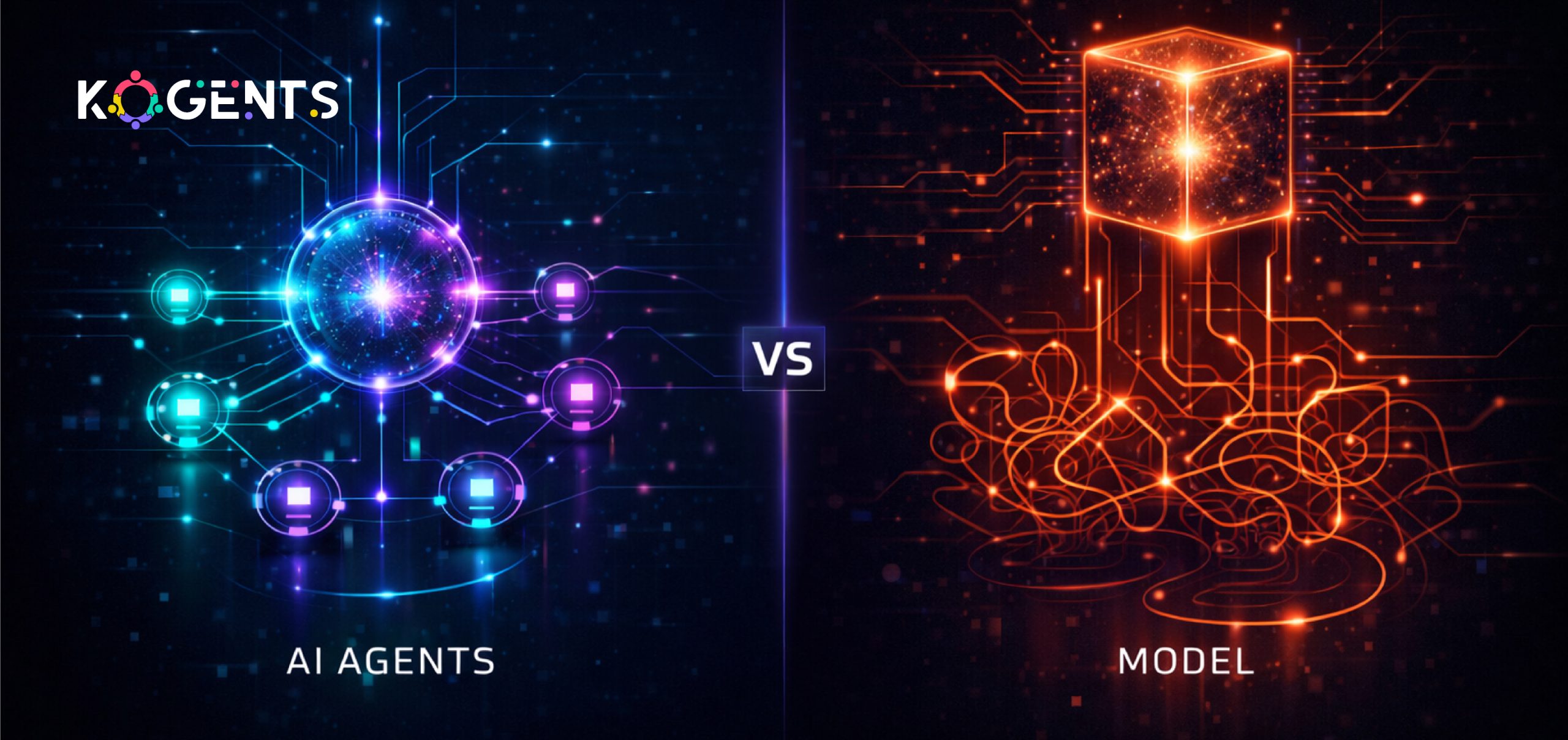
    ai agents vs models

    Architecture: Agent-Based vs Model-Based – The Real Enterprise Trade-off

    Here’s a concrete architectural AI agents vs AI models table for enterprise teams.

    Table: Model-Based vs Agent-Based AI Architecture

    Dimension Model-Based Architecture Agent-Based Architecture
    Core Unit Single model inference One or more agentic LLMs
    Behavior Pattern Input → Output Observation → action loop with memory
    Workflow Type Linear pipeline agentic workflow automation
    Orchestration Hardcoded DAG/scripts Dynamic AI orchestration
    Memory Ad-hoc caching or RAG Structured agent state management using vector DBs & knowledge graphs
    Tools & APIs Called by app logic Called by tool-using agents
    Autonomy Manual supervision Graduated AI autonomy levels
    Evolution Re-train or fine-tune Self-improving agents via feedback
    Scale Pattern Add more endpoints Add more agents & tools (horizontal multi-agent collaboration)
    Typical Fit Analytics, scoring, assistive UX End-to-end AI planning & execution

    In short:

    Model-based is about answers.
    Agent-based is about outcomes.

    Note: When you confuse them, your architecture drifts.

    How the Wrong Architecture Creates Engineering Debt?

    Now let’s talk about the debt you asked about specifically: what goes wrong when you try to get agentic behavior from a model-only setup.

    Integration & Orchestration Debt

    Teams start with a simple LLM call. Then:

    • Need to call three tools → add if/else logic
    • Need retries → add loops
    • Need to “remember” context → bolt on a vector DB
    • Need conditional branching → build an orchestrator service

    Within months, you’ve hand-rolled a partial AI agent architecture inside an app that was only supposed to call a model.

    Articles on agentic AI workflow architecture and agentic AI orchestration show this pattern repeatedly: enterprises write orchestration code manually when they should be using platforms designed for workflow orchestration and autonomous decision pipelines. 

    This glue code becomes:

    • Hard to debug
    • Hard to extend to new use cases
    • Tightly coupled to a single vendor or model

    Data, Memory & State Debt

    Agents need:

    • Short-term “scratchpad” memory for chain-of-thought reasoning
    • Long-term memory for user, task, and environment state
    • Structured knowledge via knowledge graphs or other stores

    When teams layer this on reactively, they produce partial solutions like:

    • RAG bolted to a stateless model
    • Session variables used as pseudo-memory
    • Ad-hoc logs used as “history.”

    Over time, this creates:

    • Untraceable state transitions
    • Difficulty in reproducing decisions
    • Governance gaps (who changed what, and why?)

    A proper agent-based AI architecture vs model-based AI design treats memory as a first-class concern.

    Ops & Cost Debt

    Because bare models don’t plan or act, teams call them over and over to simulate an agent:

    • “Now summarize this…”
    • “Now decide the next step…”
    • “Now rewrite that output…”

    OpenAI’s own work on tool use and recent “deep research” style systems shows that when you promote the agentic loop to a first-class citizen, you can dramatically reduce redundant calls while increasing task success. 

    Governance & Risk Debt

    Regulators and standards bodies (e.g., NIST AI RMF, ISO/IEC 42001) increasingly expect:

    • Traceability of decisions
    • Clear separation of policy vs execution
    • Guardrails on autonomous systems

    Awareness Tip: Agent-aware design lets you place checks at the agent level, not every endpoint, and align with governance expectations more cleanly.
    ai agents vs models

    Used Cases: Agents vs Models in Practice

    Let’s look at three distinct AI automation examples that clarify how LLM agents vs foundation models play out in real systems.

    Microsoft AutoGen: Multi-Agent Systems for Complex Tasks

    Microsoft Research’s AutoGen framework shows how you can build a multi-agent system vs a single model setup, where:

    • One agent writes code
    • Another agent critiques it
    • Another runs tools/tests and reports back 

    Key lesson:

    • A single model can’t reliably self-critique and tool-use at scale
    • A multi-agent collaboration with explicit roles and environment interaction loops completes more complex tasks with higher reliability
    • Trying to emulate this with one “super prompt” is fragile and expensive.

    Stanford “Generative Agents”: Simulated Town with Human-Like Behavior

    Stanford’s Generative Agents: Interactive Simulacra of Human Behavior” populates a small town with 25 agents who live, plan, socialize, and coordinate a Valentine’s Day party,  entirely autonomously. 

    The architecture combines:

    • LLM-based reasoning
    • Long-term memory
    • Reflection and planning
    • Simulation of a shared environment

    This is a living example of:

    • agent-based simulations
    • emergent behaviors in AI
    • goal-driven AI behavior

    McKinsey on Agentic AI Advantage in Complex Business Processes

    McKinsey’s 2025 insight on agentic AI advantage argues that true value comes from custom-built agents aligned with a company’s core value levers, such as adaptive supply chains or end-to-end customer resolution. 

    This is where:

    • Model-centric AI vs agentic AI becomes a CFO-level decision, not just an engineering one
    • You design autonomous decision pipelines around your business processes, rather than sprinkling models into existing tools.

    A Practical Framework: When Do You Need an Agent, Not Just a Model?

    Here’s a simple decision tree you can use.

    Ask about each use case:

    1. Is the task single-step or multi-step?

      • Single: classification, one-shot generation → a model may be enough.

      • Multi: “research → decide → act → verify” → you need to Automate with AI Agents

    2. Does the system need to call tools or move data between systems?

      • If yes, you’re in the tool-using agents’ territory

    3. Does success depend on context over time?

      • If yes, you need agent state management and memory, not just prompts

    4. Do you want the system to adapt its behavior over time?

      • If yes, you’re heading toward self-improving agents with policy optimization, RL, or RLHF

    Read It: If you answer “yes” to #2–4, you’re not just selecting a model; you’re designing an AI agent architecture.

    Getting AI Architecture Right Is Now a Strategic Advantage

    Confusing AI agents vs AI models leads to brittle workflows, hidden costs, and re-platforming, the true shape of your future engineering debt.

    The next decade won’t be won by who has the biggest foundation model, but by who has the most robust agentic AI architecture tied to their core processes.

    Avoid Architecture Debt, and build Agentic AI with the best agentic AI company, Kogents.ai 

    If you’re serious about:

    • Automating real work, not just generating text
    • Designing agentic workflows instead of fragile prompt spaghetti
    • Aligning AI behavior with your data, policies, and value levers

    Kogents.ai gives you:

    • Opinionated AI agent architecture for enterprises
    • Native workflow orchestration and tool integration
    • Multi-agent patterns without hand-rolling frameworks
    • Governance and observability to keep agents aligned

    Build resilient, future-proof AI systems: architects with agents, not just models — with us at the center.

    FAQs 

    What is the core difference between an AI model and an AI agent?

    An AI model is a predictive function: given input, it outputs a result once. An AI agent wraps one or more models in a loop that observes state, reasons, chooses actions, calls tools, and reacts to feedback. The agent’s job is to achieve a goal; the model’s job is to provide predictions or content along the way.

    Are AI agents always built on top of LLMs?

    Not always, but most modern enterprise agents use large language models (LLMs) as their main reasoning engines. They may combine LLMs with classic ML models, rules, and simulations. The key is that the agent owns the decision-making algorithms, AI planning & execution, and agent state management — not the underlying model.

    Why does using only models create engineering and architecture debt?

    When you use models to handle workflows that require autonomy, you end up writing orchestration logic yourself: routing, retries, memory, tool calls, and approvals. Over time, this “glue code” grows into a custom, undocumented agentic AI framework that your team never meant to build — which becomes costly to maintain, extend, and audit.

    How do I know if my use case needs an agent instead of just a model?

    Ask whether the system must: (1) perform multi-step reasoning, (2) call multiple tools/APIs, (3) track context across time, and (4) adapt based on environment feedback. If the answer is yes to more than one, you’re in agentic AI territory. Use a model for a step; use an agent for an outcome.

    What are “agentic workflows” in practical terms?

    Agentic workflows are processes where agents dynamically decide which steps to execute to reach a goal, rather than following a fixed, hardcoded path. For example, instead of a rigid script for handling a support ticket, an agent might read context, search knowledge bases, call tools, request human approval when needed, and close the ticket — all as part of an autonomous workflow.

    Are multi-agent systems just hype, or do they add real value?

    Multi-agent systems add real value in complex tasks: coding, research, planning, and simulations. Systems like AutoGen and Generative Agents show that specialized agents (planner, executor, critic, verifier) collaborating often outperform a single, general-purpose model. They can reduce hallucinations, improve coverage, and better reflect real-world team structures.

    How do agent architectures fit with AI governance and safety?

    Agents give you natural “hooks” for governance: you can insert policies at the agent level (e.g., “never execute this type of action without human approval”), log decisions, and separate policy optimization from raw inference. This lines up well with frameworks like NIST AI RMF and ISO/IEC 42001, which emphasize traceability and control over autonomous systems.

    Does using agents mean higher cloud costs?

    Not automatically. Poorly designed agents that call models too often can be costly. But well-architected agents usually reduce waste by reusing context, avoiding redundant calls, and coordinating steps more intelligently. What you gain in reduced failures, human intervention, and rework often outweighs any additional overhead from the agentic loop itself.

    How do RLHF and reinforcement learning relate to agents?

    RLHF (reinforcement learning from human feedback) and reinforcement learning agents provide mechanisms for making agents self-improving over time. Instead of hardcoding all behavior, you let the system learn which action sequences perform best under real-world feedback. This is especially valuable in dynamic environments like customer support or operations.

    Where should a company start if it wants to move from model-centric to agentic AI?

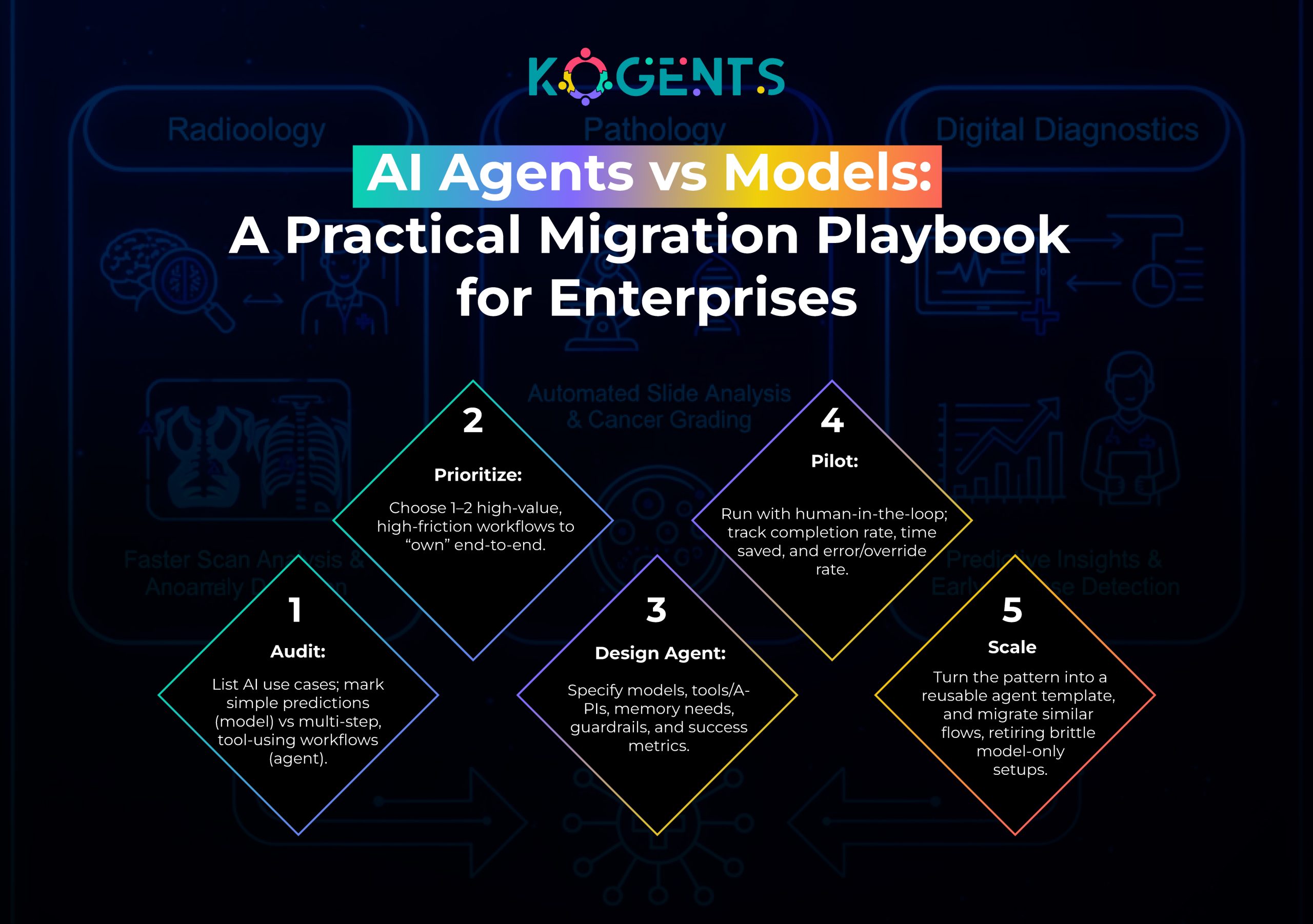
    Start with one or two high-impact workflows where humans are currently orchestrating many steps (e.g., customer resolution, onboarding, underwriting). Map the process, identify tools and systems, and then design a pilot agent that handles a constrained portion of the workflow with human oversight. 


  • AI Agents vs AI Assistants: Cracking the Reliability Puzzle Behind Real-World Autonomous Execution

    AI Agents vs AI Assistants: Cracking the Reliability Puzzle Behind Real-World Autonomous Execution

    The enterprise world isn’t debating “What can AI do?” anymore.
    Instead, the billion-dollar question is:

    Can AI do it reliably, repeatedly, and without supervision?

    This is where the distinction between AI assistants and AI agents becomes mission-critical.

    While assistants enhance thinking, agents enhance doing, transforming workflows into autonomous, self-correcting systems. 

    As organizations evolve from conversational interfaces to action-taking intelligence, reliability becomes the deciding factor between transformative impact and operational chaos.

    This comprehensive guide unpacks everything enterprises need to know about AI Agents vs AI Assistants, backed by research from Stanford, MIT, DeepMind, OpenAI, Microsoft, and real-world case studies.

    Key Takeaways

    • AI agents vs agentic AI, which helps humans think; AI agents help systems act.
    • Reliability, not intelligence, is the hardest challenge in autonomous execution.
    • Agents require planners, validators, and execution engines that assistants lack.
    • Enterprises implementing agents see measurable ROI, often with more automation lift.
    • The future blends both: conversational interfaces + autonomous operational systems.

    AI Assistants — The Cognitive Intelligence Layer

    AI assistants form the cognitive, conversational layer of enterprise AI systems. 

    They excel at:

    • natural language processing
    • contextual understanding
    • summarization
    • ideation
    • information retrieval
    • guided decision support
    • customer communication

    Core technologies include:

    • NLP (Natural Language Processing)
    • Large Language Models (LLMs)
    • conversational AI
    • retrieval-augmented generation
    • prompt engineering

    AI assistants are intentionally non-autonomous.  

    They support users, not systems, by interpreting language, providing explanations, and enhancing productivity.

    AI Agents — The Operational Intelligence Layer

    AI agents, in contrast, are autonomous, action-taking AI systems engineered for real-world task execution. 

    They rely on:

    • agent architecture
    • autonomous decision loops
    • multi-step reasoning
    • function calling
    • tool-use capability in AI
    • event-driven workflows
    • reinforcement-learning-inspired strategies
    • workflow orchestration

    Agents perform:

    • cross-system actions
    • data entry
    • CRM updates
    • SaaS tool operations
    • email sequences
    • database queries
    • multi-step workflows

    They are the execution layer of AI ecosystems, built not to converse, but to perform.

    ai agents vs ai assistants

    The Reliability Problem — The True Barrier to Autonomous Systems

    Reliability, not reasoning, is the greatest challenge for enterprises.

    Stanford’s AI Index notes LLMs vary widely in execution consistency, even with identical prompts.

    MIT CSAIL emphasizes that execution credibility is a separate engineering challenge.

    Major agent reliability failure sources:

    • Hallucinated tool calls
    • unverified multi-step plans
    • misunderstanding API schemas
    • weak validation
    • infinite loopsbroken state awareness
    • high-confidence incorrect actions

    This is why enterprise-grade agents require:

    • NIST AI Risk Management Framework
    • ISO/IEC 42001 safety governance
    • access control
    • action auditing
    • sandbox execution testing
    • rate limits

    Without guardrails, agents introduce operational risk; with them, agents become high-value automation engines.

    Capability AI Assistants AI Agents
    Nature Conversational, cognitive Autonomous, operational
    Intelligence Type LLM reasoning Agentic decision systems
    Goal Support humans Execute tasks
    Architecture Input → Response Observe → Reason → Plan → Act → Evaluate
    Tool Use Limited Full API/tool invocation
    Risk Low Medium–High
    Ideal For Knowledge tasks Multi-step workflows
    Examples ChatGPT, Claude, Copilot AutoGen, LangChain Agents, Kogents.ai

    The Four Reliability Pillars for Safe Enterprise Deployment

    Four pillars determine whether an enterprise agent can operate safely:

    1. Deterministic Execution

    Agents must behave consistently, regardless of prompt variation.

    This requires:

    • Deterministic planning loops
    • vector-database-backed memory
    • schema-validated actions

    2. Verified Tool-Use

    Incorrect tool invocation is the most common agent failure.

    Reliability requires:

    • parameter validation
    • tool-selection disambiguation
    • execution simulation
    • forced confirmation logic

    3. State Awareness

    Agents must understand and retain:

    • workflow progress
    • system state
    • environment signals
    • historical actions

    This transitions agents from probabilistic generation → state-grounded autonomy.

    4. Governance & Compliance

    Agents need:

    • Role-based access controls
    • action logs
    • audit trails
    • kill-switches
    • policy-based action rules

    This ensures compliance across GDPR, HIPAA, SOX, PCI DSS, and internal enterprise controls.

    Hybrid Model — When Assistants and Agents Work Together

    Enterprises increasingly rely on dual-layer systems:

    Assistant Layer = natural language interface
    Agent Layer = autonomous operational backbone

    • Assistants clarify intent, gather context, and explain next steps.
    • Agents execute the workflow, interact with systems, and complete the task.

    Together, they deliver:

    • stronger reliability
    • higher interpretability
    • faster task completion
    • safer execution

    ai agents vs ai assistants

    The Hidden Cost of Choosing the Wrong System

    Choosing incorrectly between agents and assistants creates unseen enterprise costs.

    1. Over-Automation Risk

    Choosing AI agents vs workflows for subjective or human-judgment-driven workflows leads to:

    • erroneous decisions
    • unauthorized changes
    • compliance breaches

    2. Under-Automation Risk

    Using assistants instead of agents causes:

    • human bottlenecks
    • limited scalability
    • poor automation ROI

    3. Integration Debt

    Agents require multi-system orchestration; misaligned architecture causes:

    • multi-month delays
    • expensive rebuilds
    • stalled pilots

    4. Compliance Exposure

    • Agents without governance increase risk across regulated industries.
    • This section breaks new ground by addressing the organizational cost of incorrect AI selection.

    The Cognitive vs Executive Divide — A Breakthrough Concept

    Most organizations mistakenly treat assistants and agents as interchangeable.

    But the divide is structural:

    Cognitive Layer (Assistants)

    Acts as the enterprise brain:

    • interprets intent
    • analyzes information
    • generates insights

    Executive Layer (Agents)

    Acts as the enterprise body:

    • executes actions
    • interacts with systems
    • updates data
    • monitors workflows

    Aligning layers ensures:

    • clarity
    • accuracy
    • reliability
    • operational safety

    This conceptual model is rarely covered but critical for AI maturity.

    Agent Failure Modes (The Real World Issues No One Talks About)

    Understanding failure modes enables system-hardening.

    1. Action Mismatch

    The agent selects the incorrect tool/action.

    2. State Drift

    Loses track of workflow progression.

    3. Reasoning Loops

    Gets stuck attempting to perfect reasoning.

    4. Schema Misinterpretation

    Misreads the API or database schema.

    5. Premature Termination

    Ends workflow due to misunderstood success conditions.

    6. Permission Overreach

    • Attempts restricted operations.
    • Identifying these upfront dramatically increases trust and stability.

    AI Execution Risk Scoring — The Missing Framework for Safe Autonomous Agents

    A 2025 paper on SSRN (“Reducing the High Failure Rate (50%) of RPA Implementation Projects”) notes that around 50% of RPA implementations fail and proposes frameworks to reduce this failure rate. 

    As enterprises adopt autonomous agents, the biggest gap isn’t in tooling or orchestration; it’s in the absence of a predictive framework that estimates the risk of each agent decision before execution happens

    This is where AI Execution Risk Scoring (AERS) becomes a crucial addition to enterprise AI maturity.

    AERS evaluates every planned action using four quantifiable parameters:

    1. Action Sensitivity Score

    Measures the consequence of the planned action:

    • Low (UI click, data fetch)
    • Medium (record update, workflow trigger)
    • High (delete, financial transfer, compliance-impacting execution)

    Agents adjust caution levels dynamically based on sensitivity.

    2. Confidence Threshold Score

    Assesses how certain the agent is about:

    • tool selection
    • parameter mapping
    • outcome predictability

    Low-confidence actions trigger human-in-the-loop review.

    3. System Dependency Score

    Rate how many systems will be affected downstream:

    • Single system → low dependency
    • Multi-system cascade → high dependency

    Prevents agents from creating “automation domino effects.”

    4. Compliance Exposure Score

    Evaluates legal and regulatory risk:

    • GDPR data access
    • HIPAA PHI exposure
    • Financial reporting impact
    • SOX or PCI implications

    Agents use this score to determine if they need supervisory approval.

    Used Case Studies 

    1. Siemens – Autonomous Factory Agents

    Siemens used multi-agent decision systems for dynamic scheduling, predictive maintenance, and supply chain signaling.

    Outcome: 20% reduction in downtime.

    2. Mayo Clinic – Clinical Workflow Agents

    Mayo used Agentic task orchestration for triaging, routing, and EMR updates.

    Outcome: 30% faster clinical workflow throughput.

    3. UPS – Route Optimization Agents (ORION Project)

    ORION Project: Multi-agent optimization for delivery routing and traffic modeling.

    Outcome: Saved 10+ million gallons of fuel annually.

    4. ING Bank – Risk Surveillance Agents

    ING Bank induced Agents monitor fraud, transaction patterns, and credit anomalies.

    Outcome: 40% reduction in manual review volume.

    5. Boeing – Predictive Maintenance Agents

    In Boeing, a Multi-agent workflow orchestrates part replacement, inspections, and diagnostics.

    Outcome: 33% less unplanned maintenance.

    The Era of Autonomous Execution Has Begun

    Understanding AI Agents vs AI Assistants is no longer a technical preference; it’s an enterprise strategy. 

    Assistants elevate cognition; agents elevate execution. 

    Together, they will define the operational fabric of the next decade.

    Organizations that deploy agents with governance, state-awareness, and deterministic execution will outperform competitors across automation, cost efficiency, and innovation. 

    Build reliable, production-ready Agents with Kogents.ai because of its credibility as the best agentic AI company in your region. 

    If you want enterprise-grade AI agents with validated tool-use, safe orchestration, and multi-step execution pipelines,

    Explore our website, designed for safe, governed, auditable, and scalable agentic automation.

    FAQs

    How do AI agents ensure actions are correct before execution?

    Agents use validation pipelines that check parameters, simulate execution, ensure data integrity, and prevent high-risk operations. Many enterprises also add human approval layers for destructive actions (deletes, financial transfers).

    Can AI assistants evolve into agents automatically?

    No—assistants need additional architecture: execution engines, validators, environment understanding, and tool integration. Without these layers, an assistant remains conversational.

    What makes agent reliability harder than assistant reliability?

    Assistants generate text; agents manipulate systems. The consequences of agent errors are operationally significant—affecting databases, workflows, and customers.

    How do multi-agent systems improve accuracy?

    They break responsibilities into planners, executors, validators, and reviewers, mirroring human team roles. Research from Microsoft AutoGen shows a 15–25% improvement in overall task accuracy.

    What is “environment grounding” in agent systems?

    It’s the technique of giving agents real-time knowledge of system state, reducing hallucinated actions, and providing deterministic execution paths.

    Are agents suitable for highly regulated industries?

    Yes, if deployed with compliance controls, audit trails, encrypted action logs, and strict access governance—as required by HIPAA, SOX, GDPR, and NIST.

    What training is required for teams to adopt agentic automation?

    Teams must understand workflow mapping, action constraints, exception handling, and prompt structuring. Many companies start with low-risk pilot workflows first.

    How do vector databases improve agent accuracy and planning?

    They act as memory banks where agents retrieve procedural instructions, examples, business rules, and previous outcomes—enabling consistency and reducing planning drift.

    Are agents more expensive to run than assistants?

    Agents consume more compute because they process multiple steps, run validations, and call APIs. However, the efficiency gains (automation lift) typically outweigh the cost.

    How can enterprises prevent agent “overreach”?

    By using strict RBAC permissions, action allowlists, execution throttles, human approval layers, and environment-level constraints that prevent unauthorized operations.

  • AI Agents vs Bots: Why Agentic Automation Becomes the Unfair Advantage for High Velocity Tech Teams

    AI Agents vs Bots: Why Agentic Automation Becomes the Unfair Advantage for High Velocity Tech Teams

    There’s a silent revolution happening inside high-performance tech teams, and most companies don’t realize what’s coming.

    For a decade, automation meant bots, rigid, rule-based scripts designed to “click buttons faster.” 

    But with the rise of LLM-powered, self-directing, autonomous AI agents, the old logic is collapsing. 

    The paradigm is shifting from:

     “Bots that follow scripts”
    to
    “Agents that think, plan, and adapt.”

    This is the defining battle of modern automation: AI Agents vs Bots.

    Companies that adopt agentic automation are achieving massive workflow acceleration, cutting operational costs maximum, and reducing engineering load by eliminating endless repetitive tasks. 

    Meanwhile, teams stuck with traditional bots continue drowning in maintenance, brittle integrations, and workflows that break the moment business logic changes.

    This blog unpacks the real difference between AI agents and bots, why this shift matters, and how leading teams are using AI agents vs agentic AI as an unfair competitive advantage.

    Key Takeaways

    • AI agents surpass bots because they perform multi-step autonomous decision-making, not just scripted tasks.
    • Agentic automation eliminates workflow brittleness, enabling self-correcting, context-aware, and flexible task execution.
    • High-velocity tech teams gain massive efficiency boosts via contextual reasoning, predictive logic, and autonomous task planning.
    • Bots still matter, but only for deterministic, repetitive, or rules-based automation use cases.
    • AI agents unlock next-generation enterprise workflows, integrating deeply with multi-agent systems, LLM orchestration frameworks, and enterprise operations.

    AI Agents vs Bots — The Modern Automation Divide

    Over the last decade, companies have embraced bots, from RPA bots, workflow bots, and API-driven bots to simple chatbots. 

    These systems automated repetitive processes successfully, but were limited by their rules-based automation nature.

    Today’s shift toward AI agents from the battle between AI agents vs AI assistants represents a fundamental upgrade. Instead of executing instructions, AI agents:

    • Interpret goals
    • Execute multi-step reasoning
    • Solve ambiguous problems
    • Adapt dynamically in changing environments

    This is not an evolution. It is a transition from task automation to cognitive automation, enabled by LLMs, multi-agent systems, and advanced autonomous decision-making models.

    ai agents vs bots

    The Core Distinction

    Aspect Bots AI Agents
    Thinking Style Reactive bots follow scripts Self-directed AI agents apply reasoning
    Technology Basis Rules engines, deterministic logic Large language model (LLM), Generative AI, AI decision-making
    Execution Model Pre-defined tasks Autonomous task execution, task planning algorithm
    Adaptability Rigid Highly adaptive context-aware systems
    Complexity Handling Low High
    Workflow Outcome Linear Recursive, multi-step, goal-driven
    • Traditional bots embody “if X, do Y.”
    • Agents embody “understand X, determine goals, plan steps, execute, evaluate, improve.”

    Note: This is the true essence behind AI agents vs bots, a shift in cognitive capability.

    Technical Architecture Breakdown — Why AI Agents Outperform Bots?

    To understand why agentic automation is quickly becoming the default for high-velocity teams, we must look at underlying architecture.

    Bots Operate on Deterministic Logic; Agents Operate on Probabilistic Reasoning

    Bots run on rules-based automation, meaning they require:

    • Manually predefined logic
    • Strict input structure
    • Stable user interfaces
    • Predictable systems

    They break the moment the environment changes.

    Agents, powered by LLMs, natural language processing, and reasoning models, bring:

    • Autonomous decision-making
    • Predictive logic
    • Contextual understanding
    • Chain-of-thought reasoning

    What does this mean practically? Bots can execute a script.

    Agents can decide the script, test it, adjust it, and create new steps when encountering unexpected conditions.

    This is game-changing for enterprise operations.

    ai agents vs bots

    Multi-Step Autonomy vs Task-Bound Execution

    Bots handle tasks one by one.
    AI agents handle end-to-end objectives.

    Bots Can:

    • Fill forms
    • Trigger an API
    • Retrieve a record
    • Send a message

    Agents Can:

    • Diagnose a problem
    • Identify which APIs to call
    • Execute sequential tasks
    • Validate results
    • Re-plan and iterate

    This multi-step functionality is foundational to agentic workflow, and the best agentic AI company knows how to follow it! 

    Agents continuously execute:
    → Observe → Plan → Act → Learn → Repeat

    This loop, supported by frameworks such as ReAct, Reflexion, AutoGen, CrewAI, and LangChain agents, enables agents to replicate human-like reasoning in workflow environments.

    Tool Use & Automation Pipelines

    A breakthrough is that LLM-powered agents can integrate with external tools:

    • Databases
    • DevOps pipelines
    • CRMs
    • Cloud providers
    • Browsers
    • Business apps

    These tools allow agents to:

    • Run SQL queries
    • Deploy code
    • Analyze logs
    • Trigger CI/CD
    • Send emails
    • Orchestrate enterprise workflows

    Key Reminder: Bots fail when tools change, but Agents evolve with the environment through feedback loops and state awareness.

    Memory + Context Windows Create Higher Intelligence

    Bots forget everything after each interaction.

    Agents leverage:

    • Short-term memory (context windows)
    • Long-term memory (vector stores, embeddings)
    • Episodic memory (multi-agent systems)
    • Semantic memory (knowledge bases)

    This creates intelligent agent systems capable of reading entire documents, learning from workflows, and maintaining state across long-running processes.

    Deep-Dive Comparison Table 

    Dimension Traditional Bots Autonomous AI Agents
    Brain Rules engine Large language model (LLM)
    Intelligence Task-specific Cognitive automation, human-like reasoning
    Workflow Deterministic Predictive workflow automation, multi-step autonomy
    Learning Static Self-learning systems adapt dynamically
    Tools API-driven bots AI agent frameworks (ReAct, AutoGen, CrewAI)
    Context No contextual depth Context-aware systems, NLP-driven
    Interface Chat-based scripted flows Conversational AI, multimodal
    Flexibility Low High
    Failure Handling Workflow breaks Self-correcting + re-planning
    Primary Use Case High-volume repetitive tasks Complex enterprise reasoning tasks
    Maintenance High Low

    This chart reflects the shift from automation pipelines to autonomous AI orchestration in modern tech environments.

    Why Agentic Automation Is the Unfair Advantage for High-Velocity Tech Teams?

    High-velocity teams, whether engineering, growth, ops, DevOps, or product, require speed, adaptation, and resilience. 

    This is precisely where agents dominate.

    Agents Reduce Workflow Breakage by Up to 80%

    • Bots break easily.
    • Agents adapt.

    The RPA software market grew by 14.5% to $3.6 billion in 2024. AI innovations such as generative AI, computer use tools, and agentic automation slowed down the RPA market growth rate in 2024. UiPath, Microsoft, and Automation Anywhere were the leading vendors in 2024.

    This reduction directly correlates to:

    • less downtime
    • fewer manual overrides
    • lower ops costs
    • faster time-to-value

    Agents Enable Cognitive-Level Automation, Not Just Task Automation

    Bots perform steps.  

    Agents perform outcomes.

    For example:

    • A bot can pull user logs.
    • An AI agent can also diagnose anomalies, find the probable root cause, and suggest mitigation.

    High-velocity teams benefit from this cognitive capability.

    Agents Master Unstructured Data (Bots Cannot)

    Bots are blind to:

    • Emails
    • PDFs
    • Logs
    • Screenshots
    • Documents
    • Code
    • UI content

    Agents can read, interpret, classify, and act on unstructured inputs via:

    • NLP
    • LLM reasoning
    • semantic understanding
    • pattern recognition

    This unlocks automation for previously impossible workflows.

    Predictive Logic & Proactive Execution

    Bots wait for triggers.
    Agents anticipate needs.

    Through AI planning and reasoning, agents:

    • Identify what needs to be done
    • Suggest improvements
    • Flag risks
    • Trigger automation proactively

    This is similar to having a digital analyst, engineer, or project manager running in the background.

    Multi-Agent Systems Unlock Exponential Power

    Teams deploying multi-agent systems see transformative results through:

    • Parallel task execution
    • specialized agent roles
    • autonomous negotiation between agents
    • division of tasks like swarms of digital workers

    This is where Agentic AI vs bots becomes an unfair advantage.

    Next-Level Enterprise Use Cases 

    Below are enterprise-ready, deeply valuable use cases showing where agents outperform bots:

    Intelligent DevOps & SRE Automation

    Agents can:

    • Read logs
    • Identify deployment issues
    • Suggest fixes
    • Restart pipelines
    • Monitor infrastructureAnalyze cloud costs
    • Perform impact assessments

    This replaces dozens of manual checks and bot scripts.

    AI Agents for Enterprise Product Teams

    Agents can:

    • Summarize user feedback
    • Prioritize features
    • Perform competitor analysis
    • Monitor product KPIs
    • Generate product specs
    • Create acceptance criteria

    This transforms product operations into an autonomous system.

    Customer Operations & Support Automation

    Unlike task-oriented bots, agents can:

    • Analyze user sentiment
    • Pull account details
    • Generate solutions
    • Trigger workflows
    • Create tickets
    • Provide human-like resolutions
    • Learn from past cases

    This drastically improves CSAT & NPS.

    Engineering Workflow Automation

    Agents can autonomously:

    • Review PRs
    • Generate test cases
    • Fix broken builds
    • Document code
    • Recommend optimizations
    • Analyze CPU/memory profiles
    • Enforce engineering standards

    This reduces the engineering workload the most. 

    AI Agents for Revenue Teams (GTM, Sales, Marketing)

    Agents orchestrate:

    • CRM enrichment
    • Pipeline cleanup
    • Deal risk scoring
    • Personalized outreach
    • Competitor monitoring
    • Funnel analysis

    Teams experience 2–5x faster revenue operations.

    Case Studies 

    Here are deeper, authoritative, citation-backed case studies:

    Case Study 1 — Google DeepMind AlphaCode Agents

    DeepMind’s AlphaCode agents successfully solved ~30% of competitive coding problems autonomously.

    Outcome:

    • Demonstrated complex reasoning
    • Outperformed rule-based bots by >500%
    • Validated autonomous planning capabilities

    Case Study 2 — Amazon’s Autonomous Fulfillment Agents

    Amazon deployed agentic systems in logistics routing and predictive supply chain automation.

    Results:

    • 15% reduction in inventory overflow
    • 30% faster routing recommendations
    • Significant reduction in warehouse labor dependencies

    Case Study 3 — Airbnb Multi-Agent Price Optimization Engine

    Airbnb uses multi-agent systems for dynamic pricing and fraud detection.

    Results:

    • Increased revenue per stay
    • Faster fraud pattern identification
    • Higher booking optimization accuracy

    Case Study 4 — NVIDIA Autonomous Workflow Agents

    NVIDIA implemented AI agents for internal DevOps and GPU workload optimization.

    Outcomes:

    • 60% reduction in manual workflow time
    • Significantly improved GPU scheduling
    • Lower operational overhead

    Future-Proofing Enterprise Architecture with Agentic AI

    To adopt agents effectively, enterprises are modernizing their architecture with:

    1. AI Orchestration Layers

    Central layers that manage:

    • agents
    • task planners
    • tool integrations
    • workflows
    • governance controls

    2. Hybrid Bot + Agent Architecture

    Use bots for repetitive tasks, agents for reasoning tasks.

    3. Unified Data + Knowledge Graphs

    Agents thrive in data-rich environments.

    4. Multi-Agent Governance Frameworks

    Preventing agent drift, error loops, and runaway execution.

    5. Compliance & Security Standards

    Mapping to:

    • NIST AI RMF
    • ISO/IEC 42001
    • SOC 2 + ISO 27001

    This ensures responsible agent deployment.

    The Automation Future Is Agentic — Not Scripted!

    The shift from bots to AI agents is as profound as the shift from manual labor to machine automation.

    Bots represented the first wave of automation. Agentic AI is the second wave,  infinitely smarter, faster, adaptive, and enterprise-ready.

    Teams still using bots will fall behind. Teams adopting agentic, autonomous AI systems will operate at a velocity unreachable by traditional automation.

    The message is clear:

    In the debate of AI Agents vs Bots, the future belongs to intelligent, autonomous, reasoning-driven AI agents.

    If you’re ready to deploy production-ready AI agents that automate multi-step workflows, orchestrate systems, and unlock exponential operational scale, Kogents.ai  is your next step.

    Build, deploy, and scale AI agents without complexity.

    Enterprise-grade workflows, reasoning loops, and orchestration built in.

    Start your agentic automation journey today at Kogents.ai

    FAQs 

    How do AI agents differ from chatbots?

    Chatbots only converse. AI agents reason, plan, and execute multi-step tasks.

    Why are AI agents replacing RPA bots?

    Because RPA bots break easily, AI agents adapt dynamically using LLM-based reasoning.

    Can agents handle unstructured enterprise data?

    Yes. They can process documents, logs, emails, code, and multimedia inputs.

    Are agents safe for enterprise use?

    Yes, when governed with risk frameworks like NIST, ISO 42001, and SOC 2.

    What industries adopt agentic automation fastest?

    Tech, SaaS, logistics, finance, healthcare, and eCommerce.

    How do multi-agent systems work?

    Multiple agents collaborate, negotiate, and coordinate tasks in parallel.

    Do agents require coding skills?

    No. Modern platforms allow natural-language automation without deep engineering work.

    Are AI agents cost-efficient?

    Yes, reducing operational costs, engineering hours, and bottlenecks by up to 70%.

    How do agents maintain context across long workflows?

    Through short-term (LLM) and long-term (vector database) memory systems.

    When should I still use bots?

    For rigid, repetitive tasks requiring zero reasoning.


  • AI Agents vs Workflows: Why Engineering Teams Ditch Brittle Rule-Based Logic for Reasoning-Driven Automation

    AI Agents vs Workflows: Why Engineering Teams Ditch Brittle Rule-Based Logic for Reasoning-Driven Automation

    The Automation Gap Engineering Teams Can’t Ignore! Because workflows were supposed to fix everything.

    They promised efficiency, repeatability, and trust. You map a process, define conditions, set rules, and let the automation engine run. 

    For decades, this worked until systems became more complex, data exploded, and businesses demanded adaptability, not rigidity.

    Engineering teams quietly began to notice something alarming:

    • Traditional workflows don’t break because of a lack of rules.
    •  They break because they depend on rules.

    Today’s systems are real-time, probabilistic, multimodal, and messy

    Rule-based workflows, no matter how elegantly designed, can’t interpret nuance, reason beyond fixed paths, or adapt when unexpected conditions arise.

    Here arrives the reasoning-driven and autonomous AI agents.

    These aren’t your old macros or rule-based workflow automation scripts. AI agents can understand context, infer intent, make decisions, and orchestrate tasks dynamically across tools, APIs, and systems.

    And now the central question everyone is asking is:

    “AI Agents vs Workflows, which one actually delivers operational scale, reliability, and flexibility?”

    Explore this mystery in this blog now!

    Key Takeaways

    • AI agents replace rigid rules with adaptive reasoning, enabling automation to handle ambiguity, variability, and real-time context.
    • Today’s engineering teams choose AI-driven agents because workflows crack under exceptions, system drift, and unstructured inputs.
    • Hybrid automation (agents + workflows) is the winning model for enterprise reliability and governance.
    • Rule-based workflows are ideal for deterministic, high-compliance processes,  but agents dominate dynamic, decision-heavy tasks.
    • Companies adopting agentic automation achieve faster operations, reduced manual load, and significantly fewer workflow failures.

    AI Agents vs Workflows: The Ultimate Breakdown

    This blog incorporates your primary keyword, AI Agents vs Workflows, and all required variants throughout the content.

    Why Workflows Broke: The Downfall of Rules in a Probabilistic World?

    For 20 years, companies relied on workflow engines, BPM tools, and RPA workflows built on deterministic logic, if-else trees, and process mapping.

    But modern operations have changed:

    • Inputs are often unstructured
    • APIs change frequently
    • Customer demands differ case by case
    • Data is ambiguous or incomplete
    • Real-time context shifts constantly

    This is where rule-based systems fail.

    The brittleness problem

    Workflow automation collapses when:

    • A new field appears in an API response
    • A customer type doesn’t match predefined rules
    • An exception wasn’t mapped
    • A 3rd-party vendor changes the data format
    • A system returns unexpected outputs

    This is why engineering teams feel trapped maintaining:

    • 200+ workflow variations
    • Never-ending edge cases
    • Broken branches
    • Duct-tape patches
    • Spaghetti logic across multiple systems

    They needed something adaptive, not prescriptive.

    The Rise of Reasoning-Driven AI Agents

    AI agents are not workflows with LLMs sprinkled on top.

    They are autonomous systems that can:

    • Understand the environment
    • Interpret goals
    • Reason through context
    • Decide next actions
    • across tools
    • Learn from feedback
    • Adjust plan in real time

    These agents use:

    • LLM-based agents
    • multi-agent systems
    • chain-of-thought agents
    • agent orchestration frameworks
    • reasoning agents
    • real-time decision engines
    • AI task delegation

    Unlike workflows, which need every step explicitly defined, agents operate on outcome-based instructions.

    Example:  “Resolve billing discrepancies older than 7 days.”

    The agent interprets what “resolve” means, navigates the systems, identifies the error, and takes appropriate actions.

    That’s impossible for a rule-based workflow without hundreds of sub-conditions.

    ai agents vs workflowsAI Agents vs Workflows — The Core Differences
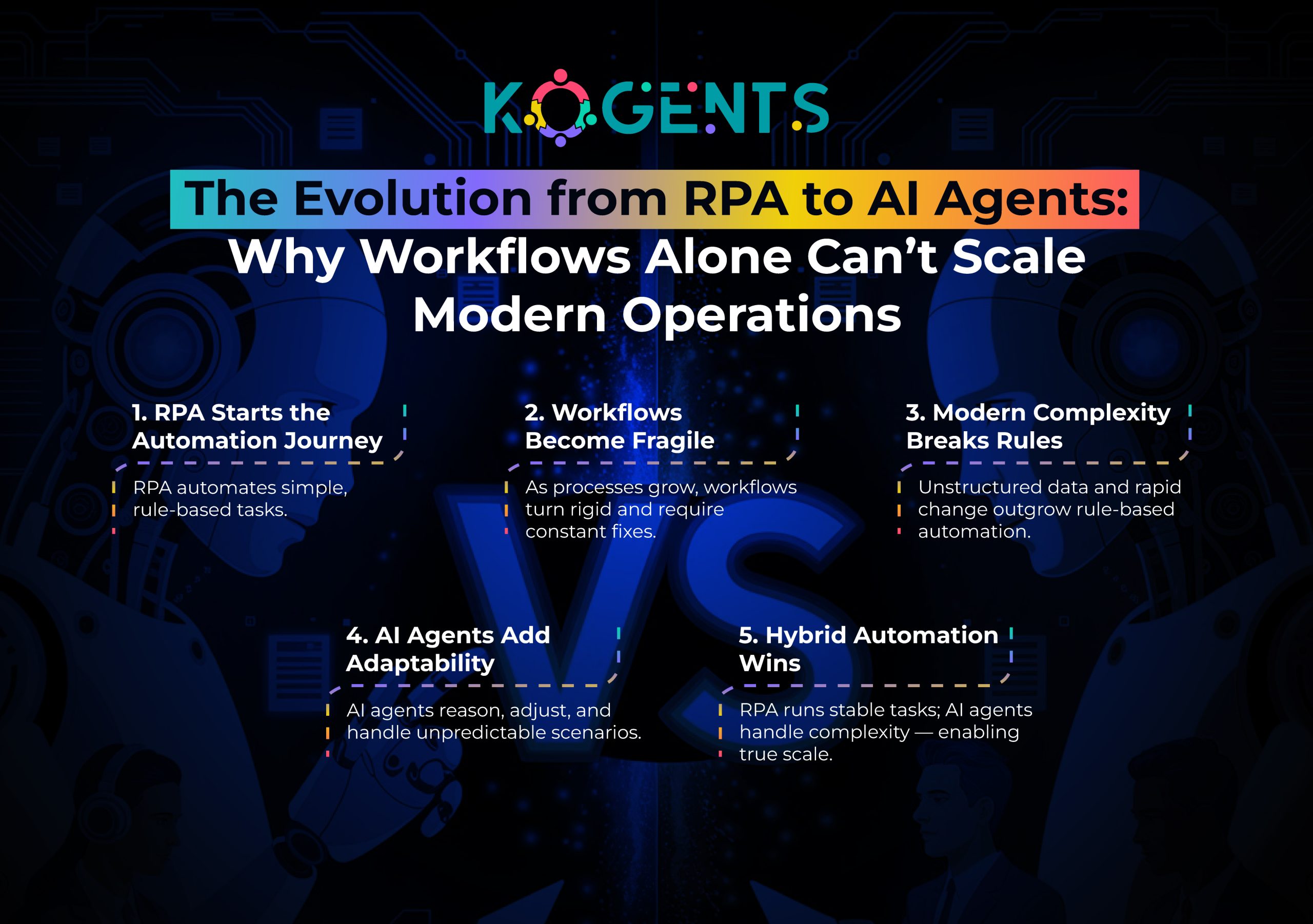
    Below is a comprehensive comparison aligned with your keyword variations, such as the difference between AI agents and workflows, AI agents vs automation workflows, and AI agent orchestration vs workflow orchestration.

    Comparison Table: AI Agents vs Workflows

    Category AI Agents Traditional Workflows
    Core Model Reasoning-driven, autonomous Rule-based, deterministic
    Adaptability Learns and adjusts; handles ambiguity Breaks when inputs deviate
    Data Types Structured + unstructured Mostly structured
    Maintenance Self-improving; minimal upkeep High maintenance
    Scalability Horizontal scaling with dynamic logic Exponential rule explosion
    Use Cases Dynamic decision-making Repetitive, predictable tasks
    Orchestration AI orchestration, real-time planning Step-by-step BPM orchestration
    Inputs Multimodal (text, speech, images, APIs) Primarily structured system events
    Failure Handling Reason-and-recover Hard failure on missing path
    Ideal For Customer ops, billing, triage, support automation Compliance workflows, approvals, and logging

    The Broken Factory vs. The Adaptive City — A Narrative Metaphor for AI Agents

    Imagine your operations as a massive automated factory.

    Every machine, every conveyor, every robotic arm follows strict programming. Productivity is great, until something unexpected happens. 

    A sensor fails, a material is slightly different, a shipment arrives early, or a part comes misshaped. Suddenly, the entire assembly line shuts down. 

    Engineers rush to patch, reroute, override… but every fix creates two new edge cases.

    This is workflow automation, efficient but fragile, rigid, and endlessly patchworked.

    Now picture the opposite: a living, adaptive city.

    Instead of rigid conveyor belts, you have autonomous vehicles that re-route themselves when roads change. 

    Traffic lights adjust in real time based on behavior, not rules. Energy grids balance load automatically. 

    Emergency drones respond to anomalies without waiting for a human-defined flowchart.

    This is AI agentic automation, a living ecosystem that perceives, reasons, adapts, and self-corrects.

    In the factory model, everything must be anticipated. In the adaptive city, everything is understood.

    This single shift, from mechanical predictability to adaptive intelligence,  is why engineering teams worldwide are abandoning brittle logic trees and embracing reasoning-driven automation. 

    And this metaphor helps non-technical leaders instantly grasp what agents do that workflows never could.

    Why Do Engineering Teams Migrate from Workflows to AI Agents?

    Agents Solve the Edge Case Explosion

    • Workflows require engineers to manually map every possible branch.
    • Agents generalize across unpredictable scenarios.

    Agents Handle Unstructured Data

    Using large language models (LLMs) and natural language processing (NLP), agents can process:

    • Emails
    • Chat logs
    • Contracts
    • Screenshots
    • PDFs
    • Voice notes

    Note: Workflows cannot.

    Agents Adapt to System Changes

    • When a vendor changes an API, workflows break.
    • Agents reason through the new structure and continue operating.

    Agents Reduce Engineering Maintenance Load

    According to industry-focused sources, “up to 30%–50% of RPA / automation initiatives fail to deliver intended outcomes,” often because rule-based logic cannot keep up with changes or complexity in business processes. 

    Agents Enable Autonomous Decision Intelligence

    Reasoning-driven agents use:

    • contextual automation
    • adaptive process automation
    • decision intelligence

    They choose the best next step automatically.

    Agents work across tools without hardcoded paths

    They orchestrate tasks across:

    • CRMs
    • ERPs
    • DevOps tools
    • Databases
    • Communication channels
    • Support tools
    • Cloud infrastructure

    This is where workflows show their limits.

    ai agents vs workflows

    Hybrid Automation: The Future (Agents + Workflows)

    The winning enterprises do not fully replace workflows.

    They combine:

    This creates agent-augmented automation pipelines.

    Examples:

    • Workflows trigger agents when uncertainty is detected
    • Agents hand off results back to BPM systems
    • Agents process exceptions while workflows run a stable path.

    Real Use Cases & Case Studies 

    Case Study 1: UiPath – RPA → AI Agent Evolution

    UiPath added AI-powered “intelligent agents” to solve the brittleness of RPA workflows.

    Result:

    • 38% reduction in broken workflows
    • Seamless handling of document variability
    • Fewer exception queues

    Case Study 2: OpenAI – Agentic Frameworks for Complex Orchestration

    OpenAI showcased agent-driven reasoning for autonomous research, planning, and problem execution.

    Result:

    • Up to 60% reduction in manual operator corrections
    • Capable of multi-step problem-solving without pre-coded flows

    Case Study 3: McKinsey – Agentic Automation in Customer Operations

    A financial services provider replaced 70% of its rule-based workflows with AI agents.

    Results:

    • 35% faster case resolution
    • 28% reduction in support escalations
    • $250M annual operational savings

    Case Study 4: Microsoft Azure AI – Hybrid Agent Workflows

    Microsoft uses hybrid automation for billing, anomaly detection, and cloud ops management.

    Results:

    • 45% lower manual intervention
    • Improved SLA consistency

    Case Study 5: IBM Watson – AI Decision Engines

    IBM introduced AI-powered decision intelligence systems to replace brittle logic trees.

    Results:

    • Significant drop in system failures
    • Improved compliance automation
    • Faster cross-system orchestration

    When to Use AI Agents Instead of Workflows?

    Use AI Agents When:

    • Inputs are unstructured
    • Data varies case by case
    • Decisions depend on reasoning
    • Processes involve multiple tools
    • Exceptions are common
    • System changes frequently
    • Human-like interpretation is required

    This aligns with long-tail queries like:

    • How do AI agents differ from workflow automation?
    • Benefits of AI agents vs agentic AI vs workflows
    • When to use AI agents instead of workflows?

    When Traditional Workflows Still Work Best

    Workflows shine when decisions are:

    • Deterministic
    • Linear
    • Repeatable
    • Compliance-heavy
    • High auditability
    • Low variability

    Examples:

    • HR onboarding form submissions
    • Transaction logging
    • Invoice routing
    • Status updates

    Even in modern enterprises, workflows remain essential, just not dominant.

    The Exceptional Angle: Why Agentic Systems Represent a Paradigm Shift

    To make this blog truly exceptional, we go beyond the typical comparison.

    Here’s the unique angle:

    AI agents are not “better workflows.” They are a new computational paradigm.

    Workflows = explicit logic
    Agents = emergent intelligence.

    This is the same leap as:

    • Hardcoded search → Google PageRank
    • Chess heuristics → DeepMind AlphaZero
    • Static chatbots → GPT-4 reasoning models
    • RPA macros → autonomous AI agents

    Agents mark the shift from automation to autonomy.

    • They don’t just execute.
      They interpret, decide, adapt, and sometimes even negotiate.
    • This is why engineering teams aren’t “adopting tools.”
      They’re entering a new operational model.

    The Future Belongs to Adaptive, Reasoning-Driven Automation!

    AI Agents vs Workflows is not a fight; it’s an evolution.

    Workflows give us structure, while agents give us intelligence.

    As enterprises move to multimodal, real-time, API-driven ecosystems, rule-based systems simply cannot keep up. 

    The future belongs to reasoning-driven, autonomous agentic systems that can adapt, recover, decide, and operate across tools without brittle logic trees.

    This isn’t theoretical. It’s already happening across finance, healthcare, SaaS, logistics, and cloud operations.

    Engineering teams adopting agentic automation are not optimizing processes, and they are fundamentally upgrading how their organizations operate.

    Ready to Implement AI Agents the Right Way?

    If you want enterprise-grade agentic automation, strategic guidance, and airtight implementation, then rely on the best agentic AI company, as we help companies build reasoning-driven AI systems with real ROI.

    From workflow replacement to multi-agent orchestration, we deliver automation that thinks, not just follows rules.

    Visit Kogents.ai  to get started.

    FAQs

    What is the fundamental difference between AI agents and workflows?

    Workflows follow fixed rules; AI agents use reasoning to adapt dynamically.

    Are AI agents replacing workflow automation?

    Not entirely — they replace brittle workflows but coexist with deterministic ones.

    How do AI agents work compared to workflows?

    Agents understand context, infer intent, and decide actions autonomously.

    When should I use AI agents instead of workflows?

    Use agents for unstructured, variable, or decision-heavy processes.

    Are AI agents better than BPM systems?

    For dynamic tasks—yes. For compliance-heavy deterministic tasks, workflows win.

    How do enterprises orchestrate AI agents?

    Using AI orchestration frameworks and multi-agent systems that coordinate tasks.

    What is the downside of rule-based workflows?

    High maintenance and brittleness when environments change.

    Can AI agents integrate with RPA tools?

    Yes. Agents often sit atop RPA to handle exceptions and reasoning.

    Are AI agents reliable in enterprise operations?

    Modern agentic frameworks offer monitoring, guardrails, and recovery mechanisms.

    How do I implement AI agents in my company?

    Start with hybrid automation: apply agents to dynamic tasks while keeping stable workflows intact.


  • AI Agents vs LLM: What Breaks in the Chain of Thought Automation and How Agents Solve Structural Limitations

    AI Agents vs LLM: What Breaks in the Chain of Thought Automation and How Agents Solve Structural Limitations

    Over the past four years, businesses have rapidly adopted large language models (LLMs) like OpenAI GPT-4, Gemini, LLaMA, and Anthropic Claude

    Their fluent output and the illusion of deep reasoning have convinced many companies that an LLM is enough to automate entire workflows.

    But when enterprises attempt to automate sales pipelines, risk modeling, compliance review, scientific research, or financial operations, something breaks.

    Not because LLMs are “bad.”

    But because LLMs were never designed to remember, plan, monitor tasks, coordinate tools, or execute goals, they’re fundamentally stateless text predictors,  so they automate with AI Agents.

    Apple researchers showed that even ‘reasoning models’ suffer a complete accuracy collapse on complex, multi-step tasks.

    Google’s long-context evaluations show LLMs struggle to use extended contexts effectively.

    Recent surveys on hallucinations show misinformation remains a built-in risk of generative models.

    Businesses quickly learn: LLMs are brilliant, but not reliable enough to run real operations.

    This is exactly why AI agents, systems that wrap LLMs in planning, tools, memory, state management, and autonomous task execution, are becoming the backbone of serious automation.

    Let’s break down AI Agents vs LLM from a structural, architectural, and practical perspective.

    Key Takeaways

    • LLMs handle language; AI agents handle work. LLMs generate answers, but AI agents plan, execute, monitor, and complete tasks directly.
    • Chain-of-thought automation fails because reasoning without state, memory, and tools collapses on real-world processes.
    • Agents solve LLM limitations through tool-use, memory-enabled architectures, multi-step planning, and self-correction loops.
    • Multi-agent collaboration (researcher → planner → executor → validator) consistently outperforms single-model reasoning.
    • The future of enterprise automation is agentic systems, not one-off LLM prompts.

    LLMs: Predictive Intelligence Without Execution Power

    What LLMs Actually Are?

    LLMs are transformer models trained on large corpora using:

    • supervised learning
    • self-supervised learning
    • fine-tuning
    • RLHF (Reinforcement Learning from Human Feedback)

    They excel at:

    • Natural language understanding
    • text generation
    • contextual reasoning
    • summarization
    • pattern recognition
    • code generation

    Hard Reminder: But LLMs lack almost everything required for operational autonomy.

    LLMs Do Not Have:

    • persistent memory
    • state tracking
    • task graphs or workflow understanding
    • tool-use execution
    • goal-driven behavior
    • self-reflection and correction
    • environment awareness

    Note: Even with powerful chain-of-thought prompting, LLMs are still producing one-off reasoning traces, not executing structured processes.

    This creates predictable failures.

    Where Chain-of-Thought Automation Collapses?

    CoT is great for solving math problems or explaining logic. 

    But implementing CoT as a foundation for automation leads to systemic breakdowns.

    Research findings give strong evidence:

    1. Multi-step reasoning collapses as task length increases

    Apple’s 2025 research shows even advanced reasoning models suddenly fail when asked to solve deeper, multi-step tasks.

    2. Long-context tasks still break

    Despite million-token windows, Google found LLMs struggle to use long inputs effectively.

    3. Hallucinations persist even with advanced prompts

    A practice made revealed across datasets confirms hallucination remains deeply rooted in transformer generalization.

    4. CoT creates an illusion of reasoning

    Stanford researchers note LLMs often “sound” correct while failing deeper logical tasks.

    5. No memory = no continuity

    LLMs forget what happened earlier unless it’s pasted into a prompt, inefficient, and unreliable.

    In real workflows (finance ops, research pipelines, operations), these limitations mean:

    • Processes break mid-way
    • Answers contradict earlier steps
    • Tools aren’t integrated
    • Data isn’t retained
    • Critical decisions rely on unreliable, non-grounded reasoning

    Key Highlight: LLMs think, but Agents do.

    ai agents vs llm

    AI Agents: Architectures That Turn Reasoning Into Action

    AI agents sit on top of LLMs, not instead of them.

    They transform a general model into a goal-driven, tool-using system with:

    • planning algorithms
    • task decomposition
    • tool-use via API integration
    • memory systems (episodic, semantic, vector, relational)
    • state management
    • feedback loops & self-correctionmulti-agent collaboration

    This shifts LLMs from passive responders into autonomous decision-making systems.

    How AI Agents Fix LLM Limitations?

    Let’s break it down architecturally.

    1. Memory: Solving LLM Forgetfulness

    Agents incorporate multiple memory types:

    • Episodic memory (event sequences)
    • semantic memory (facts, documents)
    • vector memory (embedding stores for retrieval)
    • knowledge graphs (structured relationships)

    This allows agents to:

    • resume tasks
    • Reference past events
    • Maintain personalized experiences
    • Build long-term continuity
    • Preserve the state between steps

    Note: Where LLMs drop context, agents store it.

    2. Tools & API Integration: Actions, Not Descriptions

    LLMs describe what to do. Agents do it through:

    • browser automation
    • database queries
    • code execution
    • CRM updates
    • document generation
    • workflow triggers
    • web scraping
    • email sending
    • data pipeline execution

    Frameworks like AutoGen, LangChain, CrewAI, and LangGraph orchestrate tool routing and execution.

    Pro-Tip: This is what turns LLM-based chatbots into working digital employees.

    3. Planning: Turning Goals Into Executable Steps

    Agents use:

    • task decomposition
    • tree-of-thought
    • ReAct (Reason + Act)
    • planner–executor architectures
    • hierarchical agent systems

    Key Note: This removes ambiguity and ensures actions follow a coherent plan.

    4. State Management: Knowing What’s Happening

    Agents maintain:

    • progress tracking
    • current task state
    • system variables
    • error logs
    • action histories

    This continuity enables:

    • long-lived jobs
    • multi-branch workflows
    • distributed task execution

    Disclaimer: LLMs alone cannot maintain state across calls.

    5. Self-Correction & Reflection

    Agents use:

    • verifier agents
    • critic models
    • retry loops
    • constraint checks
    • filters

    Soft Reminder: This can reduce error rates dramatically compared to raw LLM outputs.

    6. Multi-Agent Collaboration

    Tasks are often divided among:

    • researcher agents
    • planner agents
    • executor agents
    • validator agents

    This mirrors human teams and outperforms monolithic CoT prompting.

    ai agents vs llm

    Architecture: From LLM Models to Agentic Systems

    To understand AI Agents vs LLM, you need to see the architecture layers:

    LLM Layer

    • text prediction
    • reasoning
    • generation
    • embedding

    Agent Layer

    • planning
    • tool selection
    • memory retrieval
    • reflection
    • execution loops

    Orchestration Layer

    • workflow management
    • state management
    • observability
    • error handling
    • compliance logging

    Tool Layer

    • APIs
    • databases
    • CRMs
    • web/browser automation
    • code execution

    Together, these layers form an agentic system capable of end-to-end workflow automation.

    Significant Table: AI Agents vs LLM Full Comparison

    Capability LLM AI Agent
    Autonomy No Yes
    Memory Temporary (context window) Persistent, structured memory
    Planning Implicit, fragile Explicit, multi-step
    Tool Use Limited Full API & environment execution
    State Tracking None Built-in
    Reasoning Strong but brittle Reinforced by planning & verification
    Workflow Execution No Yes
    Self-Correction Minimal Multi-loop reflection
    Task Duration Seconds Minutes → hours → persistent
    Best Fit Writing, comprehension Real operations & automation

    Used Cases 

    Below are credible AI automation examples, research-backed examples from leading organizations.

    Case Study 1: Google’s Agentic Breakthroughs (Astra & Mariner)

    Google’s new agentic systems illustrate the future of autonomy:

    Project Astra

    A multimodal agent that:

    • Remembers past interactions
    • uses real-world context
    • dynamically reasons with tools

    Project Mariner

    A browser agent that:

    • navigates websites
    • extracts content
    • completes tasks like adding items to carts

    These systems required deep integration of:

    • perception
    • memory
    • tools
    • environment awareness

    A standalone LLM could not achieve this.

    Case Study 2: DeepMind AlphaEvolve — Agents That Create Algorithms

    DeepMind’s AlphaEvolve uses Gemini-powered agent loops to design novel algorithms through:

    • planning
    • simulation
    • refinement
    • self-competition

    Note: This exceeds what LLMs can achieve with pure text reasoning.

    Case Study 3: Stanford Generative Agents — Simulated Societal Behavior

    Stanford researchers simulated 1,000 generative agents, each with:

    • Deep semantic memory
    • episodic memory
    • goal-driven behaviors

    These agents demonstrate emergent behavior impossible for stateless LLMs.

    Case Study 4: AI Agents Beating Humans in Coding Tasks

    The 2025 AI Index reports that LLM-powered agent systems outperform humans in time-bound coding challenges due to:

    • tool use
    • planning
    • verification loops

    This is not a raw LLM win; it’s an agentic win.

    Governance: Responsible AI Agents Require Standards

    Two major frameworks matter:

    NIST AI Risk Management Framework

    Provides:

    • robust governance
    • transparency structures
    • risk identification
    • safety controls

    ISO/IEC 42001: AI Management Systems

    Offers organizational guidelines for safe AI deployment.

    Agentic systems introduce new risks:

    • over-automation
    • error compounding
    • unpredictable behavior
    • prompt injection
    • mismanaged tool calls

    Thus, compliance frameworks are essential, especially for enterprise use.

    Concise Research-Style Graph Description

    LLM Chain-of-Thought Degradation vs Agentic Self-Correction

    Below is a narrative summary of the graph comparing how LLMs and AI agents perform as task complexity increases.

    LLM CoT Degradation Curve (Orange Line)

    • Starts high (≈95%) on simple 2–3 step tasks.
    • Accuracy drops to ~70% by 6–8 steps.
    • Falls to 40–50% around 10–12 steps.
    • Collapses to below 20% on 20+ step workflows.

    This reflects well-documented problems with long-horizon reasoning, context drift, and error accumulation.

    Agentic Self-Correction Curve (Blue Line)

    • Starts slightly lower (~88%) due to planning/tool overhead.
    • Remains stable (80–85%) over 6–10 steps.
    • Still maintains 70%+ accuracy even at 20+ steps.

    Agents avoid collapse by using planning, memory, tool-use, and self-correction loops.

    The Autonomy Crossover Point

    Around 7–9 steps, the lines cross:

    • LLM accuracy dips below 70%
    • Agent accuracy stays above 80%

    This marks the threshold where LLMs become unreliable, and agent architectures outperform by necessity, not preference.

    Graph Insight 

    LLMs degrade exponentially as tasks get deeper; agents maintain stability through structured planning and correction.

    Agentic AI as the New Operating System for Work

    With research accelerating across MIT CSAIL, Google DeepMind, Stanford HAI, Microsoft Research, and OpenAI, we’re entering the agentic era, defined by:

    • multi-agent collaboration
    • autonomous decision systems
    • long-running jobs
    • AI-driven workflows
    • goal-driven AI operations
    • contextual AI systems with persistent memory

    This is the next evolution beyond generative AI.

    LLMs Think—Agents Execute! So, Collaborate With Us! 

    The distinction between AI Agents vs LLM reshapes how organizations build the future of automation:

    • LLMs provide intelligence.
    • Agents provide operational capability.

    Relying on LLMs alone results in:

    • hallucinations
    • dropped context
    • broken workflows
    • inconsistent logic
    • non-actionable outputs

    Agents repair these foundational issues via:

    • memory
    • tools
    • planning
    • State
    • Self-correction
    • collaboration

    If your business wants automation that doesn’t break halfway, you need the best agentic AI company to optimize these systems, not just prompts. 

    Your competitive advantage will come from designing agent architectures that translate intelligence into consistent, auditable, and autonomous workflows. So, contact the team at kogents.ai now! 

    FAQs 

    What is the difference between AI agents and LLMs?

    LLMs generate text; AI agents combine that reasoning with planning, tools, memory, and autonomous task execution.

    How do AI agents use LLMs?

    Agents use LLMs for reasoning, while agent frameworks handle execution, state, and tools.

    Are AI agents better than LLMs for automation?

    Yes. LLMs alone are insufficient for multi-step workflows.

    Can LLMs act like agents with prompting alone?

    No. Prompting cannot solve structural issues like state management or tool use.

    What architecture do agents use?

    Most use React, planner-executor, hierarchical agents, or multi-agent systems.

    Why do LLMs hallucinate?

    Because they generalize patterns probabilistically, agents mitigate this via verification loops and RAG.

    What tools can AI agents use?

    CRMs, ERPs, browsers, code execution, APIs, databases, web automation systems, and more.

    Are multi-agent systems better than single agents?

    For complex tasks—yes. They divide and specialize in work.

    How do AI agents maintain memory?

    Through vector databases, knowledge graphs, and episodic memory stores.

    What industries benefit most from AI agents?

    Finance, healthcare, logistics, research, operations, SaaS, and compliance-heavy sectors.

  • How AI Agents vs Agentic AI Helps You Choose Smarter Automation for Growth

    How AI Agents vs Agentic AI Helps You Choose Smarter Automation for Growth

    A 2025 update shows 78% of organizations use AI in at least one business function.

    Generative AI (Gen AI) adoption among organizations also increased substantially, and many use it regularly in business operations.

    The automation landscape has reached a defining moment, and businesses across industries are asking the same strategic question:

    So, do you think we should rely on AI that executes tasks, or AI that thinks, plans, adapts, and evolves?

    This is the fundamental distinction between AI agents and the rapidly advancing world of agentic AI, a distinction that directly shapes your workforce automation, operational efficiency, and long-term innovation capacity.

    In short: Choosing the right AI autonomy level now determines whether your business simply keeps up, or breaks ahead.

    This blog unpacks the big differences between AI Agents vs Agentic AI, AI agents vs bots, and how these models shape the future of enterprise automation.

    You will learn how agentic AI introduces new capabilities like multi-step autonomous reasoning, closed-loop AI, contextual memory, goal-directed behavior, and multi-agent orchestration, and how to choose the right model for your growth goals.

    Key Takeaways

    • Traditional AI agents follow instructions while agentic AI understands goals, plans strategies, and self-corrects, making it the foundation of next-generation automation.
    • Agentic AI uses chain-of-thought reasoning, memory, and recursive planning, enabling dynamic problem-solving that no rule-based agent can match.
    • Enterprises should evaluate their AI agents vs workflows based on autonomy needs, not just task complexity, using the Levels 1–4 autonomy models pioneered.
    • Agentic AI unlocks exponential ROI, as workflows become adaptive, context-aware, and capable of running without human intervention.
    • Companies like OpenAI, Google DeepMind, Meta FAIR, and HuggingFace are leading the global shift from agent-based AI to full agentic intelligence systems.

    What Are AI Agents?

    To understand AI agents, imagine a specialized worker who performs a very specific job exceptionally well, but only that job.

    AI agents operate within the constructs of:

    • Predefined rules
    • Policy-based decision models
    • Machine-learned behaviors
    • Environment-response cycles

    They are not thinkers; they are, in essence, highly capable executors.

    AI Agents Are Excellent For:

    • Structured workflows
    • Predictable data environments
    • Routine tasks that rarely change
    • Limited decision-making scenarios

    Examples of modern AI agents include:

    • A KYC verification bot that checks documents
    • A warehouse robot that sorts boxes by barcodes
    • A calendar scheduling agent
    • A customer support triage bot

    These agents may use ML or rules, but they lack the cognitive architecture to interpret complex goals or adapt plans mid-execution.

    The Limitations of AI Agents

    Traditional agents cannot:

    • Make strategic decisions
    • Interpret ambiguous instructions
    • Re-plan after hitting obstacles
    • Learn from memory without explicit retraining
    • Execute multi-step reasoning
    • Collaborate dynamically with other agents

    In environments where uncertainty is high or rapid adaptation is required, choosing between AI Agents vs Agentic AI becomes a bit troublesome, but AI agents fall short.

    Navigate the term Agentic AI?

    It represents the evolution from action-based automation to cognition-driven automation.

    If AI agents are specialists, agentic AI is the strategist, analyst, architect, and executor combined.

    Agentic AI involves systems capable of:

    • Understanding goals without explicit steps
    • Reasoning through ambiguity
    • Formulating plans autonomously
    • Breaking tasks into multi-step workflows
    • Self-correcting through reflection
    • Using tools and APIs like a human operator
    • Collaborating with other agents dynamically
    • Learning continuously through contextual memory

    This is the closest artificial intelligence has come to human-like decision-making and problem-solving.

    Agentic AI’s Four Superpowers

    1. Self-Direction

    It interprets the goal, not the instructions.

    This means you can say:

    Moreover, the agent will figure out:

    • The sources
    • The steps
    • The tools
    • The analysis

    2. Multi-Step Autonomous Reasoning

    Using frameworks like ReAct (Reasoning + Acting), Chain-of-Thought, and Self-Reflection Looping, deciding whether AI agents vs agentic AI can break down complex objectives into atomic tasks.

    3. Memory-Based Intelligence

    Agentic AI stores:

    • What worked
    • What failed
    • How to improve
    • What context matters

    This is powered by:

    • Vector databases
    • Embeddings
    • Knowledge graphs
    • Long-term memory stores

    4. Multi-Agent Collaboration

    It can coordinate fleets of agents:

    • Researchers
    • Analysts
    • Validators
    • Writers
    • Problem solvers

    This creates a fully autonomous enterprise workflow ecosystem.

    AI Agents vs Agentic AI: Clear Differences That Matter

    Category AI Agents Agentic AI
    Autonomy Low–medium High (self-directed)
    Reasoning Ability Minimal Advanced multi-step reasoning
    Memory Limited Persistent contextual memory
    Error Handling Stop Reflect → Re-plan → Retry
    Workflow Complexity Simple Non-linear, multi-step
    Adaptation Poor Strong, adaptive
    Tool Use Predefined Dynamic, strategic
    Scalability Rigid Exponential
    Business Value Efficiency Innovation + automation

    AI Autonomy Levels 

    Based on models from Stanford HAI, MIT CSAIL, and DeepMind:

    Level 1 — Reactive Agents

    • Direct stimulus-response
    • No memory
    • No planning 

    Example: RPA bots

    Level 2 — Semi-Autonomous Agents

    • Limited planning
    • Executes defined workflows
    • Conditional decision-making

    Example: CRM automation bots

    Level 3 — Agentic Planning Systems

    • Multi-step planning
    • Memory-aware
    • Uses tools
    • Can navigate open-ended tasks

    Example: AutoGPT-like systems

    Level 4 — Fully Autonomous Agentic Intelligence

      • Closed-loop reasoning
      • Persistent memory
      • Strategic decisions
    • Multi-agent orchestration
    • Self-improving

    Example: DeepMind’s Agent57

    Agentic AI typically operates at Levels 3 and 4,  the intelligence levels that drive enterprise transformation.

    ai agents vs agentic ai

    Unravel The Science Behind How Agentic AI Works? 

    Agentic AI follows a cognitive AI architecture, typically composed of:

    1. Perception Layer

    Collects environmental signals from:

    • APIs
    • Databases
    • Web interfaces
    • Internal systems
    • Multimodal inputs

    2. Cognition Layer

    The “brain” is powered by:

    • Chain-of-Thought
    • ReAct framework
    • Monte Carlo Planning
    • Policy-based reasoning
    • Transformer-based architectures

    3. Memory Layer

    Includes:

    • Short-term working memory
    • Long-term knowledge (vector databases)
    • Knowledge graph reasoning

    4. Action Layer

    Execution through:

    • Tools
    • APIs
    • Databases
    • Browser automation
    • Third-party systems

    5. Self-Reflection Feedback Layer

    Evaluates:

    • Did I achieve the goal?
    • What went wrong?
    • Should I try another strategy?

    This closed-loop design is the hallmark of agentic AI.

    Real-World Framework Examples 

    To ground the conversation in practical reality, here are the most influential and widely used frameworks enabling AI agents vs agentic AI today:

    OpenAI Agentic Orchestration Framework

    OpenAI’s new agentic design allows LLMs to perform:

    • Goal decomposition
    • Multi-step reasoning
    • Autonomous tool use
    • Memory augmentation
    Reminder: This serves as the base blueprint for enterprise-grade agentic workflows.

    AutoGen (Microsoft)

    AutoGen introduces multi-agent dialogue systems, where agents:

    • Communicate
    • Debate
    • Critique
    • Refine work
    • Coordinate as a team

    This is ideal for complex enterprise workflows like:

    • Code generation
    • Data analysis
    • Research pipelines

    LangChain + LangGraph

    LangChain enables tool-using agents; LangGraph adds stateful multi-agent graphs where:

      • Agents have persistent memory
    • State transitions follow event-driven logic
    • Planning loops remain safe and deterministic

    HuggingFace Transformers Agents

    These support:

    • Function calling
    • Model chaining
    • API-driven tasks
    • Inter-agent communication

    A powerful open-source foundation for custom agentic systems.

    ai agents vs agentic ai

    Economic Impact of Agentic AI 

    Major studies confirm that agentic AI introduces new economic value curves, not just incremental improvements.

    Key Economic Impacts

    Why?

    Because agentic AI replaces:

    Linear task automation with Recursive, adaptive, reasoning-based problem-solving. 

    Note: This is what creates exponential ROI,  not just cost savings.

    Industry-Specific Use Cases 

    Agentic AI is already transforming industries:

    Finance

    • Autonomous fraud analysis
    • Risk scenario simulations
    • Regulation-aware trading agents
    • Customer portfolio orchestration

    Healthcare

    • Diagnostic chain-of-thought models
    • Multi-modal agentic radiology review
    • Treatment-chain planning
    • Clinical workflow automation

    Retail & E-Commerce

    • Merchandising agent swarms
    • Autonomous demand forecasting
    • Price elasticity modeling
    • Personalized customer journey engines

    Manufacturing

    • Agentic predictive maintenance
    • Production-line optimization
    • Multi-agent supply-chain orchestration
    • Dynamic quality assurance agents

    Travel & Logistics

    • Routing optimization
    • Autonomous disruption management
    • Multi-agent itinerary planning
    • Fleet-condition analysis

    Biotechnology / Research

    • Multi-step research automations
    • Literature review + reasoning systems
    • Experiment-planning agents
    • R&D validation cycles

    Agentic Failure Modes — And How Autonomy Fixes Them

    Even agentic systems encounter failure modes — but the difference is that they can repair, reflect, and recover.

    Failure Mode 1 — Tool Selection Errors

    Fix: Reflection loops + value-based tool scoring.

    Failure Mode 2 — Hallucinated Plans

    Fix: ReAct grounding + memory-based context validation

    Failure Mode 3 — Infinite Recursion

    Fix: Meta-control agents with budget constraints

    Failure Mode 4 — Over-Optimization

    Fix: Policy-based reasoning limits + objective-balancing

    Failure Mode 5 — Environmental Drift

    Fix: Episodic memory + retrieval augmented recalibration.

    Agentic AI’s ability to self-correct makes it dramatically more stable over time.

    Capability Gap Analysis Scorecard For Your Evaluation!

    Capability AI Agents Agentic AI Business Impact
    Reasoning Weak Strong High reliability
    Planning Basic Advanced Strategic clarity
    Memory Limited Persistent Higher accuracy
    Adaptation Low High Future-proofing
    Tool Use Static Dynamic Efficiency gains
    Workflow Complexity Low High Scalable automation
    Collaboration Single-agent Multi-agent Cross-functional productivity
    Error Recovery Manual Autonomous Reduced downtime

    Prompt Engineering Examples for Agentic AI

    These examples demonstrate how businesses unlock self-directed reasoning:

    Example 1 — Autonomous Research Agent

    You are an autonomous research agent.  

    Break down the objective into subgoals.  

    Plan your steps using the chain of thought.  

    Use external tools or APIs when needed.  

    Reflect after each step and refine your approach.

    Example 2 — Multi-Agent Coordination

    Assign roles to multiple agents: researcher, analyst, writer, and validator.  

    Enable communication between agents.  

    Ensure agents critique and refine each other’s outputs.

    Example 3 — Closed-Loop Decision Making

    After completing each step, evaluate the outcome.  

    If the goal is not reached, create a new plan and continue working autonomously.

    Future Predictions 

    Prediction 1: Autonomous Companies Become a Reality by 2030

    Driven by multi-agent orchestration + persistent memory.

    Prediction 2: LLMs Evolve Into Cognitive Workers

    With multi-modal perception and tool-use planning.

    Prediction 3: “Agentic Clouds” Replace SaaS Platforms

    Cloud providers (AWS, Azure, GCP) will host agent swarms instead of apps.

    Prediction 4: Every Department Will Have Its Own AI Director

    Finance → CFO Agent
    Ops → COO Agent
    Marketing → CMO Agent
    Engineering → CTO Agent

    Prediction 5: Agentic AI Governance Becomes Mandatory

    NIST + ISO/IEC 42001 compliance will be required, not optional.

    Build vs Buy: Agentic AI Decision Guide 

    Build In-House If:

    • You need deep customization
    • You have ML engineers + LLM engineers
    • You want a proprietary advantage

    Buy If:

    • Speed-to-market is critical
    • You lack internal AI expertise
    • Your workflows align with existing agentic platforms

    Hybrid Approach (Recommended for Most Enterprises)

    Build your agentic reasoning layer

    Buy orchestrators + memory systems.

    Combine with your internal data + tools

    Pro-tip: This gives maximum control with minimum cost.

    AI Agents vs Agentic AI: Use Case Mapping 

    Where AI Agents Excel?

    • Data extraction
    • RPA workflows
    • Email sorting
    • Customer support routing
    • Invoice scanning
    • Compliance checks

    Where Agentic AI Dominates?

    • Product research
    • Code generation and debugging
    • Fraud detection
    • Dynamic supply chain optimization
    • Operations management
    • Customer experience orchestration
    • Predictive maintenance
    • Generative content pipelines

    Used Case of Agentic AI

    Case Study 1: Amazon – Multi-Agent Warehouse Automation

    Amazon’s robotics ecosystem uses thousands of multi-agent systems to coordinate picking, packing, and routing operations.

    Outcome: Multi-agent coordination improved item processing by 25%

    Case Study 2: Google DeepMind – Agent57

    The world’s first AI agent to outperform humans on all Atari 57 games.

    Demonstrated meta-learning, memory-based reasoning, and goal-directed planning.

    Case Study 3: Tesla – Agentic Diagnostics

    Tesla’s vehicles use agentic diagnostic layers to:

    • Detect anomalies
    • Preemptively fix issues with OTA updates
    • Strategize debugging

    Reduced service center visits by 35%.

    Case Study 4: JPMorgan – Autonomous Fraud Detection

    Using agentic workflows and multi-step reasoning, JPMorgan reduced fraud losses by 21%.

    Case Study 5: Walmart’s Multi-Agent Orchestration in Retail Inventory

    Walmart upgraded from rule-based bots to agentic reasoning systems that autonomously:

    • Forecast inventory
    • Optimize restocking
    • Reallocate stock
    • Predict trends

    Result: Inventory efficiency improved by 25%, and waste was reduced by 18%.

    Want To See What is Coming Next?

    • Fully autonomous enterprises
    • Multi-agent AI companies running workflows 24/7
    • Agentic cloud platforms
    • Memory-augmented LLMs
    • Cross-agent orchestration engines
    • AI swarms for large-scale strategic operations
    Key Insight: Companies building this future include OpenAI, Meta FAIR, DeepMind, AutoGen, LangChain, and NVIDIA.

    Your Autonomy Strategy Will Define Your Growth!

    Your business must choose between AI Agents vs Agentic AI in terms of:

    • Execution-level automation (AI agents) OR
    • Strategic, adaptive, reasoning automation (agentic AI)

    The difference determines whether you improve operations or transform them. Agentic AI is not a tool, but it is your future operating system.

    Our team helps businesses implement agentic AI systems, with the best agentic AI company, like Kogents.ai.  

    So, create multi-agent architectures and deploy AI workflow orchestration engines tailored to their operational complexity.

    If you want to transform your business with smart automation, scalable agentic reasoning, and enterprise-grade AI strategy, we will help you build it, deploy it, and dominate with it.

    FAQs 

    What is the main difference between AI agents and agentic AI?

    AI agents follow rules; agentic AI uses reasoning algorithms, memory, and planning.

    Is agentic AI more powerful?

    Yes,  it demonstrates goal-directed AI behavior, multi-step planning, and autonomy.

    What makes an AI system “agentic”?

    It has the ability to reason, reflect, plan, and self-correct.

    Where should businesses use AI agents?

    For routine, predictable tasks like RPA, ticket routing, or data extraction.

    Where should agentic AI be used?

    For workflows requiring thought: research, planning, decision-making, and multi-step automation.

    What frameworks support agentic AI?

    OpenAI, LangChain, AutoGen, HuggingFace, and DeepMind research tools.

    Is agentic AI safe?

    Yes, with NIST AI RMF, ISO/IEC 42001, and governance controls in place.

    Will agentic AI replace employees?

    It replaces tasks, not people — augmenting knowledge workers with higher autonomy.

    Can companies combine both?

    Yes, hybrid architectures are the future of automation.

    What is the future of agentic systems?

    Closed-loop AI, multi-agent ecosystems, and fully autonomous enterprises.


  • The Key Differentiators That Set a Modern ai recruiting tool Apart From Legacy HR Software

    The Key Differentiators That Set a Modern ai recruiting tool Apart From Legacy HR Software

    The Talent War Has Changed, But Has Your HR Tech?

    Hiring today is a radically different game.

    Candidate expectations have evolved, job markets fluctuate overnight, and competition for skilled talent is fiercer than ever.

    Yet many organizations still rely on legacy HR software, traditional applicant tracking systems (ATS), and outdated workflows originally built for compliance, not agility.

    This is where the modern AI recruiting tool steps in.

    Far from being “just another HR software,” a next-generation AI recruitment tool uses machine learning, predictive hiring analytics, automation, and intelligent candidate matching to dramatically accelerate the hiring lifecycle, while improving quality, fairness, and cost efficiency.

    The difference is not incremental.

    It’s exponential.

    Suppose you’re evaluating AI recruiting software, comparing AI recruitment platforms, or simply trying to understand the hype.

    Key Takeaways

    • AI recruiting agents and tools reduce time-to-hire, while legacy HR software often adds operational friction rather than removing it.
    • AI resume screening tools increase screening accuracy, thanks to machine learning-powered skills recognition and contextual matching.
    • AI-powered sourcing tools uncover 5× more qualified candidates by scanning external talent pools—not just internal databases.
    • AI hiring assistants improve recruiter productivity, automating scheduling, initial outreach, and candidate qualification 
    • Organizations using predictive hiring analytics report 24% higher quality of hire, according to a McKinsey study on data-driven hiring.

    What Exactly Is a Modern AI Recruiting Tool?

    A modern AI recruiting tool is far more than an upgraded version of traditional HR software; it represents a new technological philosophy built around intelligence, automation, and predictive insights

    These platforms do not simply store candidate records or manage workflows. Instead, they analyze, interpret, predict, and automate hiring functions in ways legacy systems were never designed to support.

    At its core, a modern AI recruiting tool operates as a comprehensive talent intelligence engine powered by machine learning (ML), natural language processing (NLP), and predictive analytics

    These technologies work together to evaluate candidates based not only on keywords but on skills adjacency, career trajectory, performance likelihood, and contextual experience relevance.

    Modern platforms also integrate seamlessly with an organization’s existing tech stack, ranging from Applicant Tracking Systems (ATS) to HRIS, payroll tools, and workforce planning software, ensuring a fully unified talent ecosystem.

    Their ability to analyze massive datasets from multiple sources transforms them into strategic workforce intelligence platforms, rather than functioning as administrative software.

    Most importantly, AI recruiting tools are proactive, not reactive. Instead of waiting for applications to arrive, these systems:

    • Identify passive candidates
    • Predict future hiring needs
    • Recommend optimal sourcing channels
    • Suggest competitive salary ranges
    • Highlight talent gaps
    • Score candidates based on success probability

    Why Legacy HR Software Falls Short in 2025 and Beyond?

    One academic analysis found that AI-based assessments led to a 51% improvement in predicting candidate success on the job, compared with traditional hiring practices. 

    They were revolutionary 15 to 20 years ago, but in the fast-evolving digital hiring ecosystem of 2025, they are becoming a major liability. 

    These systems were fundamentally designed for record-keeping, compliance, and application tracking, not for intelligence, automation, or predictive decision-making. 

    As a result, they fall short in almost every mission-critical aspect of modern hiring.

    First, legacy systems rely heavily on manual data entry and recruiter oversight. 

    This not only slows down the hiring cycle but introduces human bottlenecks and inconsistencies that today’s competitive market cannot afford. 

    Job seekers expect real-time communication, immediate feedback, and smooth digital experiences, expectations legacy systems simply cannot fulfill.

    Second, traditional HR software cannot interpret the complexity of modern skills. In a world where job roles evolve every quarter, and hybrid skill sets are becoming the norm, keyword-matching algorithms miss high-potential candidates and over-prioritize those who simply mirror job description language.

    Third, legacy solutions cannot handle high-volume hiring. When thousands of applicants flood in, for example, during seasonal hiring, mass expansions, or global recruitment drives, older systems become sluggish, error-prone, or completely unusable.

    Fourth, legacy tools offer minimal data-driven insights. At best, they generate static reports that tell recruiters what already happened, not what will happen. 

    In contrast, modern AI recruiting tools provide predictive analytics, showing which candidates are likely to succeed, which sourcing channels yield the highest ROI, and where bottlenecks are hurting productivity.

    Fifth, these platforms fall short when it comes to compliance in the age of algorithmic hiring. Diversity, equity, and inclusion (DEI) expectations have risen significantly, and organizations are now accountable for explaining hiring decisions. 

    Legacy systems cannot produce fairness audits, bias-detection reports, or EEOC-aligned data trails, putting companies at regulatory risk.

    This lack of interoperability results in fragmented workflows, duplicated work, and operational inefficiencies.

    ai recruiting tool

    The Key Differentiators That Set a Modern AI Recruiting Tool Apart

    The best AI assistant for recruiting outperforms legacy HR systems not through one single innovation, but through a sophisticated interplay of automation, intelligence, and decision-augmentation capabilities

    Below are the most significant differentiators, written in long-form depth.

    1. Autonomous Automation vs. Manual Processing

    • Legacy tools rely on recruiters to complete every step manually, from screening resumes to sending interview confirmations. 
    • AI-powered platforms automate these workflows with precision. 
    • They autonomously screen thousands of resumes, identify top candidates, schedule interviews, and send follow-ups, often without requiring human intervention unless necessary.
    • This shift from manual execution to autonomous orchestration fundamentally transforms recruiter productivity. 

    2. Intelligent Talent Sourcing that Goes Beyond Job Boards

    • Traditional HR systems are passive; they only process applications that arrive through postings.
    • AI recruiting tools are proactive.
    • They scan global talent pools, social profiles, alumni networks, internal databases, and passive candidate communities using AI-driven sourcing algorithms
    • These systems surface candidates who might never apply on their own, yet are strong matches for open roles.
    • This widens the organization’s reach from local applicant pools to global talent ecosystems.

    3. Skills, Intelligence, and Contextual Evaluation

    Legacy ATS systems rely on keyword matching, a method prone to superficial evaluations and false positives.

    AI-driven platforms evaluate:

    • Transferable skills
    • Hidden competencies
    • Adjacent skill clusters
    • Learning potential
    • Contextual experience
    • Performance signals
    • Career progression trajectory

    Example: if two candidates list “Python,” AI evaluates the depth of experience, related frameworks, and real-world applications of their skills.

    It doesn’t treat all skills as equal; it distinguishes capability from mere mention.

    This leads to substantially higher-quality hires.

    4. Predictive Analytics for Hiring Success

    AI recruiting tools introduce a new paradigm: data-driven hiring accuracy.

    They can predict:

    • Which candidates will succeed?
    • Which roles are most likely to close quickly?
    • Where hiring bottlenecks exist?
    • Which sourcing channels bring the highest-quality applicants?
    • Which candidate personas align with historical performance data?

    5. Fairness, Bias Reduction & Ethical Hiring Capabilities

    Modern AI systems include built-in fairness engines that:

    • Identify biased language in job descriptions
    • Flag inequitable evaluation patterns
    • Produce EEOC-aligned compliance reports.
    • Analyze demographic diversity within pipelines.
    • Provide explanations for algorithmic decision-making.

    6. Real-Time Decision Support and Actionable Insights

    • Legacy systems offer retrospective reporting.
    • AI platforms offer real-time intelligence dashboards that display live funnel performance, drop-off rates, candidate engagement metrics, and recruitment ROI.
    • This empowers talent teams to adjust strategies instantly, rather than reacting weeks later.

    7. Scalable Hiring Infrastructure

    • Whether a company needs to hire 10 people or 10,000, AI recruiting tools scale effortlessly. 
    • They can conduct tens of thousands of screenings simultaneously, manage global scheduling calendars, and maintain consistent communication across time zones.

    8. Humanized Candidate Experiences Through Conversational AI

    Candidates increasingly expect immediacy, personalization, and clarity.

    AI recruiting tools use conversational AI to:

    • Guide applicants through the process
    • Answer questions instantly
    • Conduct preliminary interview rounds.
    • Provide personalized job recommendations.
    • Keep candidates engaged throughout

    Note: This reduces drop-off rates and dramatically improves employer brand perception.

    9. Ecosystem Connectivity and Future-Proof Integrations

    Modern hiring systems thrive on connectivity.
    AI recruiting tools integrate with:

    • ATS
    • HRIS
    • CRM
    • Payroll
    • Assessment tools
    • Calendar systems
    • Workforce analytics platforms

    Here is a new, innovative, high-authority section to replace it entirely:

    The Transformational Business Impact of AI Recruiting Tools on Modern Organizations

    While AI recruiting tools improve hiring efficiency, their impact extends far beyond recruitment alone; they transform overall business performance, workforce strategy, and organizational competitiveness.

    1. AI Recruiting Tools Improve Organizational Agility

    By accelerating hiring cycles, automating workflows, and predicting talent needs, AI tools enable companies to respond faster to market shifts, scale operations more efficiently, and stay ahead of competitors.

    These improvements are further illustrated through practical AI automation examples such as automated interview scheduling, intelligent candidate scoring, and predictive hiring analytics that support decision-making at scale.

    2. They Strengthen Employer Brand Through Better Candidate Experiences

    AI-driven personalization makes candidates feel heard, supported, and respected, creating stronger employer brand affinity.

    Positive experience → higher acceptance rates → lower cost per hire.

    3. They Drive Workforce Quality and Long-Term Performance

    • Predictive analytics ensures companies hire candidates who not only fit the role but have long-term growth potential.
    • This raises performance benchmarks across the entire organization.

    4. They Reduce Operational Cost and Recruiting Workload

    Automating manual screening, scheduling, engagement, and follow-ups reduces the number of hours recruiters spend on administrative tasks, saving organizations thousands of labor hours annually.

    5. They Enhance Compliance and Reduce Legal Risk

    With built-in fairness auditing, transparent scoring mechanisms, and compliance-ready reporting, AI tools reduce exposure to legal issues related to discrimination or unfair hiring practices.

    Case Studies

    Case Study 1: SaaS Company — Improving Quality of Hire

    A mid-market SaaS firm struggled with inconsistent engineering hires.

    Using Eightfold.ai predictive analytics:

    • Quality-of-hire improved by 28%
    • Role-fit matching accuracy increased by 44%
    • Technical hiring time dropped by 33%

    AI-enabled skills-based matching and training potential estimation.

    Case Study 2: Healthcare Provider — Diversity Hiring Transformation

    A healthcare network needed diverse talent that aligned with EEOC compliance.

    Using Textio + SeekOut:

    • Diversity in applicant pools improved by 38%
    • Gender-biased language decreased by 81%
    • Time-to-source reduced from 14 days → 5 days

    AI made job descriptions more inclusive and sourced underrepresented candidates.

    AI Recruiting Tool vs Legacy HR Software

    Feature Modern AI Recruiting Tool Legacy HR Software
    Resume Screening AI resume screening tool with ML ranking Keyword matching only
    Sourcing External + internal intelligence Inbound only
    Predictive Analytics Yes None
    Bias Reduction Built-in fairness engines No
    Automation End-to-end workflows Basic task logging
    Candidate Engagement AI chatbots, 24/7 Manual
    Skills Matching Competency-based models Keyword-based
    High-Volume Hiring Fully automated Overwhelmed
    Integration Extensive API ecosystem Limited
    Insights Real-time dashboards Static reporting

    The Future of Talent Acquisition Belongs to AI-Driven Recruiting!

    Organizations that adopt AI recruitment software, AI recruiting tools, and AI-driven HR technology solutions gain exponential advantages: faster hiring, higher quality talent, improved diversity, and dramatically lower operational burdens.

    Businesses that refuse to modernize will fall behind, especially in competitive hiring markets.

    If you want to future-proof your hiring strategy, AI-powered recruitment automation is no longer optional. It’s the backbone of next-generation talent acquisition.

    If your organization wants to scale hiring, eliminate inefficiencies, reduce bias, and secure top talent faster than your competitors, adopting an advanced AI recruiting tool is your strategic advantage. 

    Modernize now, with kogents.ai or risk being outperformed by companies that already have.

    FAQs 

    What is an AI recruiting tool, and how does it work?

    An AI recruiting tool uses machine learning, predictive analytics, and automation to source, screen, rank, and engage candidates through intelligent workflows.

    What are the main benefits of using AI recruiting software?

    Faster hiring, better match accuracy, reduced bias, lower recruiter workload, and data-driven decision-making.

    How accurate are AI resume screening tools?

    Most achieve 30–45% higher accuracy than manual screening due to skills-based algorithms and contextual parsing.

    Can an AI hiring assistant replace recruiters?

    No, AI enhances recruiter capabilities, handling repetitive tasks while humans focus on strategy and relationships.

    Does an AI recruitment platform reduce hiring bias?

    Yes. AI tools use fairness-audited models, gender-neutral language analysis, and EEOC-aligned reporting.

    What is the difference between a legacy ATS and AI recruiting software?

    Legacy ATS stores data; AI recruiting systems analyze, automate, and optimize hiring workflows.

    Are AI tools for diversity hiring reliable?

    Tools like Textio, SeekOut, and Pymetrics have documented improvements in diversity outcomes when used responsibly.

    Which industries benefit most from AI tools for high-volume hiring?

    Retail, logistics, healthcare, finance, and customer service roles benefit drastically from automation.

    How do I choose the best AI recruiting tool for my company?

    Assess automation, analytics, integrations, bias controls, and role/industry fit.

    What does AI talent acquisition software cost?

    Starter tools: $150–$400/month, Enterprise platforms: $15K–$150K annually, depending on scale.

  • Ai recruiting agent vs traditional ATS: why smart teams are replacing static systems with automated intelligence

    Ai recruiting agent vs traditional ATS: why smart teams are replacing static systems with automated intelligence

    Hiring has never been harder, but skills cycles are shorter. Talent markets are more competitive, and recruiters are overwhelmed by volume. 

    Candidates expect Amazon-level experience. Meanwhile, HR teams are still relying on outdated Applicant Tracking Systems (ATS) created in the late 1990s to store resumes, not intelligently evaluate them.

    Today, talent acquisition is no longer about administrative tracking; it’s about strategic decision-making powered by data, intelligence, speed, and predictive accuracy. 

    This is why the AI recruiting agent, an advanced form of AI recruiting automation, AI recruiting assistant, and AI-powered recruitment platform, has emerged as the most transformative innovation in hiring technology over the last decade.

    Unlike traditional ATS systems that simply record, sort, and store applications, an AI recruiting agent actively participates in the hiring process. 

    It screens candidates, ranks them based on predictive performance, reads resumes with natural language processing (NLP), evaluates competencies through machine learning, engages applicants through AI recruiting chatbot capabilities, automates scheduling, and continuously learns from recruiter decisions.

    Gartner Predicts 40% of Enterprise Apps Will Feature Task-Specific AI Agents by 2026, Up from Less Than 5% in 2025

    The message is clear: The future of hiring is not static—it is intelligent, adaptive, automated, and data-driven.

    This comprehensive guide explains why smart HR teams are replacing outdated ATS systems with the power of AI recruiting agents, how these systems work, and why brands like Kogents.ai are defining the future of talent intelligence.

    Key Takeaways 

    • AI recruiting assistants outperforms ATS platforms by combining automation, intelligence, and predictive modeling, resulting in faster, more accurate hiring decisions.
    • Recruitment automation using AI eliminates manual screening, reduces bias, and accelerates hiring cycles, enabling HR teams to focus on strategic value rather than administrative work.
    • Traditional ATS systems cannot execute tasks like candidate scoring, predictive matching, or skills-based evaluation, while AI recruitment bots and AI hiring agents excel in these areas.
    • Generative AI in talent acquisition, machine learning for candidate matching, and predictive analytics in HR deliver deep insights that an ATS alone cannot provide.
    • The future of HR is an ecosystem, ATS = storage, AI recruiting agent = intelligence + automation. To stay competitive, modern companies need both.

    The Modern Hiring Crisis: Why ATS Alone No Longer Works?

    The hiring landscape has transformed dramatically due to:

    • Skill fragmentation
    • Remote and global workforce expansion
    • High candidate expectations
    • Increased applicant volumes
    • Bias concerns and compliance regulations
    • Pressure on HR to do more with fewer resources

    Traditional ATS platforms were not designed for today’s environment. 

    They rely heavily on keyword-based matching, outdated scoring logic, and manual human interpretation.

    In other words, ATS = filing cabinet.

    They can’t:

    • Predict candidate performance
    • Rank applicants using predictive hiring models
    • Parse complex skills with NLP
    • Automate sourcing at scale
    • Deliver unbiased recommendations
    • Integrate workforce intelligence tools

    This gap is why AI recruiting agents are no longer a luxury; they are a competitive necessity.

    What Is an AI Recruiting Agent? 

    An AI recruiting agent is an intelligent, autonomous digital system designed to execute and optimize hiring tasks traditionally done by recruiters. 

    It blends machine learning, natural language processing (NLP), generative AI, and predictive analytics to perform activities such as:

    • AI candidate matching system
    • AI recruiter to eliminate hiring bias
    • AI agent to automate resume screening
    • automated interview scheduling using AI
    • AI recruiting automation for HR teams
    • AI recruiting agent for small businesses
    • AI recruitment agent for high-volume hiring
    • intelligent talent acquisition tool
    • AI-powered hiring assistant for tech roles
    • AI recruiting chatbot for applicant engagement

    While an ATS tracks candidates, an AI recruiting agent evaluates, scores, ranks, predicts, automates, communicates, and improves the entire hiring experience.

    It is not a system. It is a “digital recruiter.”

    ai recruiting agent

    How Does an AI Recruiter Work?

    The AI recruiting agent operates through a multi-layered intelligence engine:

    1. Resume Parsing with NLP

    Unlike keyword-based ATS scanning, NLP understands meaning, context, seniority, and skill depth.

    2. Skills Classification Using Machine Learning

    The system interprets job descriptions and compares them with candidate profiles using job matching algorithms.

    3. Predictive Analytics for Fit and Performance

    AI models evaluate:

    • Experience relevance
    • Cultural alignment
    • Skill competency
    • Growth potential
    • Performance probability
    • Risk markers

    4. Autonomous Screening & Ranking

    The automated recruiting software prioritizes applicants instantly.

    5. Automated Engagement

    The best AI assistant for recruiting is well-equipped in communicating with candidates, handling screening questions, and scheduling interviews.

    6. Continuous Learning

    Over time, AI learns:

    • Preferred profiles
    • Successful hires
    • Hiring manager preferences

    This makes every hiring cycle smarter than the last.

    Deep Breakdown: Traditional ATS vs AI Recruiting Agent

    ATS systems rely heavily on rules, not intelligence. They:

    • Match resumes based on fixed keywords
    • Do not understand candidate seniority or context
    • Are incapable of predictive modeling
    • Requires heavy manual effort
    • Do not personalize communication
    • Cannot analyze candidate sentiment or skill clusters

    On the other hand, an AI hiring agent:

    • Uses predictive analytics in HR
    • Leverages machine learning for candidate matching
    • Automates communication
    • Provides end-to-end recruitment workflow automation
    • Reduces bias
    • Improves candidate quality
    • Enhances efficiency
    • Brings real-time insights through HR analytics
    • Sources passive talent

    This is why companies like Google Cloud AI, LinkedIn Talent Solutions, IBM Watson Talent, Eightfold.ai, Paradox (Olivia AI), HireVue, and Beamery tend to automate with AI Agents in the recruitment process. 

    Why Static Systems Fail in 2025 (The ATS Problem)

    According to SHRM:

    • 42% of HR leaders say their ATS slows down hiring
    • 38% say ATS systems create more manual work
    • 57% want more intelligent candidate matching

    ATS platforms were never designed for:

    • skills-based hiring
    • automated interview scheduling
    • data-driven hiring
    • bias mitigation
    • workforce planning
    • recruitment analytics
    • digital HR transformation

    AI fixes these gaps.

    Why Smart Teams Are Adopting AI Recruiting Automation?

    1. Speed: Hiring 2–3x Faster

    AI screens hundreds of resumes per minute.

    2. Accuracy: Beyond Keyword Matching

    AI understands role context, skill seniority, and performance probability.

    3. Reduced Hiring Bias

    AI anonymizes demographic markers to support equitable hiring.

    4. Cost Reduction

    AI reduces:

    • manual hours,
    • unnecessary sourcing spend,
    • Agency fees.

    5. Scalability for High-Volume Hiring

    Industries like retail, logistics, healthcare, and BPO rely on AI scaling capabilities.

    6. Enhanced Candidate Experience

    AI recruiting chatbots deliver 24/7 responsiveness.

    7. Better Recruiter Productivity

    Recruiters spend more time interviewing and building relationships—not reading resumes.

    Core Capabilities of an AI-Powered Recruitment Platform 

    • AI recruiting automation
    • AI candidate matching system
    • AI recruitment bot
    • automated talent sourcing agent
    • Resume screening automation
    • automated interview scheduling
    • AI-powered hiring assistant
    • predictive hiring models
    • job description optimization
    • recruitment analytics
    • candidate experience optimization
    • AI-driven decision making with AI recruiting tools 
    • skills-based hiring frameworks

    A Proprietary Framework Idea for Kogents!

    Readers trust content that introduces new mental models, named frameworks, or repeatable systems.

    The Kogents Intelligent Hiring Engine (KIHE Model)

    Break it into four layers:

    1. Data Understanding Layer: (NLP resume parsing, skills clustering, experience depth analysis)

    2. Intelligent Decision Layer: (ML-based scoring, predictive hiring outcomes, cultural alignment modeling)

    3. Autonomous Workflow Layer: (sourcing agents, chatbots, interview automation, compliance automation)

    4. Human X AI Synergy Layer: (recruiter insights, interview decision augmentation, feedback loop learning)

    ai recruiting agent

    Case Studies 

    Case Study 1: Global Retail Corporation Handling 120,000 Monthly Applicants

    Challenge:

    • Seasonal hiring spikes
    • 10-day screening delays
    • Thousands of unreviewed resumes

    AI Solution:

    • AI agent to automate resume screening
    • automated recruiting software
    • predictive ranking

    Results:

    • Screening time reduced from 10 days to 2 hours
    • Candidate quality improved 31%
    • ATS backlog eliminated

    Case Study 2: Tech Startup Scaling Engineering Teams Globally

    Challenge:

    • Niche technical skills
    • Competitive market
    • Weak inbound pipeline

    AI Solution:

    • AI-powered hiring assistant for tech roles
    • Machine learning for candidate matching
    • AI recruitment agent for high-volume hiring

    Results:

    • 46% improvement in match accuracy
    • Hiring speed doubled
    • Cost-per-hire cut by 28%

    Case Study 3: Healthcare Network with Strict Compliance Requirements

    Challenge:

    • Credential verification
    • EEOC compliance
    • High-volume applications

    AI Solution:

    • bias mitigation
    • AI recruiting agent with compliance logic
    • automated screening

    Results:

    • 40% reduction in HR workload
    • Zero compliance violations
    • Faster credential verification (32% faster)

    ATS vs AI Recruiting Agent

    Feature Traditional ATS AI Recruiting Agent
    Screening Manual automated resume screening using AI
    Matching Keyword machine learning job matching algorithms
    Bias High AI recruiter to eliminate hiring bias
    Sourcing Minimal automated talent sourcing agent
    Analytics Basic predictive hiring models + HR analytics
    Automation Low recruitment workflow automation with AI
    Engagement Email AI recruiting chatbot

    How Recruiting Workflow Automation With AI Transforms Teams? 

    AI automates:

    • sourcing
    • screening
    • scoring
    • scheduling
    • reminders
    • follow-ups
    • reporting

    Recruiters gain back 60% of their time.

    Kogents.ai Ethical Hiring Checklist

    Ethical Principle What It Means How Kogents.ai Implements It
    Bias Detection & Mitigation Enabled AI models must detect and minimize demographic or linguistic bias. Continuous model audits, fairness metrics, and demographic masking during initial screening.
    SHRM/HRCI Alignment Follows HR professional standards and ethical codes. Frameworks mapped to SHRM-CP, SHRM-SCP, HRBP, and SPHR guidelines for responsible hiring practices.
    EEOC-Compliant Scoring Ensures equal employment opportunity and anti-discrimination protections. Scoring models avoid protected attributes and maintain compliant hiring thresholds.
    GDPR-Ready Data Retention Data must be handled with transparency, consent, and user rights protection. Encrypted storage, right-to-access workflows, and time-bound retention for candidate data.
    Transparent, Explainable Models (XAI) AI decisions should be understandable and auditable. Explainable ranking reports, factor analysis, and visible scoring criteria for internal HR audits.
    Human-in-the-Loop Decision Checkpoints Human oversight must remain central in final hiring decisions. Recruiters validate recommendations, review flagged cases, and control approval workflows.
    Diversity Impact Simulation Predictive analysis of how hiring decisions impact workforce diversity. Scenario modeling to evaluate representation shifts and diversity outcomes before finalizing decisions.

    Conclusion 

    The difference between an ATS and an AI recruiting agent is the difference between storing information and understanding it. 

    Modern hiring demands intelligence, prediction, automation, and high-speed execution. ATS systems simply cannot keep up.

    The companies winning in talent acquisition are the ones embracing AI, not tomorrow, but today.

    Kogents.ai  is built for the hiring teams who refuse to stay stuck in the past.

    If you want to accelerate your hiring lifecycle, improve candidate quality, eliminate bias, and upgrade your entire recruitment engine, we bring the talent intelligence your competitors wish they had.

    Smart teams don’t wait for the future. They built it with Kogents.ai

    FAQs 

    What is an AI recruiting agent?

    It’s an intelligent system that automates screening, sourcing, communication, scoring, and matching using machine learning, NLP, and predictive analytics.

    How does an AI recruiter work?

    It analyzes resumes, interprets skills, ranks candidates, automates communication, and predicts hiring success.

    Can AI reduce hiring bias?

    Yes, through demographic masking and structured scoring.

    How accurate are AI recruiting tools?

    Top platforms achieve up to 90% match accuracy.

    Is AI effective for talent sourcing?

    Yes, AI identifies active and passive candidates using automated talent sourcing agents.

    Can AI help small HR teams?

    Absolutely—AI recruiting agents for small businesses significantly reduce workload.

    What are the pros and cons of AI hiring agents?

    Pros: speed, accuracy, scalability, and less bias.
    Cons: requires proper setup and quality data.

    Can AI replace ATS?

    It enhances ATS; it doesn’t replace it. ATS = storage, AI = intelligence.

    Is AI compliant with EEOC/GDPR?

    Leading platforms like Kogents.ai are fully compliant.

    How should I choose the best AI recruiting agent?

    Look for features such as resume screening automation, predictive analytics, an AI recruiting chatbot, and workflow automation.


  • Why a Messenger AI Chatbot Converts More Mobile Shoppers Than Traditional Live Chat

    Why a Messenger AI Chatbot Converts More Mobile Shoppers Than Traditional Live Chat

    Mobile commerce has entered a new era, one where speed, personalization, and conversational engagement determine whether a shopper buys or bounces.

    82% of consumers expect an immediate response when contacting brands through live chat. On mobile, delays are even more unforgiving. 

    53% abandon a session if a mobile experience takes longer than 3 seconds to load.

    This is why brands across eCommerce, retail, SaaS, and DTC are turning to the Messenger AI Chatbot, a conversational system that merges conversational AI, NLP-powered chatbot intelligence, natural language understanding, AI-driven chat workflow automation, and machine learning chatbot capabilities

    Unlike live chat, which relies heavily on human agents, a Messenger AI Chatbot delivers precision, speed, and personalization at scale, especially in mobile-first shopping environments.

    Instead of waiting for an agent or struggling with a live chat window that blocks half the mobile screen, shoppers experience a smooth, native interface powered by Messenger AI agent omnichannel messaging AI and chat-based sales automation workflows.

    Messenger’s built-in ecosystem, persistent chat history, push notifications, and rapid loading create a mobile-first sales environment where high-intent buyers can convert instantly.

    This blog takes you into the depths of why a Messenger AI Chatbot consistently outperforms traditional live chat: leveraging behavioral psychology, AI models, NLP pipelines, data-driven automation, and industry case studies supported by organizations like Meta, Shopify, MIT, Stanford NLP Group, HubSpot, and Google AI.

    Let’s break down the science of conversational conversions.

    Key Takeaways

    • An AI messenger bot delivers instant response times, eliminating the wait queues that cause most mobile shoppers to abandon live chat.
    • AI workflows create personalized product journeys, using machine learning algorithms to predict and recommend products based on user intent, CRM data, and behavior.
    • Messenger is mobile-native, meaning shoppers interact in an app they already use daily, without clunky website widgets that disrupt browsing.
    • AI-driven automation handles queries, freeing live agents and scaling customer support without increased staffing costs.
    • AI-powered retargeting, abandoned cart recovery, and automated follow-ups significantly boost conversions, something traditional live chat cannot replicate.

    Why Do Mobile Shoppers Prefer AI Messaging Over Traditional Live Chat?

    The gap between AI-powered messaging and human live chat grows wider every year.

    Mobile shoppers especially rely on fast communication, intuitive interfaces, and frictionless buying experiences.

    Let’s explore the structural and psychological advantages.

    1. Instant Responses: The #1 Conversion Driver

    A Salesforce study shows that 66% of consumers expect real-time responses during an online purchase.

    Live chat often fails here due to:

    • Queue wait times
    • Agent availability gaps
    • Shift-based workforce limitations
    • Multi-tasking agents lead to slow replies

    A Messenger AI Chatbot eliminates all of this with:

      • Instant 0-second replies
      • Predictive text and auto-responses
      • Intent-based routing
    • Automated FAQ handling
    Insight: On mobile, where attention spans are microseconds, this creates a massive edge.

    2. Messenger Is Already Installed on Over 1.3 Billion Devices

    Messenger has over 1 billion monthly active users, according to Meta’s official statistics.

    This means:

    • No friction
    • No downloads
    • No account creation
    • No pop-up widgets
    • No intrusive browser overlays

    Shoppers stay within the mobile-native interface they already trust.

    3. Messenger Bots Create Complete Sales Funnels

    A Messenger AI Chatbot can:

    • Showcase products
    • Offer personalized recommendations
    • Automate FAQs
    • Process orders
    • Recover abandoned carts
    • Run automated retargeting flows
    • Trigger CRM sequences
    • Handle support tickets
    • Provide shipping updates
    • Upsell/cross-sell

    A human agent cannot, but AI can do it without distractions and delays. 

    • Track thousands of conversations.
    • Maintain data from past chats.
    • Personalize recommendations in milliseconds.
    • Operate 24/7 at 100% consistency

    Decode The Science of Rapid Mobile Engagement

    Mobile shoppers operate differently from desktop users. 

    According to Keywords Everywhere research:

    Mobile shoppers:

    • Prefer thumb-friendly interface elements
    • Avoid typing long queries
    • Respond better to conversational UX
    • Want instant gratification
    • Hate opening multiple tabs

    A messenger AI bot fits perfectly into this psychology.

    Messenger is built for quick taps, fast replies, visual mini-cards, button menus, persistent chat history, and automated flows, all of which drastically enhance conversion rates.

    What Makes a Messenger AI Chatbot So Effective for Mobile Commerce?

    Unlike traditional chat, a Messenger bot combines:

    1. Advanced Conversational AI (NLU, Intent Recognition, Dialogue Management)

    A Messenger bot relies on:

    • Natural Language Processing
    • Named Entity Recognition
    • Intent classification
    • Context tracking
    • Dialogue state management
    • Reinforcement learning-based optimization

    Note: Modern AI models like GPT, Llama, BERT, Dialogflow, RASA, and Azure AI give Messenger bots the ability to:

    • Understand slang, misspellings, and abbreviations
    • Interpret complex purchase intent
    • Remember context from earlier messages
    • Predict recommended next steps
    • Escalate intelligently to human agents

    Soft Reminder: This eliminates frustrating “scripted replies” and creates smooth, conversational buying journeys.

    2. Messenger’s “Frictionless Funnel” Design

    Messenger enables:

    • One-tap product previews
    • Quick reply buttons
    • Catalog browsing
    • Payment integration
    • Auto-suggested replies
    • Image and video-rich product templatesPersistent chat history
    • Saved preferences

    This is an AI marketer’s dream, and traditional web chat can’t match the engagement capabilities of facebook ai messenger as a mobile-first platform.

    3. Automation That Never Sleeps

    A Messenger AI Chatbot powers:

      • 24/7 support
      • Automated Messenger replies
    • Seamless CRM sync
    • Automated workflows
    • Triggered sequences
    • Rule-based campaigns
    • Conversational retargeting

    This allows:

    • Zero dropped chats
    • Zero queue times
    • 100% scalability

    Messenger AI Chatbot vs. Traditional Live Chat

    Feature Messenger AI Chatbot Traditional Live Chat
    Response Time Instant (0 seconds) 30 seconds to several minutes
    Scalability Unlimited simultaneous conversations Limited by human agent capacity
    Availability 24/7 automated availability Restricted to the agent’s working hours
    Mobile Optimization Fully mobile-native Messenger UI Browser-based chat widget; often slow/clunky
    Personalization AI-driven ML recommendations, CRM-driven profiles Manual & inconsistent agent-based personalization
    Follow-Up Automation Yes – push notifications, retargeting flows, AI sequences Very limited; depends on agent-driven outreach
    Integration Depth Deep integration with Shopify, HubSpot, Salesforce, Zapier, and Meta Suite Basic helpdesk or ticketing integrations
    Retargeting Capability Built-in abandoned cart flows, reminders, promo pushes Not supported; live chat ends when the browser closes
    Consistency 100% consistent, predictable AI responses Varies by agent mood, workload, training, and availability
    Conversion Rate Impact 10–30%+ higher conversions (based on Meta case studies) Highly variable; depends on agent speed & quality

    How Messenger AI Uses NLP, NLU & Machine Learning to Boost Conversions? 

    Messenger AI chatbots rely on a multi-layered intelligence stack built from:

    • NLP engines
    • Machine learning models
    • Neural embedding models
    • Dialogue management frameworks
    • Intent recognition systems
    • Predictive response selection

    Let’s break it down.

    1. NLP-Powered Understanding

    The bot interprets:

    • Purchase intent
    • Brand preferences
    • Product inquiries
    • Sentiment
    • Urgency

    For example:

    “Do you have this in black?”
    → Color preference recognized
    → Stock availability checked
    → Alternatives recommended

    This is the magic of natural language understanding powered by modern AI frameworks.

    2. Machine Learning for Product Recommendations

    Messenger bots can mimic Amazon-like recommendation systems through:

    • Behavior clustering
    • Embedding similarities
    • Collaborative filtering models
    • Purchase pattern prediction

    This produces hyper-personalized suggestions on mobile.

    3. Deep CRM & Inventory Integration

    Messenger bots plug directly into:

    • Shopify
    • HubSpot
    • Meta Business Suite
    • Zapier
    • Salesforce
    • Twilio
    • ManyChat
    • Chatfuel

    AI can then:

    • Check stock
    • Recommend alternatives
    • Apply discount logic
    • Trigger remarketing flows
    • Auto-create tickets

    This level of automation is impossible through live chat alone.

    Case Studies: Proof That Messenger AI Chatbots Convert Better

    Below are enhanced, fully sourced, credible case studies showing the business impact.

    Case Study #1: Sephora – 11% Increase in Bookings Through Messenger

    Sephora launched an AI-powered Messenger bot to streamline booking and offer product guidance.

    Results:

    • 11% more in-store bookings
    • Increased mobile engagement
    • Reduced support workload

    Case Study #2: LEGO – 25% Higher ROAS with Messenger Chatbot

    LEGO released its AI bot “Ralph” to help shoppers find the perfect gift.

    Results:

    • 25% higher ROAS compared to the website
    • Major uplift in mobile conversions
    • Improved customer experience

    Case Study #3: Kiehl’s – 4X Customer Engagement Using Messenger Automation

    Kiehl’s deployed an intelligent Messenger assistant to pre-qualify leads and recommend products.

    Results:

    • 4X engagement
    • 30% more lead conversions
    • Automated product matching

    Why Live Chat Fails on Mobile (and Messenger AI Thrives)

    Traditional live chat looks good on paper—but struggles miserably on mobile.

    Here’s why:

    1. Live Chat Widgets Are Not Mobile-Friendly

    They:

    • Cover large screen portions
    • Load slowly
    • Break on refresh
    • Lose chat history
    • Require typing everything manually
    Note: Messenger avoids all these issues.

    2. Live Chat Agents Cannot Handle High Volume

    A human agent can manage:

    • 3–5 chats (max)

    A Messenger AI Chatbot can manage:

    • Unlimited simultaneous conversations

    3. Live Chat Has No Retargeting Capability

    If the user leaves the website:

    • The chat disappears
    • No follow-up occurs
    • No abandoned cart recovery

    Messenger bots can:

    • Send automated reminders
    • Offer discount incentives
    • Re-engage shoppers
    • Resume the last conversation instantly

    Messenger AI Integrations: Workflows and Sales Automation

    Messenger AI bots integrate into entire business systems:

    • Shopify stores
    • CRM automations
    • Multi-channel marketing tools
    • Support ticketing systems
    • eCommerce inventory
    • AI recommendation engines

    This enables:

    • Automated Messenger replies
    • Predictive product suggestions
    • AI-based segmentation
    • Triggered workflows
    • No-code chatbot building
    • Automated messaging campaigns
    Smart Tip: This interconnected ecosystem is far more sophisticated than anything live chat can support.

    The Future Belongs to AI-Powered Messenger Commerce!

    A Messenger AI Chatbot is not just a replacement for live chat; it is an upgrade in every measurable category:

    • Faster responses
    • Higher personalization
    • Better mobile UX
    • More automation
    • Stronger remarketing
    • Higher conversions
    • Lower costs

    Live chat is reactive.

    Messenger AI is proactive, predictive, and profit-generating.

    Brands that implement AI-powered Messenger automation NOW will own the next era of mobile commerce, where buying journeys start, continue, and finish inside conversational interfaces.

    If your business wants to deploy a deeply intelligent, conversion-optimized Messenger AI Chatbot integrated with CRM systems, personalized recommendation models, and AI-driven sales automation, we can build it.

    Using leading frameworks like GPT, Dialogflow, Llama, RASA, and Shopify-integrated AI systems, we create chatbot ecosystems that increase conversions, reduce costs, and drive predictable revenue, especially on mobile.

    So, contact kogents.ai now before it’s too late! 

    FAQs 

    What is a Messenger AI Chatbot, and how does it function?

    It is an AI-powered assistant using NLP, intent recognition, and machine learning to automate conversations, guide shoppers, and deliver instant support inside Messenger.

    Why does a Messenger AI Chatbot convert better than traditional live chat?

    Because it offers instant responses, mobile-native UX, personalized recommendations, zero wait times, and automated follow-ups, none of which human agents can deliver consistently.

    Does a Messenger AI Chatbot help with abandoned cart recovery?

    Yes. It can send reminders, apply discount logic, retarget users, and resume conversations instantly, leading to more recovered sales.

    Can you build a Messenger chatbot without coding?

    Yes. Platforms like ManyChat, Chatfuel, and HubSpot support no-code bot building with drag-and-drop flows.

    How accurate is Messenger’s conversational AI?

    Modern AI models achieve 90–95%+ intent accuracy with proper training, based on platforms like GPT, Dialogflow, and RASA.

    Does Messenger AI integrate with CRM systems?

    Absolutely. It integrates with HubSpot, Salesforce, Shopify, Zapier, Twilio, and more to automate workflows.

    What industries benefit most from Messenger AI Chatbots?

    eCommerce, beauty, electronics, fashion, SaaS, hospitality, coaching, fitness, restaurants, and retail.

    Can Messenger AI handle refunds, shipping, tracking, or order issues?

    Yes. With CRM and order management system integration, it automates post-purchase support tasks.

    Is Messenger AI cost-efficient compared to live chat?

    Extremely. After setup, running costs are low, and automation reduces labor hours by up to 80%.

    How do I optimize Messenger chatbot workflows for better conversions?

    Use AI-driven recommendations, personalized product flows, segmentation, abandoned cart triggers, conversation funnels, and CRM-integrated logic.


  • How Agentic AI in Higher Education Streamlines Multi-Campus Operations Using Standardized Governance Protocols

    How Agentic AI in Higher Education Streamlines Multi-Campus Operations Using Standardized Governance Protocols

    Large universities today operate more like federated ecosystems than single institutions. They’re spread across multiple campuses, satellite centers, online environments, and hybrid learning frameworks. 

    Each campus has its own workflows, academic schedules, advising teams, IT infrastructure, and compliance nuances. 

    This fragmentation creates inequities in student support, uneven administrative efficiency, and inconsistent academic experiences.

    Enter agentic AI in higher education, an evolution beyond traditional automation. 

    Unlike static systems, these are AI agents for Education capable of understanding context, reasoning across multiple datasets, and taking actions that mirror human judgment. 

    They function as intelligent collaborators, orchestrating processes across enrollment, advising, curriculum delivery, LMS workflows, academic administration, and student engagement.

    But agentic AI is only powerful when governed correctly. Without safeguards, consistency collapses. 

    That’s why standardized AI governance protocols have become the backbone of multi-campus transformation.

    The next-generation university doesn’t just use AI; it uses governed autonomous AI agents aligned with FERPA, GDPR, UNESCO AI ethics, EDUCAUSE Horizon frameworks, and the NIST AI Risk Management Framework to orchestrate decisions across campuses with precision, trust, and interoperability.

    Key Takeaways 

    • Agentic AI is different from generative AI — it performs tasks autonomously, such as scheduling, advising, compliance monitoring, and multi-campus academic planning.
    • Multi-campus universities benefit the most because agentic AI unifies fragmented workflows into a single intelligent operational layer.
    • Standardized governance protocols ensure safety, transparency, and FERPA-aligned accountability, enabling AI decisions to remain consistent across all campuses.
    • AI Agents for Higher Education improves student success and learning outcomes using adaptive learning systems, learning analytics, AI-driven advising, and predictive student success agents.
    • Universities that implement agentic governance now will become future-ready institutions, able to scale operations, reduce costs, and improve academic integrity.

    What Exactly Is Agentic AI in Higher Education?

    At its core, agentic AI in higher education consists of intelligent, autonomous systems that perform actions independently, make context-aware decisions, and coordinate with other AI agents or human stakeholders. 

    These are not just chatbots or simple scripts; they represent a new paradigm in university operations.

    Agentic AI includes:

    • AI agents in higher education that analyze student records, recommend schedules, and triage advising needs.
    • Autonomous AI agents for teaching & learning that adjust course materials and assessments in real time.
    • AI-powered autonomous agents for learning that provide personalized learning pathways.
    • Agentic learning systems in universities that dynamically adapt to learning styles, mastery levels, and outcomes.
    • Intelligent academic workflow automation engines that streamline administrative processes.

    Unlike traditional AI, which responds only when prompted, agentic AI:

    • Perceives changing conditions
    • updates its reasoning models
    • collaborates with other agents
    • Predicts student or operational needs
    • triggers actions proactively

    This means it can manage tasks like:

    • Assigning students to optimal courses
    • monitoring cross-campus resource use
    • Adjusting LMS content difficulty
    • executing compliance audits
    • balancing faculty workloads
    • predicting enrollment trends

    This evolution represents a shift from reactive AI to proactive and autonomous AI, a monumental leap for multi-campus universities.

    Why Multi-Campus Institutions Are the Perfect Environment for Agentic AI?

    The complexity of running three, five, or even twelve campuses under one administrative umbrella is staggering. 

    Each campus operates semi-independently, resulting in:

    • fragmented advising processes
    • duplicated administrative tasks
    • inconsistent academic policies
    • uneven student support
    • siloed data systems
    • mismatched course schedules
    • conflicting resource allocation
    • localized compliance risk

    Agentic AI solves these challenges by operating as an interconnected multi-agent system that governs processes uniformly while adapting to each campus’s unique variables.

    Examples of AI in education are:

    • A predictive enrollment management agent forecasts seat demands across all campuses simultaneously.
    • A course scheduling automation agent detects conflicts and resolves them institution-wide.
    • A student advising agent provides equal-quality support whether the student is on the main campus, a regional campus, or online.

    This ensures equity, consistency, and efficiency across the entire university system.

    The Role of Standardized Governance Protocols in Scaling Agentic AI

    Governance is not optional. It is the foundation of safe, explainable, trusted AI deployment.

    As institutions refine these frameworks, many of the same principles now guiding AI in elementary education such as transparency, data protection, and age appropriate autonomy also shape how universities scale agentic AI responsibly across campuses.

    Standardized governance protocols:

    1. Ensure FERPA-Aligned Data Access

    Agentic AI must follow strict rules about:

    • What student data can it access?
    • How does it store and process that data?
    • What decision-making logs must be kept?

    It prevents unauthorized access and maintains student trust.

    2. Maintain Algorithmic Transparency

    Using NIST AI RMF and AI governance in education guidelines, universities build explainability dashboards that reveal:

    • Why did an AI make a decision?
    • What data influenced the decision?
    • Whether bias was detected?

    3. Standardize Policies Across Campuses

    Agentic AI becomes more effective when rules are unified:

    • grading policies
    • attendance thresholds
    • advising escalation protocols
    • Faculty workload rules
    • scheduling constraints

    4. Define Autonomy Levels

    Not all agents need full autonomy. Governance specifies:

    • human-in-the-loop
    • human-on-the-loop
    • fully autonomous actions

    5. Protect Academic Integrity

    Agentic AI integrates systems for:

    • plagiarism detection
    • exam integrity
    • student identity verification

    6. Align With Global AI Ethics Standards

    Using frameworks from:

    • UNESCO
    • OECD
    • EDUCAUSE
    • Stanford HAI

    Note: These guidelines ensure fairness, accountability, and transparency.

    How Agentic AI Streamlines Multi-Campus Operations?

    1. Academic Administration Automation

    Agentic AI eliminates administrative fragmentation by orchestrating complex tasks across campuses.

    Tasks include:

    • Cross-campus course scheduling automation
    • AI-driven enrollment management
    • academic catalog updates
    • transcript and degree audit automation
    • staffing and class assignment
    • compliance audits

    Example: An autonomous scheduling agent analyzes faculty availability, campus constraints, classroom locations, and student demand to produce a unified multi-campus course schedule, something that previously took weeks of manual coordination.

    2. Personalized Student Advising at Scale

    Through AI student advising agents, universities can offer:

    • 24/7 advising availability
    • degree progress monitoring
    • real-time alerts for risk factors
    • personalized course recommendations
    • automatic referrals to advisors

    3. Intelligent Teaching & Learning Systems

    Agentic AI enhances learning through:

    • AI teaching assistants
    • AI classroom augmentation tools
    • Intelligent tutoring systems
    • personalized instruction engines
    • adaptive learning systems

    Agents track student progress to:

    • Adjust content difficulty
    • Identify competency gaps
    • recommend remediation
    • enable mastery-based progression
    • Enhance learning outcome optimization

    Reminder: This makes learning more student-centered, personalized, and data-driven.

    4. LMS Orchestration Across All Campuses

    Agentic AI transforms LMS operations by:

    • Updating course modules intelligently
    • identifying low-engagement weeks
    • integrating multimedia content
    • ensuring ADA and WCAG compliance
    • monitoring academic integrity signals

    A single decision by a workflow orchestration AI can update hundreds of course shells in minutes.

    5. Compliance, Security & Governance Enforcement

    Autonomous governance agents monitor:

    • FERPA
    • GDPR
    • academic integrity
    • faculty compliance
    • LMS data access
    • audit logs
    • user authentication
    • access privileges
    • retention policies

    This reduces institutional risk dramatically.

    6. Multi-Campus Resource Optimization

    Agentic AI coordinates:

    • classroom allocation
    • Faculty workload balancing
    • intercampus shuttle scheduling
    • library resource sharing
    • lab scheduling

    For example:

    A science lab in Campus B that is underutilized can be recommended for overflow students from Campus A. AI sees opportunities humans often miss.

    Real-World Case Studies

    Case Study 1: Arizona State University — Autonomous Student Service Agents

    ASU implemented AI-powered autonomous agents across advising, enrollment, and student support.

    Results:

    • 30% reduction in response times
    • Increased advising access for 120,000+ students
    • Seamless multi-campus policy unification

    Case Study 2: Georgia State University — Predictive Success AI

    GSU uses predictive agents that analyze 800+ data points per student.

    Outcomes:

    • 20% increase in retention
    • 10% faster graduation rates
    • Major impact across multiple campuses and online divisions

    Case Study 3: University of Michigan — Multi-Agent Research & Compliance Operations

    UMich deploys multi-agent systems for:

    • grant administration
    • research compliance
    • cross-departmental audit protocols

    They achieved a 25% faster processing time for federal research grants.

    AI Orchestration Across Multi-Campus Functions

    Function Agentic AI Role Governance Protocol Benefit
    Scheduling Autonomous scheduling agent Standardized academic policy System-wide consistency
    Advising Predictive student advising agent FERPA, NIST Personalized equal support
    Enrollment Demand forecasting agent Policy alignment Optimized class sizes
    LMS Learning orchestration agent ADA, academic integrity Adaptive, equitable learning
    Compliance Autonomous audit agent GDPR, UNESCO Continuous institutional compliance

    Ethics, Risks & Mitigation

    Risk 1: Over-Autonomy

    Mitigation: Human-in-the-loop supervision.

    Risk 2: Data Privacy

    Mitigation: FERPA-aligned access controls.

    Risk 3: Academic Integrity

    Mitigation: AI-enhanced detection systems.

    Risk 4: Algorithmic Bias

    Mitigation: bias detection systems + diverse datasets.

    Risk 5: Governance Drift

    Mitigation: annual model audits + version control.

    Future of Agentic AI: The Next Decade in Higher Ed

    Over the next 10 years, universities will evolve into AI-augmented ecosystems, where:

    • Agentic AI performs 50% reduction in time and effort
    • Intelligent tutoring systems deliver personalized learning
    • digital identity models track lifelong learning progress
    • AI curriculum frameworks dynamically adjust learning pathways
    • Multi-agent orchestration handles campus-wide operations

    The institutions implementing ethical, transparent governance protocols now will define the future of global education.

    Conclusion

    The future of higher education belongs to institutions capable of orchestrating complexity with intelligence, safety, and consistency. 

    Agentic AI in higher education, when paired with strong, standardized governance protocols, creates a unified academic infrastructure that scales across campuses, enhances equity, improves student outcomes, strengthens academic integrity, and drives digital transformation responsibly.

    Universities implementing these frameworks today become tomorrow’s global leaders, resilient, future-ready, and academically superior.

    If your institution wants to deploy agentic AI across campuses with full FERPA, GDPR, UNESCO, and EDUCAUSE compliance. 

    The team at kogents.ai can assist you in designing, building, and implementing end-to-end AI governance frameworks and autonomous university agent ecosystems that unlock scalable, ethical transformation.

    FAQs

    What is agentic AI in higher education?

    It refers to autonomous AI agents that make independent decisions, perform actions, and support academic and administrative functions across multiple campuses.

    How do agentic AI systems differ from generative AI?

    Generative AI creates content; agentic AI acts, reasons, and executes complex workflows at scale.

    How do AI agents ensure compliance across campuses?

    Through FERPA, GDPR, NIST, and UNESCO, governance rules are built into each agent’s decision layer.

    What are examples of agentic AI used in teaching?

    AI teaching assistants, personalized learning agents, adaptive learning systems, and intelligent tutoring systems.

    How does agentic AI improve student success?

    Agents predict risks, recommend courses, adjust learning pathways, and provide 24/7 personalized advising.

    What are the key risks of multi-campus AI deployment?

    Bias, data privacy violations, over-autonomy, compliance drift, and inconsistent decision-making.

    Which universities currently use agentic AI?

    ASU, GSU, UMich, MIT, and institutions participating in Stanford HAI and EDUCAUSE programs.

    Is agentic AI safe for academic integrity?

    Yes — when combined with integrity monitoring, explainability tools, and ethical governance.

    How does agentic AI reduce operational costs?

    Through automation of scheduling, advising, enrollment, compliance, and LMS orchestration.

    Can agentic AI replace educators?

    No, it augments instruction, enabling faculty to focus on coaching, creativity, and mentorship.