Author: admin

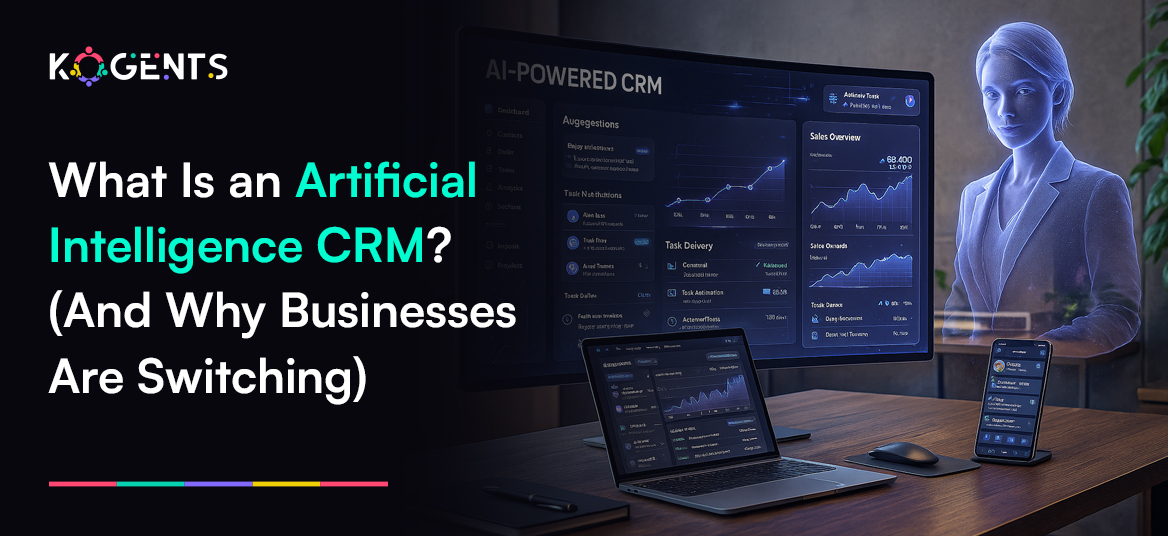
  • What Is an Artificial Intelligence CRM? (And Why Businesses Are Switching)

    What Is an Artificial Intelligence CRM? (And Why Businesses Are Switching)

    Customer relationship management (CRM) tools have been around for decades, but in 2025, a new breed is taking over: the Artificial Intelligence CRM

    Entrepreneurs and solopreneurs are ditching traditional CRMs in favor of smarter, faster, and more predictive AI-powered systems. 

    Why? Because AI is transforming how businesses connect with customers, close deals, and grow sustainably.

    With integrations like WhatsApp CRM system integration and advanced chatbot automation, AI CRMs allow businesses to automate messaging, personalize outreach, and track interactions in ways legacy systems simply can’t. 

    And it’s not just about automation, it’s about insight, efficiency, and scale

    Let’s explore what an AI CRM is, why it’s booming in 2025, and how you can leverage it for your business.

    Key Takeaways

    • An Artificial Intelligence CRM empowers businesses to scale, automate, and personalize.
    • WhatsApp CRM system integration is critical for real-time engagement.
    • AI enhances analytics, lead management, and customer retention.
    • Entrepreneurs and solopreneurs gain big-league capabilities with lean resources.

    What Are AI Agents in CRM and Why Do They Matter?

    AI agents in CRM are intelligent virtual assistants embedded in CRM platforms to automate, analyze, and enhance customer interactions

    Unlike static data entry tools, these AI agents use machine learning and natural language processing (NLP) to:

    • Predict customer behavior
    • Suggest next-best actions
    • Automate repetitive tasks like email follow-ups or WhatsApp messages
    • Deliver real-time insights to sales reps and support teams

    For entrepreneurs and solopreneurs, this means less time managing customer data and more time closing deals. 

    Today, AI agents empower small teams to punch above their weight, allowing solo founders to offer enterprise-grade customer experiences.

    AI also plays a huge role in omnichannel messaging CRM, integrating email, WhatsApp, live chat, and more into a seamless communication loop. 

    This isn’t just efficiency, it’s smarter decision-making at every customer touchpoint.

    Why Entrepreneurs & Solopreneurs Are Switching to AI-Powered CRM Software in 2025

    1. Time-Saving Automation

    • Time is the most valuable currency for entrepreneurs. 
    • AI CRMs automate follow-ups, schedule meetings, qualify leads, and send reminders. 
    • No more chasing cold leads manually.

    2. Smarter Lead Scoring

    • AI CRMs analyze behavior, interactions, and buying signals across channels. 
    • Instead of guessing who’s a hot lead, solopreneurs get ranked lists of prospects ready to buy.

    3. Integration with WhatsApp and Other Platforms

    • With WhatsApp CRM integration, entrepreneurs can manage customer chats, automate responses, and convert conversations into deals. 
    • This is critical in regions where WhatsApp is the primary business communication channel.

    4. Personalized Customer Journeys

    • AI segments customers based on behavior, demographics, and engagement. 
    • That means hyper-personalized emails, offers, and outreach, at scale.

    5. Cost-Effective Scaling

    • With AI doing the heavy lifting, solopreneurs don’t need large sales teams to scale. 
    • AI handles the grunt work while you focus on growth strategies.

    6. Unified Communication Across Channels

    • Modern customers don’t stick to one platform. 
    • AI CRMs integrate multiple touchpoints (email, WhatsApp, chatbots, SMS) into a single view, making conversations consistent and efficient.

    7. AI-Driven Forecasting

    • AI CRMs help predict revenue, sales cycle length, and churn risk using real-time data. 
    • Entrepreneurs can plan better, avoid pitfalls, and allocate resources more effectively.

    8. Better Customer Retention

    AI agents analyze customer engagement signals to spot churn risks early and automate retention campaigns, a game-changer for solo businesses that can’t afford to lose clients.

    Enhanced Customer Insights Through AI Analytics

    Predictive Analytics for Smarter Decisions

    AI CRMs don’t just track interactions; they analyze them. 

    Predictive analytics helps businesses understand:

    • Which leads are most likely to convert
    • When a customer might churn
    • Which channel performs best

    This data-driven intelligence lets entrepreneurs make faster, smarter decisions. 

    Note: Tools like Zoho CRM and HubSpot CRM now offer AI-powered dashboards that update in real time.

    Sentiment Analysis for Real-Time Feedback

    • AI can analyze the tone of emails, WhatsApp messages, and support chats. 
    • This sentiment insight allows brands to proactively fix issues and retain customers.

    Customer Lifetime Value (CLV) Forecasting

    • By analyzing purchase patterns and engagement, AI CRMs help project the future value of each customer. 
    • This helps in targeting high-value leads and managing resources efficiently.

    Artificial Intelligence CRM

    AI in Sales and Marketing

    AI-Powered Email & Message Automation

    • Entrepreneurs use AI to automate personalized messages across WhatsApp, email, and SMS. 
    • This isn’t just bulk messaging; it’s AI-optimized timing, tone, and triggers.

    Dynamic Ad Targeting

    • AI CRM systems integrate with ad platforms to dynamically target high-intent users with precision. 
    • Whether through retargeting or lookalike audiences, AI refines your spend for better ROI.

    Smart Lead Nurturing

    AI enables behavior-based workflows. 

    Example:  if a lead opens a WhatsApp message but doesn’t reply, an AI rule might trigger a follow-up SMS or email.

    How AI Agents Work in Business Using CRM

    AI agents function as the central nervous system of your CRM. Here’s how they typically operate in business environments:

    1. Data Aggregation

    • AI agents collect structured and unstructured data from multiple sources: websites, WhatsApp messages, emails, forms, and social media.
    • This forms a 360-degree view of each contact.

    2. Contextual Understanding

    • Through NLP and machine learning, AI agents understand the intent and context of customer conversations. 
    • This allows them to respond intelligently and route queries appropriately.

    3. Workflow Triggers

    AI agents trigger workflows based on customer actions. For instance, if a user fills out a pricing form, the AI can:

    • Score the lead based on behavior
    • Assign it to a sales rep
    • Initiate an email sequence
    • Send a WhatsApp confirmation message

    4. Predictive Suggestions

    • Based on past patterns, AI agents suggest the next best action: call the lead, send a discount, or follow up after 3 days. 
    • These aren’t generic reminders; they’re personalized insights.

    5. Real-Time Communication Handling

    AI agents can handle incoming messages and chats using conversational AI. These bots:

    • Answer FAQs
    • Book meetings
    • Escalate complex queries to humans
    • Learn from each interaction to improve over time

    6. Performance Feedback Loops

    AI agents constantly analyze performance metrics like email open rates, chat satisfaction scores, and deal closure times to refine strategies and optimize interactions.

    7. Seamless Integration with Tools

    From WhatsApp API integration with CRM to calendar sync and pipeline updates, AI agents operate across platforms to keep everything aligned in real-time.

    Use Cases for Entrepreneurs & Solopreneurs in CRM and AI Integration

    1. WhatsApp Messaging Automation

    Using WhatsApp Business API, solopreneurs can automate FAQs, send welcome messages, and convert leads directly from chats.

    2. Lead Management

    • Capture leads from Facebook ads, WhatsApp chats, and landing pages. 
    • AI automatically scores and routes them.

    3. Appointment Booking

    • AI bots sync with calendars and book meetings based on availability. 
    • No back-and-forth emailing.

    4. Support Automation

    Integrate a WhatsApp chatbot CRM for instant support responses, ticket creation, and escalations.

    5. Upsell and Cross-Sell Recommendations

    AI identifies customer behavior that signals interest in upgrades and recommends the right time and channel to pitch.

    Advantages of a CRM + AI Integration

    • 24/7 Availability: AI bots never sleep, offering round-the-clock support across WhatsApp, chat, and email.
    • Hyper-personalization: Messages and content are tailored to user preferences, behaviors, and engagement history, increasing conversions and satisfaction.
    • Lead Prioritization: AI scores leads based on multiple data points, allowing teams to focus on the most promising prospects.
    • Increased ROI: With optimized ad targeting, improved lead quality, and better timing, AI integrations significantly boost marketing and sales ROI.
    • WhatsApp Automation CRM Tool Benefits: Engage leads in real time with interactive messages, product catalogs, and click-to-chat ads.
    • CRM Messaging Integration: Centralizes conversations from different channels into one dashboard, improving response time and reducing errors.
    • Faster Decision-Making: AI analytics provides real-time performance insights, empowering business owners to act quickly. Systems leveraging HubSpot AI Integration deliver these insights directly within the CRM dashboard.
    • Reduced Customer Churn: AI detects early warning signs of dissatisfaction and triggers retention workflows.
    • Sales Forecasting Accuracy: AI uses historical data and current pipeline health to predict revenue with greater accuracy.
    • Low-Code / No-Code Workflow Creation: Many modern AI CRMs allow users to build automation sequences without technical skills.
    Artificial Intelligence CRM


    Challenges & Limitations of CRM and AI Integration

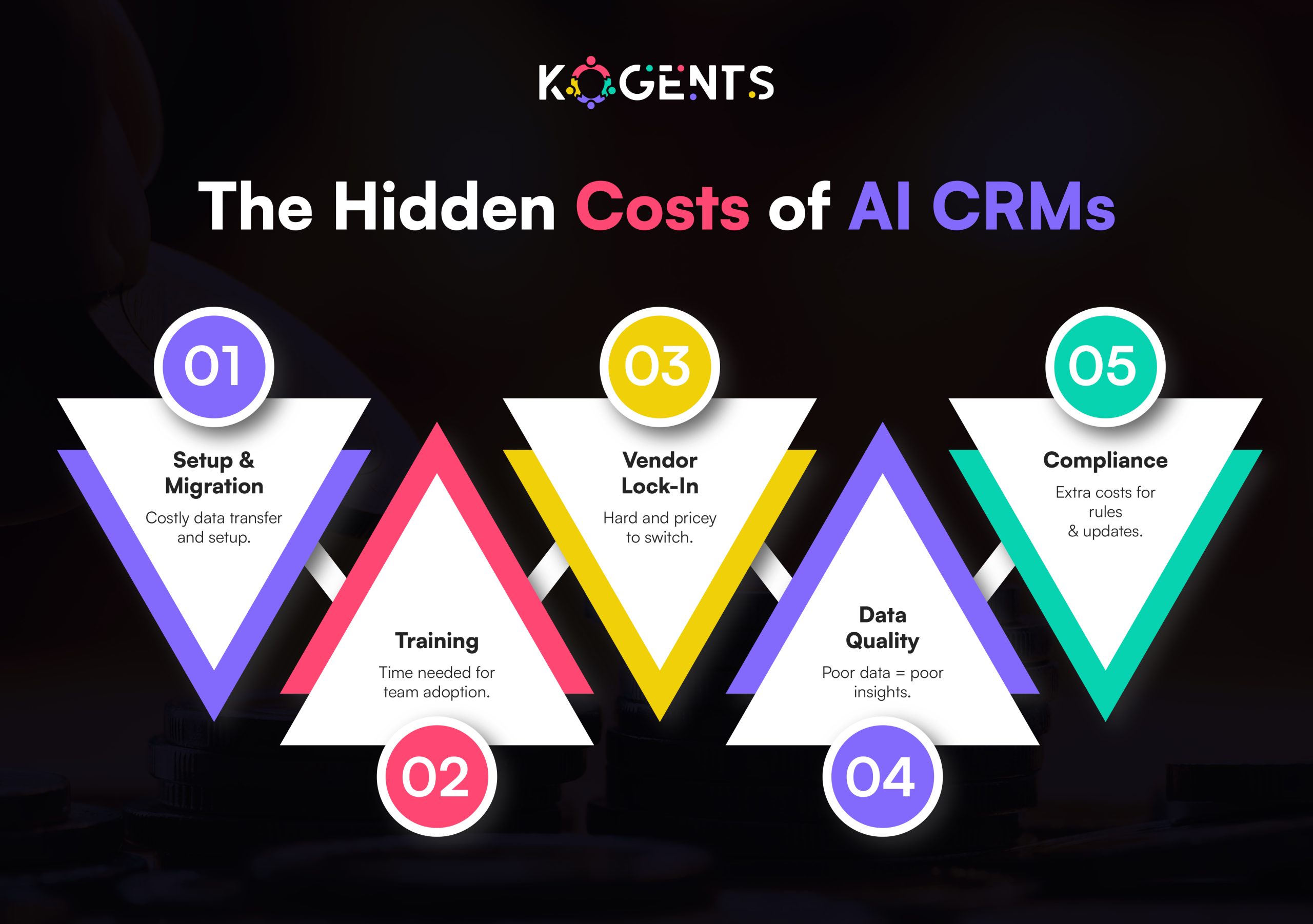
    • Initial Setup Complexity: Integrating AI into a CRM requires strategic planning, data migration, and workflow mapping. Entrepreneurs without technical teams may need outside help.
    • Data Privacy & Compliance: Using AI and tools like WhatsApp Business API must align with data protection regulations like GDPR, HIPAA, and CCPA. Missteps can result in fines and reputational damage.
    • High Learning Curve: While low-code tools exist, understanding how to maximize AI’s potential still requires learning. Without proper onboarding, users may underutilize the system.
    • Vendor Lock-In: Some CRMs offer proprietary AI features that can’t be exported or transferred easily. Switching providers becomes costly and complex.
    • Dependence on Data Quality: AI insights are only as good as the data fed into the system. Inaccurate or incomplete data can lead to misleading decision-making.
    • Limited AI Explainability: AI suggestions and automations may not always provide clear explanations for why certain actions are recommended, which can lead to trust issues.
    • Integration Compatibility: Not all tools offer seamless CRM messaging integration, especially with niche apps or older platforms.

    AI in CRM vs Other Tools (Comparison Table)

    Feature AI CRM Platforms Traditional CRM Marketing Automation Tools
    Lead Scoring Predictive & automated Manual Basic scoring
    WhatsApp CRM Integration Native/Automated Limited Plugin-dependent
    AI-Powered Messaging Yes No Yes
    Real-Time Analytics Yes Delayed or basic Yes
    Workflow Automation Dynamic & behavioral Rule-based Semi-dynamic
    Customer Sentiment Analysis Yes No No
    Self-Learning Algorithms Yes No No

    Prepare Your Business for the Next Wave Using CRM and AI Integration! 

    1. Audit Current CRM Tools: Identify gaps and limitations in automation, messaging, and lead management.
    2. Set Up WhatsApp Integration: Use a provider to enable WhatsApp API integration with CRM.
    3. Start Small, Scale Smart: Begin with one AI workflow (e.g., follow-up automation) and expand.
    4. Train Your Team: Educate your staff on how AI works, what it automates, and where human intervention is still needed.
    5. Track ROI from Day One: Use dashboards to measure time saved, leads converted, and customer satisfaction.

    Case Study Spotlight:

    HubSpot + WhatsApp Integration

    HubSpot introduced a native WhatsApp integration for sales CRM in 2024, allowing users to track, automate, and reply to chats within the CRM. 

    Their AI tools flag high-intent conversations and recommend sales actions. 

    Salesforce + Einstein AI

    Salesforce’s Einstein AI helped a fintech startup increase conversion rates by 38% through predictive lead scoring and automated WhatsApp reminders. 

    With WhatsApp integration for Salesforce, they unified chat and pipeline management. 

    Zoho + Zia AI

    Zoho CRM users now rely on Zia to suggest workflows, track customer sentiment, and optimize message timing across WhatsApp, email, and SMS. 

    Pipedrive + Chat Automation

    Pipedrive integrates AI with WhatsApp using partners like Twilio and Infobip. A travel company reported a 2x increase in lead-to-booking conversion by automating quote delivery via WhatsApp. 

    Freshsales (Freshworks) + Freddy AI

    Freshsales uses Freddy AI to analyze customer queries, automate WhatsApp messaging, and improve sales rep productivity. 

    A logistics company cut down response time by 60% after deploying the AI-driven system. 

    Last Words! 

    The shift toward Artificial Intelligence CRM platforms isn’t just a trend; it’s a necessity in 2025. 

    As customer expectations rise and competition intensifies, entrepreneurs and solopreneurs need tools that do more with less. 

    AI CRMs, powered by predictive analytics, WhatsApp chat integration for customer relationship management, and deep personalization, are becoming the backbone of modern business.

    Whether you’re managing a handful of clients or running a fast-scaling startup, adopting AI-driven CRM is your edge. 

    The barriers are falling; you no longer need an enterprise budget to access enterprise tools.

    Want to automate smarter, connect faster, and sell better? Start your AI CRM journey today with Kogents.ai and drop an email at info@portal.kogents.ai or give us a call at (267) 248-9454 and lead the change.

    FAQs

    What is an Artificial Intelligence CRM?

    An AI CRM is a customer relationship management system enhanced with AI tools that automate tasks, personalize outreach, and predict customer behavior, helping businesses connect smarter and scale efficiently

    Why are entrepreneurs and solopreneurs switching to AI CRMs in 2025?

    Because AI CRMs save time, cut costs, and provide enterprise-level capabilities like predictive lead scoring, WhatsApp integration, and real-time insights, all without requiring large teams

    How do AI agents work within CRM systems?

    AI agents act as intelligent virtual assistants that automate workflows, analyze customer data, predict actions, and provide real-time recommendations, while seamlessly syncing with platforms like WhatsApp, email, and calendars

    What are the main benefits of integrating AI into CRM?

    • 24/7 availability and instant support
    • Hyper-personalization at scale
    • Accurate sales forecasting and lead prioritization
    • Improved ROI with smarter automation and ad targeting
    • Reduced customer churn through predictive retention campaigns

    What challenges should businesses consider before adopting AI CRMs?

    Some key challenges include setup complexity, data privacy compliance (GDPR, HIPAA), dependence on data quality, potential vendor lock-in, and the learning curve for maximizing AI features

  • Revolutionizing CRM with WhatsApp: The Game-Changing Role of AI Agents

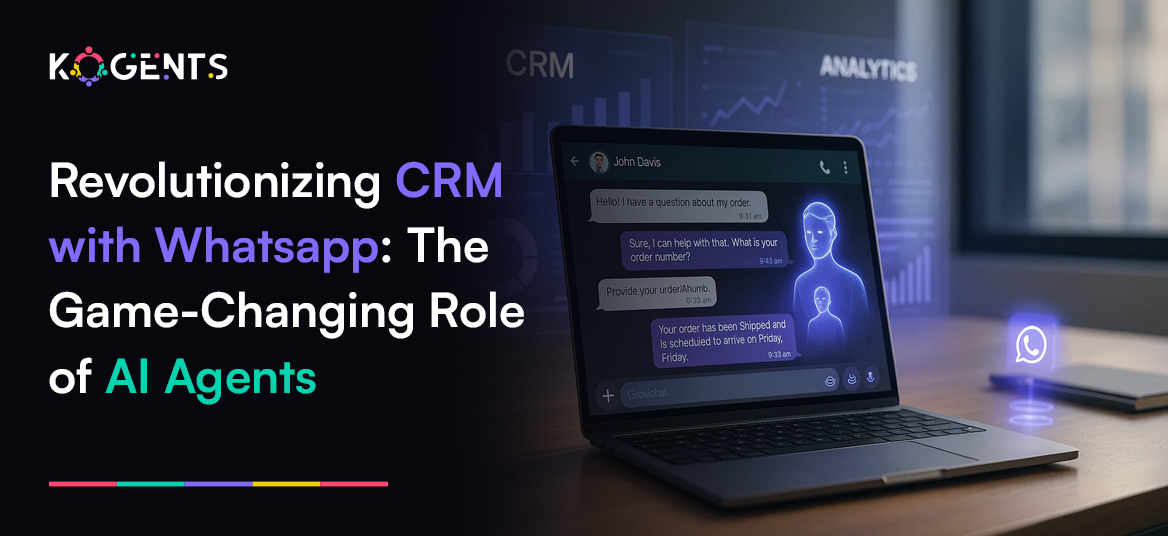
    Revolutionizing CRM with WhatsApp: The Game-Changing Role of AI Agents

    Do you know that the way entrepreneurs and solopreneurs manage customer relationships is undergoing a seismic shift? 

    At the center of this transformation is the WhatsApp CRM integration, supercharged by AI agents

    The combination isn’t just a tech trend; it’s a game-changer for how small businesses interact with leads, manage support, close sales, and build loyal communities.

    With over 2 billion active users globally, WhatsApp is more than a messaging app; it’s a customer engagement powerhouse. 

    When integrated into CRM systems and paired with AI agents, it unlocks unmatched automation, personalization, and efficiency. 

    Whether you’re managing hundreds of leads or nurturing a niche customer base, WhatsApp Business CRM integration allows you to stay human while scaling like a machine.

    Let’s break down how AI agents are not just enhancing CRM workflows but redefining what’s possible in customer communication.

    Key Takeaways

    • WhatsApp CRM system integration allows real-time, contextual, and automated communication.
    • AI agents free up time, reduce costs, and enhance personalization.
    • Entrepreneurs and solopreneurs benefit from 24/7 service without hiring.
    • WhatsApp API integration with CRM connects all customer touchpoints into one system.
    • Future-proof your business with intelligent automation and messaging.

    AI Agents in Revolutionizing CRM with WhatsApp

    AI agents are intelligent, automated systems designed to interact, learn, and assist with tasks that usually require human input. 

    Within the CRM with WhatsApp integration space, they operate as virtual assistants embedded into messaging workflows, responding to queries, qualifying leads, scheduling appointments, following up with clients, and more.

    These AI agents work on top of the WhatsApp Business API, enabling users to engage in text conversations using natural language processing (NLP) and machine learning.

    Instead of using WhatsApp just for chatting, businesses can now deploy a WhatsApp AI agent or chatbot CRM setup to intelligently handle everything from inquiries to purchase confirmations.

    For example, an AI agent can:

    • Automatically greet new leads
    • Collect contact details and push to the CRM
    • Route messages to human agents when needed
    • Send reminders or nurture messages over weeks
    Know It: This isn’t about replacing humans; it’s about extending your reach. 

    The integration creates a seamless bridge between customer communication tools and CRM platforms like Salesforce, Zoho, HubSpot, and more.

    Why Entrepreneurs & Solopreneurs Need AI Agents for Revolutionizing CRM with WhatsApp? 

    1. Time Efficiency

    • Entrepreneurs and solopreneurs typically manage every aspect of their business. 
    • AI agents drastically reduce time spent on repetitive tasks such as responding to FAQs, following up on leads, and confirming appointments. 
    • With automated conversations, you reclaim hours every week.

    2. Cost Optimization

    • Hiring support staff or sales reps can be expensive, especially for small businesses. 
    • AI agents allow solo founders to automate communications without inflating overhead costs, delivering enterprise-level service on a startup budget.

    3. Enhanced Lead Handling

    • Missing a lead or forgetting a follow-up can cost you revenue. 
    • With lead management WhatsApp integrations, AI agents instantly respond, qualify, and push contacts into your CRM, ensuring no lead falls through the cracks.

    4. Brand Consistency

    • AI agents ensure every customer interaction is aligned with your brand voice, messaging, and tone. 
    • Even when you’re offline, your customer communication remains professional, prompt, and personalized.

    5. Real-Time Insights

    • By analyzing conversations and syncing data with your CRM, AI agents provide performance insights. Know which products get the most queries, what objections your leads raise, and when to escalate to a human, all in real time.
    • WhatsApp CRM integration offers entrepreneurs and solopreneurs the kind of intelligent infrastructure once reserved for big enterprises, enabling smarter, faster, and more human customer interactions.

    whatsapp crm integration

    How AI Agents Work in Business & Healthcare to Revolutionize CRM with WhatsApp? 

    Let’s look under the hood of how AI agents integrate with WhatsApp Business CRM systems in both business and healthcare contexts.

    Step-by-Step Workflow:

    1. Trigger Point: A customer initiates a conversation via WhatsApp.
    2. WhatsApp API Integration with CRM: The message flows through the WhatsApp Business API, activating the AI agent.
    3. Natural Language Understanding: AI analyzes the user’s intent using NLP.
    4. Data Sync: Information is pulled or pushed into the CRM in real-time.
    5. Conversational Flow: AI agents respond, escalate, or schedule tasks accordingly.

    In Business:

    • Lead Nurturing: Qualify prospects using question trees.
    • Order Management: Confirm purchases, share tracking info.
    • Feedback Loops: Trigger review requests post-service.

    In Healthcare:

    • Appointment Booking: Patients schedule visits via WhatsApp with calendar integration.
    • Medication Reminders: Timely nudges to ensure adherence.
    • Symptom Triage: Early assessment to guide next steps or escalate to professionals.

    Note: This level of automation is impossible through manual WhatsApp usage. 

    Automate WhatsApp messaging in CRM to ensure every touchpoint is timely, accurate, and recorded.

    Gartner Predicts Agentic AI Will Autonomously Resolve 80% of Common Customer Service Issues Without Human Intervention by 2029. 

    Core Features of Modern AI Agents in Revolutionizing CRM with WhatsApp

    To understand their real power, let’s break down the key features you should look for in an AI agent built for WhatsApp CRM system integration:

    1. CRM Messaging Integration

    • Seamlessly sync conversations with CRMs like Zoho, HubSpot, and Salesforce.
    • Automatically log lead data, chat transcripts, and pipeline status.

    2. Conversational Intelligence

    • Leverages machine learning to analyze tone, urgency, and buying intent.
    • Supports complex dialogues with fallback to human agents when needed.

    3. Workflow Automation

    • Build logic-based trees to guide conversations.
    • Automatically execute CRM tasks like deal creation, tag updates, or appointment scheduling.

    4. Rich Media & Smart Replies

    • Share product catalogs, demo videos, documents, and clickable CTAs.
    • Use suggested replies to accelerate interactions.

    5. Lead Qualification Engine

    • Score and prioritize leads based on interaction quality and CRM tags.

    6. Security & Compliance

    • Built on the WhatsApp Business API with enterprise-grade security.
    • Meets GDPR and HIPAA compliance standards with leading vendors.

    7. Analytics & Optimization

    • Monitor KPIs like conversation duration, drop-off points, conversion rates, and satisfaction scores.

    Learn More: These features transform AI agents into powerful operational partners, capable of managing complete customer journeys.

    whatsapp crm integration

    Use Cases for Entrepreneurs, Solopreneurs & Healthcare 

    Entrepreneurs

    • Product Launch Coordination: Send scheduled announcements, answer FAQs, and drive traffic to sales pages.
    • Client Follow-Up: Automated nudges post-meeting or demo to accelerate decision-making.
    • Onboarding Journeys: Create drip sequences for onboarding new clients with how-to videos, FAQs, and next steps.

    Solopreneurs

    • Appointment Management: Freelancers and coaches can automate booking, reminders, and rescheduling.
    • Digital Products Sales: Share PDFs, gated content, or access links after payment confirmation via WhatsApp.
    • Subscription Renewal: Automatically notify clients about expiring subscriptions or upcoming charges.

    Healthcare Providers

    • Patient Intake Automation: Capture name, insurance, symptoms, and pre-appointment data directly in WhatsApp.
    • Follow-Up Care: Send post-op instructions, video check-ins, or rehab milestones.
    • Chronic Care Monitoring: Schedule regular check-ins for patients with ongoing conditions.
    Key Highlight: With WhatsApp automation CRM tools, these use cases become plug-and-play workflows that streamline operations and increase satisfaction across industries.

    The Game-Changing Benefits of AI Agents

    Unmatched Responsiveness

    • AI agents eliminate the gap between customer inquiry and business response.
    • This real-time interaction leads to higher satisfaction and significantly boosts conversion rates.

    Personalized Scale

    AI agents use CRM data to customize conversations, addressing users by name, referencing past purchases, and tailoring recommendations, without the founder lifting a finger.

    End-to-End Automation

    From lead capture to post-purchase support, AI agents automate the entire journey, helping entrepreneurs focus on growth instead of busywork.

    The Game-Changer: Intelligence and Reach Simultaneously

    What makes AI agents truly transformative is their ability to combine intelligence with reach

    Unlike traditional automation tools that rely on rigid rules, AI agents adapt, learn, and engage intelligently across channels like WhatsApp.

    They become your smartest, most consistent team member, available 24/7, never tired, always on-brand.

    In the context of WhatsApp CRM integration, this game-changing shift means:

    • No more delayed replies
    • No more disorganized customer data
    • No more scattered communications
    Note: Just fast, intelligent, and context-aware conversations that build trust and drive sales.

    Future of AI Agents in Revolutionizing CRM with WhatsApp

    The future of AI agents in WhatsApp CRM integration is not just promising, it’s already unfolding.

    As AI models become more advanced, we’re entering an era where conversations don’t just respond, they predict, suggest, and act.

    Redefining Communication

    In the next few years, AI agents will:

    • Anticipate customer needs using behavioral patterns
    • Proactively initiate conversations to prevent churn
    • Handle multilingual communication natively

    How is it Already Working? 

    According to McKinsey Digital, companies leveraging AI for customer engagement witnessed twice the ROI over those relying on traditional channels. 

    WhatsApp’s user base ensures that AI agents are deployed where users are most active.

    Why Does It Matters? 

    • Consumers expect instant answers, personalized service, and minimal friction. 
    • AI agents on WhatsApp deliver that at scale. 
    • For entrepreneurs and solopreneurs, this means running an enterprise-level experience with zero compromise.
    • This isn’t automation for automation’s sake. 
    • It’s rethinking the entire CRM model, from reactive to predictive, from human-bound to hybrid-intelligent.

    Case Study: PharmEasy 

    Background

    PharmEasy, a leading healthcare platform in India, was struggling with managing high volumes of customer queries about prescriptions, delivery status, and appointment bookings.

    Challenge

    High response times, lack of 24/7 availability, and scattered communication channels.

    Solution

    They implemented an AI-powered WhatsApp chatbot integrated with their CRM.

    Outcomes:

    • 91% increase in query resolution efficiency
    • 80% reduction in first-response time
    • 2.5x improvement in overall customer satisfaction

    How does it work? 

    • AI agents handled prescription uploads, booking confirmations, and delivery tracking in real time.
    • CRM captured and stored all chat history, synced with user profiles.
    • Escalation paths ensured complex cases were routed to support staff.

    This case proves the impact of combining AI agents and WhatsApp Business API in streamlining operations and enhancing customer trust.

    Know What Kogents Can Do For You! 

    In a world driven by speed, personalization, and constant communication, entrepreneurs and solopreneurs can’t afford to lag.

    Integrating AI agents with WhatsApp CRM systems isn’t a futuristic luxury; it’s a practical, powerful tool that meets today’s customer expectations while future-proofing your operations.

    Whether you’re managing leads, nurturing existing clients, or offering ongoing support, AI agents enable you to automate intelligently, act faster, and communicate better. 

    They’re not just virtual assistants, they’re your round-the-clock customer success engine.

    Platforms like Kogents.ai make this transformation frictionless. 

    With easy setup, prebuilt integrations, and customizable flows, you can get started in hours, not weeks.

    If you’re an entrepreneur, solopreneur, or healthcare provider looking to level up your CRM without increasing overhead, AI agents on WhatsApp are your next strategic move. 

    So, pair up with Kogents ai today and drop an email at info@portal.kogents.ai or give us a call at (267) 248-9454 and scale your business, not your stress.

    FAQs

    What is WhatsApp CRM integration with AI agents?

    It’s the combination of WhatsApp Business API with CRM platforms (like Zoho, HubSpot, Salesforce), powered by AI agents that automate conversations, qualify leads, and provide real-time customer support.

    How do AI agents benefit entrepreneurs and solopreneurs?

    AI agents save time by automating repetitive tasks, cut costs by reducing dependency on support staff, and ensure 24/7 service, delivering enterprise-level efficiency on a budget.

    What are some use cases of AI-powered WhatsApp CRM?

    • Lead nurturing and client follow-ups
    • Appointment booking and reminders
    • Digital product sales and subscription renewals
    • Patient intake, follow-up care, and chronic care monitoring

    How do AI agents ensure personalization at scale?

    By leveraging CRM data, AI agents address customers by name, reference past purchases, and tailor recommendations, providing human-like engagement without manual effort.

    What is the future of AI agents in WhatsApp CRM? 

    AI agents will evolve to anticipate needs, proactively initiate conversations, and handle multilingual support, shifting CRM from reactive to predictive.


  • How AI is changing Marketing

    How AI is changing Marketing


    Marketing has always been about connecting the right message with the right audience at the right time. 

    Yet in today’s hyper-digital economy, that alignment is harder than ever. Customers are bombarded with endless ads, messages, and offers

    Traditional strategies are no longer enough to cut through the noise. 

    This is where artificial intelligence (AI) is stepping in and reshaping the entire marketing landscape.

    From AI-powered personalization engines to predictive analytics and programmatic advertising, businesses of every size are finding new ways to optimize their customer journey. Entrepreneurs, solopreneurs, and enterprises alike are turning to AI-driven marketing strategies to gain competitive edges once reserved for the big players.

    In this blog, we’ll explore in depth how AI is changing marketing, why it matters for entrepreneurs and healthcare providers, the challenges, the benefits, and real-world case studies. 

    Whether you’re running a one-person online shop or leading a mid-size healthcare brand, this guide will show you why AI isn’t the future of marketing; it’s the present.

    Key Takeaways

    • AI is revolutionizing marketing by enabling personalization, predictive analytics, and automation.
    • Entrepreneurs and solopreneurs benefit most by saving time, cutting costs, and gaining enterprise-level insights.
    • Healthcare marketing is transformed through predictive campaigns, patient engagement, and compliance.
    • The future of AI in marketing is secure, blending human creativity with machine intelligence.

    Exploring AI Agents for Marketing

    At its core, an AI agent in marketing is a software system that leverages artificial intelligence to analyze data, make decisions, and automate tasks that would typically require human intervention. 

    Think of it as your intelligent digital assistant that never sleeps, continuously learning from customer interactions to deliver smarter insights and actions.

    Some examples include:

    • Chatbots & Conversational AI that engage with customers 24/7.
    • Recommendation engines that suggest products based on browsing history.
    • Predictive analytics tools that forecast buying behaviors.
    • Programmatic advertising systems that automatically optimize ad placements.

    Know It:  Unlike traditional marketing tools, AI agents adapt and learn. With each campaign, they process massive datasets, from customer demographics to real-time engagement signals. 

    Why Entrepreneurs & Solopreneurs Need AI Agents in Marketing? 

    For entrepreneurs and solopreneurs, the playing field has never been more competitive. Competing with established enterprises often feels like bringing a knife to a gunfight. 

    But AI levels the battlefield by giving smaller players access to enterprise-grade insights and automation.

    Key Reasons They Need AI:

    Time Efficiency: 

    Entrepreneurs often juggle multiple roles. 

    AI-powered marketing automation platforms take care of repetitive tasks like email campaigns, social media scheduling, and customer segmentation.

    Cost Optimization: 

    Instead of hiring large marketing teams, solopreneurs can leverage AI-driven marketing tools that are both affordable and scalable.

    Data-Driven Decisions: 

    With AI, even small businesses can analyze consumer insights at the scale of Fortune 500 companies.

    Personalized Marketing at Scale: 

    AI and personalization in marketing allow solopreneurs to build strong, loyal relationships with their customers, without manually customizing every message.

    Competitive Advantage: 

    By implementing AI-powered SEO, behavioral analytics, and customer journey optimization, entrepreneurs can target customers more effectively than competitors who still rely on guesswork.

    Pro Tip: Start small with AI tools like HubSpot AI for inbound campaigns or chatbots for instant customer engagement. Gradually expand into predictive analytics and advanced personalization engines.

    63% of retailers use AI agents for personalized marketing, inventory tracking, and customer support.

    How AI is Revamping Marketing for Businesses, Healthcare, Educators & Learners? 

    AI is no longer a futuristic concept; it is actively revamping marketing across industries. While its impact on businesses and healthcare is already profound, the shift is equally significant in education and learning environments.

    Businesses

    For businesses, AI reshapes marketing by enabling customer journey optimization at scale. Companies now leverage:

    • Predictive analytics to anticipate customer needs and trends.
    • AI-driven personalization engines to deliver tailored content across email, websites, and social platforms.
    • Programmatic advertising that automatically adjusts bids and placements in real time, ensuring every ad dollar generates maximum ROI.
    • AI-powered SEO tools that analyze search intent and optimize content to align with consumer behavior.

    Example: Retailers like Amazon use recommendation engines to drive over 30% of their sales by suggesting products based on browsing and purchase history.

    Healthcare

    Healthcare marketing has always been sensitive due to privacy and trust issues. AI is helping overcome these barriers:

    • Patient engagement chatbots deliver accurate health guidance 24/7.
    • Predictive outreach campaigns identify patients likely to miss appointments, reducing no-shows.
    • Sentiment analysis helps providers understand patient concerns and improve trust-based communication.
    • Data-driven personalization ensures HIPAA-compliant campaigns with secure patient targeting.

    Example: Cleveland Clinic improved appointment adherence by 20% using predictive AI tools for follow-up communication.

    Educators & Learners

    Education is undergoing a marketing revolution powered by AI. Schools, universities, and online educators now compete for learner attention, making AI-driven marketing strategies critical:

    Personalized learning journeys: 

    AI marketing platforms recommend courses, certifications, or learning modules based on student interests and prior engagement.

    Automated student outreach: 

    Universities use chatbots to answer FAQs, manage admissions queries, and nurture leads into enrolled students.

    Behavioral analytics: 

    Predicts dropout risks and sends tailored retention campaigns to at-risk learners.

    Content optimization

    Educators can leverage AI-powered SEO to reach global learners with optimized course content.

    Example: Online learning platforms like Coursera and edX use AI-powered marketing tools to match students with the right courses, boosting sign-ups and course completion rates.

    Incredible Impact: Across all sectors, the impact of AI on digital marketing is clear: smarter decisions, improved customer experience, and more efficient campaigns.

    how ai is changing marketing

    Use Cases for Entrepreneurs, Solopreneurs, Healthcare & Educators

    For Entrepreneurs & Solopreneurs

    • AI-powered SEO tools (like SurferSEO, Clearscope) help rank higher.
    • Chatbots engage leads 24/7, improving conversions without extra staff.
    • Predictive lead scoring identifies the hottest leads for small businesses.
    • Dynamic content personalization ensures even small websites feel “enterprise-grade.”

    For Healthcare

    • AI chatbots reduce strain on staff by answering routine patient questions.
    • Predictive engagement reminds patients of screenings or wellness checks.
    • AI marketing compliance tools protect sensitive health data while enabling personalization.

    For Educators & Learners

    • Chatbots for admissions: Handle queries, saving staff time.
    • Course recommendation engines: Suggest relevant modules to learners.
    • Retention campaigns: AI predicts when a student might drop out and launches engagement initiatives.
    • Virtual teaching assistants: Provide learners with real-time responses to FAQs.

    Pro Tip: Solopreneurs and educators should integrate AI chatbots early, as they’re often the highest-ROI entry point into AI marketing.

    AI Agents for Marketing vs Other Tools 

    Feature AI Agents for Marketing Traditional Marketing Tools Basic Automation Tools
    Personalization Hyper-personalized via machine learning Limited (manual targeting) Basic segmentation only
    Scalability Highly scalable across channels Resource-intensive Limited scaling
    Predictive Analytics Yes, forecast behaviors No forecasting Minimal analytics
    Customer Engagement Real-time via chatbots & NLP Reactive/manual Scheduled but not adaptive
    Cost Efficiency High ROI with automation High human resource cost Moderate savings
    Learning & Adaptation Continuously improves with data Static Limited adaptability

    Key Highlight: AI agents outperform traditional tools by offering intelligence, adaptability, and efficiency, critical for future-proof strategies.

    Why AI Agents in Marketing Are Game-Changers? 

    AI agents are game-changers because they offer benefits that compound over time:

    • Scalability: Scale campaigns without additional staff.
    • Accuracy & Precision: Minimize human bias and errors in data-driven campaigns.
    • Cost Reduction: Replace repetitive manual work with affordable automation.
    • Speed & Agility: Launch, monitor, and adapt campaigns in real time.
    • Deeper Customer Insights: AI identifies patterns humans may overlook.
    • Hyper-Personalization: Content, emails, and ads tailored down to the individual.
    • ROI Enhancement: Every dollar spent is optimized by predictive analytics.
    • 24/7 Engagement: Chatbots and automation ensure businesses never miss a customer inquiry.
    • Omnichannel Marketing: Seamlessly integrates data across email, web, social, and even voice search.
    • Customer Retention: Proactive campaigns based on behavior prevent churn.

    Challenges & Limitations of AI in Marketing 

    Despite its promise, AI agents for marketing have real-world challenges:

    Data Privacy Concerns
    With regulations like GDPR and HIPAA, mishandling consumer data can harm brand reputation.

    High Implementation Costs
    Advanced AI systems may be costly for smaller businesses to adopt.

    Skill Gaps
    Entrepreneurs and educators often lack the expertise to implement and maximize AI tools.

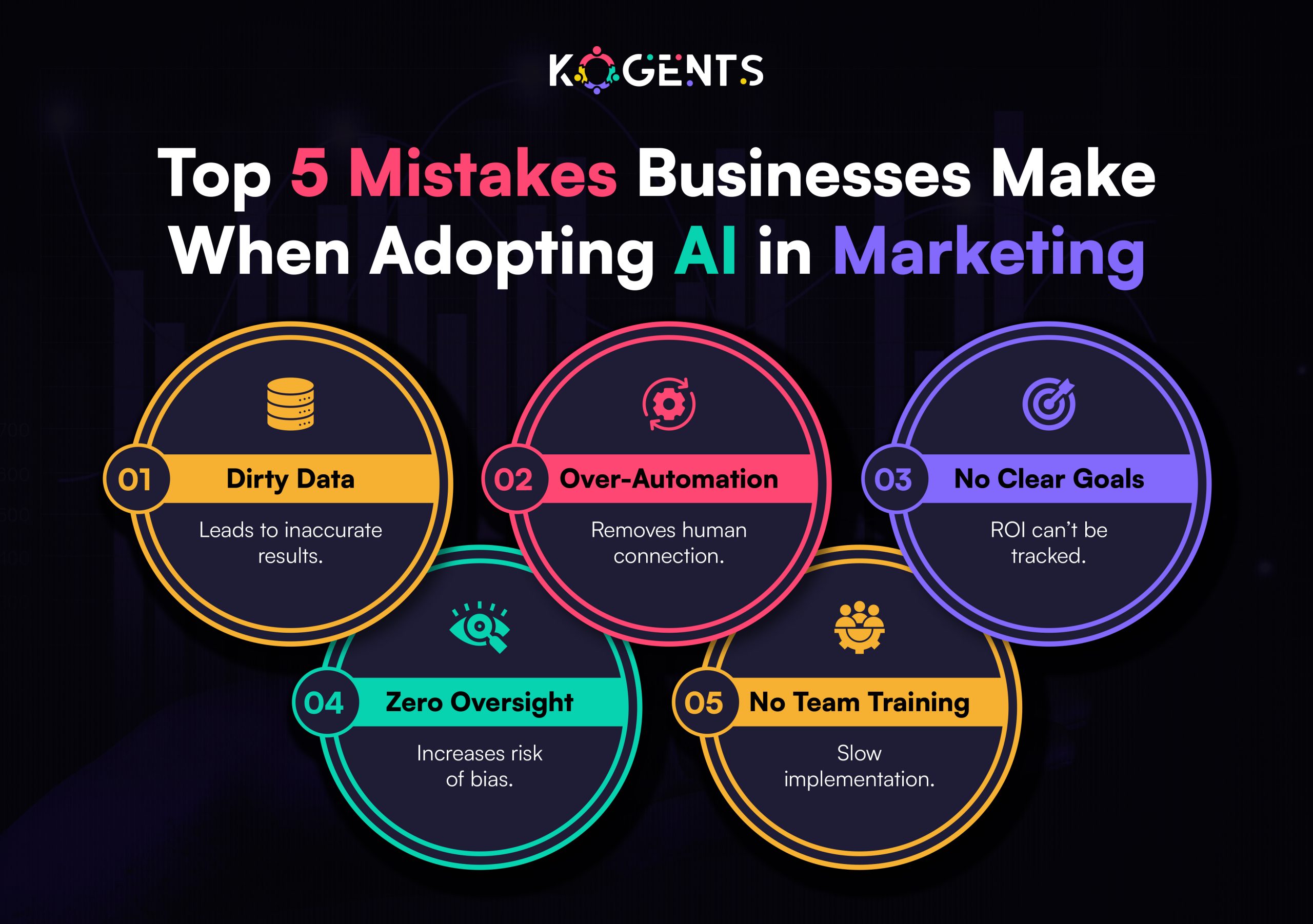
    Over-Automation Risks
    When businesses rely too heavily on AI, customer interactions can feel robotic.

    Integration Issues
    Existing systems may not easily sync with AI platforms, slowing adoption.

    Bias in AI Systems
    AI can inadvertently reflect biases in the data it’s trained on, leading to inaccurate or discriminatory results.

    Unveil The Solution: Blend AI with human creativity, oversight, and empathy.

    how ai is changing marketing


    Case Study Spotlight

    1. Sephora (Retail & AI Chatbots)

    Sephora uses conversational AI chatbots for personalized shopping assistance. 

    Customers receive tailored recommendations, improving online engagement rates by 30%.

    2. Cleveland Clinic (Healthcare Marketing)

    Cleveland Clinic leveraged predictive analytics and AI-driven outreach to improve patient appointment adherence by 20%.

    3. HubSpot AI for Entrepreneurs

    Small businesses using HubSpot AI tools saw significant improvements in lead nurturing and email campaign effectiveness, reporting up to 40% higher conversion rates.

    AI in Marketing: The Key to a Secure Future

    AI is changing marketing; it is a necessity for future-proofing marketing strategies. Here’s why:

    Evolving Consumer Expectations: 

    Customers now demand personalized experiences. 

    AI-driven marketing strategies ensure brands meet these expectations.

    Global Competition: 

    In a world where even small businesses can reach global audiences, AI provides the agility to adapt instantly.

    Data Overload:

    Human marketers can’t process terabytes of customer data, but AI thrives on it.

    Future of AI in Marketing: 

    As machine learning in marketing grows smarter, early adopters will always be ahead of the curve.

    Resilience in Uncertain Times:

    AI provides predictive forecasting, helping businesses pivot during market disruptions.

    Wrapping Up! 

    The digital economy has entered an AI-first era, where automation, personalization, and predictive analytics are no longer luxuries but necessities. 

    For entrepreneurs, solopreneurs, healthcare providers, and educators, how AI is changing marketing is more than just technology; it’s a survival strategy.

    By blending human creativity with AI-powered marketing tools, businesses can build stronger customer relationships, predict future demands, and drive scalable growth.

    Partner with Kogents AI by giving us a call at (267) 248-9454 or dropping an email at info@portal.kogents.ai, and see how we empower entrepreneurs, solopreneurs, and healthcare providers to fully harness the transformative potential of AI in marketing.

    FAQs

    What is the role of AI in marketing?

    The role of AI in marketing is to automate, personalize, and optimize campaigns. From predictive analytics to chatbots, AI helps businesses engage customers in smarter, data-driven ways.

    What are examples of AI in digital marketing?

    Examples include chatbots & conversational AI, programmatic advertising, personalization engines, and recommendation systems like Amazon’s product suggestions.

    How does AI improve customer engagement?

    AI improves customer engagement by providing real-time, personalized interactions through chatbots, dynamic content delivery, and predictive campaigns that anticipate customer needs.

    What are the benefits of AI in marketing campaigns?

    The benefits of AI in marketing campaigns include scalability, ROI improvement, personalization, better insights, and 24/7 engagement.

    How does AI personalize content for customers?

    AI personalizes content using algorithms that analyze user data, browsing patterns, and purchase history to deliver hyper-targeted recommendations and messages.

    What are the best AI tools for digital marketing?

    Some of the best AI tools for digital marketing include HubSpot AI, Salesforce Einstein, Adobe Sensei, Clearscope, and ChatGPT-based marketing assistants.

    What is AI vs traditional marketing techniques, and which is better?

    AI vs traditional marketing techniques shows a clear edge for AI: it scales better, personalizes more deeply, and delivers higher ROI compared to manual, broad-based campaigns.

    Which top companies are using AI in marketing successfully?

    Top companies using AI in marketing include Amazon, Netflix, HubSpot, Salesforce, and the Cleveland Clinic (in healthcare marketing).

    What is the pricing for AI marketing automation tools?

    Pricing for AI marketing automation tools varies; some start as low as $50/month for solopreneurs, while enterprise solutions like Salesforce or Adobe Sensei may cost thousands monthly.

    How can I hire an AI marketing agency for my business?

    To hire an AI marketing agency, research providers that specialize in your industry (e.g., healthcare or e-commerce), evaluate case studies, and ask about pricing, ROI benchmarks, and tools they use.

  • How AI Agents Can Reduce Marketing Costs and Boost ROI

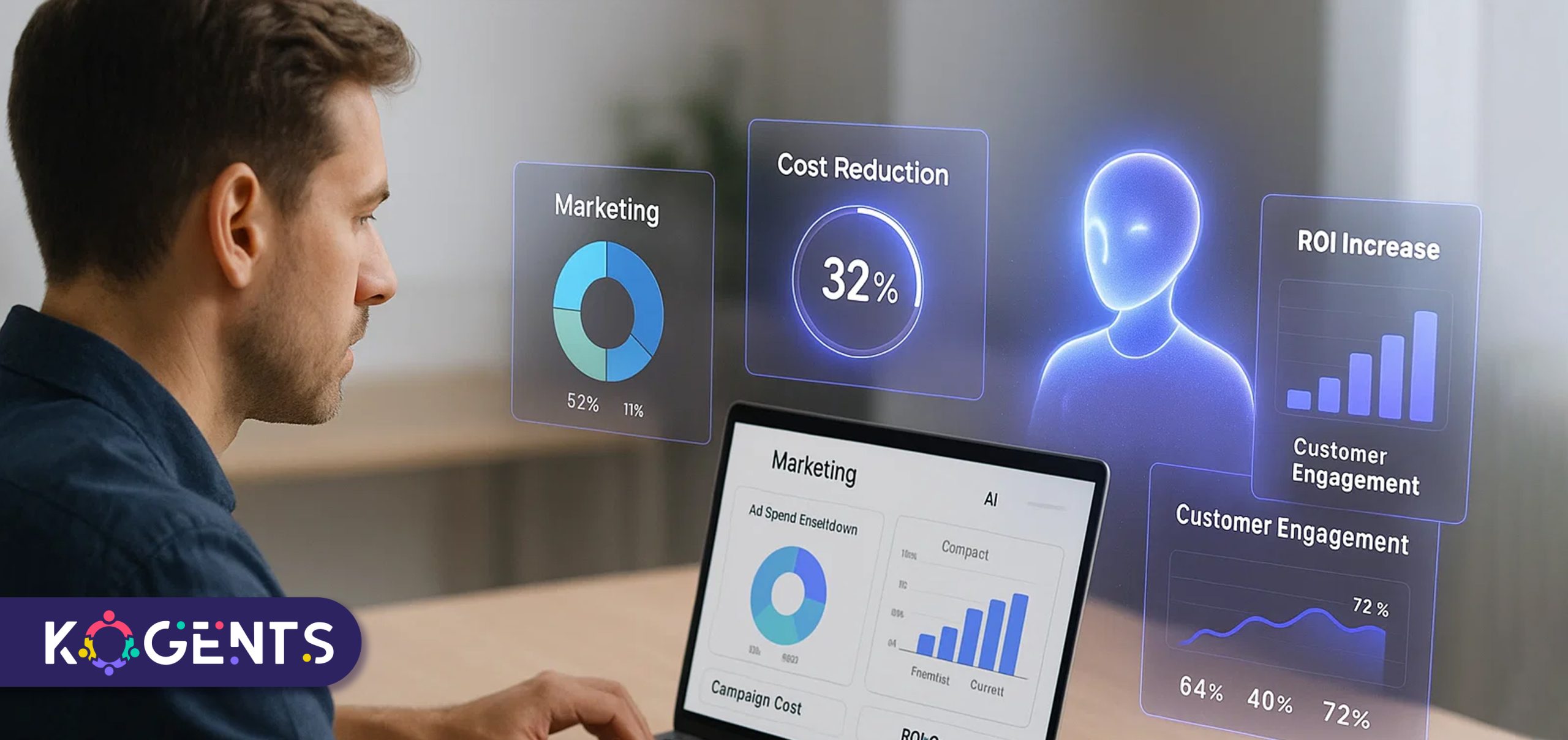
    How AI Agents Can Reduce Marketing Costs and Boost ROI

    Marketing isn’t just an expense; it’s often the lifeline of growth. 

    For entrepreneurs, solopreneurs, mental health experts, educators, and lifelong learners, every marketing dollar must be worth every count. Yet, traditional campaigns often feel like throwing money into a black hole,  budgets disappear fast, and insights on what truly drives results remain blurry.

    But, it’s not the same anymore! With the advent of AI and marketinga powerful alliance is transforming how businesses attract, engage, and retain customers

    Today’s AI marketing tools give even the smallest teams superpowers: automating repetitive tasks, running predictive analytics, and delivering hyper-personalized experiences once reserved for enterprise players.

    In this guide, we’ll explore how AI agents slash marketing costs and supercharge ROI, no matter your industry or team size. 

    Key Takeaways

    • AI agents cut costs by automating manual marketing tasks.
    • Hyper-personalization boosts engagement and conversion.
    • Predictive analytics ensure better spend allocation.
    • Entrepreneurs, educators, and clinicians can achieve enterprise-grade results without enterprise budgets.

    What Are AI Agents in Marketing?

    At their core, AI agents are intelligent software programs that can take input, analyze data, make decisions, and execute tasks, all with minimal human intervention. 

    In the context of marketing AI, these agents can perform tasks like:

    • Identifying target audience segments through customer segmentation.
    • Generating ad copy using natural language generation.
    • Optimizing campaigns with real-time A/B testing and attribution modeling.
    • Providing hyper-personalized recommendations to improve conversion rates.

    Think of AI agents as virtual team members who work tirelessly to optimize every step of the funnel, from content creation and social media marketing to email marketing automation and campaign optimization. 

    According to a report by MarketingProfs, 71% of marketers believe that AI-powered marketing automation is crucial for delivering personalized customer experiences.

    Why Entrepreneurs, Solopreneurs, Mental Health Experts, and Learners Need AI Agents?

    When you’re running a business or a personal brand on your own, every minute and dollar counts. 

    Entrepreneurs and solopreneurs often juggle strategy, content creation, client acquisition, and delivery simultaneously. 

    Similarly, healthcare professionals and educators are busy serving patients or students, leaving little time for marketing experimentation.

    Here’s why AI agents matter:

    • Time Efficiency: AI handles repetitive tasks such as scheduling posts, segmenting email lists, and running analytics, freeing you up to focus on strategy.
    • Cost Savings: Instead of hiring multiple specialists, one AI marketing solution can cover campaign management, copywriting, and data analysis.
    • Better Decisions: AI uses data, not guesswork, to guide marketing spend,  helping you double down on what works and stop wasting budget.
    • Scalability: AI grows with you, enabling even solo practitioners to operate like larger organizations.
    • Improved Outcomes: For mental health experts, AI can tailor outreach messaging to resonate with patients. For educators, AI can recommend content that engages learners.

    The bottom line: AI for marketing democratizes access to sophisticated growth strategies that were once reserved for enterprises.
    Mini Case Study: A small telehealth provider reduced administrative overhead by 40% using AI to triage patient queries, allowing staff to focus on high-value consultations. Meanwhile, a YouTube educator used AI to test thumbnail variations and doubled click-through rates.

    Role of Cost Reduction by AI Agents in Business, Healthcare, and Education? 

    AI agents are most powerful when applied to cost-sensitive functions like marketing, patient engagement, and student outreach. By combining automation, data science, and adaptive learning, they directly tackle the inefficiencies that inflate marketing budgets.

    Data-Driven Spend Optimization

    AI agents analyze advertising channels, keyword performance, and audience segments in real time. 

    They automatically pause underperforming campaigns, preventing wasted spend. 

    In education, this means stopping ads for courses that attract low-intent users and re-investing in high-enrollment keywords.

    Predictive Targeting and Personalization

    An AI agent for marketing uses machine learning models to forecast which leads are most likely to convert, allowing entrepreneurs to spend less on broad targeting

    Healthcare clinics can focus outreach on patients who are overdue for appointments, improving health outcomes and reducing the cost of re-engagement.

    Workflow Automation for Labor Savings

    AI-powered systems handle segmentation, scheduling, copy generation, and A/B testing, freeing up human staff for high-value strategic work. 

    This leads to measurable cost savings. Forrester research shows automation can cut campaign execution time by 40%.

    Outcome Enhancement Through Continuous Learning

    Because AI agents learn from every click, email open, and engagement metric, they improve campaign results over time. 

    Businesses see compounding ROI gains, while educators witness better course completion rates thanks to timely learner nudges

    According to a report by Email Monday, AI-powered marketing automation can increase email open rates by up to 50% and click-through rates by up to 100%.

    Use Cases In Reducing Marketing Costs and Boosting ROI

    AI agents are not theoretical; they’re already delivering measurable savings across industries.

    Entrepreneurs & Solopreneurs

    • Lead Scoring & Qualification: Automate lead nurturing sequences, perform customer segmentation, and even generate weekly content calendars.
    • Content Calendar Generation: Save hours weekly by auto-generating blog and social schedules.
    • Dynamic Pricing: Adjust prices based on demand, reducing discount reliance.

    Case in Point: A solopreneur coach reported a 3x increase in leads after using AI tools to personalize webinar invitations based on audience behavior data.

    Healthcare Providers

    • Patient Segmentation: Target campaigns only to relevant patient groups, reducing blanket outreach costs.
    • Automated Reminders: Decrease no-shows and lost revenue.
    • Predictive Sentiment Analysis: Use predictive modeling to identify at-risk patients and proactively engage them. AI-powered virtual assistants reduce phone traffic by answering common questions.

    Mini Case Study: A small mental health clinic implemented AI-powered patient outreach and reduced marketing expenses by 33% while increasing appointment bookings by 18%. 

    Education & Learning

    • Personalized Enrollment Campaigns: Market courses to students most likely to register.
    • Adaptive Retargeting: Build adaptive learning paths for students, automatically grading assignments and suggesting supplemental material.
    • Progress-Based Nudges: Increase course completion rates, boosting student lifetime value.

    Example: a micro-SaaS founder saw CAC drop by 28% after deploying AI-driven ad optimization that reallocated spend in real time.

    How AI Agents Reduce Marketing Costs and Boost ROI? 

    AI agents don’t just make workflows more efficient; they directly impact the bottom line by reducing wasted spend and driving measurable growth.

    1. Reducing Paid Media Waste

    AI-powered predictive analytics helps businesses identify underperforming ads early and shift spend to higher-performing campaigns. 

    According to a McKinsey study, predictive targeting can increase marketing ROI by up to 20–30%.

    Case Study: A telehealth provider used AI to analyze patient acquisition channels and discovered that 60% of their ad spend was going to keywords that generated few appointments. After the AI agent reallocated the budget to high-performing terms, cost-per-acquisition dropped 35%.

    2. Automating Time-Intensive Tasks

    AI-driven campaign automation saves countless hours by scheduling posts, segmenting lists, and running A/B tests in real time. 

    For small businesses, this can mean thousands of dollars saved annually in labor costs.

    Example: A solo educator automated email drip campaigns for a new course launch.

    The AI handled segmentation and timing, reducing manual work by 15 hours per week and increasing conversions by 28%.

    3. Improving Personalization to Increase Conversions

    AI agents leverage hyper-personalization to deliver tailored messaging. Gartner reports that personalization can lift conversion rates by up to 50%. 

    Personalized subject lines alone can boost open rates by 26%.

    Mini Case Study: A mental health clinic used AI to send custom mindfulness tips based on patient engagement data. 

    This increased follow-up appointment bookings by 22%, reducing churn and boosting lifetime value.

    4. Enhancing Attribution and Budget Allocation

    AI provides real-time, multi-touch attribution models that help businesses understand which channels drive the most revenue. 

    This reduces guesswork and maximizes every dollar spent.

    Example: An edtech startup discovered through AI-driven attribution modeling that referral traffic converted at twice the rate of paid ads. 

    They shifted strategy, reducing ad spend by 25% while maintaining revenue growth.

    5. Driving Continuous Optimization

    Unlike static dashboards, AI agents constantly learn. They improve recommendations and campaign efficiency over time, leading to compounding ROI gains.

    Key Metric: Businesses using AI-driven marketing optimization have seen 15–20% lower customer acquisition costs (CAC) and up to 30% higher marketing ROI year-over-year.

    Challenges & Limitations

    While powerful, AI agents come with caveats:

    • Data Privacy: Sensitive healthcare or student data must be protected under regulations like HIPAA and FERPA.
    • Bias & Fairness: AI must be monitored to avoid perpetuating bias in marketing or educational recommendations.
    • Human Touch: Automation should enhance, not replace, human connection, especially critical in therapy and education.
    • Initial Investment: High-quality AI tools can have upfront costs and require onboarding time.
    • Ethical & Regulatory Risks: Non-compliance can lead to fines or reputational damage.

    Pro Tip: Use platforms that offer transparency (Explainable AI) and ensure a human-in-the-loop approach for critical decisions.

    adopting ai in marketing


    AI Agents vs Other Tools

    Feature / Tool AI Agents Traditional Automation Tools Human-Only Approach
    Decision-Making Adaptive, data-driven Rule-based only Intuition-driven
    Personalization Hyper-personalized at scale Basic segmentation One-to-one only
    Cost Efficiency High (reduces human labor) Moderate Low
    Learning Capability Improves over time (ML models) Static Human learning only
    Real-Time Optimization Yes Limited Very slow
    Scalability Scales instantly Limited Requires more staff

    Future of AI in Marketing 

    The future of AI agents promises to make cost reduction and ROI improvement even more seamless and autonomous.

    Autonomous Campaign Management

    Next-generation AI agents will not only optimize campaigns but also design them from scratch. 

    Using generative AI, they will draft ad copy, select creative assets, allocate budget, and adjust bids in real time, all without human intervention. 

    This means entrepreneurs and educators will be able to launch sophisticated campaigns with minimal overhead.

    Multi-Modal Personalization

    Future AI will integrate text, voice, image, and behavioral data to create highly contextual experiences. 

    Imagine a mental health platform sending a personalized video tip or an education platform delivering AR-based learning reinforcement right when a student is likely to disengage.

    Key Fact: Companies like Netflix and HubSpot continue to invest in AI-powered marketing automation, it’s clear that this technology is becoming a cornerstone of modern marketing strategies.

    Proactive ROI Monitoring

    AI will shift from reactive reporting to proactive recommendations. 

    Agents will alert users when CAC is rising or when a campaign is underperforming, providing actionable steps to fix the issue instantly.

    Integration with Predictive Market Trends

    By analyzing macroeconomic and seasonal data, AI agents will forecast market conditions and adjust spending ahead of time. 

    For example, a healthcare clinic could anticipate flu season and ramp up vaccination campaigns automatically.

    Industry Outlook: Gartner predicts that by 2027, marketing teams using fully autonomous AI agents could reduce acquisition costs by up to 40% while improving conversion rates by 35%, creating a compounding growth advantage.

    Conclusion

    AI in marketing is smarter, leaner, and more profitable by automating workflows, personalizing engagement, and reallocating budgets to where they create the highest impact. 

    The result? Lower costs, better outcomes, and compounding ROI over time.

    If you’re ready to scale your business, streamline your marketing, and finally see clarity in your ROI metrics, now is the time to act. 

    So, start using AI to cut costs and boost ROI today,  explore Kogents.ai, by dropping an email at info@portal.kogents.ai or give us a call at (267) 248-9454 and see how effortless smart marketing can be! 

    FAQs

    What is AI in marketing, and why does it matter?

    AI in marketing refers to using machine learning, natural language processing, and predictive analytics to optimize campaigns. It matters because it automates time-consuming tasks, improves targeting, and helps entrepreneurs and educators get better results with less spend.

    What are the best AI marketing tools for small businesses and educators?

    Popular solutions include HubSpot AI, Adobe Experience Cloud, Salesforce Marketing Cloud, and Omneky for creative optimization. Free AI tools like ChatGPT can help solopreneurs generate content calendars or ad copy at no cost.

    How can AI be applied to social media and email marketing?

    AI can schedule posts at peak engagement times, generate hashtags, write subject lines, and segment email lists automatically. This ensures higher open rates and engagement without manual labor.

    What are the risks or challenges of using AI in marketing?

    Risks include data privacy concerns, algorithmic bias, over-automation that feels impersonal, and the need for proper oversight. Businesses should choose platforms with explainability features and human-in-the-loop controls.

    Is AI marketing better than traditional marketing automation?

    Yes, because AI learns and adapts. Unlike rule-based automation, AI predicts future behavior, dynamically adjusts campaigns, and provides granular attribution insights that help businesses spend smarter.

    How do I measure the ROI of AI marketing solutions?

    Track metrics such as cost-per-acquisition (CPA), customer lifetime value (CLV), conversion rate lift, and time saved on manual tasks. Many AI platforms offer built-in dashboards to calculate ROI and compare results pre- and post-implementation.

  • Why AI for Students Will Redefine the Future of Education

    Why AI for Students Will Redefine the Future of Education

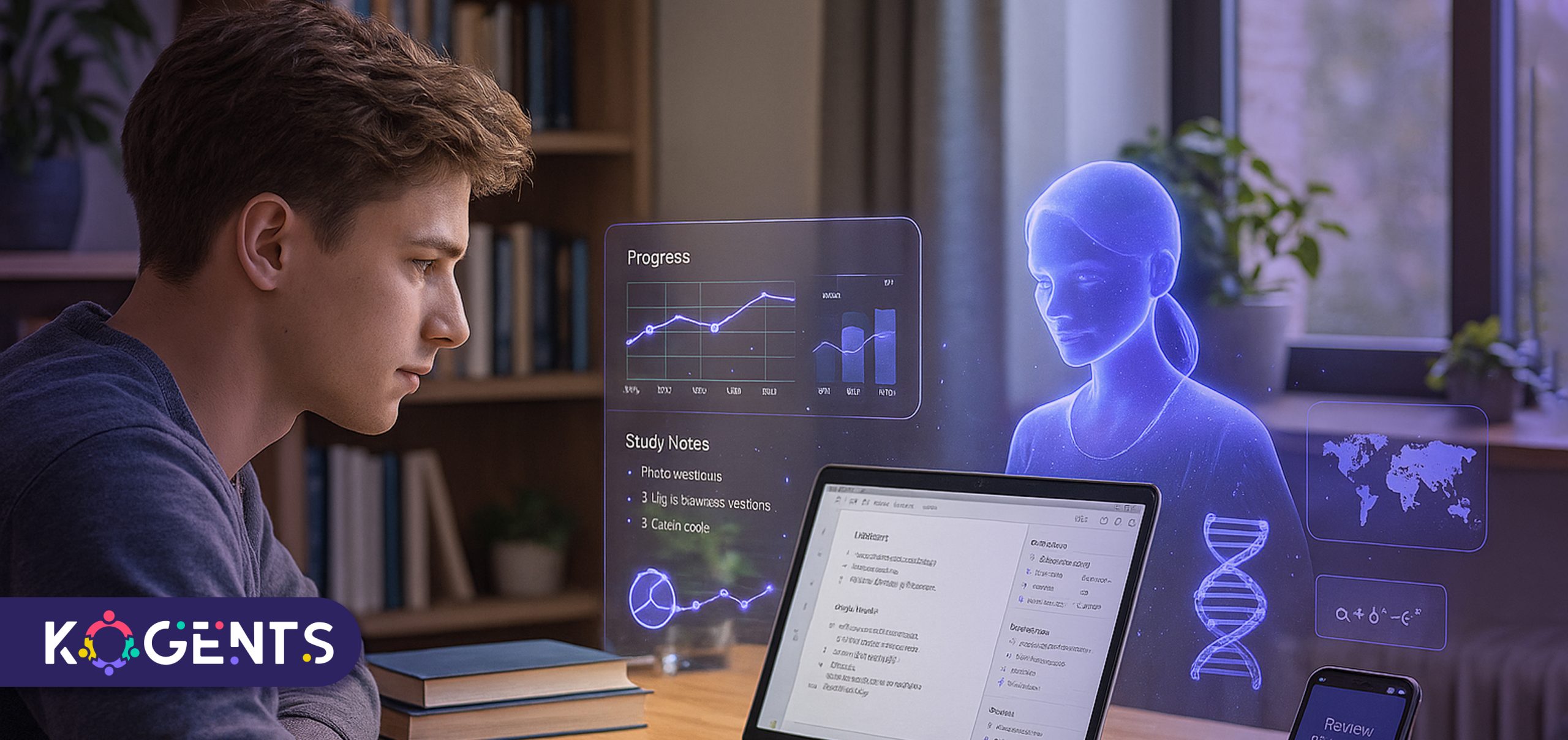
    AI is no longer a buzzword; it’s a foundational force reshaping industries, workflows, and lives. Nowhere is that impact more transformative than in education. From AI tools for students that automate study plans to AI-powered learning for students that adapts in real-time to individual skill levels, the shift is seismic. 

    Entrepreneurs, solopreneurs, and educators are rethinking learning models, and student AI applications are redefining how learners engage with knowledge. The traditional model of one-size-fits-all classrooms is giving way to personalized learning powered by intelligent tutoring systems and generative AI for students.

    This blog explores how AI for students is not just another EdTech trend but a structural transformation of learning. We’ll break down what AI agents are, how they operate, and why entrepreneurs, solopreneurs, and educators should be paying close attention. 

    Key Takeaways

    • Understanding how AI is transforming classrooms with personalized, data-driven learning.
    • Learning the difference between reactive and proactive AI agents and how they support students.
    • Exploring the benefits of AI for entrepreneurs, solopreneurs, educators, and students.
    • Recognizing the core features of AI in education, from study guides to gamification.
    • Considering the challenges and ethics of using AI in learning environments.

    What Are AI Agents in Education and Learning?

    An AI agent for education is an autonomous or semi-autonomous system that performs tasks related to teaching, tutoring, and learning. 

    Think of them as AI tutors for students, guiding them through personalized paths, providing instant feedback, or handling repetitive instructional tasks. These agents use machine learning, natural language processing, and learning analytics to interpret inputs and deliver tailored educational experiences.

    There are two primary categories:

    • Reactive AI agents: Respond to student queries (e.g., AI homework help for students).
    • Proactive AI agents: Analyze patterns and suggest next steps (e.g., AI study assistants recommending revision strategies).
    Examples:

    • ChatGPT for writing help
    • Khanmigo for STEM guidance
    • Turnitin AI for plagiarism detection
    • Canvas AI plugins for formative assessments

    Note Key Points: 

    These agents are not limited to answering questions; they can generate 

    • custom study guides
    • Monitor progress
    • Identify learning gaps
    • adapt to cognitive loads, 

    Why Entrepreneurs, Solopreneurs, and Educators Need AI Agents For Students?

    For entrepreneurs and solopreneurs building educational tools, content, or tutoring platforms, AI agents are more than efficiency hacks; they’re business accelerators.

    For Entrepreneurs

    • AI educational tools for learners create scalable learning experiences without needing to hire 50 tutors.
    • Embedded chatbots and AI learning support for students increase user retention and satisfaction.
    • Use of learning analytics offers real-time insight into learner behavior, driving better product iteration.

    For Solopreneurs

    • Running a coaching or tutoring business? A student AI chatbot can respond 24/7, so you don’t have to.
    • Build a micro-course with integrated AI study assistants, enabling personalized journeys without extra staff.
    • Free up hours by automating feedback loops, grading, and content recommendations.

    For Educators

    • AI reduces cognitive load by automating admin tasks.
    • Helps implement competency-based learning with adaptive modules.
    • Supports AI literacy by modeling responsible tech use in classrooms.
    ROI Highlights

    • 60% reduction in student support tickets (Startup example: LearnLoop.ai)
    • 4x faster grading and feedback for solopreneur-led courses
    • 3.5x increase in course completion rates with AI tutoring modules

    ai for students

    How AI Agents Work in Education and Learning?

    The core engine behind most student AI support systems is machine learning, specifically large language models (LLMs) like GPT-4, Gemini, or Claude. 

    These models process massive datasets, allowing them to:

    1. Understand context: Recognize what a student is asking.
    2. Generate content: Provide explanations, examples, or even exam questions.
    3. Adapt learning paths: Use adaptive education to adjust based on performance.
    4. Deliver feedback: Through text, audio, or video.

    Key Workflows:

    • Prompt Engineering: The quality of the input determines the quality of the output.
    • Feedback Loops: Students interact, and the system adjusts its future responses.
    • Learning Analytics Integration: AI agents are synced with LMS tools (like Moodle or Canvas) to monitor student progress.

    Common Techniques Used:

    • Natural Language Processing: For answering questions or summarizing notes.
    • Computer Vision: For homework help via photo uploads (e.g., QANDA).
    • Knowledge Graphs: To map concepts and suggest learning paths.
    • Automated Formative Assessment: Real-time quizzes or tests that adapt to the user’s level.The global AI in education market reached $7.57 billion in 2025, up 46% from 2024.

    Core Features of Modern AI Agents in Education

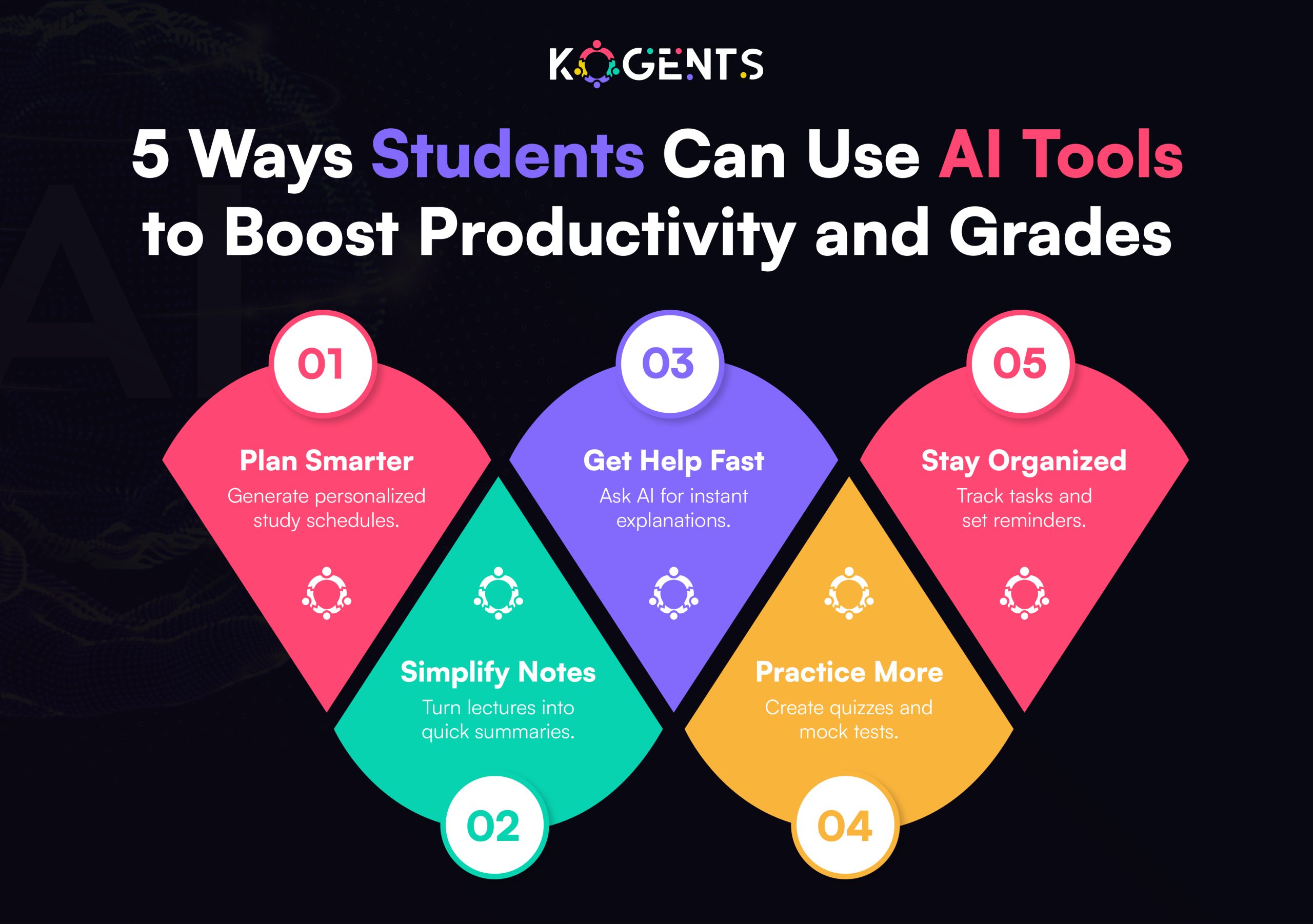
    1. Personalized Learning Plans

    AI dynamically generates individualized day-by-day study plans, customized learning content, pace, and structure to a student’s strengths, weaknesses, and goals.

    2. Real-Time Tutoring Assistance

    With student AI assistants, learners receive instant clarification and explanation of concepts in any subject area, making AI comparable to a personal tutor.

    3. Study Guide Automation

    AI converts complex chapters, lecture notes, or video content into digestible formats: bullet summaries, mind maps, or flashcards.

    4. Intelligent Resource Curation

    The agent finds the most relevant videos, articles, and interactive content to reinforce weak areas based on user behavior and knowledge gaps.

    5. Multilingual and Accessibility Support

    AI can translate materials, simplify vocabulary, and support learners with disabilities through voice, subtitles, and screen readers.

    6. Gamification Mechanics

    Motivational triggers like badges, learning streaks, point systems, and real-time progress bars drive long-term engagement.

    7. Conversational Interfaces

    With WhatsApp bots, web widgets, or app integrations, student AI chatbots are accessible anywhere, anytime.

    8. Ethical Monitoring and Plagiarism Checks

    Agents integrate with tools like Turnitin and Copyleaks to uphold academic integrity, detect AI-generated submissions, and suggest citations.

    9. Data Dashboards for Instructors

    Real-time analytics and visualizations help educators monitor cognitive load, engagement rates, and risk of dropout.

    ai for students tools

    How AI for Students Will Redefine Education? 

    1. Scalability

    A single AI agent can tutor thousands of students simultaneously, with consistent quality and responsiveness.

    2. Availability and Convenience 

    AI agents are available 24/7, breaking the time, cost, and location barriers of traditional learning. Students in remote or underserved regions gain access to the same high-quality support.

    3. Equity Education

    By offering personalized support at scale, AI closes the achievement gap for students with different socioeconomic backgrounds or learning abilities.

    4. Encouraging Meaningful Participation

    AI introduces gamification, microlearning, and interaction loops that keep students focused and intrinsically motivated.

    5. Teacher Empowerment

    Rather than replacing educators, AI empowers them by automating grading, tracking, and content distribution, allowing more time for mentorship.

    6. Impactful Learning Outcomes

    Adaptive algorithms ensure learners focus on mastery rather than memorization, leading to higher retention and performance.

    7. Cost Friendly

    For educational institutions and solopreneurs, AI reduces the need for large administrative teams, manual tutoring, and customer support infrastructures.

    Students in AI-enhanced active learning programs achieve 54% higher test scores than those in traditional environments.

    Constraints and Considerations of AI in Education

    1. Bias and Fairness

    AI models can replicate and amplify biases present in training data, affecting grading, recommendations, or feedback, especially for marginalized groups.

    2. Privacy and Data Protection

    Student interactions are data-rich. Without strict compliance with FERPA, GDPR, and local school policies, institutions risk data misuse or breaches.

    3. Over-reliance and Dependency

    Some students may become overly dependent on AI tools, reducing opportunities to build independent problem-solving and critical thinking skills.

    4. Academic Misuse

    AI-generated essays or answers raise serious academic integrity concerns. Plagiarism detection is essential but not foolproof.

    5. Teacher Training and Infrastructure Gaps

    Many schools lack the technical infrastructure or professional development programs needed for smooth AI integration.

    Teachers using AI for administrative tasks save 44% of their time on research, lesson planning, and material creation.

    AI Agents vs Other Tools

    Feature AI Agents Traditional Tools LMS Platforms Live Tutors
    Personalization High Low Medium High
    Scalability Very High Low High Low
    Cost-efficiency High (once deployed) Medium Medium Low
    Real-time Feedback Yes No Sometimes Yes
    Availability (24/7) Yes No Yes No
    Data-Driven Insights Yes No Yes No
    Plagiarism Detection Yes No Sometimes No
    Adaptive Learning Yes No Partial Yes

    Future Directions for Student AI Support

    The next decade will witness AI as a foundational pillar of educational ecosystems. Here’s what lies ahead:

    1. Human-AI Collaboration in Classrooms

    Teachers will increasingly co-teach with AI, where agents handle assessments and feedback while humans focus on creative and emotional development.

    2. Universal AI Literacy

    • Understanding how AI works will be as fundamental as math or reading. 
    • AI literacy will be embedded into K-12 and higher education curricula.

    3. Long-Term AI Mentorship

    AI tutors will follow students across academic years, learning their evolving strengths and weaknesses, and becoming lifelong companions.

    4. Contextual Memory and Learning Transfer

    Future agents will retain history across sessions, improving personalization, retention, and contextual understanding of student progress.

    5. Global Access and Multilingual Support

    Voice-based AI tutors with offline capabilities will serve rural and non-English-speaking regions, bridging global education gaps.

    Case Study Spotlight: Squirrel AI (China)

    Squirrel AI, one of China’s leading EdTech platforms, uses an advanced adaptive learning engine built on AI to personalize education for K-12 learners. 

    Founded in 2014, it delivers AI tutoring that adapts to each student’s learning needs in real-time.

    Squirrel AI demonstrates how student AI applications can drastically improve efficiency, engagement, and equity in large-scale deployments.

    Outcomes:

    • 400% improvement in learning efficiency compared to traditional classrooms (according to company case studies).
    • Students using Squirrel AI mastered subjects in half the time of their peers.
    • Teachers reported better classroom dynamics when AI handled pre-instruction and assessments.

    Empower Students and Educators with Kogents AI!

    The classroom is no longer bound by walls, and education is no longer one-size-fits-all. The rise of AI for students is revolutionizing the way we teach, learn, and grow, offering personalized, scalable, and ethical solutions for every type of learner. 

    Whether you’re a solopreneur designing micro-courses, an EdTech entrepreneur building the next big platform, or an educator striving to meet increasing demands, AI is no longer a luxury but a necessity.

    For entrepreneurs, AI streamlines course creation and scales operations without sacrificing quality. 

    For students, it means a richer, more engaging experience that adapts to their pace and style of learning.

    At Kogents.ai, we believe the future of education belongs to those who embrace AI now. 

    We empower educators, creators, and students with tools that make learning more efficient, scalable, and impactful.

    Don’t wait for the future to pass you by; start your AI for students journey today with Kogents AI and drop an email at info@portal.kogents.ai, or give us a call at (267) 248-9454, and help shape the next era of education.

    FAQs

    What is AI for students, and how does it work?

    AI for students refers to tools and systems powered by artificial intelligence that assist learners with tutoring, feedback, organization, and content deliver1y, using technologies like machine learning and NLP.

    What are the best AI tools for students in 2025?

    Top tools include ChatGPT, Grammarly, Khanmigo, QANDA, and Notion AI, offering diverse capabilities from writing assistance to math problem-solving.

    How can students use AI ethically?

    Students should use AI as a learning enhancer, not a replacement. Always cite sources, avoid AI-generated plagiarism, and follow school guidelines on academic integrity.

    Is there a free AI homework helper for students?

    Yes, platforms like ChatGPT (free tier), Socratic by Google, and Khan Academy offer AI-powered homework help at no cost.

    How does AI improve personalized learning for students?

    AI tailors content, pacing, and feedback based on individual performance and behavior, helping students master topics more efficiently.

    What’s the difference between AI tutors and traditional tutors?

    AI tutors are available 24/7, scalable, and consistent, while human tutors offer emotional intelligence and adaptability. The best outcomes often come from hybrid models.

    Can AI detect and prevent cheating?

    Yes, AI tools like Turnitin use plagiarism detection and pattern analysis to identify AI-generated content and flag dishonest behavior.

    What’s the role of AI in higher education institutions?

    Colleges use AI for admissions insights, course recommendations, risk alerts, and academic advising to support student success.

    Are there region-specific AI tools (e.g., Pakistan or India)?

    Yes, apps like Brainly, Toppr, and Byju’s have regionalized AI features, and global tools like ChatGPT now support regional languages and exam formats.

    How do I choose the right AI tool for my academic needs?

    Consider your subject, learning style, budget, and privacy preferences. Use comparison charts, reviews, and test trials to decide.

  • Artificial Intelligence Dashboards vs Business Intelligence Tools: What’s the Difference?

    Artificial Intelligence Dashboards vs Business Intelligence Tools: What’s the Difference?

    With so much buzz around AI-powered solutions, many business owners are asking: What’s the real difference between an AI dashboard and traditional BI tools? 

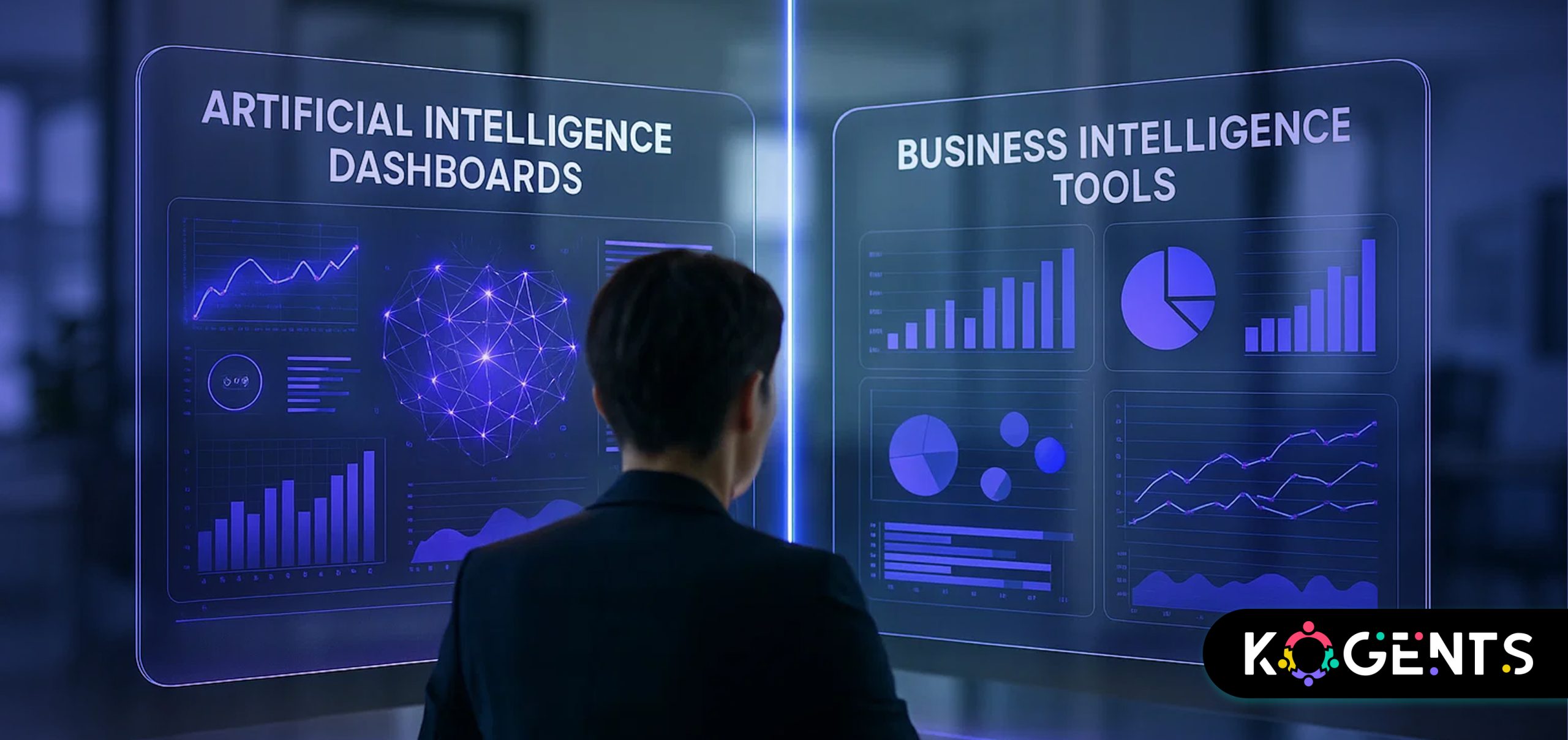
    The rise of artificial intelligence dashboards has transformed how businesses approach data visualization, analytics, and decision-making. At the same time, business intelligence (BI) tools remain the backbone of reporting and data analysis in organizations of all sizes. 

    This comprehensive guide dives deep into the comparison, offering actionable insights for entrepreneurs and solopreneurs who want to leverage data for growth, efficiency, and innovation. 

    So, let’s delve into this valuable insight now! 

    Key Takeaways

    • Understanding how AI dashboards differ from traditional BI tools.
    • Learning why combining BI and AI creates better business decisions.
    • Exploring real-world examples of AI dashboards in business, healthcare, and education.
    • Discovering how entrepreneurs can save time and make smarter decisions with AI.
    • Knowing the challenges and future trends of AI-powered analytics.

    Artificial Intelligence Dashboards vs Business Intelligence Tools?: Know The Difference 

    An artificial intelligence dashboard is a data visualization interface powered by machine learning and AI models. 

    It goes beyond traditional BI dashboards by offering predictive analytics, real-time anomaly detection, and even natural language querying (NLQ) so users can ask questions in plain English and get instant answers.

    Moreover, these AI dashboards leverage deep learning, neural networks, and cognitive computing to recommend actions, detect trends, and forecast outcomes.

    In contrast, business intelligence tools like Tableau, Power BI, and Looker primarily focus on descriptive analytics. 

    They provide a clear, organized view of past and present data through charts, graphs, and scorecards. 

    While many BI tools now include some AI features, their primary function is to consolidate, clean, and visualize data for human interpretation.

    In short, BI tools answer the question “What happened?” whereas AI dashboards are designed to answer “What’s likely to happen next?” and “What should we do about it?”

    Artificial Intelligence Dashboards vs Business Intelligence Tools

    Why Entrepreneurs & Solopreneurs Need Artificial Intelligence Dashboards vs Business Intelligence Tools? 

    Entrepreneurs and solopreneurs face unique challenges: limited manpower, tight budgets, and the constant need for speed. 

    Artificial intelligence dashboards offer a competitive edge by combining automation, predictive analytics, and intuitive interfaces. 

    They minimize manual effort, freeing up founders to focus on strategy. 

    For example, a solopreneur running an e-commerce shop can use an AI dashboard for marketing analytics to instantly see which ad campaigns are delivering ROI and automatically adjust budgets.

    A traditional BI tool would still require them to manually set up reports, filter datasets, and interpret trends.

    Key Advantages for Entrepreneurs:

    • Proactive Decision-Making: AI dashboards highlight anomalies and predict future outcomes, enabling founders to act before problems escalate.
    • Accessibility: Natural language queries make data analysis accessible even to those without technical expertise.
    • Operational Efficiency: AI can automate reporting cycles, recommend resource allocation, and provide early warnings.
    • Growth Insights: Predictive analytics uncover new market opportunities and customer segments.

    BI tools are still essential, particularly for compliance, financial planning, and deep-dive historical reporting. 

    Together, they provide a complete ecosystem, BI for clarity of what happened, and AI dashboards for foresight into what’s coming next.

    The global business intelligence market was valued at USD 29.42 billion in 2023 and is projected to grow to USD 54.27 billion by 2030, with a CAGR of ~9.1%. 

    How Artificial Intelligence Dashboards vs Business Intelligence Tools Work in Business, Healthcare, and Education? 

    AI dashboards and BI tools work differently but complement each other in key sectors:

    Business:

    • AI Dashboards: Provide real-time monitoring of sales, inventory, and customer behavior. Predictive models anticipate demand spikes and recommend pricing adjustments.
    • BI Tools: Generate historical sales performance reports, customer lifetime value calculations, and P&L statements for investors.

    Healthcare:

    • AI Dashboards: Forecast patient admissions, flag potential equipment failures, and identify population health trends using machine learning.
    • BI Tools: Create compliance dashboards for regulatory audits, monitor historical patient outcomes, and track the financial performance of departments.

    Education:

    • AI Dashboards: Spot at-risk students early by analyzing attendance, grades, and behavioral data. Recommend personalized learning paths.
    • BI Tools: Provide enrollment trend analysis, graduation rates, and funding utilization reports.

    Catch-point: In each case, AI dashboards excel at real-time, forward-looking actions, while BI tools remain critical for structured, historical understanding.

    Core Features of Artificial Intelligence Dashboards vs Business Intelligence Tools

    AI Dashboard Features:

    • Predictive Modeling: Uses machine learning to forecast outcomes (e.g., sales, patient load).
    • Prescriptive Recommendations: Suggests next steps based on data patterns.
    • Natural Language Query: Allows users to ask questions conversationally.
    • Automated Alerts: Notifies users of anomalies or opportunities.
    • Adaptive Learning: Improves accuracy over time as models are retrained.
    • Real-Time Data Processing: Enables instant insights from live data streams, and when paired with an AI agent dashboard, can immediately trigger next steps such as sending alerts or initiating automated actions.

    BI Tool Features:

    • ETL and Data Cleansing: Ensures data accuracy and reliability.
    • Custom Reporting: Supports deep-dive analysis and customizable dashboards.
    • Interactive Visualization: Provides drill-down capabilities for exploration.
    • Governance: Role-based access control and audit trails.

    About 75% of businesses now rely on cloud-based BI solutions. 

    Comparison: AI dashboards redefine decision-making by suggesting actions, whereas BI tools provide the data context for those actions. Together, they close the loop from insight to execution.

    Use Cases for Entrepreneurs, Solopreneurs & Healthcare

    For Entrepreneurs & Solopreneurs:

    • Marketing Analytics: AI dashboards for marketing analytics can identify which campaigns drive the highest ROI and recommend budget shifts.
    • Sales Forecasting: AI dashboards for sales performance can help founders prioritize leads based on conversion probability.
    • Operations Monitoring: A dashboard with AI insights can monitor supply chain metrics and alert when inventory is low.

    For Healthcare Providers:

    • Predictive Patient Care: AI dashboards can forecast admission surges, enabling better resource planning.
    • Clinical Quality Tracking: Real-time monitoring of key health outcomes can improve compliance.
    • Mental Health Support: AI-driven dashboards can track therapy session attendance and flag risks for early intervention.

    artificial intelligence dashboard automation

    Benefits of Artificial Intelligence Dashboards vs Business Intelligence Tools

    • Enhanced Agility: Respond to market changes in real time.
    • Data-Driven Culture: Empower every team member to make informed decisions.
    • Improved Forecast Accuracy: Use predictive modeling to plan with confidence.
    • Competitive Advantage: Spot opportunities earlier than competitors.
    • Time Savings: Automate routine analysis and reporting tasks.

    Key Highlight: When combined with BI tools, these benefits expand to cover both operational oversight and strategic forecasting, giving entrepreneurs and solopreneurs an edge.

    Challenges & Limitations of Artificial Intelligence Dashboards vs Business Intelligence Tools

    • Model Bias: Poorly trained models can lead to skewed recommendations.
    • Complex Implementation: Integrating data pipelines can be resource-intensive.
    • Cost Barrier: High-quality AI dashboard software may be priced out of reach for early-stage startups.
    • Data Security: Sensitive healthcare or education data requires strong compliance protocols.
    • Adoption Hurdles: Employees may resist trusting AI-generated insights until they see consistent accuracy.

    Key Note: These challenges highlight the importance of pairing AI dashboards with solid BI infrastructure and data governance practices.

    Artificial Intelligence Dashboards vs Business Intelligence Tools vs Other Tools

    Feature/Aspect AI Dashboard Business Intelligence Tool Other Tools (Spreadsheets, Static Reports)
    Focus Predictive & prescriptive insights Descriptive analytics Raw data & manual analysis
    Automation High (automated recommendations) Medium (manual analysis needed) Low
    Interactivity Conversational (NLQ) & adaptive Interactive filters & drilldowns Static
    Data Freshness Real-time or near real-time Periodic refresh Manual updates
    Complexity AI/ML-driven Data modeling & visualization Minimal
    Best For Entrepreneurs seeking growth insights, healthcare forecasting, and proactive decisions Structured historical analysis, compliance, and reporting Ad-hoc calculations

    Artificial Intelligence Dashboards vs Business Intelligence Tools: Know The Future!

    The future is not about AI dashboards replacing BI tools, but about convergence. Expect to see:

    • Unified Platforms: BI tools with built-in predictive modeling and embedded AI dashboards in BI.
    • Explainable AI: Greater transparency into how predictions are made.
    • Conversational Interfaces: More intuitive voice and chat-based analytics.
    • Autonomous Decision Support: Systems that not only recommend but also automate actions.
    • Sector-Specific Solutions: Tailored AI dashboards for healthcare, education, and small business growth.
    What You Need to Know? As these technologies mature, businesses, clinics, and schools will experience a paradigm shift toward data-driven, automated decision-making.

    Case Study 1: Startup Scaling with an AI Dashboard

    A SaaS startup implemented an AI business dashboard integrated with HubSpot and Stripe. Within 3 months, they:

    • Reduced churn by 18% using predictive models.
    • Increased MRR forecasting accuracy by 25%.
    • Saved 12 hours per week on manual reporting.

    Case Study 2: Clinic Improving Outcomes

    A mental health clinic used an AI analytics dashboard to monitor therapist workloads and patient wait times. The system predicted no-show probabilities and sent reminders, reducing no-shows by 30%.

    Closing Remarks! 

    For entrepreneurs and solopreneurs, the question isn’t whether to choose between AI dashboards and BI tools; it’s how to leverage both strategically. 

    Artificial intelligence dashboards offer agility, predictive insight, and automation, making them ideal for fast-moving businesses. 

    BI tools provide structured analysis, governance, and historical context, ensuring decisions are grounded in reliable data.

    Businesses that embrace this dual approach are future-proofing their operations. 

    Entrepreneurs gain clarity and speed, solopreneurs reclaim precious time, and healthcare providers improve outcomes. 

    The future belongs to those who not only see what has happened but act confidently on what will happen next. 

    Kogents.ai empowers you to do exactly that, turning raw data into actionable intelligence and helping you stay ahead in an increasingly competitive landscape.

    So, drop an email at info@portal.kogents.ai or give us a call at (267) 248-9454. 

    FAQs

    What is an artificial intelligence dashboard?

    An AI dashboard is an intelligent dashboard that uses machine learning to provide predictive insights, recommendations, and real-time alerts.

    How does an AI dashboard work?

    It connects to your data sources, applies AI/ML models, and visualizes insights through interactive charts and natural language interfaces.

    AI dashboard vs BI dashboard: What’s the difference?

    BI dashboards show historical data; AI dashboards predict trends and recommend actions.

    What are the best AI dashboard tools for 2025?

    Tools like Tableau (with AI features), Power BI, Databricks, and Polymer offer strong AI integrations.

    Can I use an AI dashboard for marketing analytics?

    Yes, you can track campaign ROI, recommend budget shifts, and forecast customer acquisition.

    What are the risks of AI dashboards?

    Bias, data privacy issues, and explainability are key concerns.

    Are there free AI dashboard tools?

    Yes, some platforms offer free tiers, but enterprise-grade features may require paid plans.

    How do AI dashboards integrate with BI tools?

    They can embed directly within BI platforms or work as standalone predictive layers.

    What industries benefit most from AI dashboards?

    Retail, healthcare, education, SaaS, and financial services benefit the most.

    What are AI dashboard design best practices?

    Keep it simple, prioritize real-time data, use NLQ for accessibility, and ensure explainability for trust.


  • How an automated grading system handles scalability

    How an automated grading system handles scalability

    Education and business are experiencing a digital revolution, and automated grading systems are at the forefront of this transformation. 

    As schools, universities, and online platforms scale globally, the demand for accurate, fair, and efficient grading has skyrocketed. Traditional manual grading simply can’t keep up with the massive surge in online exams, essays, and digital learning assessments.

    This is where AI-driven automated grading software shines. 

    It ensures not only speed and accuracy but also scalability, the ability to handle thousands, even millions, of assessments across diverse learning environments without sacrificing quality. For entrepreneurs, solopreneurs, and educators, understanding this technology is essential to staying ahead in the ever-expanding EdTech landscape.

    Key Takeaways

    • Understanding how automated grading systems make large-scale assessments faster and more efficient.
    • Learning why instant, consistent feedback is key to improving student motivation and performance.
    • Exploring how these systems save educators time and reduce grading stress.
    • Discovering how AI-powered tools handle peak loads and maintain fairness.
    • Seeing how scalable grading supports growth for courses, bootcamps, and EdTech platforms.

    What Are AI Agents in Automated Grading Systems?

    At the heart of today’s automated grading system are AI agents, intelligent software modules designed to mimic human evaluators. 

    They rely on machine learning (ML), natural language processing (NLP), and deep learning models to analyze student responses, essays, and exam answers.

    Think of AI agents as virtual teaching assistants that never tire. They can:

    • Score multiple-choice tests with computerized assessment systems.
    • Evaluate essays using automatic essay scoring systems.
    • Provide instant feedback via intelligent assessment platforms.

    Pro Tip for Entrepreneurs: If you’re building a learning product, consider integrating AI agents into your Learning Management System (LMS) for seamless scaling.

    Why Entrepreneurs, Solopreneurs & Educators Need an Automated Grading System

    At its core, an automated grading system uses AI to evaluate assessments (MCQs, short answers, essays, code, and more) and return scores + feedback with minimal human touch. 

    For fast-growing programs, bootcamps, MOOCs, corporate academies, and district-wide rollouts, manual grading quickly becomes the bottleneck. 

    Soft-reminder: AI grading removes that bottleneck, so you can scale without multiplying graders.

    The business case

    • Throughput at peak load: Run thousands of submissions per minute with cloud auto-scaling instead of paying weekend overtime.
    • Consistency: The same rubric, the same outputs, every time, reduces variability that creeps in with large grader teams. Studies have shown that, in certain contexts, automated essay scoring can match or exceed human-to-human agreement, especially for well-defined writing tasks.
    • Time-to-feedback: Faster feedback improves learner momentum and retention—critical for subscription or cohort models.
    • Data at your fingertips: Item-level analytics, rubric dimensions, and error categories surface what to fix in your content.

    Educator’s angle

    Teachers reclaim hours to focus on higher-order feedback and mentoring

    Many platforms embed grading directly into the LMS workflow to centralize progress, regrading, and reporting. 

    Soft reminder: if your courses spike (e.g., viral enrollments), you can’t “staff-up” graders overnight, then know that Automation is capacity insurance.

    How AI Agents Work in an Automated Grading System to Handle Scalability?

    1. Ingestion via LMS/CBT: Submissions enter through your LMS or testing platform (web, mobile, proctoring app).
    2. Queue + Orchestration: Jobs land in a task queue (e.g., XQueue in Open edX) to decouple submission from scoring, smooth spikes, and support retries.
    3. Model services:

      • Objective items (MCQ/TF): deterministic keys and item banks.
      • Short answers: semantic matching + pattern rules + answer grouping. (Turnitin’s Gradescope groups similar answers for bulk actions.)
      • Essays: NLP models (feature-based + neural) extract grammar, organization, development, and coherence features, then predict a score aligned to a rubric.

    Example: ETS’s e-rater is a canonical example.

    • Programming tasks: sandboxed autograders (often Docker-based) run test suites and return structured feedback. 

    Example: Coursera’s autograder toolkit illustrates the approach.

    1. Feedback generation: Trait-level comments and rubric-aligned notes get assembled into a human-readable response.
    2. Storage + Reporting: Scores, rubrics, and analytics write back to the LMS gradebook with dashboards for instructors/ops. 
    3. Auto-scaling: Cloud instances scale horizontally as queues grow, enabling burst capacity during deadlines.

    Why does this scale?

    • Stateless model endpoints + asynchronous queues absorb spikes.
    • Batch + streaming modes let you prioritize “instant results” or cost-efficient overnight runs.
    • Cache + shard by course or assessment to keep latency low and costs bounded.

    Reality check: For free-response writing, credible vendors combine AI + human review at the edges (spot checks, appeals) to maintain trust and address nuanced prompts. ETS

    Core Features of Modern AI Agents in Grading Systems 

    • Rubric alignment & explainability. The model doesn’t just output a number; it maps to rubric criteria (organization, mechanics, development). 

    ETS’s e-rater explicitly extracts features tied to writing constructs, supporting transparency in feedback.

    • Answer grouping & bulk actions. Cluster similar short answers to apply one decision to hundreds at once (Gradescope’s well-known timesaver).
    • Human-in-the-loop (HITL). Smart escalation when confidence is low, plus regrading and appeals.
    • Bias and drift monitoring. Track subgroup error rates and model drift; apply mitigations and periodic recalibration. 

    Example: Brookings outlines practical bias-mitigation frames you can adapt.

    • Security & integrity hooks. Proctoring data, audit trails, and anomaly detection (e.g., sudden answer-time spikes).
    • Content-aware feedback. Trait-level comments, error highlights, and suggestions that teach (not just score).
    • DevOps for ML. Canary models, versioned rubrics, offline validation suites, and rollback plans.
    • LMS integration. Gradebook sync, regrade APIs, and role-based access to keep ops lightweight. 

    Example: Open edX illustrates external grader patterns.

    Use Cases for Entrepreneurs, Solopreneurs & Educators

    Entrepreneurs (EdTech founders).

    • SaaS assessment platforms: White-label your AI-powered grading for schools and training orgs.
    • Marketplace instructors: Let creators import rubrics and auto-grade at scale; monetize via per-assessment pricing.
    • Certification engines: Mix secure proctoring with AI scoring to run rolling, global exams.

    Solopreneurs (cohort/course creators).

    • Bootcamps & nano-degrees: Autograde code + quizzes; use answer grouping on short answers to reduce your weekend grading.
    • Content accelerators: Get instant analytics on what learners miss, then re-record only the weak spots.

    Educators (K-12/Higher-Ed)

    • Large sections/MOOCs: Scale to thousands with LMS-native autograding and AI agents for education or external graders (Open edX, Coursera).
    • Writing-intensive courses: Use AI to triage grammar/organization issues, then focus human time on argument quality. (e-rater/IEA shows how NLP supports this.)

    Corporate L&D.

    • Skills verification: Code, case analyses, and scenario responses auto-scored with structured rubrics and immediate coaching tips.
    • Compliance at scale: Rapid, consistent scoring across regions/time zones.

    Benefits of Automated Grading Systems for Scalability

    • Speed + consistency: Feedback within minutes, with stable rubric adherence—even at 10× volume. Research shows AES can reliably approximate human raters in many settings, making turnaround times practical at scale.
    • Operational elasticity: Cloud auto-scaling absorbs deadline rushes without pre-booking graders.
    • Learning analytics: Item-level difficulty, distractor analysis, rubric-dimension trends, content decisions become data-driven.
    • Teacher time reclaimed: Shift human effort to coaching, projects, and interventions.
    • Global reach: Multilingual assessment pipelines (speech + writing) already exist in vendors like Pearson (Versant, IEA).

    automated grading system

    Automated Grading System vs Other Tools (Comparison Table)

    Feature Automated Grading System Traditional Grading Outsourced Grading
    Speed Instant Slow Moderate
    Scalability High (cloud-enabled) Limited Medium
    Cost Lower long-term High High
    Accuracy Consistent, bias-checked Human error Variable
    Feedback Rich + instant Delayed Delayed

    Challenges & Limitations of Automated Grading Systems

    Validity of complex writing

    • AI excels at structure/grammar features but can miss argument quality or originality. 
    • Critics like Les Perelman have shown ways to “game” some AES engines with length and obscure vocabulary, underscoring the need for human oversight in high-stakes contexts. 

    Bias and fairness

    • Models trained on historical data may reflect subgroup biases
    • Adopt bias detection/mitigation practices and publish impact assessments. 

    Transparency & appeals

    • Learners (and accreditors) need explanations and a clear appeal path. 
    • Prefer vendors that expose trait-level rationales and support regrading workflows. 

    Data privacy & governance

    Follow global guidance (e.g., UNESCO’s 2023 recommendations) for human-centered AI, data minimization, and teacher/student agency. 

    Over-automation risk

    Avoid “set-and-forget.” Use confidence thresholds to blend AI speed with human judgment where it matters most.

    Implementation guardrails (use in your policy).

    • Publish your rubrics, model versions, and regrade SLAs.
    • Log all scoring events; sample N% for human audit.
    • Report disparity metrics (e.g., score error by subgroup) each term.

    automated grading system

    Future of Automated Grading Systems for Scalable Education

    Expect AI-first pipelines with human review on edge cases. Neural models will keep improving, but governance will tighten.

    What’s coming next?

    • Richer explainability: Model rationales tied directly to rubric evidence.
    • Generative feedback: Drafting actionable, formative advice that teachers can approve or amend.
    • Policy alignment: Systems embody ethical, human-centric standards like those advocated by UNESCO—privacy, equity, transparency. UNESCO+1
    • Plug-and-play grading stacks: Standardized APIs between LMS, proctoring, identity, and AI scoring, reducing vendor lock-in.

    Founder tip: choose vendors with clear roadmaps for explainability and compliance—those will age well under emerging AI policies.

    Case Study Spotlight (Mini, Practical, and Verifiable)

    1) ETS e-rater (high-volume writing assessment).

    What it does: Extracts features (grammar, mechanics, organization, lexical complexity) and predicts rubric-aligned writing scores; used alongside human raters for exams like TOEFL/GRE.

    Scalability angle: Stateless scoring + strong agreement with human raters for appropriate tasks; supports fast turnaround for global test windows. 

    2) Turnitin Gradescope

    AI-assisted answer grouping clusters similar responses so instructors grade a group once, then apply across hundreds of papers.

    Scalability angle: Massive time savings in large STEM and CS courses; supports paper-based or digital workflows; integrates into institutional LMS. 

    3) Open edX & Coursera

    • Open edX supports external autograders via XQueue, enabling scalable code testing and automated feedback.
    • Coursera uses auto-graded quizzes and has introduced AI-assisted peer review to speed and scale qualitative feedback.
    • Scalability angle: Queue-based async processing and containerized graders (e.g., Docker) allow courses to expand to tens of thousands without reviewer backlogs.

    4) Pearson

    Intelligent Essay Assessor (IEA) scores essays/short answers; Versant auto-scores spoken language.

    Scalability angle: Multi-skill assessment (writing + speaking) at global test volumes, reducing cycle time to results.

    Action Panels 

    Pro Tips (fast wins)

    • Start with hybrid: auto-grade everything, human-review 10–20% of low-confidence cases.
    • Require rubric-aligned explanations in feedback to build trust.
    • Set SLOs: median turnaround under 5 minutes; 99th-percentile under 30 minutes during peak.

    ROI Box

    • Cost drivers: grader hours, regrading rounds, learner support load.
    • Savings levers: answer grouping, rubric libraries, instant feedback (fewer tickets), reduced churn from slow grades.
    • Rule of thumb: If you cross 500+ submissions/week, automation typically pays for itself (via time saved + retention uplift).

    Before You Leave! 

    If you’re scaling fast or aiming to, grading shouldn’t be the bottleneck holding you back. 

    A thoughtfully designed automated grading system delivers speed, consistency, and deep analytics, while a human-in-the-loop approach ensures trust and fairness in high-stakes evaluations. 

    The result? More time to teach, coach, innovate, and grow your business instead of drowning in manual work.

    Here, we empower entrepreneurs, solopreneurs, educators, teachers, learners, and students with tools that make grading smarter, scalable, and more impactful. Whether you’re running a micro-course or an entire EdTech platform, we help you focus on what matters most: creating transformative learning experiences.

    Don’t let grading limit your growth. Partner with Kogents AI today and drop an email at info@portal.kogents.ai or give us a call at (267) 248-9454 and redefine what’s possible for your classroom, your students, and your business.

    FAQs

    How do automated grading systems work?

    They use AI, ML, and NLP to analyze and score student responses digitally.

    What are the benefits of using AI for grading exams?

    Faster turnaround, reduced costs, and consistent accuracy.

    How accurate are automated grading systems compared to humans?

    Up to 90% accurate, though oversight is recommended for essays.

    What are the limitations of automated grading systems?

    Bias, data privacy risks, and difficulty with creative writing.

    Can small businesses use automated grading software?

    Yes, solopreneurs and startups can integrate it into online courses.

    What is the difference between automated grading and traditional grading?

    Automated grading is faster, scalable, and data-driven; traditional grading is slower and labor-intensive.

    What is the cost of implementing an automated grading system?

    Varies, SaaS models start from a few hundred dollars monthly.

    What companies provide AI-powered grading software?

    Pearson, ETS, Turnitin, Google Cloud AI, Microsoft Azure Cognitive Services.

    Is AI grading ethical?

    Yes, but institutions must address bias, transparency, and accountability.

    How will automated grading systems evolve in the future?

    Expect hybrid human-AI models, adaptive testing, and blockchain for secure exams.


  • How AI for Teachers Defines the Future of Faculty Support

    How AI for Teachers Defines the Future of Faculty Support

    From lesson planning and classroom management to grading automation and personalized learning, artificial intelligence is transforming how teachers, faculty members, and even education entrepreneurs operate.

    For entrepreneurs and solopreneurs exploring the education market, AI-powered teacher tools represent both a massive business opportunity and a way to address long-standing challenges in the teaching profession. 

    Faculty around the world are seeking solutions that reduce administrative load, improve teaching outcomes, and create more engaging student experiences. With educational technology (EdTech) advancing rapidly, AI has emerged as the most powerful driver of faculty efficiency, creativity, and resilience.

    This article dives deep into how AI for teachers defines the future of faculty support, why it matters to education entrepreneurs, and how it will shape learning ecosystems in higher education and lifelong learning.

    Key Takeaways

    • Understanding how AI tools transform lesson planning, grading, and classroom management.
    • Discovering the time-saving benefits that allow teachers to focus on students.
    • Learning how adaptive AI systems personalize learning for every student.
    • Exploring new opportunities for entrepreneurs in the growing EdTech market.
    • Recognizing the importance of ethical, teacher-centered AI adoption.

    Learn First: What Is AI for Teachers?

    At its core, AI for teachers refers to the use of artificial intelligence in education to augment, support, and enhance the teaching process. 

    Unlike traditional digital learning tools, AI uses adaptive learning systems, machine learning models, and natural language processing to create intelligent, responsive solutions for faculty.

    Examples include:

    Why Entrepreneurs & Solopreneurs Need AI for Teachers? 

    Education is one of the world’s largest industries, and entrepreneurs who understand the growing demand for AI tools for teachers can position themselves at the heart of this transformation.

    Key Opportunities for Entrepreneurs:

    Faculty Productivity Solutions
    Teachers spend nearly 50% of their time on non-teaching tasks. AI systems that handle automated grading, attendance, and curriculum design open a multi-billion-dollar efficiency market.

    Scalable Platforms for Schools
    AI for schools, especially in K–12 education, creates scalable opportunities to design tools that districts and governments can deploy widely.

    Personalized Learning Ventures
    AI enables smart learning platforms and AI tutoring systems that adapt to student needs, appealing to solopreneurs building specialized EdTech products.

    Bridging Academia and Business
    Higher education faculty require sophisticated curriculum planning software and AI for higher education teachers

    Note: Entrepreneurs can deliver platforms that improve both pedagogy and research.

    How AI Agents Work in Business & Faculty Support?

    AI agents are autonomous systems powered by machine learning that act as intelligent co-pilots for teachers. 

    They analyze large sets of educational data, identify patterns, and execute tasks without constant human supervision.

    How They Support Faculty:

    • Lesson Planning: AI agents curate resources, recommend teaching strategies, and create adaptive lesson structures.
    • Classroom Analytics: Using learning analytics, AI agents provide insights into student performance and flag at-risk learners.
    • Administrative Relief: By automating scheduling, grading, and communication, teachers reclaim valuable teaching time.
    • Professional Development: Faculty can use AI to access tailored upskilling programs and generate research summaries.

    Catch Point! The parallel between faculty support and business productivity means entrepreneurs can design AI solutions that work seamlessly across both domains.

    ai for teachers

    What Modern AI Agents Bring to the Classroom

    1. Adaptive Learning Technology
    Adjusts teaching pace and style to individual student needs.

    2. Natural Language AI Chatbots
    Provides real-time student support and faculty Q&A systems.

    3. Automated Grading & Feedback
    Saves hours of teacher time while ensuring consistency.

    4. Curriculum Alignment
    AI ensures lesson plans meet local, national, or international education standards.

    5. Smart Learning Platforms
    Integrates with Google Classroom, Microsoft Teams for Education, and other classroom technology.

    6. Faculty Productivity Tools
    AI streamlines tasks like scheduling, report generation, and content curation.

    Use Cases for Entrepreneurs, Solopreneurs & Educators

    • AI in K–12 Education: Automating attendance, grading homework, and customizing lessons for diverse learners.
    • AI for Higher Education Teachers: Supporting research, creating adaptive course modules, and managing large student groups.
    • AI Tutoring Systems: Building direct-to-student platforms that provide affordable, 24/7 academic support.
    • Faculty Training Programs: Solopreneurs can design EdTech AI platforms that teach teachers how to use AI effectively.
    • Classroom Management: AI tools track student engagement and help educators design interventions.

    Case Study: 

    A U.S. school district implemented AI grading tools that reduced teacher grading hours by 60%. 

    Teachers used the extra time for small-group interventions, improving student literacy rates by 15% in one academic year.

    ai for teachers

    Why Teachers Need AI Agents Now: Key Advantages

    The adoption of AI for teachers brings a transformative range of benefits that extend beyond simple convenience. 

    These advantages touch on efficiency, instructional quality, student engagement, and even the long-term sustainability of the teaching profession.

    1. Time Savings

    One of the most significant impacts of an AI agent for education is its ability to free teachers from repetitive, time-consuming tasks.

    • AI grading tools can evaluate essays, assignments, and multiple-choice tests in seconds, offering constructive feedback aligned with rubrics. 
    • Similarly, AI lesson planning software generates curriculum-aligned materials in minutes, helping teachers prepare faster without sacrificing quality. 
    • Studies show that teachers can reclaim 5–10 hours per week, time they can reinvest into personalized instruction, mentoring, or professional development.

    2. Adaptive Learning For Students 

    • AI’s ability to adapt to individual student needs is reshaping classrooms. Adaptive learning systems analyze performance in real time, identifying strengths, weaknesses, and knowledge gaps. 
    • Instead of a one-size-fits-all approach, students receive tailored resources, additional practice, or advanced challenges depending on their progress. 
    • This ensures that no student is left behind while allowing high-achievers to accelerate. 
    • Teachers can then use AI insights to design targeted interventions, making learning more equitable and effective.

    3. Consistency in Grading and Feedback

    • Traditional grading often suffers from human subjectivity, fatigue, or unconscious bias. 
    • AI grading tools bring objectivity and consistency by applying the same criteria uniformly across hundreds of student submissions. 
    • While human oversight remains essential, this consistency builds fairness and transparency into the evaluation process. 
    • Additionally, AI can provide students with instant feedback, closing the gap between learning an idea and understanding what needs improvement.

    4. Scalable Impact Across Classrooms

    • AI is not limited by class size. 
    • Whether a teacher has 20 students or 200, AI-powered platforms can scale seamlessly to manage assignments, analyze learning data, and suggest differentiated pathways. 
    • This scalability is especially powerful in higher education, where faculty often manage large cohorts. 
    • For schools and districts, scaling AI solutions can create a multiplier effect, improving outcomes across entire education systems without proportionally increasing teacher workload.

    5. Faculty Well-being and Retention

    • Teacher burnout is one of education’s most pressing challenges, contributing to high turnover rates worldwide. 
    • By reducing administrative burden and streamlining classroom management, AI tools enable teachers to focus on the creative and relational aspects of teaching, the very reasons most choose the profession. 
    • Improved work-life balance leads to higher faculty satisfaction, stronger retention rates, and ultimately, better continuity for students.

    Challenges & Limitations

    While the promise of AI in education is undeniable, its implementation comes with real-world challenges that must be carefully addressed.

    1. Equity Gaps in Access

    • Not all schools have equal access to resources, funding, or infrastructure.
    • Wealthier districts can adopt advanced AI tools for teachers, while underfunded schools risk being left behind. 
    • To ensure equitable adoption, policymakers and EdTech entrepreneurs must prioritize accessibility and affordability.

    Note: This creates a “digital divide” where students in low-resource environments may not benefit from innovations in AI for schools. 

    2. Ethical Compliance, Data Privacy, and Security

    • AI systems process vast amounts of sensitive student data—from academic performance to behavioral patterns. 
    • Ensuring compliance with FERPA, GDPR, and UNESCO’s AI ethics guidelines is critical. 
    • Schools and developers must establish transparent data policies, safeguard against misuse, and involve parents and teachers in understanding how student data is handled. 
    • Failure to address privacy could erode trust in AI-based education tools.

    3. Teacher Resistance and Adoption Barriers

    • Some educators fear that AI may replace teachers or diminish their role in the classroom. Others are concerned about steep learning curves and a lack of training. 
    • For AI adoption to succeed, faculty must be positioned as collaborators, not competitors, with AI systems. 

    4. Algorithmic Bias and Ethical Risks

    • AI systems are only as unbiased as the data they’re trained on. Poorly designed algorithms can perpetuate inequities, disproportionately affecting students from marginalized backgrounds. 
    • For example, predictive analytics may mislabel students as “at risk” based on skewed historical data. 
    • Developers must implement transparent AI models, conduct audits, and involve diverse stakeholders to reduce bias and ensure fair outcomes.

    Case Study Spotlight: Khan Academy’s AI Tutor “Khanmigo”

    One of the most influential examples of AI tutoring systems in action is Khan Academy’s “Khanmigo,” launched under the leadership of Sal Khan. 

    This initiative highlights both the potential and practicality of AI in real classrooms.

    Key Results from Early Trials:

    • Reduced Teacher Workload: Teachers reported spending 30% less time preparing lessons, as Khanmigo generated outlines, practice problems, and discussion prompts aligned with curriculum standards.
    • Deeper Student Engagement: Students interacted with the AI tutor to explore concepts at their own pace, asking clarifying questions without hesitation. This encouraged more problem-solving, inquiry, and curiosity-driven learning.
    • Improved Faculty Satisfaction: With routine tasks delegated to AI, teachers were able to dedicate more energy to one-on-one mentoring and small-group facilitation. Faculty reported feeling less overwhelmed and more effective in their teaching roles.

    Why It Matters? 

    Khanmigo demonstrates how AI teaching assistants can operate as supportive partners in the classroom. 

    Instead of replacing teachers, AI tools amplify their ability to personalize instruction, manage diverse learning needs, and focus on higher-order educational goals. 

    As more platforms adopt similar approaches, this model could redefine global best practices for AI in education.

    AI for Teachers vs Other Tools

    Feature AI for Teachers Traditional Tools General Productivity Software
    Lesson Planning AI-driven, adaptive to curriculum Manual, time-intensive Limited templates
    Grading Automated & scalable Manual, slow, subjective Not designed for grading
    Classroom Management Real-time analytics & tracking Manual observation Limited scheduling tools
    Personalized Learning Adaptive pathways per student One-size-fits-all Minimal customization
    Faculty Productivity Automates admin, reporting Manual paperwork General task management

    Future of AI Agents for Teachers

    The future of AI for teachers is not about replacing human educators but about augmenting their expertise with intelligent support systems. Several innovations are already shaping what’s next:

    1. Immersive AR/VR Integration

    • Imagine a history teacher guiding students through ancient Rome using VR headsets, while an AI system adjusts the difficulty and pacing for each learner. 
    • AI combined with AR/VR will create deeply immersive, interactive lessons that go far beyond textbooks and lectures.

    2. Voice-Powered AI Assistants

    • Just as smart speakers have transformed homes, voice-enabled AI assistants are poised to enter classrooms. 
    • Teachers could issue verbal commands like, “Show me the class’s progress on algebra skills this week. This hands-free interaction makes classroom AI tools more natural and efficient.

    3. Predictive Learning Analytics

    • AI will increasingly provide long-term insights into student development. 
    • By analyzing years of performance data, advanced learning analytics can predict future challenges, such as identifying students who are likely to struggle in higher-level math or are at risk of dropping out. 
    • Early interventions could dramatically improve student success rates.

    4. Professional Certification and Training

    • Organizations like ISTE are already rolling out AI certifications for educators, signaling a future where proficiency in AI-powered tools is a core competency for teachers. 
    • Professional development programs will standardize AI literacy, ensuring that faculty can confidently integrate technology into pedagogy.

    5. Global Policy and Ethical Frameworks

    • International bodies like UNESCO and the OECD Education Directorate are shaping global policy frameworks to ensure AI adoption is safe, equitable, and ethical
    • These guidelines will continue influencing how schools worldwide deploy AI, protecting both students and teachers.

    Final Thoughts! 

    The future of education is being shaped right now, and at the heart of this transformation lies AI for teachers

    By combining the power of artificial intelligence in education with the creativity and empathy of human educators, we are building classrooms that are more efficient, more personalized, and more inspiring. 

    From AI lesson planning and automated grading to adaptive learning systems and AI tutoring platforms, these technologies are redefining how faculty teach and how students learn. The next decade won’t be about replacing teachers, but about amplifying them through smart learning platforms, AI classroom assistants, and teacher productivity tools that create lasting impact. 

    See how Kogents AI can help you in this regard. So, drop an email at info@portal.kogents.ai or give us a call at (267) 248-9454.

    FAQs 

    What is AI for teachers?

    AI for teachers refers to the use of artificial intelligence in education to support tasks like lesson planning, grading, and classroom management so teachers can focus more on student engagement.

    How can teachers use AI tools in the classroom?

    Teachers can integrate AI teaching assistants, AI grading tools, and AI chatbots for education to automate repetitive tasks, provide real-time feedback, and personalize student learning experiences.

    What are the main benefits of AI for teachers?

    The benefits include time savings, personalized learning, consistency in grading, teacher productivity, and reduced burnout—all while enhancing student outcomes.

    What challenges do schools face when adopting AI in education?

    Common challenges include equity gaps, data privacy concerns, potential algorithmic bias, and teacher resistance to adopting new classroom technology.

    What is the future of AI in K–12 and higher education?

    The future includes adaptive learning systems, AI tutoring platforms, voice-powered classroom assistants, and AI certification programs for teachers, guided by ethical frameworks from UNESCO and OECD.


  • What AI vs Machine Learning Means for Adaptive Education

    What AI vs Machine Learning Means for Adaptive Education

    The difference between AI vs Machine Learning is shaping the next era of learning. 

    Adaptive education, systems that modify content in real time based on learner behavior, is now central to how students, professionals, and businesses acquire skills. A report from McKinsey notes that companies implementing AI in education see up to a 30% improvement in efficiency

    Universities like Stanford AI Lab are pioneering adaptive systems that promise highly personalized learning. For entrepreneurs and solopreneurs, adaptive education opens doors to scalable products, efficient employee training, and customer onboarding platforms.

    This article unpacks AI vs ML in adaptive education: their features, benefits, limitations, future outlook, and case studies, all designed to give entrepreneurs and educators a roadmap. So, give it a read! 

    Key Takeaways

    • AI vs Machine Learning drives adaptive education, offering personalized pathways and predictive learning.
    • Features include personalization, automation, predictive insights, real-time feedback, and scalability.
    • Benefits include improved engagement, efficiency, and ROI for learners, educators, and entrepreneurs.
    • Challenges that can be witnessed are data privacy, algorithmic bias, and high infrastructure costs.
    • The future includes generative AI classrooms, immersive VR learning, and new EdTech careers.
    • Real-world case studies prove adaptive education improves retention, reduces costs, and scales globally.

    Defining the Basics: AI vs Machine Learning

    • Artificial Intelligence (AI): The overarching field that builds systems capable of replicating or augmenting human intelligence
    • AI spans areas like robotics, natural language processing (NLP), cognitive computing, and automation.
    • Machine Learning (ML): A subset of AI where algorithms improve automatically through data-driven learning.

    ai vs machine learning

    Key Algorithms in Adaptive Education

    • Supervised Learning: Models trained on labeled datasets (e.g., predicting exam results).
    • Unsupervised Learning: Finds hidden patterns (e.g., clustering students with similar study habits).
    • Reinforcement Learning: Improves via trial and error, like an AI tutor rewarding correct answers.

    Neural Networks, Deep Learning & NLP

    • Neural Networks simulate brain functions to track learning behavior.
    • Deep Learning, pioneered by experts like Geoffrey Hinton and Yann LeCun, powers speech recognition and automated grading.
    • NLP allows adaptive systems to converse naturally with students, think like chatbots and virtual tutors like IBM Watson Education.

    How Adaptive Education Works with AI vs ML?

    Adaptive education systems follow a structured workflow powered by AI and ML:

    1. Input (Data Collection): Collects learner activity, quiz responses, reading time, and clicks.
    2. Reasoning (Pattern Recognition): ML algorithms analyze performance and detect gaps.
    3. Action (Adaptive Adjustment): AI dynamically adjusts lesson content, simplifying, accelerating, or diversifying materials.
    4. Feedback (Continuous Loop): Learner outcomes are re-evaluated, refining personalization.

    Example: A Coursera adaptive module, influenced by Andrew Ng’s ML course, might detect a learner struggling with linear regression. 

    The platform shifts to additional resources, quizzes, and explainer videos before advancing.

    Core Features of AI vs Machine Learning in Adaptive Education

    1. Intelligent Personalization

    AI vs ML tailors learning at the individual level. AI agents for education ensure every quiz, lesson, and recommendation adapts in real time to the learner’s performance.

    Example: Duolingo modifies grammar exercises instantly based on mistakes.

    2. Real-Time Assessment & Feedback

    Unlike traditional models, adaptive systems give instant evaluations, crucial for building confidence and correcting errors before they compound.

    3. Predictive Insights

    ML anticipates when learners might disengage or fail, enabling proactive interventions.

    • Used in platforms like Knewton, predicting student dropouts weeks in advance.

    4. Automation of Routine Tasks

    • AI grading tools free teachers from repetitive marking.
    • Automated scheduling personalizes pacing for each student.

    5. Multi-Modal Learning Adaptation

    AI supports diverse formats: video, VR simulations, gamified exercises, and text. Learners get content aligned with their preferences.

    6. Scalable Support Systems

    Entrepreneurs can serve thousands of learners with consistent quality. Coursera’s ML engine, for example, supports millions worldwide.

    ai vs machine learning

    AI vs Machine Learning: What They Mean for Modern Learning

    By technology, machine learning and deep learning are expected to have the biggest market share by 2032, accounting for more than two-thirds of the overall global AI in education market. Natural language processing (NLP) has a forecasted CAGR of +46.6% during this period as the communication and interaction between people and machines continue to develop.

    For Learners

    • Engagement Boost: Personalized, gamified learning keeps motivation high.
    • Learning Efficiency: Time spent focuses only on weak areas.
    • Equity: NLP-based platforms support learners with disabilities or different native languages.

    For Educators

    • Reduced Burnout: Automation handles grading, tracking, and repetitive support.
    • Actionable Data: Analytics reveal patterns in learning behaviors.
    • Scalability: A single instructor can effectively manage large cohorts with AI assistants.

    For Entrepreneurs & Solopreneurs

    • ROI Gains: Adaptive platforms reduce training costs while increasing adoption.
    • Market Differentiation: Offering adaptive features creates a competitive edge.
    • Monetization Opportunities: Launching niche adaptive solutions (e.g., compliance training for SMEs).

    Challenges & Limitations For Adaptive Education

    1. Data Privacy & Ethics

    Adaptive platforms depend on vast datasets, raising risks around GDPR, FERPA, and HIPAA compliance. Mishandling erodes trust.

    2. Bias in Algorithms

    ML models reflect their training data. If biased, they can perpetuate inequity, an issue flagged by IEEE Transactions on Neural Networks research.

    3. Technical & Cost Barriers

    • Developing adaptive systems requires high-cost infrastructure like AWS AI or Google Cloud AI.
    • Smaller businesses face barriers without partnerships.

    4. Balance Between Automation & Human Input

    While automation boosts efficiency, over-reliance risks reducing human mentorship and emotional connection in learning.

    AI vs Machine Learning vs Other Tools: Comparison Table

    Feature AI Machine Learning Deep Learning Data Science
    Definition Intelligent systems simulating humans Subset of AI learning from data Neural network-based ML subset Broad field analyzing data
    Focus Decision-making & automation Pattern recognition & adaptation Complex computations Extracting insights
    Education Use Virtual tutors, automation Personalized pathways Speech & vision grading Predictive analytics
    Complexity High Medium Very High Variable

    Future of AI vs Machine Learning in Education

    Generative AI Classrooms

    OpenAI’s ChatGPT and Google Gemini will create real-time adaptive lesson plans, changing the teacher’s role from content creator to mentor.

    Immersive VR & AR

    Companies like NVIDIA are experimenting with adaptive VR simulations—ideal for medicine, engineering, and language training.

    Expanded Career Opportunities

    Adaptive education will demand new expertise:

    • AI curriculum designers blending pedagogy and technology.
    • Data scientists specializing in education analytics.
    • AI ethics consultants ensure fair systems.

    Global Reach & Inclusion

    Adaptive platforms will democratize education globally, reaching learners in underserved communities where teachers are scarce.

    Case Study Highlights

    Case Study 1: SME Training Startup

    A European EdTech startup developed an adaptive learning platform for SMEs. 

    Employees received dynamic training modules customized to their job roles.

    Results: Training time fell 40%, retention rose 65%, and SMEs reported 25% savings in L&D costs.

    Case Study 2: Healthcare Adaptive Tutor

    A U.S. hospital integrated AI-driven adaptive simulators into continuing medical education. Doctors received personalized training scenarios.

    Results: Knowledge retention improved 45%, diagnostic accuracy increased 30%, and patient outcomes saw measurable improvements.

    Case Study 3: Solopreneur Tutor Platform

    A solopreneur launched an AI-powered language-learning platform

    The system adapted lessons based on pronunciation accuracy using speech recognition ML models.

    Results: Engagement doubled compared to static apps, and subscription renewals increased by 50%.

    Unlock the Power of AI vs Machine Learning in Adaptive Education!

    As we’ve explored, the conversation around AI vs Machine Learning goes far beyond technical definitions. 

    In the context of adaptive education, these technologies are not abstract buzzwords; they are practical tools shaping how individuals, organizations, and entire industries learn and grow. Artificial Intelligence provides the overarching intelligence framework, while Machine Learning powers the ability to adapt and evolve through data. 

    Together, they enable adaptive systems to deliver personalized, predictive, and scalable learning experiences that traditional education models simply cannot match. For learners, this means more efficient progress and higher engagement. 

    For educators, it means reduced workload and actionable insights. And for entrepreneurs and solopreneurs, it opens new avenues to build, monetize, and scale innovative learning solutions.

    The future is clear: adaptive education, driven by AI and ML, will redefine not just classrooms but businesses, healthcare, and professional training worldwide.

    So, discover how Kogents AI empowers entrepreneurs, solopreneurs, and healthcare providers with adaptive AI solutions. 

    Give us a call at (267) 248-9454 or drop an email at info@portal.kogents.ai for further information. 

    FAQs

    What is the difference between AI and Machine Learning?

    Artificial Intelligence (AI) is the broad field of creating intelligent systems, while Machine Learning (ML) is a subset of AI that uses data and algorithms to improve automatically. In adaptive education, AI defines the overall intelligence, while ML powers real-time personalization.

    Can you give examples of AI vs Machine Learning in real life?

    Yes. Examples include Netflix’s recommendation system (ML predicting what you’ll watch) and IBM Watson Education (AI offering virtual tutoring). In adaptive classrooms, ML adjusts difficulty levels, while AI manages the holistic learning experience.

    How is AI vs Machine Learning used in healthcare education?

    Hospitals use AI-driven simulators to train surgeons, while ML algorithms personalize modules for nurses based on past performance. A U.S. hospital reported 45% higher knowledge retention using adaptive AI vs traditional training.

    Which is better: AI vs ML for data analysis?

    ML is generally better for data analysis since it specializes in finding patterns, making predictions, and classifying large datasets. AI adds decision-making and automation, making them most powerful when used together.

    What are the best AI software vs Machine Learning platforms for education?

    Popular platforms include Google AI, Microsoft Azure ML, AWS Machine Learning, Knewton, and DreamBox Learning. These tools power adaptive education systems used by schools and businesses alike.

    Are there AI vs Machine Learning courses online with certification?

    Yes. Top certifications include:

    • Stanford Machine Learning by Andrew Ng (Coursera)
    • MIT AI Professional Certificate
    • Google AI/ML Certification
    • AWS Machine Learning Specialty

    AI vs ML for small businesses, what’s more useful

    For small businesses, ML tools are usually the entry point, enabling predictive analytics, adaptive customer training, and automation. AI adds value later with chatbots, virtual tutors, and intelligent automation.

    AI vs ML jobs and salaries, what’s the outlook? 

    According to Glassdoor and LinkedIn reports, demand for AI and ML roles is booming.

    • ML Engineers: $110K–$150K annually.
    • AI Specialists: $120K–$160K annually.
    • EdTech AI roles (curriculum designers, adaptive system developers) are rapidly growing.
  • How AI Tutoring for Students Cuts Costs for School Districts

    How AI Tutoring for Students Cuts Costs for School Districts


    Do you know that school districts worldwide are under immense trouble and pressure? Due to the
    shrinking budgets, rising costs, and teacher shortages, teachers are being stretched to the limit. 

    On the contrary, traditional tutoring may help, but it’s expensive, hard to scale, and leaves too many students behind. 

    The question is no longer if schools should adopt AI tutoring systems, but how fast they can integrate them to save money while driving better results.

    This is why many districts are now turning to AI tutoring for students, a groundbreaking innovation in educational technology (EdTech) that is transforming how academic support is delivered.

    At its core, AI tutoring for students leverages intelligent tutoring systems (ITS), adaptive AI learning assistants, and AI-powered tutoring platforms to provide scalable, personalized learning experiences. 

    Unlike generic digital learning assistants or static online resources, these tools use natural language processing, tutoring, and learning analytics in education to give students instant feedback, tailor lessons to their progress, and improve student academic performance at a fraction of the cost of human tutoring.

    Districts that adopt AI academic support tools gain more than savings; they unlock equity. 

    Every student, regardless of background, can access a personalized AI tutor app or virtual AI tutor for learning, leveling the playing field across classrooms.

    What Is AI Tutoring for Students?

    It is the use of artificial intelligence systems to deliver one-on-one or group learning experiences in a digital environment. 

    Unlike generic EdTech tools that provide static content, AI tutors or an AI agent for education adapt in real time to each student’s strengths and weaknesses.

    Key concepts include:

    • Virtual AI Tutor for Learning: Chatbot-style assistants that answer questions and guide students through exercises.
    • AI-Powered Tutoring Platforms: Comprehensive apps that deliver lessons, quizzes, and practice exercises tailored to each student.
    • Intelligent Tutoring Systems (ITS): AI programs that mimic human tutors, offering hints, explanations, and scaffolding.
    • Personalized AI Tutor Apps: Mobile and web-based apps that provide continuous learning support beyond the classroom.

    Why Do School Districts Need AI Tutoring Agents? 

    1. Rising Costs of Traditional Tutoring

    • Hiring human tutors is costly, ranging from $50 to $100 per hour per student. 
    • When scaled to hundreds or thousands of students, these costs are simply unsustainable for most districts.

    2. Teacher Shortages

    • Across the U.S. and many other countries, schools are facing teacher and tutor shortages. 
    • Even when budgets allow for additional tutoring, there often aren’t enough qualified educators to fill the roles.

    3. Demand for Personalized Learning

    • Students learn at different paces, yet traditional classrooms often take a one-size-fits-all approach. 
    • Parents and educators are increasingly demanding individualized support, which AI tutors provide affordably at scale.

    How AI Tutoring Systems Work? 

    AI tutoring systems use advanced technologies to deliver customized academic support:

    • Natural Language Processing (NLP): Enables AI tutors to understand student questions in plain language.
    • Adaptive AI Learning Assistant: Adjusts content difficulty based on student performance.
    • Smart Tutoring Systems: Mimic real human tutors by giving hints, explanations, and practice exercises.
    • AI-Powered Assessments: Provide instant grading and insights into learning gaps.

    Example: intelligent tutoring systems in education can track student behavior (time spent per problem, incorrect answers, etc.) and generate personalized AI tutor app recommendations.

    The global AI in education market was worth £2.5 billion in 2022 and is expected to reach $6 billion by 2025.

    Core Features of AI-Powered Tutoring Platforms

    Modern AI tutoring platforms come equipped with advanced features designed to maximize student learning and minimize costs for districts:

    1. Real-Time Feedback

    Students receive instant corrections and hints. 

    Unlike delayed grading, AI ensures errors are addressed immediately, preventing misconceptions from solidifying.

    2. Personalized Learning Paths

    Each student follows a unique journey. 

    AI analyzes past performance and adjusts the curriculum in real time, ensuring lessons are neither too easy nor too hard.

    3. Intelligent Questioning & Socratic Dialogue

    Some AI tutors engage students with guided questions rather than giving direct answers, fostering critical thinking skills rather than rote memorization.

    4. AI-Powered Assessments

    Quizzes, assignments, and tests are auto-graded. AI not only marks right or wrong but also explains errors, providing students with actionable learning insights.

    5. Learning Analytics Dashboards

    Teachers and administrators access data-rich dashboards that highlight patterns in student performance, enabling targeted interventions.

    6. Accessibility & 24/7 Availability

    AI tutors are device-friendly and available anytime, offering consistent academic support far beyond classroom hours.

    Together, these features transform AI tutors from simple study tools into full-fledged intelligent tutoring ecosystems.

    ai tutoring for students

    Key Advantages of AI Tutoring for School Districts

    The benefits of AI tutoring extend across cost savings, learning outcomes, and systemic equity:

    1. Dramatic Cost Reduction

    Traditional tutoring programs are financially draining. 

    AI reduces costs by up to 80% through affordable subscriptions that scale across thousands of students.

    2. Scalable Access

    Unlike human tutors limited by schedules, AI can support an entire district simultaneously, ensuring no student is left behind.

    3. Improved Academic Performance

    Research shows students using AI tutors achieve 20–40% better performance on standardized assessments thanks to adaptive, personalized support.

    4. Greater Educational Equity

    AI ensures that underserved students, who often lack access to private tutors, receive the same level of academic help as wealthier peers.

    5. Teacher Empowerment

    Instead of replacing educators, AI assists them by:

    • Reducing grading workloads.
    • Highlighting students needing extra help.
    • Providing real-time insights for lesson adjustments.

    6. Flexibility for Students

    Students learn at their own pace, revisit concepts on demand, and access AI tutors anytime, anywhere.

    By delivering these benefits, AI tutoring becomes both an economic necessity and an educational innovation.

    The most common AI tools used in primary education (K-12) are virtual learning platforms, such as Google Classroom, used by 80% of teachers at least once a week.

    Use Cases in Education

    AI tutoring is not a futuristic concept anymore; it’s actively reshaping how students learn. Let’s look at some practical use cases inside school districts:

    • Homework AI Chatbot: Students can get AI homework help for math, science, and language arts through conversational tutoring bots.
    • Online AI Tutoring Services: Districts can provide AI-powered support platforms to supplement classroom teaching.
    • Personalized AI Tutor Apps: Each student can carry a digital learning assistant on their phone or tablet, offering 24/7 study help.
    • Virtual AI Tutors for Learning: Language learners, for instance, benefit from Duolingo’s AI tutor that simulates real-life conversations.
    • AI Academic Support Tools for Teachers: Educators use AI-powered assessments and learning analytics to spot at-risk students early.

    Soft-Reminder: By integrating these systems, school districts give every student the individualized attention once reserved for expensive private tutoring.

    Case Studies of AI Tutoring in Schools

    1. Khan Academy & GPT-4 Integration

    In 2023, Khan Academy partnered with OpenAI’s GPT-4 to launch Khanmigo, an AI tutor that engages students in Socratic-style dialogue.

    • Teachers reported students were more engaged in math practice.
    • The district saved thousands in supplemental tutoring costs by replacing external tutoring contracts.

    2. Duolingo’s AI Tutor for Languages

    Duolingo introduced AI-driven lessons that personalize challenges.

    • Students showed 20% faster retention of new vocabulary.
    • Districts could cut back on external ESL (English as a Second Language) tutors while providing scalable support.

    3. Carnegie Learning

    Carnegie’s intelligent tutoring system has been studied in multiple districts.

    • Results show a 1.5x improvement in math test scores compared to traditional methods.
    • Lowered reliance on costly after-school tutoring programs.

    What Do You Get? These case studies highlight how AI tutoring systems cut costs while improving student learning outcomes.

    Cost Savings Breakdown

    Tutoring Model Cost per Student (Annual) Scalability Accessibility
    Traditional Human Tutoring $1,500–$3,000 Limited Budget-restricted
    Online Human Tutors $800–$1,200 Moderate Flexible but costly
    AI Tutoring Platforms $50–$200 High 24/7, scalable
    Hybrid (AI + Teacher Oversight) $300–$500 Very High Balanced

    Key Fun Fact: A district of 10,000 students could save millions annually by switching to AI tutoring.

    Challenges & Limitations For AI Tutoring for Students 

    Despite its strengths, AI tutoring has challenges:

    1. Data Privacy & Compliance

    Districts must verify platforms comply with FERPA (US), GDPR (EU), and other local data protection regulations. Student data safety is non-negotiable.

    2. Teacher & Parent Acceptance and Concerns 

    Some teachers fear being replaced, while some parents worry about “robots teaching their kids.” Training and transparent communication are crucial for adoption.

    3. Equity of Access

    Without internet and device access, students risk being left behind. Districts must consider device-lending programs and subsidized internet access.

    4. Over-Reliance on AI

    AI tutors excel at structured learning but cannot provide emotional support or mentorship. A hybrid AI + teacher model ensures balance.

    5. Accuracy & Bias

    AI systems can sometimes provide inaccurate answers or biased responses. Continuous monitoring and vendor accountability are critical.

    AI Tutoring vs Other EdTech Tools

    Feature AI Tutoring Traditional Tutoring Generic EdTech Tools
    Cost Low High Medium
    Personalization High High Low
    Availability 24/7 Limited Always, but static
    Scalability Very High Low High
    Feedback Speed Instant Delayed None
    Teacher Role Supportive Direct Supplemental

    Future of AI Tutoring in Education

    The future of AI tutoring looks even more transformative:

    • AI-Driven Personalized Learning: Each student’s curriculum will be auto-adjusted daily.
    • AR/VR Integration: Imagine virtual classrooms with AI tutors guiding students through 3D simulations.
    • Learning Analytics Dashboards: District administrators will get predictive insights into student success rates.
    • AI-Powered Assessments: Fully automated grading that reduces teacher workload.

    Know It! Within the next decade, AI tutoring may become as common as textbooks in classrooms.

    ai tutoring for students

    Why AI Tutoring for Students Is the Smartest Choice!

    The future of education belongs to districts that embrace technology designed for efficiency and impact. 

    By integrating AI tutoring systems, students and administrators not only lower costs but also ensure that every student, regardless of background, has access to individualized learning support. 

    This shift strengthens teachers, elevates classrooms, and prepares schools for the demands of modern education.

    Kogents AI adopts AI tutoring for students with scalable, compliant, and results-driven solutions. 

    to see how you can save money while unlocking better outcomes for every learner. Call us at (267) 248-9454. Today, or drop an email at info@portal.kogents.ai

    FAQs 

    How effective are AI tutors for improving grades?

    Studies show AI tutors can improve student performance by 20–40% compared to traditional methods.

    How much does AI tutoring cost for schools?

    Typically $50–$200 per student annually, far cheaper than human tutoring.

    Which are the best AI tutoring platforms in 2025?

    Khan Academy (Khanmigo), Carnegie Learning, Duolingo AI tutor, and ChatGPT-powered tutoring services.

    Is AI tutoring safe for students’ data?

    Yes, reputable platforms comply with FERPA, GDPR, and ISO 21001 standards.

    Will AI tutors replace teachers?

    No, AI supplements teachers by handling routine tutoring, freeing educators for higher-level instruction.

    Can AI tutors help with homework?

     Yes, AI homework help for students is one of the most common applications, especially in math and science.