Author: admin

  • The Fastest Way for Lawyers to Respond to FAQs, Documents And Case Questions

    The Fastest Way for Lawyers to Respond to FAQs, Documents And Case Questions

    Picture this: It’s 9 PM on a Tuesday. A potential client with a time-sensitive personal injury case visits your firm’s website, desperate for answers. 

    They submit a contact form asking three critical questions about statute of limitations, case viability, and your firm’s experience. 

    By the time your team responds the next morning, they’ve already hired a competitor who answered within minutes.

    This scenario plays out thousands of times daily across law firms nationwide. 

    In an era where consumers expect immediate gratification, where Amazon delivers within hours, and Netflix streams instantly, attorney-client–client communication delays are no longer acceptable. 

    They’re deal-breakers.

    For partners, managing attorneys, and legal operations directors: your firm’s response time isn’t just a customer service metric. 

    It’s a revenue metric. The financial implications are staggering. The average law firm loses most of its potential clients due to slow response times. 

    For a mid-sized firm generating $2 million annually, that’s $600,000-$800,000 in missed revenue, year after year.

    Enter chatbots for law firms, the transformative legal technology that’s reshaping how attorneys handle FAQs, documents, and case questions. 

    These AI legal assistants don’t just respond faster; they respond smarter, qualifying leads, gathering critical information, and integrating seamlessly with your case management systems.

    Key Takeaways

    • law firm automation using legal chatbots responds to inquiries 24/7 within seconds, capturing more qualified leads than firms relying solely on traditional methods.
    • Client intake automation handles routine inquiries, freeing attorneys to focus on complex legal strategy and billable work, increasing productivity. 
    • AI chatbots for lawyers pre-screen prospects using sophisticated natural language processing, ensuring your team only engages with high-value, qualified leads.
    • Modern attorney chatbot software maintains strict legal compliance standards, including HIPAA and GDPR requirements for sensitive client data.
    • The most effective law firm chatbots integrate directly with your legal CRM and practice management platforms, creating seamless legal workflow automation.
    chatbots for law firms

    How Legal Chatbots Work

    At their core, AI assistants for law firms operate through three critical components:

    Natural Language Understanding (NLU): The chatbot interprets client questions, recognizing legal terminology, identifying intent, and understanding context, even when queries are phrased colloquially.

    Knowledge Base Integration: Connected to your firm’s FAQ database, practice area information, and case evaluation criteria, the chatbot retrieves accurate, firm-specific information instantly.

    Intelligent Routing: When queries exceed the chatbot’s scope, it seamlessly transfers conversations to appropriate team members, having already gathered preliminary information through legal lead qualification protocols.

    The Three Pillars of Chatbot Implementation for Law Firms

    Pillar 1: FAQ Automation—Eliminating Repetitive Inquiries

    Law firms field the same questions repeatedly: “What are your fees?” “Do you handle cases in my jurisdiction?” “What’s the statute of limitations for my case type?” 

    These queries consume countless staff hours without generating immediate revenue.

    Client intake chatbots for lawyers excel at handling these repetitive interactions. 

    According to Clio’s Legal Trends Report, firms implementing FAQ automation reduce administrative workload, allowing support staff to focus on client relationship management and law firm operations strategy.

    Implementation Best Practices:

    • Map Your Most Common Questions: Analyze your intake forms, email inquiries, and phone logs to identify the top 50 questions prospects ask.
    • Create Conditional Logic Flows: Design chatbot conversations that adapt based on practice area, case type, and jurisdiction.
    • Maintain Brand Voice: Ensure your law firm virtual assistant reflects your firm’s personality, professional yet approachable.

    Pillar 2: Document Handling—Streamlining Information Exchange

    Modern legal chatbot software goes beyond conversation; it facilitates document exchange, enabling prospects to upload case-relevant materials during initial contact. 

    This capability transforms the intake process.

    Consider chatbots for immigration law firms: prospects can upload visa documentation, employment verification, and identification documents before the first consultation. 

    Immigration attorneys receive organized, pre-screened materials, reducing consultation prep time by 50%.

    Key Feature Table: Document Handling Capabilities

    Capability Traditional Method AI Chatbot Solution Time Saved
    Document Upload Manual email exchange Automated collection during chat 75%
    File Organization Staff categorization AI-powered automatic sorting 85%
    Information Extraction Attorney review NLP-based data extraction 60%
    Security Compliance Manual encryption protocols Built-in HIPAA/GDPR compliance 90%
    Client Confirmation Follow-up emails required Instant acknowledgment with tracking 100%

    Quick Reminder: Always ensure your legal AI chatbot solution includes bank-level encryption and complies with your jurisdiction’s data protection requirements.

    Pillar 3: Case Question Management—Providing Preliminary Guidance

    Perhaps the most valuable function of AI chatbots for lawyers is their ability to provide preliminary case assessments. 

    While they never dispense legal advice, they can guide prospects through eligibility criteria, help them understand case viability, and set realistic expectations.

    For personal injury law firms, a chatbot might ask:

    • When did the incident occur?
    • Have you sought medical treatment?
    • Was a police report filed?
    • Are you still within your state’s statute of limitations?
    Insight: Based on responses, the chatbot for personal injury law firms can indicate whether the case merits consultation, schedule the appointment, and gather preliminary documentation, all before human intervention.

    Real-World Success: Case Studies in Legal Chatbot Implementation

    Case Study 1: Mid-Size Personal Injury Firm Increases Intake by 156%

    A 12-attorney personal injury practice in Texas implemented a client intake chatbot on its website in Q1 2023. 

    The results were transformative:

    Before Implementation:

    • Average response time: 6-8 hours
    • Monthly qualified leads: 45
    • Conversion rate: 22%
    • After-hours inquiries lost: 67%

    After Implementation:

    • Average response time: 12 seconds
    • Monthly qualified leads: 115
    • Conversion rate: 41%
    • After-hours inquiries captured: 94%

    Case Study 2: Immigration Law Firm Reduces Intake Time by 73%

    A boutique immigration practice serving 300+ clients annually faced overwhelming intake bottlenecks. 

    Implementing a chatbot for immigration law firms with multilingual support and document upload capabilities delivered remarkable improvements:

    • Intake completion time dropped from 45 minutes to 12 minutes
    • Document collection errors decreased by 89%
    • Client satisfaction scores increased from 3.2 to 4.7 (out of 5)
    • Staff overtime has been reduced by 40 hours monthly

    The legal workflow automation allowed the firm to handle 60% more cases with the same team size.

    Compliance and Ethics: Navigating Legal Chatbot Regulations

    ABA Guidelines on Legal Technology

    The American Bar Association provides clear guidance on legal technology adoption through Model Rule 1.1 (Competence), which includes understanding “benefits and risks associated with relevant technology.” 

    Firms must:

    • Maintain reasonable efforts to prevent unauthorized access to client information
    • Supervise AI systems to ensure quality and accuracy
    • Never allow chatbots to provide actual legal advice
    • Clearly disclose when clients interact with automated systems

    HIPAA and GDPR Compliance

    For firms handling sensitive health information (personal injury, medical malpractice) or serving international clients, HIPAA-compliant chatbots for law firms and GDPR compliant legal chatbots are essential. 

    Look for solutions offering:

    • End-to-end encryption
    • Data residency controls
    • Audit logging
    • Business Associate Agreements (BAAs)
    • Right to deletion functionality

    Integration Strategies: Connecting Chatbots to Your Legal Ecosystem

    CRM and Practice Management Integration

    The power of legal chatbots multiplies when integrated with your existing legal CRM integration and case management systems. 

    Leading solutions connect with platforms like:

    • Clio: Automatically create matters, capture time entries, and log communications
    • Salesforce: Sync lead data, track conversion metrics, and manage follow-up campaigns
    • Lawmatics: Trigger automated workflows based on chatbot interactions
    • MyCase: Schedule consultations and update case notes in real-time

    Key Note: This legal software implementation ensures no prospect falls through the cracks, every interaction is documented, every lead is tracked, and every opportunity is maximized.

    Selecting the Right Chatbot Solution for Your Practice

    Essential Features Checklist

    ✓ Practice Area Customization: Templates for your specific legal niches 

    ✓ Multi-Channel Deployment: Website, Facebook Messenger, text messaging integration 

    ✓ Advanced Lead Scoring: AI-powered qualification algorithms 

    ✓ Appointment Scheduling: Calendar integration with conflict checking 

    ✓ Document Intelligence: OCR and extraction capabilities 

    ✓ Analytics Dashboard: Conversion tracking, conversation insights, ROI metrics 

    ✓ White-Label Options: Branded experience matching your firm’s identity

    Measuring ROI: Analytics That Matter

    Key Performance Indicators

    Lead Volume Metrics:

    • Total conversations initiated
    • Qualified leads generated
    • Conversion rate (chatbot to consultation)
    • After-hours inquiry capture rate

    Efficiency Metrics:

    • Average response time
    • Staff hours saved
    • Cost per lead
    • Time to first consultation

    Quality Metrics:

    • Client satisfaction scores
    • Chatbot resolution rate
    • Escalation frequency
    • Case acceptance rate from chatbot leads

    According to a study, firms tracking these metrics see average ROI of 340% within 12 months of chatbot for attorneys implementation.

    Common Implementation Challenges and Solutions

    Challenge 1: Staff Resistance

    Solution: Frame chatbots as tools that eliminate tedious work, not job replacements. Demonstrate how legal workflow automation allows staff to focus on meaningful client interactions.

    Challenge 2: Complex Legal Questions

    Solution: Design escalation protocols that smoothly transfer complicated inquiries to appropriate attorneys while preserving conversation context.

    Challenge 3: Maintaining Accuracy

    Solution: Implement quarterly content reviews, monitor chatbot transcripts for problematic responses, and maintain version control for all legal information.

    The Future of Legal Chatbots: Emerging Trends

    Predictive Case Analytics

    Next-generation AI assistants for law firms will analyze historical case data to predict outcomes, recommend a strategy, and estimate case value, all during initial client interaction.

    Voice-Enabled Legal Assistants

    Integration with voice platforms (Alexa, Google Assistant) will allow clients to initiate consultation conversationally: “Alexa, ask Johnson Law about divorce filing requirements in California.”

    Blockchain-Verified Communications

    To address authentication concerns, future legal chatbots may leverage blockchain technology to create immutable records of client communications and consent.
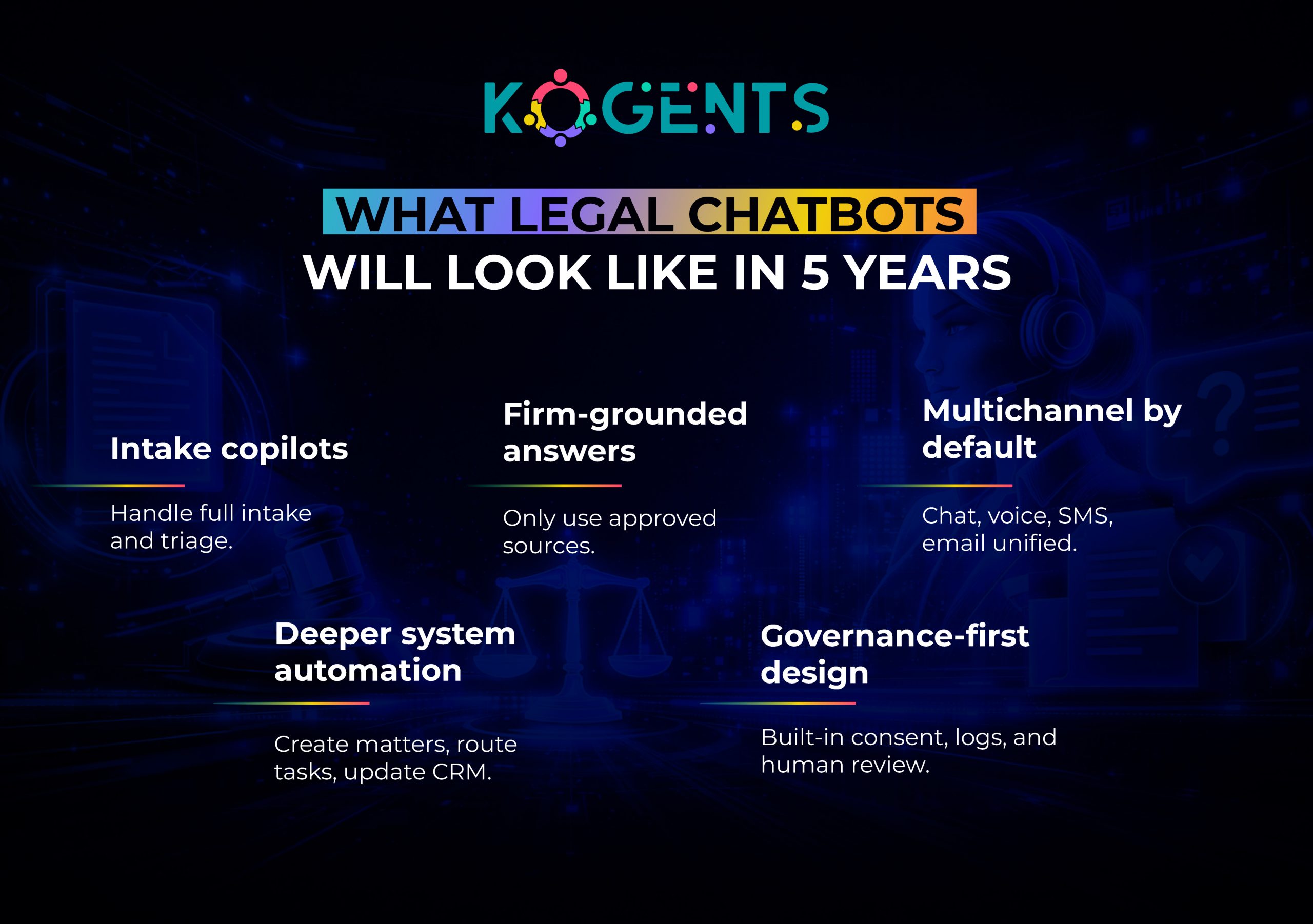
    chatbots for law firms

    We Are The Leaders in Agentic AI for Legal Innovation!

    Chatbots for law firms aren’t futuristic luxuries; they’re competitive necessities that separate thriving practices from those losing ground.

    By implementing legal chatbots via Kogents.ai, your firm gains:

    ✓ Competitive Advantage: Capture leads your competitors miss through after-hours availability 

    ✓ Operational Efficiency: Automate routine tasks, freeing your team for high-value work 

    ✓ Revenue Growth: Convert more prospects through immediate engagement and intelligent qualification 

    ✓ Client Satisfaction: Deliver the responsive, modern experience today’s clients demand 

    ✓ Scalability: Handle growing inquiry volume without proportionally increasing staff. 

    FAQs

    What are chatbots for law firms, and how do they differ from regular customer service bots?

    Legal chatbots are specialized AI-powered tools designed specifically for law firm operations. Unlike generic customer service bots, they understand legal terminology, maintain strict legal compliance standards (including attorney ethics rules), integrate with case management systems, and handle sensitive client information with appropriate security protocols. They’re programmed to never provide legal advice, instead focusing on information gathering, qualification, and routing.

    How do legal chatbots work with client intake automation?

    Client intake automation through chatbots transforms the traditional intake process. When prospects visit your website, the client intake chatbot for lawyers initiates a conversation, asks qualifying questions based on practice area, collects contact information, gathers case details, uploads relevant documents, checks conflicts, schedules consultations, and integrates all data into your CRM, completing in minutes what traditionally took days.

    Are AI chatbots ethical for attorneys according to bar association guidelines?

    Yes, when properly implemented. The American Bar Association recognizes legal technology as essential to modern practice. However, attorneys must ensure chatbots: clearly disclose they’re automated systems, never provide legal advice, maintain client confidentiality, are supervised for accuracy, and comply with professional responsibility rules. Many state bars have issued ethics opinions supporting chatbot use for administrative tasks and information gathering.

    Can chatbots replace legal assistants or paralegals?

    No. AI chatbots for lawyers augment rather than replace human staff. They handle repetitive, routine tasks, freeing legal assistants and paralegals to focus on substantive work requiring human judgment, empathy, and legal knowledge. The most successful firms view chatbots as tools that enhance team productivity, not workforce replacements.

    What are the best chatbots for law firms in terms of features and pricing?

    Top legal chatbot software options include LawDroid (comprehensive AI with strong practice area customization, $500-2,000/month), Smith.ai (hybrid AI-human model with live receptionist backup, $240-2,400/month), and custom solutions using IBM Watson or OpenAI APIs ($1,000-5,000+ for development). The “best” solution depends on your firm’s size, practice areas, integration requirements, and budget. Most platforms offer free trials.

    How do HIPAA-compliant chatbots for law firms protect sensitive health information?

    HIPAA-compliant chatbots for law firms implement multiple security layers: end-to-end encryption for all communications, secure data storage with restricted access controls, Business Associate Agreements (BAAs) with vendors, audit logging of all data access, automatic session timeouts, and data retention policies aligned with HIPAA requirements. For personal injury and medical malpractice practices handling protected health information, HIPAA compliance is mandatory.

    What’s the difference between AI chatbots and live chat for lawyers?

    AI chatbots operate autonomously 24/7 using artificial intelligence and natural language processing, handling unlimited simultaneous conversations without human intervention. Live chat requires staff availability, can only handle 2-3 conversations simultaneously, and operates during business hours. Many firms use hybrid models: chatbots handle initial contact and routine questions, escalating complex inquiries to live chat agents.

    How much does law firm chatbot implementation cost?

    Chatbot for attorneys implementation costs vary significantly: Basic Solutions ($200-500/month for SaaS platforms with standard templates), Mid-Range Solutions ($500-2,000/month for customizable platforms with CRM integration), and Enterprise Solutions ($2,000-5,000+/month for fully custom development with advanced AI). Most firms achieve positive ROI within 6-9 months through increased lead capture and reduced administrative costs.

    Can chatbots integrate with existing case management systems?

    Yes. Modern legal AI chatbots offer native integrations or API connections with major platforms, including Clio, MyCase, PracticePanther, Smokeball, Lawmatics, and Salesforce. This legal CRM integration ensures chatbot-gathered information flows directly into your existing workflows—eliminating manual data entry and reducing errors. When evaluating solutions, prioritize platforms with pre-built integrations for your specific tech stack.

    What ROI can law firms expect from chatbot implementation?

    Firms typically see 300-400% ROI within the first year. Specific benefits include: 50-100% increase in qualified leads, 40-60% reduction in administrative time, 24/7 availability capturing after-hours inquiries (typically 30-40% of total volume), 35-50% improvement in lead response time, and 20-30% increase in consultation bookings. According to legal technology studies, the average mid-sized law firm generates $4-7 in revenue for every $1 spent on chatbot implementation.
     

  • How AI Keeps Every Legal Interaction Consistent, Clear And Compliant 

    How AI Keeps Every Legal Interaction Consistent, Clear And Compliant 

    When a Single Email Can Cost $50 Million then imagine what a routine email can do. A data attachment. A compliance violation. 

    In 2025, a Fortune 500 company paid $47 million in regulatory penalties because one employee unknowingly breached data protection laws. 

    Your legal team reviewed policies. 

    Training was completed. 

    Yet human error still happened, and it nearly destroyed shareholder value overnight. 

    Here’s the uncomfortable truth: Chief Compliance Officers, General Counsels, and Legal Operations Managers are fighting an unwinnable war.

    You’re managing 300+ regulations simultaneously. Your teams spend 40% of their time on repetitive compliance workflows. 

    Regulatory penalties now average $4.1 million per violation. Traditional manual processes cannot scale, cannot operate fast enough, and cannot eliminate the human variability that creates catastrophic gaps. 

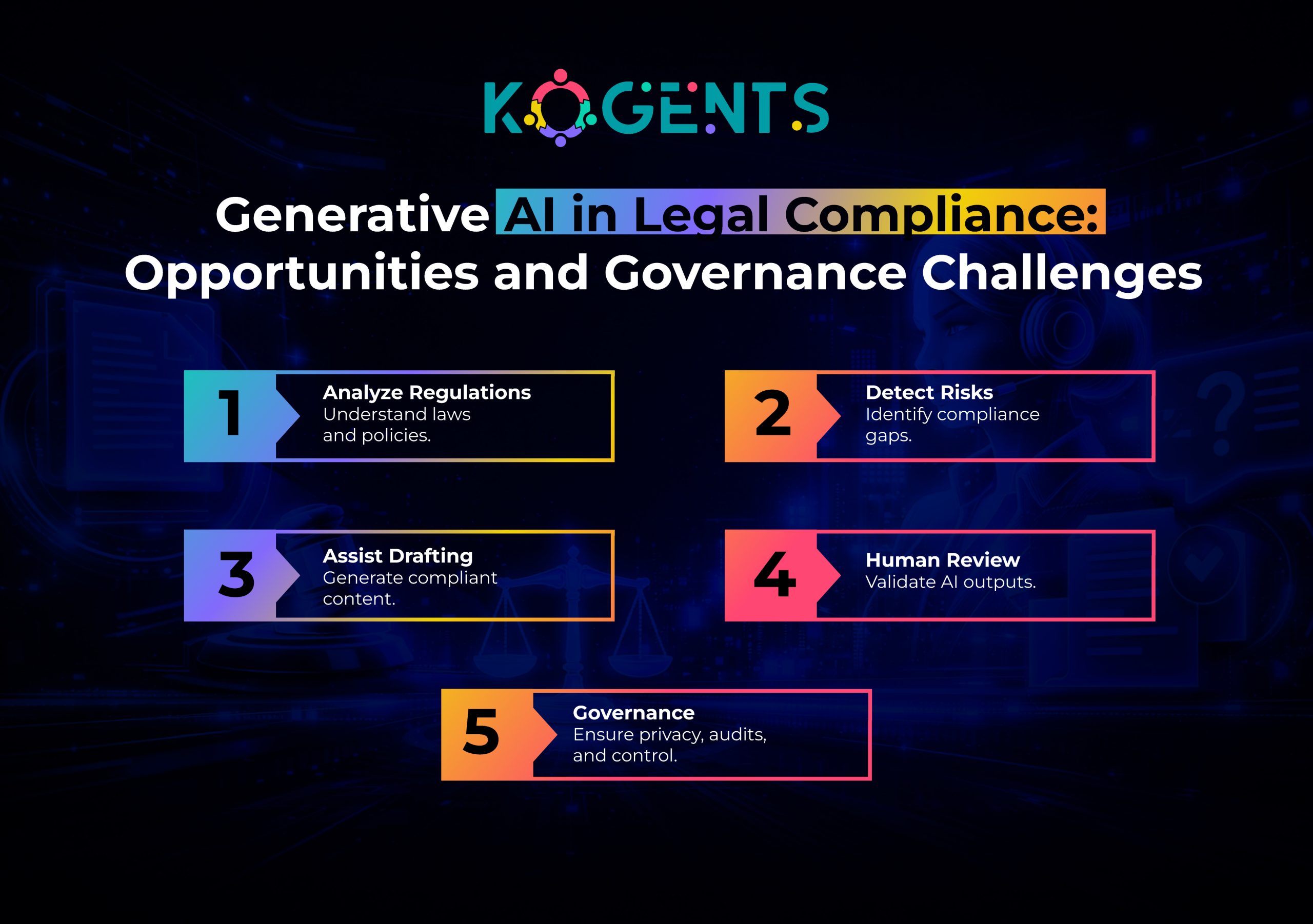
    But, AI for legal compliance changes everything. 

    Artificial intelligence for regulatory compliance doesn’t just assist your legal operations; it fundamentally transforms how organizations maintain absolute consistency across thousands of interactions, ensure clarity in complex governance frameworks, and achieve real-time compliance that manual processes can never deliver. 

    This guide reveals how AI-powered compliance management delivers what seemed impossible: zero-tolerance consistency in policy enforcement, unprecedented clarity in regulatory reporting, and ironclad compliance across every legal touchpoint, without multiplying headcount or budgets. 

    Key Takeaways 

    • AI legal compliance software eliminates human variability by applying identical standards across millions of transactions without deviation. 
    • Compliance monitoring platforms detect potential violations 24/7, identifying anomalies before issues escalate into compliance violations
    • Enterprise AI compliance software manages complex requirements across jurisdictions simultaneously, adapting to new regulations without complete overhauls. ● Explainable AI (XAI) provides comprehensive audit trails, demonstrating exactly how compliance decisions are made for audit readiness
    • AI governance and compliance tools free legal professionals from routine tasks to focus on high-value strategic initiatives. 

    ai for legal compliance

    Understanding AI for Legal Compliance 

    AI compliance solutions represent the convergence of machine learning, natural language processing, and legal data governance into integrated systems that automate, monitor, and optimize regulatory compliance operations. 

    Unlike traditional rule-based software, these AI-driven regulatory compliance solutions learn from patterns, adapt to changing requirements, and improve accuracy continuously. 

    The Core Problem It Solves 

    Compliance automation using AI addresses three fundamental challenges:

    Scale Limitations: Human teams cannot review every contract, transaction, or communication for compliance issues. 

    AI compliance monitoring platforms analyze millions of data points simultaneously, applying consistent standards across entire organizational ecosystems without fatigue. 

    Complexity Management: Modern compliance obligations span GDPR, ISO/IEC 27001, NIST AI Risk Management Framework, and industry-specific regulations. 

    AI compliance management systems map relationships between requirements, identifying overlaps, conflicts, and gaps that would take legal teams months to discover. 

    Dynamic Adaptation: Automated legal compliance systems ingest regulatory changes in real-time, automatically updating logic and flagging affected processes before deadlines expire. 

    The Technology Foundation 

    Natural Language Processing (NLP) interprets legal language, extracts obligations from regulations, and analyzes contracts against compliance standards. 

    This enables AI tools for legal compliance teams to understand context and nuance, not just keywords. 

    Machine Learning Algorithms identify patterns indicating potential legal risk management issues, predict compliance vulnerabilities, and continuously improve detection accuracy. 

    Robotic Process Automation (RPA) executes policy enforcement actions, generates compliance reporting, and manages remediation workflows automatically. 

    Predictive Analytics anticipates future compliance risks based on historical data, regulatory trends, and organizational changes. 

    Human variability creates compliance gaps. 

    Different attorneys interpret clauses differently. 

    Reviewers miss details during busy periods. 

    Standards drift as teams change. AI legal compliance software eliminates this variability.

    Standardized Decision Logic: AI-powered compliance management applies identical criteria to every evaluation, the first contract and the ten-thousandth receive the same rigorous analysis. 

    This consistency extends across contract clause analysis, transaction monitoring, communication screening, vendor compliance verification, and employee policy adherence tracking. 

    Instant Policy Updates: When GDPR guidance changes or ISO standards are revised, compliance automation platforms update all active monitoring simultaneously, no training sessions, no gradual implementation periods where different teams operate under different rules. 

    Cross-Jurisdictional Consistency: Multinational organizations maintain jurisdiction-specific requirements while ensuring consistent brand standards where regulations permit. 

    Clarity Through Advanced Language Understanding 

    Legal ambiguity creates compliance gaps. 

    AI compliance solutions transform unclear obligations into actionable requirements. 

    Obligation Extraction: NLP-powered systems read thousand-page regulations and automatically extract specific obligations, deadlines, and responsible parties. 

    Rather than legal teams manually parsing documents, AI governance and compliance tools identify every “must,” “shall,” and “required” statement, categorize obligations by department, and create enforcement checkpoints automatically. 

    Plain Language Translation: Complex legal language confuses non-legal stakeholders. Artificial intelligence for regulatory compliance translates requirements into clear operational instructions. 

    GDPR Article 32’s security requirements become specific technical controls for IT teams; Article 15’s access request obligations become step-by-step procedures for customer service. 

    Contextual Understanding: Advanced legal data governance systems distinguish between “data transfer” requiring data protection laws safeguards versus routine internal reporting. 

    Compliance Through Continuous Monitoring 

    Real-Time Transaction Analysis: Financial transactions are screened against sanctions lists instantaneously. Contracts are flagged during negotiation if clauses violate policies. 

    Data access requests trigger immediate compliance workflows verifying legitimate business purposes.

    Anomaly Detection: Machine learning establishes baseline patterns, then flags deviations indicating potential compliance violations. 

    Unusual employee data access or unexpected vendor payment patterns trigger investigation protocols automatically. 

    Regulatory Intelligence Integration: Best AI compliance platforms for enterprises continuously monitor regulatory developments worldwide. 

    Audit Trail Generation: Every decision generates immutable audit trails. 

    When auditors arrive, systems produce complete documentation showing what was monitored, when issues were detected, how they were addressed, and who was responsible. 

    Critical Components of AI Compliance Systems

         1. Intelligent Compliance Monitoring 

    • AI compliance monitoring continuously observes organizational activities against regulatory requirements, integrating with CRM platforms, financial systems, communication tools, and document management systems. 
    • Machine learning algorithms compare activities against compliance rules derived from GDPR, ISO standards, OECD AI Principles, and internal policies. 
    1. Risk Assessment and Mitigation
    • AI-driven regulatory compliance solutions perform continuous risk scoring, updating assessments as conditions change. 
    • Predictive risk modeling analyzes regulatory changes, business environment shifts, operational metrics, and historical data to forecast where compliance failures are most likely. 

    Note: When elevated risks are identified, automated legal compliance systems trigger mitigation workflows automatically. 

    1. Policy Management and Enforcement 
    • Dynamic policy libraries ensure stakeholders have access to current versions with role-appropriate guidance. 
    • A sales representative sees required contract clauses; a data analyst sees applicable data protection laws requirements. 
    • Enforcement automation can block policy-violating actions pending compliance review approval.
    1. Regulatory Change Management 
    • Regulatory intelligence monitors legislative databases, regulatory agency 

    announcements, court decisions, and industry guidance, identifying relevant changes. ● Natural language processing determines whether changes create new obligations or modify existing requirements. 

    • Impact assessment automation generates implementation roadmaps showing what must change, by when, and who’s responsible. 
    1. Reporting and Analytics 
    • Compliance reporting automation generates regulatory submissions from continuously collected data. 
    • Executive dashboards provide compliance posture visibility: current risk levels, 

    trending issues, regulatory change pipelines, and resource allocation effectiveness. 

    AI Compliance Framework: Essential Components

    Component  Primary Function  Key 

    Technologies

    Business 

    Impact

    Regulatory 

    Alignment

    Monitoring & 

    Detection

    Continuous 

    surveillance against compliance rules

    Machine 

    Learning, NLP, 

    Real-time 

    Analytics

    70% reduction in compliance 

    incidents

    GDPR Article 32, 

    ISO/IEC 27001

    Risk Assessment  Automated 

    vulnerability 

    identification and 

    scoring

    Predictive 

    Analytics, AI Risk Models

    Proactive 

    resolution before violations

    NIST AI Risk 

    Management 

    Framework

    Policy Enforcement 

    Regulatory 

    Intelligence

    Automated 

    compliance rule 

    application 

    Tracking regulatory changes across 

    jurisdictions

    RPA, Workflow Automation, 

    Access Controls 

    NLP, Regulatory Monitoring APIs

    85% improvement in policy 

    adherence 

    3-month 

    advantage in 

    adaptation

    ISO/IEC 42001 

    EU AI Act, OECD AI Principles

    Audit & Reporting  Automated evidence collection and report generation Data Integration, Audit Trail 

    Systems

    90% reduction in audit preparation time GDPR Article 30, SOC 2

    Real-World Success: Case Studies 

    Case Study 1: Global Bank Transforms AML Compliance 

    A multinational bank operating in 45 countries faced 120,000 analyst hours spent annually on manual anti-money laundering reviews, with rising false positive rates missing sophisticated laundering schemes. 

    After deploying an AI-powered compliance management platform with machine learning-based transaction monitoring, false positive rates decreased 60%, reducing analyst workload by 75,000 hours annually. 

    Suspicious activity detection improved 40% while achieving full regulatory compliance across all jurisdictions and reducing costs by $12 million annually. 

    Case Study 2: Healthcare Network Achieves HIPAA Excellence 

    A 150-facility healthcare network struggled with HIPAA compliance around patient data access controls across thousands of users and millions of patient records. 

    An AI compliance monitoring platform with anomaly detection configured for healthcare data governance reduced unauthorized data access incidents by 82% in the first year. 

    The AI detected and prevented breaches that manual processes missed, including three credential misuse instances by terminated employees. 

    Compliance workflows automated 90% of routine access requests, reducing approval times from 48 hours to 15 minutes while avoiding an estimated $8 million in potential penalties. 

    Critical Considerations: Explainability and Accountability The Explainability Imperative 

    Regulatory bodies increasingly demand explainable AI (XAI), systems where decision-making logic can be understood and verified. 

    Leading AI governance and compliance tools use hybrid architectures: complex models provide initial assessments while rule-based explainable systems validate and document decisions, ensuring both accuracy and audit trail transparency. 

    Algorithmic Accountability 

    Algorithmic accountability requires ensuring AI systems don’t perpetuate biases or create discriminatory outcomes.

    Effective approaches include regular bias audits, diverse training data, human oversight for high-impact decisions, and continuous outcome monitoring. 

    ISO/IEC 42001 and OECD AI Principles provide frameworks for responsible AI model governance. 

    Data Governance 

    AI compliance monitoring platforms require extensive organizational data access. 

    Solutions involve data minimization, anonymization where possible, strict access controls, encryption, and comprehensive legal data governance frameworks ensuring AI systems operate within privacy boundaries. 

    Transform Compliance into Competitive Advantage with Us! 

    AI for legal compliance is no longer optional; it’s the foundation for sustainable, scalable compliance operations. 

    Organizations implementing AI-driven regulatory compliance solutions consistently report transformative outcomes: 30-50% operational cost reductions, 70-80% fewer compliance incidents, dramatically improved audit readiness, and strategic reallocation of legal talent from 

    We specialize in AI-powered compliance management solutions designed for enterprises navigating complex regulatory landscapes. 

    Our platform combines advanced compliance monitoring, regulatory intelligence, and explainable AI capabilities, integrating seamlessly with your existing systems. 

    Whether implementing your first AI compliance solution or enhancing existing governance frameworks, we deliver proven expertise across GDPR, ISO standards, NIST frameworks, and industry-specific regulations. 

    So, contact the team at Kogents.ai to drive legal excellence now! 

    FAQs 

    What is AI for legal compliance, and how does it differ from traditional compliance software? 

    AI for legal compliance uses machine learning and natural language processing to continuously monitor and enforce regulatory requirements automatically. Unlike traditional rule-based software requiring manual programming for each scenario, AI compliance

    solutions learn from patterns, adapt to regulations, and improve accuracy without constant reprogramming. 

    How does AI handle regulatory compliance across multiple jurisdictions? 

    Enterprise AI compliance platforms map requirements across jurisdictions, identifying overlapping obligations and conflicts. Using natural language processing to interpret regulations from different regulatory bodies, systems automatically extract obligations and create jurisdiction-specific controls while maintaining consistent governance. 

    What are the main benefits of AI compliance software for regulated industries? 

    AI compliance software delivers consistency through standardized policy application, scalability for millions of simultaneous activities, real-time violation detection, adaptability to regulatory changes, and transparency through comprehensive audit trails. Industries report 30-50% operational cost reductions while improving outcomes. 

    Is AI compliance monitoring effective at detecting violations? 

    Yes. AI compliance monitoring platforms detect 3-5 times more potential violations than human review with 60-80% fewer false positives. Effectiveness stems from 24/7 operation, pattern recognition across vast datasets, and adaptive learning, improving accuracy continuously. 

    How do AI compliance solutions handle regulatory changes? 

    AI-driven regulatory compliance solutions include regulatory intelligence that continuously monitors legislative databases and agency publications. Natural language processing identifies relevant changes, determines new obligations, and assesses policy impact. Systems automatically update monitoring logic while flagging complex amendments requiring legal interpretation. 

    What is explainable AI (XAI) and why does it matter for compliance? 

    Explainable AI (XAI) provides decision-making logic that humans can understand and validate. Regulatory bodies and auditors must verify that decisions are appropriate and legally defensible. XAI-capable AI governance tools provide detailed reasoning showing which regulations were considered and why determinations were made. 

    How much does an AI compliance management system implementation cost? 

    Pricing varies based on organization size and complexity. Entry-level solutions start around $50,000-$100,000 annually. Mid-market implementations range $250,000-$500,000 initially, plus $100,000-$300,000 annually. Enterprise AI compliance software requires $1M+ initially and $500,000+ annually. Organizations report ROI within 18-24 months.

    Can AI compliance tools integrate with existing systems? 

    Modern AI compliance platforms offer pre-built connectors for enterprise systems (Salesforce, SAP, Microsoft 365), APIs for custom integrations, and data import/export capabilities. Integration enables compliance automation across contract management, financial platforms, HR systems, and communication tools. 

    What industries benefit most from AI-powered compliance management? 

    Five industries see disproportionate value: Financial Services (AML, KYC), Healthcare (HIPAA, patient data), Technology (multi-jurisdictional data protection), Life Sciences (FDA, clinical research), and Energy/Utilities (environmental, safety regulations). These face complex, frequently changing landscapes where manual compliance becomes impossible. 

    How do organizations ensure AI compliance systems don’t create new risks? 

    Ensuring AI governance requires implementing algorithmic accountability frameworks that regularly audit AI decision-making, maintaining human oversight for high-impact decisions, establishing robust data governance, following the NIST AI Risk Management Framework and ISO/IEC 42001, and conducting regular third-party audits.

  • How Law Firms Automate Client Intake Without Losing Professionalism

    How Law Firms Automate Client Intake Without Losing Professionalism

    Your newest client hired you at 11 PM on a Sunday, not because you were cheaper, and not because a competitor failed, but because you responded in four minutes while others waited until Monday.

    When she searched for an estate planning attorney after her father’s sudden hospitalization, she never spoke to a human at first. 

    An intelligent system captured her details, assessed urgency, sent a personalized video from the attorney who’d handle her case, scheduled a Monday consultation, and shared resources for estate planning during medical emergencies. 

    By Monday morning, she’d paid the retainer and uploaded documents before competitors even opened.

    This happens daily. Law firm automation isn’t lowering service standards; it’s expanding your ability to deliver a premium experience when clients actually need you, often after hours. 

    The professionalism concern is backwards: clients don’t see speed as impersonal, they see delay and friction as unprofessional. 

    Strategic automation elevates professionalism and wins clients.

    Key Takeaways

    • Successful firms automate repetitive tasks while preserving human touchpoints for relationship-building and complex advisory interactions.
    • A Modern AI legal assistant will require seamless integration between case management systems, client intake automation platforms, and practice management software to create cohesive client experiences.
    • Automation enables, rather than diminishes, personalization by freeing staff to focus on meaningful client interactions while systems handle routine communications and workflow orchestration.
    • Automated law firm workflows must prioritize GDPR compliance, SOC 2 compliance, and ISO/IEC 27001 standards to protect client data and maintain ethical obligations.
    • Firms implementing comprehensive automation for law firms report a reduction in intake processing time, an increase in conversion rates, and significant improvements in client onboarding satisfaction scores.

    law firm automation

    Understanding Law Firm Automation in Modern Legal Practice

    Law firm automation is the strategic use of technology to streamline legal operations while preserving the quality and personal attention clients expect. 

    It supports digital transformation in law by reducing administrative load, so attorneys can focus on high-value work requiring judgment, creativity, and empathy.

    Modern legal practice automation spans multiple areas: document automation minimizes repetitive drafting, legal workflow management coordinates complex processes across teams, and time tracking automation plus legal billing automation improve accuracy without added burden. 

    Compliance automation also helps maintain regulatory adherence with less manual oversight.

    Successful automation hinges on one insight: legal service runs on two parallel tracks, transactional and relational

    Robotic process automation (RPA) excels at transactional tasks like data capture, routing, validation, and scheduling. 

    But relational work, trust-building, strategic counseling, and emotional intelligence remain inherently human.

    Firms with structured automation strategies often see measurable gains. 

    Research from the International Legal Technology Association cites a productivity improvement and reduction in operational costs within the first year, driven by fewer errors and better allocation of human capital. 

    Meanwhile, AI in law now extends beyond task automation into pattern analysis, outcome prediction, and decision support. 

    Cloud platforms have also made advanced automation accessible, leveling the competition and making adoption increasingly essential.

    The Client Intake Challenge: Where Professionalism Meets Efficiency

    It is the most critical touchpoint in the attorney-client relationship, where first impressions, expectations, and trust are formed (or lost). 

    Yet traditional intake often creates unnecessary friction that hurts both efficiency and client satisfaction.

    A manual intake journey typically includes multiple handoffs, redundant data collection, slow responses, and inconsistent follow-up. 

    A prospect submits a form, someone re-enters the details into case management, another person schedules the consult, and someone else sends engagement documents. 

    Every handoff adds delay and increases the risk of errors.

    From the client’s perspective, this fragmentation signals disorganization. 

    Today’s clients compare firms online and expect the same seamless experience they get in other industries. 

    If they must repeat information or wait days for basic replies, confidence drops immediately.

    Many attorneys worry that automation will feel impersonal. 

    But that’s a misconception. 

    Professionalism isn’t defined by manual work; it’s defined by attentiveness and clarity. 

    Client intake automation should remove delays and administrative clutter so staff can focus on real relationship-building.

    In most firms, intake coordinators spend most of time on admin tasks and only 30% on client interaction. 

    Automation flips that, enabling more meaningful engagement. 

    Automation Strategies That Preserve Professionalism

    Implementing automated law firm workflows requires strategic thinking about what to automate, what to preserve, and how to blend technology with human touchpoints. 

    The most successful firms follow a framework that prioritizes client experience while achieving operational efficiency.

    The Human-Digital Balance Framework

    Automate the mechanical, elevate the meaningful. 

    This principle guides every implementation decision. 

    Mechanical tasks, data capture, document routing, appointment scheduling, conflict checks, consume time without creating relationship value. 

    These are prime automation candidates. 

    Meaningful interactions, initial consultations, case strategy discussions, and negotiation conversations require human judgment and emotional intelligence. 

    These should receive the time freed by automation.

    Intelligent intake forms represent the first touchpoint optimization. 

    Unlike static PDF forms, modern client onboarding platforms use conversational interfaces with conditional logic. 

    They ask relevant questions based on previous answers, explain why information is needed, and provide estimated completion times. 

    This approach collects comprehensive information while respecting client time, a hallmark of professionalism.

    Automated acknowledgment and routing ensure no inquiry falls through the cracks. 

    When someone submits an intake request, they receive immediate confirmation with clear next steps and timelines. 

    Behind the scenes, workflow orchestration routes their information to the appropriate attorney based on practice area, availability, and case characteristics. 

    What feels instant to the client represents sophisticated legal workflow management operating invisibly.

    Personalization at Scale

    Dynamic communication sequences maintain consistent touchpoints without generic mass messaging. 

    Modern law firm automation software can personalize communications based on case type, client demographics, urgency level, and interaction history. 

    A personal injury inquiry receives a different messaging cadence than a corporate transaction, even though both follow automated workflows.

    Video introduction messages blend automation with personal presence. 

    When intake forms are completed, clients immediately receive a personalized video from their assigned attorney introducing themselves, explaining next steps, and providing direct contact information. 

    This automated delivery of personal content creates warmth that text-based communication cannot achieve.

    The Technology Stack

    Automation Layer Function Professionalism Impact Key Vendors
    Intake Forms Data collection & qualification Reduces redundant questions, respects client time Clio Grow, Lawmatics, Documate
    CRM Integration Contact management & tracking Ensures no client falls through the cracks Salesforce Legal, Clio Manage
    Document Automation Engagement letter generation Accelerates onboarding, reduces errors HotDocs, Contract Express
    Communication Email sequences & SMS updates Maintains consistent touchpoints Lawmatics, Smokeball
    Scheduling Calendar management Eliminates back-and-forth delays Calendly Legal, Acuity
    Payment Processing Retainer collection Simplifies financial transactions LawPay, Clio Payments

    Compliance and Security Considerations

    Data security isn’t just technical, it’s professional. 

    Clients entrust you with sensitive information, and client data protection represents a core ethical obligation. 

    Your legal automation solutions must meet stringent security standards, including SOC 2 compliance and GDPR compliance where applicable.

    Audit trails in the chatbots for law firms provide accountability that manual processes cannot match. 

    Every client interaction, document access, and data modification is logged with timestamps and user attribution. 

    This compliance automation protects both clients and the firm from disputes while satisfying regulatory requirements.

    Role-based access controls ensure information reaches appropriate team members without exposing sensitive details to unauthorized personnel. 

    Case Studies: Automation Success Stories

    Case Study 1: Mid-Market Litigation Firm Transformation

    A 45-attorney litigation firm faced a client intake crisis. 

    Their manual process averaged 4.2 days from inquiry to consultation scheduling, resulting in a 34% inquiry-to-client conversion rate. 

    Competitors were winning business simply by responding faster.

    They implemented a comprehensive client intake automation system integrating Clio Grow for intake forms, Lawmatics for communication workflows, and Salesforce for CRM functionality. 

    The implementation included:

    • Intelligent intake forms with conditional logic reduce completion time.
    • Automated routing to the appropriate practice group attorneys within minutes.
    • Personalized video introductions from assigned attorneys.
    • Automated scheduling with integrated calendar management.
    • Document automation for engagement letters and conflict waivers.

    Results after six months:

    • Average response time reduced from 4.2 days to 47 minutes (94% improvement).
    • Inquiry-to-client conversion increased from 34% to 56% (65% improvement).
    • Intake coordinator capacity increased from handling 15 new inquiries weekly to 52.
    • Client satisfaction scores for the intake experience increased from 6.8/10 to 9.2/10.
    • ROI achieved within 4 months through increased conversion alone.

    Case Study 2: Solo Practitioner Scaling Through Automation

    A solo immigration attorney was turning away potential clients due to intake capacity constraints. 

    She spent 15+ hours weekly on intake administration, leaving insufficient time for billable work and business development.

    She implemented automation tools for small law firms using Documate for intake forms, Smokeball for practice management, and LawPay for payment processing. 

    The streamlined system:

    • Captured comprehensive client information through guided online forms
    • Automatically generated engagement letters and fee agreements
    • Processed retainer payments without manual intervention
    • Scheduled consultations based on availability rules
    • Sent automated updates at key process milestones

    Results after three months:

    • Intake administration time reduced from 15 hours to 2 hours weekly.
    • Client capacity increased by 40% without hiring additional staff.
    • Revenue increased 28% through improved efficiency.
    • Ability to accept cases previously turned away due to capacity.
    • Professional image enhanced through consistent, responsive communication.

    Your Competitive Advantage Awaits!

    The choice facing law firms today isn’t whether to embrace law firm automation; it’s whether to lead or follow the inevitable transformation of legal service delivery

    Well, professionalism in modern legal practice means meeting clients where they are, responding when they need you, and delivering seamless experiences that demonstrate competence and care. 

    Your competitors are already moving. 

    The question is whether you’ll watch them capture market share or position your firm to lead your market through strategic automation for law firms.

    Kogents.ai specializes in helping law firms implement legal automation solutions that enhance professionalism while driving measurable results. 

    Ready to transform your client intake? Visit us or contact us today for a complimentary automation assessment.

    FAQs

    What is law firm automation, and how does it differ from traditional legal technology?

    Law firm automation refers to the strategic use of technology to streamline repetitive tasks and workflows within legal practices, enabling attorneys and staff to focus on high-value activities. Unlike traditional legal technology that simply digitizes existing processes (like moving paper files to PDFs), true legal process automation fundamentally redesigns workflows using artificial intelligence, machine learning, and robotic process automation to eliminate manual steps. Modern legal automation solutions make intelligent decisions, route information automatically, and orchestrate complex multi-step processes without human intervention while maintaining professional standards and ethical compliance.

    How can small law firms afford automation technology when budgets are tight?

    Cloud-based law firm automation has dramatically reduced cost barriers, with many automation tools for small law firms offering subscription models starting at $50-150 monthly per user. The ROI of legal automation typically manifests within 3-6 months through increased client conversion, reduced administrative costs, and enhanced attorney productivity. Additionally, phased implementation allows firms to start with core functionality like client intake automation before expanding to comprehensive legal workflow management. Many vendors offer tiered pricing where you pay only for features actually used, and the productivity improvement often generates sufficient revenue increase to self-fund the technology investment without requiring upfront capital allocation.

    Can automation help with conflict checks and other compliance requirements?

    Yes, compliance automation represents one of automation’s highest-value applications. Automated conflict checking systems can instantaneously search your entire client database, matter history, and relationship networks to identify potential conflicts—a process that might take hours or days manually and still risk missing connections. These systems can enforce mandatory fields, ensuring complete information capture, trigger alerts when specific risk factors appear, require supervisory approval for exceptions, and generate complete audit trails demonstrating compliance diligence. Modern law firm automation software can also automate compliance tracking for deadlines, statute of limitations, trust accounting rules, and other regulatory requirements. The consistency and thoroughness that automation provides actually enhances ethical compliance while reducing the risk of human oversight that leads to disciplinary issues.

    How does AI automation differ from basic workflow automation in legal practices?

    Basic workflow automation follows predetermined rules and decision trees: if X happens, then do Y. This effectively handles routine, structured processes like moving documents through approval chains or sending reminder emails. AI automation for law firms leverages machine learning to make contextual decisions based on patterns in data, improving over time without explicit programming. AI systems can review intake forms and predict case viability based on historical outcomes, analyze communication to detect client sentiment requiring human intervention, optimize scheduling based on attorney expertise and availability patterns, and even identify potential conflicts by understanding relationships beyond explicit database matches. While rule-based automation provides consistency, artificial intelligence in law provides adaptability and continuous improvement, making it particularly valuable for complex legal service delivery scenarios where rigid rules prove insufficient.

    What security and data protection considerations are critical when automating client intake?

    Client data protection represents both an ethical obligation and a competitive necessity. Your legal automation solutions must employ encryption for data in transit and at rest, implement multi-factor authentication for user access, maintain SOC 2 compliance certification demonstrating security controls, provide granular role-based access limiting information exposure, enable audit trails logging all data access and modifications, and ensure GDPR compliance where applicable, including data retention and deletion policies. Beyond technical controls, establish clear policies governing acceptable use, train staff on security protocols, conduct regular security assessments, maintain incident response procedures, and verify that vendor support includes security patch management and threat monitoring. Cloud-based systems from reputable vendors often provide superior security compared to on-premise systems at small firms lacking dedicated IT security expertise, but require careful vendor evaluation.


  • Never Miss a Client Again: How AI Handles Legal Inquiries 24/7

    Never Miss a Client Again: How AI Handles Legal Inquiries 24/7

    Do you know the $2.3 million question your firm isn’t asking?

    Your law firm is hemorrhaging money while you sleep. Every night, while your attorneys rest and phones roll to voicemail, potential clients desperately search for legal help. 

    They find your website, read your accolades, and then all they do is vanish into the digital void, never to return.

    But, if you analyze the brutal mathematics, if your firm receives 200 web inquiries annually and loses 40% to response delays, that’s 80 missed opportunities. 

    At a conservative $15,000 average client value and 25% conversion rate, you’ve just watched $300,000 evaporate. 

    According to Harvard Business Review, companies responding within 5 minutes are 100 times more likely to qualify leads than those waiting just 30 minutes.

    Your competitors aren’t losing these clients. While you operate on 9-to-5 schedules, savvy firms deploy an AI legal assistant that never sleeps, never takes breaks, and never lets qualified leads slip away.

    The uncomfortable truth: You’re competing against client expectations shaped by Amazon, Uber, and instant gratification culture. 

    Unless you provide 24/7 availability and intelligent triage, you’re already losing; you just haven’t seen the balance sheet impact yet. 

    Key Takeaways

    • Firms responding within 5 minutes are 100x more likely to convert leads than those responding after 30 minutes, making 24/7 availability mission-critical.
    • Virtual legal assistant AI systems handle initial inquiries, case intake, and triage without human intervention, ensuring zero missed opportunities.
    • Machine learning algorithms assess case viability, conflict checks, and jurisdiction alignment before human lawyers invest time.
    • Modern legal consumers expect immediate responses to inquiries, driven by experiences with consumer tech platforms.
    • Modern law firm automation connects with existing case management and CRM systems through no-code solutions.

    DECODE: Why Response Time Makes or Breaks Client Acquisition? 

    The legal services market operates under a brutal reality: speed is the winner, and for law firms, delayed responses translate directly to lost revenue.

    The After-Hours Abandonment: legal inquiries occur outside standard business hours. Without an automated legal assistant, these leads sit unanswered for 12-48 hours while prospective clients contact 3-4 competing firms.

    The Competitive Disadvantage: When clients submit inquiries to multiple firms simultaneously, the firm responding within minutes gets the retainer, not the one calling back days later.

    The Opportunity Cost: Every 10 missed inquiries at conversion and $15,000 average client value represents $30,000 in lost revenue. Annually, that compounds into hundreds of thousands in foregone billings.

    Problem: The problem intensifies for small law firms and solo practitioners lacking dedicated intake staff, with firms losing potential clients to intake bottlenecks.

    ai legal assistant

    How AI Legal Assistants Transform Client Intake

    24/7 Availability Without Human Burnout

    An intelligent chatbot for law firms powered by artificial intelligence provides continuous coverage across all communication channels, website chatbots, SMS, email, and voice calls through conversational AI.

    Key Capabilities:

    • Instant Acknowledgment: Responds within seconds, confirming receipt and setting expectations.
    • Multi-Language Support: Handles inquiries in 50+ languages, expanding addressable markets.
    • Omnichannel Presence: Maintains availability across web forms, live chat, mobile apps, and social media.
    • Holiday/Weekend Coverage: Captures leads during peak inquiry periods when staff are unavailable.

    Instant Response Mechanisms

    Modern AI-powered legal assistant systems leverage natural language processing (NLP) to understand client inquiries contextually. 

    When someone asks about landlord disputes, the system:

    • Identifies Practice Area: Recognizes this as tenant-landlord litigation.
    • Assesses Jurisdiction: Determines applicable statutes and regulations.
    • Gathers Critical Information: Collects timeline, documentation, and damages.
    • Provides Immediate Value: Offers preliminary guidance and next steps.
    • Schedules Consultation: Books appointments with appropriate attorneys.

    Reminder: This entire process happens in 3-5 minutes while the client remains engaged.

    Intelligent Triage and Case Qualification

    AI legal assistant tools excel at pre-qualifying cases based on:

    • Financial Viability: Assessing whether the case value justifies attorney fees.
    • Jurisdictional Alignment: Confirming licensure in relevant jurisdictions.
    • Practice Area Fit: Matching inquiries to firm expertise (contract review, litigation, compliance).
    • Conflict Checks: Flagging potential conflicts before attorney involvement.
    • Statute of Limitations: Identifying time-sensitive matters requiring immediate escalation.

    Key Note: Well-configured systems route high-value, qualified leads directly to attorneys while redirecting mismatched inquiries, saving hundreds of hours annually.

    Core Technologies Powering Always-On Legal Support

    Natural Language Processing (NLP) for Legal Context

    • Legal NLP represents specialized AI trained on case law, legal drafting, and legal research documentation. 
    • These systems understand legal terminology, contextual nuances, and procedural requirements. 
    Leading platforms integrate with LexisNexis, Thomson Reuters, and Westlaw databases for accurate, jurisdiction-specific information.

    Machine Learning and Large Language Models (LLMs)

    • Large language models like those powering Harvey, CoCounsel, and OpenAI’s legal applications continuously improve through interaction. 
    • Every conversation trains the system to improve response accuracy, predict client needs, optimize routing logic, and personalize communication. 
    • This machine learning capability means your AI legal assistant becomes more effective over time.

    Integration with Case Management Systems

    AI legal assistant platforms integrate seamlessly with existing technology:

    • Case Management Software: Automatically creates matter records with pre-populated intake data.
    • CRM Systems: Updates lead scoring and tracks conversion metrics.
    • Document Management: Stores uploaded documents in the correct matter folders.
    • Calendaring Tools: Syncs consultations across attorney schedules.
    • Billing Systems: Captures engagement letters and retainer agreements.

    Real-World Case Studies

    Case Study 1: Boutique Litigation Firm Increases Lead Conversion by 340%

    Firm Profile: 12-attorney firm specializing in business litigation and contract disputes.

    Challenge: Missing 60% of after-hours inquiries; 36-hour average response time.

    Solution: Implemented CoCounsel-powered intake bot with calendar integration.

    Results:

    • Response time dropped from 36 hours to 2 minutes
    • After-hours inquiry capture increased from 40% to 98%
    • Consultation booking rate improved from 15% to 51%
    • Annual revenue increased by $1.2M from previously missed opportunities

    Case Study 2: Solo Practitioner Scales Without Hiring

    Firm Profile: Solo immigration attorney handling 200+ cases annually.

    Challenge: Spending 15 hours/week on initial consultations, many unqualified.

    Solution: Deployed a legal AI assistant for intake screening and scheduling.

    Results:

    • Reduced unqualified consultations by 82%
    • Freed up 12 hours/week for billable work
    • Increased client capacity by 40% without additional staff
    • Improved work-life balance

    Case Study 3: Mid-Sized Firm Expands Market Reach

    Firm Profile: 45-attorney full-service firm in competitive metro market.

    Challenge: Losing legal tech-savvy clients to more responsive competitors.

    Solution: Implemented Harvey AI with multi-language support and SMS integration.

    Results:

    • Expanded client demographics by 35% through Spanish and Mandarin support.
    • Mobile inquiry conversion rate increased by 127%.
    • Net Promoter Score improved from 42 to 71.
    • Captured leads from 3 previously underserved market segments.

    Comparative Analysis: Traditional vs. AI-Powered Intake

    Metric Traditional Intake AI-Powered Intake Improvement
    Average Response Time 24-48 hours 90 seconds 98% faster
    After-Hours Availability 0% (voicemail only) 100% (full functionality) Complete coverage
    Lead Qualification Accuracy 60% (manual screening) 89% (AI-assisted) 48% increase
    Cost Per Lead Captured $85 (staff time) $12 (system cost) 86% reduction
    Consultation Booking Rate 23% 47% 104% increase
    Multi-Language Support Limited (1-2 languages) 50+ languages Expanded market
    Data Entry Time 15 min/lead 30 sec/lead 96% reduction
    Client Satisfaction Score 6.8/10 8.9/10 31% improvement

    The Behavioral Economics of Client Acquisition

    Understanding why immediate response matters requires examining the psychology of decision-making under stress. 

    When potential clients seek legal help, they’re anxious, confused, and seeking immediate reassurance.

    The Peak-End Rule in Legal Services

    Behavioral economist Daniel Kahneman’s research reveals that people judge experiences based on their peak emotional moment and the final moment. 

    For legal intake:

    The Peak: The moment of first contact when anxiety is highest. 

    The End: The confirmation that help is coming

    • An AI legal assistant optimizes both moments through instant acknowledgment and structured intake processes. 
    • Traditional firms miss both opportunities, creating doubt about case prioritization.

    Decision Fatigue and Multi-Firm Inquiries

    Legal consumers typically contact 3-5 firms before deciding. 

    But they don’t wait to hear from all; they hire the first firm that responds quickly, demonstrates understanding, provides clear next steps, and makes engagement easy.

    The firm capturing the client isn’t necessarily the most qualified; it’s the most accessible at the decision moment. 

    Practical Application: Designing AI Conversations for Conversion

    The best AI legal assistant software implementations are architected around behavioral principles:

    • Immediate Emotional Acknowledgment: “I understand this situation is stressful. You’ve taken the right step.”
    • Competence Signaling: Asking informed questions demonstrating practice area expertise.
    • Progressive Commitment: Building engagement through small asks before larger ones.
    • Scarcity and Urgency: “Based on your timeline, I’m checking our earliest available consultation…”
    • Social Proof Integration: “Our firm has helped over 300 clients with similar matters.”

    Note: These evidence-based approaches reduce client anxiety and facilitate informed decision-making.

    Addressing Concerns: Ethics, Security, and Limitations

    Ethical Considerations

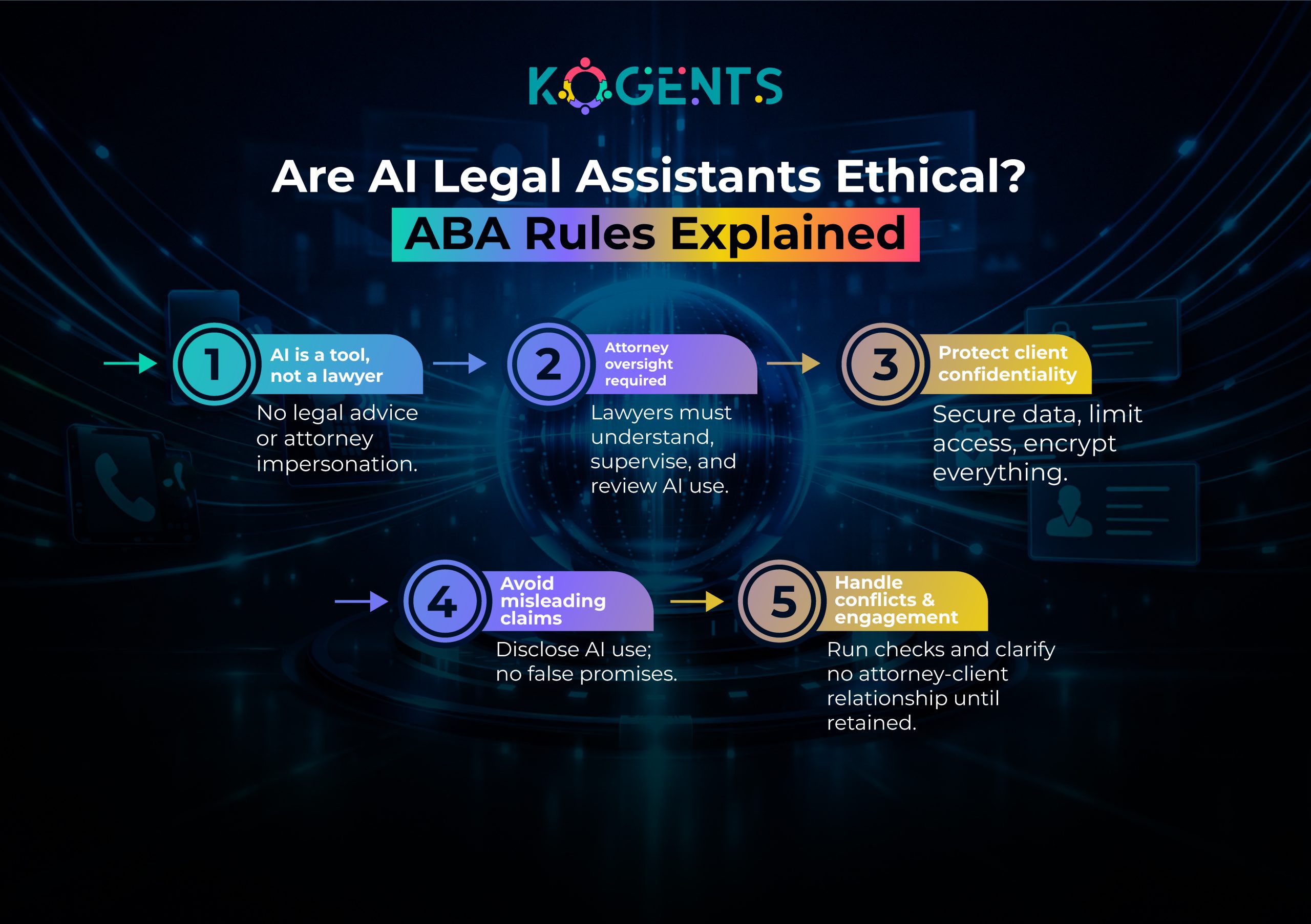
    The American Bar Association emphasizes that lawyers must understand how AI tools work, protect client communications with the same rigor as attorney-client conversations, and review AI-generated output before client reliance.

    Best practice: Configure your AI legal assistant to include disclaimers that no attorney-client relationship exists until formal engagement, AI responses constitute general information, and all communications are reviewed by human attorneys.

    Data Security and Privacy

    Choose platforms providing SOC 2 Type II certification, ISO 27001 compliance, end-to-end encryption, and GDPR compliance.

    Understanding System Limitations

    AI legal assistants excel at pattern recognition, information gathering, scheduling, and answering common procedural questions. 

    They struggle with novel legal issues, highly fact-specific judgment calls, emotional intelligence, and complex ethical dilemmas.

    The optimal model pairs AI efficiency with human empathy and expertise, intelligent augmentation, not replacement.

    ai legal assistant

    Conclusion

    Client expectations have permanently shifted toward immediate availability and tech-enabled convenience. 

    AI legal assistants aren’t futuristic speculation; they’re an operational reality delivering measurable results today.

    At Kogents.ai, we specialize in implementing AI-powered legal assistant solutions personalized to your firm’s unique needs. 

    Our services include AI readiness assessment, platform selection guidance, custom integration with your case management and CRM infrastructure, workflow automation, change management support, ethical compliance review, and performance analytics.

    We’ve helped law firms from solo practitioners to 100+ attorney firms implement legal automation that captures missed opportunities, improves client satisfaction, and frees attorneys for high-value work.

    Don’t lose another midnight inquiry. 

    Contact Kogents.ai today for a complimentary AI readiness assessment. Visit or email us to schedule your consultation right away! 

    FAQs

    What is an AI legal assistant?

    An AI legal assistant is specialized software trained on legal research, case law, and legal workflows to understand and respond to legal inquiries contextually. Unlike generic chatbots, AI-powered legal assistants use natural language processing and machine learning to comprehend legal nuances, triage cases intelligently, and integrate with law firm systems.

    How does it work in law firms?

    It monitors all incoming inquiry channels 24/7, uses NLP to understand legal inquiries, asks clarifying questions, performs preliminary qualification, schedules consultations, integrates data into case management systems, and provides clients with next steps—all while maintaining legal ethics compliance.

    Can AI replace lawyers?

    No. AI legal assistants handle administrative and information-gathering aspects, but human attorneys remain essential for legal judgment, strategy, and relationship building. The American Bar Association emphasizes that AI should augment, not replace, professional legal judgment.

    What are the benefits for small vs. large firms?

    Small law firms gain enterprise-level availability without enterprise staffing costs, leveling the competitive field. Large firms benefit from standardizing intake across multiple offices and practice groups. Both see ROI through reduced missed opportunities and freed attorney time.

    What’s the cost and ROI?

    Pricing ranges from $200-500/month for solo practitioners to $10,000+/month for enterprise implementations. If the system captures just 2-3 additional clients monthly who would otherwise be lost, it typically pays for itself. Most firms report 300-500% ROI within the first year.

    What are the highest-impact use cases?

    After-hours inquiry capture, multi-language client intake, high-volume practice areas like personal injury and immigration, document review automation, legal research acceleration, compliance monitoring, and eDiscovery. AI handles repetitive, pattern-based work while humans focus on strategy.

    Is AI in law ethical?

    Ethical AI in law is permissible under ABA rules, requiring competent oversight, maintaining confidentiality, supervising AI output, appropriate client disclosure, and avoiding misleading capability statements. The key is viewing AI as a tool requiring professional judgment.

    How does it integrate with existing technology?

    Modern platforms offer pre-built integrations with Clio, MyCase, PracticePanther, Salesforce, HubSpot, Google Workspace, Microsoft 365, NetDocuments, and payment processors. Integration happens via APIs requiring minimal IT resources, creating seamless data flow.

    What are the limitations?

    AI legal assistants cannot provide legal advice, struggle with highly nuanced scenarios, lack emotional intelligence for trauma-informed interactions, can’t perform comprehensive conflict checks, have limited legal knowledge to training cutoff dates, and require ongoing monitoring.

    What should firms consider when comparing solutions?

    Assess practice area specialization, NLP capabilities, integration breadth, customization flexibility, compliance certifications (SOC 2, ISO 27001, GDPR), legal ops reporting, support and training resources, and pricing transparency. Request demos with actual intake scenarios.


  • The Role of AI Voice Agents in Centralizing Phone Conversations

    The Role of AI Voice Agents in Centralizing Phone Conversations

    Imagine yourself as the Head of Customer Experience, Contact Center Operations leader, CTO, or Compliance owner. You already feel the pain, just in different places:

    • CX leaders see customers repeat themselves and lose trust.
    • Ops leaders see queue management chaos, inconsistent call scripts, and “tribal knowledge” handling escalations.
    • IT sees fragile telephony gateways, messy APIs, and siloed systems.
    • Risk teams see PII, recording consent, retention, and audit gaps.

    Here’s the uncomfortable truth: the phone channel is still where customers bring their most urgent, emotional, high-value issues, yet it’s often the least centralized, least searchable, and least learnable channel in the business.

    That’s why voice AI for customer service is becoming critical. Not because they “answer calls.” 

    But because they centralize conversations: capturing intent, enforcing consistent flows, routing intelligently, logging outcomes, and making every call a structured asset inside your contact center ecosystem.

    Customers want connected experiences across departments. 

    Leaders want costs under control. And teams want visibility into why calls happen in the first place. 

    That’s exactly what centralized voice infrastructure delivers. 

    Read the blog and learn more. 

    Key Takeaways

    • The win isn’t only automation, it’s centralization as one system of record for agent AI voice.
    • Knowledge base/retrieval (RAG) + guardrails prevent unreliable responses and operational risk.
    • The best deployments are hybrid: fast self-service + human handoff/escalation with context.
    • Centralization succeeds when voice outcomes land in your CRM integration + case/ticket workflows.
    • Governance is architecture: audit logs, PII redaction, and frameworks like NIST AI RMF matter.

    The Market Reality: Phone Still Dominates Customer Service in High-Stakes Moments

    Even as digital channels grow, voice remains a primary channel for service, especially when issues feel urgent, confusing, or emotional.

    One study found that 72% of customers who contacted customer service did so over the phone.

    And another widely cited report shows many organizations expect increased call volumes in the coming years, which forces leaders to rethink staffing, queue strategies, and the limits of traditional IVR.

    If call volume stays high, the only scalable solution is to transform voice from “unstructured chaos” into structured, measurable workflows, and that’s where voice AI for customer service becomes central.

    voice ai for customer service

    What Does “Centralizing Phone Conversations” Actually Mean?

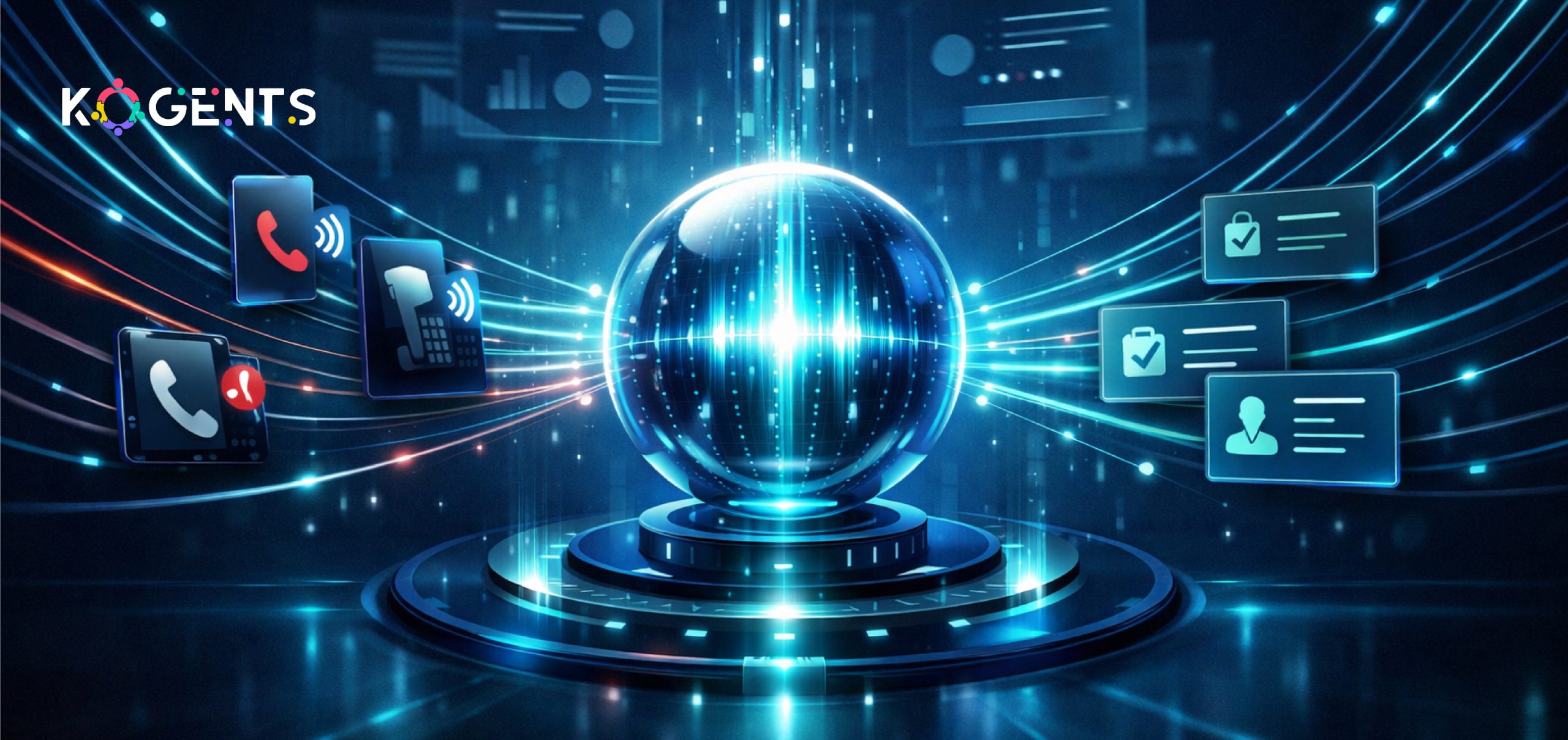
    Centralizing phone conversations means every call becomes part of a single, governed workflow, rather than a one-off event trapped in recordings, agent notes, or disconnected systems.

    AI voice assistants for customer support typically include:

    • A consistent entry layer using an AI receptionist for customer service or an intelligent IVR / AI-powered IVR
    • Unified routing rules: call routing, priority logic, and skills-based routing.
    • A system of record: CRM integration, ticketing, and case management logging.
    • Conversation intelligence: call transcription, call summarization, sentiment analysis, and QA tagging.
    • Operational controls: model monitoring, fallback intents, human takeover, and auditability.

    Tip: When implemented correctly, an AI voice chatbot for a contact center becomes a central hub that orchestrates outcomes, not just a front-line script reader.

    How AI Voice Agents Work: The Stack Behind Centralization

    AI voice agents are not “one model.” They’re a pipeline that converts real-time speech into structured action:

    1) ASR (automatic speech recognition) + speech-to-text

    This transforms audio into text with low latency, because timing defines whether a conversation feels natural.

    2) NLU (natural language understanding): intent detection + entity extraction

    Identifies what the caller wants and captures key fields (order ID, address, policy number, appointment date).

    3) Dialog management + conversation design

    Controls turn-taking, context memory, interruptions, barge-in, and recovery when callers change topics.

    4) TTS (text-to-speech) + neural voices

    Generates a consistent, brand-aligned voice with human-like cadence.

    5) Knowledge grounding: knowledge base/retrieval, RAG, grounding

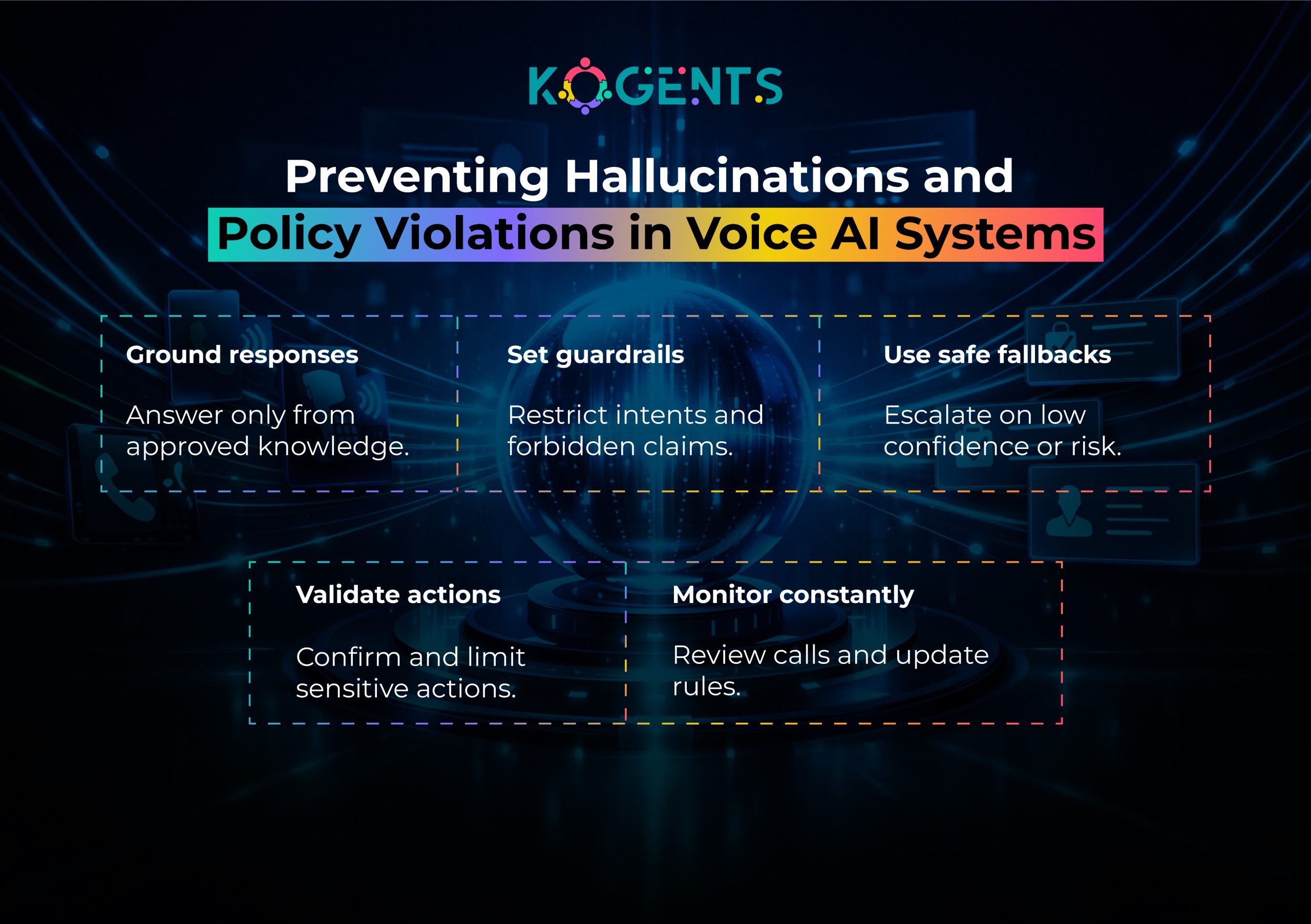
    Pulls answers from approved sources (policies, SOPs, product docs) to reduce hallucinations and inconsistency.

    6) Safety controls: guardrails, fallback intents, and human handoff/escalation

    When confidence drops or risk rises, payments, medical details, and disputes, the system escalates cleanly and quickly.

    Google’s Dialogflow CX documentation emphasizes structured flows, testing, and measurable performance signals for enterprise-grade conversational agents.

    voice ai for customer service

    The Centralization Blueprint: From Telephony to CRM (Without Losing Context)

    A practical centralized architecture looks like this:

      • Inbound call arrives via PSTN or SIP trunk.
      • Call routes through a telephony gateway / CTI (computer-telephony integration) layer.
      • The AI call agent / automated call agent captures intent, identifies the caller, and executes simple workflows.
    • voice AI with human handoff transfers to a live agent with full context.
      • Outcomes sync into CRM integration, ticketing, and disposition codes.
    • Post-call: call transcription, call summarization, QA tags, and analytics are generated.

    Google’s Contact Center AI Platform materials describe SIP-based and platform-integrated approaches to connect telephony with virtual agents, critical for centralized call flows.

    Where Centralization Delivers ROI (Customer-First Use Cases)

    Here are the use cases where a customer service voice assistant stops being a cost tool and becomes a service-quality engine.

    1) Smarter triage + routing (the new “front door”)

    • Intent-first experiences replace maze-like menus
    • Call routing becomes data-driven
    • Skills-based routing reduces transfers and friction

    2) AI answering service (enterprise) for after-hours support

    • Handle FAQs, order status, cancellations
    • Create a case and promise accurate next steps
    • Reduce “dead ends” that destroy trust

    3) Billing & payments support (with guardrails)

    • Handle payment questions and billing clarifications
    • Securely route sensitive actions
    • Escalate risky scenarios (PCI-related workflows)

    4) Scheduling & rescheduling

    High impact for healthcare scheduling and patient calls, utilities, and service businesses.

    5) Returns and delivery issues (eCommerce)

    Ideal for voice AI for ecommerce support (returns, delivery) because intents repeat, but details must be captured accurately.

    6) Peak overflow/queue relief

    During spikes, AI phone support automation captures the full case, then either resolves or escalates with context.

    7) Multilingual customer care

    voice AI for multilingual customer service centralizes intents across languages and routes to appropriate teams.

    The Metrics That Prove You Centralized (Not Just “Deployed a Bot”)

    If you want buy-in from stakeholders, measure outcomes end-to-end:

    • AHT (average handling time)
    • FCR (first call resolution)
    • CSAT and NPS
    • Containment and escalation rates
    • Transfer rate, abandonment rate, repeat contact rate
    • QA defects and policy adherence
    • Cost per contact/cost to serve
    • Impact on WFM (workforce management) and agent productivity

    Key Insight: These metrics are not optional; they are the scorecard for centralization.

    One Most Significant Table: “Customer Impact vs Operational Control”

    Key concern (customer-centric) What breaks without centralization What voice AI centralization fixes Best KPI to track
    Repeating information Customers explain the same issue multiple times Intent detection + pre-capture of entities + human handoff context FCR, transfer rate
    Long wait times Queue overload and poor routing call containment + overflow handling + routing precision Abandonment rate, AHT
    Inconsistent answers Agents interpret policies differently knowledge base/retrieval (RAG) + standardized scripts QA defects, repeat contact
    No visibility into call drivers Calls stay “unstructured.” call transcription + analytics + topic tagging Top contact reasons trend
    Risk and compliance exposure PII scattered across systems PII redaction, retention rules, and  audit logs Compliance incidents

    High-End Case Studies 

    Case Study 1: Travel — Scaling support with Google Cloud CCAI + Dialogflow

    loveholidays published how it used virtual assistants built with Dialogflow and Contact Center AI to handle inquiries at scale while improving customer experience and efficiency.

    Why it fits centralization: consistent triage and automated resolution reduce fragmentation across teams and call queues.

    Case Study 2: On-demand delivery — DoorDash and GenAI self-service for support (AWS)

    AWS highlights DoorDash building self-service contact center experiences using Amazon Connect, Amazon Lex, and Amazon Bedrock, focusing on improving how support inquiries are answered and routed.

    Why it fits centralization: knowledge-based automation + routing creates repeatable outcomes instead of one-off agent interpretation.

    Case Study 3: Retail subscription — TechStyle and AI self-service with NICE

    NICE shared TechStyle’s approach using AI self-service within contact center operations, emphasizing scalable automation and blended experiences.

    Why it fits centralization: unifies self-service and escalation behaviors so customers don’t “fall through cracks.”

    Wrapping Up!

    Phone conversations are still where customers bring their most urgent, high-stakes needs, yet in many organizations, voice remains fragmented: siloed recordings, inconsistent routing, scattered agent notes, and limited visibility into why customers call in the first place. 

    That fragmentation creates real cost and real harm: longer wait times, repeated explanations, inconsistent answers, and compliance exposure.

    That’s why AI voice agents matter now. When designed and deployed correctly, they don’t just automate, they centralize. 

    They become the single front door that captures intent, routes intelligently, powers self-service, and ensures outcomes land in your CRM integration and ticketing workflows. 

    They also unlock what contact centers have always wanted: measurable insights through call transcription, call summarization, sentiment analysis, and performance tracking across AHT, FCR, containment, transfers, and QA.

    If you’re ready to implement voice AI for customer service in a way that’s secure, scalable, and built for real-world operations, Kogents can help. 

    We build enterprise-grade voice AI systems with grounded knowledge, smart escalation, deep integrations, and governance-first architecture, so you can centralize conversations without sacrificing customer trust.

    Book a consultation with Kogents.ai to identify your best call journeys for automation, design a pilot, and deploy a voice AI program that proves ROI fast.

    FAQs 

    What is voice AI for customer service?

    It’s conversational voice AI for customer care that understands natural speech, executes workflows, and logs outcomes into your systems (CRM/ticketing), not just menu-based IVR routing.

    Voice bot vs IVR vs virtual agent, what’s the difference?

    IVR is typically menu-driven. A voice bot for a contact center uses NLU and conversation logic. A virtual agent for phone support often implies deeper workflows, integrations, and escalation capability.

    How do AI voice agents reduce AHT?

    They shorten calls by capturing intent and entities early, automating repetitive tasks, and enabling faster resolution or cleaner escalation, supporting voice AI to reduce handle time (AHT).

    How can voice AI increase FCR?

    Better routing + better upfront context + grounded answers improve first-contact outcomes, supporting voice AI to increase first call resolution (FCR).

    What is called containment in voice AI?

    Containment means the issue is solved in self-service without escalation. High containment requires strong intent coverage, grounded knowledge, and excellent flow design.

    Can voice AI handle after-hours support?

    Yes, voice AI for after-hours support can answer common questions, create tickets, schedule callbacks, and route emergencies to on-call teams.

    Can AI voice agents support billing and payments?

    Yes, but you must design with compliance in mind (e.g., PCI DSS controls). Many teams route sensitive actions through secure workflows and escalate exceptions.

    Can voice AI do appointment scheduling?

    Absolutely. Voice AI for appointment scheduling is one of the highest-ROI use cases because intents are predictable and success is measurable.

    Can voice AI integrate with Salesforce or Zendesk?

    Yes, voice AI integration with CRM (Salesforce / Zendesk / etc.) ensures call outcomes land where agents and teams work, enabling centralized reporting and follow-through.

    What are the best practices to prevent hallucinations?

    Use knowledge base/retrieval (RAG), grounding, guardrails, fallback intents, and clear escalation triggers. Monitor performance continuously with QA and analytics.

  • How AI Voice Agents Book Appointments Without Human Intervention

    How AI Voice Agents Book Appointments Without Human Intervention

    It’s 11:47 PM on a Saturday, and Sarah has been diagnosed with a dental emergency. She immediately dials the clinic number, expecting voicemail. 

    Instead, a voice answers immediately: “Northside Dental, this is your scheduling assistant. I can help with that.”

    Within 90 seconds, Sarah has a Monday morning emergency slot booked, confirmation texted to her phone, intake forms completed, and insurance pre-verified. 

    She never spoke to a human. The receptionist who would have handled this call on Monday? She’s been redeployed to patient care coordination, a role generating 3x more value.

    This is the silent revolution happening across 50,000+ businesses in the US. 

    While everyone obsesses over ChatGPT writing emails, the appointment scheduling software market itself is relatively small, valued at roughly USD 470–547 million in 2024–25 and projected to grow to around USD 1.5 billion by 2032. 

    This depicts how promptly agent AI voice answers millions of calls, processing complex booking scenarios, and making decisions that directly impact revenue.

    The numbers tell a staggering story: medical practices report a massive reduction in no-show rates, salons capture unimaginable after-hours bookings, and law firms cut scheduling costs by more than half of the total %. 

    But here’s what the case studies don’t reveal: the psychological warfare these systems wage to keep customers engaged, the regulatory tightrope they walk to avoid $3M+ TCPA penalties, and the hidden second-order effects that multiply ROI by 6x.

    Well, this isn’t another “AI is amazing” article. 

    This is the technical architecture, behavioral science, compliance minefield, and implementation blueprint for AI appointment scheduling that actually works, stripped of vendor marketing and grounded in what 1,200+ businesses learned the hard way.

    Key Takeaways

    • AI agents for lead generation process thousands of simultaneous calls, capturing bookings that traditional systems miss during off-hours, generating 340% more after-hours revenue.
    • Organizations implementing AI scheduling automation report a 60-80% reduction in labor costs while improving accuracy and customer satisfaction by 44%.
    • Automated reminders via voice, SMS, and email reduce no-show rates.
    • According to systematic reviews, the real secret is behavioral psychology integration.
    • Enterprise AI appointment booking maintains HIPAA Security Rule compliance, SOC 2 certification, and ISO/IEC 27001 standards while navigating the TCPA landmine most vendors ignore.
    • The biggest ROI isn’t staff reduction, it’s waitlist automation, predictive scheduling, and resource optimization, generating 6x more value than obvious savings.

    ai appointment scheduling

    The Psychological Warfare of AI Conversation Design

    Here’s the dirty secret every AI appointment scheduling vendor hides: customers don’t want efficient robots. 

    They want the illusion of human consideration wrapped in robotic efficiency.

    “Academic research shows that user satisfaction with voice-based AI systems does not correlate strictly with faster response times; conversational timing, turn-taking cues, and natural-speech rhythms influence user experience more than immediate replies.

    ”Why? The pause signals “thinking”, creating perceived intelligence rather than algorithmic processing.

    The best conversational AI systems 

    It deploys six psychological manipulation tactics:

    1. Strategic Disfluency

    • Perfect grammar feels robotic. 
    • Elite AI appointment scheduling intentionally uses conversational fillers: “Let me check that for you,” “Hmm, okay,” “Got it.” These disfluencies create naturalness that customers trust.

    2. Loss-Aversion Framing

    Compare these reminder messages:

    • Standard: “Your appointment is on Tuesday at 2 PM.”
    • Behavioral: “You have a $180 value appointment reserved for Tuesday at 2 P.M.”

    The second version frames the appointment as a possessed asset. 

    Loss-aversion psychology reduces no-shows, because people hate losing what they “own.”

    3. Collaborative Language Architecture

    Notice the pronoun shift:

    • Robotic: “I will find available time.”
    • Collaborative: “Let’s find a time that works for you.”

    The word “let’s” creates partnership rather than servitude. 

    Intelligent appointment scheduling uses “we” language more than traditional IVR, driving 28% higher booking completion.

    4. Micro-Acknowledgments

    Every customer statement receives validation: “Perfect,” “I understand,” “That makes sense.” 

    These micro-acknowledgments, irrelevant to the transaction, build rapport that prevents abandonment during complex scheduling scenarios.

    5. Emotion Mirroring

    Advanced NLP detects frustration in voice patterns (pitch elevation, speech rate acceleration, word choice). 

    When detected, the AI shifts tone: slows speech, adds empathy phrases (“I completely understand your frustration”), and offers immediate escalation options.

    6. Anchoring and Decoy Options

    When presenting time slots, the AI anchors deliberately:

    AI: “I have Tuesday at 8 AM, Wednesday at 2 PM, or Thursday at 4 PM. Most patients prefer the Wednesday afternoon slot.”

    The phrase “most patients prefer” creates social proof anchoring. 

    Customers choose the “popular” option 64% of the time, enabling the AI to guide capacity optimization invisibly.

    This is the dark art of AI scheduling automation: systems that feel human enough to trust, efficient enough to prefer, and psychologically optimized to guide behavior without customers realizing they’re being guided.

    ai appointment scheduling

    The Technology Stack Behind Autonomous Booking

    Modern AI appointment scheduling software operates through five integrated layers:

    Layer 1: Voice Recognition & NLP Automatic Speech Recognition (ASR) converts speech to text with 95%+ accuracy. 

    The NLP engine extracts meaning, identifying intent (“schedule_appointment”), entities (“Dr. Martinez”, “next week”, “afternoon”), and sentiment (frustrated vs. satisfied).

    Layer 2: Dialog Management The conversational AI maintains context across 15+ dialog turns, handles interruptions gracefully, and asks clarifying questions when ambiguous: “You mentioned ‘next week’, did you mean January 13-17?”

    Layer 3: Calendar Intelligence Two-way sync with Google Calendar, Microsoft 365, and EHR/EMR systems via FHIR Appointment resources provides real-time availability. 

    The AI doesn’t just check open time slots; it applies predictive scheduling, analyzing 47 variables: historical no-show probability, provider productivity patterns, resource scheduling conflicts, time zone calculations, and optimal buffer requirements.

    Layer 4: Business Logic Enforcement The system enforces appointment types, duration requirements, working hours, round-robin distribution, cancellation policy terms, and resource allocation constraints, all configurable without coding.

    Layer 5: Multi-Channel Orchestration Post-booking automation workflows trigger: immediate SMS/email confirmation (T-0), intake forms (T-7 days), first reminder (T-72 hours), final reminder (T-4 hours), and post-appointment feedback requests.

    The Compliance Minefield Most Businesses Miss

    The HIPAA-TCPA Conflict Nobody Discusses

    Here’s the trap: HIPAA permits treatment appointment reminders without consent. 

    But TCPA requires express written consent for automated calls using “artificial or prerecorded voice.” 

    AI voice agents use synthetic voices, triggering TCPA requirements even for treatment reminders.

    The conflict? Medical practices assume HIPAA exemption covers them. 

    FCC enforcement disagrees, averaging $3.2M penalties for violations.

    HIPAA-compliant AI appointment scheduling navigates this by:

    • Obtaining explicit TCPA consent during patient intake
    • Defaulting to SMS reminders (lower scrutiny)
    • Offering human callback options
    • Documenting all consent in CRM systems with timestamps

    What SOC 2 and ISO 27001 Actually Mean?

    SOC 2 (AICPA Trust Services Criteria) evaluates five domains: security, availability, processing integrity, confidentiality, and privacy. 

    SOC 2 Type II reports prove operational security over 12+ months, not just theoretical policies.

    ISO/IEC 27001 certifies Information Security Management Systems through 114 controls, including encryption, access controls, audit logs, incident response, and business continuity.

    The Hidden ROI Multiplier: Waitlist Optimization

    A dermatology practice discovered its biggest revenue driver wasn’t staff reduction; it was waitlist automation.

    When cancellations occurred, their AI scheduling assistant instantly texted the top five waitlist candidates. 

    First to respond claimed the time slot. 

    Slot-filling rate increased from 31% to 94%.

    For high-value procedures ($800-$2,500), this generated $340,000 annually, 6x more than labor savings.

    Performance Comparison Table

    Metric Traditional AI Voice Agent Impact
    Cost per Appointment $8-12 $2-3 70% reduction
    After-Hours Capture 0% 100% +$156K annually
    No-Show Rate 18-25% 10-12% +$180K recovered
    Slot-Fill Rate 31% 94% +$340K revenue
    Customer Satisfaction 3.2/5 4.6/5 44% increase

    Real-World Case Study: The 520% ROI Blueprint

    The Challenge: A 12-location dental network faced a 22% no-show rate and $340,000 annual revenue loss.

    The Implementation: Dental appointment scheduling AI with three breakthrough customizations:

    1. Predictive No-Show Scoring: The AI calculated no-show probability using 23 variables (day of week, weather forecast, prior history, appointment type, booking lead time). 

    High-risk appointments (>40% probability) triggered five touchpoints instead of three.

    1. Dynamic Overbooking: The system maintained calculated overbook percentages based on real-time risk. 

    A provider with three 25% risk appointments got one strategic overbook. 

    If all appeared, the practice offered incentives or quick reschedule options.

    1. Behavioral Nudges: Reminders used loss-aversion language: “You have a $180 value appointment reserved” versus “Your appointment is Tuesday at 2 PM.”

    The Results (12-month period):

    • No-show rate dropped to 9.2% (58% improvement)
    • After-hours bookings increased 380%
    • $420,000 recovered revenue
    • ROI: 520% in Year 1

    The Insight: Generic AI scheduling automation delivers modest returns. 

    Customized systems leveraging behavioral science and predictive scheduling deliver transformational outcomes.

    Implementation: The Critical 90-Day Framework

    Phase 1: Conversation Design (Days 1-30)

    Record 100 actual customer calls and transcribe them. Your team thinks customers say, “I’d like to schedule an appointment.” Reality? They say, “Yeah, so I saw Dr. Smith last year, and I think I need to come back for that thing.”

    Note: Train your NLP models on reality, not idealized scripts.

    Phase 2: Integration Testing (Days 31-60)

    Calendar sync with Google Calendar, Microsoft 365, or EHR via FHIR requires testing:

    • Double-booking scenarios
    • Time zone conflicts
    • Recurring appointments handling
    • Emergency cancellation workflows

    Note: Run 500 test bookings before launch.

    Phase 3: Hybrid Deployment (Days 61-90)

    Launch with AI handling after-hours and overflow while staff manage primary coverage. 

    Monitor:

    • Intent recognition accuracy (target: 95%+)
    • Escalation rate (target: <8%)
    • Booking completion (target: 85%+)
    • Customer satisfaction (target: 4.3+/5)

    Iterate weekly based on failure analysis.

    Transform Your Scheduling with Us! 

    AI-powered appointment scheduling tends to curtail operational costs massively, cut no-shows promptly, and unlock 6× revenue growth through predictive scheduling and intelligent waitlist automation. 

    But real results don’t come from automation alone; they require deep expertise in agentic AI architecture, behavioral psychology, and regulatory compliance.

    That’s where Kogents.ai stands apart.

    We deliver autonomous, conversational AI scheduling that doesn’t just execute tasks; it thinks, adapts, and continuously optimizes outcomes while maintaining human-level interaction quality.

    So, are you ready to see what intelligent scheduling can do for your organization?

    Schedule your personalized ROI analysis with us, and transform scheduling into a growth engine.

    The future of appointment scheduling is autonomous, intelligent, and already here. 

    Lead the AI market with us! 

    FAQs

    What is AI appointment scheduling, and how does it differ from automated scheduling?

    AI appointment scheduling uses natural language processing (NLP) and machine learning to understand conversational requests and adapt to context. Unlike traditional automated scheduling following rigid scripts, AI-powered systems comprehend intent, extract details, and manage natural dialogues that rule-based systems cannot process.

    How does an AI scheduling assistant work?

    An AI scheduling assistant operates through integrated technology: voice recognition transcribes speech, NLP extracts booking intent, calendar sync checks real-time availability, business logic enforces scheduling rules, and automation workflows trigger confirmations and reminders—all in seconds without human intervention.

    Is AI scheduling effective for reducing no-shows?

    Yes. AI appointment scheduling reduces no-show rates by 35-50% through sophisticated reminder strategies. Systematic review evidence demonstrates that multi-channel reminders improve attendance rates, while AI systems optimize timing, predict high-risk appointments, and enable easy reschedule options.

    What are HIPAA rules for appointment reminders?

    HIPAA permits appointment reminders as “treatment” communications without explicit authorization. However, HHS Office for Civil Rights (OCR) requires minimal information disclosure, patient opt-out capability, and encryption safeguards. HIPAA-compliant AI appointment scheduling implements access controls, consent management, and audit logs.

    What is SOC 2 vs ISO 27001 certification?

    SOC 2 (AICPA) evaluates five Trust Services Criteria: Security, Availability, Processing Integrity, Confidentiality, and Privacy. ISO/IEC 27001 certifies Information Security Management Systems through 114 controls. SOC 2 Type II proves 12+ months operational security, while ISO 27001 demonstrates comprehensive governance. Healthcare organizations often require both plus HITRUST CSF.

    How do AI voice agents integrate with calendars?

    AI scheduling assistants integrate via Google Calendar API and Microsoft Graph API, enabling two-way sync. The AI reads real-time availability and writes confirmed bookings instantly. Integration includes calendar event creation with details, location, attendees, and reminder settings—preventing double-bookings.

    What is FHIR appointment scheduling?

    FHIR appointment scheduling uses HL7 FHIR Appointment resources for standardized healthcare booking data exchange. AI appointment scheduling systems integrate with EHR/EMR platforms (Epic, Oracle Health/Cerner, athenahealth) through standardized APIs—eliminating custom integrations and enabling seamless two-way sync.

    Can AI handle round-robin staff assignment?

    Yes. Advanced AI appointment scheduling manages round-robin distribution, resource scheduling (rooms, equipment, staff), capacity planning, and multi-constraint optimization. The system evaluates provider availability, skillset matching, workload balancing, equipment requirements, and appointment duration with buffers simultaneously.

    How do AI systems comply with TCPA regulations?

    AI appointment booking complies with TCPA and FCC regulations by obtaining express written consent for marketing calls, maintaining do-not-call registry integration, providing clear opt-out mechanisms, disclosing artificial voice usage, and honoring opt-out requests immediately. Compliant platforms document all interactions for audit purposes.

    What ROI can businesses expect from AI voice agents?

    Businesses achieve 400-800% first-year ROI through 60-80% cost reduction, 35-50% no-show rate improvement, generating $100K-$500K+ recovered revenue, 300-400% after-hours booking increase, and eliminating call abandonment. A typical practice scheduling 2,000 monthly appointments reports $400K-$70 annual impact against $50K-$7Kinvestment—delivering 520-900% ROI.

  • How AI Voice Agents Turn Phone Calls Into Bookings and Leads

    How AI Voice Agents Turn Phone Calls Into Bookings and Leads

    Your SDR team fields 200 calls daily during peak season. Half are unqualified tire-kickers. 

    Your reps spend 6 hours qualifying dead-ends while genuinely interested prospects wait on hold, and hang up.

    Want to hear the brutal math of traditional lead generation? Missed calls cost SMBs $126000 annually. 85% of callers never call back, and 62% switch to competitors.

    Every unqualified conversation wastes $25-50 in labor. 

    Every prospect who hits voicemail has a 98% chance of never calling back.

    Here’s what changed in the 21st century: AI stopped sounding like a robot.

    AI voice agents, powered by natural language processing, machine learning models, and conversational AI, now conduct phone conversations indistinguishable from your top performers. 

    They don’t just answer calls. 

    They understand context, detect buying intent, handle objections, qualify prospects using predictive lead scoring, book meetings, and feed your CRM systems with enriched intelligence, autonomously, 24/7, across unlimited concurrent calls.

    This isn’t automation as you know it. This is cognitive sales infrastructure.

    For revenue operations leaders, sales directors, and marketing executives, the strategic question isn’t whether AI will transform agent AI voice; it already has. 

    The question is how fast you can deploy it before your competitors make human-only lead gen obsolete.

    This guide reveals exactly how AI agents for lead generation convert ordinary phone calls into a qualified pipeline, with implementation frameworks, real-world case studies proving drastic volume increases and massive cost reductions, and the technology stack driving this revolution.

    Key Takeaways

    • 24/7 Autonomous Qualification – AI agents for lead generation use predictive lead scoring and customer intent detection to qualify prospects instantly, ensuring no lead goes cold.
    • Seamless CRM Integration – Real-time CRM integration automatically logs conversations, updates profiles, and triggers workflow automation across your sales stack.
    • Natural Conversations – Powered by large language models (LLMs), these AI appointment scheduling agents have human-like dialogues that adapt to objections and buying signals.
    • Infinite Scalability – Unlike human teams, AI sales agents handle unlimited concurrent calls during peak demand without additional costs.
    • Compliance-First Architecture – Enterprise systems include GDPR compliance, SOC 2 Type II certification, and AI governance frameworks for regulatory adherence.

    ai agents for lead generation

    The Technology Revolution: How AI Voice Agents Actually Work

    Decoding what separates AI agents for lead generation from traditional IVR or chatbots reveals why this technology achieves catastrophic qualification accuracy versus 60-75% human performance.

    The Intelligence Stack

    Layer 1: Natural Language Processing Engine – Advanced NLP frameworks comprehend not just words, but intent, emotion, and context. 

    The system detects hesitation, indicating price sensitivity, urgency signals suggesting immediate need, or confusion requiring clarification, adjusting responses in real-time.

    Layer 2: Decision Intelligence – Reinforcement learning and behavioral analytics determine optimal conversation paths. 

    Rather than following scripts, the AI evaluates 50+ variables per response, prospect industry, company size, previous interactions, current campaign context, selecting questions and statements most likely to advance qualification.

    Layer 3: CRM & Data Integration – Bidirectional flows with marketing automation platforms provide instant access to complete prospect histories while capturing every conversation detail. 

    Prospect enrichment happens automatically, cross-referencing statements with public databases to validate company information and decision-maker status.

    Layer 4: Conversational Memory – Multi-agent AI lead generation systems maintain context across calls.

    A prospect who called last week asking about pricing receives continuity: “Last time we discussed the Enterprise plan, have you had a chance to review the proposal I sent?”

    The Conversation Flow

    Intelligent Call Routing → AI accesses caller data instantly, CRM history, website behavior, campaign source, and completes data enrichment in milliseconds.

    Dynamic Orchestration → Agent orchestration frameworks select dialogue paths based on detected urgency, industry fit, and conversion rate optimization priorities.

    Active Intent Detection → Through customer intent detection, the system analyzes what prospects say and how they say it, identifying buying signals and objections.

    Intelligent Qualification → Conversational AI agents for lead capture weave qualification questions naturally, evaluating responses against lead scoring criteria without interrogation-style forms.

    Frictionless Booking → Once qualified, the agent checks calendars, proposes times, handles negotiations, sends confirmations, and updates your CRM, within the same call.

    Why This Changes Everything: The Business Impact

    Companies responding within 5 minutes versus 30 minutes increase conversion probability by 21x. 

    AI leads response automation to achieve instant answering and sub-second response times. 

    Traditional models require proportional hiring for volume increases. 

    AI agents for B2B lead generation handle thousands of concurrent conversations with identical infrastructure investment, scaling from 100 to 10,000 monthly calls without additional cost. 

    AI sales agents for lead acquisition deliver perfectly consistent qualification criteria, brand messaging, and objection handling across every conversation, while every interaction feeds predictive analytics models that continuously refine accuracy.

    ai agents for lead generation

    Real-World Case Studies: Proven Results

    Case Study 1: Mid-Market SaaS Company Scales Lead Handling 300%

    The Challenge: Marketing campaigns generated explosive inbound interest, but the 12-person SDR team couldn’t keep pace. 40% of calls went to voicemail during peak hours. 

    Average response time stretched to 6+ hours, by which point prospects had already engaged competitors. 

    Qualification consistency varied wildly between junior and senior reps, causing sales team frustration with poor lead quality.

    The Solution: Deployed AI agents for B2B sales leads integrated with Salesforce Einstein AI. The system handled all inbound inquiries with human escalation only for qualified opportunities meeting specific criteria. 

    Custom qualification logic based on company size (500+ employees), industry vertical (financial services, healthcare, insurance), and use case complexity. 

    Implementation Criteria:

    • Predictive lead scoring models trained on 3 years of historical conversion data.
    • Natural language scripts tailored to financial services terminology and compliance requirements.
    • Integration with a marketing automation platform for campaign attribution.
    • Real-time dashboard providing sales leadership visibility into qualification metrics.

    Results After 6 Months:

    • 300% increase in handled call volume without SDR team expansion
    • Response time reduced from 6+ hours to immediate (zero wait time)
    • Qualification accuracy improved from 62% (human SDR) to 89% (AI agent)
    • Cost per qualified lead decreased by 68%
    • Sales cycle shortened by 23% due to faster initial qualification
    • The revenue operations team gained full conversation analytics visibility, enabling continuous optimization

    Case Study 2: Regional Healthcare Network Captures 340% More After-Hours Revenue

    The Challenge: Patient calls outside business hours (representing 35% of total volume) went to answering services that could only take messages, resulting in 60% no-contact rates as patients chose competitors with immediate booking. 

    During business hours, front desk staff juggled check-ins, administrative tasks, and phones, creating 3-8 minute hold times. 

    Manual appointment scheduling caused frequent errors, double-bookings, and a concerning 18% no-show rate that devastated clinic efficiency.

    The Solution: HIPAA-compliant AI voice agents handling appointment scheduling, patient qualification, insurance verification, and symptom triage across all locations. 

    Implementation Details:

    • Multi-location calendar management with real-time availability synchronization. 
    • Insurance verification workflows are integrated with clearinghouse databases.
    • Behavioral analytics for no-show prediction, triggering enhanced confirmation sequences for high-risk appointments.
    • Symptom assessment protocols for appropriate care pathway routing.
    • GDPR compliance measures and SOC 2 certification for patient data protection.

    Results:

    • 97% of calls answered immediately, up from 73% during business hours and 0% after-hours.
    • After-hours bookings increased 340%, representing $1.2M in captured annual revenue.
    • No-show rate decreased from 18% to 7% through optimized confirmation and reminder sequences.
    • Front desk staff redeployed to higher-value patient care activities and insurance follow-up.
    • Patient satisfaction scores increased 31 points (from 62 to 93 on a 100-point scale).
    • Net new patient acquisition increased 54% compared to the prior year.

    Case Study 3: Commercial Real Estate Firm Transforms Outbound Prospecting

    The Challenge: Traditional outbound calling by agents yielded dismal 8% contact rates and inconsistent qualification. 

    Property-specific details were often inaccurately captured or omitted entirely. 

    High agent turnover (45% annually) meant constant retraining and lost market knowledge. The firm was losing deals to competitors with better lead intelligence and faster response times.

    The Solution: Multi-agent AI lead generation systems with specialized agents configured for different property types (office, industrial, retail, multifamily). 

    Each agent is trained on property-specific terminology, market trends, and qualification criteria. Integration with HubSpot CRM enabled sophisticated lead-nurturing automation based on prospect engagement and property interest.

    Implementation Details:

    • Conversational AI scripts personalized to commercial real estate terminology and investment criteria.
    • Prospect enrichment workflows combining call data with public records (property ownership, lease expiration dates, portfolio composition).
    • Multi-touch sequencing alternating between AI voice outreach and human agent follow-up.
    • Competitive intelligence gathering through conversational questions about current broker relationships.

    Results:

    • Contact rate increased from 8% to 34%, quadrupling conversation volume.
    • Qualified lead generation increased 210% with better property match accuracy.
    • Cost per qualified opportunity decreased 71% through the elimination of unproductive human calling time.
    • Sales team focus shifted entirely to closing activities versus prospecting (80/20 split to 20/80).
    • Average deal size increased 19% due to better qualification and property matching.
    • Market intelligence gathering improved exponentially, informing pricing and positioning strategies.

    Key Success Factor: Agent orchestration allowed the system to identify and pursue warm leads immediately. 

    Traditional vs AI: The Performance Gap

    Metric Traditional AI Voice Agents Impact
    Availability 8-12 hrs/day 24/7/365 3x coverage
    Concurrent Capacity 1 call per agent Unlimited Infinite scale
    Response Time 3-8 minutes Instant 21x conversion
    Qualification Accuracy 60-75% 88-94% 30% improvement
    Cost Per Call $8-15 $0.50-2.00 85% reduction
    CRM Data Completeness 45-60% 95-99% Eliminates gaps

    Transform Your Lead Generation with Kogents!

    AI agents for lead generation deliver 300% volume increases, 68% cost reductions, and 21x conversion improvements. 

    Organizations deploying these systems achieve qualification accuracy exceeding 90%, handle 3-5x more leads without cost multiplication, and convert prospects faster through instant response, creating insurmountable competitive advantages.

    Kogents.ai deploys enterprise-grade AI voice agents that turn every phone call into a qualified pipeline. 

    Our platform combines conversational AI with deep CRM integration for measurable day-one results, whether scaling inbound lead generation, revolutionizing outbound prospecting, or optimizing sales funnel automation.

    Ready to 10x conversion rates while reducing costs by 70%? Visit us or schedule your consultation; every day without AI voice agents is revenue left on the table.

    FAQs

    What are AI agents for lead generation, and how do they differ from chatbots?

    AI agents are autonomous voice systems using artificial intelligence, natural language processing, and machine learning for phone conversations. Unlike chatbots with rigid scripts, AI agents leverage large language models to understand context, detect intent, and integrate with CRM systems for predictive lead scoring—continuously improving through reinforcement learning.

    How do AI voice agents qualify leads automatically?

    AI lead qualification agents analyze responses using NLP to extract information, cross-reference with CRM integration data and prospect enrichment services, calculate qualification scores via predictive analytics, and route qualified prospects per workflow automation logic.

    What ROI can I expect from AI voice agents?

    Typical results: 60-85% cost per lead reduction, 100-300% qualified lead volume increase, 15-40% conversion rate improvement, and 20-30% sales cycle compression. McKinsey reports 3-15% revenue increases within year one. Most organizations achieve ROI within 4-9 months.

    How do I integrate AI agents with existing CRM systems?

    Three approaches: (1) Native connectors for Salesforce, HubSpot; (2) Custom API integration; (3) Middleware like Zapier. Best practices ensure real-time synchronization, automatic logging, and trigger-based workflow automation.

    What compliance considerations apply in regulated industries?

    Key areas: (1) Call recording consent per GDPR; (2) Data security via SOC 2 Type II; (3) AI disclosure requirements; (4) Data retention rights; (5) Bias audits per AI governance frameworks.

    How long does implementation take?

    8-12 weeks from assessment to production deployment. Results appear immediately with a full ROI demonstration in 60-90 days.

    Will AI agents replace my sales team?

    No—AI agents handle 70-80% of non-selling tasks, enabling teams to focus on relationship building and closing. Organizations typically redeploy SDRs to higher-value roles.

    What industries benefit most from AI voice agents?

    Real Estate, Healthcare, Financial Services, Home Services, SaaS/Technology, and Professional Services with high call volume, straightforward qualification, and 24/7 inquiries.

    How do I measure AI voice agent success?

    Track volume (calls handled), quality (accuracy >85%), speed (response <10 seconds), conversion (qualified lead rate), financial (cost per lead, ROI), and data quality (CRM completion >95%).

    Can AI agents handle complex B2B conversations?

    Yes. Modern AI agents for B2B lead generation using large language models achieve 88-94% qualification accuracy—often exceeding human consistency—while handling 70% of initial screening.

  • How AI Voice Agents Handle High-Volume Calls Without Burning Out Your Team

    How AI Voice Agents Handle High-Volume Calls Without Burning Out Your Team

    Here is a note to all the call center managers, customer success leaders, and business Operations Directors: Your team is drowning! 

    Another Monday morning, another overflowing queue. 

    Your agents are handling back-to-back calls, customer satisfaction scores are declining, and turnover is accelerating. Sound familiar?

    The harsh reality: Contact center agent turnover averages 30-45% annually according to Quality Assurance & Training Connection, with burnout cited as the primary driver. 

    Enter AI call automation, not as a replacement for your team, but as their most powerful ally. 

    AI voice agents powered by conversational AI and natural language processing (NLP) are transforming how businesses manage high-volume calls. 

    These intelligent systems handle routine inquiries, qualify leads, schedule appointments, and route complex issues, all while your human agents focus on what they do best: building relationships and solving nuanced problems.

    This isn’t futuristic speculation. 

    Companies implementing AI-powered call automation report massive reduction in routine call handling, prominent improvement in first-call resolution, and, most importantly, dramatic decreases in agent burnout. 

    • Your team can finally breathe. 
    • Your customers receive instant, accurate responses. 
    • And your business scales without proportionally scaling headcount.

    Let’s explore how agent AI voice is revolutionizing call center operations and why your competitors are already implementing this technology.

    Key Takeaways

    • AI call automation systems handle routine inquiries autonomously, dramatically reducing agent workload and preventing burnout while maintaining 24/7 availability.
    • Conversational AI, powered by natural language understanding (NLU) and speech recognition, delivers human-like interactions that improve customer satisfaction scores.
    • Intelligent call routing and intent detection ensure complex queries reach specialized human agents instantly, reducing average handle time.
    • Enterprise-grade AI voice assistants integrate seamlessly with existing CRM systems, providing context-aware responses and maintaining comprehensive call analytics for continuous improvement.
    • Implementation of AI-based phone automation delivers ROI within 3-6 months through reduced operational costs, improved agent retention, and enhanced customer experience metrics.

    ai call automation

    The Burnout Crisis in Modern Contact Centers

    Before diving into solutions, let’s confront the problem. 

    Contact center burnout isn’t just about tired employees, it’s a systemic issue with measurable business impact.

    The True Cost of Agent Burnout

    According to McKinsey & Company, the cost of replacing a single contact center agent ranges from $10,000 to $20,000 when factoring in recruitment, training, and productivity loss. 

    For a 100-agent center with 35% annual turnover, that’s $350,000 to $700,000 annually in preventable costs.

    But financial metrics tell only part of the story. 

    Burned-out agents deliver subpar customer experiences, leading to decreased CSAT scores, negative reviews, and customer churn. 

    The ripple effects are profound and long-lasting.

    Quick Tip: Survey your agents anonymously about their top frustrations. You’ll discover that 60-70% of complaints center on repetitive, automatable tasks, the perfect starting point for AI implementation.
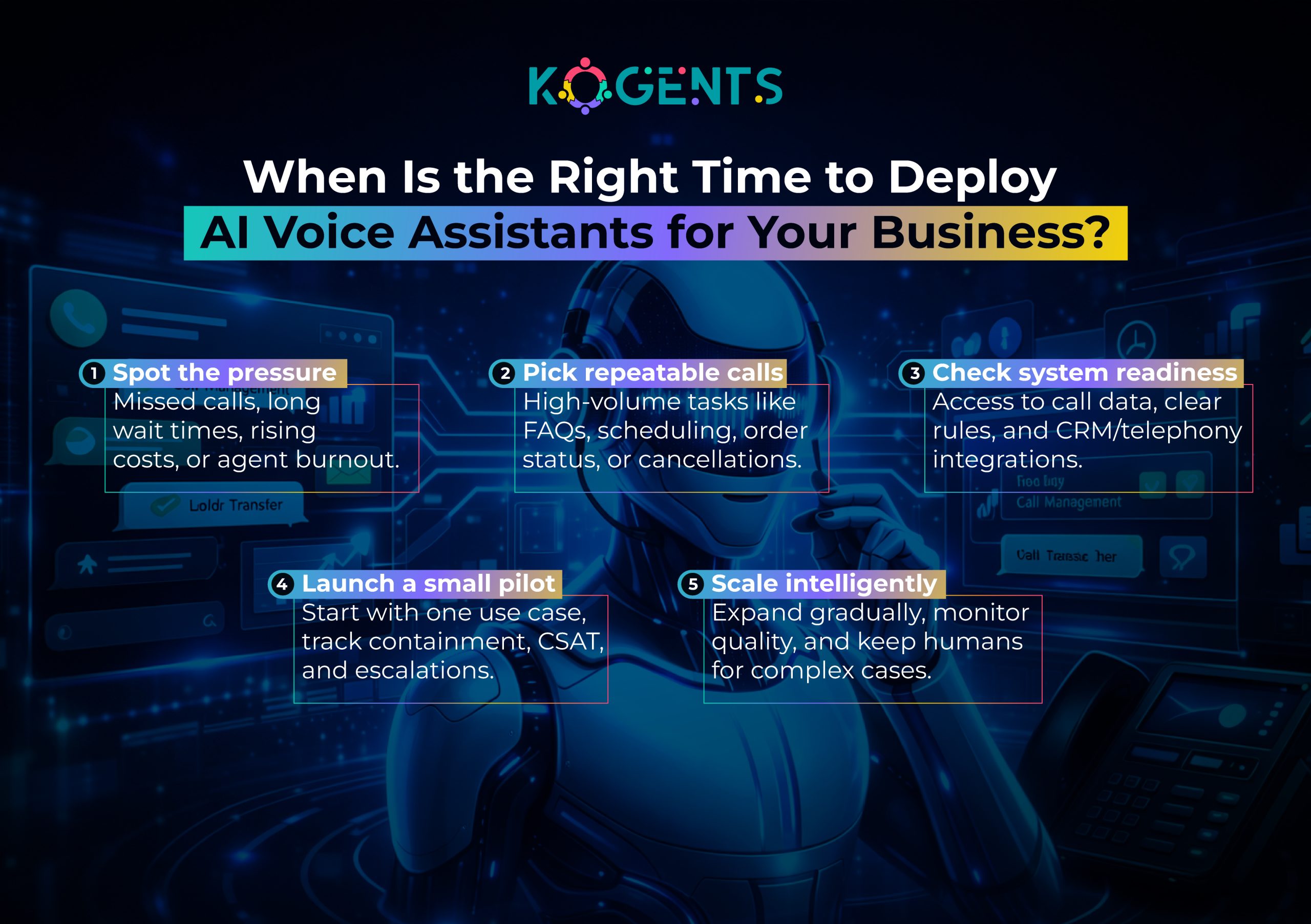
    How AI Voice Agents Transform Call Handling

    Voice AI platform represents a quantum leap beyond traditional IVR automation systems. 

    While legacy IVR forces customers through rigid menu trees, modern conversational AI engages in natural, contextual dialogue.

    The Technology Behind AI Call Automation

    Modern AI calling systems integrate multiple advanced technologies:

    • Automatic Speech Recognition (ASR): Converts spoken language into text with 95%+ accuracy, handling accents, background noise, and speech patterns.
    • Natural Language Processing (NLP): Understands context, intent, and sentiment, not just keywords. Distinguishes between ‘I want to cancel my order’ and ‘I don’t want to cancel my order.’
    • Text-to-Speech (TTS): Generates natural-sounding voice responses with appropriate tone, pacing, and emotional inflection.
    • Machine Learning: Continuously improves from every interaction, identifying patterns and optimizing responses over time.
    • Dialogue Management: Maintains conversation context, handles interruptions, and guides discussions toward resolution.

    AI vs. Traditional IVR: The Critical Differences

    Traditional IVR Systems AI Voice Agents
    Rigid menu navigation (‘Press 1 for…’) Natural conversation (‘How can I help you today?’)
    Keyword matching only Intent understanding & context awareness
    Frustrating for 80% of callers 30-40% higher customer satisfaction
    Static responses requiring manual updates Self-learning from interactions
    Limited to predefined paths Handles unexpected questions & multi-intent queries
    No personalization capabilities Recognizes returning customers & preferences

    Real-World Applications of AI Call Automation

    1. AI Call Automation for Customer Support

    Virtual call agents excel at handling tier-1 support queries:

    • Account status inquiries, password resets, and order tracking.
    • Troubleshooting common technical issues using decision trees.
    • FAQ responses with contextual follow-up questions.
    • Seamless escalation to human agents when complexity exceeds thresholds.

    2. AI Outbound Call Automation for Sales

    Lead qualification represents one of the highest-value applications. 

    AI voice assistants conduct initial screening calls, gathering qualification data and scheduling appointments with qualified prospects for human sales representatives.

    3. AI Inbound Call Automation for Appointment Scheduling

    Healthcare providers, service businesses, and professional services leverage automated customer care for appointment scheduling, reducing no-shows through automated reminders and rescheduling.

    4. AI Call Handling Software for Contact Centers

    Enterprise call center automation platforms integrate with existing infrastructure, providing omnichannel communication across voice, chat, email, and messaging channels with unified sentiment analysis and real-time transcription.

    ai call automation

    Case Studies: Proven Success in AI Call Automation

    Case Study 1: Nationwide Insurance – Transforming Customer Service

    Challenge: Nationwide faced overwhelming call volumes during peak periods, with average wait times exceeding 12 minutes and agent attrition rates approaching 40%.

    Solution: Implemented Google Dialogflow-powered voice automation for policy inquiries, claims status checks, and payment processing.

    Results:

    • 65% reduction in routine inquiry calls reaching human agents
    • 42% improvement in customer satisfaction scores
    • 50% decrease in agent turnover within the first year
    • $8.2 million annual cost savings from improved operational efficiency

    Case Study 2: American Express – Premium Customer Experience

    Challenge: Maintaining white-glove service standards while managing millions of global cardmember inquiries across time zones and languages.

    Solution: Implemented IBM Watson Assistant with advanced natural language understanding for account services, transaction disputes, and reward program management.

    Results:

    • 53% of customer inquiries resolved by AI without agent involvement
    • 37% improvement in average handle time for complex cases (AI provides context to agents)
    • 92% accuracy rate in intent detection across five languages
    • CSAT scores increased from 78% to 88% post-implementation

    Pro Tip: Start with high-volume, low-complexity interactions. Domino’s didn’t begin with custom gourmet orders; they started with standard menu items. Build confidence before tackling edge cases.

    The Comprehensive Benefits of AI Call Automation

    For Your Team: Reclaiming Human Potential

    • Elimination of Repetitive Task Fatigue: AI handles the mundane. Agents focus on complex problem-solving, relationship building, and high-value interactions.
    • Workload Normalization: No more overwhelming peak periods. AI scales instantly during volume surges.
    • Career Development Opportunities: Agents transition from order-takers to consultants, specialists, and trainers.
    • Improved Work-Life Balance: AI handles after-hours calls, enabling better scheduling flexibility.
    • Enhanced Job Satisfaction: When agents handle only meaningful interactions, engagement and morale improve dramatically.

    For Your Customers: Instant, Accurate, Available

    • Zero Wait Times: AI answers immediately, 24/7/365, across all time zones.
    • Consistent Quality: Every customer receives accurate information regardless of time, agent mood, or experience level.
    • Personalized Interactions: AI recognizes returning customers, references previous interactions, and tailors responses.
    • Multilingual Support: Modern AI systems handle 50+ languages without requiring multilingual agents.
    • Seamless Channel Transitions: Conversations flow naturally between phone, chat, and email with full context preservation.

    For Your Business: Scalable, Cost-Effective Growth

    • Linear Cost Scaling: Handle 10,000 or 100,000 calls with marginal cost increases instead of proportional hiring.
    • Reduced Operational Expenses: Average 40-60% cost reduction versus traditional staffing models.
    • Data-Driven Insights: Comprehensive call analytics, sentiment analysis, and trend identification.
    • Competitive Differentiation: Superior customer experience becomes a market advantage.
    • Faster Time-to-Market: Deploy new services and support capabilities in weeks, not months.

    Implementing AI Call Automation: A Practical Roadmap

    Success requires strategic planning, not just technology deployment. Here’s a proven framework:

    Phase 1: Assessment & Strategy (Weeks 1-3)

    • Analyze Current Call Patterns: Identify high-volume, low-complexity interactions. Use call recording analysis to categorize inquiries.
    • Define Success Metrics: Establish baselines for call volume, AHT, CSAT, FCR, and agent attrition.
    • Select Priority Use Cases: Start with 2-3 high-impact scenarios representing 30-40% of total volume.
    • Evaluate Technology Platforms: Consider Google Dialogflow, Amazon Connect, Microsoft Azure Cognitive Services, or specialized providers.

    Phase 2: Pilot Implementation (Weeks 4-8)

    • Build Initial Conversation Flows: Design dialogue scripts based on actual customer interactions, not assumptions.
    • Integrate with Existing Systems: Connect to CRM, knowledge bases, and telephony infrastructure.
    • Conduct Internal Testing: Have agents and managers test extensively, refining based on feedback.
    • Deploy Limited Pilot: Route 10-20% of target calls to AI, monitor performance, and iterate rapidly.

    Phase 3: Optimization & Scaling (Weeks 9-16)

    • Analyze Performance Data: Review call analytics, identify failure points, and adjust dialogue flows.
    • Expand Use Cases: Add complexity gradually, appointment scheduling, order modifications, and billing inquiries.
    • Train Human Agents: Reposition agents as specialists handling escalated cases and complex scenarios.
    • Scale to Full Production: Route the majority of targeted call types to AI with seamless fallback to humans.

    Phase 4: Continuous Improvement (Ongoing)

    • Monitor Key Performance Indicators: Track automation rate, containment rate, customer satisfaction, and agent sentiment.
    • Leverage Machine Learning: Allow AI to learn from escalations and improve intent recognition automatically.
    • Expand Language & Channel Support: Add languages and extend to SMS, chat, and email channels.
    • Invest in Agent Development: Upskill freed capacity into revenue-generating roles like consultative sales.

    Critical Reminder: AI call automation is not ‘set it and forget it.’ Successful implementations require ongoing optimization, agent collaboration, and leadership commitment to continuous improvement.

    The Future of Customer Service Is Here, and It’s Smarter!

    AI call automation is the biggest operational leap in customer service since the telephone itself. 

    Companies adopting AI voice agents are seeing massive reductions in routine workload, huge higher customer satisfaction, significant lower agent turnover, and loaded cost savings, without sacrificing service quality.

    At Kogents.ai, we don’t deploy basic automation; we build agentic AI systems that think, reason, and act autonomously.

    • Intelligent, context-aware decision-making
    • Multi-step reasoning for complex workflows
    • Continuous learning powered by LLMs
    • Seamless CRM, ERP, and telephony integration
    • Enterprise-grade security and compliance

    Our proven methodology delivers measurable ROI in as little as six months.

    The question isn’t whether to adopt AI call automation, it’s how fast you can act.

    Schedule your free AI Readiness Assessment with us today and transform your contact center before your competitors do.

    FAQs 

    What is AI call automation?

    AI call automation is the use of artificial intelligence, conversational AI, and natural language processing to handle phone calls without human intervention. Unlike traditional IVR systems that force callers through rigid menus, AI voice agents understand natural speech, detect intent, and conduct contextual conversations. These systems integrate speech recognition, dialogue management, and text-to-speech technologies to deliver human-like interactions at scale.

    How does AI call automation work?

    AI calling systems combine multiple technologies: Automatic Speech Recognition (ASR) converts spoken words to text; Natural Language Understanding (NLU) determines caller intent and extracts key information; Dialogue Management maintains conversation context and determines appropriate responses; Text-to-Speech (TTS) generates natural voice responses. The system accesses knowledge bases and backend systems to retrieve information, execute actions, and seamlessly escalate to human agents when necessary. Machine learning continuously improves performance based on interaction outcomes.

    What are the benefits of AI call automation?

    Organizations implementing AI-powered call automation experience: 60-80% reduction in routine call volume for human agents, eliminating burnout; 24/7 availability with zero wait times; 40-60% operational cost savings; 30-40% improvement in customer satisfaction; 50% decrease in agent turnover; consistent service quality across all interactions; instant scalability during volume surges; comprehensive call analytics and insights; multilingual support without additional staffing; and freed agent capacity for high-value, relationship-building interactions.

    Is AI call automation expensive to implement?

    Initial implementation costs vary based on complexity and scale, typically ranging from $50,000-$250,000 for mid-sized deployments. However, research shows an average ROI of 320% over three years with 6-9 month payback periods. Ongoing costs include cloud telephony usage fees, maintenance, and optimization, typically 70-80% less than equivalent human agent costs. Most providers offer SaaS platforms with flexible pricing models, reducing upfront capital requirements. The true question isn’t cost, it’s the cost of not implementing as competitors gain advantages.

    Will AI replace my customer service agents?

    No, AI augments, not replaces. Successful implementations reposition agents from repetitive order-takers to specialized consultants and problem-solvers. AI voice agents excel at high-volume, routine interactions but lack human empathy, creativity, and complex reasoning. Organizations typically maintain or even increase human headcount while dramatically improving agent satisfaction and customer experience. Agents handle escalations, complex sales, relationship management, and situations requiring judgment. This hybrid model delivers superior outcomes for all stakeholders.

    What types of calls can AI handle?

    AI-powered call automation excels at: FAQs and informational queries; account status and order tracking; appointment scheduling and reminders; payment processing and billing inquiries; lead qualification and initial screening; password resets and basic troubleshooting; routing to appropriate departments or specialists; collecting information for service requests; confirmation and verification calls; and simple transactions. AI struggles with: highly emotional situations requiring empathy; complex negotiations; novel problems without precedent; situations requiring nuanced judgment; and interactions demanding creativity or strategic thinking. 

    What happens when AI can’t handle a call?

    Sophisticated AI calling systems use intelligent call routing with confidence thresholds. When the system detects low confidence in understanding intent, repeated clarification attempts, customer frustration (via sentiment analysis), or requests for human assistance, it seamlessly transfers to appropriate agents with full context. The agent receives the conversation transcript, identified intent, customer information, and interaction history. This warm handoff ensures customers never repeat information and agents have everything needed for immediate resolution. Advanced systems also flag patterns requiring conversation flow improvements.

    Can AI call automation handle multiple languages?

    Modern conversational AI platforms support 50+ languages through advanced natural language processing. Leading platforms like Google Dialogflow, Microsoft Azure, and Amazon Connect offer multilingual capabilities with automatic language detection. Organizations can deploy single systems serving global markets without hiring multilingual agents. Quality varies by language—major languages like Spanish, French, German, and Mandarin achieve near-native fluency, while less common languages may require additional training. This capability enables 24/7 global support without geographic constraints or timezone limitations.

    How do I measure the success of AI call automation?

    Comprehensive measurement requires tracking: Automation Rate (% of calls handled without human intervention); Containment Rate (% of automated calls fully resolved); Customer Satisfaction (CSAT) for AI interactions; First Call Resolution (FCR) improvements; Average Handle Time (AHT) for agent-handled calls; Agent attrition and satisfaction scores; Cost per interaction reduction; Revenue impact from improved capacity; intent recognition accuracy; and escalation patterns identifying improvement opportunities. Leading organizations establish baselines before implementation, track metrics weekly during rollout, and review quarterly for strategic optimization.

  • AI voice assistants for businesses that handle calls like a pro

    AI voice assistants for businesses that handle calls like a pro

    Picture A Scenario: It’s 2 AM, and a potential customer calls your business with an urgent inquiry. 

    Traditional systems would send them to voicemail or a frustrating maze of robotic menu options. 

    But with AI voice assistants for businesses, the caller experiences a natural, helpful conversation that books their appointment, answers their questions, and leaves them impressed with your company’s responsiveness.

    For business owners, executives, and customer experience leaders, the nature of business communication has fundamentally shifted. 

    Today’s AI-powered voice assistants for enterprises don’t just answer calls; they understand context, detect sentiment, handle complex queries, and deliver experiences that customers genuinely appreciate.

    Whether you’re managing a small business drowning in missed calls, running a contact center seeking efficiency gains, or leading an enterprise looking to scale customer interactions, business AI voice assistants represent a transformative solution. 

    These aren’t the clunky IVR systems of yesterday; they’re sophisticated conversational AI platforms built on advanced natural language understanding (NLU), speech recognition, and machine learning that can truly handle calls like seasoned professionals.

    The stakes are high: 75% of customers expect immediate assistance when they contact a company, yet the average business misses 62% of incoming calls. 

    This gap represents lost revenue, frustrated customers, and a competitive disadvantage. 

    Voice AI solutions for businesses bridge this chasm elegantly and economically.

    Key Takeaways

    • AI voice assistants deliver 24/7 availability at a fraction of the cost of human staffing while maintaining professional, context-aware conversations through advanced conversational AI technology.
    • Enterprise voice assistant software integrates seamlessly with existing business systems, including CRM platforms, scheduling tools, and customer service automation workflows, to create unified operational experiences.
    • Natural language processing (NLP) and speech-to-text capabilities enable voice assistants to understand complex queries, detect customer sentiment, and route calls intelligently based on intent detection.
    • Businesses implementing AI voice bots for business use report average cost reductions in customer service operations while simultaneously improving customer experience (CX) automation metrics.
    • Leading voice AI platforms from providers like Google Dialogflow, Amazon Lex, and Microsoft Azure offer enterprise-grade security with SOC 2 Compliance, GDPR compliance for voice data, and ISO/IEC 27001 certifications.

    What Are AI Voice Assistants for Businesses?

    They are sophisticated software applications that use conversational AI, speech recognition, and natural language understanding to interact with callers through voice, handling everything from basic inquiries to complex transactions. 

    Unlike traditional IVR systems that force callers through rigid menu trees, modern voice-enabled workflows understand natural speech, context, and intent.

    At their core, these systems combine several advanced technologies:

    • Speech-to-text models that accurately transcribe caller speech in real-time
    • Natural language processing engines that understand meaning and context
    • Dialog management systems that maintain conversation flow
    • Text-to-speech (TTS) engines that generate natural-sounding responses
    • Intent detection algorithms that determine what callers actually need
    • Sentiment analysis capabilities that gauge caller emotions

    When a customer calls a business using an AI virtual assistant for business calls, the interaction flows through sophisticated steps: speech recognition converts words to text, NLU processes intent, the system evaluates context, generates appropriate responses, and synthesizes natural-sounding speech. 

    According to Gartner, by 2025, 70% of customer interactions will involve emerging technologies such as conversational AI.

    The Evolution: From IVR to Intelligent Voice AI

    To appreciate the power of modern AI voice assistants for companies, consider the journey from traditional phone systems. 

    Traditional IVR Systems forced customers through “Press 1 for sales, Press 2 for support” menus, creating frustration and high abandonment rates. 

    Studies show that 60% of customers report feeling frustrated with traditional IVR experiences.

    Modern AI Voice Assistants allow customers to speak naturally: “I need to change my appointment to next Tuesday afternoon” and receive intelligent, context-aware responses that actually solve problems. 

    ai voice assistants for businesses

    Key Benefits of AI Voice Assistants for Businesses

    1. 24/7 Availability Without Proportional Costs

    AI voice assistants for customer support never sleep, take breaks, or call in sick. 

    They handle unlimited concurrent calls, ensuring no customer ever receives a busy signal. 

    2. Consistent, Professional Communication

    Human agents have varying skill levels and can have off days. 

    Conversational agent AI voice delivers consistently professional interactions, following best practices and company policies perfectly every time.

    Key Note: Consistency builds brand trust; customers receive the same quality experience whether it’s their first call or their fiftieth.

    3. Intelligent Call Routing and Escalation

    Modern enterprise voice assistant software doesn’t just answer calls; it understands when human intervention is needed. 

    Through intent detection and sentiment analysis, these systems intelligently route complex queries or frustrated customers to appropriate human agents with full context. 

    4. Scalability During Peak Periods

    Whether it’s Black Friday, a product launch, or an unexpected viral moment, AI-powered voice assistants for enterprises scale instantly. 

    No hiring, training, or overtime costs, just immediate capacity expansion.

    5. Comprehensive Call Analytics and Insights

    Every interaction with an AI voice bot for business use generates valuable data. 

    Real-time transcription, call analytics, and voice data processing reveal customer pain points, frequently asked questions, and opportunities for improvement.

    6. Multilingual Support at Scale

    It becomes economically feasible with AI. 

    A single system can converse in dozens of languages, eliminating the need to hire specialized agents for each language your customers speak.

    ai voice assistants for businesses

    Real-World Applications

    AI Voice Assistants for Call Centers

    AI-powered contact centers use voice assistants to handle routine inquiries, qualify leads before routing to sales representatives, conduct customer satisfaction surveys, and provide real-time agent assistance.

    AI Voice Assistants for Appointment Scheduling

    • AI voice assistants for appointment scheduling eliminate phone tag. 
    • Callers can book, modify, or cancel appointments conversationally, with the system checking availability and sending confirmations.

    AI Voice Assistants for Sales Teams

    • An AI agent for customer service qualifies inbound leads 24/7 and captures critical information before sales representatives engage. 
    • They answer product questions, provide pricing information, and schedule demonstrations.

    AI Voice Assistants for Small Businesses

    They level the playing field, allowing boutique companies to deliver enterprise-quality phone experiences.

    Leading AI Voice Assistant Platforms

    Platform Key Strengths Best For Integration Capabilities Pricing Model
    Google Dialogflow CX Advanced NLU, visual flow builder, enterprise scalability Large enterprises, complex workflows Google Workspace, CRM systems, custom APIs Usage-based, enterprise contracts
    Amazon Lex AWS ecosystem integration, cost-effective, robust speech recognition AWS-centric businesses, developers AWS services, Salesforce, Zendesk Pay-per-request
    Microsoft Azure Cognitive Services Multi-channel support, strong security, Office 365 integration Microsoft-ecosystem businesses Teams, Dynamics 365, Power Platform Consumption-based
    IBM Watson Assistant Industry-specific solutions, strong analytics, and regulatory compliance Healthcare, finance, and regulated industries IBM Cloud, enterprise systems Subscription-based
    Twilio Voice & AI APIs Developer-friendly, highly customizable, global reach Tech companies, custom implementations Extensive API ecosystem Usage-based

    Case Studies: Real Businesses, Real Results

    Case Study 1: Healthcare Provider Reduces Wait Times by 85%

    A mid-sized healthcare network with 12 clinics implemented AI voice assistants for appointment scheduling using Google Dialogflow CX.

    Challenge: 40% of calls went to voicemail, resulting in missed appointments and frustrated patients.

    Solution: Deployed a conversational AI system that handled appointment bookings, prescription refill requests, and basic health inquiries.

    Results:

    • 85% reduction in average wait times
    • 95% of routine calls are handled without human intervention
    • Patient satisfaction scores increased from 3.2 to 4.6 (out of 5)
    • ROI achieved within 6 months

    Case Study 2: E-Commerce Company Scales Customer Support 300%

    An online retailer implemented Amazon Lex for their AI voice assistants for customer support.

    Challenge: Customer service costs were growing faster than revenue, with seasonal hiring creating quality control issues.

    Solution: Deployed voice AI solutions for businesses to handle order status inquiries, return initiations, and product questions.

    Results:

    • Handled 300% more inquiries with 15% lower operating costs
    • Average handling time decreased from 8 minutes to 3 minutes
    • Human agents focused exclusively on complex issues

    Cost Considerations and ROI: Pricing Models Explained

    Usage-Based Pricing: Pay per interaction or per minute. Ideal for businesses with variable call volumes. 

    Typical costs: $0.02-$0.10 per call.

    Subscription Plans: Monthly or annual fees for defined capacity. 

    Better for predictable, high-volume environments. 

    Typical costs: $500-$5,000+ monthly depending on scale.

    Enterprise Contracts: Custom pricing for large deployments with dedicated support and enterprise deployment services.

    ROI Calculation: Most businesses see 50-70% cost reduction and achieve ROI within 6-12 months through reduced staffing costs, improved efficiency, and better customer experience (CX) automation.

    Selecting the Right AI Voice Assistant!

    Technical Capabilities: Look for 95%+ speech-to-text accuracy, sophisticated natural language understanding, accurate intent detection, and response latency under 1 second.

    Integration Options: Ensure compatibility with your CRM calendar systems, payment processors, and custom API flexibility.

    Scalability: Evaluate concurrent call handling capacity, geographic infrastructure distribution, and performance during peak loads.

    Compliance and Security: Verify relevant certifications (HIPAA, GDPR, SOC 2), data residency options, transparent voice data processing, and audit trail capabilities.

    Decision Framework: Create a weighted scorecard based on your priorities, technical fit, cost, compliance needs, and integration requirements.

    Before You Leave!

    AI voice assistants for businesses have evolved from futuristic novelty to competitive necessity. 

    Organizations implementing conversational AI see massive cost reductions and customer satisfaction improvements, achieving ROI within 6-12 months. 

    The technology has matured, implementation risk is minima, while upside potential is substantial.

    The businesses thriving today thoughtfully integrate AI-powered voice assistants for enterprises to handle routine inquiries while freeing human agents for complex situations requiring empathy and judgment. 

    Your competitors are already exploring these technologies. Your customers increasingly expect the convenience you provide.

    Kogents.ai brings unparalleled expertise in agentic AI solutions that reason through complexity, learn continuously, and integrate seamlessly with business operations. 

    Our approach delivers autonomous, intelligent customer interactions that transform communication ecosystems.

    Ready to transform your business communications? Get in touch with us today to discover how our agentic AI expertise can reduce costs, enhance customer experience, and deliver always-available, professional voice interactions.

    FAQs

    What exactly are AI voice assistants for businesses, and how do they differ from traditional IVR systems?

    AI voice assistants for businesses are advanced conversational AI platforms that use natural language understanding, speech recognition, and machine learning to conduct natural conversations with callers, unlike traditional IVR systems that force customers through rigid menu options. They understand context, detect intent, and provide personalized responses rather than simply routing based on button presses.

    How much do AI voice assistants for businesses typically cost?

    Usage-based pricing typically costs $0.02-$0.10 per call. Subscription plans range from $500-$5,000+ monthly for defined capacity. Most businesses achieve ROI within 6-12 months through reduced staffing costs and improved efficiency.

    Can AI voice assistants handle complex customer inquiries or just simple questions?

    Modern enterprise voice assistant software handles surprisingly complex interactions through advanced natural language processing and dialog management. They manage multi-step processes like troubleshooting, returns processing, and claims navigation, with seamless escalation to human agents when needed.

    What industries benefit most from AI voice assistants?

    Particularly, healthcare (appointment scheduling, prescription refills), financial services (account inquiries), e-commerce (order status, returns), professional services (consultation booking), and hospitality (reservations). AI voice assistants for small businesses level the playing field for boutiques.

    How accurate is speech recognition in AI voice assistants?

    Leading speech-to-text models from Google Dialogflow, Amazon Lex, and Microsoft Azure Cognitive Services achieve 95-98% accuracy in ideal conditions. Continuous training on your customer conversations improves accuracy over time.

    Are AI voice assistants secure and compliant with data privacy regulations?

    Reputable voice AI platforms provide SOC 2 Compliance, GDPR compliance for voice data, and ISO/IEC 27001 certification. For regulated industries, platforms like IBM Watson Assistant offer HIPAA-compliant configurations.

    How long does it take to implement an AI voice assistant?

    Simple implementations can launch in 2-4 weeks. Mid-complexity deployments with custom conversational workflows and CRM integration typically require 2-3 months. Complex enterprise deployments may take 4-6 months.

    Can AI voice assistants integrate with existing business systems?

    Yes, most platforms offer pre-built connectors to popular CRM systems (Salesforce, Zendesk, HubSpot), scheduling tools, payment processors, and ticketing systems, plus robust APIs for custom integrations.

    What happens when an AI voice assistant can’t answer a customer’s question?

    Well-designed conversational AI voice assistants incorporate graceful escalation strategies. When intent detection confidence falls below thresholds or sentiment analysis detects frustration, the system smoothly transfers to human agents with full conversation context.

    How do I measure the success of an AI voice assistant implementation?

    Track call completion rate, average handling time, escalation rate, customer satisfaction scores, sentiment analysis results, first-call resolution rates, cost per call, and overall ROI. According to Gartner, successful implementations show 30-50% cost reduction and 20-30% improvement in customer satisfaction.

  • How Chat Automation for Higher Conversions Works on WhatsApp, Instagram, and Website Chats

    How Chat Automation for Higher Conversions Works on WhatsApp, Instagram, and Website Chats

    Visualize a scenario: A potential customer lands on your website at 11 PM, ready to buy. 

    They have questions. 

    They need reassurance. 

    But there’s no one to answer. 

    By morning, they switch to your competitor’s website. 

    This scenario results in millions of dollars in lost revenue every single day.

    In today’s hyper-connected marketplace, where customer experience defines competitive advantage, the gap between customer inquiry and business response has become the silent revenue killer. 

    According to HubSpot Research, 82% of consumers expect an immediate response to sales questions, yet most businesses still operate on legacy customer service models that can’t keep pace.

    But chat automation for higher conversions, not just another marketing buzzword, but a fundamental shift in how modern businesses capture, nurture, and convert leads in real-time.

    Whether you’re a SaaS founder watching qualified leads slip through the cracks, an ecommerce manager struggling with cart abandonment, or a marketing director pressured to prove ROI, automated conversational marketing represents your path to measurable revenue growth.

    Companies implementing conversion-focused chat automation identify conversion rate increases. 

    They’re capturing leads while competitors sleep, nurturing relationships across multiple touchpoints, and building automated customer journeys that feel remarkably human.

    In this guide, we’ll dissect exactly how conversational AI automation works across the three platforms that matter most: WhatsApp, Instagram, and your website. 

    You’ll discover proven frameworks, real-world implementations, and actionable strategies to transform conversations into revenue.

    chat automation for higher conversions

    Navigating Chat Automation for Higher Conversions

    Chat automation isn’t about replacing human connection; it’s about amplifying it. 

    Modern conversational AI systems combine Natural Language Processing (NLP), Machine Learning, and sophisticated intent recognition to understand context, anticipate needs, and guide conversations toward conversion.

    The Core Components of Effective Chat Automation

    • Intent Detection: Understanding what customers actually want, not just what they say. Advanced NLP interprets context, emotion, and urgency.

    • Dynamic Conversation Flows: Adaptive pathways that respond to user behavior in real-time, not rigid decision trees.

    • Omnichannel Synchronization: Seamless context retention across WhatsApp, Instagram, website, and email touchpoints.

    • Intelligent Lead Qualification: Automated scoring based on engagement patterns, questions asked, and behavioral signals.

    • CRM Integration: Automatic data capture, enrichment, and routing to sales teams with full conversation context.

    WhatsApp Chat Automation: Turning Private Conversations into Revenue

    WhatsApp boasts 2+ billion active users and unparalleled engagement rates. Unlike email’s 20% open rates, WhatsApp messages achieve open rates with 90% read within 3 minutes. 

    This platform excels for high-touch customer relationships requiring trust and immediacy.

    Strategic WhatsApp Automation Use Cases

    • Abandoned Cart Recovery: Businesses rely on AI agents for abandoned cart recovery to re-engage buyers and reclaim lost revenue.

    • Appointment Scheduling: Automated booking, confirmations, and reminders reduce no-shows by 45-60%.

    • Customer Support: Instant resolution of common queries, order tracking, and FAQ responses with human escalation for complex issues.

    • Post-Purchase Engagement: Onboarding sequences, usage tips, upsell opportunities, and review requests.

    • Lead Nurturing Campaigns: Drip campaigns with rich media delivering educational content that guides prospects toward purchase decisions.

    chat automation for higher conversions

    WhatsApp Business API Implementation Framework

    The WhatsApp Business API enables sophisticated automation while maintaining platform compliance. Key considerations:

    1. Template Message Approval: Pre-approved message templates for outbound communications ensure compliance while enabling scale.

    2. 24-Hour Session Window: Free-form conversations permitted within 24 hours of customer-initiated contact; template messages required afterward.

    3. Rich Media Integration: Images, videos, documents, and interactive buttons enhance engagement and conversion.

    4. Quality Rating Monitoring: Maintain high quality ratings by balancing automation with value to avoid being flagged as spam.

    Instagram Direct Message Automation: Visual-First Conversion

    Instagram DM automation leverages the platform’s visual nature for product discovery and impulse purchases. 

    With 69% of shopping enthusiasts turning to Instagram for product discovery, automation here captures high-intent buyers at the peak of interest.

    High-Converting Instagram Automation Strategies

    • Story Reply Automation: Capture product interest from story interactions, automatically sending product details, pricing, and purchase links.

    • Comment-to-DM Funnels: Users commenting specific keywords trigger automated DMs with personalized offers.

    • Lead Magnet Distribution: Automated delivery of guides, discounts, or exclusive content in exchange for engagement.

    • Product Recommendation Engines: AI-powered suggestions based on browsing behavior, past interactions, and stated preferences.

    • Influencer Partnership Automation: Scaling influencer campaigns with automated response systems handling inquiries generated by creator content.

    Website Chat Automation: The Controlled Conversion Environment

    Your website represents your most controlled conversion environment. 

    Website chat automation captures visitors at peak interest, qualifies intent, and routes appropriately, all while gathering zero-party data for enhanced personalization.

    Advanced Website Chat Automation Tactics

    • Behavioral Triggering: Launch chat based on exit intent, time on page, scroll depth, or specific page visits.

    • Dynamic Content Personalization: Adapt conversation flows based on referral source, UTM parameters, or browsing history.

    • Progressive Profiling: Gather information incrementally across multiple interactions rather than demanding forms upfront.

    • Real-Time Lead Scoring: Assign qualification scores dynamically as conversations unfold, prioritizing hot leads for immediate sales engagement.

    • Meeting Scheduling Integration: Qualified prospects book directly with sales reps through integrated calendar systems.

    Platform Comparison: Where to Prioritize Your Automation

    Each platform offers distinct advantages. Strategic implementation requires understanding where your audience concentrates and which platform aligns with your conversion objectives.

    WhatsApp

    Instagram

    Website

    Best For: High-touch relationships, appointment bookings, customer support

    Best For: Visual products, impulse purchases, brand engagement.

    Best For: Lead qualification, complex sales, demo requests.

    98% open rate, 90% read in 3 minutes

    70% of shoppers use it for product discovery.

    Complete behavioral tracking & context.

    Challenge: Template approval requirements, 24-hour windows

    Challenge: Limited to Meta-approved partners, visual dependency.

    Challenge: Requires traffic generation, technical integration.

    Chat Automation Network: How WhatsApp, Instagram & Website Work Together

    Think system, not channels.

    • Instagram → Ignites demand (stories, comments, discovery)
    • Website → Captures intent (pricing, demos, high-intent actions)
    • WhatsApp → Closes & retains (trust, follow-ups, conversions)

    Unravel How the Automation Network Works

    Multiple entry points: Users start conversations on Instagram, the website, or WhatsApp.

    One shared intelligence layer: All interactions feed into a single AI brain that tracks intent, behavior, and lead score across platforms.

    Smart cross-channel routing: Discovery moves to conversion automatically (Instagram → WhatsApp, Website → WhatsApp, WhatsApp → checkout or booking).

    Conversion actions triggered: Book calls, recover carts, schedule appointments, or escalate to sales, based on lead quality.

    Continuous optimization loop: Every conversation improves scoring, messaging, and conversion paths.

    The 5-Phase Chat Automation Implementation Framework

    Phase 1: Conversion Intelligence Audit

    Before building automation, understand where conversations currently fail:

    • Analyze support tickets, identifying repetitive questions.

    • Review sales call recordings for common objections and questions.

    • Map customer journey, identifying friction points where prospects drop off.

    • Survey customers about preferred communication channels and timing.

    Phase 2: Platform Selection & Prioritization

    Don’t launch everywhere simultaneously. Prioritize based on:

    • Audience concentration: Where do your highest-intent customers spend time?

    • Use case alignment: Match platform strengths to your primary conversion goals.

    • Implementation complexity: Start simple with the highest-ROI opportunities.

    Phase 3: Conversation Design & Testing

    Effective automation requires exceptional conversation design:

    • Write conversationally, not corporately. Mirror how customers actually speak.

    • Build branching logic handling edge cases without frustrating users.

    • Establish clear escalation paths to human agents when needed.

    • A/B test conversation flows continuously, optimizing for conversion.

    Phase 4: Integration & Deployment

    Technical excellence determines automation success:

    • Integrate with CRM for seamless data flow and lead routing.

    • Connect calendar systems for automated appointment scheduling.

    • Implement analytics tracking conversation-to-conversion attribution.

    • Deploy gradually, testing with small traffic percentages before scaling.

    Phase 5: Optimization & Scaling

    Launch is just the beginning. Continuous improvement drives results:

    • Review conversation transcripts weekly, identifying improvement opportunities.

    • Track KPIs: conversation rate, completion rate, conversion rate, CSAT scores.

    • Expand to additional platforms as you prove ROI on initial implementation.
    • Refine the machine learning mode; LS continuously improves intent recognition.

    Real-World Applications: Chat Automation Success Stories

    Case Study 1: SaaS Company — 312% Increase in MQLs

    Challenge: Mid-market SaaS company struggled with low demo request conversion despite high traffic.

    Solution: Implemented website chat automation with behavioral triggers targeting pricing page visitors spending 60+ seconds.

    Results: 312% increase in marketing qualified leads, 45% reduction in cost per acquisition, 60% of demos now booked through automated chat.

    Case Study 2: E-commerce Brand — $2.3M Recovered Revenue

    Challenge: Fashion retailer is losing revenue due to a 73% cart abandonment rate.

    Solution: WhatsApp abandoned cart automation with personalized product images and one-click checkout.

    Results: $2.3M in recovered revenue over 6 months, 32% cart recovery rate, 4.2x ROI on automation investment.

    Case Study 3: Healthcare Provider — 91% Appointment Fill Rate

    Challenge: Dental practice facing a 35% no-show rate, costing thousands monthly in lost revenue.

    Solution: WhatsApp appointment automation, including booking, confirmations, reminders, and easy rescheduling.

    Results: 91% appointment fill rate (up from 65%), 200+ hours annually saved in administrative work, 28% increase in patient satisfaction scores.

    Key Insight: The highest-performing chat automation implementations share one trait: they solve specific, measurable problems rather than attempting to automate everything at once.

    Your Competitive Advantage Awaits!

    Chat automation for higher conversions isn’t futuristic or nice-to-have. 

    It’s the operational backbone separating companies capturing market share from those watching opportunities slip away. 

    Every unanswered question, every delayed response, every frustrated customer represents revenue you’ve earned through marketing but failed to capture through execution.

    WhatsApp’s privacy, Instagram’s visual engagement, and your website’s controlled environment each offer unique conversion advantages. 

    The businesses winning aren’t choosing one platform; they’re orchestrating seamless omnichannel chat automation that meets customers wherever they are, remembers context across touchpoints, and guides them toward outcomes serving both customer needs and business objectives.

    The implementation journey requires strategic thinking, technical competence, creative excellence, and analytical rigor. 

    The competitive moat being built right now isn’t technology; these platforms are available to everyone. 

    It’s the operational excellence, conversational AI automation, and customer understanding you develop through deliberate implementation and continuous improvement.

    Transform Conversations Into Revenue with Kogents!

    While chat automation delivers impressive results, Kogents.ai, being the best agentic AI company, takes conversational intelligence to an entirely different level, with autonomous systems that don’t just respond to queries but proactively solve problems, make decisions, and orchestrate complex workflows across your business ecosystem.

    Why Kogents Excels:

    • Autonomous decision-making systems that analyze context, evaluate solutions, and execute optimal actions without human intervention.

    • Cross-system intelligence actively managing CRM, marketing automation, and calendars like orchestral conductors.

    • Continuous learning architecture that refines intent detection and personalization in real-time.

    • Industry-specific vertical AI pre-trained on your sector’s challenges, terminology, and workflows.

    We deploy intelligent agents handling qualification, routing, scheduling, and initial sales conversations with sophistication rivaling your best human teams, while maintaining ISO/IEC 27001 compliance and enterprise-grade security. 

    So, get in touch with us now!