Picture A Scenario: It’s 2 AM, and a potential customer calls your business with an urgent inquiry.
Traditional systems would send them to voicemail or a frustrating maze of robotic menu options.
But with AI voice assistants for businesses, the caller experiences a natural, helpful conversation that books their appointment, answers their questions, and leaves them impressed with your company’s responsiveness.
For business owners, executives, and customer experience leaders, the nature of business communication has fundamentally shifted.
Today’s AI-powered voice assistants for enterprises don’t just answer calls; they understand context, detect sentiment, handle complex queries, and deliver experiences that customers genuinely appreciate.
Whether you’re managing a small business drowning in missed calls, running a contact center seeking efficiency gains, or leading an enterprise looking to scale customer interactions, business AI voice assistants represent a transformative solution.
These aren’t the clunky IVR systems of yesterday; they’re sophisticated conversational AI platforms built on advanced natural language understanding (NLU), speech recognition, and machine learning that can truly handle calls like seasoned professionals.
The stakes are high: 75% of customers expect immediate assistance when they contact a company, yet the average business misses 62% of incoming calls.
This gap represents lost revenue, frustrated customers, and a competitive disadvantage.
Voice AI solutions for businesses bridge this chasm elegantly and economically.
Key Takeaways
- AI voice assistants deliver 24/7 availability at a fraction of the cost of human staffing while maintaining professional, context-aware conversations through advanced conversational AI technology.
- Enterprise voice assistant software integrates seamlessly with existing business systems, including CRM platforms, scheduling tools, and customer service automation workflows, to create unified operational experiences.
- Natural language processing (NLP) and speech-to-text capabilities enable voice assistants to understand complex queries, detect customer sentiment, and route calls intelligently based on intent detection.
- Businesses implementing AI voice bots for business use report average cost reductions in customer service operations while simultaneously improving customer experience (CX) automation metrics.
- Leading voice AI platforms from providers like Google Dialogflow, Amazon Lex, and Microsoft Azure offer enterprise-grade security with SOC 2 Compliance, GDPR compliance for voice data, and ISO/IEC 27001 certifications.
What Are AI Voice Assistants for Businesses?
They are sophisticated software applications that use conversational AI, speech recognition, and natural language understanding to interact with callers through voice, handling everything from basic inquiries to complex transactions.
Unlike traditional IVR systems that force callers through rigid menu trees, modern voice-enabled workflows understand natural speech, context, and intent.
At their core, these systems combine several advanced technologies:
- Speech-to-text models that accurately transcribe caller speech in real-time
- Natural language processing engines that understand meaning and context
- Dialog management systems that maintain conversation flow
- Text-to-speech (TTS) engines that generate natural-sounding responses
- Intent detection algorithms that determine what callers actually need
- Sentiment analysis capabilities that gauge caller emotions
When a customer calls a business using an AI virtual assistant for business calls, the interaction flows through sophisticated steps: speech recognition converts words to text, NLU processes intent, the system evaluates context, generates appropriate responses, and synthesizes natural-sounding speech.
The Evolution: From IVR to Intelligent Voice AI
To appreciate the power of modern AI voice assistants for companies, consider the journey from traditional phone systems.
Traditional IVR Systems forced customers through “Press 1 for sales, Press 2 for support” menus, creating frustration and high abandonment rates.
Studies show that 60% of customers report feeling frustrated with traditional IVR experiences.
Modern AI Voice Assistants allow customers to speak naturally: “I need to change my appointment to next Tuesday afternoon” and receive intelligent, context-aware responses that actually solve problems.
Key Benefits of AI Voice Assistants for Businesses
1. 24/7 Availability Without Proportional Costs
AI voice assistants for customer support never sleep, take breaks, or call in sick.
They handle unlimited concurrent calls, ensuring no customer ever receives a busy signal.
2. Consistent, Professional Communication
Human agents have varying skill levels and can have off days.
Conversational agent AI voice delivers consistently professional interactions, following best practices and company policies perfectly every time.
Key Note: Consistency builds brand trust; customers receive the same quality experience whether it’s their first call or their fiftieth.
3. Intelligent Call Routing and Escalation
Modern enterprise voice assistant software doesn’t just answer calls; it understands when human intervention is needed.
Through intent detection and sentiment analysis, these systems intelligently route complex queries or frustrated customers to appropriate human agents with full context.
4. Scalability During Peak Periods
Whether it’s Black Friday, a product launch, or an unexpected viral moment, AI-powered voice assistants for enterprises scale instantly.
No hiring, training, or overtime costs, just immediate capacity expansion.
5. Comprehensive Call Analytics and Insights
Every interaction with an AI voice bot for business use generates valuable data.
Real-time transcription, call analytics, and voice data processing reveal customer pain points, frequently asked questions, and opportunities for improvement.
6. Multilingual Support at Scale
It becomes economically feasible with AI.
A single system can converse in dozens of languages, eliminating the need to hire specialized agents for each language your customers speak.
Real-World Applications
AI Voice Assistants for Call Centers
AI-powered contact centers use voice assistants to handle routine inquiries, qualify leads before routing to sales representatives, conduct customer satisfaction surveys, and provide real-time agent assistance.
AI Voice Assistants for Appointment Scheduling
- AI voice assistants for appointment scheduling eliminate phone tag.
- Callers can book, modify, or cancel appointments conversationally, with the system checking availability and sending confirmations.
AI Voice Assistants for Sales Teams
- An AI agent for customer service qualifies inbound leads 24/7 and captures critical information before sales representatives engage.
- They answer product questions, provide pricing information, and schedule demonstrations.
AI Voice Assistants for Small Businesses
They level the playing field, allowing boutique companies to deliver enterprise-quality phone experiences.
Leading AI Voice Assistant Platforms
| Platform | Key Strengths | Best For | Integration Capabilities | Pricing Model |
| Google Dialogflow CX | Advanced NLU, visual flow builder, enterprise scalability | Large enterprises, complex workflows | Google Workspace, CRM systems, custom APIs | Usage-based, enterprise contracts |
| Amazon Lex | AWS ecosystem integration, cost-effective, robust speech recognition | AWS-centric businesses, developers | AWS services, Salesforce, Zendesk | Pay-per-request |
| Microsoft Azure Cognitive Services | Multi-channel support, strong security, Office 365 integration | Microsoft-ecosystem businesses | Teams, Dynamics 365, Power Platform | Consumption-based |
| IBM Watson Assistant | Industry-specific solutions, strong analytics, and regulatory compliance | Healthcare, finance, and regulated industries | IBM Cloud, enterprise systems | Subscription-based |
| Twilio Voice & AI APIs | Developer-friendly, highly customizable, global reach | Tech companies, custom implementations | Extensive API ecosystem | Usage-based |
Case Studies: Real Businesses, Real Results
Case Study 1: Healthcare Provider Reduces Wait Times by 85%
A mid-sized healthcare network with 12 clinics implemented AI voice assistants for appointment scheduling using Google Dialogflow CX.
Challenge: 40% of calls went to voicemail, resulting in missed appointments and frustrated patients.
Solution: Deployed a conversational AI system that handled appointment bookings, prescription refill requests, and basic health inquiries.
Results:
- 85% reduction in average wait times
- 95% of routine calls are handled without human intervention
- Patient satisfaction scores increased from 3.2 to 4.6 (out of 5)
- ROI achieved within 6 months
Case Study 2: E-Commerce Company Scales Customer Support 300%
An online retailer implemented Amazon Lex for their AI voice assistants for customer support.
Challenge: Customer service costs were growing faster than revenue, with seasonal hiring creating quality control issues.
Solution: Deployed voice AI solutions for businesses to handle order status inquiries, return initiations, and product questions.
Results:
- Handled 300% more inquiries with 15% lower operating costs
- Average handling time decreased from 8 minutes to 3 minutes
- Human agents focused exclusively on complex issues
Cost Considerations and ROI: Pricing Models Explained
Usage-Based Pricing: Pay per interaction or per minute. Ideal for businesses with variable call volumes.
Typical costs: $0.02-$0.10 per call.
Subscription Plans: Monthly or annual fees for defined capacity.
Better for predictable, high-volume environments.
Typical costs: $500-$5,000+ monthly depending on scale.
Enterprise Contracts: Custom pricing for large deployments with dedicated support and enterprise deployment services.
ROI Calculation: Most businesses see 50-70% cost reduction and achieve ROI within 6-12 months through reduced staffing costs, improved efficiency, and better customer experience (CX) automation.
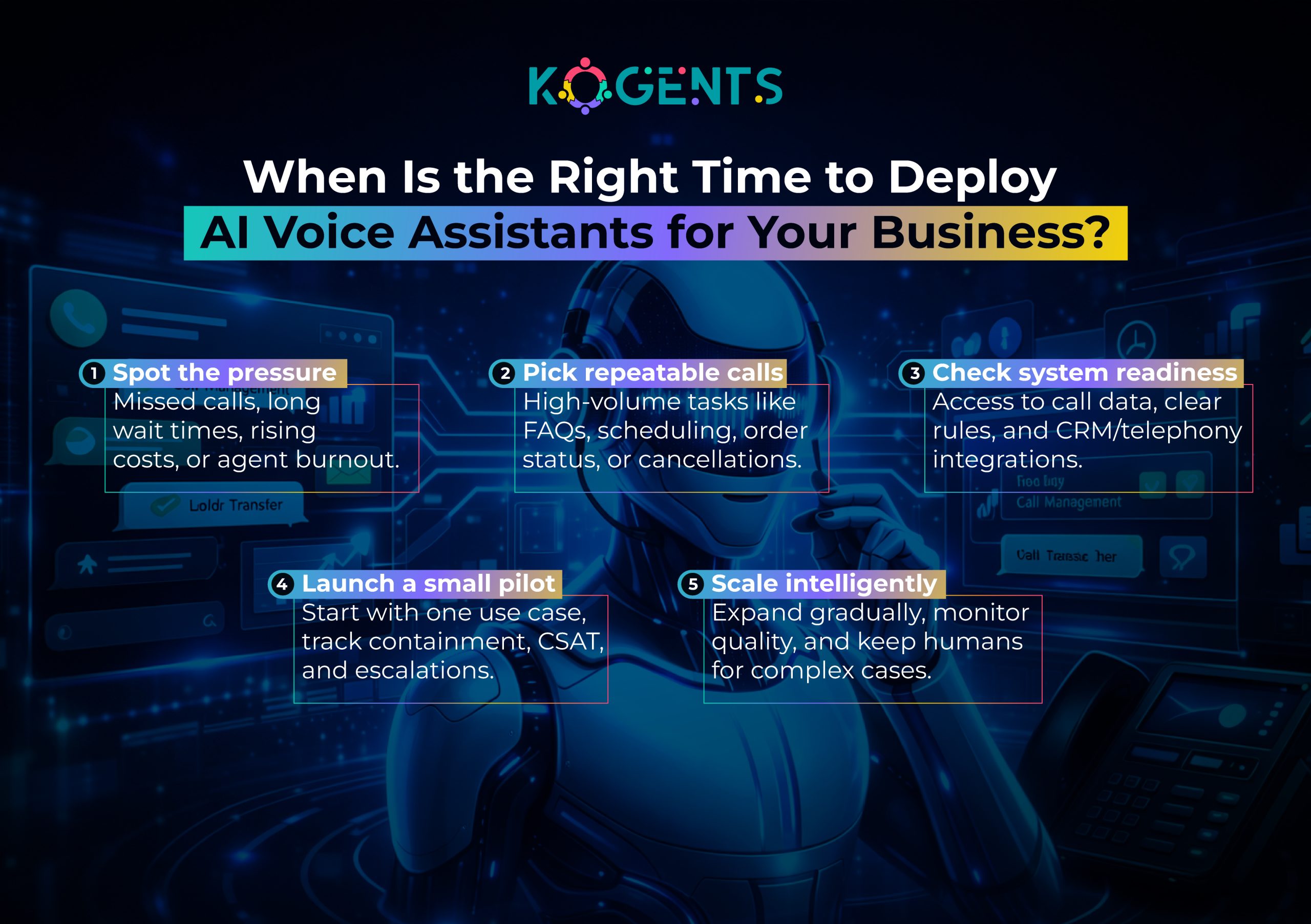
Selecting the Right AI Voice Assistant!
Technical Capabilities: Look for 95%+ speech-to-text accuracy, sophisticated natural language understanding, accurate intent detection, and response latency under 1 second.
Integration Options: Ensure compatibility with your CRM calendar systems, payment processors, and custom API flexibility.
Scalability: Evaluate concurrent call handling capacity, geographic infrastructure distribution, and performance during peak loads.
Compliance and Security: Verify relevant certifications (HIPAA, GDPR, SOC 2), data residency options, transparent voice data processing, and audit trail capabilities.
Decision Framework: Create a weighted scorecard based on your priorities, technical fit, cost, compliance needs, and integration requirements.
Before You Leave!
AI voice assistants for businesses have evolved from futuristic novelty to competitive necessity.
Organizations implementing conversational AI see massive cost reductions and customer satisfaction improvements, achieving ROI within 6-12 months.
The technology has matured, implementation risk is minima, while upside potential is substantial.
The businesses thriving today thoughtfully integrate AI-powered voice assistants for enterprises to handle routine inquiries while freeing human agents for complex situations requiring empathy and judgment.
Your competitors are already exploring these technologies. Your customers increasingly expect the convenience you provide.
Kogents.ai brings unparalleled expertise in agentic AI solutions that reason through complexity, learn continuously, and integrate seamlessly with business operations.
Our approach delivers autonomous, intelligent customer interactions that transform communication ecosystems.
Ready to transform your business communications? Get in touch with us today to discover how our agentic AI expertise can reduce costs, enhance customer experience, and deliver always-available, professional voice interactions.
FAQs
What exactly are AI voice assistants for businesses, and how do they differ from traditional IVR systems?
AI voice assistants for businesses are advanced conversational AI platforms that use natural language understanding, speech recognition, and machine learning to conduct natural conversations with callers, unlike traditional IVR systems that force customers through rigid menu options. They understand context, detect intent, and provide personalized responses rather than simply routing based on button presses.
How much do AI voice assistants for businesses typically cost?
Usage-based pricing typically costs $0.02-$0.10 per call. Subscription plans range from $500-$5,000+ monthly for defined capacity. Most businesses achieve ROI within 6-12 months through reduced staffing costs and improved efficiency.
Can AI voice assistants handle complex customer inquiries or just simple questions?
Modern enterprise voice assistant software handles surprisingly complex interactions through advanced natural language processing and dialog management. They manage multi-step processes like troubleshooting, returns processing, and claims navigation, with seamless escalation to human agents when needed.
What industries benefit most from AI voice assistants?
Particularly, healthcare (appointment scheduling, prescription refills), financial services (account inquiries), e-commerce (order status, returns), professional services (consultation booking), and hospitality (reservations). AI voice assistants for small businesses level the playing field for boutiques.
How accurate is speech recognition in AI voice assistants?
Leading speech-to-text models from Google Dialogflow, Amazon Lex, and Microsoft Azure Cognitive Services achieve 95-98% accuracy in ideal conditions. Continuous training on your customer conversations improves accuracy over time.
Are AI voice assistants secure and compliant with data privacy regulations?
Reputable voice AI platforms provide SOC 2 Compliance, GDPR compliance for voice data, and ISO/IEC 27001 certification. For regulated industries, platforms like IBM Watson Assistant offer HIPAA-compliant configurations.
How long does it take to implement an AI voice assistant?
Simple implementations can launch in 2-4 weeks. Mid-complexity deployments with custom conversational workflows and CRM integration typically require 2-3 months. Complex enterprise deployments may take 4-6 months.
Can AI voice assistants integrate with existing business systems?
Yes, most platforms offer pre-built connectors to popular CRM systems (Salesforce, Zendesk, HubSpot), scheduling tools, payment processors, and ticketing systems, plus robust APIs for custom integrations.
What happens when an AI voice assistant can’t answer a customer’s question?
Well-designed conversational AI voice assistants incorporate graceful escalation strategies. When intent detection confidence falls below thresholds or sentiment analysis detects frustration, the system smoothly transfers to human agents with full conversation context.
How do I measure the success of an AI voice assistant implementation?
Track call completion rate, average handling time, escalation rate, customer satisfaction scores, sentiment analysis results, first-call resolution rates, cost per call, and overall ROI. According to Gartner, successful implementations show 30-50% cost reduction and 20-30% improvement in customer satisfaction.