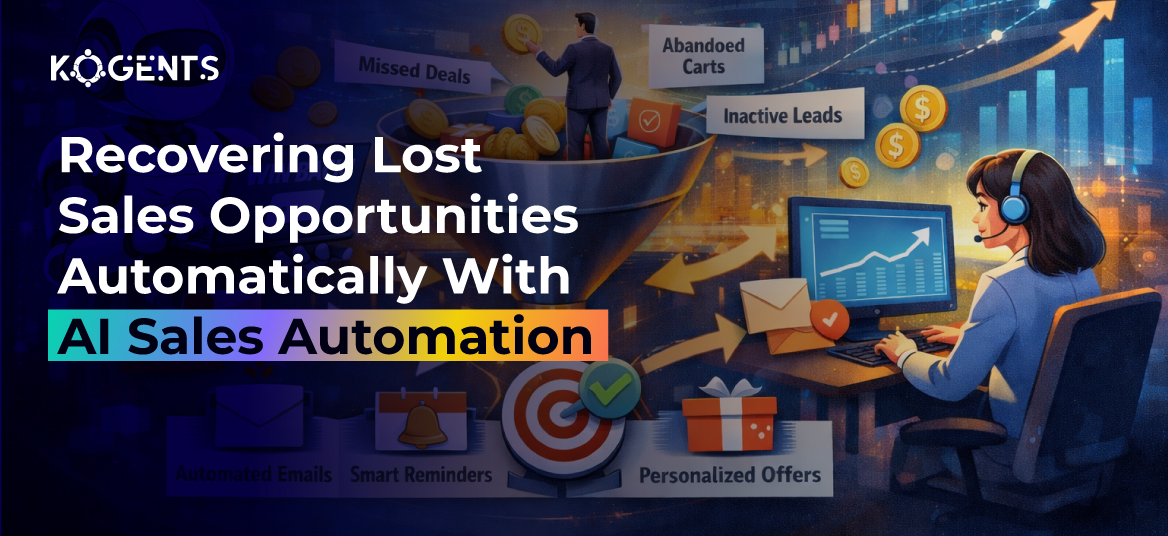
Well, sales are not vanished, but systems have mostly abandoned them. Every year, companies lose 30–50% of qualified sales opportunities not because prospects say “no,” but because the follow-ups are delayed.
What happens? Leads go cold, demos stall, and deals are obstructed in CRMs.
Not due to bad salespeople, but because manual sales processes are inefficient when it comes to decision timing.
But AI sales automation has fundamentally altered the ground for companies dealing with such issues.
Unlike traditional sales pipeline automation, AI-powered sales automation understands buyer intent, behavior patterns, and probability of conversion, enabling systems to recover lost sales opportunities automatically, without relying on human memory or rigid workflows.
This article breaks down:
- How does artificial intelligence sales automation work?
- Why are lost opportunities predictable?
- How top companies reclaim revenue with intelligent sales automation?
- Real case studies, frameworks, tools, and ROI
Key Takeaways
- Over 80% of lost deals can be re-engaged using intent-based AI triggers.
- AI sales automation software increases deal velocity by up to 30%.
- AI outperforms rule-based automation in lead scoring, timing, and messaging.
- Automated re-engagement recovers revenue without increasing headcount.
- Companies using AI-driven sales process automation outperform peers by 15–20% in revenue growth (McKinsey).
What Is AI Sales Automation?
AI sales automation is the incorporation and execution of artificial intelligence, machine learning, and natural language processing (NLP), predictive modeling, automation algorithms, and customer intent prediction to automate, optimize, and continuously improve sales workflows across the entire customer lifecycle.
Unlike traditional CRM automation, AI-powered sales automation:
- Learns from historical deal data
- Predicts buyer behavior
- Adapts outreach dynamically
- Acts autonomously through AI agents via Instagram bot automation and an AI messenger bot
Why Traditional Sales Automation Fails to Recover Lost Deals?
Traditional sales automation relies on:
- Static workflows
- Time-based triggers
- Manual CRM updates
Common Failures:
- Lack of intent awareness
- Absence of probability forecasting
- Paucity of behavioral analysis
- One-size-fits-all follow-ups
AI-driven sales process automation solves this by detecting micro-signals humans miss.
How AI-Powered Sales Automation Recovers Lost Sales Automatically
1. Intent Detection Through Behavioral Signals
AI systems analyze:
- Email engagement
- Website visits
- Demo replays
- Content downloads
- CRM inactivity
- Buying committee behavior
Incorporating predictive analytics and machine learning, AI identifies when a “lost” lead is actually re-entering the buying window.
2. Predictive Lead Scoring & Opportunity Prioritization
Lead scoring automation, powered by AI, dynamically updates deal priority based on:
- Historical conversions
- Industry benchmarks
- Behavioral similarity modeling
Note: This ensures sales teams focus only on recoverable opportunities.
3. Autonomous Outreach & Personalization
Inducing conversational AI for sales, systems:
- Draft personalized follow-ups
- Optimize send timing
- Adapt tone and messaging
- Trigger multi-channel outreach (email, LinkedIn, SMS)
Learn It: This is outbound sales automation without spam.
4. Sales Workflow Automation Across CRM
AI sales automation for CRM integrates with platforms like:
- Salesforce Einstein
- HubSpot AI
- Microsoft Dynamics 365 AI
- Zoho Zia
AI updates stages, flags risks, and recommends next actions, without manual input.
Core Use Cases Where Sales Revenue Is Lost
- Stalled demos
- Unresponsive leads
- Price-sensitive drop-offs
- Multi-stakeholder delays
- Poor timing of follow-ups
- CRM decay & data rot
AI sales workflow automation addresses each systematically.
Manual vs AI-Driven Sales Recovery
| Dimension | Traditional Sales | AI Sales Automation |
| Lead Follow-Up | Manual & delayed | Real-time automated outreach |
| Deal Prioritization | Rep intuition | Predictive opportunity scoring |
| Personalization | Generic templates | Behavior-based messaging |
| Lost Deal Recovery | Rare | Automated re-engagement loops |
| CRM Accuracy | Low | Self-updating pipelines |
| Revenue Forecasting | Reactive | AI-driven revenue intelligence |
AI Technologies Powering Intelligent Sales Automation
- Machine learning for pattern detection
- Natural language processing (NLP) for messaging & conversation analysis
- Large language models (LLMs) for dynamic sales content
- Predictive modeling for deal probability
- Automation engines for workflow orchestration
- API integrations for CRM & sales tech stack
The Uncomfortable Truth About “Lost” Deals
Most sales teams believe lost revenue happens at the top of the AI sales funnel automation.
It doesn’t.
It happens after interest.
- After demos.
- After the pricing discussions.
- After internal approvals stall
- After “circle back next quarter.”
We already know that more than half of the B2B deals result in no outcome, not a competitor’s win.
That’s not rejection.
That’s neglect.
And neglect is exactly what AI-powered sales automation is designed to eliminate.
What Makes This Different From Every Sales Automation Tool You’ve Tried?
Traditional automation behaves like a checklist.
- Day 3 → send email
- Day 7 → follow up
- Day 14 → mark cold
But buyers don’t think in timelines. They think in intent spikes
AI Sales Automation doesn’t wait for schedules.
It watches signals.
It understands:
- buying hesitation
- stakeholder influence
- deal decay
- urgency windows
And it acts before the opportunity disappears.
The Moment AI Starts Selling With You!
Here’s the shift most teams don’t expect:
AI doesn’t replace your best reps.
It protects them from losing deals they already earned.
With intelligent sales automation, the system:
|
No spray-and-pray.
No awkward “just checking in.”
No CRM archaeology.
What You Need! Just timely relevance.
A Short Story: That Feels Uncomfortably Familiar!
A SaaS company we analyzed had a 90-day sales cycle.
Their CRM showed:
- 1,200 closed-lost deals
- Average deal size: $18,000
- Assumed value: $0
When AI sales workflow automation was layered on top:
- 27% of those “lost” deals re-engaged
- 14% converted within 60 days
- Revenue recovered: $4.5M annually
Nothing changed about the product, even the price remained the same.
What changed was the timing.
That’s the power of AI-driven sales process automation.
Why AI Is Exceptionally Good at Recovering Lost Sales?
Because lost deals aren’t emotional problems.
They’re pattern problems.
AI excels at:
- recognizing hesitation patterns
- identifying buying committee delays
- correlating content engagement with readiness
- Predicting when silence ≠ is disinterest
Using machine learning, predictive analytics, and NLP, AI spots what humans miss:
“This deal didn’t die.
It just went quiet.”
The Quiet Advantage Most Companies Don’t See Yet
Companies using AI Sales Automation don’t necessarily close more deals upfront.
They close fewer deals and unnecessarily lose.
That’s a subtle, but devastating, competitive edge.
While competitors chase new leads, AI-driven teams quietly harvest value from deals already paid for in marketing spend.
- Lower CAC
- Higher LTV
- Faster velocity.
Same funnel, but different outcome.
The New Definition of Sales Maturity
In 2025 and beyond, sales maturity won’t be measured by:
- Number of reps
- number of tools
- number of outbound sequences
It will be measured by how few opportunities you let die unintentionally.
That’s what AI Sales Automation ultimately delivers:
A system that remembers
When humans forget
and acts when humans hesitate
Just remember that lost sales aren’t failures. They’re unfinished conversations.
AI just knows when to restart them.
Case Studies: Real-World Revenue Recovery
Case Study 1: B2B SaaS (Mid-Market)
Challenge: 40% of demo requests never progressed.
Solution: Implemented AI sales automation for SaaS using intent-based follow-ups and predictive scoring.
Results:
- 22% demo re-activation
- 18% increase in close rate
- $1.4M annual recovered revenue
Case Study 2: Enterprise Sales (Manufacturing)
Challenge: Long sales cycles and CRM stagnation.
Solution: Deployed AI-driven sales process automation with Salesforce Einstein.
Results:
- 30% reduction in deal velocity
- 25% increase in forecast accuracy
- Improved multi-stakeholder engagement
Case Study 3: B2B Services Firm
Challenge: High lead acquisition cost, low follow-up efficiency.
Solution: Used AI automation for sales teams with conversational AI and lead enrichment.
Results:
- 3× response rate
- 19% revenue uplift
- Reduced sales workload by 35%
Pro-Tips for Maximizing AI Sales Recovery
- Train models on closed-lost deals, not just wins
- Align AI with sales enablement tools
- Use customer lifecycle automation, not isolated workflows
- Ensure ISO/IEC 27001-level data security
- Combine AI insights with human judgment
Key Notes
- AI doesn’t guess, it predicts
- Lost deals are data patterns, not failures
- Automation without intelligence is obsolete
Conclusion: The Competitive Edge of AI-Driven Sales Recovery!
In modern markets, speed and relevance win, not volume.
AI sales automation offers businesses the unfair advantage of never forgetting, never mistiming, and never guessing.
By turning abandoned opportunities into re-engaged prospects, AI-powered sales automation transforms lost revenue into predictable growth, automatically.
Brands like Kogents.ai that adopt intelligent sales automation today don’t just close more deals.
They build resilient, scalable revenue engines for the future.
FAQs
What is AI sales automation?
AI sales automation uses machine learning, NLP, and predictive analytics to automate sales workflows, recover lost deals, and optimize revenue outcomes.
How does AI sales automation work?
It analyzes behavioral data, predicts intent, triggers automated outreach, and updates CRM pipelines autonomously.
Can AI automate sales processes end-to-end?
Yes. AI-driven sales process automation handles lead scoring, outreach, forecasting, and opportunity prioritization.
What are the benefits of AI sales automation?
Higher conversion rates, faster deal velocity, reduced manual work, and recovered lost revenue.
Best AI sales automation tools for B2B?
Salesforce Einstein, HubSpot AI, Gong, Outreach, Apollo.io, and Microsoft Dynamics 365 AI.
AI sales automation vs traditional sales automation?
Traditional automation follows rules. AI-powered sales automation learns, adapts, and predicts.
Is AI sales automation expensive to implement?
Costs vary. Many platforms offer scalable pricing; ROI often exceeds 5–10× investment.
Can AI recover lost or cold leads?
Yes. Intent-based re-engagement recovers up to 30% of abandoned opportunities.
Does AI replace sales reps?
No. AI augments reps by removing low-value tasks and improving focus.
Is AI sales automation secure?
Enterprise platforms comply with ISO standards, SOC 2, and GDPR requirements.