If you’re a retail executive, ecommerce director, or supply chain manager, here’s a sobering reality: product returns cost U.S. retailers alone $816 billion in 2022, representing 16.5% of total retail sales according to the National Retail Federation.
For every $1 billion in sales, the average retailer incurs $165 million in merchandise returns.
Traditional manual returns processing devours profit margins, frustrates customers with 7-14 day refund cycles, and creates operational nightmares involving multiple touchpoints, fraud risks, and inventory reconciliation challenges.
But that assumption is already breaking down, with the advent of AI-powered product return solutions that are transforming this costly liability into a strategic advantage.
Leading retailers implementing automated returns management systems are witnessing massive reductions in processing costs, prompt refund cycles, and improvements in customer retention rates.
The question isn’t whether AI-driven returns management software will become standard; it’s whether your organization can afford to lag while competitors leverage intelligent product return automation to slash costs, accelerate operations, and deliver the seamless customer experience optimization that modern consumers demand.
Key Takeaways
- AI-powered product return solutions reduce processing costs massively through intelligent automation and predictive analytics.
- Machine learning algorithms detect return fraud with 95%+ accuracy, saving retailers millions in fraudulent claims annually.
- Automated refunds and exchanges systems cut processing time from 7-14 days to 24-48 hours, dramatically improving customer satisfaction.
- Reverse supply chain optimization through AI increases product resale value by 25-35% through faster restocking decisions.
- The implementation of AI-driven processing platforms and AI support agents delivers ROI within 6-12 months for mid-to-large retailers.
Comprehending the Returns Challenge: Why Traditional Systems Fail?
The Hidden Costs of Manual Returns Processing
Traditional returns management drains resources across multiple dimensions.
Usually, manual returns processing involves an average of 12 separate touchpoints, requiring coordination between customer service, warehouse management systems, logistics providers, and finance teams.
Key cost drivers include:
- Labor-intensive inspection and sorting processes
- Extended inventory holding periods during decision-making
- High fraud rates
- automated customer care overhead managing inquiries
- Lost revenue from delayed restocking
- Premium shipping costs for reverse logistics
The Complete AI Returns Automation Workflow
Stage 1: Intelligent Return Initiation
Smart returns management solutions begin the moment a customer considers a return. Customer-facing portals powered by AI:
- Use natural language processing to understand return reasons in the customer’s own words.
- Leverage machine learning to suggest alternatives (exchanges, store credit) based on customer history.
- Automatically verify eligibility by checking purchase date, condition requirements, and policy compliance.
- Generate dynamic return merchandise authorization (RMA) with QR codes for frictionless drop-off.
Stage 2: Fraud Detection and Risk Assessment
Return fraud detection represents one of AI’s most valuable contributions. Advanced fraud prevention capabilities:
- Analyze customer return history and behavioral patterns.
- Flag suspicious activities like wardrobing (buying for temporary use), receipt fraud, or serial returners.
- Cross-reference returns against purchase databases to detect mismatched transactions.
- Apply risk scoring algorithms that determine approval, manual review, or rejection automatically.
Stage 3: Automated Inspection and Disposition
Once products arrive at return centers, computer vision and AI-powered quality control systems:
- Scan products using high-resolution cameras and compare against original condition baselines
- Identify defects, damage, missing components, or authenticity concerns
- Assign disposition categories: resell at full price, discount, refurbish, liquidate, or dispose
- Route products to appropriate locations automatically
Key Highlight: This stage eliminates most of the manual inspection labor while increasing accuracy and consistency.
Stage 4: Dynamic Refund Processing
Intelligent refund automation determines optimal refund methods based on multiple factors:
- Customer lifetime value (CLV) analysis: high-value customers may receive instant refunds.
- Risk assessment scores: low-risk returns processed immediately, high-risk held for verification.
- Payment method optimization: original payment method, store credit, or exchanges based on profitability.
- Regulatory compliance: automatic adherence to regional refund timing requirements.
Processing time drops from 7-14 days to 24-48 hours, dramatically improving customer satisfaction scores.
Stage 5: Inventory Optimization and Restocking
AI-driven inventory management ensures returned products maximize value:
- Predictive analytics forecast demand for returned items by location, season, and sales velocity.
- Dynamic pricing algorithms adjust resale prices based on condition, market demand, and holding costs.
- Warehouse management system integration automatically updates stock levels across all channels.
- Reverse logistics optimization routes products to optimal locations for the fastest resale.
Statistical Benefit: This increases product resale value compared to traditional batch processing methods.
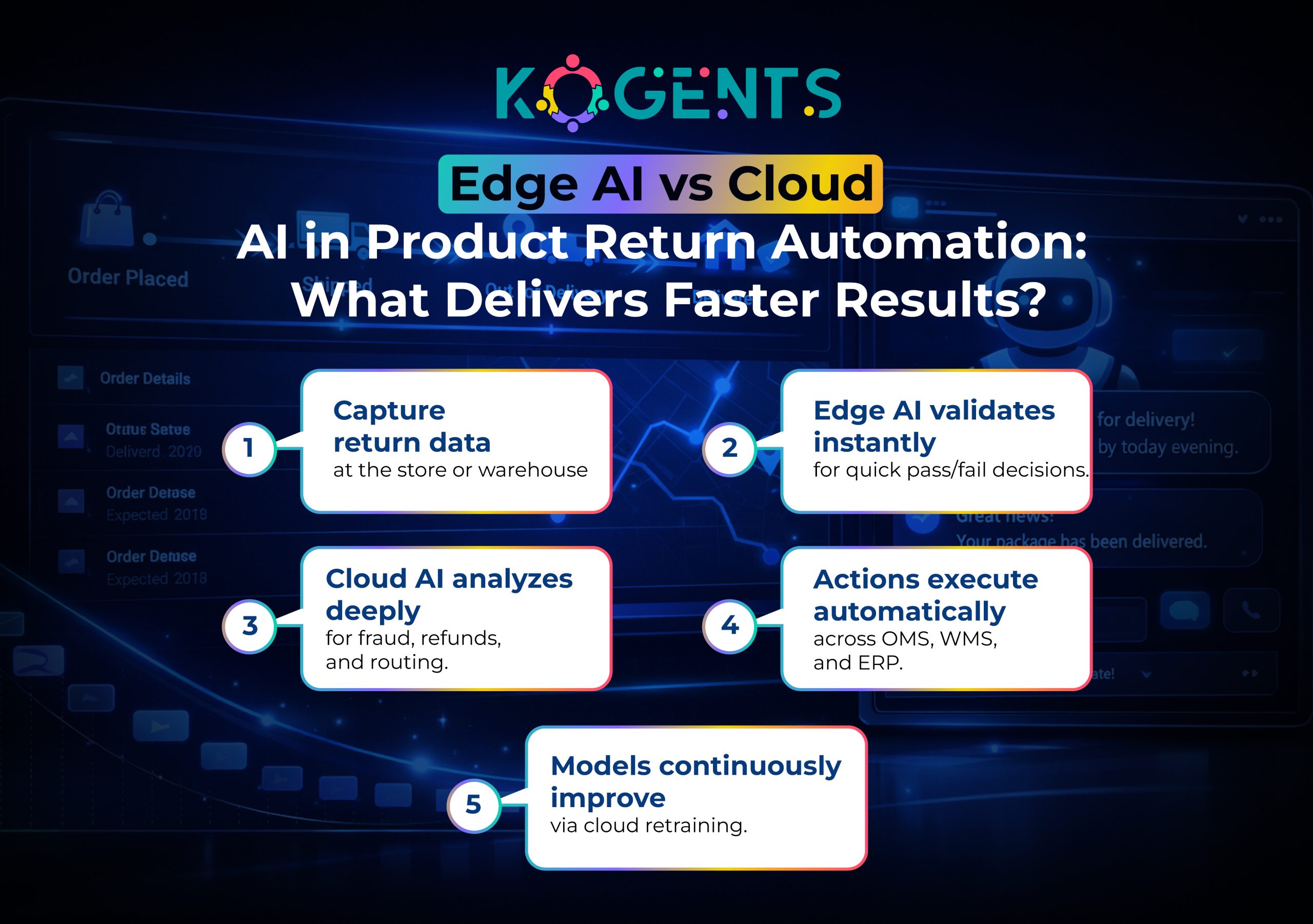
Implementation Strategy: Your Roadmap to AI-Powered Returns
Phase 1: Assessment and Planning (Weeks 1-4)
Conduct a comprehensive returns audit:
- Analyze current return volumes, costs, and processing times
- Identify pain points in existing workflows
- Quantify fraud losses and inspection inefficiencies
- Map integration requirements with existing systems
Define success metrics:
- Processing time reduction targets
- Cost savings goals
- Customer satisfaction improvement benchmarks
- Fraud detection accuracy requirements
Phase 2: Vendor Selection and Integration (Weeks 5-12)
Evaluate AI returns platforms based on:
- Scalability for current and projected return volumes
- Integration capabilities with existing ERP, OMS, and WMS systems
- Customization options for unique business rules and policies
- Security and compliance certifications (SOC 2, ISO 27001, PCI DSS)
- Vendor track record and customer references
Plan integration architecture:
- API connections to core systems
- Data migration strategies
- Testing protocols
- Change management and training programs
Phase 3: Pilot Deployment (Weeks 13-20)
Launch controlled pilot:
- Begin with a single product category or geographic region
- Test all workflow stages with real returns
- Validate fraud detection accuracy
- Measure processing time improvements
- Gather customer feedback
Iterate based on results:
- Fine-tune machine learning models with actual data
- Adjust business rules and thresholds
- Optimize integration performance
- Document learnings for full rollout
Phase 4: Full-Scale Rollout (Weeks 21-26)
Deploy enterprise-wide:
- Expand to all product categories and locations
- Train all relevant staff on the new systems
- Activate all AI-powered automation features
- Monitor performance metrics continuously
Optimize continuously:
- Review AI model performance monthly
- Analyze customer feedback for improvements
- Update fraud detection patterns regularly
- Refine inventory routing algorithms
Note: Implementation timelines vary based on organization size, system complexity, and customization requirements.
Key Considerations for Successful Implementation
Integration Requirements
Modern AI returns platforms must connect with:
- Order management systems (Shopify, Magento, SAP Commerce)
- Warehouse management systems (Manhattan, Blue Yonder, Oracle WMS)
- Customer service platforms (Zendesk, Salesforce Service Cloud)
- Financial/ERP systems (SAP, Oracle, NetSuite)
- Carrier systems (FedEx, UPS, USPS)
Note: Most platforms offer pre-built connectors, but budget for custom API development for unique systems.
Data Quality and Volume
Machine learning effectiveness depends on data quality. Minimum requirements:
- 12-24 months of historical returns data
- Complete transaction records (purchase date, product details, customer info)
- Return reason codes and outcomes
- Fraud incident documentation
Organizations with insufficient data may need 3-6 months of data collection before full AI capabilities activate.
Change Management
Organizational readiness determines success:
- Executive sponsorship, ensuring resource allocation
- Staff training on AI-augmented workflows
- Clear communication about AI role (augmentation, not replacement)
- Performance metrics aligned with new capabilities
Soft Reminder: Resistance often stems from fear; emphasize how AI eliminates tedious tasks, allowing teams to focus on complex problem-solving and customer relationships.
ROI Comparison: Traditional vs AI-Powered Returns Management
| Performance Metric | Traditional Manual System | AI-Powered Returns Solution | Improvement |
| Average Processing Time | 7-14 days | 24-48 hours | 85% faster |
| Cost Per Return | $15-$30 | $6-$12 | 60% reduction |
| Fraud Detection Accuracy | 60-70% | 95%+ | 35% improvement |
| Customer Service Labor | 12-15 mins per return | 2-3 mins per return | 80% reduction |
| Restocking Speed | 10-21 days | 2-5 days | 75% faster |
| Product Resale Value | 45-55% of the original | 70-80% of the original | 40% increase |
| Customer Satisfaction | 62% (industry avg) | 89% | 27 point increase |
| Return Rate Reduction | Baseline | 15-25% lower | Return prevention |
Real-World Impact: Case Studies
Case Study 1: Major Fashion Retailer Cuts Processing Costs by 38%
A leading fashion retailer facing 32% return rates implemented an AI-powered returns solution with transformative results:
Challenges:
- Processing 12 million returns annually with 150+ customer service representatives
- The average 11-day refund cycle is causing customer dissatisfaction
- Fraud losses exceeding $8 million annually
- Manual inspection bottlenecks are delaying restocking by 14+ days
Solution: Deployed end-to-end AI-driven returns management software integrating NLP chatbots, computer vision inspection, and machine learning fraud detection.
Results:
- 38% reduction in processing costs ($18.4 million annual savings)
- Refund cycle reduced to 2.8 days (74% improvement)
- Fraud detection accuracy improved from 62% to 96%, preventing $6.2 million in losses
- Customer satisfaction scores increased by 31 percentage points
- Return rate decreased 19% through intelligent prevention
Case Study 2: Electronics Retailer Achieves 95% Fraud Detection Accuracy
A national electronics chain struggling with sophisticated return fraud deployed AI-powered fraud prevention:
Key outcomes:
- Identified $21.7 million in fraudulent returns in the first year
- Reduced fraudulent approvals by 87%
- Maintained a legitimate customer approval rate of 98.3%
- Decreased manual review requirements by 73%
The machine learning model continuously adapts to emerging fraud patterns, providing increasingly sophisticated protection over time.
Convert Returns from Cost Center to Competitive Advantage!
The evidence is clear: AI-powered product return solutions represent not just an operational improvement but a fundamental reimagining of reverse logistics.
Organizations implementing these technologies achieve most cost reductions, rapid processing, and dramatically improved customer experiences.l
The question isn’t whether to adopt AI-driven returns automation, it’s how quickly you can implement these capabilities before competitors gain insurmountable advantages.
At Kogents.ai, we design and deploy agentic AI solutions that transform complex returns workflows into intelligent, autonomous systems.
We build custom machine learning models tailored to your unique return patterns and integrate seamlessly with ERP, OMS, and WMS platforms.
Our autonomous AI agents manage returns end-to-end, minimizing manual intervention while continuously optimizing performance.
The best AI agents for customer support don’t just automate, they adapt, learn, and make profit-driven decisions in real time.
Ready to turn returns into a strategic advantage? Contact us today to unlock the power of AI-driven automation.
FAQs
How long does it take to implement an AI-powered returns management system?
Implementation typically ranges from 3-6 months, depending on organizational complexity and integration requirements. A phased approach begins with assessment and planning (4 weeks), followed by vendor selection and integration (8 weeks), pilot deployment (8 weeks), and full-scale rollout (6 weeks). Organizations with complex legacy systems or extensive customization needs may require 9-12 months. The pilot phase is critical—testing with one product category or region before enterprise rollout significantly reduces risks and allows for optimization based on real-world results.
What ROI can we expect from AI returns automation, and when does payback occur?
Mid-to-large retailers typically achieve ROI within 6-12 months. Cost reductions come from multiple sources: 30-40% reduction in processing costs, 60% lower cost per return, 80% reduction in customer service labor, and 25-35% improvement in product resale value through faster restocking. Additional benefits include fraud prevention (saving millions for high-volume retailers), improved customer retention, and return rate reduction. Calculate your potential ROI by multiplying annual return volume by cost-per-return savings, adding fraud prevention value, and factoring in customer lifetime value improvements.
How accurate is AI fraud detection compared to manual review?
AI-powered fraud detection achieves 95%+ accuracy rates compared to 60-70% with manual review, according to Appriss Retail’s 2024 research. Machine learning models analyze hundreds of variables simultaneously—purchase history, return patterns, timing anomalies, product preferences, payment methods, shipping addresses, and behavioral indicators—identifying subtle patterns humans miss. The system flags suspicious activities like wardrobing, receipt fraud, and serial returning while maintaining 98%+ approval rates for legitimate customers. Critically, AI models continuously learn from new fraud techniques, adapting to emerging patterns without manual reprogramming. False positive rates drop below 2%, meaning legitimate customers rarely experience unnecessary friction.
How does AI-powered returns management support omnichannel and buy-online-return-in-store (BORIS) scenarios?
Omnichannel returns represent one of AI’s most valuable capabilities, unifying fragmented processes across channels into seamless customer experiences. AI-driven returns management software enables: unified return visibility (single platform tracks returns regardless of purchase or return channel), intelligent channel routing (AI determines optimal return location based on customer preference, inventory needs, and operational costs), BORIS automation (in-store staff scan QR codes, AI validates eligibility and approves refunds in real-time), cross-channel fraud detection (machine learning identifies patterns across all channels), inventory reconciliation (returned items automatically added to available inventory at receiving location), and consistent policies (AI ensures policy application consistency regardless of channel). Oracle Retail and Salesforce Commerce Cloud excel at omnichannel commerce integration.
How do we handle the change management and staff training required for AI adoption?
Change management determines whether AI implementations succeed or fail. Critical success factors include: executive sponsorship ensuring adequate resource allocation and organization-wide support, comprehensive communication explaining AI’s role as augmentation rather than replacement (emphasizing how it eliminates tedious tasks), role-specific training programs for customer service, warehouse, and IT teams, gradual rollout allowing teams to adapt progressively, performance metrics aligned with new capabilities, feedback mechanisms for continuous improvement, and incentive structures rewarding AI-augmented performance. Common challenges include fear of job displacement (address by highlighting value-added opportunities), resistance from long-tenured employees (involve them as change champions), and technical difficulties (provide ongoing support resources).
What are the key differentiators when evaluating AI returns platform vendors?
Critical evaluation criteria include: proven fraud detection accuracy (request case studies with specific results), scalability to handle peak return volumes without performance degradation, integration capabilities with your specific technology stack, customization flexibility for unique business rules and policies, AI model transparency and explainability, security certifications and compliance capabilities, implementation track record in your industry, ongoing support and optimization services, pricing model alignment with your volume and budget, and vendor financial stability and product roadmap. Request proof of concepts or pilots before full commitment, speak with at least three current customers about real-world experiences, evaluate data ownership and portability, review service level agreements for uptime and performance guarantees, and assess the vendor’s commitment to continuous AI model improvement.