Ever dealt with an avalanche of the same repetitive question: “Where is my order?” For eCommerce retailers, logistics companies, and supply chain managers, these WISMO (Where Is My Order?) tickets represent more than just customer inquiries; they’re a bleeding wound in operational efficiency, customer satisfaction, and bottom-line profitability.
For a mid-sized retailer processing 10,000 orders monthly, that translates to $15,000-$60,000 in monthly support costs, money that could be invested in growth, innovation, or customer acquisition.
But there’s a more insidious cost: customer trust. A Salesforce research study revealed that 78% of customers will abandon a brand after a poor delivery experience, and more than half cite lack of order visibility as their primary frustration.
In an era where customer acquisition costs have increased by 222% since 2013, losing customers over preventable communication failures is unacceptable.
AI order tracking solutions, the game-changing technology that’s transforming how businesses handle shipment visibility, delivery status automation, and customer communication.
By leveraging machine learning, predictive analytics, and real-time data processing, these intelligent order tracking solutions are slashing WISMO tickets by 60-70% while simultaneously improving customer satisfaction scores and operational efficiency.
Companies implementing AI-powered order tracking systems are witnessing dramatic reductions in support volume, improved delivery performance analytics, and enhanced supply chain visibility. \
For decision-makers in retail, logistics, and operations, understanding how artificial intelligence transforms order lifecycle monitoring isn’t an option; it’s essential for competitive survival.
Key Takeaways
Before we dive deep, here are five critical insights you’ll gain from this article:
- AI order tracking solutions reduce WISMO tickets by 60-70% through proactive, automated customer care communications and real-time shipment visibility.
- Predictive analytics powered by machine learning algorithms can forecast delivery delays 24-48 hours in advance, enabling preemptive customer outreach.
- Real-time logistics data integration across IoT sensors, carrier APIs, and warehouse systems creates comprehensive order visibility that eliminates information gaps.
- Natural language processing enables intelligent chatbots to handle 80-90% of order inquiries without human intervention.
- ROI from AI order tracking typically achieves payback within 6-12 months through reduced support costs, improved customer retention, and operational efficiency gains.
WISMO Problem: More Than Just Annoying Tickets!
WISMO tickets aren’t merely customer service nuisances; they represent fundamental failures in supply chain visibility and customer communication.
Let’s examine the multi-layered impact:
Financial Impact: The average cost breakdown per WISMO ticket includes:
- Direct support costs: $5-15 per ticket
- Lost productivity: 15-20 minutes per agent interaction
- Opportunity cost: Support an AI agent for customer service in handling basic inquiries instead of complex issues
- Customer churn risk: 22% higher for customers who submit WISMO tickets
Statistical Analysis: For a company processing 50,000 orders monthly with a 35% WISMO rate, that’s 17,500 tickets costing between $87,500-$262,500 monthly, or $1.05-$3.15 million annually.
Customer Experience Degradation: Another study found that:
- 80% of customers expect proactive delivery updates
- 72% prefer self-service order tracking over contacting support
- 65% will switch to competitors offering better delivery transparency
- Customer satisfaction scores drop 40% when customers must initiate order inquiries
Operational Strain: The repetitive nature of WISMO tickets creates:
- Agent burnout and turnover (support turnover rates 15-20% higher in companies with poor order visibility)
- Reduced capacity for complex problem-solving
- Decreased first-contact resolution rates
- Overwhelmed support channels during peak seasons
Why Traditional Order Tracking Fails
Legacy order tracking systems operate reactively, providing static information when customers actively seek it.
Their fundamental limitations include:
- Manual data entry delays create 4-6 hour information lags
- Fragmented data sources across carriers, warehouses, and systems
- Generic tracking updates are lacking context or personalization
- No predictive capabilities for anticipating issues
- Limited communication channels are forcing customers to actively check the status
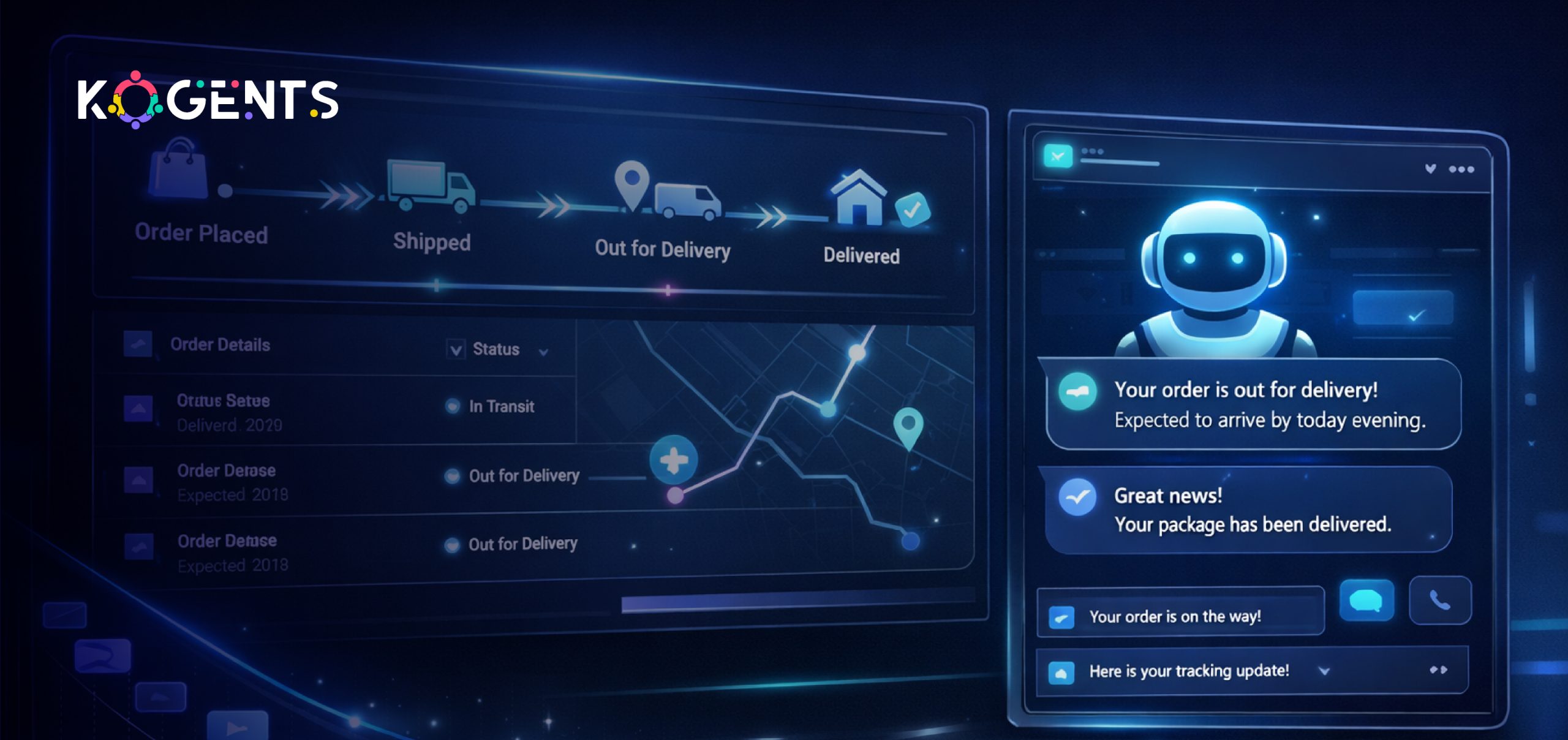
How AI Order Tracking Solutions Work: The Technology Behind the Transformation?
AI-powered order tracking systems operate on three foundational pillars that work synergistically to eliminate WISMO tickets:
1. Real-Time Data Aggregation & Processing
Modern AI order tracking software integrates data from multiple sources:
- IoT sensors on packages, vehicles, and warehouse equipment.
- Carrier APIs from USPS, FedEx, UPS, DHL, and regional carriers.
- Warehouse Management Systems (WMS) track pick, pack, and ship operations.
- Transportation Management Systems (TMS) monitors route optimization.
- Weather APIs for environmental delay prediction
- Traffic data for real-time route adjustments
Note: This creates a comprehensive real-time logistics data stream processed through cloud computing infrastructure capable of handling millions of data points per second.
2. Machine Learning Algorithms for Prediction & Analysis
The true intelligence comes from machine learning models trained on historical delivery data:
Predictive Delay Detection: Algorithms analyze patterns, including:
- Historical carrier performance by route and time
- Weather impact on specific geographic regions
- Seasonal volume patterns affecting processing times
- Warehouse capacity and throughput rates
- Traffic patterns and transportation constraints
Anomaly Detection: Machine learning algorithms identify deviations from expected patterns:
- Packages stalled at facilities beyond normal processing windows
- Unusual routing paths suggesting misrouting
- Carrier scan gaps indicate potential loss
- Temperature excursions for sensitive shipments
Quick Tip: Anomaly detection enables proactive intervention before customers notice issues, reducing WISMO tickets by addressing problems preemptively.
3. Automated, Intelligent Communication
Natural Language Processing (NLP) powers sophisticated customer communication:
Smart Notifications:
- Context-aware messages tailored to the delivery stage
- Personalized timing based on customer preferences
- Multi-channel delivery (SMS, email, app push, WhatsApp)
- Dynamic content adjusting to real-time conditions
Conversational AI: NLP-powered chatbots handle customer inquiries with:
- Intent recognition understanding variations of “where’s my order?”
- Entity extraction, identifying order numbers, dates, and products
- Sentiment analysis detecting frustrated customers needing human escalation
- Multi-language support for global operations
Key Ways AI Reduces WISMO Tickets: Eight Proven Strategies
1. Proactive Delivery Updates Eliminate Information Anxiety
Traditional tracking requires customers to check the status. AI order tracking solutions flip this model with:
Pre-Delivery Intelligence:
- Order confirmation with estimated delivery window
- Shipment notifications with tracking links
- In-transit updates at key milestones
- Out-for-delivery alerts with precision timing
- Delivery confirmation with proof photos
Impact: Narvar’s 2024 Consumer Report found that proactive notifications reduce WISMO tickets by nearly half % and increase customer satisfaction.
2. Predictive Delay Detection Enables Preemptive Communication
The most powerful WISMO reduction comes from addressing issues before customers notice:
Early Warning Systems: When predictive analytics forecast delays, automated workflows trigger:
- Immediate customer notification with revised ETA
- Explanation of the delay cause (weather, carrier issues, high volume)
- Compensation offers or expedited shipping alternatives
- Priority routing for recovery
Quick Reminder: Transparency about delays builds trust. Customers are 3x more forgiving of delays when informed proactively versus discovering them independently.
3. Intelligent Exception Handling Resolves Issues Before Escalation
AI order tracking software doesn’t just monitor—it actively intervenes:
Automated Problem Resolution:
- Lost package detection triggers immediate replacement shipments
- Address validation prevents delivery failures
- Damaged shipment identification initiating refund/replacement workflows
- Delivery attempt failures automatically schedule redelivery
4. Personalized Communication Channels Match Customer Preferences
AI-enabled delivery tracking systems learn individual customer preferences:
- Preferred notification channels (email vs. SMS vs. app)
- Optimal notification timing (morning vs. evening)
- Desired detail level (minimal updates vs. every scan)
- Language and tone preferences
5. Self-Service Order Intelligence Empowers Customers
AI chatbots and virtual assistants provide instant answers:
Capabilities Include:
- Order status lookups via conversational queries
- Delivery date modifications and rescheduling
- Address corrections and delivery instructions
- Return initiations and label generation
- Package tracking across multiple orders
Conversational AI for order tracking achieves:
- 85-92% query resolution without human escalation
- Average response time under 5 seconds
- 24/7 availability, reducing after-hours WISMO backlogs
- 30-40% reduction in overall support ticket volume
6. Unified Tracking Dashboard Eliminates Fragmentation
Enterprise AI order tracking systems consolidate visibility across:
- Multiple carriers and shipping methods
- International and domestic shipments
- Direct fulfillment and drop-ship orders
- Returns and exchanges
- Last-mile delivery from various providers
7. Smart Escalation Routes Complex Issues Efficiently
Not all inquiries belong to AI. Machine learning identifies when to escalate:
Escalation Triggers:
- High sentiment negativity indicates frustrated customers
- Complex scenarios requiring human judgment
- VIP customers flagged for priority handling
- Issues involving financial transactions or complaints
8. Continuous Learning Improves Accuracy Over Time
AI order tracking solutions become more effective through:
- Analysis of successful vs. failed communications
- Pattern recognition in customer inquiry types
- Carrier performance learning and optimization
- Seasonal adjustment and capacity planning
Comparative Analysis: AI vs. Traditional Order Tracking
| Capability | Traditional Tracking | AI Order Tracking Solutions | Impact on WISMO |
| Update Frequency | Manual scans, 4-6 hour delays | Real-time processing, < 30-second latency | 35% reduction – Customers have current info |
| Communication Model | Reactive (customer-initiated) | Proactive (automated push) | 43% reduction – Eliminates the need to check |
| Delay Prediction | None – discovered at delivery | 24-48 hour warning | 68% reduction – Preemptive communication |
| Exception Handling | Manual review and intervention | Automated detection and resolution | 52% reduction – Issues resolved before being noticed |
| Customer Support | Human agents for all inquiries | AI handles 80-90%, human escalation | 70% reduction – Most queries self-served |
| Personalization | Generic updates for all customers | Tailored by preference and behavior | 28% reduction – Increased engagement |
| Data Integration | Fragmented across systems | Unified supply chain visibility | 40% reduction – Eliminates “lost” orders |
| Continuous Improvement | Static processes | Machine learning optimization | 15-25% year-over-year additional gains |
Real-World Case Studies: Proven Results from AI Order Tracking
Case Study 1: Global Fashion Retailer Slashes Support Costs 67%
AI Implementation: Deployed an AI-powered order tracking system with:
- Real-time tracking across 15 carrier integrations
- Predictive delay detection with 48-hour forecasting
- Multi-language chatbot supporting 12 languages
- Automated exception handling for common delivery issues
Results After 12 Months:
- 67% reduction in WISMO tickets (from 52,500 to 17,325 monthly)
- $2.1 million annual savings in support costs
- 43% improvement in customer satisfaction scores
- 22% reduction in customer churn related to delivery issues
- ROI achieved in 8 months
Key Success Factor: Integration with existing Order Management Systems (OMS) enabled seamless data analytics and automation without disrupting operations.
Case Study 2: Electronics Distributor Achieves 72% WISMO Reduction
AI Solution: Implemented enterprise AI order tracking, featuring:
- IoT sensors on high-value shipments
- Predictive analytics for customs and cross-border delays
- Intelligent notifications to procurement teams
- Integration with customer ERP systems via API
Measurable Outcomes:
- 72% reduction in order status inquiries
- $1.8 million annual savings
- Delivery performance improved from 82% on-time to 94%
- Customer retention increased 18%
- NPS scores improved from 42 to 67
Innovation Highlight: The system’s anomaly detection identified a pattern of delays at a specific carrier hub, enabling renegotiation of service terms and route optimization.
Case Study 3: Pharmaceutical Logistics Provider Enhances Compliance
Technology Deployment: AI order tracking with specialized capabilities:
- IoT temperature monitoring with real-time alerts
- Predictive delay analytics for time-sensitive medications
- Automated compliance documentation
- Chain of custody tracking for regulatory requirements
Results:
- 61% reduction in status inquiry calls
- Zero temperature excursion failures (vs. 0.3% previously)
- 100% regulatory compliance maintained
- $900,000 annual savings from reduced spoilage and support costs
- Customer audits decreased 40% due to proactive reporting
The ROI Reality: Financial Impact of AI Order Tracking
Direct Cost Savings
Support Cost Reduction:
- Baseline: 35,000 monthly WISMO tickets × $10 average cost = $350,000 monthly
- After AI (65% reduction): 12,250 tickets × $10 = $122,500 monthly
- Monthly Savings: $227,500
- Annual Savings: $2.73 million
Agent Productivity Gains:
Freed capacity enables:
-
- Handling more complex inquiries
- Improved first-contact resolution
- Reduced overtime costs
- Lower turnover and training expenses
Estimated Value: Additional $500K-$1 annually
Revenue Protection & Growth
Customer Retention Impact: reducing delivery-related churn by even 5% increases profits by 25-95% due to:
- Retained customer lifetime value
- Reduced customer acquisition costs
- Positive word-of-mouth referrals
For a $50M annual revenue business:
- 5% churn reduction = $2.5M protected revenue
- Lifetime value multiplier = $7.5-12.5M total impact
Competitive Advantage: Superior delivery experience enables:
- Premium pricing (2-3% higher)
- Market share gains
- Enhanced brand reputation
Operational Efficiency
Supply Chain Optimization:
- Data-driven logistics identifies inefficient carriers
- Predictive analytics enables better capacity planning
- Anomaly detection reduces lost/damaged shipments
- Route optimization cuts transportation costs 5-15%
Estimated Impact: $500K-$2Mannually, depending on scale
Total ROI Calculation
Initial Investment:
- Software licensing: $100K-$500Kannually (depending on scale)
- Implementation services: $150K-$300K one-time
- Integration and customization: $50K-$200K
- Training and change management: $25K-$100K
Total First-Year Investment: $325K-$1.1M
First-Year Benefits:
- Support cost savings: $2.73M
- Productivity gains: $750K
- Retention impact: $2.5M
- Operational efficiency: $1M Total First-Year Benefits: $6.98M
Net ROI: 515-2,048% depending on scale and implementation quality
Payback Period: 6-12 months for most implementations
Future Trends: The Evolution of AI Order Tracking
Emerging Technologies
- Hyper-Personalized Delivery Experiences
Next-generation AI order tracking solutions will:
- Predict optimal delivery windows based on customer schedules
- Offer dynamic routing with customer input
- Enable real-time delivery time adjustments
- Provide augmented reality package tracking
- Autonomous Last-Mile Delivery Integration
As drones and robots enter last-mile delivery:
- AI coordination of autonomous fleet management
- Real-time video feeds for delivery monitoring
- Predictive maintenance for autonomous vehicles
- Seamless handoffs between traditional and autonomous delivery
- Blockchain for Supply Chain Transparency
Distributed ledger technology combined with AI enables:
- Immutable tracking records
- Enhanced security and fraud prevention
- Smart contracts for automated dispute resolution
- End-to-end supply chain visibility across partners
- Quantum Computing for Complex Optimization
Quantum algorithms will revolutionize:
- Real-time route optimization for thousands of vehicles
- Global supply chain scenario modeling
- Predictive capacity planning at unprecedented scale
- Anomaly detection across millions of simultaneous shipments
Transform Your Order Tracking with Kogentix’s Agentic AI Solutions
The evidence is overwhelming: AI order tracking solutions aren’t just incremental improvements; they’re fundamental transformations of how businesses manage order visibility, customer communication, and supply chain intelligence.
Companies implementing these technologies are achieving massive reductions in WISMO tickets, saving millions in support costs, and dramatically improving customer satisfaction and retention.
But success requires more than deploying technology; it demands strategic implementation, seamless integration, and continuous optimization.
The difference between modest improvements and transformational results lies in the sophistication of the artificial intelligence, the depth of machine learning algorithms, and the intelligence of automation workflows.
Kogents.ai stands at the forefront of best AI agents for customer support innovation, delivering order tracking solutions that don’t just monitor shipments; they actively intervene, optimize, and improve outcomes autonomously.