When a Single Email Can Cost $50 Million then imagine what a routine email can do. A data attachment. A compliance violation.
In 2025, a Fortune 500 company paid $47 million in regulatory penalties because one employee unknowingly breached data protection laws.
Your legal team reviewed policies.
Training was completed.
Yet human error still happened, and it nearly destroyed shareholder value overnight.
Here’s the uncomfortable truth: Chief Compliance Officers, General Counsels, and Legal Operations Managers are fighting an unwinnable war.
You’re managing 300+ regulations simultaneously. Your teams spend 40% of their time on repetitive compliance workflows.
Regulatory penalties now average $4.1 million per violation. Traditional manual processes cannot scale, cannot operate fast enough, and cannot eliminate the human variability that creates catastrophic gaps.
But, AI for legal compliance changes everything.
Artificial intelligence for regulatory compliance doesn’t just assist your legal operations; it fundamentally transforms how organizations maintain absolute consistency across thousands of interactions, ensure clarity in complex governance frameworks, and achieve real-time compliance that manual processes can never deliver.
This guide reveals how AI-powered compliance management delivers what seemed impossible: zero-tolerance consistency in policy enforcement, unprecedented clarity in regulatory reporting, and ironclad compliance across every legal touchpoint, without multiplying headcount or budgets.
Key Takeaways
- AI legal compliance software eliminates human variability by applying identical standards across millions of transactions without deviation.
- Compliance monitoring platforms detect potential violations 24/7, identifying anomalies before issues escalate into compliance violations.
- Enterprise AI compliance software manages complex requirements across jurisdictions simultaneously, adapting to new regulations without complete overhauls. ● Explainable AI (XAI) provides comprehensive audit trails, demonstrating exactly how compliance decisions are made for audit readiness.
- AI governance and compliance tools free legal professionals from routine tasks to focus on high-value strategic initiatives.
Understanding AI for Legal Compliance
AI compliance solutions represent the convergence of machine learning, natural language processing, and legal data governance into integrated systems that automate, monitor, and optimize regulatory compliance operations.
Unlike traditional rule-based software, these AI-driven regulatory compliance solutions learn from patterns, adapt to changing requirements, and improve accuracy continuously.
The Core Problem It Solves
Compliance automation using AI addresses three fundamental challenges:
Scale Limitations: Human teams cannot review every contract, transaction, or communication for compliance issues.
AI compliance monitoring platforms analyze millions of data points simultaneously, applying consistent standards across entire organizational ecosystems without fatigue.
Complexity Management: Modern compliance obligations span GDPR, ISO/IEC 27001, NIST AI Risk Management Framework, and industry-specific regulations.
AI compliance management systems map relationships between requirements, identifying overlaps, conflicts, and gaps that would take legal teams months to discover.
Dynamic Adaptation: Automated legal compliance systems ingest regulatory changes in real-time, automatically updating logic and flagging affected processes before deadlines expire.
The Technology Foundation
Natural Language Processing (NLP) interprets legal language, extracts obligations from regulations, and analyzes contracts against compliance standards.
This enables AI tools for legal compliance teams to understand context and nuance, not just keywords.
Machine Learning Algorithms identify patterns indicating potential legal risk management issues, predict compliance vulnerabilities, and continuously improve detection accuracy.
Robotic Process Automation (RPA) executes policy enforcement actions, generates compliance reporting, and manages remediation workflows automatically.
Predictive Analytics anticipates future compliance risks based on historical data, regulatory trends, and organizational changes.
Human variability creates compliance gaps.
Different attorneys interpret clauses differently.
Reviewers miss details during busy periods.
Standards drift as teams change. AI legal compliance software eliminates this variability.
Standardized Decision Logic: AI-powered compliance management applies identical criteria to every evaluation, the first contract and the ten-thousandth receive the same rigorous analysis.
This consistency extends across contract clause analysis, transaction monitoring, communication screening, vendor compliance verification, and employee policy adherence tracking.
Instant Policy Updates: When GDPR guidance changes or ISO standards are revised, compliance automation platforms update all active monitoring simultaneously, no training sessions, no gradual implementation periods where different teams operate under different rules.
Cross-Jurisdictional Consistency: Multinational organizations maintain jurisdiction-specific requirements while ensuring consistent brand standards where regulations permit.
Clarity Through Advanced Language Understanding
Legal ambiguity creates compliance gaps.
AI compliance solutions transform unclear obligations into actionable requirements.
Obligation Extraction: NLP-powered systems read thousand-page regulations and automatically extract specific obligations, deadlines, and responsible parties.
Rather than legal teams manually parsing documents, AI governance and compliance tools identify every “must,” “shall,” and “required” statement, categorize obligations by department, and create enforcement checkpoints automatically.
Plain Language Translation: Complex legal language confuses non-legal stakeholders. Artificial intelligence for regulatory compliance translates requirements into clear operational instructions.
GDPR Article 32’s security requirements become specific technical controls for IT teams; Article 15’s access request obligations become step-by-step procedures for customer service.
Contextual Understanding: Advanced legal data governance systems distinguish between “data transfer” requiring data protection laws safeguards versus routine internal reporting.
Compliance Through Continuous Monitoring
Real-Time Transaction Analysis: Financial transactions are screened against sanctions lists instantaneously. Contracts are flagged during negotiation if clauses violate policies.
Data access requests trigger immediate compliance workflows verifying legitimate business purposes.
Anomaly Detection: Machine learning establishes baseline patterns, then flags deviations indicating potential compliance violations.
Unusual employee data access or unexpected vendor payment patterns trigger investigation protocols automatically.
Regulatory Intelligence Integration: Best AI compliance platforms for enterprises continuously monitor regulatory developments worldwide.
Audit Trail Generation: Every decision generates immutable audit trails.
When auditors arrive, systems produce complete documentation showing what was monitored, when issues were detected, how they were addressed, and who was responsible.
Critical Components of AI Compliance Systems
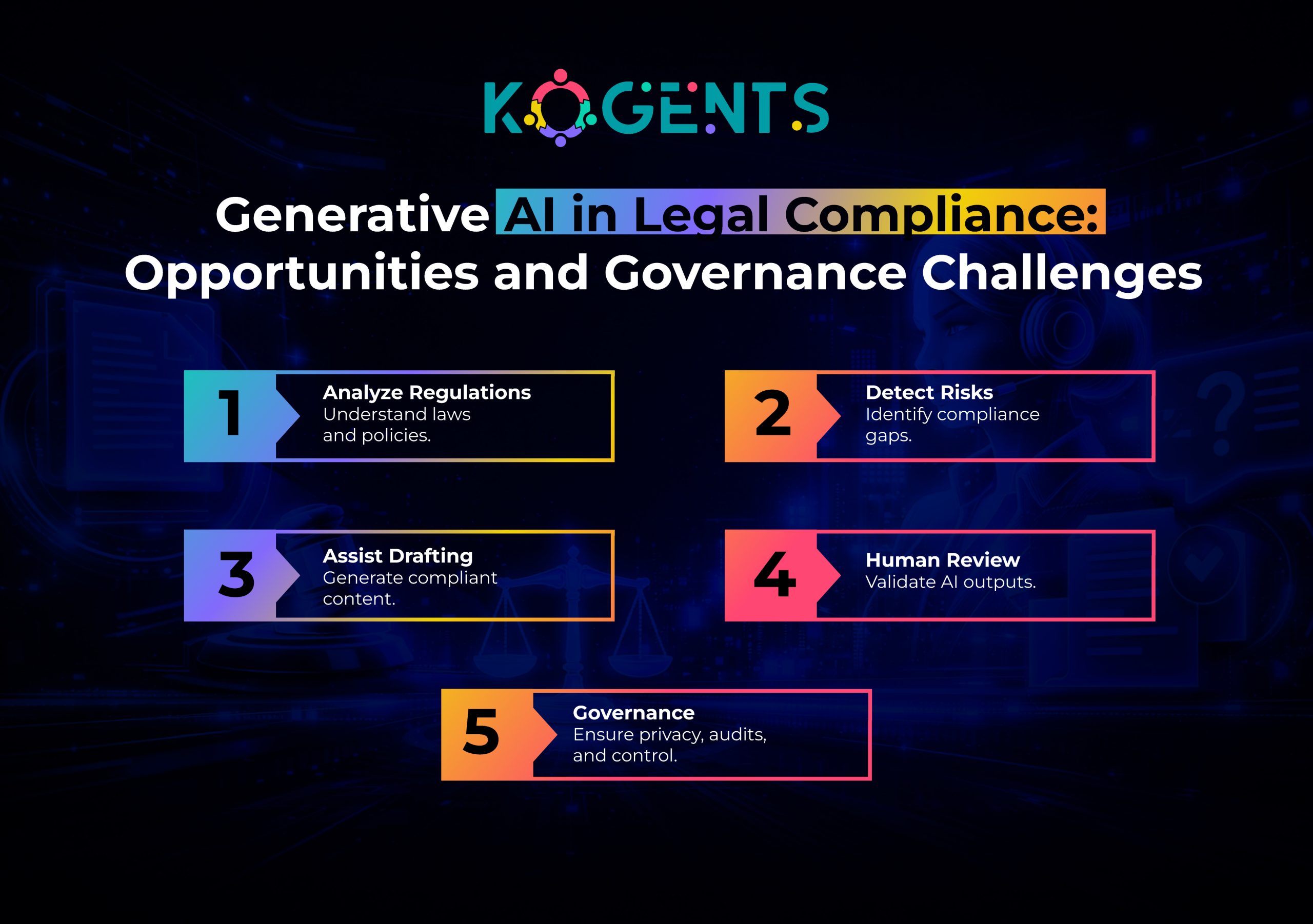
1. Intelligent Compliance Monitoring
- AI compliance monitoring continuously observes organizational activities against regulatory requirements, integrating with CRM platforms, financial systems, communication tools, and document management systems.
- Machine learning algorithms compare activities against compliance rules derived from GDPR, ISO standards, OECD AI Principles, and internal policies.
- Risk Assessment and Mitigation
- AI-driven regulatory compliance solutions perform continuous risk scoring, updating assessments as conditions change.
- Predictive risk modeling analyzes regulatory changes, business environment shifts, operational metrics, and historical data to forecast where compliance failures are most likely.
Note: When elevated risks are identified, automated legal compliance systems trigger mitigation workflows automatically.
- Policy Management and Enforcement
- Dynamic policy libraries ensure stakeholders have access to current versions with role-appropriate guidance.
- A sales representative sees required contract clauses; a data analyst sees applicable data protection laws requirements.
- Enforcement automation can block policy-violating actions pending compliance review approval.
- Regulatory Change Management
- Regulatory intelligence monitors legislative databases, regulatory agency
announcements, court decisions, and industry guidance, identifying relevant changes. ● Natural language processing determines whether changes create new obligations or modify existing requirements.
- Impact assessment automation generates implementation roadmaps showing what must change, by when, and who’s responsible.
- Reporting and Analytics
- Compliance reporting automation generates regulatory submissions from continuously collected data.
- Executive dashboards provide compliance posture visibility: current risk levels,
trending issues, regulatory change pipelines, and resource allocation effectiveness.
AI Compliance Framework: Essential Components
| Component | Primary Function | Key
Technologies |
Business
Impact |
Regulatory
Alignment |
| Monitoring &
Detection |
Continuous
surveillance against compliance rules |
Machine
Learning, NLP, Real-time Analytics |
70% reduction in compliance
incidents |
GDPR Article 32,
ISO/IEC 27001 |
| Risk Assessment | Automated
vulnerability identification and scoring |
Predictive
Analytics, AI Risk Models |
Proactive
resolution before violations |
NIST AI Risk
Management Framework |
| Policy Enforcement
Regulatory Intelligence |
Automated
compliance rule application Tracking regulatory changes across jurisdictions |
RPA, Workflow Automation,
Access Controls NLP, Regulatory Monitoring APIs |
85% improvement in policy
adherence 3-month advantage in adaptation |
ISO/IEC 42001
EU AI Act, OECD AI Principles |
| Audit & Reporting | Automated evidence collection and report generation | Data Integration, Audit Trail
Systems |
90% reduction in audit preparation time | GDPR Article 30, SOC 2 |
Real-World Success: Case Studies
Case Study 1: Global Bank Transforms AML Compliance
A multinational bank operating in 45 countries faced 120,000 analyst hours spent annually on manual anti-money laundering reviews, with rising false positive rates missing sophisticated laundering schemes.
After deploying an AI-powered compliance management platform with machine learning-based transaction monitoring, false positive rates decreased 60%, reducing analyst workload by 75,000 hours annually.
Suspicious activity detection improved 40% while achieving full regulatory compliance across all jurisdictions and reducing costs by $12 million annually.
Case Study 2: Healthcare Network Achieves HIPAA Excellence
A 150-facility healthcare network struggled with HIPAA compliance around patient data access controls across thousands of users and millions of patient records.
An AI compliance monitoring platform with anomaly detection configured for healthcare data governance reduced unauthorized data access incidents by 82% in the first year.
The AI detected and prevented breaches that manual processes missed, including three credential misuse instances by terminated employees.
Compliance workflows automated 90% of routine access requests, reducing approval times from 48 hours to 15 minutes while avoiding an estimated $8 million in potential penalties.
Critical Considerations: Explainability and Accountability The Explainability Imperative
Regulatory bodies increasingly demand explainable AI (XAI), systems where decision-making logic can be understood and verified.
Leading AI governance and compliance tools use hybrid architectures: complex models provide initial assessments while rule-based explainable systems validate and document decisions, ensuring both accuracy and audit trail transparency.
Algorithmic Accountability
Algorithmic accountability requires ensuring AI systems don’t perpetuate biases or create discriminatory outcomes.
Effective approaches include regular bias audits, diverse training data, human oversight for high-impact decisions, and continuous outcome monitoring.
ISO/IEC 42001 and OECD AI Principles provide frameworks for responsible AI model governance.
Data Governance
AI compliance monitoring platforms require extensive organizational data access.
Solutions involve data minimization, anonymization where possible, strict access controls, encryption, and comprehensive legal data governance frameworks ensuring AI systems operate within privacy boundaries.
Transform Compliance into Competitive Advantage with Us!
AI for legal compliance is no longer optional; it’s the foundation for sustainable, scalable compliance operations.
Organizations implementing AI-driven regulatory compliance solutions consistently report transformative outcomes: 30-50% operational cost reductions, 70-80% fewer compliance incidents, dramatically improved audit readiness, and strategic reallocation of legal talent from
We specialize in AI-powered compliance management solutions designed for enterprises navigating complex regulatory landscapes.
Our platform combines advanced compliance monitoring, regulatory intelligence, and explainable AI capabilities, integrating seamlessly with your existing systems.
Whether implementing your first AI compliance solution or enhancing existing governance frameworks, we deliver proven expertise across GDPR, ISO standards, NIST frameworks, and industry-specific regulations.
So, contact the team at Kogents.ai to drive legal excellence now!
FAQs
What is AI for legal compliance, and how does it differ from traditional compliance software?
AI for legal compliance uses machine learning and natural language processing to continuously monitor and enforce regulatory requirements automatically. Unlike traditional rule-based software requiring manual programming for each scenario, AI compliance
solutions learn from patterns, adapt to regulations, and improve accuracy without constant reprogramming.
How does AI handle regulatory compliance across multiple jurisdictions?
Enterprise AI compliance platforms map requirements across jurisdictions, identifying overlapping obligations and conflicts. Using natural language processing to interpret regulations from different regulatory bodies, systems automatically extract obligations and create jurisdiction-specific controls while maintaining consistent governance.
What are the main benefits of AI compliance software for regulated industries?
AI compliance software delivers consistency through standardized policy application, scalability for millions of simultaneous activities, real-time violation detection, adaptability to regulatory changes, and transparency through comprehensive audit trails. Industries report 30-50% operational cost reductions while improving outcomes.
Is AI compliance monitoring effective at detecting violations?
Yes. AI compliance monitoring platforms detect 3-5 times more potential violations than human review with 60-80% fewer false positives. Effectiveness stems from 24/7 operation, pattern recognition across vast datasets, and adaptive learning, improving accuracy continuously.
How do AI compliance solutions handle regulatory changes?
AI-driven regulatory compliance solutions include regulatory intelligence that continuously monitors legislative databases and agency publications. Natural language processing identifies relevant changes, determines new obligations, and assesses policy impact. Systems automatically update monitoring logic while flagging complex amendments requiring legal interpretation.
What is explainable AI (XAI) and why does it matter for compliance?
Explainable AI (XAI) provides decision-making logic that humans can understand and validate. Regulatory bodies and auditors must verify that decisions are appropriate and legally defensible. XAI-capable AI governance tools provide detailed reasoning showing which regulations were considered and why determinations were made.
How much does an AI compliance management system implementation cost?
Pricing varies based on organization size and complexity. Entry-level solutions start around $50,000-$100,000 annually. Mid-market implementations range $250,000-$500,000 initially, plus $100,000-$300,000 annually. Enterprise AI compliance software requires $1M+ initially and $500,000+ annually. Organizations report ROI within 18-24 months.
Can AI compliance tools integrate with existing systems?
Modern AI compliance platforms offer pre-built connectors for enterprise systems (Salesforce, SAP, Microsoft 365), APIs for custom integrations, and data import/export capabilities. Integration enables compliance automation across contract management, financial platforms, HR systems, and communication tools.
What industries benefit most from AI-powered compliance management?
Five industries see disproportionate value: Financial Services (AML, KYC), Healthcare (HIPAA, patient data), Technology (multi-jurisdictional data protection), Life Sciences (FDA, clinical research), and Energy/Utilities (environmental, safety regulations). These face complex, frequently changing landscapes where manual compliance becomes impossible.
How do organizations ensure AI compliance systems don’t create new risks?
Ensuring AI governance requires implementing algorithmic accountability frameworks that regularly audit AI decision-making, maintaining human oversight for high-impact decisions, establishing robust data governance, following the NIST AI Risk Management Framework and ISO/IEC 42001, and conducting regular third-party audits.