
Tier-1 support has long been the foundation of customer experience, handling routine queries, triaging concerns, authenticating users, verifying accounts, assisting with orders, and resolving the most repetitive customer service tasks.
For decades, human agents filled this role, often operating under enormous pressure, high volume, and unrelenting customer expectations.
But today, a new operational reality is emerging:
At the same time, human support costs have increased across nearly every global market:
- Rising labor costs
- Attrition as high as 60% in some regions
- Multilingual staffing shortages
- Expanding customer expectations for 24/7 availability
- Increased regulatory requirements
This is why forward-thinking enterprises are rapidly transitioning to an AI call center agent, a new class of intelligent voice AI customer service automation built on black bold NLP, black bold speech recognition, black bold machine learning, black bold neural networks, and black bold conversational AI models capable of handling thousands of support calls simultaneously.
This isn’t IVR.
This isn’t a chatbot.
This is the beginning of a global AI-powered support workforce.
Before we dive deeper into the economics and operational impact, here are five critical insights to frame your understanding.
Key Takeaways
- Global enterprises save a lot of total Tier-1 operating costs by deploying an AI call center agent.
- AI eliminates the three biggest cost drains: attrition, idle time, and multilingual staffing requirements.
- AI agents improve CSAT in industries that adopt agent AI voice automation.
- Companies gain access to true 24/7 support coverage without needing multiple shifts or overnight teams.
- The biggest ROI comes not just from cost reduction, but from improved elasticity, consistency, scalability, and customer experience enhancements.
Why Tier-1 Is the Most Expensive Layer (Even When It Appears “Cheap”)?
Organizations often underestimate the true cost of Tier-1 support because the salaries involved appear lower than technical roles.
But Tier-1 is the most volume-intensive, training-heavy, management-heavy, and attrition-heavy layer.
Key cost contributors:
- Large headcounts: 68.8% is the net first-level resolution rate. This statistic indicates that a significant percentage of issues require further escalation, suggesting room for improvement in initial support interactions
- High churn: Average annual attrition of massive drives repetitive training cycles.
- Inefficiency: the maximum of Tier-1 issues are repetitive workflows perfectly suited for automation.
- Mandated availability: To achieve 24/7 coverage, companies must run 2–3 shifts globally.
Note: This sets the stage for why AI presents an extraordinary opportunity to reduce operational drag.
What Is an AI Call Center Agent?
It is a black bold conversational AI system capable of receiving calls, understanding natural speech, determining customer intent, and resolving Tier-1 issues without human intervention. It leverages:
- Black bold Speech recognition to capture customer input
- black bold Natural language understanding (NLU) to extract meaning
- black bold Automated workflows to execute actions
- black bold Text-to-speech to respond naturally
- black bold Customer support automation for repetitive tasks
- black bold CRM integration for personalized responses
These systems are trained using black bold deep learning, black bold large language models (LLMs), and black bold neural network architectures similar to those used in modern virtual assistants.
| Important Pick: These AI agents can perform, scale, learn, and operate in ways that traditional IVRs never could. |
Strategic Transformation: How AI Reshapes Global Tier-1 Support Models?
Replacing human Tier-1 agents with AI doesn’t simply cut costs; it transforms support operations into a more scalable, data-driven, and predictable machine.
1. From Labor-Driven to Automation-Driven Models
AI removes dependency on fluctuating staffing, turnover, and labor markets.
2. From Reactive Support to Proactive Engagement
AI can predict customer intent and pre-emptively solve problems.
3. From Workforce Uncertainty to Predictable Performance
AI operates with 100% uptime and consistent quality.
4. From Limited Human Availability to True Global 24/7 Access
AI removes shift-based limitations, offering uninterrupted coverage.
5. From Basic Resolution to Intelligent Understanding
Using black bold sentiment analysis, black bold behavioral patterns, and black bold past interaction data, AI can dynamically adjust tone and approach.
Note: This shift fundamentally changes customer experience and operational efficiency worldwide.
Capability Spectrum of AI Call Center Agents (Beyond IVR)
Modern AI agents operate across a broad capability spectrum unmatched by legacy systems.
1. Natural Conversation Ability
AI uses black bold conversational AI to engage with customers like a human.
2. Omnichannel Integration
Voice AI assistant + SMS + chat + email coordination.
3. Full CRM Synchronization
AI accesses order history, account status, previous tickets, and preferences in real time.
4. Multilingual Native Voice
AI supports 50+ languages using black bold speech synthesis technologies.
5. Intelligent Call Routing
If human escalation is needed, AI hands off with complete context.
6. Domain-Specific Workflow Automation
Telecom, retail, banking, healthcare, insurance, travel, all fully customizable.
How AI Call Center Agents Work Across Global Operations?
Replacing Tier-1 agents with AI is not just about automating tasks; it’s about engineering an operational engine that can support millions of queries across continents with precision.
Let’s break it down:
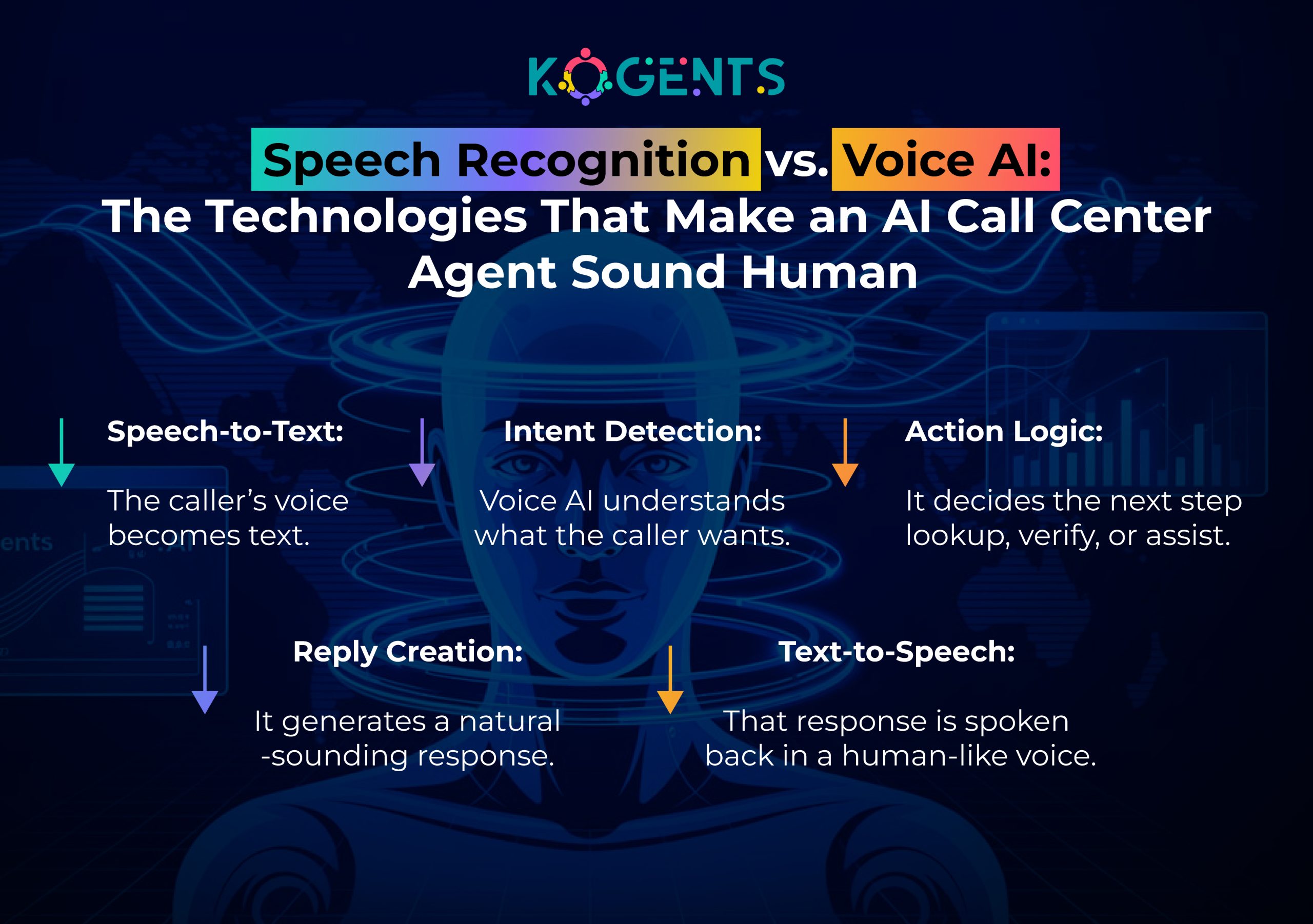
1. Voice Capture Layer (Speech-to-Text)
The system uses cloud speech technologies such as:
- Google Speech-to-Text
- Amazon Transcribe
- OpenAI Whisper
Example: Google AI API converts voice to text in over 85+ languages and variants.
2. Intent Recognition & Language Understanding
This layer uses black bold NLP, black bold natural language understanding, and black bold generative AI to:
- Identify what the customer wants
- Extract entities (order number, account ID)
- Gauge sentiment
- Understand context
Reminder: This allows the AI to navigate complex, multi-turn conversations seamlessly.
3. Task Execution via Automated Workflows
Once the intent is recognized, the AI:
- Looks up customer details
- Updates account info
- Processes refunds
- Schedules appointments
- Troubleshoots issues
- Sends verification codes
Need to Know: This replaces hundreds of manual steps done by human agents.
4. Integrated Knowledge Base & Real-Time Learning
AI continuously learns from:
- Past customer interactions
- Human escalation outcomes
- FAQ patterns
- Historical resolution workflows
Bonus Tip: Unlike IVR systems that require rule updates, AI automatically adapts.
5. Response Generation (Text-to-Speech)
Using technologies like:
- Google WaveNet
- Amazon Polly
- OpenAI TTS
Bonus Point: AI responds with human-like tone, pace, and emotion.
6. Global Elasticity & Scaling
The system auto-scales on cloud platforms like:
- AWS
- Google Cloud
- Microsoft Azure
Valuable Tip: This allows enterprises to handle massive spikes like Black Friday or holiday seasons instantly.
7. Compliance & Security Layer
AI platforms support:
- black bold GDPR
- black bold CCPA
- black bold SOC 2
- black bold HIPAA (healthcare deployments)
Industry Benefit: This makes AI reliable for regulated industries worldwide.
Core Cost Savings Breakdown
Replacing human Tier-1 agents with AI unlocks several layers of savings.
1. Labor Cost Elimination (50–70%)
AI replaces multiple shifts and overlapping teams, cutting labor costs down to near zero for Tier-1.
2. Attrition Cost Reduction (100% Savings)
Instead of spending thousands per agent in:
- Retraining
- Recruiting
- Quality control
- Productivity ramp-up
Note: AI remains constant.
3. Idle Time & Occupancy Optimization
Humans cannot be productive 100% of the time, but AI can remain active, charged throughout.
4. Multilingual Support Savings
AI natively handles dozens of languages without needing:
- Separate teams
- Country-specific operations
- Overnight staffing
5. Infrastructure & Real Estate Reduction
AI reduces:
-
- Workstations
- Office space
- Telecom hardware
- Quality monitoring systems
6. Higher First-Call Resolution (FCR)
AI uses black bold machine learning to resolve more queries on the first attempt, reducing repeat calls.
7. Faster Onboarding of New Markets
AI deploys globally in hours, not months.
Human vs AI Costs Across Global Operations
| Category | Human Tier-1 Cost | AI Call Center Agent Cost | Global Savings |
| Labor | $30k–$45k/yr | $0 | 100% |
| Training | $4,500/yr | $0 | 100% |
| Infrastructure | $2k–$4k | Included | 100% |
| Attrition | $3,800/yr | $0 | 100% |
| Idle Time | 20% | 0% | 100% |
| Multilingual Needs | 2–4 agents | Included | 80–90% |
| Total Per Agent | $45k–$68k | $8k–$12k | 50–80% |
Case Studies
Case Study 1 — Asia-Pacific Telecom Provider
Before AI: Overwhelmed by repetitive troubleshooting calls; long wait times reduced customer satisfaction.
After AI: AI automated 62% of Tier-1 resolutions, cutting wait times by 28% and saving $18.4M annually.
The telecom provider realized that repetitive Tier-1 workflows were perfectly automatable.
By adopting AI, the Asia Pacific provider turned a high-cost support center into a lean, responsive, high-availability operation.
Case Study 2 — U.S. Healthcare Appointment Network
Before AI: Call volumes spiked during seasonal peaks, overwhelming staff and delaying appointment scheduling.
After AI: AI automated 78% of scheduling calls while maintaining HIPAA compliance.
Healthcare environments demand accuracy and reliability, and AI delivers both with measurable improvements in time-to-schedule and patient experience.
Case Study 3 — European E-Commerce Enterprise
Before AI: Holiday seasons required massive temporary staffing, creating unpredictable service quality.
After AI: AI handled 84% of Tier-1 calls during seasonal peaks, saving over $6M annually.
By integrating AI, the European retailer scaled effortlessly across languages and regions without compromising customer satisfaction.
AI Is Becoming the Global Standard for Tier-1 Operations!
The shift toward AI call center agents is not a passing trend; it’s a global restructuring of the customer support workforce.
With massive cost savings, instant scalability, unlimited availability, and industry-leading accuracy, AI is transforming how enterprises handle Tier-1 support.
Organizations adopting AI today gain an operational edge that compounds exponentially over time.
If your enterprise is ready to modernize Tier-1 operations with AI-driven automation, our platform Kogents.ai delivers unmatched accuracy, compliance, and scalability, empowering you to build a high-performance global support engine.
FAQs
How accurate are AI call center agents?
Modern systems achieve huge intent accuracy, depending on language and domain, due to advancements in black bold NLP, black bold speech recognition, and black bold neural networks.
Can AI fully replace human Tier-1 agents?
AI can automate 60–85% of Tier-1 workflows. The remaining portion often requires empathy, negotiation, or complex reasoning better suited to human agents.
How does AI improve customer satisfaction?
AI provides instant responses, 24/7 availability, and consistent quality, attributes that increase CSAT by more than half.
Can AI handle multilingual support?
Yes. AI supports 50+ languages using sophisticated black bold speech synthesis and black bold natural language understanding models.
How secure is an AI call center deployment?
Top AI providers follow major global frameworks, including black bold SOC 2, black bold GDPR, black bold HIPAA, and black bold CCPA.
What happens when AI cannot resolve an issue?
AI performs a contextual handoff, passing the customer, transcripts, sentiment analysis, and extracted data to a human agent.
How long does implementation take?
Most AI systems deploy within 4–12 weeks, depending on workflow complexity and integrations.
Does AI reduce long-term operational risk?
Absolutely. AI removes dependency on labor markets, seasonal staffing, and high churn rates.
Can AI handle outbound calls as well as inbound?
Yes, AI supports proactive outreach, such as reminders, renewals, payment alerts, and customer recovery.
What industries see the fastest ROI?
Telecommunications, healthcare, retail, banking, insurance, logistics, and travel typically break even within 3–6 months.