Do you know that every missed customer intimidation through message or call is lost intent, lost trust, and often lost revenue.
Well, with the advent of the digital economy, customers expect prompt responses across chat, email, WhatsApp, SMS, social DMs, and web forms.
But when businesses fail to meet customer expectations, buyers don’t wait. They leave.
Yet, most organizations still rely on manual workflows, limited staff availability, or disconnected systems.
This is where a modern AI Automation Playbook plays the role of a game changer.
An AI-driven automation framework doesn’t just answer messages; it captures intent, routes conversations intelligently, personalizes responses, and drives revenue outcomes at scale.
Key Takeaways
- Missed messages represent unrealized revenue intent.
- AI automation playbooks outperform manual workflows.
- NLP-powered AI agents capture buyer intent in real time.
- Human-in-the-loop governance ensures accuracy and trust.
- AI automation is a growth engine, not a cost center.
The Business Case for AI-Driven Message Automation
An AI automation playbook for enterprises enables real-time engagement at scale and provides an enormous amount of benefits.
Key Benefits
- Operational efficiency
- Productivity gains
- Cost reduction
- Revenue optimization
- Risk mitigation
- Compliance automation
What Is an AI Automation Playbook?
An AI Automation Playbook is not a chatbot script, a rules engine, or a simple automation flow.
It is a strategic, enterprise-grade operating model that defines how artificial intelligence detects intent, makes decisions, orchestrates workflows, and drives business outcomes, without human delay.
At its core, an Artificial Intelligence Automation Playbook combines:
- Artificial intelligence
- Machine learning
- Workflow automation
- Natural language processing (NLP)
- AI agents
- Decision automation
- Business process automation
What Makes a Playbook Different From Tools?
Most companies adopt tools, but mature firms rely more on playbooks.
A Business AI Automation Playbook answers:
- What should AI automate?
- When should AI act independently?
- When should humans intervene?
- How does automation scale across teams, channels, and regions?
Why This Matters?
This gap is where revenue is lost, and where an AI workflow automation playbook offers leverage.
Why Missed Messages Are a Revenue Crisis?
Missed messages are not just unanswered chats; they represent decaying intent, broken buyer psychology, and irreversible opportunity loss.
The Chemistry of Intent Decay
Buyer intent is time-sensitive.
- Interest peaks at the first interaction
- Confidence erodes with silence.
- Alternatives become more attractive.
Note: Every missed or delayed message accelerates intent decay.
Where Businesses Actually Lose Messages?
Most organizations don’t “ignore” customers intentionally. Messages are missed due to:
- Channel fragmentation (chat, email, WhatsApp, social DMs)
- Manual routing between marketing, sales, and support
- After-hours inquiries
- Understaffed teams
- No intent prioritization logic
- Static forms with no real-time follow-up
Reminder: This creates silent leakage across the funnel.
Revenue Impact Across the FunnelMissed messages affect:
|
This is why AI process automation playbooks are no longer optional, they are revenue infrastructure.
Why AI, Not Humans Alone, Solves This Problem?
Humans are constrained by:
- Time
- Attention
- Cognitive load
- Cost
AI is not.
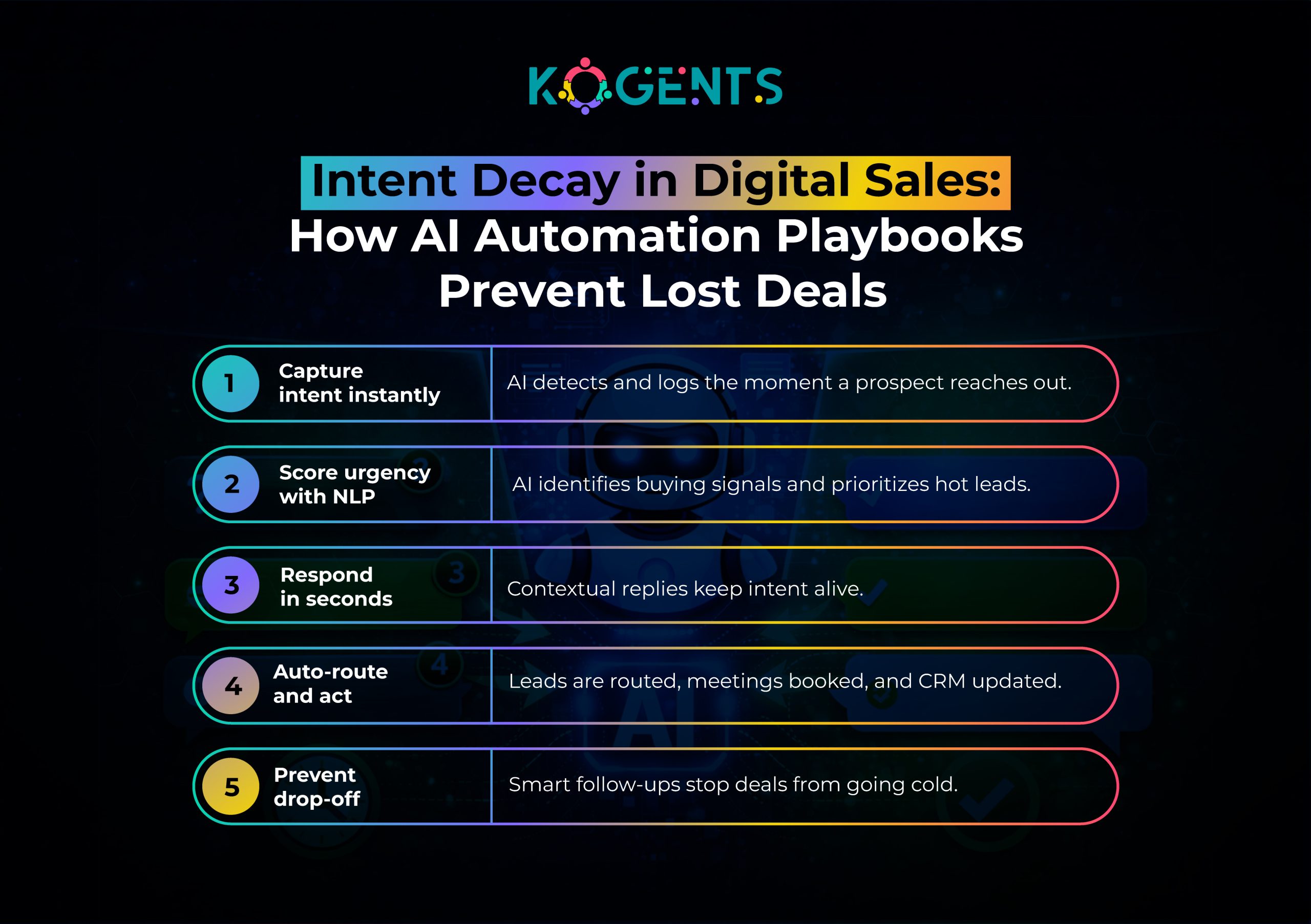
An AI-driven automation framework provides:
- 24/7 availability
- Instant response
- Context retention
- Infinite scalability
Most importantly, AI never drops intent.
The Core Pillars of an AI Automation Playbook
1. AI Readiness Assessment
Before automation, organizations must evaluate:
- AI maturity model
- Data quality
- Existing workflows
- Change management readiness
- Compliance requirements
2. Automation Architecture
A scalable automation architecture includes:
- API integration
- Workflow engines
- AI orchestration
- Cloud infrastructure
- MLOps pipelines
3. Intent Detection & NLP
Using Natural Language Processing (NLP), AI systems classify:
- Lead intent
- Sentiment
- Urgency
- Buying stage
This is the foundation of business process automation.
4. AI Agents & Decision Logic
ai messenger bot handle:
- Message triage
- Contextual replies
- Intelligent routing
- Escalation to humans
5. Human-in-the-Loop Governance
To ensure model accuracy and trust:
- Manual review for edge cases
- Feedback loops
- Model retraining
- AI monitoring
Step-by-Step AI Automation Implementation Playbook
Step 1: Map Message Entry Points
-
- Website chat
- Contact forms
- SMS
- Social media DMs
- Email inboxes
- best AI chatbot for WhatsApp
Step 2: Build Data Pipelines
-
- CRM integration
- Marketing automation tools
- Support ticketing systems
Step 3: Deploy NLP Models
- Intent classification
- Entity extraction
- Context preservation
Step 4: Automate Workflow Actions
- Lead qualification
- Appointment booking
- Sales routing
- Follow-ups
Step 5: Measure & Optimize
- Conversion rate
- Response time
- Revenue per conversation
- Error handling metrics
The Intent Half-Life Framework: Why Speed Beats Persuasion?
Most businesses think lost revenue comes from poor messaging.
In reality, it comes from late messaging.
Introducing the Intent Half-Life Framework
Borrowed from behavioral economics and adapted for AI-driven automation frameworks, the Intent Half-Life Framework™ explains how buyer intent decays over time, even when interest is genuine.
Intent Half-Life = the amount of time it takes for a prospect’s purchase intent to drop by 50% after initial contact.
How Intent Decays in the Real World?
When a customer sends a message, three things are happening simultaneously:
- Motivation is at its peak
- Cognitive commitment is fragile
- Competitive alternatives are one click away
Research-backed behavioral patterns show:
- After 5 minutes, intent drops ~30%
- After 30 minutes, intent drops ~50%
- After 24 hours, intent collapses below recovery thresholds
This explains why:
- Follow-ups fail
- Discounts don’t convert
- “Just checking in” emails get ignored
The intent is already dead.
Why can humans not Beat Intent Decay?
Even elite sales teams cannot consistently win against intent half-life because:
- Humans are reactive
- Humans require context switching
- Humans operate in time blocks
AI does not.
An AI automation playbook operates in milliseconds, not minutes, preserving intent before decay begins.
This is why companies using AI workflow automation playbooks don’t just improve response time, they change buyer physics.
Intent Preservation vs Persuasion (Critical Shift)
Traditional revenue teams focus on:
- Objection handling
- Persuasive messaging
- Follow-up cadences
But persuasion after intent decay is exponentially harder.
High-performing organizations flip the model:
| Old Model | AI Automation Playbook Model |
| Persuade late | Preserve early |
| Follow up | Intercept instantly |
| Convince | Capture |
| Recover lost intent | Prevent intent loss |
This is a structural advantage, not a tactical one.
Message DNA: Why Every Conversation Is a Revenue Asset?
Most companies treat messages as events.
Elite organizations treat them as data assets.
What Is Message DNA™?
Message DNA™ is the complete behavioral and contextual signature embedded in every inbound message, including:
- Language patterns
- Emotional tone
- Urgency signals
- Objection indicators
- Buying-stage cues
- Channel preference
An AI process automation playbook extracts this DNA using:
- Natural language processing (NLP)
- Predictive analytics
- Decision automation
- AI agents
Humans read messages.
AI decodes them.
Why Message DNA Changes Revenue Outcomes?
When Message DNA™ is captured:
- Sales sees intent strength, not just lead volume
- Marketing learns which campaigns create real buyers
- Support detects churn risk before escalation
- Operations forecast demand signals earlier
This turns conversations into predictive revenue signals.
AI Automation as a Compounding Advantage
Most automation delivers linear gains.
A mature AI automation playbook for enterprises creates a compounding flywheel:
- More conversations captured
- More intent data learned
- Better AI decisions
- Higher conversion rates
- Faster responses
- Stronger customer trust
- More inbound demand
| Each loop improves the next.
This is why AI-driven automation frameworks don’t plateau; they accelerate. |
The Core Architecture of an AI Automation Playbook
1. Intent Intelligence Layer
Powered by Natural Language Processing (NLP) and machine learning, this layer:
- Detects buyer intent
- Classifies urgency
- Identifies the decision stage
- Extracts entities (budget, timeline, product)
This is what separates intelligent automation from scripted bots.
2. AI Agents & Decision Engines
AI agents act autonomously to:
- Respond contextually
- Ask qualifying questions
- Route high-intent leads
- Trigger workflows
This enables decision automation at scale.
3. Workflow Orchestration Layer
Using workflow engines and AI orchestration, the system:
- Books meetings
- Assigns sales reps
- Sends follow-ups
- Updates CRM
- Triggers campaigns
All without human delay.
Table: Traditional Messaging vs AI Playbook
| Capability | Traditional Systems | AI Automation Playbook |
| Response Speed | Minutes–Hours | Seconds |
| Intent Detection | None | AI-Based |
| Scalability | Linear | Infinite |
| Lead Qualification | Manual | Autonomous |
| Availability | Business Hours | 24/7 |
| Revenue Impact | Unpredictable | Compounding |
Case Studies
Case Study 1: B2B SaaS – Intent-Based Routing Boosts Revenue
A mid-market SaaS firm implemented an AI automation playbook for SaaS companies.
Outcome:
- 41% increase in qualified demos
- 29% faster deal cycles
- The sales team focused only on high-intent leads.
Case Study 2: Healthcare Provider – Reducing Patient Drop-Off
A healthcare network used an AI automation playbook for healthcare to handle appointment inquiries.
Outcome:
- 34% reduction in missed appointments
- 26% increase in patient satisfaction
- Fully automated triage without compliance risk
Case Study 3: Enterprise IT Services – After-Hours Lead Capture
An enterprise IT firm deployed an enterprise AI automation playbook for global inbound leads.
Outcome:
- 100% message capture across time zones
- 31% revenue uplift from after-hours leads
- Zero increase in staffing costs
Case Study 4: E-Commerce Brand – Conversational Recovery
An e-commerce brand automated WhatsApp, Instagram, and site chat.
Outcome:
- 22% recovery of abandoned conversations
- 18% lift in conversion rate
- Always-on personalized engagement
AI as a Revenue Orchestration Layer (Not a Tool)?
Most businesses treat AI as a feature.
High-growth organizations treat AI as a revenue orchestration layer.
An AI automation strategy playbook connects:
- Marketing intent
- Sales engagement
- Support resolution
- Retention signals
This creates a closed-loop revenue system where:
- No message is lost
- No intent goes cold
- No opportunity slips unnoticed.
The Future: From Automation to Autonomous Growth!
The next evolution includes:
- Self-learning AI agents
- Predictive buyer intent scoring
- Cross-channel context memory
- Autonomous workflow optimization
Final Brand Edge!
This is not about answering messages faster.
It’s about never letting intent die.
A well-executed AI Automation Playbook turns conversations into conversions, speed into leverage, and automation into a compounding growth advantage.
So, what are you still waiting for? Get in touch with the team at Kogents.ai to automate and maximize your revenue!
FAQs
What exactly does an AI automation playbook include?
An AI automation playbook includes strategy, architecture, workflows, AI models, orchestration logic, escalation rules, and optimization loops that guide enterprise-wide automation.
How is an AI automation playbook different from chatbots?
Chatbots follow scripts. AI automation playbooks use machine learning, NLP, and decision automation to adapt, learn, and act across systems.
Can small businesses use AI automation playbooks?
Yes. Modern AI automation playbooks for businesses scale modularly, allowing startups to automate high-impact workflows without enterprise budgets.
How does AI understand customer intent accurately?
Through NLP, predictive analytics, contextual memory, and continuous model retraining using real conversation data.
What channels can an AI automation playbook handle?
Website chat, email, SMS, WhatsApp, social DMs, CRM inboxes, and internal tools, through unified API integration.
How long does it take to deploy an AI automation playbook?
A focused implementation typically takes 6–12 weeks, depending on workflow complexity and data readiness.
Is AI automation secure for enterprise use?
Yes. Enterprise-grade implementations follow ISO AI standards, encrypted data pipelines, and role-based access controls.
Can AI automation personalize responses at scale?
Yes. AI uses contextual signals, CRM data, and behavioral history to deliver hyper-personalized responses instantly.
What teams benefit most from AI automation playbooks?
Sales, marketing, customer success, support, operations, and RevOps teams see immediate gains.
What is the biggest mistake companies make with AI automation?
Treating AI as a tool instead of a strategic operating system for revenue and operations.