
The Automation Gap Engineering Teams Can’t Ignore! Because workflows were supposed to fix everything.
They promised efficiency, repeatability, and trust. You map a process, define conditions, set rules, and let the automation engine run.
For decades, this worked until systems became more complex, data exploded, and businesses demanded adaptability, not rigidity.
Engineering teams quietly began to notice something alarming:
- Traditional workflows don’t break because of a lack of rules.
- They break because they depend on rules.
Today’s systems are real-time, probabilistic, multimodal, and messy.
Rule-based workflows, no matter how elegantly designed, can’t interpret nuance, reason beyond fixed paths, or adapt when unexpected conditions arise.
Here arrives the reasoning-driven and autonomous AI agents.
These aren’t your old macros or rule-based workflow automation scripts. AI agents can understand context, infer intent, make decisions, and orchestrate tasks dynamically across tools, APIs, and systems.
And now the central question everyone is asking is:
“AI Agents vs Workflows, which one actually delivers operational scale, reliability, and flexibility?”
Explore this mystery in this blog now!
Key Takeaways
- AI agents replace rigid rules with adaptive reasoning, enabling automation to handle ambiguity, variability, and real-time context.
- Today’s engineering teams choose AI-driven agents because workflows crack under exceptions, system drift, and unstructured inputs.
- Hybrid automation (agents + workflows) is the winning model for enterprise reliability and governance.
- Rule-based workflows are ideal for deterministic, high-compliance processes, but agents dominate dynamic, decision-heavy tasks.
- Companies adopting agentic automation achieve faster operations, reduced manual load, and significantly fewer workflow failures.
AI Agents vs Workflows: The Ultimate Breakdown
This blog incorporates your primary keyword, AI Agents vs Workflows, and all required variants throughout the content.
Why Workflows Broke: The Downfall of Rules in a Probabilistic World?
For 20 years, companies relied on workflow engines, BPM tools, and RPA workflows built on deterministic logic, if-else trees, and process mapping.
But modern operations have changed:
- Inputs are often unstructured
- APIs change frequently
- Customer demands differ case by case
- Data is ambiguous or incomplete
- Real-time context shifts constantly
This is where rule-based systems fail.
The brittleness problem
Workflow automation collapses when:
- A new field appears in an API response
- A customer type doesn’t match predefined rules
- An exception wasn’t mapped
- A 3rd-party vendor changes the data format
- A system returns unexpected outputs
This is why engineering teams feel trapped maintaining:
- 200+ workflow variations
- Never-ending edge cases
- Broken branches
- Duct-tape patches
- Spaghetti logic across multiple systems
They needed something adaptive, not prescriptive.
The Rise of Reasoning-Driven AI Agents
AI agents are not workflows with LLMs sprinkled on top.
They are autonomous systems that can:
- Understand the environment
- Interpret goals
- Reason through context
- Decide next actions
- across tools
- Learn from feedback
- Adjust plan in real time
These agents use:
- LLM-based agents
- multi-agent systems
- chain-of-thought agents
- agent orchestration frameworks
- reasoning agents
- real-time decision engines
- AI task delegation
Unlike workflows, which need every step explicitly defined, agents operate on outcome-based instructions.
Example: “Resolve billing discrepancies older than 7 days.”
The agent interprets what “resolve” means, navigates the systems, identifies the error, and takes appropriate actions.
That’s impossible for a rule-based workflow without hundreds of sub-conditions.
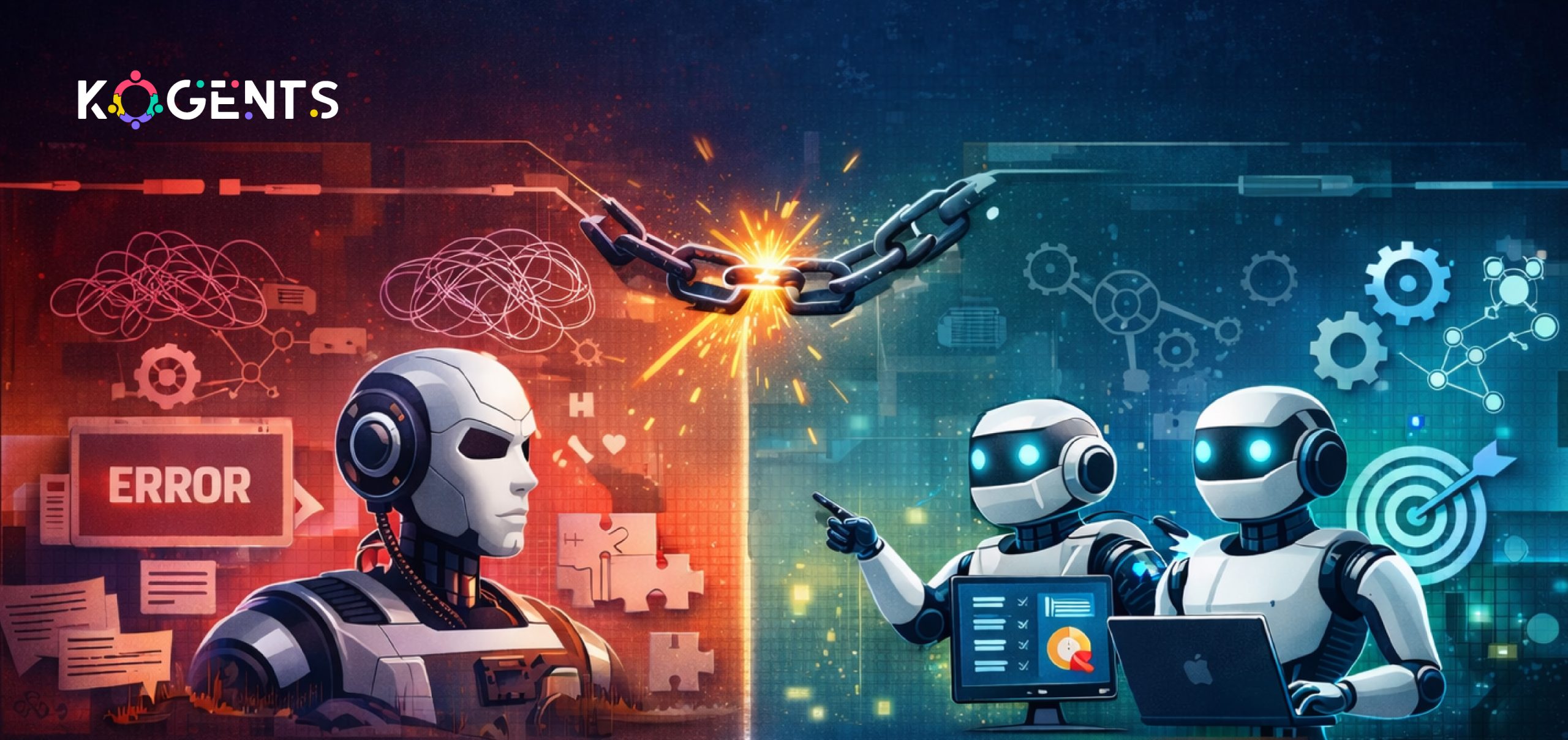 AI Agents vs Workflows — The Core Differences
Below is a comprehensive comparison aligned with your keyword variations, such as the difference between AI agents and workflows, AI agents vs automation workflows, and AI agent orchestration vs workflow orchestration.
Comparison Table: AI Agents vs Workflows
| Category | AI Agents | Traditional Workflows |
| Core Model | Reasoning-driven, autonomous | Rule-based, deterministic |
| Adaptability | Learns and adjusts; handles ambiguity | Breaks when inputs deviate |
| Data Types | Structured + unstructured | Mostly structured |
| Maintenance | Self-improving; minimal upkeep | High maintenance |
| Scalability | Horizontal scaling with dynamic logic | Exponential rule explosion |
| Use Cases | Dynamic decision-making | Repetitive, predictable tasks |
| Orchestration | AI orchestration, real-time planning | Step-by-step BPM orchestration |
| Inputs | Multimodal (text, speech, images, APIs) | Primarily structured system events |
| Failure Handling | Reason-and-recover | Hard failure on missing path |
| Ideal For | Customer ops, billing, triage, support automation | Compliance workflows, approvals, and logging |
The Broken Factory vs. The Adaptive City — A Narrative Metaphor for AI Agents
Imagine your operations as a massive automated factory.
Every machine, every conveyor, every robotic arm follows strict programming. Productivity is great, until something unexpected happens.
A sensor fails, a material is slightly different, a shipment arrives early, or a part comes misshaped. Suddenly, the entire assembly line shuts down.
Engineers rush to patch, reroute, override… but every fix creates two new edge cases.
This is workflow automation, efficient but fragile, rigid, and endlessly patchworked.
Now picture the opposite: a living, adaptive city.
Instead of rigid conveyor belts, you have autonomous vehicles that re-route themselves when roads change.
Traffic lights adjust in real time based on behavior, not rules. Energy grids balance load automatically.
Emergency drones respond to anomalies without waiting for a human-defined flowchart.
This is AI agentic automation, a living ecosystem that perceives, reasons, adapts, and self-corrects.
In the factory model, everything must be anticipated. In the adaptive city, everything is understood.
This single shift, from mechanical predictability to adaptive intelligence, is why engineering teams worldwide are abandoning brittle logic trees and embracing reasoning-driven automation.
And this metaphor helps non-technical leaders instantly grasp what agents do that workflows never could.
Why Do Engineering Teams Migrate from Workflows to AI Agents?
Agents Solve the Edge Case Explosion
- Workflows require engineers to manually map every possible branch.
- Agents generalize across unpredictable scenarios.
Agents Handle Unstructured Data
Using large language models (LLMs) and natural language processing (NLP), agents can process:
- Emails
- Chat logs
- Contracts
- Screenshots
- PDFs
- Voice notes
Note: Workflows cannot.
Agents Adapt to System Changes
- When a vendor changes an API, workflows break.
- Agents reason through the new structure and continue operating.
Agents Reduce Engineering Maintenance Load
Agents Enable Autonomous Decision Intelligence
Reasoning-driven agents use:
- contextual automation
- adaptive process automation
- decision intelligence
They choose the best next step automatically.
Agents work across tools without hardcoded paths
They orchestrate tasks across:
- CRMs
- ERPs
- DevOps tools
- Databases
- Communication channels
- Support tools
- Cloud infrastructure
This is where workflows show their limits.
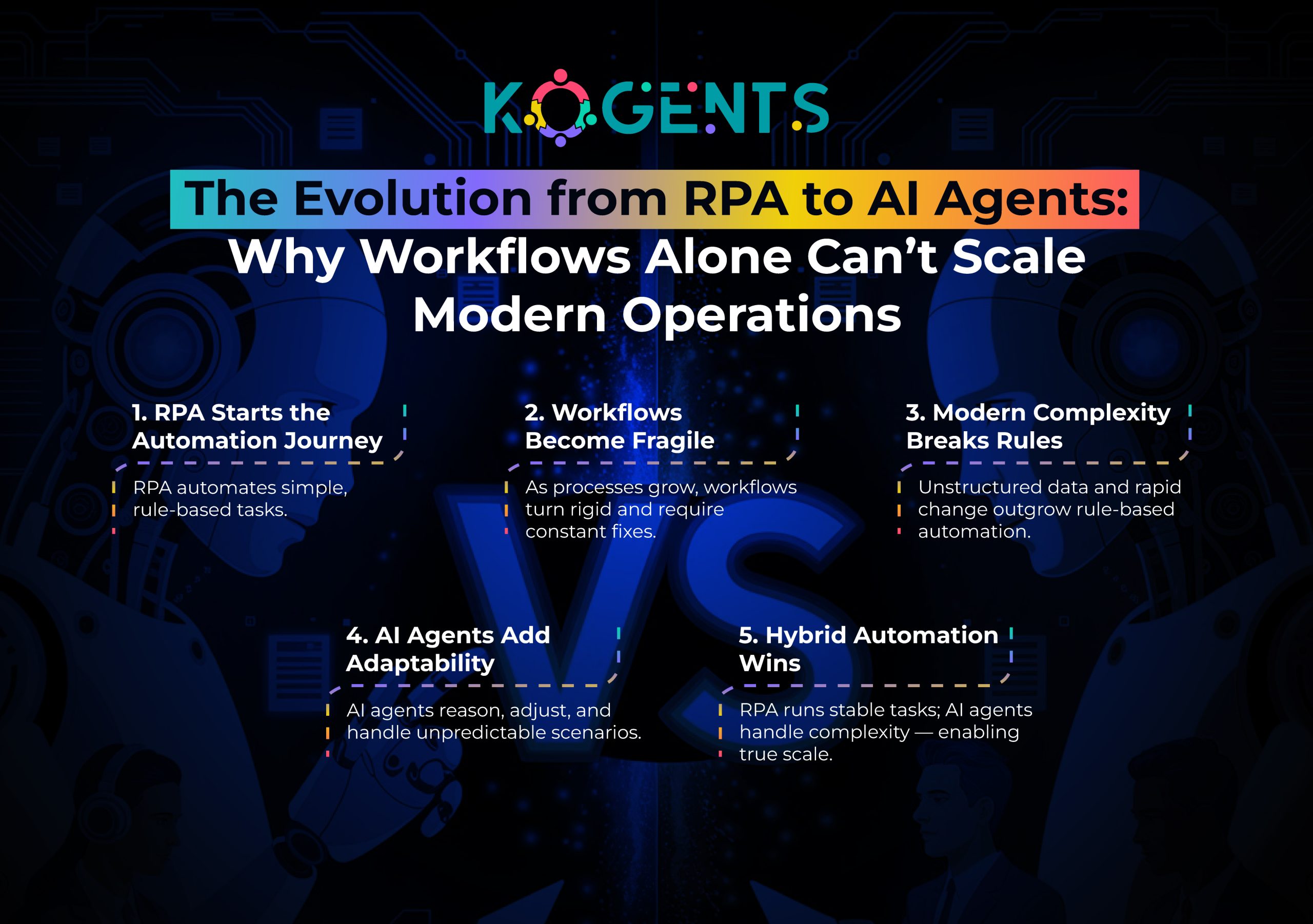
Hybrid Automation: The Future (Agents + Workflows)
The winning enterprises do not fully replace workflows.
They combine:
- Workflows for deterministic operations
- AI agents vs bots for dynamic decisions
This creates agent-augmented automation pipelines.
Examples:
- Workflows trigger agents when uncertainty is detected
- Agents hand off results back to BPM systems
- Agents process exceptions while workflows run a stable path.
Real Use Cases & Case Studies
Case Study 1: UiPath – RPA → AI Agent Evolution
UiPath added AI-powered “intelligent agents” to solve the brittleness of RPA workflows.
Result:
- 38% reduction in broken workflows
- Seamless handling of document variability
- Fewer exception queues
Case Study 2: OpenAI – Agentic Frameworks for Complex Orchestration
OpenAI showcased agent-driven reasoning for autonomous research, planning, and problem execution.
Result:
- Up to 60% reduction in manual operator corrections
- Capable of multi-step problem-solving without pre-coded flows
Case Study 3: McKinsey – Agentic Automation in Customer Operations
A financial services provider replaced 70% of its rule-based workflows with AI agents.
Results:
- 35% faster case resolution
- 28% reduction in support escalations
- $250M annual operational savings
Case Study 4: Microsoft Azure AI – Hybrid Agent Workflows
Microsoft uses hybrid automation for billing, anomaly detection, and cloud ops management.
Results:
- 45% lower manual intervention
- Improved SLA consistency
Case Study 5: IBM Watson – AI Decision Engines
IBM introduced AI-powered decision intelligence systems to replace brittle logic trees.
Results:
- Significant drop in system failures
- Improved compliance automation
- Faster cross-system orchestration
When to Use AI Agents Instead of Workflows?
Use AI Agents When:
- Inputs are unstructured
- Data varies case by case
- Decisions depend on reasoning
- Processes involve multiple tools
- Exceptions are common
- System changes frequently
- Human-like interpretation is required
This aligns with long-tail queries like:
- How do AI agents differ from workflow automation?
- Benefits of AI agents vs agentic AI vs workflows
- When to use AI agents instead of workflows?
When Traditional Workflows Still Work Best
Workflows shine when decisions are:
- Deterministic
- Linear
- Repeatable
- Compliance-heavy
- High auditability
- Low variability
Examples:
- HR onboarding form submissions
- Transaction logging
- Invoice routing
- Status updates
Even in modern enterprises, workflows remain essential, just not dominant.
The Exceptional Angle: Why Agentic Systems Represent a Paradigm Shift
To make this blog truly exceptional, we go beyond the typical comparison.
Here’s the unique angle:
AI agents are not “better workflows.” They are a new computational paradigm.
Workflows = explicit logic
Agents = emergent intelligence.
This is the same leap as:
- Hardcoded search → Google PageRank
- Chess heuristics → DeepMind AlphaZero
- Static chatbots → GPT-4 reasoning models
- RPA macros → autonomous AI agents
Agents mark the shift from automation to autonomy.
- They don’t just execute.
They interpret, decide, adapt, and sometimes even negotiate. - This is why engineering teams aren’t “adopting tools.”
They’re entering a new operational model.
The Future Belongs to Adaptive, Reasoning-Driven Automation!
AI Agents vs Workflows is not a fight; it’s an evolution.
Workflows give us structure, while agents give us intelligence.
As enterprises move to multimodal, real-time, API-driven ecosystems, rule-based systems simply cannot keep up.
The future belongs to reasoning-driven, autonomous agentic systems that can adapt, recover, decide, and operate across tools without brittle logic trees.
This isn’t theoretical. It’s already happening across finance, healthcare, SaaS, logistics, and cloud operations.
Engineering teams adopting agentic automation are not optimizing processes, and they are fundamentally upgrading how their organizations operate.
Ready to Implement AI Agents the Right Way?
If you want enterprise-grade agentic automation, strategic guidance, and airtight implementation, then rely on the best agentic AI company, as we help companies build reasoning-driven AI systems with real ROI.
From workflow replacement to multi-agent orchestration, we deliver automation that thinks, not just follows rules.
Visit Kogents.ai to get started.
FAQs
What is the fundamental difference between AI agents and workflows?
Workflows follow fixed rules; AI agents use reasoning to adapt dynamically.
Are AI agents replacing workflow automation?
Not entirely — they replace brittle workflows but coexist with deterministic ones.
How do AI agents work compared to workflows?
Agents understand context, infer intent, and decide actions autonomously.
When should I use AI agents instead of workflows?
Use agents for unstructured, variable, or decision-heavy processes.
Are AI agents better than BPM systems?
For dynamic tasks—yes. For compliance-heavy deterministic tasks, workflows win.
How do enterprises orchestrate AI agents?
Using AI orchestration frameworks and multi-agent systems that coordinate tasks.
What is the downside of rule-based workflows?
High maintenance and brittleness when environments change.
Can AI agents integrate with RPA tools?
Yes. Agents often sit atop RPA to handle exceptions and reasoning.
Are AI agents reliable in enterprise operations?
Modern agentic frameworks offer monitoring, guardrails, and recovery mechanisms.
How do I implement AI agents in my company?
Start with hybrid automation: apply agents to dynamic tasks while keeping stable workflows intact.