Picture this: It’s 9 PM on a Tuesday. A potential client with a time-sensitive personal injury case visits your firm’s website, desperate for answers.
They submit a contact form asking three critical questions about statute of limitations, case viability, and your firm’s experience.
By the time your team responds the next morning, they’ve already hired a competitor who answered within minutes.
This scenario plays out thousands of times daily across law firms nationwide.
In an era where consumers expect immediate gratification, where Amazon delivers within hours, and Netflix streams instantly, attorney-client–client communication delays are no longer acceptable.
They’re deal-breakers.
For partners, managing attorneys, and legal operations directors: your firm’s response time isn’t just a customer service metric.
It’s a revenue metric. The financial implications are staggering. The average law firm loses most of its potential clients due to slow response times.
For a mid-sized firm generating $2 million annually, that’s $600,000-$800,000 in missed revenue, year after year.
Enter chatbots for law firms, the transformative legal technology that’s reshaping how attorneys handle FAQs, documents, and case questions.
These AI legal assistants don’t just respond faster; they respond smarter, qualifying leads, gathering critical information, and integrating seamlessly with your case management systems.
Key Takeaways
- law firm automation using legal chatbots responds to inquiries 24/7 within seconds, capturing more qualified leads than firms relying solely on traditional methods.
- Client intake automation handles routine inquiries, freeing attorneys to focus on complex legal strategy and billable work, increasing productivity.
- AI chatbots for lawyers pre-screen prospects using sophisticated natural language processing, ensuring your team only engages with high-value, qualified leads.
- Modern attorney chatbot software maintains strict legal compliance standards, including HIPAA and GDPR requirements for sensitive client data.
- The most effective law firm chatbots integrate directly with your legal CRM and practice management platforms, creating seamless legal workflow automation.
How Legal Chatbots Work
At their core, AI assistants for law firms operate through three critical components:
Natural Language Understanding (NLU): The chatbot interprets client questions, recognizing legal terminology, identifying intent, and understanding context, even when queries are phrased colloquially.
Knowledge Base Integration: Connected to your firm’s FAQ database, practice area information, and case evaluation criteria, the chatbot retrieves accurate, firm-specific information instantly.
Intelligent Routing: When queries exceed the chatbot’s scope, it seamlessly transfers conversations to appropriate team members, having already gathered preliminary information through legal lead qualification protocols.
The Three Pillars of Chatbot Implementation for Law Firms
Pillar 1: FAQ Automation—Eliminating Repetitive Inquiries
Law firms field the same questions repeatedly: “What are your fees?” “Do you handle cases in my jurisdiction?” “What’s the statute of limitations for my case type?”
These queries consume countless staff hours without generating immediate revenue.
Client intake chatbots for lawyers excel at handling these repetitive interactions.
Implementation Best Practices:
- Map Your Most Common Questions: Analyze your intake forms, email inquiries, and phone logs to identify the top 50 questions prospects ask.
- Create Conditional Logic Flows: Design chatbot conversations that adapt based on practice area, case type, and jurisdiction.
- Maintain Brand Voice: Ensure your law firm virtual assistant reflects your firm’s personality, professional yet approachable.
Pillar 2: Document Handling—Streamlining Information Exchange
Modern legal chatbot software goes beyond conversation; it facilitates document exchange, enabling prospects to upload case-relevant materials during initial contact.
This capability transforms the intake process.
Consider chatbots for immigration law firms: prospects can upload visa documentation, employment verification, and identification documents before the first consultation.
Immigration attorneys receive organized, pre-screened materials, reducing consultation prep time by 50%.
Key Feature Table: Document Handling Capabilities
| Capability | Traditional Method | AI Chatbot Solution | Time Saved |
| Document Upload | Manual email exchange | Automated collection during chat | 75% |
| File Organization | Staff categorization | AI-powered automatic sorting | 85% |
| Information Extraction | Attorney review | NLP-based data extraction | 60% |
| Security Compliance | Manual encryption protocols | Built-in HIPAA/GDPR compliance | 90% |
| Client Confirmation | Follow-up emails required | Instant acknowledgment with tracking | 100% |
Quick Reminder: Always ensure your legal AI chatbot solution includes bank-level encryption and complies with your jurisdiction’s data protection requirements.
Pillar 3: Case Question Management—Providing Preliminary Guidance
Perhaps the most valuable function of AI chatbots for lawyers is their ability to provide preliminary case assessments.
While they never dispense legal advice, they can guide prospects through eligibility criteria, help them understand case viability, and set realistic expectations.
For personal injury law firms, a chatbot might ask:
- When did the incident occur?
- Have you sought medical treatment?
- Was a police report filed?
- Are you still within your state’s statute of limitations?
| Insight: Based on responses, the chatbot for personal injury law firms can indicate whether the case merits consultation, schedule the appointment, and gather preliminary documentation, all before human intervention. |
Real-World Success: Case Studies in Legal Chatbot Implementation
Case Study 1: Mid-Size Personal Injury Firm Increases Intake by 156%
A 12-attorney personal injury practice in Texas implemented a client intake chatbot on its website in Q1 2023.
The results were transformative:
Before Implementation:
- Average response time: 6-8 hours
- Monthly qualified leads: 45
- Conversion rate: 22%
- After-hours inquiries lost: 67%
After Implementation:
- Average response time: 12 seconds
- Monthly qualified leads: 115
- Conversion rate: 41%
- After-hours inquiries captured: 94%
Case Study 2: Immigration Law Firm Reduces Intake Time by 73%
A boutique immigration practice serving 300+ clients annually faced overwhelming intake bottlenecks.
Implementing a chatbot for immigration law firms with multilingual support and document upload capabilities delivered remarkable improvements:
- Intake completion time dropped from 45 minutes to 12 minutes
- Document collection errors decreased by 89%
- Client satisfaction scores increased from 3.2 to 4.7 (out of 5)
- Staff overtime has been reduced by 40 hours monthly
The legal workflow automation allowed the firm to handle 60% more cases with the same team size.
Compliance and Ethics: Navigating Legal Chatbot Regulations
ABA Guidelines on Legal Technology
The American Bar Association provides clear guidance on legal technology adoption through Model Rule 1.1 (Competence), which includes understanding “benefits and risks associated with relevant technology.”
Firms must:
- Maintain reasonable efforts to prevent unauthorized access to client information
- Supervise AI systems to ensure quality and accuracy
- Never allow chatbots to provide actual legal advice
- Clearly disclose when clients interact with automated systems
HIPAA and GDPR Compliance
For firms handling sensitive health information (personal injury, medical malpractice) or serving international clients, HIPAA-compliant chatbots for law firms and GDPR compliant legal chatbots are essential.
Look for solutions offering:
- End-to-end encryption
- Data residency controls
- Audit logging
- Business Associate Agreements (BAAs)
- Right to deletion functionality
Integration Strategies: Connecting Chatbots to Your Legal Ecosystem
CRM and Practice Management Integration
The power of legal chatbots multiplies when integrated with your existing legal CRM integration and case management systems.
Leading solutions connect with platforms like:
- Clio: Automatically create matters, capture time entries, and log communications
- Salesforce: Sync lead data, track conversion metrics, and manage follow-up campaigns
- Lawmatics: Trigger automated workflows based on chatbot interactions
- MyCase: Schedule consultations and update case notes in real-time
Key Note: This legal software implementation ensures no prospect falls through the cracks, every interaction is documented, every lead is tracked, and every opportunity is maximized.
Selecting the Right Chatbot Solution for Your Practice
Essential Features Checklist
✓ Practice Area Customization: Templates for your specific legal niches
✓ Multi-Channel Deployment: Website, Facebook Messenger, text messaging integration
✓ Advanced Lead Scoring: AI-powered qualification algorithms
✓ Appointment Scheduling: Calendar integration with conflict checking
✓ Document Intelligence: OCR and extraction capabilities
✓ Analytics Dashboard: Conversion tracking, conversation insights, ROI metrics
✓ White-Label Options: Branded experience matching your firm’s identity
Measuring ROI: Analytics That Matter
Key Performance Indicators
Lead Volume Metrics:
- Total conversations initiated
- Qualified leads generated
- Conversion rate (chatbot to consultation)
- After-hours inquiry capture rate
Efficiency Metrics:
- Average response time
- Staff hours saved
- Cost per lead
- Time to first consultation
Quality Metrics:
- Client satisfaction scores
- Chatbot resolution rate
- Escalation frequency
- Case acceptance rate from chatbot leads
Common Implementation Challenges and Solutions
Challenge 1: Staff Resistance
Solution: Frame chatbots as tools that eliminate tedious work, not job replacements. Demonstrate how legal workflow automation allows staff to focus on meaningful client interactions.
Challenge 2: Complex Legal Questions
Solution: Design escalation protocols that smoothly transfer complicated inquiries to appropriate attorneys while preserving conversation context.
Challenge 3: Maintaining Accuracy
Solution: Implement quarterly content reviews, monitor chatbot transcripts for problematic responses, and maintain version control for all legal information.
The Future of Legal Chatbots: Emerging Trends
Predictive Case Analytics
Next-generation AI assistants for law firms will analyze historical case data to predict outcomes, recommend a strategy, and estimate case value, all during initial client interaction.
Voice-Enabled Legal Assistants
Integration with voice platforms (Alexa, Google Assistant) will allow clients to initiate consultation conversationally: “Alexa, ask Johnson Law about divorce filing requirements in California.”
Blockchain-Verified Communications
To address authentication concerns, future legal chatbots may leverage blockchain technology to create immutable records of client communications and consent.
We Are The Leaders in Agentic AI for Legal Innovation!
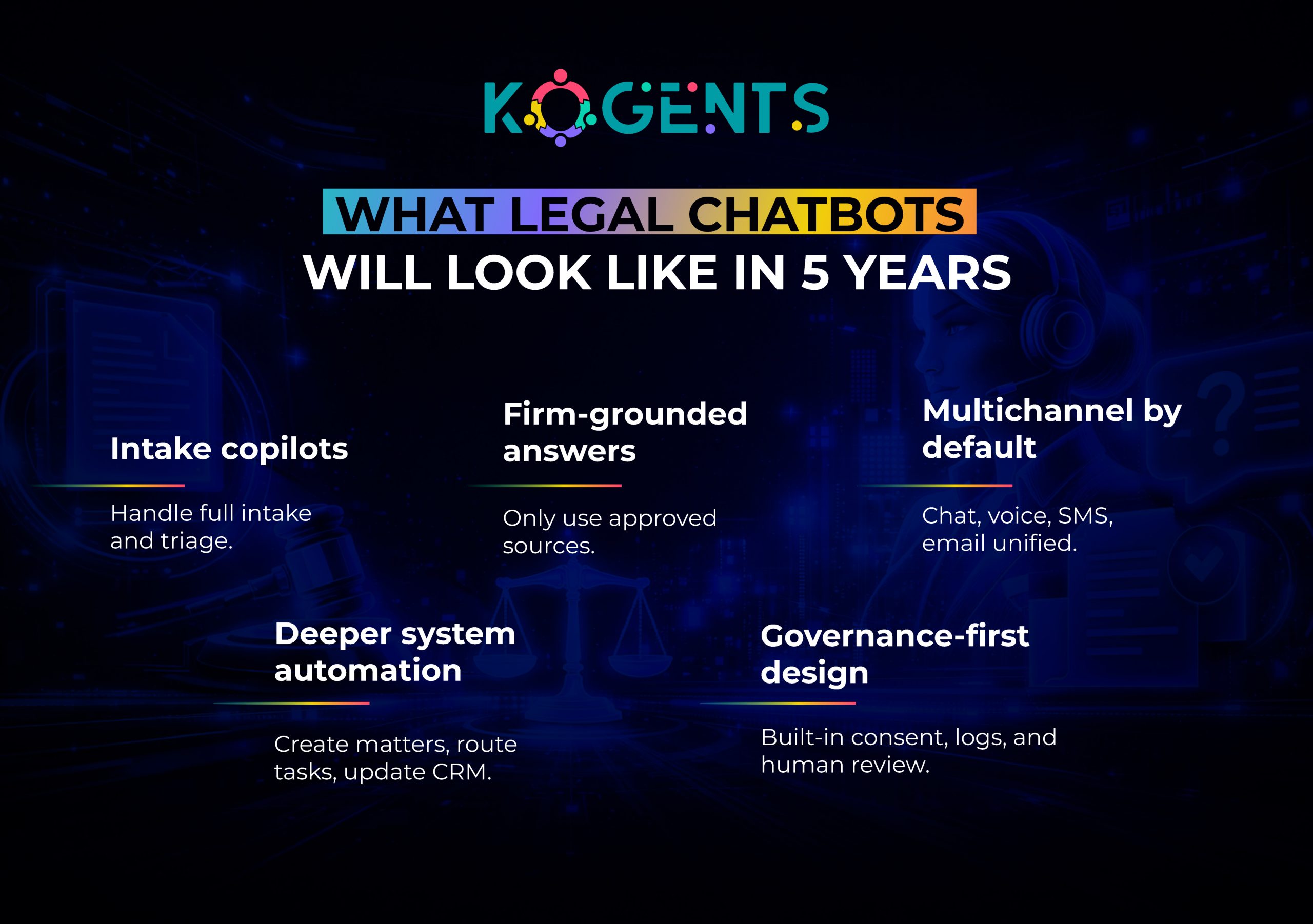
Chatbots for law firms aren’t futuristic luxuries; they’re competitive necessities that separate thriving practices from those losing ground.
By implementing legal chatbots via Kogents.ai, your firm gains:
✓ Competitive Advantage: Capture leads your competitors miss through after-hours availability
✓ Operational Efficiency: Automate routine tasks, freeing your team for high-value work
✓ Revenue Growth: Convert more prospects through immediate engagement and intelligent qualification
✓ Client Satisfaction: Deliver the responsive, modern experience today’s clients demand
✓ Scalability: Handle growing inquiry volume without proportionally increasing staff.
FAQs
What are chatbots for law firms, and how do they differ from regular customer service bots?
Legal chatbots are specialized AI-powered tools designed specifically for law firm operations. Unlike generic customer service bots, they understand legal terminology, maintain strict legal compliance standards (including attorney ethics rules), integrate with case management systems, and handle sensitive client information with appropriate security protocols. They’re programmed to never provide legal advice, instead focusing on information gathering, qualification, and routing.
How do legal chatbots work with client intake automation?
Client intake automation through chatbots transforms the traditional intake process. When prospects visit your website, the client intake chatbot for lawyers initiates a conversation, asks qualifying questions based on practice area, collects contact information, gathers case details, uploads relevant documents, checks conflicts, schedules consultations, and integrates all data into your CRM, completing in minutes what traditionally took days.
Are AI chatbots ethical for attorneys according to bar association guidelines?
Yes, when properly implemented. The American Bar Association recognizes legal technology as essential to modern practice. However, attorneys must ensure chatbots: clearly disclose they’re automated systems, never provide legal advice, maintain client confidentiality, are supervised for accuracy, and comply with professional responsibility rules. Many state bars have issued ethics opinions supporting chatbot use for administrative tasks and information gathering.
Can chatbots replace legal assistants or paralegals?
No. AI chatbots for lawyers augment rather than replace human staff. They handle repetitive, routine tasks, freeing legal assistants and paralegals to focus on substantive work requiring human judgment, empathy, and legal knowledge. The most successful firms view chatbots as tools that enhance team productivity, not workforce replacements.
What are the best chatbots for law firms in terms of features and pricing?
Top legal chatbot software options include LawDroid (comprehensive AI with strong practice area customization, $500-2,000/month), Smith.ai (hybrid AI-human model with live receptionist backup, $240-2,400/month), and custom solutions using IBM Watson or OpenAI APIs ($1,000-5,000+ for development). The “best” solution depends on your firm’s size, practice areas, integration requirements, and budget. Most platforms offer free trials.
How do HIPAA-compliant chatbots for law firms protect sensitive health information?
HIPAA-compliant chatbots for law firms implement multiple security layers: end-to-end encryption for all communications, secure data storage with restricted access controls, Business Associate Agreements (BAAs) with vendors, audit logging of all data access, automatic session timeouts, and data retention policies aligned with HIPAA requirements. For personal injury and medical malpractice practices handling protected health information, HIPAA compliance is mandatory.
What’s the difference between AI chatbots and live chat for lawyers?
AI chatbots operate autonomously 24/7 using artificial intelligence and natural language processing, handling unlimited simultaneous conversations without human intervention. Live chat requires staff availability, can only handle 2-3 conversations simultaneously, and operates during business hours. Many firms use hybrid models: chatbots handle initial contact and routine questions, escalating complex inquiries to live chat agents.
How much does law firm chatbot implementation cost?
Chatbot for attorneys implementation costs vary significantly: Basic Solutions ($200-500/month for SaaS platforms with standard templates), Mid-Range Solutions ($500-2,000/month for customizable platforms with CRM integration), and Enterprise Solutions ($2,000-5,000+/month for fully custom development with advanced AI). Most firms achieve positive ROI within 6-9 months through increased lead capture and reduced administrative costs.
Can chatbots integrate with existing case management systems?
Yes. Modern legal AI chatbots offer native integrations or API connections with major platforms, including Clio, MyCase, PracticePanther, Smokeball, Lawmatics, and Salesforce. This legal CRM integration ensures chatbot-gathered information flows directly into your existing workflows—eliminating manual data entry and reducing errors. When evaluating solutions, prioritize platforms with pre-built integrations for your specific tech stack.
What ROI can law firms expect from chatbot implementation?
Firms typically see 300-400% ROI within the first year. Specific benefits include: 50-100% increase in qualified leads, 40-60% reduction in administrative time, 24/7 availability capturing after-hours inquiries (typically 30-40% of total volume), 35-50% improvement in lead response time, and 20-30% increase in consultation bookings. According to legal technology studies, the average mid-sized law firm generates $4-7 in revenue for every $1 spent on chatbot implementation.