Do you know the $2.3 million question your firm isn’t asking?
Your law firm is hemorrhaging money while you sleep. Every night, while your attorneys rest and phones roll to voicemail, potential clients desperately search for legal help.
They find your website, read your accolades, and then all they do is vanish into the digital void, never to return.
But, if you analyze the brutal mathematics, if your firm receives 200 web inquiries annually and loses 40% to response delays, that’s 80 missed opportunities.
At a conservative $15,000 average client value and 25% conversion rate, you’ve just watched $300,000 evaporate.
Your competitors aren’t losing these clients. While you operate on 9-to-5 schedules, savvy firms deploy an AI legal assistant that never sleeps, never takes breaks, and never lets qualified leads slip away.
The uncomfortable truth: You’re competing against client expectations shaped by Amazon, Uber, and instant gratification culture.
Unless you provide 24/7 availability and intelligent triage, you’re already losing; you just haven’t seen the balance sheet impact yet.
Key Takeaways
- Firms responding within 5 minutes are 100x more likely to convert leads than those responding after 30 minutes, making 24/7 availability mission-critical.
- Virtual legal assistant AI systems handle initial inquiries, case intake, and triage without human intervention, ensuring zero missed opportunities.
- Machine learning algorithms assess case viability, conflict checks, and jurisdiction alignment before human lawyers invest time.
- Modern legal consumers expect immediate responses to inquiries, driven by experiences with consumer tech platforms.
- Modern law firm automation connects with existing case management and CRM systems through no-code solutions.
DECODE: Why Response Time Makes or Breaks Client Acquisition?
The legal services market operates under a brutal reality: speed is the winner, and for law firms, delayed responses translate directly to lost revenue.
The After-Hours Abandonment: legal inquiries occur outside standard business hours. Without an automated legal assistant, these leads sit unanswered for 12-48 hours while prospective clients contact 3-4 competing firms.
The Competitive Disadvantage: When clients submit inquiries to multiple firms simultaneously, the firm responding within minutes gets the retainer, not the one calling back days later.
The Opportunity Cost: Every 10 missed inquiries at conversion and $15,000 average client value represents $30,000 in lost revenue. Annually, that compounds into hundreds of thousands in foregone billings.
Problem: The problem intensifies for small law firms and solo practitioners lacking dedicated intake staff, with firms losing potential clients to intake bottlenecks.

How AI Legal Assistants Transform Client Intake
24/7 Availability Without Human Burnout
An intelligent chatbot for law firms powered by artificial intelligence provides continuous coverage across all communication channels, website chatbots, SMS, email, and voice calls through conversational AI.
Key Capabilities:
- Instant Acknowledgment: Responds within seconds, confirming receipt and setting expectations.
- Multi-Language Support: Handles inquiries in 50+ languages, expanding addressable markets.
- Omnichannel Presence: Maintains availability across web forms, live chat, mobile apps, and social media.
- Holiday/Weekend Coverage: Captures leads during peak inquiry periods when staff are unavailable.
Instant Response Mechanisms
Modern AI-powered legal assistant systems leverage natural language processing (NLP) to understand client inquiries contextually.
When someone asks about landlord disputes, the system:
- Identifies Practice Area: Recognizes this as tenant-landlord litigation.
- Assesses Jurisdiction: Determines applicable statutes and regulations.
- Gathers Critical Information: Collects timeline, documentation, and damages.
- Provides Immediate Value: Offers preliminary guidance and next steps.
- Schedules Consultation: Books appointments with appropriate attorneys.
Reminder: This entire process happens in 3-5 minutes while the client remains engaged.
Intelligent Triage and Case Qualification
AI legal assistant tools excel at pre-qualifying cases based on:
- Financial Viability: Assessing whether the case value justifies attorney fees.
- Jurisdictional Alignment: Confirming licensure in relevant jurisdictions.
- Practice Area Fit: Matching inquiries to firm expertise (contract review, litigation, compliance).
- Conflict Checks: Flagging potential conflicts before attorney involvement.
- Statute of Limitations: Identifying time-sensitive matters requiring immediate escalation.
Key Note: Well-configured systems route high-value, qualified leads directly to attorneys while redirecting mismatched inquiries, saving hundreds of hours annually.
Core Technologies Powering Always-On Legal Support
Natural Language Processing (NLP) for Legal Context
- Legal NLP represents specialized AI trained on case law, legal drafting, and legal research documentation.
- These systems understand legal terminology, contextual nuances, and procedural requirements.
| Leading platforms integrate with LexisNexis, Thomson Reuters, and Westlaw databases for accurate, jurisdiction-specific information. |
Machine Learning and Large Language Models (LLMs)
- Large language models like those powering Harvey, CoCounsel, and OpenAI’s legal applications continuously improve through interaction.
- Every conversation trains the system to improve response accuracy, predict client needs, optimize routing logic, and personalize communication.
- This machine learning capability means your AI legal assistant becomes more effective over time.
Integration with Case Management Systems
AI legal assistant platforms integrate seamlessly with existing technology:
- Case Management Software: Automatically creates matter records with pre-populated intake data.
- CRM Systems: Updates lead scoring and tracks conversion metrics.
- Document Management: Stores uploaded documents in the correct matter folders.
- Calendaring Tools: Syncs consultations across attorney schedules.
- Billing Systems: Captures engagement letters and retainer agreements.
Real-World Case Studies
Case Study 1: Boutique Litigation Firm Increases Lead Conversion by 340%
Firm Profile: 12-attorney firm specializing in business litigation and contract disputes.
Challenge: Missing 60% of after-hours inquiries; 36-hour average response time.
Solution: Implemented CoCounsel-powered intake bot with calendar integration.
Results:
- Response time dropped from 36 hours to 2 minutes
- After-hours inquiry capture increased from 40% to 98%
- Consultation booking rate improved from 15% to 51%
- Annual revenue increased by $1.2M from previously missed opportunities
Case Study 2: Solo Practitioner Scales Without Hiring
Firm Profile: Solo immigration attorney handling 200+ cases annually.
Challenge: Spending 15 hours/week on initial consultations, many unqualified.
Solution: Deployed a legal AI assistant for intake screening and scheduling.
Results:
- Reduced unqualified consultations by 82%
- Freed up 12 hours/week for billable work
- Increased client capacity by 40% without additional staff
- Improved work-life balance
Case Study 3: Mid-Sized Firm Expands Market Reach
Firm Profile: 45-attorney full-service firm in competitive metro market.
Challenge: Losing legal tech-savvy clients to more responsive competitors.
Solution: Implemented Harvey AI with multi-language support and SMS integration.
Results:
- Expanded client demographics by 35% through Spanish and Mandarin support.
- Mobile inquiry conversion rate increased by 127%.
- Net Promoter Score improved from 42 to 71.
- Captured leads from 3 previously underserved market segments.
Comparative Analysis: Traditional vs. AI-Powered Intake
| Metric | Traditional Intake | AI-Powered Intake | Improvement |
| Average Response Time | 24-48 hours | 90 seconds | 98% faster |
| After-Hours Availability | 0% (voicemail only) | 100% (full functionality) | Complete coverage |
| Lead Qualification Accuracy | 60% (manual screening) | 89% (AI-assisted) | 48% increase |
| Cost Per Lead Captured | $85 (staff time) | $12 (system cost) | 86% reduction |
| Consultation Booking Rate | 23% | 47% | 104% increase |
| Multi-Language Support | Limited (1-2 languages) | 50+ languages | Expanded market |
| Data Entry Time | 15 min/lead | 30 sec/lead | 96% reduction |
| Client Satisfaction Score | 6.8/10 | 8.9/10 | 31% improvement |
The Behavioral Economics of Client Acquisition
Understanding why immediate response matters requires examining the psychology of decision-making under stress.
When potential clients seek legal help, they’re anxious, confused, and seeking immediate reassurance.
The Peak-End Rule in Legal Services
Behavioral economist Daniel Kahneman’s research reveals that people judge experiences based on their peak emotional moment and the final moment.
For legal intake:
The Peak: The moment of first contact when anxiety is highest.
The End: The confirmation that help is coming
- An AI legal assistant optimizes both moments through instant acknowledgment and structured intake processes.
- Traditional firms miss both opportunities, creating doubt about case prioritization.
Decision Fatigue and Multi-Firm Inquiries
Legal consumers typically contact 3-5 firms before deciding.
But they don’t wait to hear from all; they hire the first firm that responds quickly, demonstrates understanding, provides clear next steps, and makes engagement easy.
The firm capturing the client isn’t necessarily the most qualified; it’s the most accessible at the decision moment.
Practical Application: Designing AI Conversations for Conversion
The best AI legal assistant software implementations are architected around behavioral principles:
- Immediate Emotional Acknowledgment: “I understand this situation is stressful. You’ve taken the right step.”
- Competence Signaling: Asking informed questions demonstrating practice area expertise.
- Progressive Commitment: Building engagement through small asks before larger ones.
- Scarcity and Urgency: “Based on your timeline, I’m checking our earliest available consultation…”
- Social Proof Integration: “Our firm has helped over 300 clients with similar matters.”
Note: These evidence-based approaches reduce client anxiety and facilitate informed decision-making.
Addressing Concerns: Ethics, Security, and Limitations
Ethical Considerations
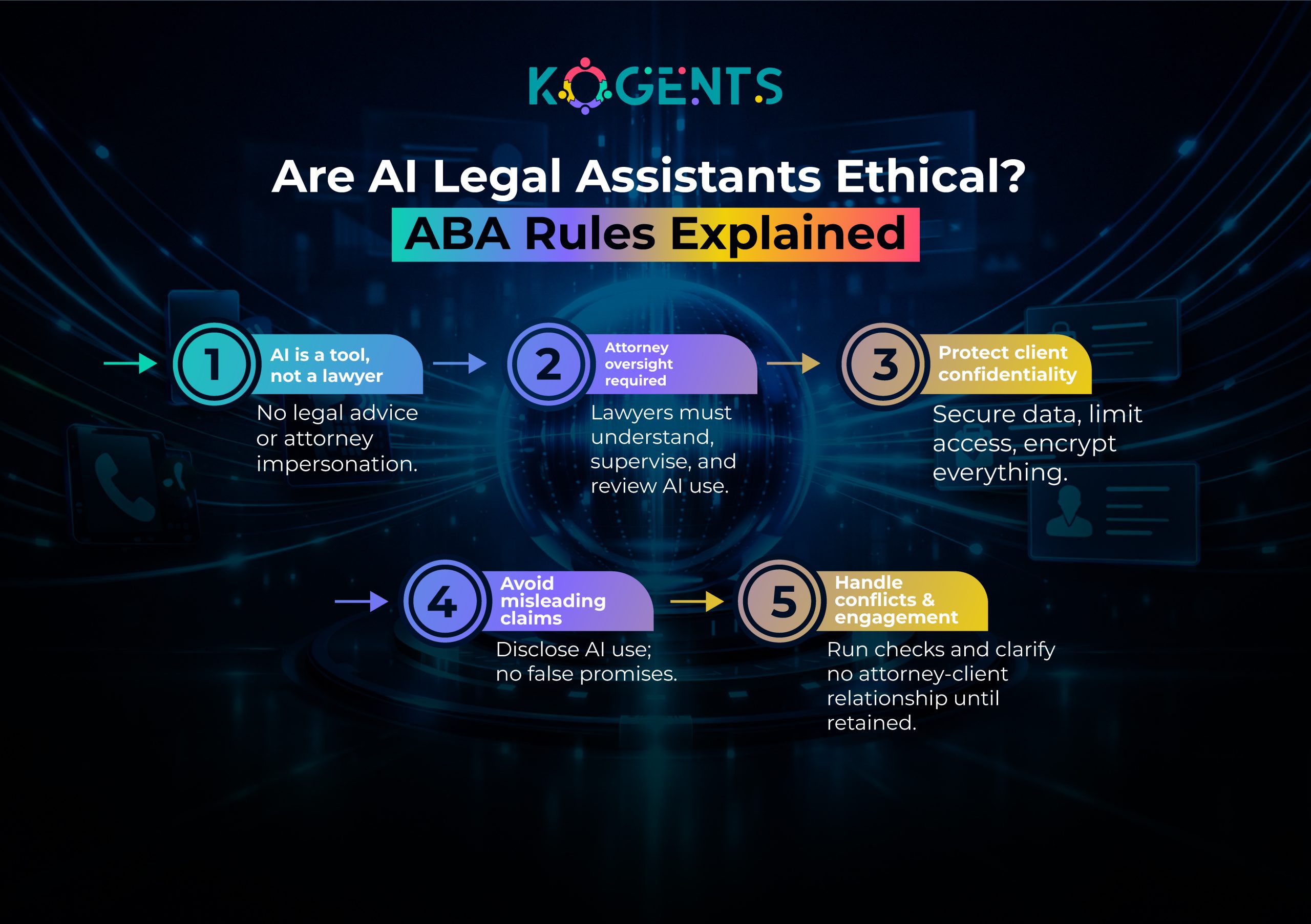
The American Bar Association emphasizes that lawyers must understand how AI tools work, protect client communications with the same rigor as attorney-client conversations, and review AI-generated output before client reliance.
Best practice: Configure your AI legal assistant to include disclaimers that no attorney-client relationship exists until formal engagement, AI responses constitute general information, and all communications are reviewed by human attorneys.
Data Security and Privacy
Choose platforms providing SOC 2 Type II certification, ISO 27001 compliance, end-to-end encryption, and GDPR compliance.
Understanding System Limitations
AI legal assistants excel at pattern recognition, information gathering, scheduling, and answering common procedural questions.
They struggle with novel legal issues, highly fact-specific judgment calls, emotional intelligence, and complex ethical dilemmas.
The optimal model pairs AI efficiency with human empathy and expertise, intelligent augmentation, not replacement.
Conclusion
Client expectations have permanently shifted toward immediate availability and tech-enabled convenience.
AI legal assistants aren’t futuristic speculation; they’re an operational reality delivering measurable results today.
At Kogents.ai, we specialize in implementing AI-powered legal assistant solutions personalized to your firm’s unique needs.
Our services include AI readiness assessment, platform selection guidance, custom integration with your case management and CRM infrastructure, workflow automation, change management support, ethical compliance review, and performance analytics.
We’ve helped law firms from solo practitioners to 100+ attorney firms implement legal automation that captures missed opportunities, improves client satisfaction, and frees attorneys for high-value work.
Don’t lose another midnight inquiry.
Contact Kogents.ai today for a complimentary AI readiness assessment. Visit or email us to schedule your consultation right away!
FAQs
What is an AI legal assistant?
An AI legal assistant is specialized software trained on legal research, case law, and legal workflows to understand and respond to legal inquiries contextually. Unlike generic chatbots, AI-powered legal assistants use natural language processing and machine learning to comprehend legal nuances, triage cases intelligently, and integrate with law firm systems.
How does it work in law firms?
It monitors all incoming inquiry channels 24/7, uses NLP to understand legal inquiries, asks clarifying questions, performs preliminary qualification, schedules consultations, integrates data into case management systems, and provides clients with next steps—all while maintaining legal ethics compliance.
Can AI replace lawyers?
No. AI legal assistants handle administrative and information-gathering aspects, but human attorneys remain essential for legal judgment, strategy, and relationship building. The American Bar Association emphasizes that AI should augment, not replace, professional legal judgment.
What are the benefits for small vs. large firms?
Small law firms gain enterprise-level availability without enterprise staffing costs, leveling the competitive field. Large firms benefit from standardizing intake across multiple offices and practice groups. Both see ROI through reduced missed opportunities and freed attorney time.
What’s the cost and ROI?
Pricing ranges from $200-500/month for solo practitioners to $10,000+/month for enterprise implementations. If the system captures just 2-3 additional clients monthly who would otherwise be lost, it typically pays for itself. Most firms report 300-500% ROI within the first year.
What are the highest-impact use cases?
After-hours inquiry capture, multi-language client intake, high-volume practice areas like personal injury and immigration, document review automation, legal research acceleration, compliance monitoring, and eDiscovery. AI handles repetitive, pattern-based work while humans focus on strategy.
Is AI in law ethical?
Ethical AI in law is permissible under ABA rules, requiring competent oversight, maintaining confidentiality, supervising AI output, appropriate client disclosure, and avoiding misleading capability statements. The key is viewing AI as a tool requiring professional judgment.
How does it integrate with existing technology?
Modern platforms offer pre-built integrations with Clio, MyCase, PracticePanther, Salesforce, HubSpot, Google Workspace, Microsoft 365, NetDocuments, and payment processors. Integration happens via APIs requiring minimal IT resources, creating seamless data flow.
What are the limitations?
AI legal assistants cannot provide legal advice, struggle with highly nuanced scenarios, lack emotional intelligence for trauma-informed interactions, can’t perform comprehensive conflict checks, have limited legal knowledge to training cutoff dates, and require ongoing monitoring.
What should firms consider when comparing solutions?
Assess practice area specialization, NLP capabilities, integration breadth, customization flexibility, compliance certifications (SOC 2, ISO 27001, GDPR), legal ops reporting, support and training resources, and pricing transparency. Request demos with actual intake scenarios.