Imagine yourself as the Head of Customer Experience, Contact Center Operations leader, CTO, or Compliance owner. You already feel the pain, just in different places:
- CX leaders see customers repeat themselves and lose trust.
- Ops leaders see queue management chaos, inconsistent call scripts, and “tribal knowledge” handling escalations.
- IT sees fragile telephony gateways, messy APIs, and siloed systems.
- Risk teams see PII, recording consent, retention, and audit gaps.
Here’s the uncomfortable truth: the phone channel is still where customers bring their most urgent, emotional, high-value issues, yet it’s often the least centralized, least searchable, and least learnable channel in the business.
That’s why voice AI for customer service is becoming critical. Not because they “answer calls.”
But because they centralize conversations: capturing intent, enforcing consistent flows, routing intelligently, logging outcomes, and making every call a structured asset inside your contact center ecosystem.
Customers want connected experiences across departments.
Leaders want costs under control. And teams want visibility into why calls happen in the first place.
That’s exactly what centralized voice infrastructure delivers.
Read the blog and learn more.
Key Takeaways
- The win isn’t only automation, it’s centralization as one system of record for agent AI voice.
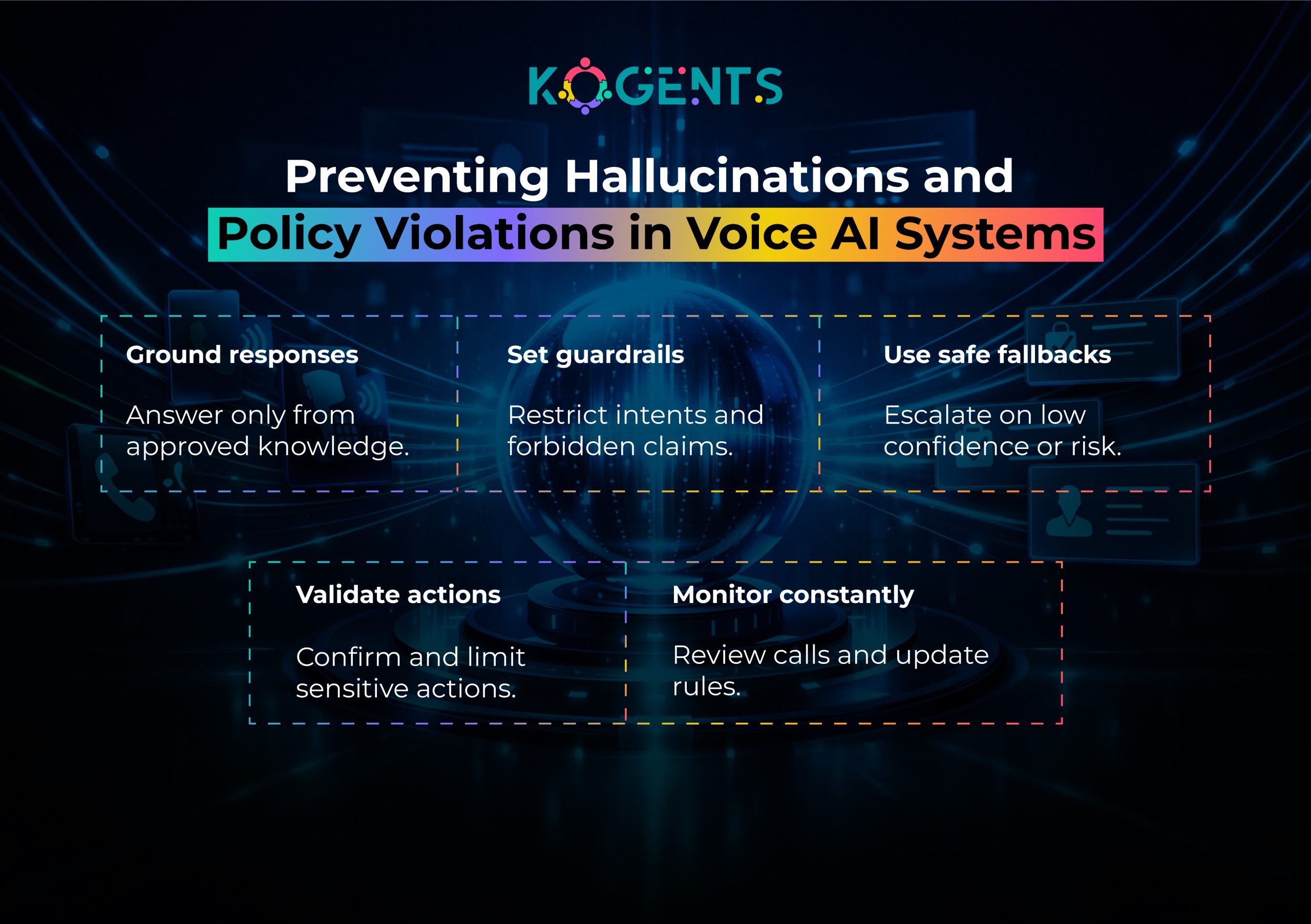
- Knowledge base/retrieval (RAG) + guardrails prevent unreliable responses and operational risk.
- The best deployments are hybrid: fast self-service + human handoff/escalation with context.
- Centralization succeeds when voice outcomes land in your CRM integration + case/ticket workflows.
- Governance is architecture: audit logs, PII redaction, and frameworks like NIST AI RMF matter.
The Market Reality: Phone Still Dominates Customer Service in High-Stakes Moments
Even as digital channels grow, voice remains a primary channel for service, especially when issues feel urgent, confusing, or emotional.
One study found that 72% of customers who contacted customer service did so over the phone.
And another widely cited report shows many organizations expect increased call volumes in the coming years, which forces leaders to rethink staffing, queue strategies, and the limits of traditional IVR.
If call volume stays high, the only scalable solution is to transform voice from “unstructured chaos” into structured, measurable workflows, and that’s where voice AI for customer service becomes central.

What Does “Centralizing Phone Conversations” Actually Mean?
Centralizing phone conversations means every call becomes part of a single, governed workflow, rather than a one-off event trapped in recordings, agent notes, or disconnected systems.
AI voice assistants for customer support typically include:
- A consistent entry layer using an AI receptionist for customer service or an intelligent IVR / AI-powered IVR
- Unified routing rules: call routing, priority logic, and skills-based routing.
- A system of record: CRM integration, ticketing, and case management logging.
- Conversation intelligence: call transcription, call summarization, sentiment analysis, and QA tagging.
- Operational controls: model monitoring, fallback intents, human takeover, and auditability.
Tip: When implemented correctly, an AI voice chatbot for a contact center becomes a central hub that orchestrates outcomes, not just a front-line script reader.
How AI Voice Agents Work: The Stack Behind Centralization
AI voice agents are not “one model.” They’re a pipeline that converts real-time speech into structured action:
1) ASR (automatic speech recognition) + speech-to-text
This transforms audio into text with low latency, because timing defines whether a conversation feels natural.
2) NLU (natural language understanding): intent detection + entity extraction
Identifies what the caller wants and captures key fields (order ID, address, policy number, appointment date).
3) Dialog management + conversation design
Controls turn-taking, context memory, interruptions, barge-in, and recovery when callers change topics.
4) TTS (text-to-speech) + neural voices
Generates a consistent, brand-aligned voice with human-like cadence.
5) Knowledge grounding: knowledge base/retrieval, RAG, grounding
Pulls answers from approved sources (policies, SOPs, product docs) to reduce hallucinations and inconsistency.
6) Safety controls: guardrails, fallback intents, and human handoff/escalation
When confidence drops or risk rises, payments, medical details, and disputes, the system escalates cleanly and quickly.
Google’s Dialogflow CX documentation emphasizes structured flows, testing, and measurable performance signals for enterprise-grade conversational agents.
The Centralization Blueprint: From Telephony to CRM (Without Losing Context)
A practical centralized architecture looks like this:
-
- Inbound call arrives via PSTN or SIP trunk.
- Call routes through a telephony gateway / CTI (computer-telephony integration) layer.
- The AI call agent / automated call agent captures intent, identifies the caller, and executes simple workflows.
- voice AI with human handoff transfers to a live agent with full context.
-
- Outcomes sync into CRM integration, ticketing, and disposition codes.
- Post-call: call transcription, call summarization, QA tags, and analytics are generated.
Google’s Contact Center AI Platform materials describe SIP-based and platform-integrated approaches to connect telephony with virtual agents, critical for centralized call flows.
Where Centralization Delivers ROI (Customer-First Use Cases)
Here are the use cases where a customer service voice assistant stops being a cost tool and becomes a service-quality engine.
1) Smarter triage + routing (the new “front door”)
- Intent-first experiences replace maze-like menus
- Call routing becomes data-driven
- Skills-based routing reduces transfers and friction
2) AI answering service (enterprise) for after-hours support
- Handle FAQs, order status, cancellations
- Create a case and promise accurate next steps
- Reduce “dead ends” that destroy trust
3) Billing & payments support (with guardrails)
- Handle payment questions and billing clarifications
- Securely route sensitive actions
- Escalate risky scenarios (PCI-related workflows)
4) Scheduling & rescheduling
High impact for healthcare scheduling and patient calls, utilities, and service businesses.
5) Returns and delivery issues (eCommerce)
Ideal for voice AI for ecommerce support (returns, delivery) because intents repeat, but details must be captured accurately.
6) Peak overflow/queue relief
During spikes, AI phone support automation captures the full case, then either resolves or escalates with context.
7) Multilingual customer care
voice AI for multilingual customer service centralizes intents across languages and routes to appropriate teams.
The Metrics That Prove You Centralized (Not Just “Deployed a Bot”)
If you want buy-in from stakeholders, measure outcomes end-to-end:
- AHT (average handling time)
- FCR (first call resolution)
- CSAT and NPS
- Containment and escalation rates
- Transfer rate, abandonment rate, repeat contact rate
- QA defects and policy adherence
- Cost per contact/cost to serve
- Impact on WFM (workforce management) and agent productivity
Key Insight: These metrics are not optional; they are the scorecard for centralization.
One Most Significant Table: “Customer Impact vs Operational Control”
| Key concern (customer-centric) | What breaks without centralization | What voice AI centralization fixes | Best KPI to track |
| Repeating information | Customers explain the same issue multiple times | Intent detection + pre-capture of entities + human handoff context | FCR, transfer rate |
| Long wait times | Queue overload and poor routing | call containment + overflow handling + routing precision | Abandonment rate, AHT |
| Inconsistent answers | Agents interpret policies differently | knowledge base/retrieval (RAG) + standardized scripts | QA defects, repeat contact |
| No visibility into call drivers | Calls stay “unstructured.” | call transcription + analytics + topic tagging | Top contact reasons trend |
| Risk and compliance exposure | PII scattered across systems | PII redaction, retention rules, and audit logs | Compliance incidents |
High-End Case Studies
Case Study 1: Travel — Scaling support with Google Cloud CCAI + Dialogflow
loveholidays published how it used virtual assistants built with Dialogflow and Contact Center AI to handle inquiries at scale while improving customer experience and efficiency.
Why it fits centralization: consistent triage and automated resolution reduce fragmentation across teams and call queues.
Case Study 2: On-demand delivery — DoorDash and GenAI self-service for support (AWS)
AWS highlights DoorDash building self-service contact center experiences using Amazon Connect, Amazon Lex, and Amazon Bedrock, focusing on improving how support inquiries are answered and routed.
Why it fits centralization: knowledge-based automation + routing creates repeatable outcomes instead of one-off agent interpretation.
Case Study 3: Retail subscription — TechStyle and AI self-service with NICE
NICE shared TechStyle’s approach using AI self-service within contact center operations, emphasizing scalable automation and blended experiences.
Why it fits centralization: unifies self-service and escalation behaviors so customers don’t “fall through cracks.”
Wrapping Up!
Phone conversations are still where customers bring their most urgent, high-stakes needs, yet in many organizations, voice remains fragmented: siloed recordings, inconsistent routing, scattered agent notes, and limited visibility into why customers call in the first place.
That fragmentation creates real cost and real harm: longer wait times, repeated explanations, inconsistent answers, and compliance exposure.
That’s why AI voice agents matter now. When designed and deployed correctly, they don’t just automate, they centralize.
They become the single front door that captures intent, routes intelligently, powers self-service, and ensures outcomes land in your CRM integration and ticketing workflows.
They also unlock what contact centers have always wanted: measurable insights through call transcription, call summarization, sentiment analysis, and performance tracking across AHT, FCR, containment, transfers, and QA.
If you’re ready to implement voice AI for customer service in a way that’s secure, scalable, and built for real-world operations, Kogents can help.
We build enterprise-grade voice AI systems with grounded knowledge, smart escalation, deep integrations, and governance-first architecture, so you can centralize conversations without sacrificing customer trust.
Book a consultation with Kogents.ai to identify your best call journeys for automation, design a pilot, and deploy a voice AI program that proves ROI fast.
FAQs
What is voice AI for customer service?
It’s conversational voice AI for customer care that understands natural speech, executes workflows, and logs outcomes into your systems (CRM/ticketing), not just menu-based IVR routing.
Voice bot vs IVR vs virtual agent, what’s the difference?
IVR is typically menu-driven. A voice bot for a contact center uses NLU and conversation logic. A virtual agent for phone support often implies deeper workflows, integrations, and escalation capability.
How do AI voice agents reduce AHT?
They shorten calls by capturing intent and entities early, automating repetitive tasks, and enabling faster resolution or cleaner escalation, supporting voice AI to reduce handle time (AHT).
How can voice AI increase FCR?
Better routing + better upfront context + grounded answers improve first-contact outcomes, supporting voice AI to increase first call resolution (FCR).
What is called containment in voice AI?
Containment means the issue is solved in self-service without escalation. High containment requires strong intent coverage, grounded knowledge, and excellent flow design.
Can voice AI handle after-hours support?
Yes, voice AI for after-hours support can answer common questions, create tickets, schedule callbacks, and route emergencies to on-call teams.
Can AI voice agents support billing and payments?
Yes, but you must design with compliance in mind (e.g., PCI DSS controls). Many teams route sensitive actions through secure workflows and escalate exceptions.
Can voice AI do appointment scheduling?
Absolutely. Voice AI for appointment scheduling is one of the highest-ROI use cases because intents are predictable and success is measurable.
Can voice AI integrate with Salesforce or Zendesk?
Yes, voice AI integration with CRM (Salesforce / Zendesk / etc.) ensures call outcomes land where agents and teams work, enabling centralized reporting and follow-through.
What are the best practices to prevent hallucinations?
Use knowledge base/retrieval (RAG), grounding, guardrails, fallback intents, and clear escalation triggers. Monitor performance continuously with QA and analytics.