Here is a note to all the call center managers, customer success leaders, and business Operations Directors: Your team is drowning!
Another Monday morning, another overflowing queue.
Your agents are handling back-to-back calls, customer satisfaction scores are declining, and turnover is accelerating. Sound familiar?
The harsh reality: Contact center agent turnover averages 30-45% annually according to Quality Assurance & Training Connection, with burnout cited as the primary driver.
Enter AI call automation, not as a replacement for your team, but as their most powerful ally.
AI voice agents powered by conversational AI and natural language processing (NLP) are transforming how businesses manage high-volume calls.
These intelligent systems handle routine inquiries, qualify leads, schedule appointments, and route complex issues, all while your human agents focus on what they do best: building relationships and solving nuanced problems.
This isn’t futuristic speculation.
Companies implementing AI-powered call automation report massive reduction in routine call handling, prominent improvement in first-call resolution, and, most importantly, dramatic decreases in agent burnout.
- Your team can finally breathe.
- Your customers receive instant, accurate responses.
- And your business scales without proportionally scaling headcount.
Let’s explore how agent AI voice is revolutionizing call center operations and why your competitors are already implementing this technology.
Key Takeaways
- AI call automation systems handle routine inquiries autonomously, dramatically reducing agent workload and preventing burnout while maintaining 24/7 availability.
- Conversational AI, powered by natural language understanding (NLU) and speech recognition, delivers human-like interactions that improve customer satisfaction scores.
- Intelligent call routing and intent detection ensure complex queries reach specialized human agents instantly, reducing average handle time.
- Enterprise-grade AI voice assistants integrate seamlessly with existing CRM systems, providing context-aware responses and maintaining comprehensive call analytics for continuous improvement.
- Implementation of AI-based phone automation delivers ROI within 3-6 months through reduced operational costs, improved agent retention, and enhanced customer experience metrics.
The Burnout Crisis in Modern Contact Centers
Before diving into solutions, let’s confront the problem.
Contact center burnout isn’t just about tired employees, it’s a systemic issue with measurable business impact.
The True Cost of Agent Burnout
For a 100-agent center with 35% annual turnover, that’s $350,000 to $700,000 annually in preventable costs.
But financial metrics tell only part of the story.
Burned-out agents deliver subpar customer experiences, leading to decreased CSAT scores, negative reviews, and customer churn.
The ripple effects are profound and long-lasting.
| Quick Tip: Survey your agents anonymously about their top frustrations. You’ll discover that 60-70% of complaints center on repetitive, automatable tasks, the perfect starting point for AI implementation. |
How AI Voice Agents Transform Call Handling
Voice AI platform represents a quantum leap beyond traditional IVR automation systems.
While legacy IVR forces customers through rigid menu trees, modern conversational AI engages in natural, contextual dialogue.
The Technology Behind AI Call Automation
Modern AI calling systems integrate multiple advanced technologies:
- Automatic Speech Recognition (ASR): Converts spoken language into text with 95%+ accuracy, handling accents, background noise, and speech patterns.
- Natural Language Processing (NLP): Understands context, intent, and sentiment, not just keywords. Distinguishes between ‘I want to cancel my order’ and ‘I don’t want to cancel my order.’
- Text-to-Speech (TTS): Generates natural-sounding voice responses with appropriate tone, pacing, and emotional inflection.
- Machine Learning: Continuously improves from every interaction, identifying patterns and optimizing responses over time.
- Dialogue Management: Maintains conversation context, handles interruptions, and guides discussions toward resolution.
AI vs. Traditional IVR: The Critical Differences
| Traditional IVR Systems | AI Voice Agents |
| Rigid menu navigation (‘Press 1 for…’) | Natural conversation (‘How can I help you today?’) |
| Keyword matching only | Intent understanding & context awareness |
| Frustrating for 80% of callers | 30-40% higher customer satisfaction |
| Static responses requiring manual updates | Self-learning from interactions |
| Limited to predefined paths | Handles unexpected questions & multi-intent queries |
| No personalization capabilities | Recognizes returning customers & preferences |
Real-World Applications of AI Call Automation
1. AI Call Automation for Customer Support
Virtual call agents excel at handling tier-1 support queries:
- Account status inquiries, password resets, and order tracking.
- Troubleshooting common technical issues using decision trees.
- FAQ responses with contextual follow-up questions.
- Seamless escalation to human agents when complexity exceeds thresholds.
2. AI Outbound Call Automation for Sales
Lead qualification represents one of the highest-value applications.
AI voice assistants conduct initial screening calls, gathering qualification data and scheduling appointments with qualified prospects for human sales representatives.
3. AI Inbound Call Automation for Appointment Scheduling
Healthcare providers, service businesses, and professional services leverage automated customer care for appointment scheduling, reducing no-shows through automated reminders and rescheduling.
4. AI Call Handling Software for Contact Centers
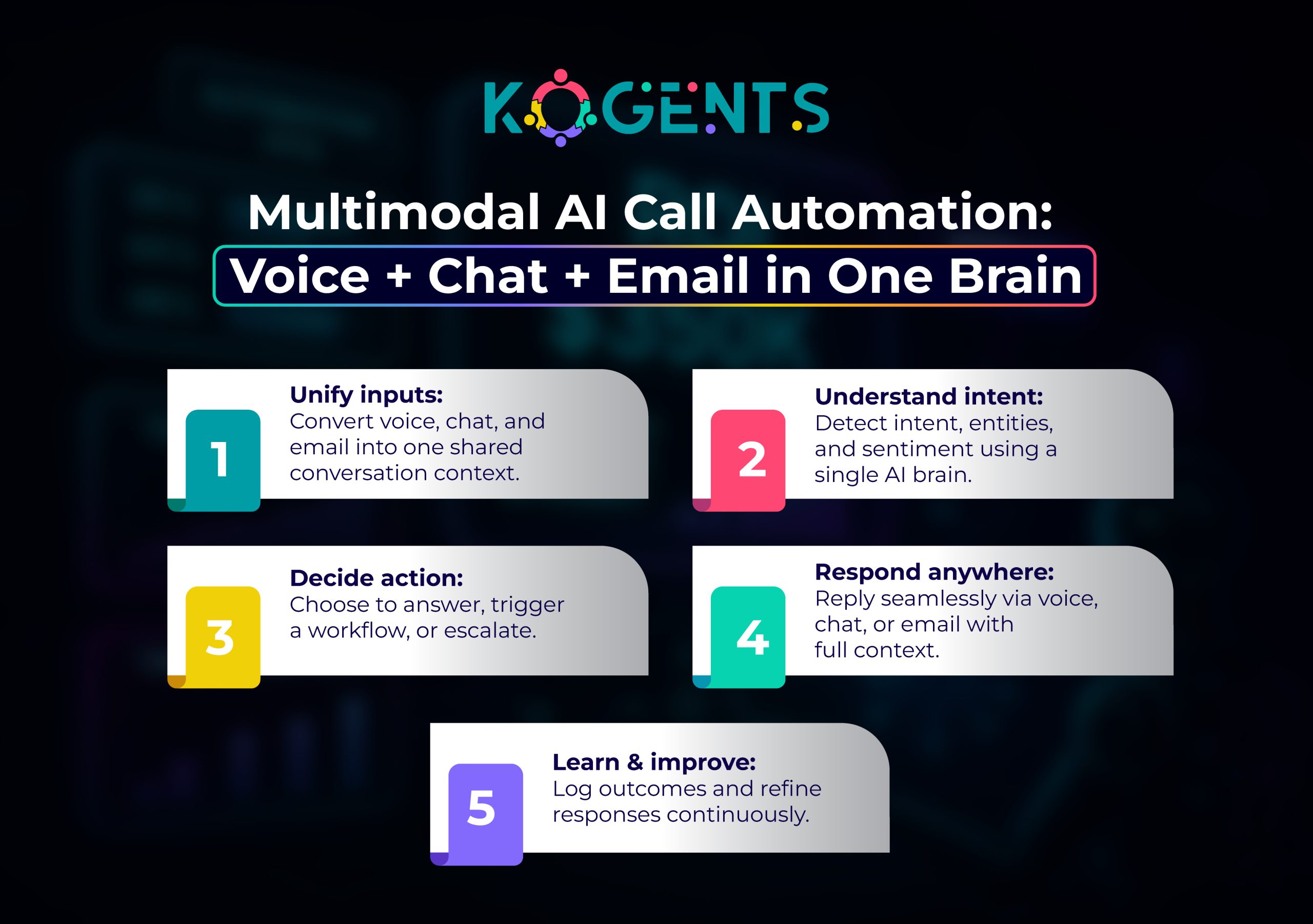
Enterprise call center automation platforms integrate with existing infrastructure, providing omnichannel communication across voice, chat, email, and messaging channels with unified sentiment analysis and real-time transcription.
Case Studies: Proven Success in AI Call Automation
Case Study 1: Nationwide Insurance – Transforming Customer Service
Challenge: Nationwide faced overwhelming call volumes during peak periods, with average wait times exceeding 12 minutes and agent attrition rates approaching 40%.
Solution: Implemented Google Dialogflow-powered voice automation for policy inquiries, claims status checks, and payment processing.
Results:
- 65% reduction in routine inquiry calls reaching human agents
- 42% improvement in customer satisfaction scores
- 50% decrease in agent turnover within the first year
- $8.2 million annual cost savings from improved operational efficiency
Case Study 2: American Express – Premium Customer Experience
Challenge: Maintaining white-glove service standards while managing millions of global cardmember inquiries across time zones and languages.
Solution: Implemented IBM Watson Assistant with advanced natural language understanding for account services, transaction disputes, and reward program management.
Results:
- 53% of customer inquiries resolved by AI without agent involvement
- 37% improvement in average handle time for complex cases (AI provides context to agents)
- 92% accuracy rate in intent detection across five languages
- CSAT scores increased from 78% to 88% post-implementation
Pro Tip: Start with high-volume, low-complexity interactions. Domino’s didn’t begin with custom gourmet orders; they started with standard menu items. Build confidence before tackling edge cases.
The Comprehensive Benefits of AI Call Automation
For Your Team: Reclaiming Human Potential
- Elimination of Repetitive Task Fatigue: AI handles the mundane. Agents focus on complex problem-solving, relationship building, and high-value interactions.
- Workload Normalization: No more overwhelming peak periods. AI scales instantly during volume surges.
- Career Development Opportunities: Agents transition from order-takers to consultants, specialists, and trainers.
- Improved Work-Life Balance: AI handles after-hours calls, enabling better scheduling flexibility.
- Enhanced Job Satisfaction: When agents handle only meaningful interactions, engagement and morale improve dramatically.
For Your Customers: Instant, Accurate, Available
- Zero Wait Times: AI answers immediately, 24/7/365, across all time zones.
- Consistent Quality: Every customer receives accurate information regardless of time, agent mood, or experience level.
- Personalized Interactions: AI recognizes returning customers, references previous interactions, and tailors responses.
- Multilingual Support: Modern AI systems handle 50+ languages without requiring multilingual agents.
- Seamless Channel Transitions: Conversations flow naturally between phone, chat, and email with full context preservation.
For Your Business: Scalable, Cost-Effective Growth
- Linear Cost Scaling: Handle 10,000 or 100,000 calls with marginal cost increases instead of proportional hiring.
- Reduced Operational Expenses: Average 40-60% cost reduction versus traditional staffing models.
- Data-Driven Insights: Comprehensive call analytics, sentiment analysis, and trend identification.
- Competitive Differentiation: Superior customer experience becomes a market advantage.
- Faster Time-to-Market: Deploy new services and support capabilities in weeks, not months.
Implementing AI Call Automation: A Practical Roadmap
Success requires strategic planning, not just technology deployment. Here’s a proven framework:
Phase 1: Assessment & Strategy (Weeks 1-3)
- Analyze Current Call Patterns: Identify high-volume, low-complexity interactions. Use call recording analysis to categorize inquiries.
- Define Success Metrics: Establish baselines for call volume, AHT, CSAT, FCR, and agent attrition.
- Select Priority Use Cases: Start with 2-3 high-impact scenarios representing 30-40% of total volume.
- Evaluate Technology Platforms: Consider Google Dialogflow, Amazon Connect, Microsoft Azure Cognitive Services, or specialized providers.
Phase 2: Pilot Implementation (Weeks 4-8)
- Build Initial Conversation Flows: Design dialogue scripts based on actual customer interactions, not assumptions.
- Integrate with Existing Systems: Connect to CRM, knowledge bases, and telephony infrastructure.
- Conduct Internal Testing: Have agents and managers test extensively, refining based on feedback.
- Deploy Limited Pilot: Route 10-20% of target calls to AI, monitor performance, and iterate rapidly.
Phase 3: Optimization & Scaling (Weeks 9-16)
- Analyze Performance Data: Review call analytics, identify failure points, and adjust dialogue flows.
- Expand Use Cases: Add complexity gradually, appointment scheduling, order modifications, and billing inquiries.
- Train Human Agents: Reposition agents as specialists handling escalated cases and complex scenarios.
- Scale to Full Production: Route the majority of targeted call types to AI with seamless fallback to humans.
Phase 4: Continuous Improvement (Ongoing)
- Monitor Key Performance Indicators: Track automation rate, containment rate, customer satisfaction, and agent sentiment.
- Leverage Machine Learning: Allow AI to learn from escalations and improve intent recognition automatically.
- Expand Language & Channel Support: Add languages and extend to SMS, chat, and email channels.
- Invest in Agent Development: Upskill freed capacity into revenue-generating roles like consultative sales.
Critical Reminder: AI call automation is not ‘set it and forget it.’ Successful implementations require ongoing optimization, agent collaboration, and leadership commitment to continuous improvement.
The Future of Customer Service Is Here, and It’s Smarter!
AI call automation is the biggest operational leap in customer service since the telephone itself.
Companies adopting AI voice agents are seeing massive reductions in routine workload, huge higher customer satisfaction, significant lower agent turnover, and loaded cost savings, without sacrificing service quality.
At Kogents.ai, we don’t deploy basic automation; we build agentic AI systems that think, reason, and act autonomously.
- Intelligent, context-aware decision-making
- Multi-step reasoning for complex workflows
- Continuous learning powered by LLMs
- Seamless CRM, ERP, and telephony integration
- Enterprise-grade security and compliance
Our proven methodology delivers measurable ROI in as little as six months.
The question isn’t whether to adopt AI call automation, it’s how fast you can act.
Schedule your free AI Readiness Assessment with us today and transform your contact center before your competitors do.
FAQs
What is AI call automation?
AI call automation is the use of artificial intelligence, conversational AI, and natural language processing to handle phone calls without human intervention. Unlike traditional IVR systems that force callers through rigid menus, AI voice agents understand natural speech, detect intent, and conduct contextual conversations. These systems integrate speech recognition, dialogue management, and text-to-speech technologies to deliver human-like interactions at scale.
How does AI call automation work?
AI calling systems combine multiple technologies: Automatic Speech Recognition (ASR) converts spoken words to text; Natural Language Understanding (NLU) determines caller intent and extracts key information; Dialogue Management maintains conversation context and determines appropriate responses; Text-to-Speech (TTS) generates natural voice responses. The system accesses knowledge bases and backend systems to retrieve information, execute actions, and seamlessly escalate to human agents when necessary. Machine learning continuously improves performance based on interaction outcomes.
What are the benefits of AI call automation?
Organizations implementing AI-powered call automation experience: 60-80% reduction in routine call volume for human agents, eliminating burnout; 24/7 availability with zero wait times; 40-60% operational cost savings; 30-40% improvement in customer satisfaction; 50% decrease in agent turnover; consistent service quality across all interactions; instant scalability during volume surges; comprehensive call analytics and insights; multilingual support without additional staffing; and freed agent capacity for high-value, relationship-building interactions.
Is AI call automation expensive to implement?
Initial implementation costs vary based on complexity and scale, typically ranging from $50,000-$250,000 for mid-sized deployments. However, research shows an average ROI of 320% over three years with 6-9 month payback periods. Ongoing costs include cloud telephony usage fees, maintenance, and optimization, typically 70-80% less than equivalent human agent costs. Most providers offer SaaS platforms with flexible pricing models, reducing upfront capital requirements. The true question isn’t cost, it’s the cost of not implementing as competitors gain advantages.
Will AI replace my customer service agents?
No, AI augments, not replaces. Successful implementations reposition agents from repetitive order-takers to specialized consultants and problem-solvers. AI voice agents excel at high-volume, routine interactions but lack human empathy, creativity, and complex reasoning. Organizations typically maintain or even increase human headcount while dramatically improving agent satisfaction and customer experience. Agents handle escalations, complex sales, relationship management, and situations requiring judgment. This hybrid model delivers superior outcomes for all stakeholders.
What types of calls can AI handle?
AI-powered call automation excels at: FAQs and informational queries; account status and order tracking; appointment scheduling and reminders; payment processing and billing inquiries; lead qualification and initial screening; password resets and basic troubleshooting; routing to appropriate departments or specialists; collecting information for service requests; confirmation and verification calls; and simple transactions. AI struggles with: highly emotional situations requiring empathy; complex negotiations; novel problems without precedent; situations requiring nuanced judgment; and interactions demanding creativity or strategic thinking.
What happens when AI can’t handle a call?
Sophisticated AI calling systems use intelligent call routing with confidence thresholds. When the system detects low confidence in understanding intent, repeated clarification attempts, customer frustration (via sentiment analysis), or requests for human assistance, it seamlessly transfers to appropriate agents with full context. The agent receives the conversation transcript, identified intent, customer information, and interaction history. This warm handoff ensures customers never repeat information and agents have everything needed for immediate resolution. Advanced systems also flag patterns requiring conversation flow improvements.
Can AI call automation handle multiple languages?
Modern conversational AI platforms support 50+ languages through advanced natural language processing. Leading platforms like Google Dialogflow, Microsoft Azure, and Amazon Connect offer multilingual capabilities with automatic language detection. Organizations can deploy single systems serving global markets without hiring multilingual agents. Quality varies by language—major languages like Spanish, French, German, and Mandarin achieve near-native fluency, while less common languages may require additional training. This capability enables 24/7 global support without geographic constraints or timezone limitations.
How do I measure the success of AI call automation?
Comprehensive measurement requires tracking: Automation Rate (% of calls handled without human intervention); Containment Rate (% of automated calls fully resolved); Customer Satisfaction (CSAT) for AI interactions; First Call Resolution (FCR) improvements; Average Handle Time (AHT) for agent-handled calls; Agent attrition and satisfaction scores; Cost per interaction reduction; Revenue impact from improved capacity; intent recognition accuracy; and escalation patterns identifying improvement opportunities. Leading organizations establish baselines before implementation, track metrics weekly during rollout, and review quarterly for strategic optimization.