The billion-dollar question your business can’t afford to ignore is this: that every second your customer waits for a response, your revenue bleeds.
Yet, the average business response time hovers around 12 hours, creating a chasm where potential revenue is lost to competitors.
Consider this: A 1-second delay (or 3 seconds of waiting) decreases customer satisfaction.
For a mid-sized enterprise processing 10,000 customer interactions monthly, this translates to approximately $180,000 in lost annual revenue.
CEOs, CIOs, Customer Experience Directors, and Revenue Leaders understand that in today’s hyper-connected marketplace, speed isn’t just a convenience metric; it’s a revenue multiplier. Your customers demand instantaneous engagement.
When your systems lag, your competitors win.
AI to improve response time isn’t just about answering faster; it’s about transforming latency reduction into a strategic asset that fundamentally restructures how your organization captures, converts, and retains revenue.
Fail to deliver, and will abandon your brand after just one bad experience.
For a company generating $50 million annually, this represents potential losses exceeding $16 million.
Key Takeaways
- Responding within 60 seconds increases lead conversion rates by 391% compared to responses after 5 minutes, directly impacting revenue generation.
- Slow response times create compounding negative effects through poor reviews, reduced customer lifetime value, and increased churn rates that cost businesses annual revenue.
- AI to handle slow replies reduces through latency from hours to milliseconds while improving accuracy, eliminating the traditional trade-off between speed and quality.
- Delayed responses affect every revenue touchpoint, from sales qualification (7x conversion difference) to customer support to upsell opportunities.
- Organizations implementing AI response time optimization report average payback periods of 3-6 months with documented revenue increases within the first year.
The Hidden Revenue Drains: Quantifying What Slow Responses Actually Cost
The Immediate Conversion Hemorrhage
Every industry has a “golden response window”, the timeframe where conversion probability peaks.
For B2B SaaS, it’s under 5 minutes.
For e-commerce, it’s under 90 seconds. Missing this window doesn’t just reduce conversion; it cuts it exponentially.
MIT Sloan Management Review reveals that lead response time is the single most important factor in lead conversion. InsideSales.com data shows the stark reality:
- Within 1 minute: 391% higher qualification rate
- Within 5 minutes: 100% baseline rate
- Within 10 minutes: 62% qualification rate
- After 30 minutes: 21% qualification rate
For a B2B organization generating 1,000 qualified leads monthly with an average customer lifetime value of $15,000, improving response time from 30 minutes to under 5 minutes translates to $10.8 million in additional annual revenue.
The Compounding Customer Lifetime Value Erosion
First impressions set lifetime expectations.
A slow first response doesn’t just risk losing one transaction; it establishes a precedent that affects every future interaction, reducing customer lifetime value.
Response speed directly impacts retention through multiple mechanisms.
In another research, we found that customers would consider switching companies after just one instance of poor service, with “slow response time” cited as a top-three frustration.
The Competitive Displacement Factor
Markets don’t wait for slow responders.
According to SuperOffice, 80% of customers research competitors after experiencing slow service.
In financial services, research shows that more than half % of consumers considering new banking relationships expect responses within 24 hours.
Banks need an AI reply generator while responding within this window to capture a massive number of new account openings, while slower responders capture only a few.
The predictive routing and real-time decision-making capabilities of AI-driven orchestration ensure organizations never cede competitive ground due to response delays.
Why Traditional Solutions Fail?
The Linear Scaling Trap
Adding more support staff creates a linear cost-to-capacity relationship that never achieves meaningful ROI:
- Each additional agent adds $45,000-$75,000 annual cost
- Training costs average $1,200 per agent with 90-day ramp periods
- Quality consistency degrades with team size
- Seasonal demand creates persistent staffing imbalances
The Template Trap
Pre-written templates reduce response latency superficially but create new problems:
- 71% of customers report frustration with “robotic” template responses (HubSpot)
- Template mismatches require follow-ups, increasing total resolution time by 43%
- Personalization gaps reduce conversion rates by 26%
Note: Templates optimize the wrong metric; they reduce time to first response while increasing time to resolution.
How AI to Improve Response Time Transforms Revenue Generation
Modern artificial intelligence response optimization fundamentally differs from previous automation attempts.
AI-powered real-time response systems augment human capability with machine learning that understands context, predicts intent, and delivers personalized responses at scale.
Real-Time Inference: From Hours to Milliseconds
Deep learning models powered by GPU acceleration and model compression now process customer inquiries in 50-200 milliseconds.
This enables:
Instant Intent Detection: NLP algorithms analyze inquiry sentiment, urgency, topic, and customer history simultaneously, routing to optimal resources.
Contextual Response Generation: Modern AI systems generate contextually appropriate responses incorporating customer history, product knowledge, and brand voice guidelines.
Continuous Learning: Every interaction trains the model, improving accuracy over time without manual intervention.
Intercom deployed conversational AI with real-time inference capabilities and reported:
- 44% reduction in average response time (8.3 hours to 4.6 hours)
- 29% increase in first-contact resolution rates
- 67% reduction in support costs per ticket
- $4.2M additional annual revenue attributed to improved conversion rates
Key Insight: The value isn’t just speed, it’s intelligent speed.
Predictive Response: Solving Problems Before They’re Asked
Advanced predictive analytics: enable AI systems to anticipate customer needs based on behavioral patterns, product usage data, and historical interactions:
Behavioral Trigger Recognition: AI identifies patterns indicating impending customer issues and initiates support before explicit requests.
Sentiment-Adaptive Communication: It adjusts tone, urgency, and escalation protocols based on emotional state.
Adobe implemented AI-assisted diagnostics with predictive capabilities across its creative cloud support infrastructure:
- 38% reduction in total support tickets through proactive intervention
- 52% improvement in customer satisfaction scores
- 71% reduction in escalations to senior support staff
- $8.7M annual savings with simultaneous quality improvements
Intelligent Workload Distribution
AI-driven orchestration implements intelligent process automation considering:
- Agent expertise mapping: Matching inquiry complexity with agent capabilities
- Real-time capacity monitoring: Balancing workload dynamically
- Customer value prioritization: Routing high-value customers to senior resources
- Resolution probability scoring: Assigning cases to agents most likely to achieve first-contact resolution
Load balancing algorithms ensure no agent becomes overwhelmed while others remain underutilized, maximizing system throughput without additional headcount.
Pro Tip: The best AI routing systems learn from outcomes. When specific agents consistently resolve certain issues faster, the system progressively assigns more similar cases while providing others additional training resources.
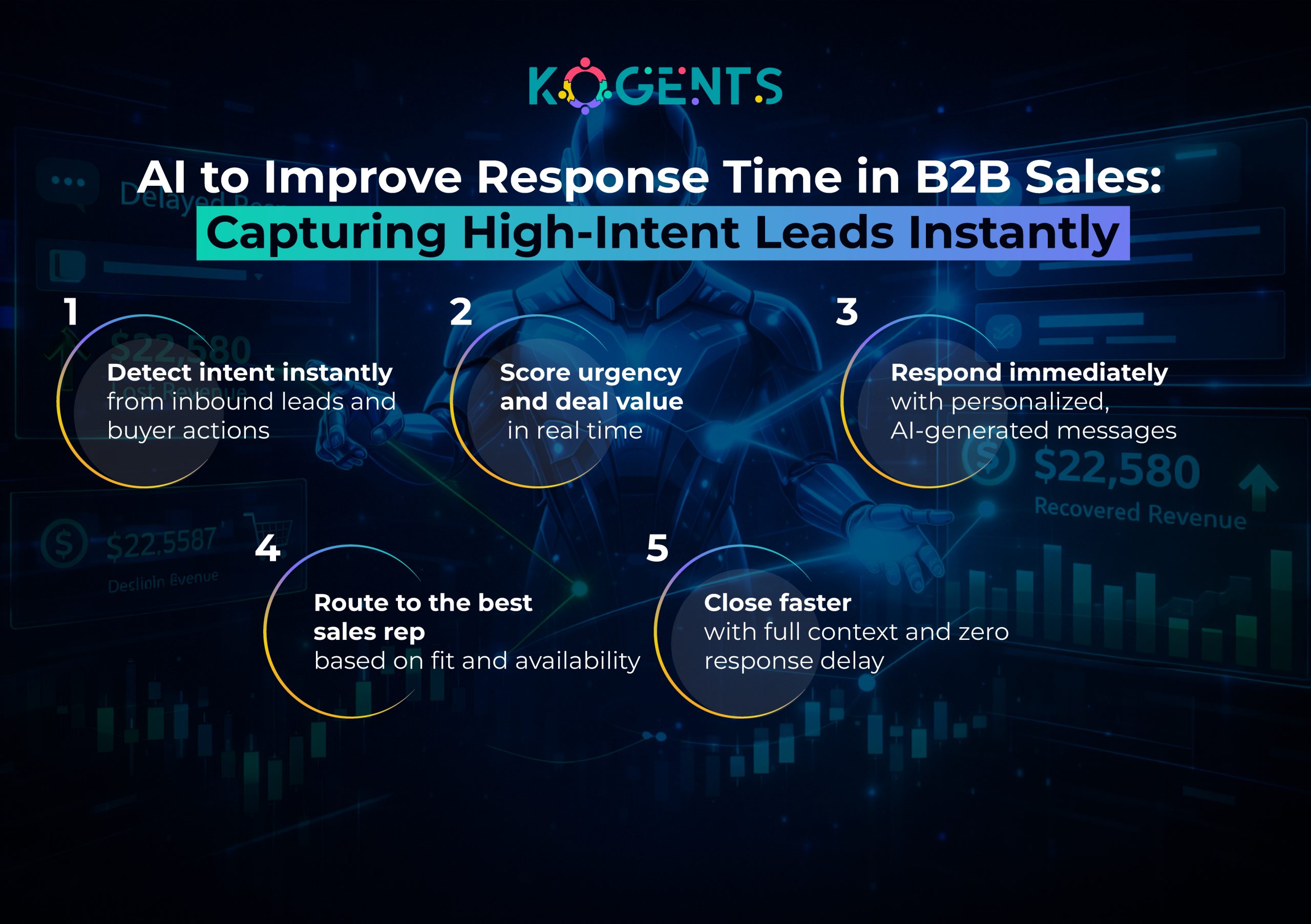
Table: The Revenue Impact Matrix of Response Time Delays
| Response Time Window | Lead Conversion Rate | Customer Satisfaction | Revenue Retention | Annual Cost Impact (per $10M revenue) |
| Under 1 minute | 391% higher baseline | 95-98% | 92-95% | Baseline (optimal) |
| 1-5 minutes | 100% (baseline) | 85-90% | 85-88% | -$250,000 |
| 5-10 minutes | 62% of baseline | 75-82% | 78-82% | -$580,000 |
| 10-30 minutes | 36% of baseline | 65-72% | 68-74% | -$1,200,000 |
| 1+ hours | 14% of baseline | 45-58% | 48-58% | -$2,400,000+ |
High-End Case Studies: Real-World Revenue Transformation
Case Study 1: Sephora – Beauty Retail AI Transformation
Challenge: Sephora, the global beauty retailer with 2,600+ stores and a massive e-commerce presence, faced declining conversion rates due to complex product consultation needs and response delays averaging 8+ hours for beauty advice inquiries.
AI Implementation: Deployed Sephora Virtual Artist and conversational AI chatbot, integrating real-time inference, computer vision, and NLP for instant product recommendations and beauty consultations.
Results:
- Response time reduced from 8+ hours to under 30 seconds
- 11% increase in conversion rate for chatbot users
- Virtual Artist drove an 8.5x increase in product trial rates
- 60% of users who tried virtual features returned to make purchases
Case Study 2: Domino’s Pizza – DOM AI Ordering Revolution
Challenge: Domino’s Pizza recognized that order friction and slow responses during peak hours were costing millions in abandoned carts and customer frustration, with phone wait times exceeding 10 minutes during dinner rushes.
AI Implementation: Introduced DOM, an AI-powered ordering assistant across web, mobile app, SMS using an AI messenger bot, and voice platforms, using conversational AI, predictive routing, and real-time processing for instant order placement and tracking.
Results:
- Response time reduced from 10+ minutes to instant
- Over 65% of sales now through digital channels, driven by AI efficiency
- 25%+ increase in average order value through AI-powered upselling
- Customer retention improved by 30% for app users
- Digital sales surpassed $7.5 billion annually
The ROI Calculation
Example: Mid-market B2B SaaS Company
- 5,000 monthly inbound leads
- Current conversion rate: 3.5%
- AI-improved conversion rate: 8.2%
- Average customer value: $45,000 annually
- Implementation cost: $380,000 (year one)
Calculation:
- Additional conversions: 235 customers monthly
- Annual new customer revenue: $126.9M
Net ROI: 34,316% first-year return
Even with conservative assumptions (half the conversion improvement), ROI exceeds 4,000% annually.
Financial Reality Check: Most organizations achieve full payback within 3-8 months, with 300-800% ROI in year one.
Transforming Response Speed from Cost Center to Revenue Engine!
AI to improve response time fundamentally restructures this equation by eliminating traditional trade-offs between speed, accuracy, personalization, and cost.
Organizations achieving revenue increases recognized that response latency directly impacts every revenue-generating activity.
They deployed artificial intelligence response optimization not as a technology initiative, but as a revenue strategy.
Your competitors are already deploying these capabilities, capturing customers you’re losing to slow replies.
The question isn’t whether to implement AI-driven response acceleration; it’s how quickly you can close this gap and reclaim millions in hidden revenue.
Our platform deploys intelligent AI agents that learn from every interaction, make real-time contextual decisions, orchestrate workflows across your tech stack, proactively prevent issues, and scale instantly without sacrificing speed or accuracy.
What sets us apart is our proprietary multi-agent architecture, revenue-first design approach, and industry-specific intelligence, projecting rapid deployment and continuous autonomous improvement.
Organizations partnering with Kogents achieve an average revenue increase within 12 months, response time reductions from hours to seconds, and gains in customer satisfaction.
Ready to stop losing revenue to slow responses?
Schedule your personalized AI revenue impact assessment → Contact Kogents.ai.
FAQs
How does AI improve response time in customer support?
AI improves response time through real-time inference that processes inquiries in milliseconds, automated ticket routing that instantly directs inquiries to optimal resources, and predictive routing that anticipates customer needs. Modern AI-powered chatbots combine natural language processing with machine learning to understand context, sentiment, and intent simultaneously, generating accurate responses. AI systems handle unlimited concurrent conversations, never experience fatigue, and continuously learn from every interaction.
What is AI response time optimization?
AI response time optimization is the strategic application of artificial intelligence and automation to minimize response latency while maintaining response quality. It encompasses inference optimization (accelerating AI processing), system throughput improvements, load balancing, predictive analytics, and intelligent orchestration. Unlike simple automation, it uses deep learning and NLP to understand context and generate appropriate responses dynamically, transforming response speed into a competitive advantage that drives measurable revenue growth.
How does AI reduce latency in systems?
AI reduces latency through model compression (reducing AI model size without sacrificing accuracy), GPU acceleration (parallelizing computations), edge AI (processing locally rather than requiring server communication), caching mechanisms (storing frequent responses), and asynchronous processing (handling multiple requests simultaneously). Modern low-latency models process complex language understanding in 50-200 milliseconds, a 1,000x improvement over earlier systems.
What are the best AI tools to improve response time?
Leading solutions include Intercom for conversational AI, Zendesk Answer Bot for support automation, Ada for enterprise-scale chatbot deployment, IBM Watson Assistant for complex conversations, and Google Dialogflow for custom experiences. For agentic AI capabilities, autonomous systems that learn and optimize independently, Kogents provides specialized multi-agent architectures for revenue-critical response optimization. Prioritize platforms offering industry-specific models, comprehensive integrations, continuous learning, and clear ROI measurement.
How does AI response time optimization impact sales conversion rates?
Harvard Business Review found that responding within 5 minutes (versus 30 minutes) increases qualification rates by 21x. AI systems routinely achieve sub-minute response times. Real-time decision making ensures high-value prospects receive immediate attention. Predictive analytics identify buying signals, triggering proactive engagement. InsideSales.com research shows leads contacted within 1 minute convert 391% more often than those contacted after 5 minutes. AI eliminates conversion killers like after-hours delays and information gaps.
What industries benefit most from AI-powered response time improvements?
E-commerce, financial services (regulatory inquiries and fraud alerts require instant responses), healthcare (clinical decision support systems save lives through faster triage), B2B SaaS (lead response time correlates with deal size), travel and hospitality (most of the travelers switch after slow responses), and insurance (claims processing speed impacts retention). Industries where purchasing decisions are time-sensitive and customer experience impacts both acquisition and retention benefit most.
How can small businesses implement AI response optimization cost-effectively?
Start with AI chatbots for FAQs using affordable platforms like ManyChat ($15-50/month), Tidio ($18-394/month), or Chatfuel ($15-300/month). Implement automated ticket routing using existing help desk features. Leverage free AI tools to draft response templates that human agents personalize. Focus on 1-2 channels initially. Many platforms offer freemium models or SMB pricing. Start with routine, high-volume inquiries where AI delivers immediate ROI, then expand as revenue impact funds broader implementation. Basic AI typically pays for itself within 3-6 months.
What is the difference between AI chatbots and AI response optimization?
AI chatbots are conversational interfaces handling routine inquiries, the visible, customer-facing element. AI response optimization encompasses the entire ecosystem, minimizing response latency across all channels: backend intelligent process automation, predictive routing algorithms, sentiment analysis systems, machine learning models improving accuracy, load balancing infrastructure, and AI-driven orchestration coordinating multiple systems.