Imagine a scenario: A potential customer visits your website at 11 PM on a Saturday, credit card in hand, ready to solve their problem.
They have a simple question about your product.
They wait.
Five minutes pass.
Ten minutes.
They leave and take their business to your competitor, who responded in 30 seconds.
This scenario costs businesses billions annually.
Every second of delay represents lost revenue, diminished customer trust, and opportunities handed directly to competitors who understand that customer engagement automation begins with instantaneous response.
With the realm of AI chatbots for lead generation, the technology is revolutionizing how businesses capture, qualify, and convert prospects across every touchpoint of the customer journey.
These conversational AI solutions don’t sleep, don’t take breaks, and don’t let a single opportunity slip through the cracks.
They’re transforming response times from hours to milliseconds, and in doing so, they’re reshaping revenue generation itself.
But this isn’t just about technology, it’s about understanding the psychology of modern buyers, the economics of attention, and the strategic imperative of meeting customers exactly where they are, exactly when they need you.
So, are you ready to discover how seconds are converted into dollars?
Let’s explore how faster responses create measurable revenue impact across every stage of your customer journey, and why businesses that master this principle will dominate their markets in the decade ahead.
Key Takeaways
Businesses responding within 1 minute see 391% higher conversion rates compared to 5-minute response times, directly correlating speed with revenue generation.
Most buyers choose vendors based on response availability, meaning round-the-clock AI-powered customer interaction captures leads competitors miss.
AI lead response automation, qualifies prospects instantly, reducing sales cycle length by 30-50% and allowing sales teams to focus on high-value opportunities.
Most customers expect immediate responses to marketing questions, and conversational marketing that combines speed with personalization increases customer lifetime value.
Companies implementing chatbot lead generation software report more than half then lower customer acquisition costs through improved conversion efficiency and automated lead qualification.
The Revenue Psychology of Speed: Why Seconds Matter?
The Neuroscience of Waiting
Human psychology has fundamentally shifted in the digital age.
This neurological reality has profound implications for revenue generation.
When a potential customer initiates contact, their intent detection is at its peak.
They’re experiencing what behavioral economists call “hot state” decision-making, emotions are elevated, problem awareness is acute, and willingness to act is maximized.
Every second of delay allows that hot state to cool, doubt to creep in, and competitive alternatives to gain consideration.
Pro Tip: The first 60 seconds after a prospect shows interest are your highest-conversion window; every system should be optimized to act within that minute.
The Economic Reality of Response Time
Let’s translate this to hard numbers: If your average customer value is $10,000 and you receive 1,000 leads monthly:
- 1-minute response: 391% higher qualification = ~195 qualified leads
- 5-minute response: Baseline = ~50 qualified leads
- 47-hour response (industry average): <5 qualified leads
Key Note: The revenue differential? Over $1.9 million in potential monthly revenue was lost to response delays alone.
The Competitive Landscape Shift
This creates a brutal competitive dynamic: whoever responds first, responds best, and responds consistently wins not just individual transactions but long-term customer relationships.
Conversational AI and AI chatbots for lead generation have become the equalizers, allowing businesses of any size to compete on response speed with enterprise-level efficiency.
Awareness & Discovery—Capturing Attention Instantly
The Critical First Impression
The awareness stage represents your first opportunity to demonstrate value.
Prospective customers are researching solutions, consuming content, and evaluating options.
Website chatbot for lead generation solutions deployed at this stage serves multiple revenue-accelerating functions:
Immediate Engagement: When visitors land on your site, conversational UX immediately offers assistance, reducing bounce rates according to benchmarking data.
Intent Classification: Natural language processing algorithms analyze visitor queries to determine user intent, whether they’re researchers, evaluators, or ready buyers, enabling intelligent routing to appropriate resources.
24/7 Availability: McKinsey research shows that website traffic occurs outside traditional business hours. AI-powered customer interaction captures these after-hours opportunities that human teams miss.
Data Collection & Qualification Begins
Early-stage real-time lead capture through chatbot form alternatives has revolutionized how businesses build their sales pipeline.
Rather than forcing visitors through friction-heavy forms, conversational flows gather information naturally:
- Engagement rates: 3-5x higher than traditional forms
- Completion rates: 60-80% versus 10-20% for static forms
- Data quality: Superior due to automated conversations that clarify responses
Quick Tip: Deploy an AI chatbot for lead generation on websites with industry-specific conversation flows.
Building Trust Through Responsiveness
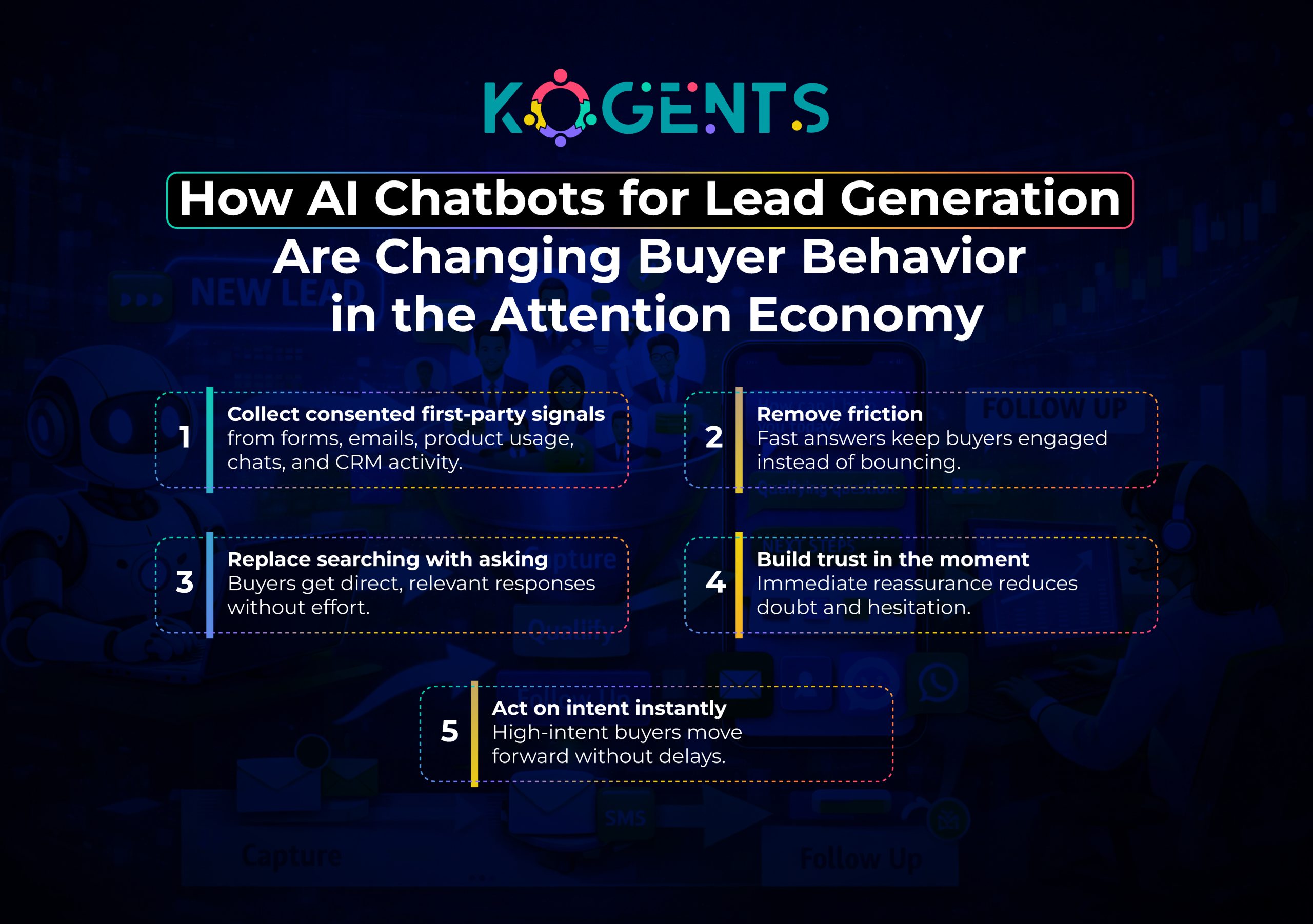
IBM Watson studies demonstrate that immediate acknowledgment, even without complete resolution, increases perceived trustworthiness.
This psychological principle, known as “recognition response,” forms the foundation of effective conversational marketing.
Lead generation chatbot solutions leverage this by:
- Instantly acknowledging every inquiry
- Setting clear expectations for next steps
- Providing valuable information immediately
- Capturing contact details for follow-up
Consideration & Evaluation—Accelerating Decision-Making
Reducing Research Friction
During consideration, prospects compare solutions, evaluate features, and justify decisions to stakeholders.
Google Cloud AI analysis reveals that B2B buyers consume an average of 13 pieces of content before engaging with sales.
The speed of access to relevant information directly impacts who makes the shortlist.
AI lead generation chatbots excel here by:
Intelligent Content Delivery: Machine learning chatbots analyze conversation context and automatically surface case studies, whitepapers, and comparison guides most relevant to specific data collection signals.
Real-Time Objection Handling: Intent detection algorithms identify hesitation patterns and proactively address concerns before they become deal-breakers.
Competitive Positioning: When prospects ask about alternatives, automated responses provide positioning that highlights differentiation without bashing competitors.
Automated Lead Qualification at Scale
Traditional lead qualification requires sales development representatives to spend hours on discovery calls. AI-powered lead scoring automates this through conversational flows that assess:
- Budget authority: Fiscal decision-making power
- Need urgency: Timeline for implementation
- Solution fit: Alignment between requirements and capabilities
- Company profile: Size, industry, and technical infrastructure
Important Note: Prospect qualification isn’t about eliminating leads, it’s about smart routing: high-intent prospects go straight to sales, while early-stage leads enter automated nurture flows.
Personalization Through Conversation History
CRM integration enables a chatbot marketing strategy that remembers every interaction. When prospects return, conversations resume contextually rather than starting from zero.
This engagement continuity creates the perception of attentive, personalized service at scale.
Strategic Insight: Implement conversational AI for lead capture with full CRM synchronization. Every chatbot interaction should update prospect records, triggering appropriate marketing automation workflows.
Purchase & Conversion—Eliminating Friction
Purchase decisions are fragile.
Conversational AI deployed at conversion stages reduces abandonment through:
Proactive Intervention: When engagement metrics indicate hesitation, the AI sales funnel automation optimization initiates supportive conversations.
Instant Question Resolution: Purchasing questions about contracts, implementation, or payment terms get immediate clarification, preventing the “I’ll come back later” (they won’t) scenario.
Simplified Transactions: For e-commerce, an AI chatbot for eCommerce lead capture can complete entire transactions conversationally, bypassing traditional checkout flows that contribute to abandonment.
Building Purchase Confidence
One research indicates that 72% of customers report purchasing anxiety, particularly for high-value or complex solutions. Speed of reassurance directly correlates with completion likelihood.
Chatbot-driven funnels address anxiety through:
- Social proof delivery: Automatically sharing relevant testimonials and case studies
- Risk reversal: Highlighting guarantees, trial periods, and cancellation policies
- Technical validation: Confirming compatibility and integration capabilities
- Implementation support: Outlining onboarding and success resources
Transaction Speed as Competitive Advantage
In B2B contexts, contract signing represents the traditional conversion bottleneck. DocuSign integration with AI chatbot SaaS for sales teams enables:
- Instant contract generation based on discussed terms
- Real-time negotiation and amendment
- Electronic signature capture within conversation flow
- Immediate post-signature onboarding initiation
Business Case: Every day a contract sits unsigned represents opportunity cost. Pipeline acceleration through conversational contract management can increase quarterly revenue by 5-8% without acquiring additional leads.
Onboarding & Activation—Ensuring Success
Customer acquisition costs are sunk at purchase; profitability depends on retention and expansion.
AI-powered customer interaction transforms onboarding through:
Proactive Guidance: Automated conversations guide new customers through setup steps, checking in at critical milestones rather than waiting for help requests.
Instant Troubleshooting: When customers encounter obstacles, natural language processing interprets issues and provides solutions immediately or escalates to human specialists with full context.
Activation Metrics & Revenue Correlation
OpenAI analysis reveals stra ong correlation between activation speed and lifetime value:
- Customers activating within 7 days: 2.5x higher LTV
- Customers activating within 30 days: 1.5x higher LTV
- Customers taking 60+ days: 40% higher churn risk
Conversational marketing during onboarding accelerates activation by maintaining engagement momentum from purchase. When customers have questions, instant answers prevent the disengagement that leads to delayed activation.
Building Product Champions
Successful onboarding creates advocates. Salesforce data shows that customers who experience excellent onboarding have 50% higher net promoter scores and generate 3x more referrals than those with poor experiences.
Customer engagement automation scales personalized onboarding that was previously impossible:
- Celebrating milestones: Automated recognition of achievements and progress
- Encouraging exploration: Suggesting advanced features based on usage patterns
- Community connection: Introducing customers to peers and resources
- Feedback collection: Gathering insights while enthusiasm is high
Retention & Growth—Building Loyalty
According to one study, acquiring new customers costs 5-25x more than retaining existing ones. Yet most businesses obsess over acquisition while neglecting retention infrastructure.
Slow responses to questions or issues communicate indifference louder than any marketing message.
Conversational AI creates retention advantages through automated responses and natural language processing chatbots.
Expansion Revenue Through Timely Engagement
Gartner analysis indicates that most of the expansion revenue opportunities are missed because customers don’t know additional capabilities exist, or don’t receive timely outreach when needs evolve.
AI lead generation chatbots repurposed for customer success identify expansion signals:
- Usage patterns indicating capacity constraints
- Questions about features in higher-tier plans
- Team growth sugsuggestsed for additional seats
- Integration inquiries signaling platform consolidation interest
When these signals emerge, intelligent routing connects customers with expansion specialists immediately, capturing opportunity while intent is fresh.
Creating Loyalty Through Consistent Speed
Customer lifetime value correlates strongly with support experience quality. But loyalty isn’t built through occasional heroic support efforts; it’s built through consistent, reliable responsiveness.
AI chatbots for lead generation principles apply equally to customer success:
- Immediate acknowledgment of every inquiry
- Intelligent triage to appropriate resources
- Proactive communication at every step
- Continuous availability across all channels
Strategic Table: Response Speed Impact Across Customer Journey Stages
| Customer Journey Stage | Response Delay Impact | AI Chatbot Solution | Revenue Improvement |
| Awareness & Discovery | 35-45% higher bounce rate; lost first impression | 24/7 instant engagement; intelligent content delivery | 40% higher lead volume; 50% better lead quality |
| Consideration & Evaluation | 10x lower qualification rates; competitor research advantage | Automated lead qualification; real-time objection handling | 30-50% shorter sales cycle; 25-35% higher win rate |
| Purchase & Conversion | 69.8% cart abandonment; last-minute friction | Proactive intervention; instant question resolution | 15-25% lower abandonment; 10-20% higher AOV |
| Onboarding & Activation | 23% onboarding churn; delayed time-to-value | Proactive guidance; instant troubleshooting | 30% faster activation; 35% higher satisfaction |
| Retention & Growth | 68% leave due to perceived indifference; missed expansion | Predictive support; timely expansion identification | 40% churn reduction; 40% higher expansion revenue |
Case Studies: Real-World Revenue Impact
Case Study 1: SaaS Company Transforms Lead Conversion
Company: CloudSync (B2B project management SaaS).
Challenge: 42-hour average response time, 8% lead-to-customer conversion.Solution: Implemented an AI chatbot for SaaS lead generation with automated lead qualification
Results (12-month period):
- Response time reduced from 42 hours to 90 seconds
- Lead-to-customer conversion increased from 8% to 31%
- Sales cycle shortened from 47 days to 28 days
- Customer acquisition cost decreased by 52%
- Annual recurring revenue increased $8.2 million
Case Study 2: E-Commerce Retailer Reduces Cart Abandonment
Company: TechGear Online (consumer electronics retailer).
Challenge: 74% cart abandonment rate, limited support during high-traffic periods.
Solution: AI chatbot for eCommerce lead capture with proactive checkout assistance.
Results (6-month period):
- Cart abandonment reduced from 74% to 51%
- Average order value increased 18% through contextual upselling
- Customer support tickets decreased 35%
- After-hours conversion rate improved 290%
- Incremental revenue attributed to chatbot: $3.7 million
Case Study 3: Real Estate Firm Captures Off-Hours Leads
Company: Premier Properties Group (commercial real estate)
Challenge: 67% of website traffic occurred outside business hours; most inquiries went unanswered
Solution: Lead generation chatbot for real estate with 24/7 availability
Results (9-month period):
- After-hours lead capture increased 412%
- Qualified appointment bookings increased 87%
- Sales team efficiency improved—60% more appointments with the same headcount
- Average days-to-close decreased from 93 to 71 days
- Revenue per agent increased $420,000 annually
Case Study 4: B2B Manufacturer Accelerates Pipeline
Company: IndustrialTech Solutions (manufacturing equipment supplier).
Challenge: Complex products requiring extensive pre-sale education; long sales cycles.
Solution: Chatbots for B2B lead generation with technical specification assistance.
Results (18-month period):
- Qualified lead volume increased 143%
- Average sales cycle reduced from 127 days to 89 days
- Win rate improved from 22% to 34%
- Pipeline value increased $47 million
- Sales team productivity increased 65%
Before you leave!
Speed is no longer a nice-to-have; it’s the difference between capturing revenue and quietly losing it to faster competitors.
Across every stage of the customer journey, from first touch to long-term retention, faster responses keep intent high, reduce friction, and build trust at scale.
This is why AI chatbots for lead generation have become a critical growth lever, not just a support tool.
Businesses that win today engage instantly, qualify intelligently, and respond without delay. If you’re ready to turn response time into measurable revenue growth, Kogents helps you do exactly that with intelligent, revenue-driven conversational AI.
Discover how Kogents.ai can help you capture more leads, convert faster, and grow smarter, starting today.
FAQs
What are AI chatbots for lead generation, and how do they work?
AI chatbots for lead generation are conversational AI systems that engage website visitors, qualify prospects, and capture contact information through automated conversations. They use natural language processing to understand user intent, machine learning to improve responses, and intelligent routing to connect qualified leads with sales teams. Unlike static forms, they create interactive experiences that gather information naturally while providing immediate value through instant answers to questions. These systems operate 24/7, ensuring no lead opportunity is missed regardless of when prospects visit your site.
How do AI chatbots improve lead generation compared to traditional methods?
Traditional methods like forms and email capture suffer from friction and delay. AI lead generation chatbots improve results through multiple mechanisms: (1) engagement rates 3-5x higher than static forms, (2) completion rates reaching 60-80% versus 10-20% for traditional forms, (3) 24/7 availability capturing after-hours leads comprising 40% of traffic, (4) automated lead qualification reducing sales team wasted effort, and (5) real-time lead capture that engages prospects during peak interest.
Are chatbots effective for lead generation across different industries?
Yes, conversational AI for lead capture proves effective across virtually all industries, though implementation varies. B2B businesses use chatbots for B2B lead generation to qualify complex enterprise sales prospects and schedule qualified appointments. E-commerce deploys an AI chatbot for eCommerce lead capture to reduce cart abandonment and guide product selection. Real estate leverages a lead generation chatbot for real estate for property matching and showing scheduling. SaaS companies use an AI chatbot for SaaS lead generation for trial signups and feature education. Success requires tailoring conversational flows to industry-specific buyer journeys and common questions.
Do AI chatbots integrate with existing CRM and marketing platforms?
Modern chatbot platforms offer extensive integration capabilities with leading business systems. CRM integrations with Salesforce, HubSpot, Microsoft Dynamics, and others enable bi-directional data flow—chatbot conversations update prospect records while accessing customer history for personalization. Marketing automation integrations trigger nurture sequences based on chatbot interactions. API integration connects payment processors, scheduling systems, support tickets, and proprietary databases. Leading solutions like Drift, Intercom, and enterprise platforms provide pre-built integrations plus custom API capabilities. Integration depth directly correlates with revenue impact, making CRM integration a critical success factor.
Can AI chatbots support multilingual lead generation?
Yes, advanced natural language processing enables multilingual conversational marketing. Leading platforms support 50+ languages with varying sophistication levels. Implementation approaches include: (1) separate conversational flows optimized per language, (2) automatic language detection triggering appropriate conversation paths, (3) machine learning chatbots trained on multilingual datasets, and (4) real-time translation for less common languages. Quality varies; high-resource languages (English, Spanish, Mandarin) perform better than low-resource options. For global businesses, multilingual capabilities capture international leads missed by English-only systems, significantly expanding addressable market and revenue opportunities.