The Cost of Silence Is Revenue! If you’re a sales leader, revenue head, marketing director, or founder, here’s a hard truth:
Every minute your lead waits, your conversion probability drops dramatically.
In a world of instant gratification, prospects don’t wait for callbacks, inbox replies, or “we’ll get back to you shortly” emails.
They expect real-time engagement, contextual answers, and intelligent follow-ups across messaging channels.
AI Lead Response Automation does the job less daunting for you!
By combining artificial intelligence, conversational AI, machine learning, and automation workflows, businesses can now capture, qualify, and follow up with inbound leads instantly, without burning out sales teams or sacrificing personalization.
This guide breaks down how AI-led response automation works, why it’s replacing manual processes, and how agentic AI platforms like Kogents deliver measurable revenue acceleration.
Key Takeaways
- Responding within 5 minutes makes leads 9x more likely to convert than waiting 30 minutes.
- AI-led response automation eliminates response latency across chat, SMS, email, and web forms.
- Agentic AI doesn’t just reply, it reasons, qualifies, and decides next actions autonomously.
- Businesses using AI-powered lead response systems report 30–50% higher pipeline velocity.
- Manual lead handling is no longer scalable, accurate, or cost-efficient in 2025.
What Is AI Lead Response Automation?
AI Lead Response Automation is the use of AI-driven systems to automatically:
- Respond to inbound leads in real time
- Qualify prospects using predictive logic
- Route leads to the right sales or support flows
- Execute automated follow-ups across messaging channels
- Hand off to human agents only when necessary
Unlike basic chatbots, modern systems rely on:
-
- Natural language processing (NLP)
- Machine learning models
- Conversational AI
- CRM automation engines
- Predictive response logic
- best AI chatbot for WhatsApp
- Instagram bot automation
This enables automated AI lead engagement that feels natural, personalized, and context-aware.
Why Manual Lead Response Is Broken?
Let’s be direct.
Manual lead response fails because of:
- Delayed response times
- Inconsistent messaging
- Human fatigue and errors
- Poor lead prioritization
- Missed after-hours inquiries
- Lack of follow-up discipline
InsideSales reports that 50% of buyers choose the vendor that responds first.
AI-lead response automation eliminates these structural failures by design.
How AI Lead Response Automation Works?
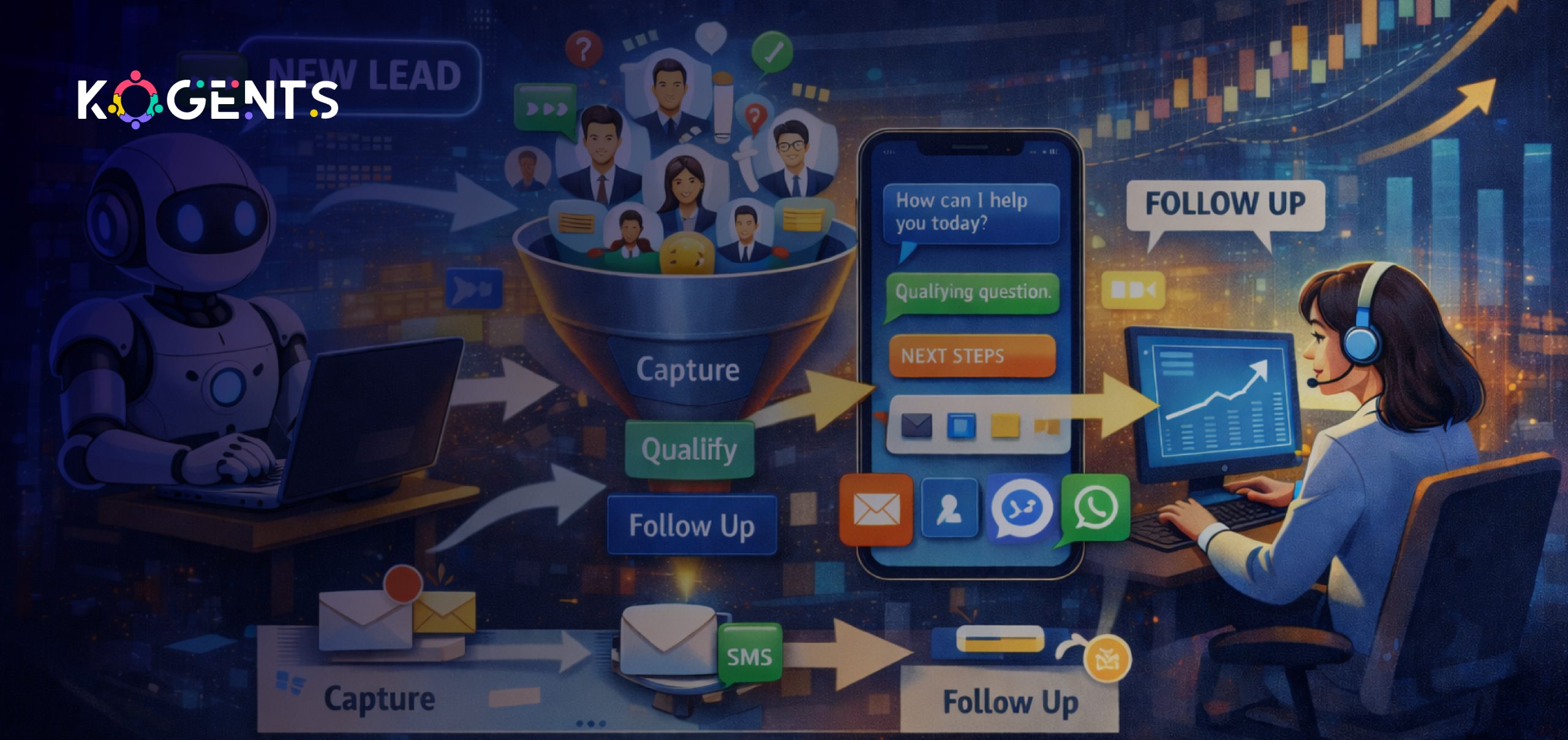
At its core, an AI-powered lead response system operates through an intelligent workflow:
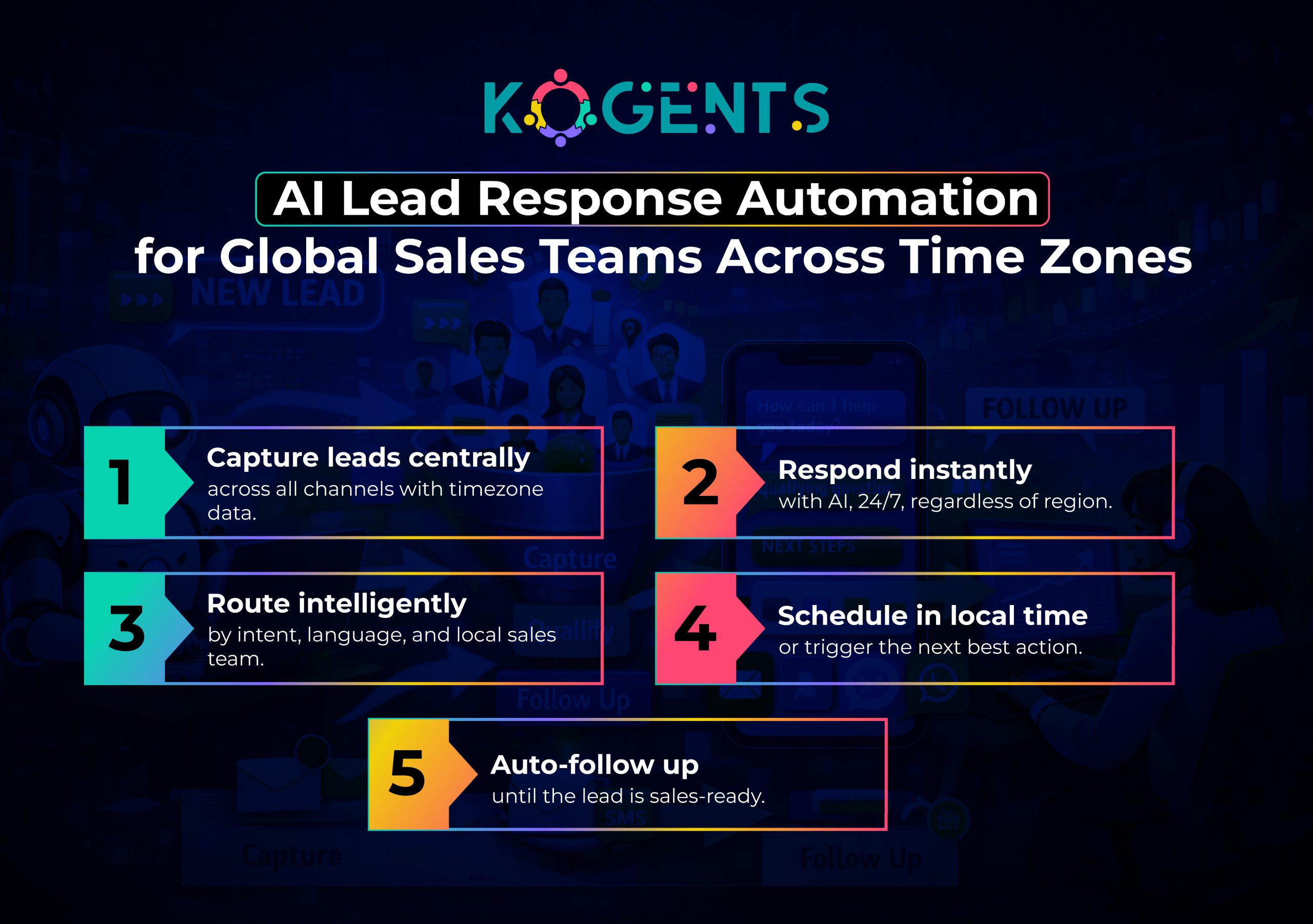
Step 1: Lead Capture (Omnichannel)
Leads enter through:
- Website forms
- Chatbots
- SMS
- Email inquiries
- Paid ads & landing pages
Step 2: Real-Time AI Response
Using conversational AI, the system:
- Understands intent
- Acknowledges the inquiry instantly
- Asks qualifying questions
- Projects AI to handle slow replies
It is a real-time AI-led response, not scripted replies.
Step 3: Lead Qualification & Scoring
AI evaluates:
- Buyer intent
- Industry relevance
- Budget signals
- Urgency
- Funnel stage
This replaces manual lead scoring with predictive intelligence.
Step 4: Automated Follow-Ups
Through AI lead follow-up automation, the system:
- Sends reminders
- Nurtures leads
- Schedules meetings
- Escalates hot prospects
Step 5: Smart Handoff to Humans
Only qualified, high-intent leads are routed to sales reps, reducing noise.
Messaging-First Lead Engagement Channels
Modern buyers live in messaging apps.
AI-driven lead communication works best across:
- Chatbots for leads
- SMS automation
- Email sequencing
- WhatsApp & social messaging
- Omnichannel lead response systems
| What You Should Know: If your AI can’t talk where your buyers live, it won’t convert. |
The Hidden Economics of Lead Response Time: Why Seconds Matter More Than Spend?
One of the most underestimated growth levers in modern revenue operations is lead response latency.
What AI Lead Response Automation changes fundamentally is not just speed, but probability economics.
Every delayed response causes:
- Drop in buyer intent
- Competitive leakage
- Funnel decay
- Lost pipeline velocity
By enabling instant lead response, AI systems shift the odds in your favor at the exact moment of intent.
Key Note: Conversion optimization is no longer a marketing tactic; it’s a response-time strategy.
AI Lead Qualification: From Static Rules to Predictive Intelligence
Traditional lead qualification relies on:
- Static rules
- Form fields
- Human intuition
AI-powered lead response systems replace this with predictive response logic.
How AI Qualifies Leads Intelligently
AI evaluates:
- Linguistic intent (via natural language processing – NLP)
- Behavioral signals
- Channel context
- Historical conversion patterns
- Funnel stage alignment
Instead of asking “Is this lead good?”, AI asks:
“What is the next best action for this lead right now?”
This enables:
- Smarter lead scoring
- Dynamic routing
- Context-aware engagement
- Reduced handoff friction
Key Reminder: AI doesn’t judge leads, it prioritizes outcomes.
AI Lead Follow-Up Automation: Where Most Revenue Is Won or Lost?
AI lead follow-up automation ensures:
- No lead is forgotten
- Follow-ups adapt to engagement signals
- Messaging stays personalized at scale
AI-Driven Follow-Up Capabilities
- Automated reminders via email & SMS
- Time-zone aware engagement
- Channel switching (email → SMS → chat)
- Intelligent stop conditions
- Sales-ready alerts
Pro-Tip: Persistence converts, but only when it’s intelligent, not intrusive.
Omnichannel AI Lead Response: Meeting Buyers Where They Are
Modern buyers don’t move linearly.
They bounce across:
- Websites
- Chat
- SMS
- CRM touchpoints
Omnichannel lead response automation ensures continuity.
AI maintains:
- Conversation memory
- Context awareness
- Unified customer journey view
This eliminates:
- Repetitive questions
- Disjointed handoffs
- Broken buyer experiences
Key Insight: Channel-agnostic AI beats channel-specific tools, every time.
AI Lead Response Automation + CRM Integration (The Revenue Spine)
Without CRM integration, automation becomes a silo.
Modern AI leads response automation platforms to integrate deeply with:
- HubSpot
- Salesforce
- Zoho CRM
- Microsoft Dynamics 365
What Deep CRM Integration Enables
- Real-time lead enrichment
- AI-driven workflow triggers
- Automated deal creation
- Sales pipeline updates
- Revenue attribution tracking
Key Note: CRM is the system of record, AI is the system of action.
Governance, Accuracy & Trust in AI Lead Response Systems
Enterprise adoption demands trust.
High-performing systems include:
- Human-in-the-loop escalation
- Confidence thresholds
- Audit logs
- Explainable AI decisions
This ensures:
- Automation accuracy
- Compliance readiness
- Ethical AI deployment
Soft Reminder: Responsible AI builds trust faster than aggressive automation.
Agentic AI: The Evolution Beyond Chatbots
Traditional automation reacts.
Agentic AI acts.
Agentic AI systems:
- Observe context
- Reason autonomously
- Decide next actions
- Execute workflows
- Learn from outcomes
This is what separates enterprise AI lead response automation from basic tools.
Agentic AI Capabilities in Lead Response
- Autonomous follow-up planning
- Contextual conversation memory
- Intelligent escalation
- CRM synchronization
- Self-optimizing workflows
Most Significant Table: Manual vs AI Lead Response Automation
| Key Area | Manual Lead Response | AI Lead Response Automation |
| Response Time | Minutes to hours | Instant (seconds) |
| Availability | Business hours only | 24/7 lead engagement |
| Lead Qualification | Subjective & inconsistent | AI-driven lead scoring |
| Follow-Ups | Often missed | Automated follow-ups using AI |
| Scalability | Limited by team size | Unlimited & elastic |
| Data Accuracy | Error-prone | High automation accuracy |
| Conversion Rate | Low to moderate | Significantly higher |
Industry-Specific Use Cases
AI Lead Response Automation for SaaS
- Trial sign-up qualification
- Demo scheduling
- Feature-based routing
AI Lead Response Automation for Real Estate
- Property inquiries
- Buyer intent scoring
- Agent routing
AI Lead Response Automation for Healthcare
- Appointment triage
- HIPAA-safe inquiry handling
- Care pathway routing
Enterprise & B2B Sales Teams
- Complex inbound lead management
- Multi-stakeholder qualification
- CRM-integrated automation
High-End Case Studies
Case Study 1: B2B SaaS Company (Mid-Market)
Challenge: Slow response times, overloaded SDRs, and poor demo conversion.
Solution: Implemented AI sales lead response automation with conversational qualification and automated scheduling.
Results:
- 42% increase in demo bookings
- 67% reduction in lead response time
- SDRs focused only on high-intent leads
Case Study 2: Enterprise Real Estate Platform
Challenge: High inquiry volume, low agent efficiency.
Solution: Deployed AI inbound lead automation across chat and SMS.
Results:
- 35% higher conversion rate
- 24/7 inquiry handling
- Faster agent response to qualified buyers
Case Study 3: Healthcare Provider Network
Challenge: Missed patient inquiries and long wait times.
Solution: Used AI customer inquiry automation with secure messaging workflows.
Results:
- 50% reduction in call center load
- Improved patient satisfaction
- Faster appointment scheduling
Key Benefits of AI Lead Response Automation
- Reduced lead response time with AI
- Higher pipeline velocity
- Improved customer engagement metrics
- Lower CAC
- Better sales productivity
- Predictable lead handling
Pro-tip: Speed + relevance beats volume, every time.
Implementation Best Practices
- Integrate with CRM systems (HubSpot, Salesforce, Zoho)
- Define qualification logic upfront
- Start with top-performing channels
- Monitor automation accuracy
- Use human-in-the-loop escalation
Soft Reminder: Automation should assist humans, not alienate customers.
Conclusion: Why Kogents Leads in Agentic AI!
Most platforms automate replies.
Kogents builds agentic AI systems that think, decide, and act.
With deep expertise in:
- Agentic AI orchestration
- AI-driven lead communication
- Enterprise-grade automation workflows
- CRM-native integrations
- Predictive response logic
Kogents.ai enables businesses to move beyond static chatbots into self-directed AI agents that own the entire lead response lifecycle.
FAQs
What is AI-led response automation, a nd why is it important?
AI Lead Response Automation is the use of artificial intelligence, machine learning, and conversational AI to instantly respond to inbound leads, qualify intent, and trigger follow-ups without human delay.
It is critical because speed directly impacts conversion optimization, pipeline velocity, and revenue growth.
How does AI automate lead responses in real time?
AI uses natural language processing (NLP) to understand inquiries, applies predictive response logic, and executes automation workflows across chat, email, and SMS—often within seconds of lead arrival.
How does AI reduce lead response time with accuracy?
Unlike humans, AI systems:
- Operate 24/7
- Respond instantly
- Never forget follow-ups
- Maintain consistent messaging
This eliminates response latency while preserving context and personalization.
What is the ROI of AI lead response automation?
Organizations typically see:
- 30–50% higher conversion rates
- Faster pipeline velocity
- Lower cost per acquisition (CPA)
- Improved customer engagement metrics
ROI compounds over time as AI learns from outcomes.
How does AI lead qualification differ from traditional lead scoring?
Traditional scoring uses fixed rules.
AI uses dynamic intent analysis, behavioral data, and historical patterns, resulting in more accurate prioritization and routing.
What industries benefit most from AI-led response automation?
High-impact industries include:
- SaaS
- B2B services
- Healthcare
- Real estate
- Financial services
- Enterprise sales organizations
Anywhere inbound leads matter, AI adds value.
Is AI-led response automation suitable for enterprise organizations?
Yes. Enterprise AI lead response automation supports:
- Multi-region deployments
- Complex CRM ecosystems
- Compliance requirements
- High lead volumes
- Advanced governance controls
Can AI automate lead follow-ups without hurting brand trust?
Yes, when designed correctly.
AI adapts tone, timing, and channel based on engagement signals, ensuring follow-ups feel helpful, not spammy.
How does agentic AI improve lead response outcomes?
Agentic AI goes beyond replies by:
- Deciding next best actions
- Managing workflows autonomously
- Escalating intelligently
- Learning from conversions
This creates self-optimizing lead engagement systems.
How long does it take to implement AI lead response automation?
Most deployments take 2–6 weeks, depending on:
- CRM complexity
- Channel coverage
- Qualification logic
- Custom workflows