That’s the power of AI-Driven Personalization, a transformation that turns passive customers into loyal fans.
In a world where customer experience optimization separates winners from merely surviving brands, personalization isn’t just nice to have; it’s expected.
And it’s powered by advanced machine learning personalization, AI recommendation systems, and how AI automates lead nurturing that make interactions feel intuitive and emotionally connected.
This blog uncovers exactly how AI-Driven Personalization improves Customer Satisfaction (CSAT) and boosts retention rates, backed by real statistics and robust case studies.
We’ll explore core mechanisms, implementation strategies, business impacts, and future trajectories.
Key Takeaways
- AI-Driven Personalization increases CSAT and customer loyalty through the best AI agents for customer support via tailor-made experiences that reflect user preferences and behavior.
- Companies implementing personalization see benchmark retention increases and conversion improvements.
- Technologies like real-time personalization engines and predictive personalization are essential for maximizing ROI.
- Top brands like Amazon, Netflix, Nike, and Starbucks demonstrate measurable gains in both satisfaction and customer lifetime value.
- Personalized experiences across omnichannel touchpoints (web, mobile, email, CRM) sustain growth and deepen loyalty.
What Is AI-Driven Personalization?
AI-Driven Personalization refers to systems that use data science, including machine learning, behavioral targeting with AI, and customer journey optimization, to tailor content, product recommendations, and experiences to each customer.
Unlike traditional segmentation, which groups customers into broad buckets, AI personalization algorithms analyze user signals in real time to deliver hyper-personalized technology responses.
This includes:
- Tailored product recommendations
- Personalized content across touchpoints
- Adaptive user experiences based on behavior
- Contextual messaging in emails and push notifications
Why Personalization Matters for CSAT and Retention?
What Drives These Results?
AI personalization enhances CSAT and retention by:
- Understanding individual preferences and delivering relevant content.
- Reducing friction and simplifying decision journeys.
- Anticipating needs through predictive analytics.
- Updating recommendations in real time based on behavior.
All these contribute to a sense of feeling understood, a core emotional driver of loyalty and satisfaction.
The Mechanisms Behind AI-Driven Personalization
To understand how personalization works under the hood, let’s break down the key technologies:
A. Customer Data Platforms (CDPs)
Centralized data repositories that unify customer behavior across channels for real-time analysis.
B. Predictive Personalization Models
These use historical and real-time behavioral data to predict what customers want next, not just what they did in the past.
C. Real-Time Personalization Engines
Systems that adjust content, UI, and offers instantly based on user engagement signals.
D. Automated Customer Segmentation
AI systems cluster customers into dynamic groups that evolve with behavior rather than static demographics.
E. Recommendation Systems
Powerful AI algorithms that drive personalized product, content, and message suggestions, the backbone of platforms like Amazon and Netflix.
Industry Use Cases: Real Business Impact
Case Study 1: Netflix – Retention Through Personalized Content
Netflix’s AI recommendation engine is credited with helping the company achieve a user retention rate by continuously suggesting relevant shows and movies.
Impact:
- More relevant content choices
- Higher viewer engagement
- Fewer customer cancellations
Case Study 2: Amazon – Revenue & Satisfaction Boost
Amazon attributes roughly 35% of its revenue to its AI-powered product recommendations.
Impact:
- Personalized product discovery
- Increased basket size
- Enhanced customer purchasing satisfaction
Case Study 3: Nike – Omnichannel Personalization Engine
Nike uses real-time behavioral data across mobile, web, and offline touchpoints to personalize product recommendations and campaign offers.
Reported Results:
Personalized Customer Journey Optimization
Personalizing touchpoints across the customer journey means delivering tailored experiences at every stage:
Awareness → Dynamic content based on interests
Consideration → AI recommendation systems suggest relevant products
Purchase → Personalized offers drive conversion
Post-Purchase → Follow-ups and re-engagement strategies maintain loyalty
Whether through email, mobile app notifications, or dynamic web pages, personalized journeys encourage customers to feel seen, understood, and catered to, key drivers of long-term retention.
Emotional Personalization — The Psychological Layer AI Unlocks
Most personalization strategies focus on products and content, but the next evolution is emotional resonance.
Using sentiment analysis, tone detection, and behavioral patterning, AI can sense:
- frustration
- excitement
- Uncertainty
- curiosity
- Hesitation
Imagine an AI system that adapts its interface to soothe anxious customers, simplify experiences for overwhelmed users, or celebrate milestones with motivational messaging.
Emotional personalization is where CX meets psychology, creating memorable experiences that dramatically boost loyalty and satisfaction.
Cognitive Load Personalization — Reducing Mental Effort
Consumers face daily decision fatigue.
AI can reduce cognitive load by:
- Auto-curating product bundles
- Hiding irrelevant options
- Shortening checkout flows
- Pre-filling preferences
- Recommending next-best actions
By minimizing mental friction, brands boost usability and satisfaction while increasing conversion.
This aligns with UX research showing that the fewer decisions a user must make, the more likely they complete a task.
Anticipatory Service — Solving Customer Problems Before They Occur
The real magic of personalization is proactive intelligence.
An anticipatory system can:
- Detect when a user is likely to churn
- Identify friction points before complaints arise
- Predict inventory needs
- Adjust pricing for loyalty segments
- Offer support before users seek it
This fundamentally shifts CX from reactive service to predictive experience design.
Brands that master anticipatory personalization will dominate retention metrics through unparalleled customer trust, and Zendesk chatbot integration uses the same approach.
Table: AI Personalization Impact Metrics by Business Outcome
| Business Metric | Before AI Personalization | After AI Personalization | Source/Study |
| CSAT Improvement | Baseline | +25–30%* | Forrester/SAP Stats SuperAGI |
| Conversion Rates | Baseline | +20–40%* | SuperAGI/SAP SuperAGI+1 |
| Retention Rates | Baseline | +15–30%* | Forrester SuperAGI |
| Customer Loyalty | Baseline | +20%+† | Industry benchmark Sobot |
| Revenue Uplift | Baseline | +10–25%‡ | McKinsey Benchmark McKinsey & Company |
Real Challenges & Ethical Considerations
While personalization lifts satisfaction and retention, businesses must navigate:
Data Privacy Concerns
AI personalization depends on consumer insights, but must balance data privacy and transparency, especially under GDPR and similar regulations.
Algorithmic Transparency
- Too much personalization without control can feel intrusive.
- Brands must ensure customers can understand and control their data usage.
Bias & Fairness
- Personalization models must be monitored for bias to ensure equitable experiences.
- Ethical, explainable AI builds trust, and trust is itself a retention driver.
Future Trends in AI-Driven Personalization
The personalization horizon continues to evolve with:
- AI-Powered Marketing Personalization Platforms (Salesforce Einstein, Adobe Experience Cloud)
- Contextual Personalization Using NLP & Real-Time Signals
- Hyper-Personalization at Scale
- Omnichannel Personalization Across Devices
- Predictive Personalization That Anticipates Needs Before They Arise
As these technologies mature, the boundary between expectation and experience blurs, and brands delivering individualized journeys will thrive.
The Personalization Imperative You Need!
AI-Driven Personalization doesn’t just enhance metrics; it creates emotional resonance.
It makes customers feel seen, relevant, and valued, translating directly to higher CSAT, stronger retention, and improved lifetime value.
As competition intensifies across digital ecosystems, personalization is more than a technology play; it’s a business strategy that builds lasting customer relationships.
At Kogents.ai, we specialize in scaling AI-Driven Personalization solutions that transform experiences into measurable growth.
Whether you’re optimizing churn, upgrading your predictive personalization capabilities, or orchestrating omnichannel customer journeys, our platform delivers intelligent, data-driven results.
See how Kogents.ai can elevate your personalization strategy and improve CSAT and retention now. Transform experiences. Delight customers. Drive loyalty.
FAQs
What is AI-Driven Personalization, and how does it work at a technical level?
AI-Driven Personalization uses machine learning models, predictive analytics, real-time decisioning, and automated segmentation to tailor every customer interaction. Technically, it leverages systems such as collaborative filtering, content-based filtering, and deep neural networks to identify patterns across vast customer datasets. Then, it dynamically adapts content, offers, and messaging across channels in milliseconds.
How does AI-Driven Personalization improve customer satisfaction (CSAT)?
AI personalizes not just what customers see, but how and when they experience it, resulting in seamless journeys, lower friction, and higher confidence. By predicting needs, reducing irrelevant noise, and presenting tailored solutions instantly, customers feel understood and valued. This emotional alignment boosts CSAT, strengthens brand affinity, and reduces service frustrations because customers find what they’re seeking faster.
Which industries benefit the most from AI-Driven Personalization?
Industries that rely on choice, discovery, and ongoing engagement benefit the most:
- Ecommerce (product discovery, tailored merchandising)
- Streaming (Netflix, Spotify) for content sequencing
- Fintech for personalized financial planning and nudges
- Healthcare for precision content, medication reminders, and digital therapeutic engagement
- SaaS onboarding where adaptive flows reduce user drop-off
- Travel and hospitality for contextual recommendations
Is personalization only about recommendations?
Not at all. Recommendations are just one branch. Mature AI personalization covers:
- Behavioral journey triggers
- Dynamic website layout changes
- Predictive churn prevention messaging
- Adaptive pricing models
- Context-aware mobile experiences
- Personalized search results
- Individually optimized email flows
Can AI personalization really improve customer retention? How?
Yes, personalization directly impacts retention because it increases perceived relevance, emotional connection, and convenience. AI identifies signs of churn before they happen, such as drop-off patterns, declining engagement, or silent dissatisfaction. It then triggers automated retention workflows with tailored incentives, educational content, or re-engagement nudges. This proactive approach typically delivers retention improvements and can significantly boost Customer Lifetime Value (CLV).
What platforms or tools support AI-Driven Personalization?
Leading platforms include:
- Salesforce Einstein – real-time data activation
- Adobe Experience Cloud – omnichannel personalization engine
- Dynamic Yield – ecommerce-focused personalization
- Google Recommendations AI – a deep learning product recommendation system
- Twilio Segment – unified customer data infrastructure
- Optimizely Personalization – testing + intelligent customization
How does personalization intersect with privacy laws like GDPR or CCPA?
AI personalization operates under strict privacy frameworks. Ethical implementations require:
- Explicit consent mechanisms
- Clear user data explanations
- Granular preference center controls
- Anonymization and secure data hashing
- Data minimization (collect only what’s necessary)
What does the future of AI-Driven Personalization look like?
Future innovations include:
- Emotion-aware personalization (via sentiment and behavioral cues)
- Predictive digital twins of customer behavior
- Personalization powered by LLMs (Large Language Models)
- AI-generated individualized content at scale
- Autonomous customer journeys where the journey rebuilds itself for each user
How do brands quantify the long-term financial gains of personalization?
Beyond immediate engagement spikes, brands model:
- CLV uplift
- Cross-sell/upsell probability increases
- Churn risk reduction percentages
- Acquisition cost savings (CAC) via organic loyalty)
What challenges do businesses face when scaling personalization?
Scalability challenges include:
- Fragmented data sources
- Lack of CDP (Customer Data Platform) maturity
- Bias in ML models
- High experimentation volume required
- Ensuring real-time latency performance
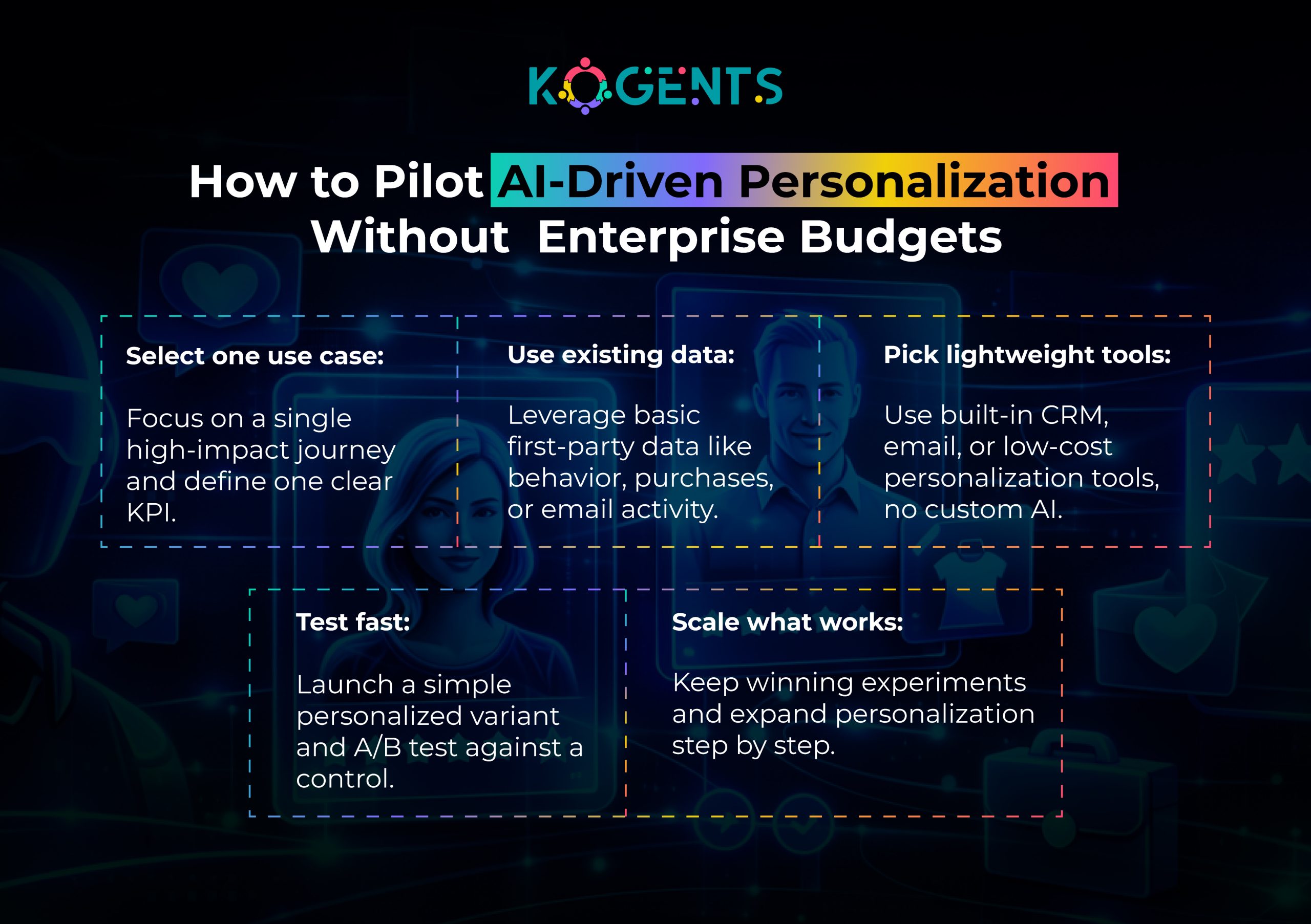
How can small and mid-sized companies adopt personalization without enterprise budgets?
They can:
- Use first-party data from CRM and analytics tools
- Implement lightweight recommendation APIs
- Use CDP-lite tools like Segment, HubSpot, or Klaviyo.
- Start with automated segmentation, then scale toward predictive modeling.g
- Implement real-time UX personalization via low-code, too.