
In a world where cyber threats evolve faster than IT teams can react, businesses face a mounting crisis: overworked security teams, alert fatigue, delayed incident response, and increasing vulnerability to breaches.
Traditional cybersecurity support models are reactive, siloed, and grossly inefficient in the face of AI-powered adversaries.
AI support agent totally revamps and alters the scenario to a new breed of AI-powered technical support agent engineered to transform cyber defense operations.
This is not just another chatbot. It’s an autonomous customer support agent fueled by machine learning support systems, retrieval-augmented generation (RAG), natural language understanding (NLU), and reinforcement learning agents, acting as the frontline triage officer, incident responder, and knowledge base automation assistant, all in one.
Key Takeaways
- AI support agents are revolutionizing cybersecurity support by automating tier-1 and tier-2 triage, reducing MTTR.
- The best AI agents for customer support analyze logs, route incidents, and orchestrate responses due to generative AI.
- Organizations using AI technical support agents see faster threat containment, improved CX, and reduced analyst burnout.
- AI escalation prediction ensures critical incidents are prioritized in real-time using sentiment analysis and context.
- Leading enterprises like Microsoft, IBM, and ServiceNow are successfully deploying AI customer support automation to secure their digital environments.
Understanding AI Support Agent in Cybersecurity
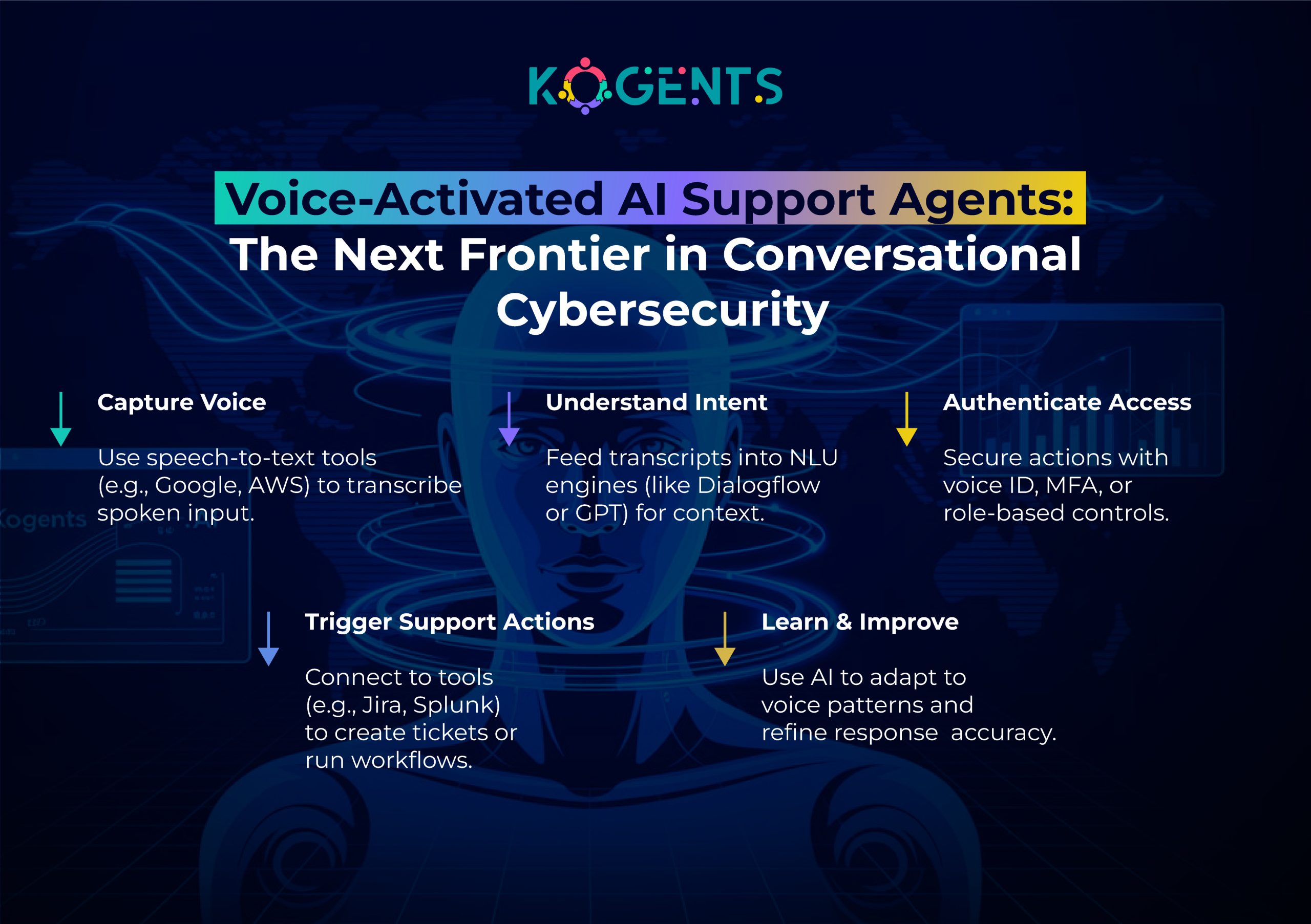
An AI support agent is an intelligent virtual assistant (IVA) designed to interact with users, interpret technical language, and respond to cybersecurity incidents automatically.
Unlike a generic AI agent for customer service, these agents integrate with SIEM tools, ticketing systems, and enterprise knowledge bases to:
- Conduct automated threat triage
- Classify, tag, and escalate alerts
- Suggest remediation steps
- Log incidents in real time
- Facilitate omnichannel support automation
They rely on:
- Natural Language Processing (NLP) for interpreting human queries
- Machine learning support systems to learn from past tickets
- AI decision-making engines to act based on patterns
- Vector search in support systems for context-aware threat resolution
Key Capabilities
| Function | Description |
| Threat Triage Automation | Analyzes incoming alerts and classifies severity |
| Incident Routing and Classification | Directs incidents to appropriate channels or agents |
| Knowledge Base Retrieval | Leverages RAG to provide accurate, contextual answers from internal KBs |
| Escalation Prediction | Uses ML to prioritize incidents based on sentiment and impact |
| Workflow Orchestration for Support | Triggers automated scripts or human review sequences |
How AI Support Agents Automate Threat Triage?
Threat triage is often the most resource-intensive phase of cybersecurity. Manual inspection leads to alert fatigue and human oversight.
AI agents apply:
- Predictive customer support algorithms
- Contextual understanding of AI
- Sentiment analysis for support
to make real-time triage decisions.
Example: a customer service AI chatbot integrated with a SIEM like Splunk or Microsoft Sentinel can:
- Detect anomalous behavior (e.g., lateral movement, unauthorized access)
- Cross-reference with threat intel feeds
- Assign risk scores
- Trigger automated ticket resolution workflows
Case Study: IBM QRadar & Watson Integration
IBM integrated Watson AI into its QRadar platform to enable real-time triage.
This reduced manual triage time by 65% and improved detection accuracy by over 30% source.
Incident Response with AI Service Agents
Once a threat is triaged, incident response must be swift. An AI automation consultant assists in:
- Triggering containment actions
- Updating stakeholders
- Generating playbook-based responses
- Auto-documenting post-mortems
AI support agents can operate autonomously or assist human analysts with recommendations, using AI routing and classification tools and generative AI troubleshooting features.
Example: Microsoft Security Copilot
Microsoft uses Security Copilot (powered by OpenAI) to generate remediation steps, recommend next actions, and summarize alerts.
This shortens response time and enhances the precision source.
Expanded Capability: AI-Powered Threat Intelligence Enrichment
AI agents now contribute to threat intelligence enrichment by:
- Aggregating real-time threat feeds
- Enriching alerts with contextual threat actor data
- Auto-tagging IOCs (Indicators of Compromise)
- Suggesting mitigation based on threat behavior modeling
Why it matters: Analysts no longer have to manually search threat databases like VirusTotal or AlienVault. AI does it in milliseconds.
AI Support Agent + SOAR: A Perfect Match
Security Orchestration, Automation, and Response (SOAR) platforms get a power boost when integrated with an AI support assistant for businesses.
Benefits of AI + SOAR:
- Dynamic playbook triggering
- Automated alert de-duplication
- AI-curated post-incident analysis
- Adaptive response scripting
Example: AI detects a phishing email pattern → triggers SOAR → isolates email → notifies users → documents the sequence automatically.
Navigating Bias and Ethics in AI Security Agents
As AI decision-making engines become central to support, ethical considerations grow.
Ethical Safeguards:
- Explainable AI: Ensure actions taken are transparent
- Bias Audits: Regular reviews of training data and model output
- Access Controls: Granular permissions to prevent overreach
- User Feedback Loops: Incorporating analyst feedback into model improvements
Following frameworks like the NIST AI Risk Management Framework and the EU AI Act is crucial for compliance.
Localization and Multilingual Threat Support
Cyber threats are global. AI support agents must support multilingual interfaces to:
- Respond in local languages
- Interpret threat indicators from foreign sources
- Handle region-specific compliance (e.g., GDPR, HIPAA, CCPA)
Reminder: NLP-powered language translation + region-aware security policies enable support for global operations.
Continuous Learning and Model Retraining
AI agents aren’t static. They continuously evolve through:
- Reinforcement learning from analyst feedback
- Ingestion of new threat intel reports
- Simulation environments for skill testing
This ensures the AI-powered support agent remains current with emerging threats like:
- Supply chain attacks
- Multi-stage ransomware
- IoT exploits
Real-Time Monitoring Dashboards Powered by AI Agents
Modern AI support automation software includes dashboards with:
- Live incident flow maps
- Agent decision tracking
- Analyst-agent collaboration trails
- CSAT feedback and SLA performance visualizations
These interfaces make AI behavior transparent and foster trust.
Bonus: Gamification in AI-Augmented SOCs
Introducing gamification in AI-driven security centers boosts analyst engagement:
- Analysts score points by validating AI-suggested actions
- AI agents recommend learning resources based on alert types
- Tier-1 analysts graduate faster by collaborating with virtual co-pilots
This improves upskilling while ensuring continuous SOC enhancement.
Technical Architecture Behind AI Support Agents
AI agents rely on a layered architecture that includes:
- LLMs + NLU + NLG: For understanding incident context and generating human-like responses
- Retrieval-Augmented Generation (RAG): For pulling answers from internal support knowledge bases
- Integration Layer: Connects to tools like Jira, ServiceNow, CrowdStrike, etc.
- Reinforcement Learning: For optimizing actions based on outcomes
- Workflow Orchestration Engine: For managing automated incident playbooks
Industry Adoption & Use Cases
1. ServiceNow – AI Incident Management
ServiceNow’s AI-powered customer assistance agent helps IT teams resolve incidents autonomously using AI co-pilot support.
Clients saw a 40% reduction in response times.
2. Intercom Fin – AI Troubleshooting for SaaS
Intercom uses Fin to automatically respond to SaaS-related incidents with high precision using support ticket automation and knowledge base automation.
3. Google Cloud – AI Support for Vertex AI
Google uses Dialogflow and Vertex AI to enable real-time incident tracking and classification in its security command center.
4. Salesforce Einstein – CX Automation
Einstein bots route security incidents to the right teams while enhancing the customer journey improvement process via AI-driven support workflows.
5. Kogents.ai – AI Agent for MSP Security Teams
Kogents deploys AI-powered support agents for MSPs and SaaS platforms, integrating with security tools to provide real-time triage, escalation, and remediation scripting.
Futuristic Vision: Sentient Security Agents in Hyper-Automated SOCs
Let’s leap five years ahead.
Imagine an AI support agent that doesn’t just follow rules or scripts, but self-evolves, negotiates across agents, and adapts to organizational culture.
Welcome to the Hyper-Automated SOC:
- Agents collaborate across companies in real-time threat intelligence exchanges.
- AI agents simulate attacker paths and preemptively patch vulnerable systems.
- Support agents learn an organization’s behavioral DNA to flag even non-technical insider threats.
- Security becomes an autonomous economy of micro-decisions, governed by agent consensus and reinforcement learning.
Experimental Research Snapshot
Stanford HAI is already researching multi-agent cyber defense swarms, networks of AI agents that defend digital borders collaboratively and autonomously.
MIT CSAIL is piloting AI behavioral mirrors, digital reflections of enterprise behavior, to simulate attacks before they occur.
Key Innovations on the Horizon
| Innovation | Impact |
| AI-Agent Federated Learning | Collective security learning without sharing sensitive data |
| Cognitive Digital Twins | AI that understands business workflows and adapts to support contextually |
| Autonomous Threat War-Gaming | AI agents simulate cyberattacks for predictive defense |
| AI Governance via Smart Contracts | Immutable AI policies enforced on blockchain-based ledgers |
Humanizing AI Agents: Empathy Engines for Cybersecurity Support
What if an AI technical support agent could sense stress or urgency not just from data, but from human emotion?
Enter empathy-driven AI support, where emotion detection and language tone analysis help prioritize support tickets during security crises.
Real Applications
- Agents detect emotional urgency in voice or chat to fast-track triage.
- Empathetic LLMs provide not just fixes, but humanized reassurance to non-technical users under stress.
- Language is tailored based on user persona: technical vs non-technical, calm vs anxious.
Result: Less panic, higher trust, and more effective incident response collaboration.
Backed by Science
Why Do Businesses Need AI Support Agents for Cybersecurity Now?
Cyberattacks occur every 39 seconds.
Average breach detection time is 212 days.
Benefits
- Fewer false positives
- Always-on monitoring
- Human + AI hybrid orchestration
- Fast, documented, auditable response
- Enhanced customer satisfaction AI metrics
The Future is Autonomous, Secure, and Scalable!
The traditional cybersecurity model can no longer keep pace. An AI support agent is not a luxury; it’s a necessity for digital resilience.
From threat triage to full-scale incident response, AI agents augment human capabilities, reduce burnout, and enhance accuracy.
Platforms like Kogents.ai offer tailored deployment of AI virtual support agents that integrate into your current SOC workflows, enabling secure, fast, and cost-efficient support operations.
Ready to fortify your cybersecurity with intelligent automation?
Explore our website today to deploy your AI-powered security support co-pilot.
FAQs
What is an AI support agent in cybersecurity?
It’s an intelligent virtual agent that automates threat triage, incident routing, and resolution within security operations.
How does it differ from a regular AI chatbot?
Unlike basic chatbots, AI support agents integrate with SIEMs, ticketing tools, and act contextually using machine learning.
Can AI agents fully replace human security analysts?
Not entirely. They act as AI co-pilots, handling repetitive tasks and augmenting human decision-making.
What tools are needed to deploy an AI support agent?
You need integrations with SIEM, ticketing (Jira, ServiceNow), and a knowledge base (Confluence, Notion).
Is my data secure with an AI support agent?
Yes, platforms follow GDPR, ISO 27001, and SOC 2 Type II standards to ensure security and compliance.
What is the ROI of deploying such agents?
Businesses see 30-70% MTTR reduction, fewer SLA breaches, and higher CSAT scores.
Can it work across multiple communication channels?
Yes, omnichannel automation allows support via email, chat, Slack, and dashboards.
How does the agent learn over time?
It uses reinforcement learning and pattern recognition to improve response and accuracy.
How long does it take to implement?
With tools like Kogents, setup can take as little as 2-3 weeks, depending on system complexity.
What industries benefit most from AI support agents?
Finance, SaaS, healthcare, government, and e-commerce sectors benefit greatly from AI-enhanced cybersecurity support.