A 2025 update shows 78% of organizations use AI in at least one business function.
The automation landscape has reached a defining moment, and businesses across industries are asking the same strategic question:
So, do you think we should rely on AI that executes tasks, or AI that thinks, plans, adapts, and evolves?
This is the fundamental distinction between AI agents and the rapidly advancing world of agentic AI, a distinction that directly shapes your workforce automation, operational efficiency, and long-term innovation capacity.
In short: Choosing the right AI autonomy level now determines whether your business simply keeps up, or breaks ahead.
This blog unpacks the big differences between AI Agents vs Agentic AI, AI agents vs bots, and how these models shape the future of enterprise automation.
You will learn how agentic AI introduces new capabilities like multi-step autonomous reasoning, closed-loop AI, contextual memory, goal-directed behavior, and multi-agent orchestration, and how to choose the right model for your growth goals.
Key Takeaways
- Traditional AI agents follow instructions while agentic AI understands goals, plans strategies, and self-corrects, making it the foundation of next-generation automation.
- Agentic AI uses chain-of-thought reasoning, memory, and recursive planning, enabling dynamic problem-solving that no rule-based agent can match.
- Enterprises should evaluate their AI agents vs workflows based on autonomy needs, not just task complexity, using the Levels 1–4 autonomy models pioneered.
- Agentic AI unlocks exponential ROI, as workflows become adaptive, context-aware, and capable of running without human intervention.
- Companies like OpenAI, Google DeepMind, Meta FAIR, and HuggingFace are leading the global shift from agent-based AI to full agentic intelligence systems.
What Are AI Agents?
To understand AI agents, imagine a specialized worker who performs a very specific job exceptionally well, but only that job.
AI agents operate within the constructs of:
- Predefined rules
- Policy-based decision models
- Machine-learned behaviors
- Environment-response cycles
They are not thinkers; they are, in essence, highly capable executors.
AI Agents Are Excellent For:
- Structured workflows
- Predictable data environments
- Routine tasks that rarely change
- Limited decision-making scenarios
Examples of modern AI agents include:
- A KYC verification bot that checks documents
- A warehouse robot that sorts boxes by barcodes
- A calendar scheduling agent
- A customer support triage bot
These agents may use ML or rules, but they lack the cognitive architecture to interpret complex goals or adapt plans mid-execution.
The Limitations of AI Agents
Traditional agents cannot:
- Make strategic decisions
- Interpret ambiguous instructions
- Re-plan after hitting obstacles
- Learn from memory without explicit retraining
- Execute multi-step reasoning
- Collaborate dynamically with other agents
In environments where uncertainty is high or rapid adaptation is required, choosing between AI Agents vs Agentic AI becomes a bit troublesome, but AI agents fall short.
Navigate the term Agentic AI?
It represents the evolution from action-based automation to cognition-driven automation.
If AI agents are specialists, agentic AI is the strategist, analyst, architect, and executor combined.
Agentic AI involves systems capable of:
- Understanding goals without explicit steps
- Reasoning through ambiguity
- Formulating plans autonomously
- Breaking tasks into multi-step workflows
- Self-correcting through reflection
- Using tools and APIs like a human operator
- Collaborating with other agents dynamically
- Learning continuously through contextual memory
This is the closest artificial intelligence has come to human-like decision-making and problem-solving.
Agentic AI’s Four Superpowers
1. Self-Direction
It interprets the goal, not the instructions.
This means you can say:
Moreover, the agent will figure out:
- The sources
- The steps
- The tools
- The analysis
2. Multi-Step Autonomous Reasoning
Using frameworks like ReAct (Reasoning + Acting), Chain-of-Thought, and Self-Reflection Looping, deciding whether AI agents vs agentic AI can break down complex objectives into atomic tasks.
3. Memory-Based Intelligence
Agentic AI stores:
- What worked
- What failed
- How to improve
- What context matters
This is powered by:
- Vector databases
- Embeddings
- Knowledge graphs
- Long-term memory stores
4. Multi-Agent Collaboration
It can coordinate fleets of agents:
- Researchers
- Analysts
- Validators
- Writers
- Problem solvers
This creates a fully autonomous enterprise workflow ecosystem.
AI Agents vs Agentic AI: Clear Differences That Matter
| Category | AI Agents | Agentic AI |
| Autonomy | Low–medium | High (self-directed) |
| Reasoning Ability | Minimal | Advanced multi-step reasoning |
| Memory | Limited | Persistent contextual memory |
| Error Handling | Stop | Reflect → Re-plan → Retry |
| Workflow Complexity | Simple | Non-linear, multi-step |
| Adaptation | Poor | Strong, adaptive |
| Tool Use | Predefined | Dynamic, strategic |
| Scalability | Rigid | Exponential |
| Business Value | Efficiency | Innovation + automation |
AI Autonomy Levels
Based on models from Stanford HAI, MIT CSAIL, and DeepMind:
Level 1 — Reactive Agents
- Direct stimulus-response
- No memory
- No planning
Example: RPA bots
Level 2 — Semi-Autonomous Agents
- Limited planning
- Executes defined workflows
- Conditional decision-making
Example: CRM automation bots
Level 3 — Agentic Planning Systems
- Multi-step planning
- Memory-aware
- Uses tools
- Can navigate open-ended tasks
Example: AutoGPT-like systems
Level 4 — Fully Autonomous Agentic Intelligence
-
- Closed-loop reasoning
- Persistent memory
- Strategic decisions
- Multi-agent orchestration
- Self-improving
Example: DeepMind’s Agent57
Agentic AI typically operates at Levels 3 and 4, the intelligence levels that drive enterprise transformation.
Unravel The Science Behind How Agentic AI Works?
Agentic AI follows a cognitive AI architecture, typically composed of:
1. Perception Layer
Collects environmental signals from:
- APIs
- Databases
- Web interfaces
- Internal systems
- Multimodal inputs
2. Cognition Layer
The “brain” is powered by:
- Chain-of-Thought
- ReAct framework
- Monte Carlo Planning
- Policy-based reasoning
- Transformer-based architectures
3. Memory Layer
Includes:
- Short-term working memory
- Long-term knowledge (vector databases)
- Knowledge graph reasoning
4. Action Layer
Execution through:
- Tools
- APIs
- Databases
- Browser automation
- Third-party systems
5. Self-Reflection Feedback Layer
Evaluates:
- Did I achieve the goal?
- What went wrong?
- Should I try another strategy?
This closed-loop design is the hallmark of agentic AI.
Real-World Framework Examples
To ground the conversation in practical reality, here are the most influential and widely used frameworks enabling AI agents vs agentic AI today:
OpenAI Agentic Orchestration Framework
OpenAI’s new agentic design allows LLMs to perform:
- Goal decomposition
- Multi-step reasoning
- Autonomous tool use
- Memory augmentation
| Reminder: This serves as the base blueprint for enterprise-grade agentic workflows. |
AutoGen (Microsoft)
AutoGen introduces multi-agent dialogue systems, where agents:
- Communicate
- Debate
- Critique
- Refine work
- Coordinate as a team
This is ideal for complex enterprise workflows like:
- Code generation
- Data analysis
- Research pipelines
LangChain + LangGraph
LangChain enables tool-using agents; LangGraph adds stateful multi-agent graphs where:
-
- Agents have persistent memory
- State transitions follow event-driven logic
- Planning loops remain safe and deterministic
HuggingFace Transformers Agents
These support:
- Function calling
- Model chaining
- API-driven tasks
- Inter-agent communication
A powerful open-source foundation for custom agentic systems.
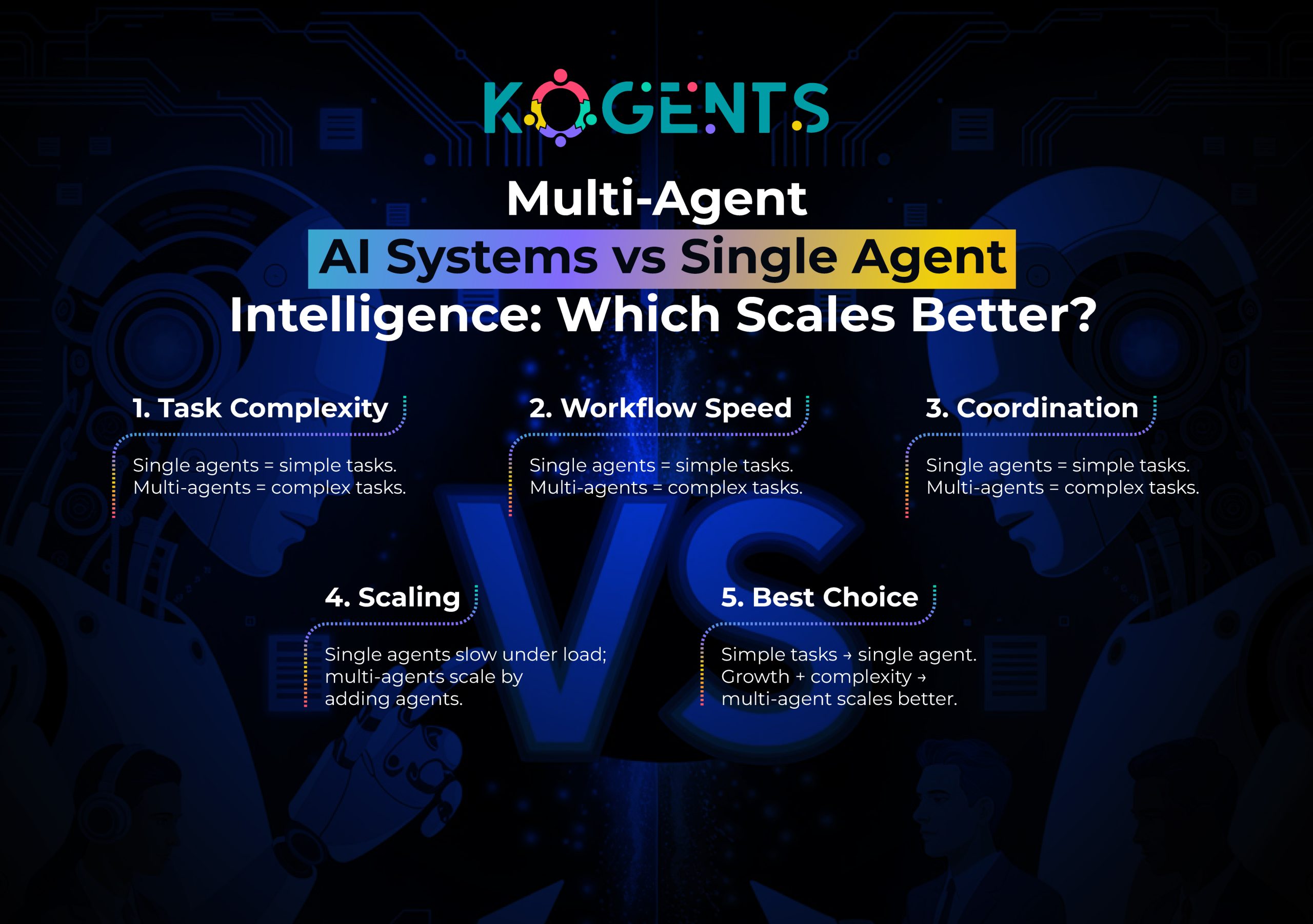
Economic Impact of Agentic AI
Major studies confirm that agentic AI introduces new economic value curves, not just incremental improvements.
Key Economic Impacts
- 54% of leaders expect AI and GenAI to deliver cost savings in 2024.
- In 2024, Marc Benioff announced that. Salesforce would “hard pivot” to Agentforce, a platform for building and deploying autonomously.
Why?
Because agentic AI replaces:
Linear task automation with Recursive, adaptive, reasoning-based problem-solving.
| Note: This is what creates exponential ROI, not just cost savings. |
Industry-Specific Use Cases
Agentic AI is already transforming industries:
Finance
- Autonomous fraud analysis
- Risk scenario simulations
- Regulation-aware trading agents
- Customer portfolio orchestration
Healthcare
- Diagnostic chain-of-thought models
- Multi-modal agentic radiology review
- Treatment-chain planning
- Clinical workflow automation
Retail & E-Commerce
- Merchandising agent swarms
- Autonomous demand forecasting
- Price elasticity modeling
- Personalized customer journey engines
Manufacturing
- Agentic predictive maintenance
- Production-line optimization
- Multi-agent supply-chain orchestration
- Dynamic quality assurance agents
Travel & Logistics
- Routing optimization
- Autonomous disruption management
- Multi-agent itinerary planning
- Fleet-condition analysis
Biotechnology / Research
- Multi-step research automations
- Literature review + reasoning systems
- Experiment-planning agents
- R&D validation cycles
Agentic Failure Modes — And How Autonomy Fixes Them
Even agentic systems encounter failure modes — but the difference is that they can repair, reflect, and recover.
Failure Mode 1 — Tool Selection Errors
Fix: Reflection loops + value-based tool scoring.
Failure Mode 2 — Hallucinated Plans
Fix: ReAct grounding + memory-based context validation
Failure Mode 3 — Infinite Recursion
Fix: Meta-control agents with budget constraints
Failure Mode 4 — Over-Optimization
Fix: Policy-based reasoning limits + objective-balancing
Failure Mode 5 — Environmental Drift
Fix: Episodic memory + retrieval augmented recalibration.
Agentic AI’s ability to self-correct makes it dramatically more stable over time.
Capability Gap Analysis Scorecard For Your Evaluation!
| Capability | AI Agents | Agentic AI | Business Impact |
| Reasoning | Weak | Strong | High reliability |
| Planning | Basic | Advanced | Strategic clarity |
| Memory | Limited | Persistent | Higher accuracy |
| Adaptation | Low | High | Future-proofing |
| Tool Use | Static | Dynamic | Efficiency gains |
| Workflow Complexity | Low | High | Scalable automation |
| Collaboration | Single-agent | Multi-agent | Cross-functional productivity |
| Error Recovery | Manual | Autonomous | Reduced downtime |
Prompt Engineering Examples for Agentic AI
These examples demonstrate how businesses unlock self-directed reasoning:
Example 1 — Autonomous Research Agent
You are an autonomous research agent.
Break down the objective into subgoals.
Plan your steps using the chain of thought.
Use external tools or APIs when needed.
Reflect after each step and refine your approach.
Example 2 — Multi-Agent Coordination
Assign roles to multiple agents: researcher, analyst, writer, and validator.
Enable communication between agents.
Ensure agents critique and refine each other’s outputs.
Example 3 — Closed-Loop Decision Making
After completing each step, evaluate the outcome.
If the goal is not reached, create a new plan and continue working autonomously.
Future Predictions
Prediction 1: Autonomous Companies Become a Reality by 2030
Driven by multi-agent orchestration + persistent memory.
Prediction 2: LLMs Evolve Into Cognitive Workers
With multi-modal perception and tool-use planning.
Prediction 3: “Agentic Clouds” Replace SaaS Platforms
Cloud providers (AWS, Azure, GCP) will host agent swarms instead of apps.
Prediction 4: Every Department Will Have Its Own AI Director
Finance → CFO Agent
Ops → COO Agent
Marketing → CMO Agent
Engineering → CTO Agent
Prediction 5: Agentic AI Governance Becomes Mandatory
NIST + ISO/IEC 42001 compliance will be required, not optional.
Build vs Buy: Agentic AI Decision Guide
Build In-House If:
- You need deep customization
- You have ML engineers + LLM engineers
- You want a proprietary advantage
Buy If:
- Speed-to-market is critical
- You lack internal AI expertise
- Your workflows align with existing agentic platforms
Hybrid Approach (Recommended for Most Enterprises)
Build your agentic reasoning layer
→
Buy orchestrators + memory systems.
→
Combine with your internal data + tools
Pro-tip: This gives maximum control with minimum cost.
AI Agents vs Agentic AI: Use Case Mapping
Where AI Agents Excel?
- Data extraction
- RPA workflows
- Email sorting
- Customer support routing
- Invoice scanning
- Compliance checks
Where Agentic AI Dominates?
- Product research
- Code generation and debugging
- Fraud detection
- Dynamic supply chain optimization
- Operations management
- Customer experience orchestration
- Predictive maintenance
- Generative content pipelines
Used Case of Agentic AI
Case Study 1: Amazon – Multi-Agent Warehouse Automation
Amazon’s robotics ecosystem uses thousands of multi-agent systems to coordinate picking, packing, and routing operations.
Outcome: Multi-agent coordination improved item processing by 25%
Case Study 2: Google DeepMind – Agent57
The world’s first AI agent to outperform humans on all Atari 57 games.
Demonstrated meta-learning, memory-based reasoning, and goal-directed planning.
Case Study 3: Tesla – Agentic Diagnostics
Tesla’s vehicles use agentic diagnostic layers to:
- Detect anomalies
- Preemptively fix issues with OTA updates
- Strategize debugging
Reduced service center visits by 35%.
Case Study 4: JPMorgan – Autonomous Fraud Detection
Using agentic workflows and multi-step reasoning, JPMorgan reduced fraud losses by 21%.
Case Study 5: Walmart’s Multi-Agent Orchestration in Retail Inventory
Walmart upgraded from rule-based bots to agentic reasoning systems that autonomously:
- Forecast inventory
- Optimize restocking
- Reallocate stock
- Predict trends
Result: Inventory efficiency improved by 25%, and waste was reduced by 18%.
Want To See What is Coming Next?
- Fully autonomous enterprises
- Multi-agent AI companies running workflows 24/7
- Agentic cloud platforms
- Memory-augmented LLMs
- Cross-agent orchestration engines
- AI swarms for large-scale strategic operations
| Key Insight: Companies building this future include OpenAI, Meta FAIR, DeepMind, AutoGen, LangChain, and NVIDIA. |
Your Autonomy Strategy Will Define Your Growth!
Your business must choose between AI Agents vs Agentic AI in terms of:
- Execution-level automation (AI agents) OR
- Strategic, adaptive, reasoning automation (agentic AI)
The difference determines whether you improve operations or transform them. Agentic AI is not a tool, but it is your future operating system.
Our team helps businesses implement agentic AI systems, with the best agentic AI company, like Kogents.ai.
So, create multi-agent architectures and deploy AI workflow orchestration engines tailored to their operational complexity.
If you want to transform your business with smart automation, scalable agentic reasoning, and enterprise-grade AI strategy, we will help you build it, deploy it, and dominate with it.
FAQs
What is the main difference between AI agents and agentic AI?
AI agents follow rules; agentic AI uses reasoning algorithms, memory, and planning.
Is agentic AI more powerful?
Yes, it demonstrates goal-directed AI behavior, multi-step planning, and autonomy.
What makes an AI system “agentic”?
It has the ability to reason, reflect, plan, and self-correct.
Where should businesses use AI agents?
For routine, predictable tasks like RPA, ticket routing, or data extraction.
Where should agentic AI be used?
For workflows requiring thought: research, planning, decision-making, and multi-step automation.
What frameworks support agentic AI?
OpenAI, LangChain, AutoGen, HuggingFace, and DeepMind research tools.
Is agentic AI safe?
Yes, with NIST AI RMF, ISO/IEC 42001, and governance controls in place.
Will agentic AI replace employees?
It replaces tasks, not people — augmenting knowledge workers with higher autonomy.
Can companies combine both?
Yes, hybrid architectures are the future of automation.
What is the future of agentic systems?
Closed-loop AI, multi-agent ecosystems, and fully autonomous enterprises.