
Hiring has never been harder, but skills cycles are shorter. Talent markets are more competitive, and recruiters are overwhelmed by volume.
Candidates expect Amazon-level experience. Meanwhile, HR teams are still relying on outdated Applicant Tracking Systems (ATS) created in the late 1990s to store resumes, not intelligently evaluate them.
Today, talent acquisition is no longer about administrative tracking; it’s about strategic decision-making powered by data, intelligence, speed, and predictive accuracy.
This is why the AI recruiting agent, an advanced form of AI recruiting automation, AI recruiting assistant, and AI-powered recruitment platform, has emerged as the most transformative innovation in hiring technology over the last decade.
Unlike traditional ATS systems that simply record, sort, and store applications, an AI recruiting agent actively participates in the hiring process.
It screens candidates, ranks them based on predictive performance, reads resumes with natural language processing (NLP), evaluates competencies through machine learning, engages applicants through AI recruiting chatbot capabilities, automates scheduling, and continuously learns from recruiter decisions.
The message is clear: The future of hiring is not static—it is intelligent, adaptive, automated, and data-driven.
This comprehensive guide explains why smart HR teams are replacing outdated ATS systems with the power of AI recruiting agents, how these systems work, and why brands like Kogents.ai are defining the future of talent intelligence.
Key Takeaways
- AI recruiting assistants outperforms ATS platforms by combining automation, intelligence, and predictive modeling, resulting in faster, more accurate hiring decisions.
- Recruitment automation using AI eliminates manual screening, reduces bias, and accelerates hiring cycles, enabling HR teams to focus on strategic value rather than administrative work.
- Traditional ATS systems cannot execute tasks like candidate scoring, predictive matching, or skills-based evaluation, while AI recruitment bots and AI hiring agents excel in these areas.
- Generative AI in talent acquisition, machine learning for candidate matching, and predictive analytics in HR deliver deep insights that an ATS alone cannot provide.
- The future of HR is an ecosystem, ATS = storage, AI recruiting agent = intelligence + automation. To stay competitive, modern companies need both.
The Modern Hiring Crisis: Why ATS Alone No Longer Works?
The hiring landscape has transformed dramatically due to:
- Skill fragmentation
- Remote and global workforce expansion
- High candidate expectations
- Increased applicant volumes
- Bias concerns and compliance regulations
- Pressure on HR to do more with fewer resources
Traditional ATS platforms were not designed for today’s environment.
They rely heavily on keyword-based matching, outdated scoring logic, and manual human interpretation.
In other words, ATS = filing cabinet.
They can’t:
- Predict candidate performance
- Rank applicants using predictive hiring models
- Parse complex skills with NLP
- Automate sourcing at scale
- Deliver unbiased recommendations
- Integrate workforce intelligence tools
This gap is why AI recruiting agents are no longer a luxury; they are a competitive necessity.
What Is an AI Recruiting Agent?
An AI recruiting agent is an intelligent, autonomous digital system designed to execute and optimize hiring tasks traditionally done by recruiters.
It blends machine learning, natural language processing (NLP), generative AI, and predictive analytics to perform activities such as:
- AI candidate matching system
- AI recruiter to eliminate hiring bias
- AI agent to automate resume screening
- automated interview scheduling using AI
- AI recruiting automation for HR teams
- AI recruiting agent for small businesses
- AI recruitment agent for high-volume hiring
- intelligent talent acquisition tool
- AI-powered hiring assistant for tech roles
- AI recruiting chatbot for applicant engagement
While an ATS tracks candidates, an AI recruiting agent evaluates, scores, ranks, predicts, automates, communicates, and improves the entire hiring experience.
It is not a system. It is a “digital recruiter.”
How Does an AI Recruiter Work?
The AI recruiting agent operates through a multi-layered intelligence engine:
1. Resume Parsing with NLP
Unlike keyword-based ATS scanning, NLP understands meaning, context, seniority, and skill depth.
2. Skills Classification Using Machine Learning
The system interprets job descriptions and compares them with candidate profiles using job matching algorithms.
3. Predictive Analytics for Fit and Performance
AI models evaluate:
- Experience relevance
- Cultural alignment
- Skill competency
- Growth potential
- Performance probability
- Risk markers
4. Autonomous Screening & Ranking
The automated recruiting software prioritizes applicants instantly.
5. Automated Engagement
The best AI assistant for recruiting is well-equipped in communicating with candidates, handling screening questions, and scheduling interviews.
6. Continuous Learning
Over time, AI learns:
- Preferred profiles
- Successful hires
- Hiring manager preferences
This makes every hiring cycle smarter than the last.
Deep Breakdown: Traditional ATS vs AI Recruiting Agent
ATS systems rely heavily on rules, not intelligence. They:
- Match resumes based on fixed keywords
- Do not understand candidate seniority or context
- Are incapable of predictive modeling
- Requires heavy manual effort
- Do not personalize communication
- Cannot analyze candidate sentiment or skill clusters
On the other hand, an AI hiring agent:
- Uses predictive analytics in HR
- Leverages machine learning for candidate matching
- Automates communication
- Provides end-to-end recruitment workflow automation
- Reduces bias
- Improves candidate quality
- Enhances efficiency
- Brings real-time insights through HR analytics
- Sources passive talent
This is why companies like Google Cloud AI, LinkedIn Talent Solutions, IBM Watson Talent, Eightfold.ai, Paradox (Olivia AI), HireVue, and Beamery tend to automate with AI Agents in the recruitment process.
Why Static Systems Fail in 2025 (The ATS Problem)
According to SHRM:
- 42% of HR leaders say their ATS slows down hiring
- 38% say ATS systems create more manual work
- 57% want more intelligent candidate matching
ATS platforms were never designed for:
- skills-based hiring
- automated interview scheduling
- data-driven hiring
- bias mitigation
- workforce planning
- recruitment analytics
- digital HR transformation
AI fixes these gaps.
Why Smart Teams Are Adopting AI Recruiting Automation?
1. Speed: Hiring 2–3x Faster
AI screens hundreds of resumes per minute.
2. Accuracy: Beyond Keyword Matching
AI understands role context, skill seniority, and performance probability.
3. Reduced Hiring Bias
AI anonymizes demographic markers to support equitable hiring.
4. Cost Reduction
AI reduces:
- manual hours,
- unnecessary sourcing spend,
- Agency fees.
5. Scalability for High-Volume Hiring
Industries like retail, logistics, healthcare, and BPO rely on AI scaling capabilities.
6. Enhanced Candidate Experience
AI recruiting chatbots deliver 24/7 responsiveness.
7. Better Recruiter Productivity
Recruiters spend more time interviewing and building relationships—not reading resumes.
Core Capabilities of an AI-Powered Recruitment Platform
- AI recruiting automation
- AI candidate matching system
- AI recruitment bot
- automated talent sourcing agent
- Resume screening automation
- automated interview scheduling
- AI-powered hiring assistant
- predictive hiring models
- job description optimization
- recruitment analytics
- candidate experience optimization
- AI-driven decision making with AI recruiting tools
- skills-based hiring frameworks
A Proprietary Framework Idea for Kogents!
Readers trust content that introduces new mental models, named frameworks, or repeatable systems.
The Kogents Intelligent Hiring Engine (KIHE Model)
Break it into four layers:
- Data Understanding Layer: (NLP resume parsing, skills clustering, experience depth analysis)
- Intelligent Decision Layer: (ML-based scoring, predictive hiring outcomes, cultural alignment modeling)
- Autonomous Workflow Layer: (sourcing agents, chatbots, interview automation, compliance automation)
- Human X AI Synergy Layer: (recruiter insights, interview decision augmentation, feedback loop learning)
Case Studies
Case Study 1: Global Retail Corporation Handling 120,000 Monthly Applicants
Challenge:
- Seasonal hiring spikes
- 10-day screening delays
- Thousands of unreviewed resumes
AI Solution:
- AI agent to automate resume screening
- automated recruiting software
- predictive ranking
Results:
- Screening time reduced from 10 days to 2 hours
- Candidate quality improved 31%
- ATS backlog eliminated
Case Study 2: Tech Startup Scaling Engineering Teams Globally
Challenge:
- Niche technical skills
- Competitive market
- Weak inbound pipeline
AI Solution:
- AI-powered hiring assistant for tech roles
- Machine learning for candidate matching
- AI recruitment agent for high-volume hiring
Results:
- 46% improvement in match accuracy
- Hiring speed doubled
- Cost-per-hire cut by 28%
Case Study 3: Healthcare Network with Strict Compliance Requirements
Challenge:
- Credential verification
- EEOC compliance
- High-volume applications
AI Solution:
- bias mitigation
- AI recruiting agent with compliance logic
- automated screening
Results:
- 40% reduction in HR workload
- Zero compliance violations
- Faster credential verification (32% faster)
ATS vs AI Recruiting Agent
| Feature | Traditional ATS | AI Recruiting Agent |
| Screening | Manual | automated resume screening using AI |
| Matching | Keyword | machine learning job matching algorithms |
| Bias | High | AI recruiter to eliminate hiring bias |
| Sourcing | Minimal | automated talent sourcing agent |
| Analytics | Basic | predictive hiring models + HR analytics |
| Automation | Low | recruitment workflow automation with AI |
| Engagement | AI recruiting chatbot |
How Recruiting Workflow Automation With AI Transforms Teams?
AI automates:
- sourcing
- screening
- scoring
- scheduling
- reminders
- follow-ups
- reporting
Recruiters gain back 60% of their time.
Kogents.ai Ethical Hiring Checklist
| Ethical Principle | What It Means | How Kogents.ai Implements It |
| Bias Detection & Mitigation Enabled | AI models must detect and minimize demographic or linguistic bias. | Continuous model audits, fairness metrics, and demographic masking during initial screening. |
| SHRM/HRCI Alignment | Follows HR professional standards and ethical codes. | Frameworks mapped to SHRM-CP, SHRM-SCP, HRBP, and SPHR guidelines for responsible hiring practices. |
| EEOC-Compliant Scoring | Ensures equal employment opportunity and anti-discrimination protections. | Scoring models avoid protected attributes and maintain compliant hiring thresholds. |
| GDPR-Ready Data Retention | Data must be handled with transparency, consent, and user rights protection. | Encrypted storage, right-to-access workflows, and time-bound retention for candidate data. |
| Transparent, Explainable Models (XAI) | AI decisions should be understandable and auditable. | Explainable ranking reports, factor analysis, and visible scoring criteria for internal HR audits. |
| Human-in-the-Loop Decision Checkpoints | Human oversight must remain central in final hiring decisions. | Recruiters validate recommendations, review flagged cases, and control approval workflows. |
| Diversity Impact Simulation | Predictive analysis of how hiring decisions impact workforce diversity. | Scenario modeling to evaluate representation shifts and diversity outcomes before finalizing decisions. |
Conclusion
The difference between an ATS and an AI recruiting agent is the difference between storing information and understanding it.
Modern hiring demands intelligence, prediction, automation, and high-speed execution. ATS systems simply cannot keep up.
The companies winning in talent acquisition are the ones embracing AI, not tomorrow, but today.
Kogents.ai is built for the hiring teams who refuse to stay stuck in the past.
If you want to accelerate your hiring lifecycle, improve candidate quality, eliminate bias, and upgrade your entire recruitment engine, we bring the talent intelligence your competitors wish they had.
Smart teams don’t wait for the future. They built it with Kogents.ai.
FAQs
What is an AI recruiting agent?
It’s an intelligent system that automates screening, sourcing, communication, scoring, and matching using machine learning, NLP, and predictive analytics.
How does an AI recruiter work?
It analyzes resumes, interprets skills, ranks candidates, automates communication, and predicts hiring success.
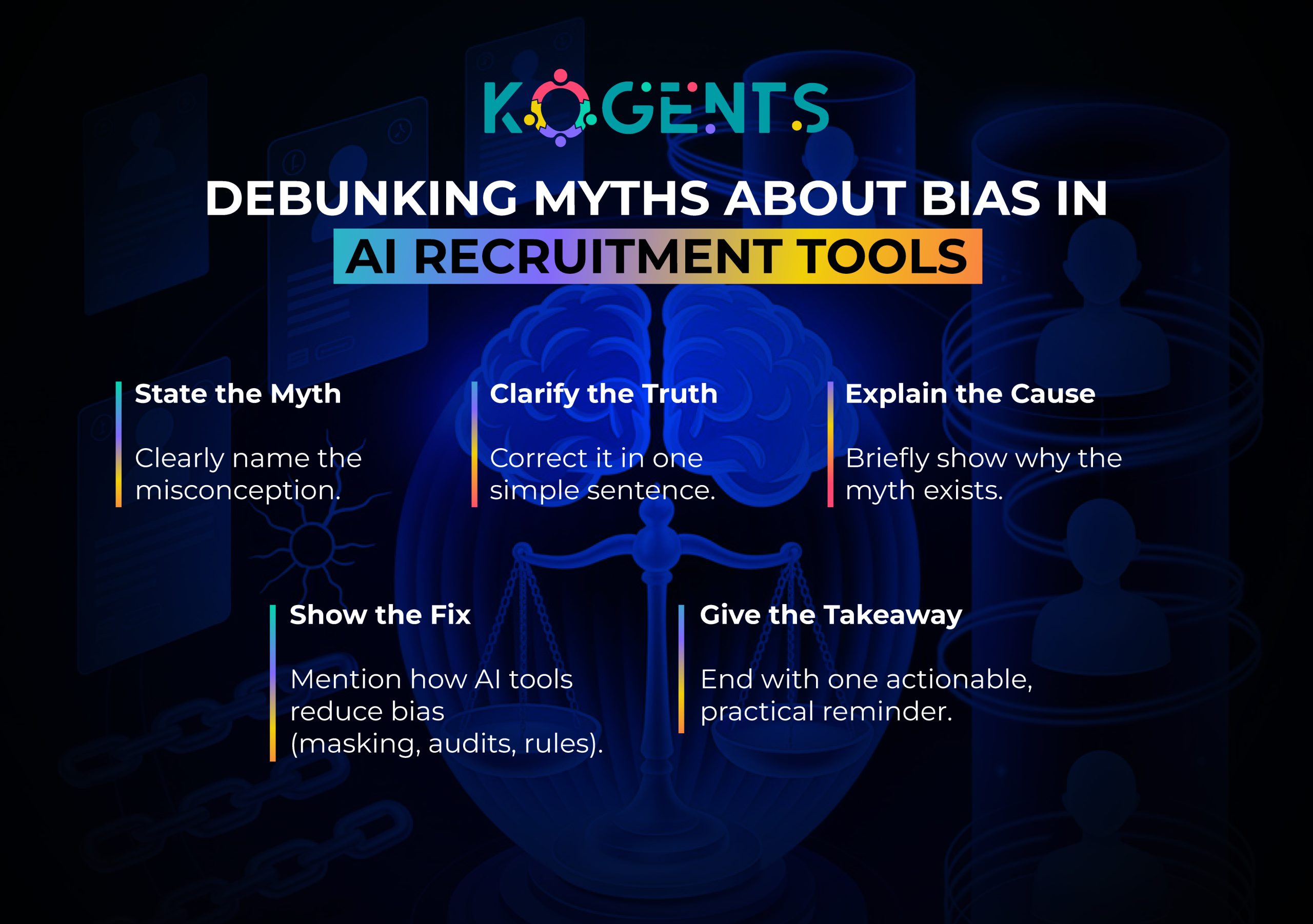
Can AI reduce hiring bias?
Yes, through demographic masking and structured scoring.
How accurate are AI recruiting tools?
Top platforms achieve up to 90% match accuracy.
Is AI effective for talent sourcing?
Yes, AI identifies active and passive candidates using automated talent sourcing agents.
Can AI help small HR teams?
Absolutely—AI recruiting agents for small businesses significantly reduce workload.
What are the pros and cons of AI hiring agents?
Pros: speed, accuracy, scalability, and less bias.
Cons: requires proper setup and quality data.
Can AI replace ATS?
It enhances ATS; it doesn’t replace it. ATS = storage, AI = intelligence.
Is AI compliant with EEOC/GDPR?
Leading platforms like Kogents.ai are fully compliant.
How should I choose the best AI recruiting agent?
Look for features such as resume screening automation, predictive analytics, an AI recruiting chatbot, and workflow automation.